Overview
Quantitative comparison arithmetic represents one of the most distinctive and strategically important question types on the GRE Quantitative Reasoning section. Unlike traditional problem-solving questions that ask for a specific numerical answer, quantitative comparison questions present two quantities—Quantity A and Quantity B—and require test-takers to determine the relationship between them. These questions test not just computational ability, but also conceptual understanding, estimation skills, and the capacity to reason efficiently under time pressure. Mastering GRE quantitative comparison arithmetic is essential because these questions constitute approximately one-third of all Quantitative Reasoning questions, making them a high-impact area for score improvement.
The unique format of quantitative comparison questions demands a fundamentally different approach than standard multiple-choice problems. Rather than calculating exact values, successful test-takers learn to compare quantities through strategic techniques such as simplification, substitution of values, and recognition of patterns. This question type rewards mathematical insight over brute-force calculation, often allowing students to reach correct answers in 30-45 seconds rather than the full 1-2 minutes allocated per question. The arithmetic concepts tested—including operations with integers, fractions, decimals, percentages, ratios, and exponents—are foundational, but the comparison format adds layers of complexity that can trap unprepared students.
Within the broader Quantitative Reasoning curriculum, quantitative comparison arithmetic serves as both a standalone skill set and an integrative assessment tool. These questions frequently combine multiple arithmetic concepts in a single problem, requiring students to understand how operations interact and how changes to one quantity affect relative magnitude. Success in this area builds directly on fundamental arithmetic knowledge while developing the higher-order analytical skills needed for more advanced algebra, geometry, and data interpretation questions. The strategic thinking cultivated through quantitative comparison practice—particularly the habit of asking "What relationship must hold?" rather than "What is the exact answer?"—transfers beneficially to all other GRE question types.
Learning Objectives
- [ ] Identify when quantitative comparison arithmetic is being tested
- [ ] Explain the core rule or strategy behind quantitative comparison arithmetic
- [ ] Apply quantitative comparison arithmetic to GRE-style questions accurately
- [ ] Distinguish between situations requiring calculation versus strategic comparison
- [ ] Recognize when the relationship between quantities depends on variable values
- [ ] Execute efficient simplification techniques to compare quantities without full computation
- [ ] Avoid common traps specific to quantitative comparison format
Prerequisites
- Basic arithmetic operations: Addition, subtraction, multiplication, and division with integers, fractions, and decimals form the computational foundation for all comparisons
- Order of operations (PEMDAS): Correct evaluation sequence is essential when simplifying complex expressions in both quantities
- Properties of positive and negative numbers: Understanding how signs affect magnitude and operations is critical for accurate comparisons
- Fraction and decimal equivalencies: Converting between forms enables efficient comparison of quantities expressed differently
- Exponent rules: Basic laws of exponents appear frequently in comparison questions involving powers
- Percentage calculations: Many comparison questions involve percent increase, decrease, or part-whole relationships
Why This Topic Matters
Quantitative comparison questions appear with remarkable consistency on the GRE, comprising approximately 7-8 questions out of the 20 questions per Quantitative Reasoning section. This translates to roughly 35-40% of the quantitative score, making this question type one of the highest-yield areas for focused preparation. Unlike some advanced topics that appear sporadically, quantitative comparison arithmetic is guaranteed to appear on every GRE administration, making mastery non-negotiable for students targeting competitive scores.
From a practical standpoint, the skills developed through quantitative comparison practice extend far beyond standardized testing. The ability to compare quantities efficiently without unnecessary calculation mirrors real-world decision-making in fields ranging from finance and economics to engineering and data science. Professionals regularly face situations requiring quick magnitude comparisons, estimation, and relative value assessments—precisely the skills that quantitative comparison questions develop. The strategic thinking required to determine "which is larger" or "are they equal" without exhaustive computation represents a form of mathematical maturity valued in graduate-level coursework and professional contexts.
On the GRE specifically, quantitative comparison questions appear in predictable formats but with infinite variation in content. Common manifestations include comparing arithmetic expressions with different operations, evaluating quantities involving variables where the relationship may depend on the variable's value, comparing geometric measurements, and assessing statistical measures. The arithmetic-focused versions typically test understanding of how operations affect magnitude, properties of special numbers (like zero, one, and negative numbers), and the behavior of fractions, decimals, and percentages under various transformations. Recognizing these patterns allows students to approach questions with proven strategies rather than starting from scratch each time.
Core Concepts
The Quantitative Comparison Format
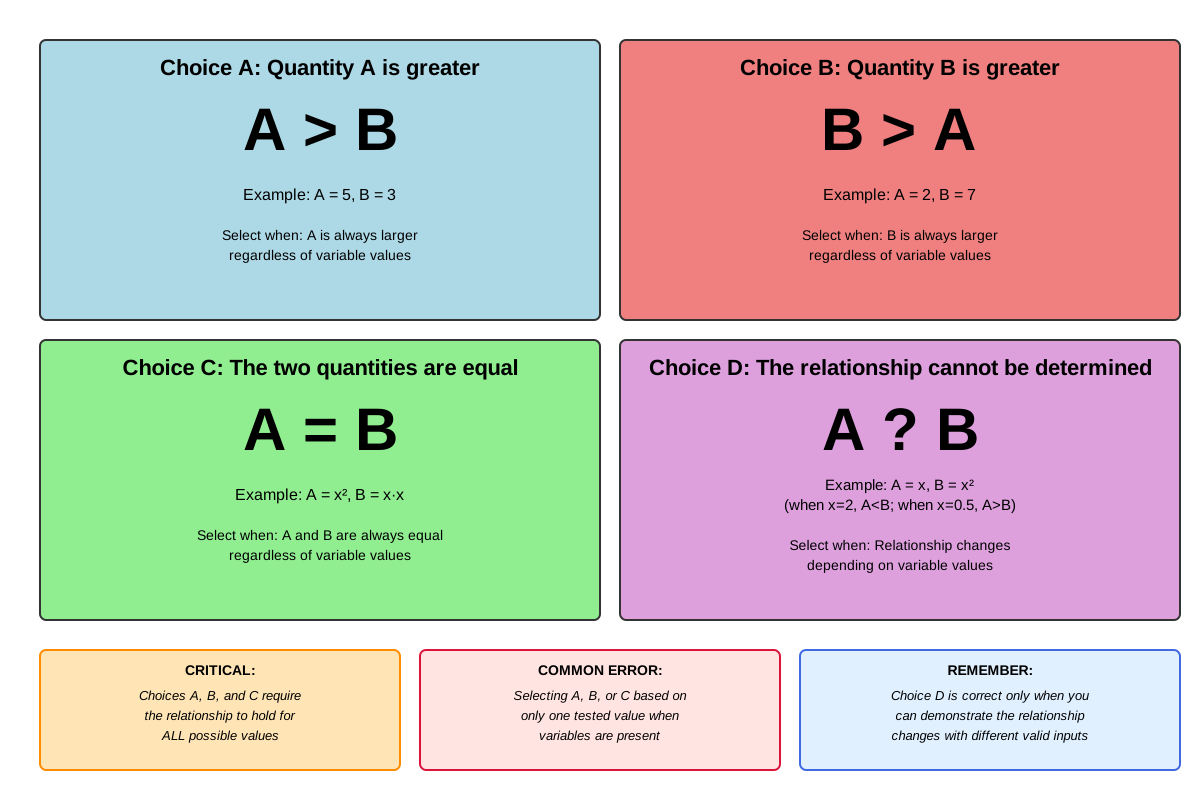
Every quantitative comparison question presents two quantities labeled Quantity A and Quantity B, along with four answer choices that remain constant across all questions:
- (A) Quantity A is greater
- (B) Quantity B is greater
- (C) The two quantities are equal
- (D) The relationship cannot be determined from the information given
This standardized format means students never waste time reading different answer choices; the cognitive load focuses entirely on analyzing the relationship between the quantities. Some questions include additional information in a centered box above the quantities, which applies to both Quantity A and Quantity B. This information might define variables, establish constraints, or provide context necessary for comparison.
The Four-Answer Framework
Understanding when each answer choice is appropriate forms the foundation of quantitative comparison strategy:
| Answer Choice | When to Select | Key Indicator |
|---|---|---|
| (A) Quantity A is greater | A is always larger regardless of any variables | A > B in all valid cases |
| (B) Quantity B is greater | B is always larger regardless of any variables | B > A in all valid cases |
| (C) The two quantities are equal | A and B are always equal regardless of any variables | A = B in all valid cases |
| (D) The relationship cannot be determined | The relationship changes depending on variable values | Sometimes A > B, sometimes B > A |
The critical insight is that answers (A), (B), and (C) require the relationship to hold always—for every possible value of any variables involved. If even one valid case produces a different relationship, the answer must be (D). This principle underlies many strategic approaches to these questions.
Strategic Comparison Techniques
Rather than calculating exact values for both quantities, efficient test-takers employ several powerful techniques:
1. Simplification by Subtraction or Division
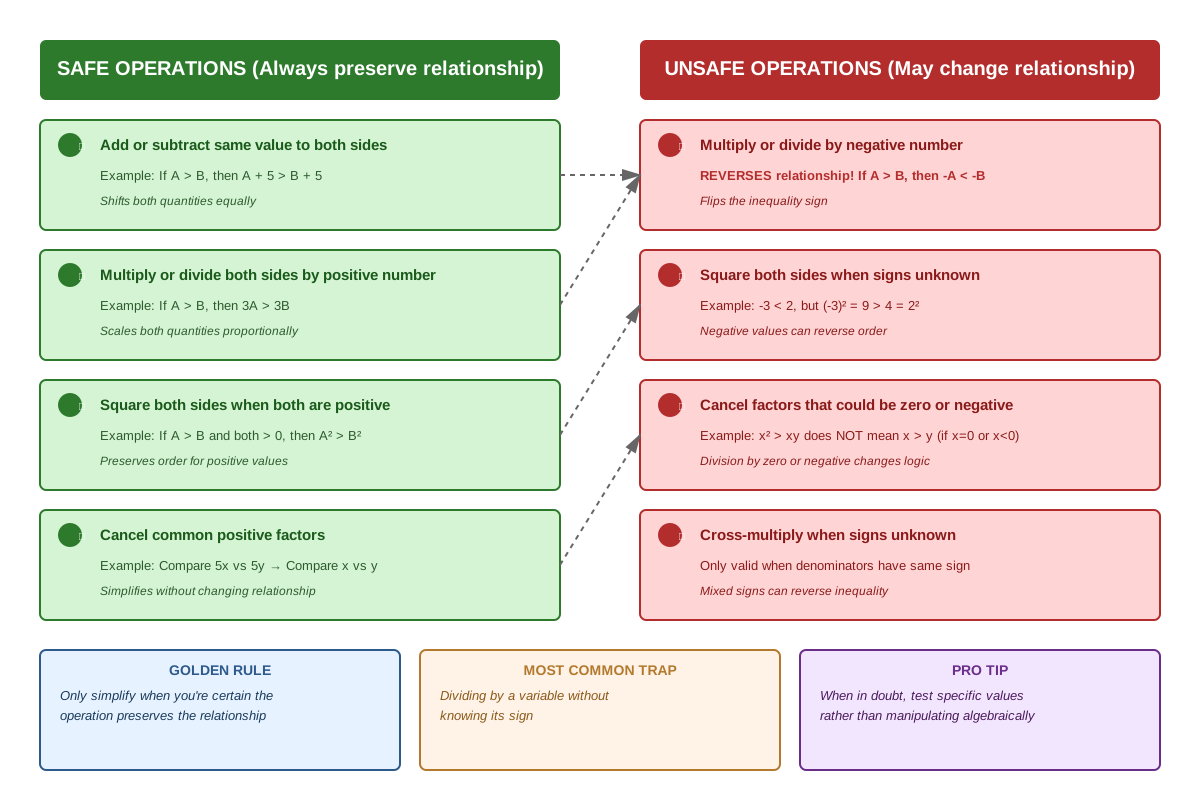
When both quantities contain common terms, subtracting the same amount from both sides preserves the relationship. Similarly, dividing both sides by the same positive number maintains the inequality direction.
For example, comparing:
- Quantity A: 5x + 7
- Quantity B: 5x + 3
Subtracting 5x from both yields:
- Quantity A: 7
- Quantity B: 3
The simplified comparison (7 vs. 3) is much easier to evaluate, and the relationship is preserved.
2. Testing Strategic Values
When variables are present without sufficient constraints, testing specific values can reveal whether the relationship is constant or variable. The most strategic values to test include:
- Positive integers (especially 1 and 2)
- Negative integers (especially -1)
- Zero (when permitted)
- Fractions between 0 and 1 (like 1/2)
- Fractions greater than 1 (like 3/2)
If testing different valid values produces different relationships (sometimes A is greater, sometimes B is greater), the answer is definitively (D).
3. Recognizing Arithmetic Properties
Certain arithmetic properties allow immediate comparison without calculation:
- Multiplying a positive number by a value greater than 1 increases it
- Multiplying a positive number by a value between 0 and 1 decreases it
- Adding a positive number increases a value; adding a negative number decreases it
- Squaring a number between 0 and 1 makes it smaller; squaring a number greater than 1 makes it larger
- The reciprocal of a number greater than 1 is between 0 and 1
4. Estimation and Magnitude Analysis
Many comparison questions can be resolved through estimation rather than precise calculation. Recognizing that 47 × 23 is approximately 50 × 20 = 1,000 may be sufficient to determine which quantity is larger without computing the exact product of 1,081.
Common Arithmetic Scenarios
Comparing Expressions with Different Operations
Questions frequently present one quantity involving addition and another involving multiplication, or one with exponents and another with products. Understanding how operations scale differently is crucial:
- Quantity A: 2 + 2 + 2 + 2 + 2
- Quantity B: 2 × 5
Both equal 10, illustrating that repeated addition equals multiplication.
Fraction and Decimal Comparisons
Converting between forms or finding common denominators enables comparison:
- Quantity A: 3/7
- Quantity B: 5/12
Cross-multiplying: 3 × 12 = 36 vs. 5 × 7 = 35, so Quantity A is greater.
Percentage Relationships
Understanding that percentages represent proportional relationships helps compare quantities:
- Quantity A: 20% of 80
- Quantity B: 80% of 20
Both equal 16, demonstrating the commutative property of percentage calculations.
The Role of Variables and Constraints
When variables appear, the presence or absence of constraints determines the answer:
With Sufficient Constraints: If x > 5, comparing x + 3 versus 10 yields a definite relationship (A is greater).
Without Sufficient Constraints: If x is any real number, comparing x² versus x yields different relationships depending on x's value (answer D).
The key question becomes: "Can I find two different valid values for the variable(s) that produce different relationships?" If yes, the answer is (D).
Concept Relationships
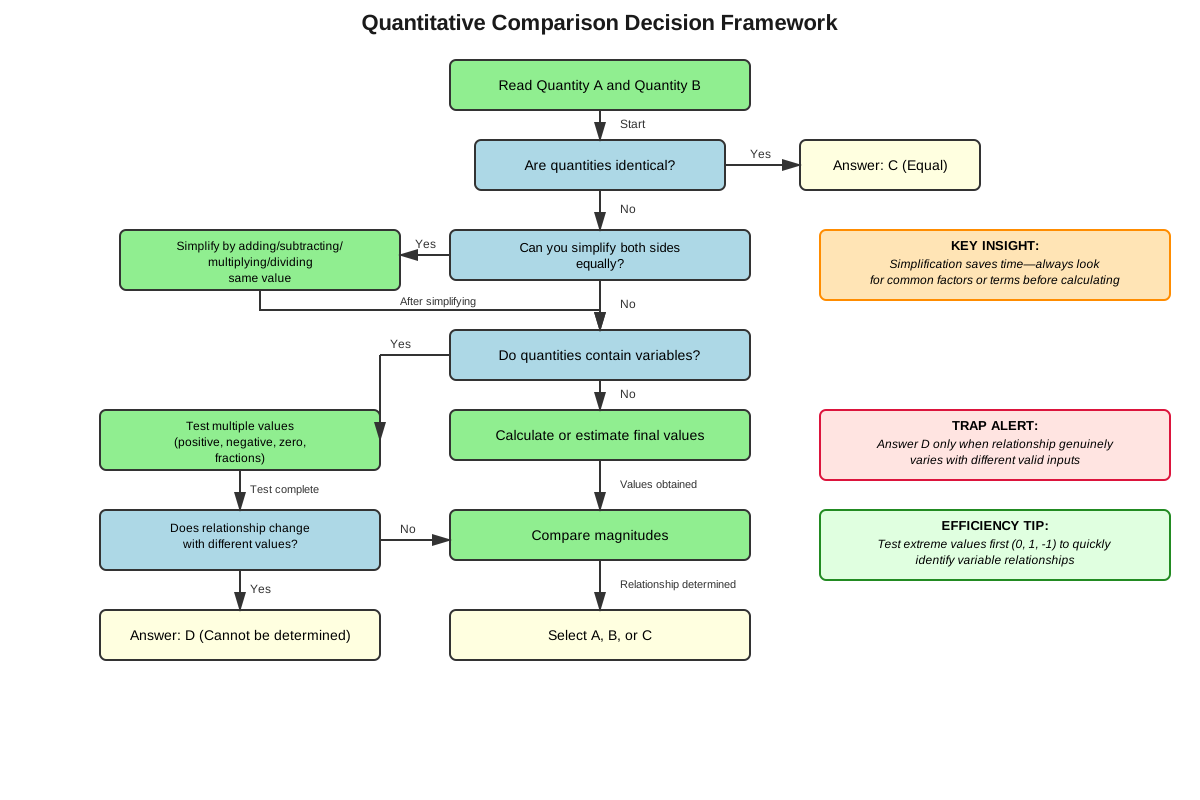
The core concepts in quantitative comparison arithmetic form an interconnected strategic framework. The four-answer format establishes the fundamental decision tree that guides all analysis: determining whether the relationship is constant (leading to A, B, or C) or variable (leading to D). This decision depends directly on applying strategic comparison techniques, which themselves rely on understanding arithmetic properties and operational relationships.
The flow of analysis typically follows this pattern:
Initial Assessment → Simplification Attempt → Variable Analysis → Strategic Testing or Property Application → Answer Selection
Simplification techniques (subtraction, division, factoring) connect to prerequisite knowledge of arithmetic operations and algebraic manipulation. When simplification reveals a clear relationship, the process terminates early with high confidence. When variables remain, the analysis shifts to constraint evaluation—determining whether given information restricts variables sufficiently to guarantee a constant relationship.
The testing strategic values technique bridges to the concept of relationship variability. By systematically testing extreme and special cases (positive, negative, zero, fractions), students can definitively establish whether answer (D) is correct. This connects to deeper understanding of how arithmetic operations behave differently across number domains—a concept that extends beyond quantitative comparison to all GRE quantitative reasoning.
Estimation and magnitude analysis represents the highest-level strategic skill, integrating all other concepts. It requires recognizing when precise calculation is unnecessary because the relative magnitudes are already clear from the structure of the expressions. This skill develops through practice and connects to real-world quantitative reasoning where exact answers are often less important than correct relative assessments.
Quick check — test yourself on Quantitative comparison arithmetic so far.
Try Flashcards →High-Yield Facts
⭐ The answer choices are always the same: (A) Quantity A is greater, (B) Quantity B is greater, (C) The two quantities are equal, (D) The relationship cannot be determined
⭐ If you can find two different valid values that produce different relationships, the answer must be (D)
⭐ Subtracting the same value from both quantities preserves the relationship and often simplifies comparison
⭐ Dividing both quantities by the same positive number preserves the relationship; dividing by a negative number reverses it
⭐ When variables appear without constraints, test 0, 1, -1, and a fraction between 0 and 1 to check for relationship variability
- Squaring both sides of a comparison only preserves the relationship when both quantities are known to be positive
- Adding or subtracting the same amount to both quantities never changes the relationship
- Multiplying a positive number less than 1 by itself makes it smaller; multiplying a number greater than 1 by itself makes it larger
- The reciprocal relationship reverses order for positive numbers: if a > b > 0, then 1/a < 1/b
- Percentage of X is always equal to X percent (20% of 80 = 80% of 20)
- When comparing fractions with the same numerator, the fraction with the smaller denominator is larger
- When comparing fractions with the same denominator, the fraction with the larger numerator is larger
- Zero raised to any positive power equals zero; any nonzero number raised to the zero power equals one
Common Misconceptions
Misconception: If Quantity A looks more complicated or has more terms, it must be larger.
Correction: Complexity of expression has no relationship to magnitude. The quantity 1,000,000 is simpler than (2 + 3 + 4 + 5) but much larger. Always evaluate or compare based on mathematical relationships, not visual complexity.
Misconception: When variables are present, you must solve for their exact values before comparing.
Correction: Quantitative comparison questions often deliberately provide insufficient information to solve for exact values. The goal is to determine the relationship, which may be possible through simplification, property application, or recognizing that the relationship varies (answer D).
Misconception: If testing one value shows Quantity A is greater, then (A) is the correct answer.
Correction: Testing a single value only eliminates possibilities; it doesn't confirm the answer. You must verify that the relationship holds for all valid values. If testing a second valid value produces a different relationship, the answer is (D).
Misconception: Squaring both quantities is always a safe simplification technique.
Correction: Squaring can reverse relationships when negative numbers are involved. For example, -3 < 2, but (-3)² = 9 > 4 = 2². Only square both sides when you know both quantities are positive, or when you're prepared to consider multiple cases.
Misconception: Answer choice (C) means the quantities look the same or have the same form.
Correction: Answer (C) means the quantities are mathematically equal in value, regardless of how they appear. The expressions 2 + 3 and 10/2 look completely different but are equal (both equal 5).
Misconception: More information in the centered box makes the problem harder.
Correction: Additional information typically constrains variables, making relationships more determinable. Questions with no centered information often lead to answer (D) because variables are unconstrained. Information is provided to help, not to confuse.
Misconception: You should always calculate exact values for both quantities.
Correction: Exact calculation is often unnecessary and wastes time. Strategic comparison through simplification, estimation, or property recognition is faster and less error-prone. Calculate exactly only when simpler methods don't reveal the relationship.
Worked Examples
Example 1: Simplification Through Subtraction
Given Information: x > 0
Quantity A: 7x + 13
Quantity B: 7x + 9
Solution Process:
Step 1: Recognize that both quantities contain the term 7x. Since we're comparing the quantities, we can subtract 7x from both sides without changing their relationship.
Step 2: After subtracting 7x from both:
- Quantity A becomes: 13
- Quantity B becomes: 9
Step 3: Compare the simplified quantities: 13 > 9
Step 4: Since Quantity A is greater after simplification, and simplification preserves the relationship, Quantity A is greater in the original problem.
Answer: (A)
Key Insight: This problem demonstrates the power of simplification. Rather than considering what happens to 7x + 13 versus 7x + 9 for different values of x, we eliminate the variable entirely by subtracting the common term. The constraint x > 0 turns out to be irrelevant because the relationship doesn't depend on x at all—it depends only on comparing 13 to 9.
Example 2: Testing Values to Determine Variability
Given Information: n is an integer
Quantity A: n²
Quantity B: n³
Solution Process:
Step 1: Recognize that the relationship between n² and n³ likely depends on the value of n. Since no constraints are given beyond n being an integer, we should test several strategic values.
Step 2: Test n = 2 (a positive integer greater than 1):
- Quantity A: 2² = 4
- Quantity B: 2³ = 8
- Result: Quantity B is greater
Step 3: Test n = 1 (the boundary case):
- Quantity A: 1² = 1
- Quantity B: 1³ = 1
- Result: The quantities are equal
Step 4: Test n = 0 (zero is an integer):
- Quantity A: 0² = 0
- Quantity B: 0³ = 0
- Result: The quantities are equal
Step 5: Test n = -1 (a negative integer):
- Quantity A: (-1)² = 1
- Quantity B: (-1)³ = -1
- Result: Quantity A is greater
Step 6: We've found that sometimes Quantity B is greater (when n = 2) and sometimes Quantity A is greater (when n = -1). This means the relationship is not constant.
Answer: (D)
Key Insight: This problem illustrates why systematic value testing is essential when variables are unconstrained. The relationship between n² and n³ depends critically on whether n is greater than 1, equal to 0 or 1, or between 0 and 1, or negative. Understanding how exponents behave across different domains of numbers is crucial for GRE success. The moment we found two different relationships (B greater when n = 2, A greater when n = -1), we could confidently select (D) without further testing.
Exam Strategy
Approaching Quantitative Comparison Questions
Step 1: Read the centered information carefully if present. This information applies to both quantities and often provides crucial constraints on variables. Underline or mentally note any restrictions like "x > 0" or "n is a positive integer."
Step 2: Scan both quantities before calculating anything. Look for common terms, similar structures, or obvious relationships. Ask yourself: "Can I simplify this comparison without computing exact values?"
Step 3: Apply simplification techniques when possible. Subtract common terms, divide by common positive factors, or factor out common elements. The goal is to reduce the comparison to its simplest form.
Step 4: Identify whether variables are sufficiently constrained. If variables appear, determine whether the given information restricts them enough to guarantee a constant relationship. If not, prepare to test values.
Step 5: Test strategic values systematically when variables are unconstrained:
- Start with simple positive integers (1, 2)
- Test zero if it's a valid value
- Test negative integers (-1, -2)
- Test fractions between 0 and 1 (1/2)
- Stop as soon as you find two different relationships (confirming answer D)
Step 6: Use estimation when exact calculation seems tedious. If Quantity A is approximately 500 and Quantity B is approximately 200, you don't need exact values to determine A is greater.
Trigger Words and Phrases
Watch for these indicators that signal specific strategies:
- "x is a positive integer" or similar constraints: These limit the values you need to test and often make relationships determinable
- "x > y" or other inequalities: These provide ordering information that can be combined with the quantities through addition or multiplication
- "even integer," "odd integer": These suggest testing specific examples of each type
- Expressions with the same variable in both quantities: Signal opportunity for simplification through subtraction or division
- Fractions, decimals, or percentages: Consider converting to a common form for easier comparison
Process of Elimination Tips
- Eliminate (D) first if you can find any way to determine a definite relationship. Answer (D) should only be selected when you've confirmed the relationship varies.
- If testing one value gives A > B and another gives A = B, the answer cannot be (A) or (C), so it's either (B) or (D). Test another value to decide.
- If both quantities are constants (no variables), the answer cannot be (D). The relationship is determinable even if calculation is complex.
- If you've simplified to identical expressions, the answer is (C) regardless of variable values.
Time Allocation
Quantitative comparison questions should generally take 45-60 seconds each, making them faster than standard problem-solving questions. If you find yourself calculating for more than 90 seconds, stop and reconsider your approach—you're likely missing a simpler comparison strategy. The format is designed to reward insight over computation, so extended calculation usually indicates a strategic error rather than a necessary step.
Memory Techniques
The "SATE" Approach
Remember the four-step process with SATE:
- Simplify: Remove common terms through subtraction or division
- Analyze: Determine if variables are constrained or free
- Test: Try strategic values if variables are unconstrained
- Evaluate: Make the comparison and select the answer
The "PZNF" Testing Sequence
When testing values for unconstrained variables, remember PZNF:
- Positive integers (especially 1 and 2)
- Zero (if valid)
- Negative integers (especially -1)
- Fractions (especially 1/2 for values between 0 and 1)
The "Always/Sometimes" Rule
Visualize a traffic light:
- Green (A, B, or C): The relationship is ALWAYS the same—go ahead and select
- Red (D): The relationship is SOMETIMES different—stop and select D
If you can think of even one valid case where the relationship changes, you must stop at red (answer D).
Reciprocal Reversal
Remember: "Reciprocals Reverse" (for positive numbers). If a > b and both are positive, then 1/a < 1/b. The bigger the number, the smaller its reciprocal.
Squaring Sign Switch
"Squaring Switches Signs" (potentially). Negative numbers become positive when squared, which can reverse relationships. Always check signs before squaring both sides.
Summary
Quantitative comparison arithmetic represents a high-yield, strategically distinct question type that appears consistently on the GRE Quantitative Reasoning section. Success requires understanding the four-answer framework, where answers (A), (B), and (C) indicate relationships that hold always, while answer (D) indicates variability. The most efficient approach emphasizes simplification over calculation—subtracting common terms, dividing by common positive factors, and recognizing arithmetic properties that allow comparison without computing exact values. When variables appear without sufficient constraints, systematic testing of strategic values (positive integers, zero, negative integers, and fractions) reveals whether the relationship is constant or variable. Common pitfalls include assuming complexity correlates with magnitude, failing to test multiple values before selecting an answer, and unnecessarily calculating exact values when estimation or simplification would suffice. Mastery of quantitative comparison arithmetic builds on foundational arithmetic knowledge while developing higher-order analytical skills applicable throughout the GRE and beyond.
Key Takeaways
- Quantitative comparison questions use a standardized four-answer format that never changes, allowing you to focus entirely on analyzing the relationship between quantities
- Simplification through subtraction or division of common terms is the most powerful technique for efficient comparison
- When variables are unconstrained, systematically test positive, zero, negative, and fractional values to determine if the relationship varies
- If you can find two different valid values that produce different relationships, the answer must be (D)
- Avoid unnecessary calculation—estimation, property recognition, and strategic comparison are faster and less error-prone
- These questions should take 45-60 seconds on average; extended calculation suggests you're missing a simpler approach
- Understanding how arithmetic operations behave across different number domains (positive, negative, fractions, integers) is essential for accurate comparison
Related Topics
Quantitative Comparison with Algebra: Extends comparison strategies to algebraic expressions, equations, and inequalities, building on the simplification techniques mastered here.
Quantitative Comparison with Geometry: Applies comparison logic to geometric quantities like areas, perimeters, angles, and volumes, requiring integration of geometric formulas with comparison strategies.
Arithmetic Word Problems: Uses the arithmetic concepts tested in quantitative comparison (percentages, ratios, operations) in traditional problem-solving format with real-world contexts.
Properties of Numbers: Deepens understanding of how different number types (primes, evens, odds, consecutive integers) behave under operations, enhancing ability to predict relationships without calculation.
Estimation and Approximation: Develops the magnitude analysis skills introduced in quantitative comparison, applicable to all GRE quantitative question types for time efficiency.
Practice CTA
Now that you've mastered the core concepts and strategies for quantitative comparison arithmetic, it's time to solidify your understanding through active practice. Attempt the practice questions designed specifically for this topic, focusing on applying the simplification techniques and strategic value testing you've learned. Use the flashcards to reinforce high-yield facts and common patterns until recognizing them becomes automatic. Remember: quantitative comparison rewards strategic thinking over computational power, so approach each practice question by asking "How can I compare these efficiently?" rather than "How do I calculate both exactly?" Your investment in deliberate practice with these questions will yield significant score improvements, as this question type appears consistently on every GRE administration. You've got this!
Sign up free to keep reading
Create a free AnvayaPrep account to finish this GRE guide on Quantitative comparison arithmetic — plus flashcards and practice questions.