Overview
Estimation is one of the most powerful and frequently tested skills on the GRE Quantitative Reasoning section. Rather than performing lengthy calculations, estimation allows test-takers to quickly approximate values and eliminate incorrect answer choices, saving precious time while maintaining accuracy. This strategic approach is particularly valuable on the GRE, where time management often determines success as much as mathematical knowledge. The ability to recognize when exact calculation is unnecessary—and when a reasonable approximation will suffice—distinguishes high-scoring test-takers from those who struggle to complete sections within time limits.
The GRE explicitly rewards GRE estimation skills through question design. Many problems feature answer choices that are sufficiently spread apart that precise calculation becomes unnecessary. Additionally, Quantitative Comparison questions often require only determining which quantity is larger, not calculating exact values. Test-makers intentionally include "trap" answers that catch students who waste time on unnecessary precision or make calculation errors during complex arithmetic. Understanding when and how to estimate transforms the test-taking experience from a race against time into a strategic exercise in efficient problem-solving.
Within the broader Arithmetic unit, estimation serves as a foundational skill that enhances performance across multiple question types. It connects directly to concepts like rounding, place value, and order of magnitude, while supporting more advanced topics including percent approximations, ratio comparisons, and data interpretation. Mastering estimation creates a multiplier effect on overall Quantitative Reasoning performance, as this skill applies to geometry, algebra, and data analysis questions throughout the exam.
Learning Objectives
- [ ] Identify when Estimation is being tested
- [ ] Explain the core rule or strategy behind Estimation
- [ ] Apply Estimation to GRE-style questions accurately
- [ ] Determine the appropriate level of precision needed for different question types
- [ ] Recognize answer choice spacing that signals estimation opportunities
- [ ] Execute strategic rounding to simplify calculations while maintaining accuracy
- [ ] Combine multiple estimation techniques to solve complex multi-step problems
Prerequisites
- Place value and decimal notation: Understanding the relative magnitude of digits in different positions enables effective rounding decisions
- Basic arithmetic operations: Estimation builds upon addition, subtraction, multiplication, and division to create approximate calculations
- Order of magnitude concepts: Recognizing whether numbers are in the tens, hundreds, thousands, or millions helps gauge reasonable approximations
- Fraction and decimal equivalents: Converting between forms allows flexible estimation strategies depending on which representation simplifies calculations
- Percent fundamentals: Many estimation problems involve approximating percentage calculations or percent changes
Why This Topic Matters
In real-world applications, estimation is an essential skill used daily by professionals across all fields. Engineers estimate material requirements, financial analysts approximate investment returns, scientists gauge experimental outcomes, and business leaders project revenue and costs. The ability to quickly determine whether a calculation result is reasonable prevents costly errors and enables rapid decision-making when precise data is unavailable or unnecessary. This practical skill extends far beyond standardized testing into career success and everyday financial literacy.
On the GRE specifically, estimation appears in approximately 30-40% of Quantitative Reasoning questions, either as the primary skill being tested or as an efficient solution strategy. The skill is tested across all question formats: Quantitative Comparison, Multiple Choice (single and multiple answer), and Numeric Entry. Estimation is particularly prevalent in:
- Data Interpretation questions where graphs require reading approximate values
- Quantitative Comparison questions where determining relative magnitude suffices
- Word problems with complex calculations but widely-spaced answer choices
- Time-intensive calculations where estimation provides a strategic shortcut
- Questions involving irrational numbers like π or √2 where exact values are impractical
The GRE rewards test-takers who recognize estimation opportunities because these students complete sections faster with equal or better accuracy than those who calculate precisely. This time savings allows for careful review of challenging questions and reduces the pressure that leads to careless errors.
Core Concepts
Fundamental Principles of Estimation
Estimation is the process of finding an approximate value that is close enough to the exact answer to serve the problem's purpose. On the GRE, "close enough" means either identifying the correct answer choice or determining the relationship between two quantities. The core principle underlying all estimation is that strategic imprecision can be more valuable than exact calculation when time is limited and answer choices are distinct.
Effective estimation requires three key judgments:
- Recognition: Identifying when estimation is appropriate
- Precision: Determining how close the approximation must be
- Method: Selecting the estimation technique that balances speed and accuracy
Strategic Rounding
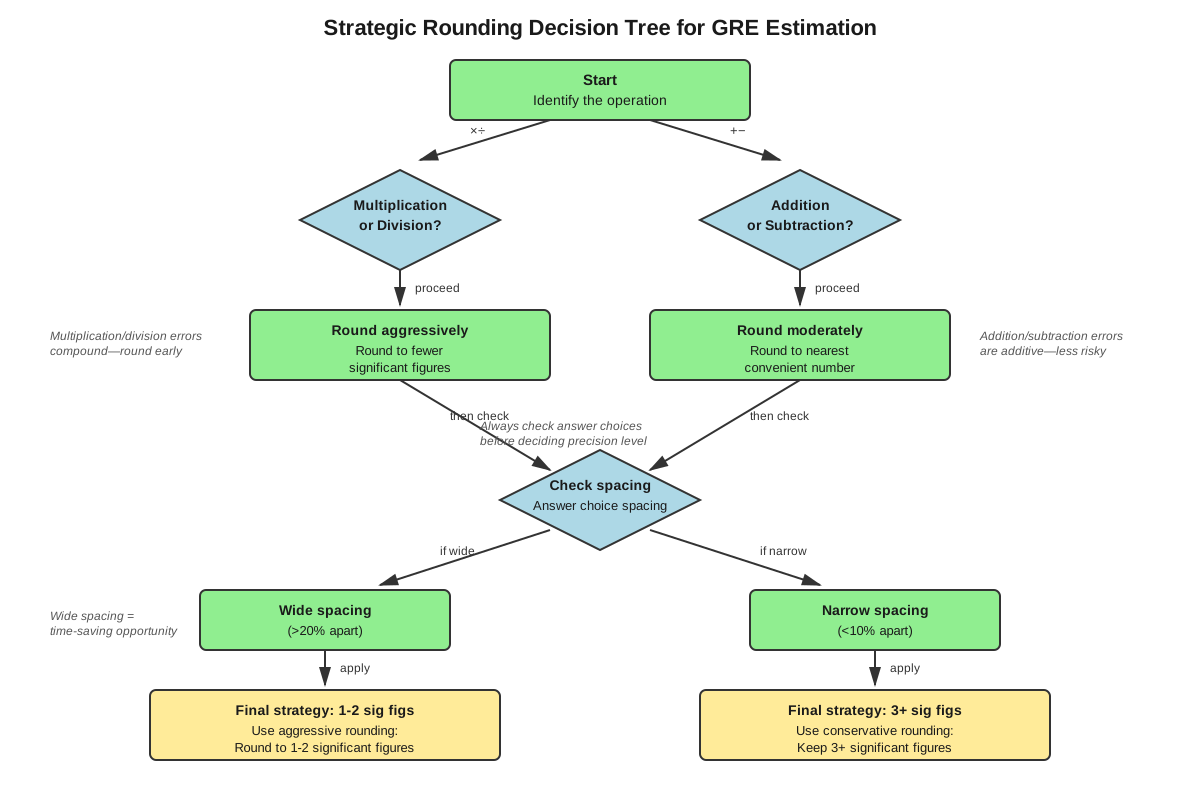
Strategic rounding forms the foundation of most estimation techniques. Unlike mechanical rounding rules taught in elementary school, strategic rounding on the GRE involves deliberately choosing approximations that simplify calculations while maintaining sufficient accuracy.
Rounding Guidelines for Estimation:
| Original Value | Strategic Rounding | Rationale |
|---|---|---|
| 49 × 23 | 50 × 20 | Round one up, one down to balance error |
| 3.14159... (π) | 3 or 3.14 | Use 3 for rough estimates, 3.14 for closer approximation |
| 0.48 | 0.5 or 1/2 | Round to convenient fraction for mental math |
| 198 + 203 | 200 + 200 | Round both to same value for easy addition |
| 87% of 520 | 90% of 500 | Round both to simplify percent calculation |
The key principle is compensatory rounding: when multiplying, round some numbers up and others down to minimize cumulative error. When adding or subtracting, track whether you're consistently over- or under-estimating to adjust your final approximation.
Magnitude Estimation
Magnitude estimation focuses on determining the order of magnitude (scale) of an answer rather than its precise value. This technique is particularly powerful for eliminating answer choices that are off by factors of 10 or more.
For example, estimating 47 × 89:
- Recognize both numbers are close to 50 and 90
- Calculate 50 × 90 = 4,500
- The exact answer must be close to 4,500 (actually 4,183)
- Immediately eliminate any answer choices like 418, 41,830, or 450
Magnitude estimation is essential for:
- Catching decimal point errors
- Verifying calculator entries (on calculator-permitted questions)
- Quickly eliminating unreasonable answer choices
- Checking whether a complex calculation result makes sense
Benchmark Values
Using benchmark values—familiar reference points—accelerates estimation by leveraging memorized facts. Common benchmarks include:
- Fraction-decimal-percent equivalents: 1/4 = 0.25 = 25%, 1/3 ≈ 0.33 = 33%, 1/2 = 0.5 = 50%
- Common squares: 10² = 100, 15² = 225, 20² = 400, 25² = 625
- Powers of 2: 2³ = 8, 2⁴ = 16, 2⁵ = 32, 2¹⁰ = 1,024 ≈ 1,000
- Common roots: √2 ≈ 1.4, √3 ≈ 1.7, √5 ≈ 2.2
- π approximations: π ≈ 3 (rough), π ≈ 3.14 (standard), π ≈ 22/7 (fractional)
When encountering unfamiliar values, relate them to these benchmarks. For instance, to estimate √50, recognize that √49 = 7 and √64 = 8, so √50 ≈ 7.1.
Answer Choice Analysis
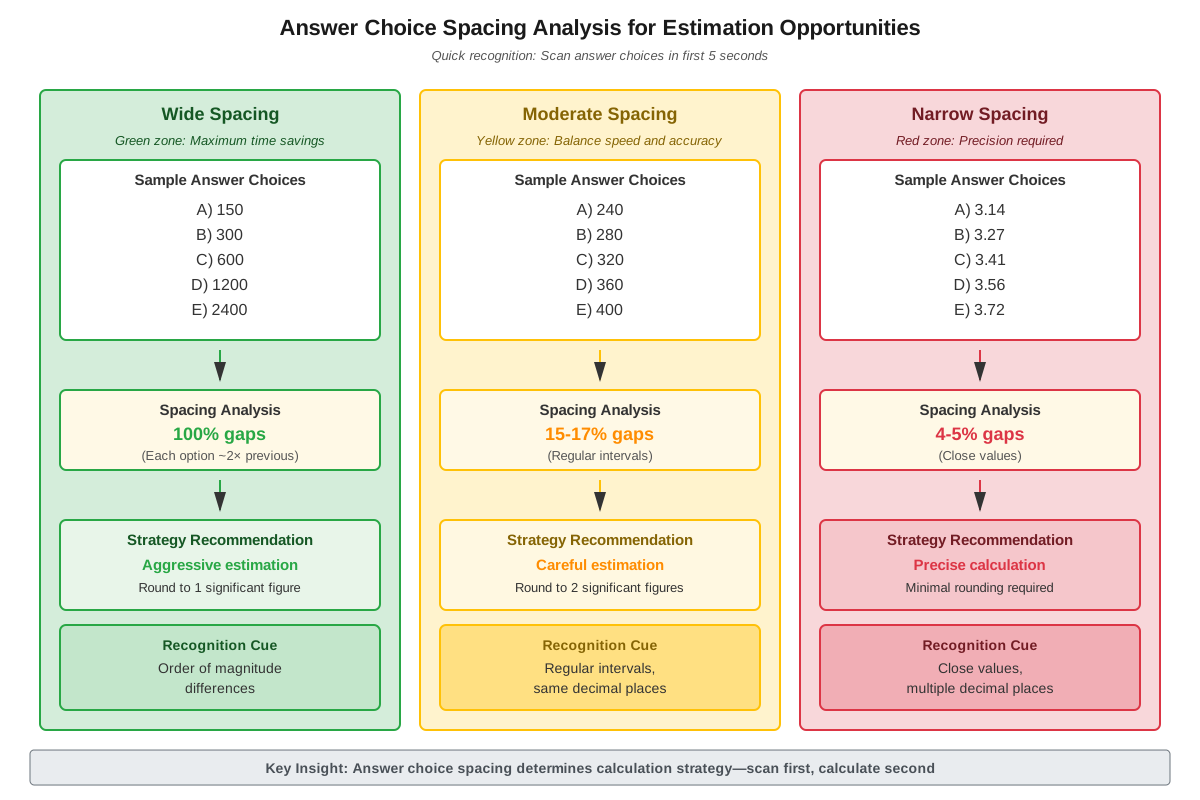
A critical but often overlooked estimation skill is analyzing answer choice spacing before attempting calculations. When answer choices are widely separated, precise calculation is unnecessary and potentially wasteful.
Consider these two scenarios:
Scenario A (widely spaced):
- (A) 15
- (B) 45
- (C) 135
- (D) 405
- (E) 1,215
Scenario B (closely spaced):
- (A) 127
- (B) 134
- (C) 141
- (D) 148
- (E) 155
In Scenario A, even rough estimation will identify the correct answer. In Scenario B, more precise calculation or careful estimation is required. Always examine answer choices first to calibrate your approach.
Estimation in Quantitative Comparison
Quantitative Comparison questions are particularly suited to estimation because they only require determining which quantity is larger, not calculating exact values. Strategies include:
- Simplify both quantities equally: Divide, multiply, add, or subtract the same value from both columns
- Estimate bounds: Determine that Quantity A must be greater than X while Quantity B must be less than X
- Use inequality reasoning: Compare approximate values to establish relationships
- Test extreme cases: Use simple numbers to understand the relationship pattern
Multi-Step Estimation
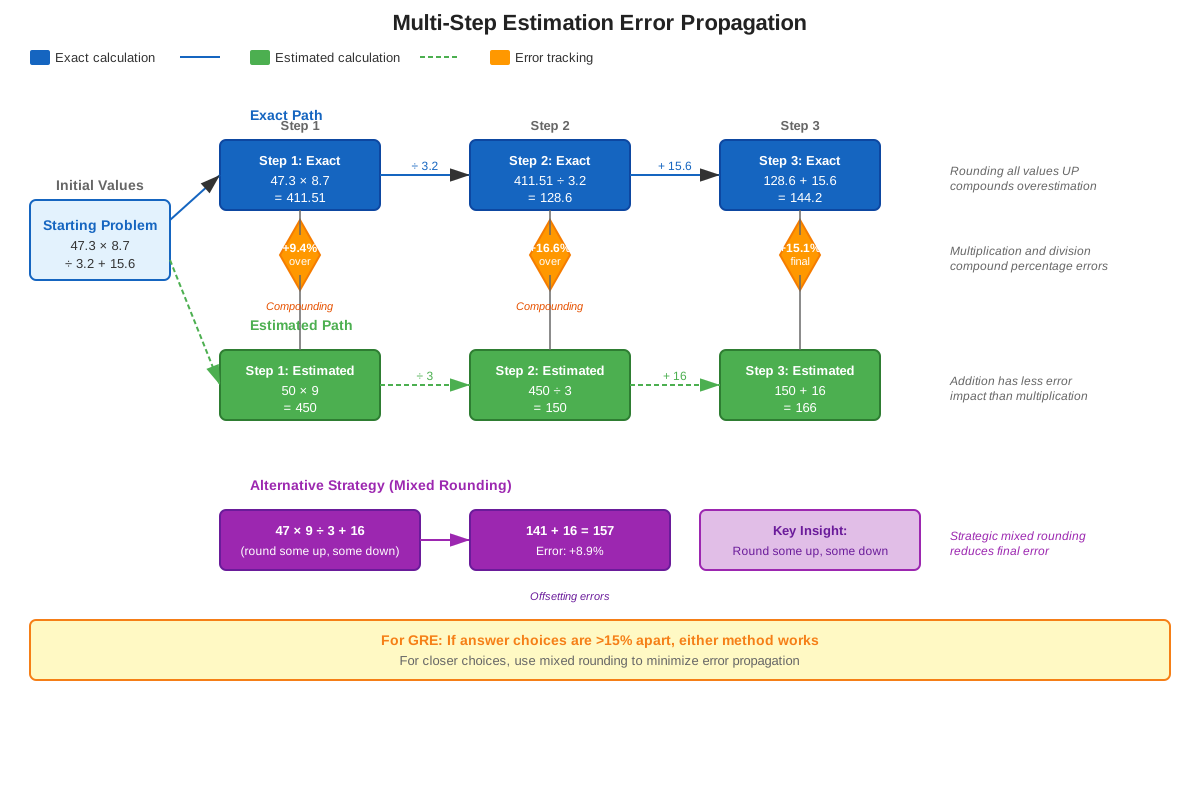
Complex problems often require chaining multiple estimation techniques. The key is maintaining awareness of cumulative error—each estimation step introduces some imprecision, so track whether you're consistently over- or under-estimating.
For example, estimating (48 × 73) / (19 × 24):
- Round to (50 × 70) / (20 × 25)
- Calculate numerator: 50 × 70 = 3,500
- Calculate denominator: 20 × 25 = 500
- Divide: 3,500 / 500 = 7
- Recognize the exact answer is close to 7 (actually 7.3)
Concept Relationships
The concepts within estimation form a hierarchical structure where fundamental principles (recognizing when to estimate) lead to technique selection (choosing rounding, magnitude, or benchmark approaches), which then enables strategic application (analyzing answer choices and executing multi-step estimation).
Strategic rounding serves as the foundation for magnitude estimation—you must round effectively to quickly determine order of magnitude. Benchmark values enhance both rounding and magnitude estimation by providing mental reference points. Answer choice analysis determines which estimation techniques are necessary and sufficient. All these skills converge in multi-step estimation, where complex problems require combining multiple approaches.
Estimation connects to prerequisite topics through direct application: place value understanding enables effective rounding decisions, arithmetic fluency allows rapid mental calculation of approximations, and fraction-decimal-percent knowledge provides benchmark values. Looking forward, estimation skills enhance performance in ratio and proportion problems, percent calculations, data interpretation, and even algebraic simplification where approximating coefficients can reveal solution strategies.
Relationship Map:
Recognition of estimation opportunity → Answer choice analysis → Technique selection (rounding/magnitude/benchmarks) → Execution → Verification → Correct answer or elimination of choices
High-Yield Facts
⭐ Answer choices spaced by factors of 3 or more signal that rough estimation will suffice
⭐ In Quantitative Comparison, you never need exact values—only the relationship between quantities
⭐ When multiplying, round one number up and another down to minimize cumulative error
⭐ Magnitude estimation (order of magnitude) eliminates answer choices faster than precise calculation
⭐ Benchmark values (π ≈ 3, √2 ≈ 1.4, 1/3 ≈ 0.33) should be memorized for instant reference
- Estimation is appropriate when answer choices differ by more than 10% of the smallest value
- Rounding to multiples of 5, 10, 25, or 50 typically simplifies mental arithmetic most effectively
- For percent problems, estimating the base value often matters more than estimating the percentage
- When estimating square roots, use perfect squares as boundaries (√50 is between √49 = 7 and √64 = 8)
- Data interpretation questions almost always require estimation since graph values cannot be read with precision
- Compensatory rounding (balancing over- and under-estimates) reduces cumulative error in multi-step problems
- Testing whether your estimated answer is reasonable prevents careless errors and misplaced decimals
- The GRE never requires calculations beyond what can be reasonably estimated or computed mentally
- Estimation saves an average of 30-45 seconds per question where it's applicable
Quick check — test yourself on Estimation so far.
Try Flashcards →Common Misconceptions
Misconception: Estimation is less accurate and should only be used as a last resort when time is running out.
Correction: Strategic estimation is often more accurate than rushed precise calculation because it reduces opportunities for arithmetic errors. On the GRE, estimation is a primary strategy, not a backup plan.
Misconception: Always round to the nearest 10 or 100 using standard rounding rules.
Correction: Strategic rounding depends on the calculation type and answer choice spacing. Round to values that simplify mental math (like 25, 50, or 75) and use compensatory rounding to balance errors.
Misconception: Estimation cannot be used for Numeric Entry questions since there are no answer choices to eliminate.
Correction: While estimation alone may not provide the exact answer for Numeric Entry, it establishes bounds and verifies that your calculated answer is reasonable, catching decimal point errors and calculation mistakes.
Misconception: You should calculate precisely first, then estimate to check your answer.
Correction: Analyze answer choices before calculating. If they're widely spaced, estimate first and only calculate precisely if estimation doesn't clearly identify the answer. This reverses the typical approach and saves significant time.
Misconception: Rounding always introduces error that makes the answer less reliable.
Correction: Compensatory rounding (rounding some values up and others down) often produces estimates within 5% of exact values, which is more than sufficient when answer choices differ by 20% or more. The time saved far outweighs the minor precision loss.
Misconception: Estimation only works for arithmetic problems, not for algebra or geometry.
Correction: Estimation applies across all Quantitative Reasoning topics. You can estimate algebraic expressions by substituting simple values, approximate geometric measurements, and estimate data interpretation values from graphs.
Worked Examples
Example 1: Strategic Rounding in Multiplication
Problem: A rectangular garden measures 47 feet by 83 feet. Which of the following is closest to the area of the garden in square feet?
(A) 360
(B) 1,200
(C) 3,900
(D) 12,000
(E) 39,000
Solution:
Step 1 - Analyze answer choices: The choices are widely spaced (factors of 3+ apart), signaling that rough estimation will suffice.
Step 2 - Apply strategic rounding: Round 47 to 50 (up by 3) and 83 to 80 (down by 3). This compensatory rounding balances the error.
Step 3 - Calculate the estimate: 50 × 80 = 4,000
Step 4 - Select the closest answer: 4,000 is closest to 3,900 (choice C).
Step 5 - Verify reasonableness: The exact answer (47 × 83 = 3,901) confirms our estimate was excellent. Notice that choice (D) 12,000 would result from a decimal point error (reading 4,000 as 40 × 100 instead of 50 × 80), and choice (E) would result from incorrectly calculating 50 × 80 as 50 × 800.
Learning Objective Connection: This example demonstrates identifying when estimation is appropriate (widely spaced answers), applying the core strategy (compensatory rounding), and executing accurately.
Example 2: Quantitative Comparison with Estimation
Problem:
Quantity A: (√101 + √99) / 2
Quantity B: 10
Solution:
Step 1 - Recognize the estimation opportunity: We don't need exact values, only which quantity is larger.
Step 2 - Use benchmark values: √100 = 10, so both √101 and √99 are very close to 10.
Step 3 - Establish bounds: √99 is slightly less than 10 (approximately 9.95), and √101 is slightly more than 10 (approximately 10.05).
Step 4 - Estimate Quantity A: (√101 + √99) / 2 ≈ (10.05 + 9.95) / 2 = 20 / 2 = 10
Step 5 - Compare: Quantity A ≈ 10, which equals Quantity B.
Step 6 - Consider precision: Since √101 and √99 are symmetrically positioned around √100, their average is exactly 10 (by the properties of square roots and averages).
Answer: The two quantities are equal (C).
Learning Objective Connection: This example shows how estimation in Quantitative Comparison requires only determining relationships, not exact values. It also demonstrates using benchmark values (√100 = 10) and reasoning about bounds.
Example 3: Multi-Step Estimation with Percents
Problem: A store increases prices by 18%, then offers a 22% discount. If an item originally cost $89, approximately what is the final price?
(A) $75
(B) $83
(C) $89
(D) $95
(E) $103
Solution:
Step 1 - Analyze answer choices: Moderately spaced, requiring reasonable estimation accuracy.
Step 2 - Round the original price: $89 ≈ $90 for easier calculation.
Step 3 - Estimate the price increase: 18% ≈ 20% (rounding up slightly). 20% of $90 = $18. New price ≈ $90 + $18 = $108.
Step 4 - Estimate the discount: 22% ≈ 20% (rounding down to compensate for rounding up earlier). 20% of $108 ≈ 20% of $110 = $22. Final price ≈ $108 - $22 = $86.
Step 5 - Adjust for rounding: We rounded the original price up ($89 → $90), the increase percentage up (18% → 20%), and the discount percentage down (22% → 20%). The net effect is a slight overestimate, so the actual answer is probably slightly less than $86.
Step 6 - Select the closest answer: $83 (choice B) is closest to our estimate of $86.
Step 7 - Verify with exact calculation if time permits: $89 × 1.18 = $105.02; $105.02 × 0.78 = $81.92 ≈ $83. Our estimation was within $3 of the exact answer, more than sufficient for answer selection.
Learning Objective Connection: This demonstrates multi-step estimation, strategic rounding with compensatory adjustments, and determining appropriate precision levels based on answer choice spacing.
Exam Strategy
Approach Framework:
- Read the question completely before beginning any calculation
- Examine answer choices first to determine spacing and required precision
- Decide: estimate or calculate? based on answer choice analysis and question type
- If estimating, select technique(s): rounding, magnitude, benchmarks, or combination
- Execute the estimation with attention to cumulative error
- Verify reasonableness by checking order of magnitude
Trigger Words and Phrases:
- "Approximately" or "closest to" → explicit invitation to estimate
- "Which of the following could be" → often solvable through estimation and elimination
- Quantitative Comparison questions → almost always benefit from estimation
- Data interpretation with graphs → values cannot be read precisely, estimation required
- Complex calculations with widely-spaced answers → estimate rather than calculate
Process of Elimination Tips:
- Eliminate answers that differ in order of magnitude from your estimate
- Remove choices that would require unrealistic values (e.g., percentages over 100% in growth problems)
- Cross out answers that fail basic reasonableness tests (e.g., area smaller than a side length)
- When two choices remain close, only then perform more precise calculation
Time Allocation:
- Spend 5-10 seconds analyzing answer choices before calculating
- Estimation should take 30-60 seconds for most problems
- If estimation doesn't clearly identify the answer within 60 seconds, switch to precise calculation
- Reserve 15-20 seconds to verify your answer makes sense
Exam Tip: On calculator-permitted questions, use estimation to verify calculator results. Mistyping a number or operation is a common error that estimation catches immediately.
Memory Techniques
SPACE Mnemonic for estimation approach:
- Space: Check answer choice spacing
- Precision: Determine required accuracy
- Approximate: Round strategically
- Calculate: Perform simplified computation
- Evaluate: Verify reasonableness
Rounding Visualization: Picture a number line with your target values. Visualize rounding to the nearest "friendly" number (multiples of 5, 10, 25, 50) that simplifies mental math.
Benchmark Anchors: Create mental "anchor points" for common values:
- The "3-family": π ≈ 3, √10 ≈ 3, e ≈ 3 (all close to 3)
- The "1.4-family": √2 ≈ 1.4, 10/7 ≈ 1.4
- The "0.33-family": 1/3 ≈ 0.33, √(1/9) ≈ 0.33
Compensatory Rounding Reminder: "Up-Down Balance" → When multiplying, if you round one factor up, round another down to maintain balance.
Magnitude Check Acronym - DOME:
- Decimal point correct?
- Order of magnitude reasonable?
- Math operation performed correctly?
- Expected range achieved?
Summary
Estimation is a high-yield GRE Quantitative Reasoning skill that enables test-takers to solve problems faster and more accurately by strategically approximating values rather than calculating precisely. The core principle is recognizing when "close enough" suffices—which is surprisingly often on the GRE, given the test's design with widely-spaced answer choices and Quantitative Comparison questions requiring only relative magnitude. Effective estimation requires three competencies: identifying estimation opportunities through answer choice analysis, selecting appropriate techniques (strategic rounding, magnitude estimation, or benchmark values), and executing calculations while managing cumulative error through compensatory adjustments. Strategic rounding involves deliberately choosing approximations that simplify mental arithmetic, often rounding to multiples of 5, 10, 25, or 50, and balancing over-estimates with under-estimates. Magnitude estimation focuses on order of magnitude to eliminate unreasonable answer choices quickly. Benchmark values—memorized reference points like π ≈ 3, √2 ≈ 1.4, and common fraction-decimal equivalents—accelerate estimation by providing instant comparison standards. Multi-step problems require chaining these techniques while tracking whether cumulative rounding creates over- or under-estimates. Mastering estimation transforms GRE performance by saving 30-45 seconds per applicable question, reducing arithmetic errors, and enabling strategic time allocation to more challenging problems.
Key Takeaways
- Always analyze answer choice spacing before calculating—widely spaced choices (factors of 3+) signal estimation opportunities
- Strategic rounding differs from mechanical rounding—round to values that simplify mental math and use compensatory rounding to balance errors
- Quantitative Comparison questions almost never require exact values—estimation determines relationships faster and more reliably
- Benchmark values (π ≈ 3, √2 ≈ 1.4, 1/3 ≈ 0.33) should be memorized for instant reference in estimation problems
- Estimation is a primary strategy, not a backup plan—it often produces better results than rushed precise calculation
- Magnitude estimation catches decimal point errors and unreasonable answers before you commit to a choice
- The GRE rewards efficient problem-solving—estimation saves time that can be reallocated to challenging questions, improving overall scores
Related Topics
Rounding and Significant Figures: Deepens understanding of how to round strategically and maintain appropriate precision across different contexts, building directly on estimation fundamentals.
Order of Operations and Mental Math: Enhances calculation speed for estimated values, enabling faster execution of estimation strategies without calculator dependence.
Percent Estimation and Approximation: Applies estimation specifically to percentage problems, which appear frequently on the GRE and benefit significantly from approximation techniques.
Data Interpretation and Graph Reading: Requires estimation as a core skill since graph values cannot be read with precision, making this a natural extension of estimation mastery.
Ratio and Proportion Approximation: Uses estimation to quickly compare ratios and determine proportional relationships without precise calculation, particularly valuable in Quantitative Comparison questions.
Practice CTA
Now that you've mastered the concepts and strategies of estimation, it's time to put your skills into action! Attempt the practice questions to reinforce your understanding and build the pattern recognition that distinguishes top scorers. Work through the flashcards to internalize benchmark values and strategic rounding principles until they become automatic. Remember: estimation is not just a time-saving trick—it's a fundamental GRE skill that, when mastered, transforms your test-taking efficiency and accuracy. Every practice problem you solve using estimation strengthens your ability to recognize opportunities and execute strategies confidently on test day. You've got this!
Sign up free to keep reading
Create a free AnvayaPrep account to finish this GRE guide on Estimation — plus flashcards and practice questions.