Overview
Arithmetic word problems represent one of the most frequently tested question types on the GRE Quantitative Reasoning section, appearing in approximately 20-30% of all quantitative questions. These problems require test-takers to translate real-world scenarios described in words into mathematical expressions and equations, then solve them using fundamental arithmetic operations. Unlike straightforward computational questions, GRE arithmetic word problems demand both reading comprehension skills and mathematical reasoning, making them a critical bridge between verbal and quantitative abilities.
The challenge of arithmetic word problems lies not in the complexity of the mathematics involved—most require only basic operations like addition, subtraction, multiplication, and division—but rather in the interpretation and setup phase. Students must identify relevant information, recognize what the question is actually asking, establish relationships between quantities, and construct appropriate mathematical models. This translation process is precisely what the GRE tests: the ability to apply mathematical thinking to practical situations rather than merely executing calculations.
Mastering arithmetic word problems provides a foundation for more advanced Quantitative Reasoning topics including algebra word problems, rate problems, work problems, and data interpretation questions. The problem-solving framework developed through arithmetic word problems—careful reading, variable identification, equation setup, and systematic solving—transfers directly to these more complex question types. Additionally, the logical reasoning skills honed through these problems enhance performance across all GRE sections, making this topic essential for achieving competitive scores.
Learning Objectives
- [ ] Identify when Arithmetic word problems is being tested
- [ ] Explain the core rule or strategy behind Arithmetic word problems
- [ ] Apply Arithmetic word problems to GRE-style questions accurately
- [ ] Translate complex word problem scenarios into mathematical expressions within 60 seconds
- [ ] Distinguish between relevant and irrelevant information in multi-step word problems
- [ ] Verify solutions by checking whether answers make logical sense in the original context
Prerequisites
- Basic arithmetic operations: Addition, subtraction, multiplication, and division form the computational foundation for solving all arithmetic word problems
- Order of operations (PEMDAS): Essential for correctly evaluating multi-step expressions that arise from word problem translations
- Fractions, decimals, and percentages: Many word problems involve these number forms and require fluency in converting between them
- Basic algebraic thinking: Understanding variables and simple equations helps in setting up problem frameworks
- Unit awareness: Recognizing and working with different units (dollars, hours, miles, etc.) prevents common calculation errors
Why This Topic Matters
Arithmetic word problems appear throughout daily life in contexts ranging from calculating tips and splitting bills to determining travel times and comparing prices. The GRE tests these problems because they assess practical quantitative literacy—the ability to use mathematics as a tool for real-world problem-solving rather than as an abstract exercise. Employers and graduate programs value this applied mathematical reasoning because it directly translates to research design, data analysis, budgeting, and logical decision-making.
On the GRE specifically, arithmetic word problems appear in multiple formats: as standalone Quantitative Comparison questions, as Problem Solving questions (both multiple-choice and numeric entry), and embedded within Data Interpretation sets. Research on GRE question distributions indicates that 4-6 questions per Quantitative section involve arithmetic word problems, making them one of the highest-yield topics for focused study. These questions typically appear at all difficulty levels, with easier versions testing straightforward single-step translations and harder versions incorporating multiple relationships, indirect reasoning, or requiring test-takers to work backwards from constraints.
Common manifestations include age problems, money and pricing scenarios, simple interest calculations, mixture problems, consecutive integer problems, and basic ratio/proportion applications. The GRE favors contexts that are universally accessible—avoiding specialized knowledge—so problems typically involve everyday situations like shopping, travel, scheduling, and basic business transactions. Recognizing these common frameworks allows test-takers to quickly categorize problems and apply appropriate solution strategies.
Core Concepts
The Translation Process
The fundamental skill in arithmetic word problems is translation: converting English sentences into mathematical expressions. This process follows a systematic approach. First, identify the unknown quantity—what the problem asks you to find. Second, recognize known quantities and their relationships. Third, identify mathematical operations implied by specific words and phrases. Fourth, construct an equation or expression that captures these relationships.
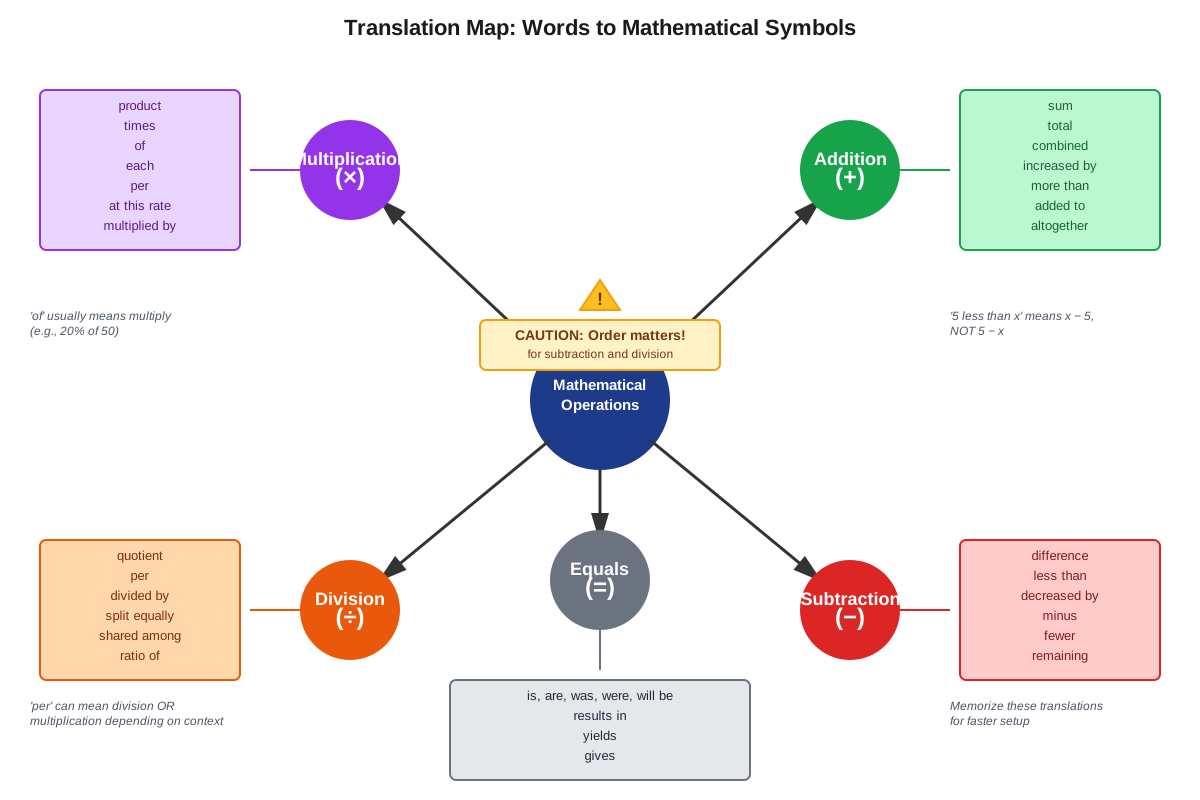
Key translation patterns include:
- "More than," "sum," "total," "increased by" → addition (+)
- "Less than," "difference," "decreased by," "reduced by" → subtraction (−)
- "Times," "product," "of" (as in "half of"), "twice" → multiplication (×)
- "Per," "quotient," "ratio," "divided by" → division (÷)
- "Is," "equals," "was," "will be" → equals sign (=)
Problem Categories and Setup Strategies
Age Problems involve relationships between people's ages at different times. The key insight is that everyone ages at the same rate, so if Person A is 5 years older than Person B now, Person A will still be 5 years older in 10 years. Set up a table with columns for "Now," "Past," and "Future" to organize information systematically.
Money and Pricing Problems require tracking quantities and unit prices. The fundamental relationship is: Total Cost = (Quantity) × (Unit Price). When dealing with multiple items, set up equations that sum individual costs. Always verify that your final answer makes practical sense (e.g., a shirt shouldn't cost $10,000).
Consecutive Integer Problems involve numbers that follow in sequence. For consecutive integers, use n, n+1, n+2, etc. For consecutive even or odd integers, use n, n+2, n+4, etc. (since even and odd numbers are spaced 2 apart). The sum of consecutive integers can often be found using the formula: Sum = (Average) × (Count).
Simple Interest Problems use the formula I = PRT, where I is interest earned, P is principal (initial amount), R is annual interest rate (as a decimal), and T is time in years. Total amount after interest is A = P + I = P(1 + RT).
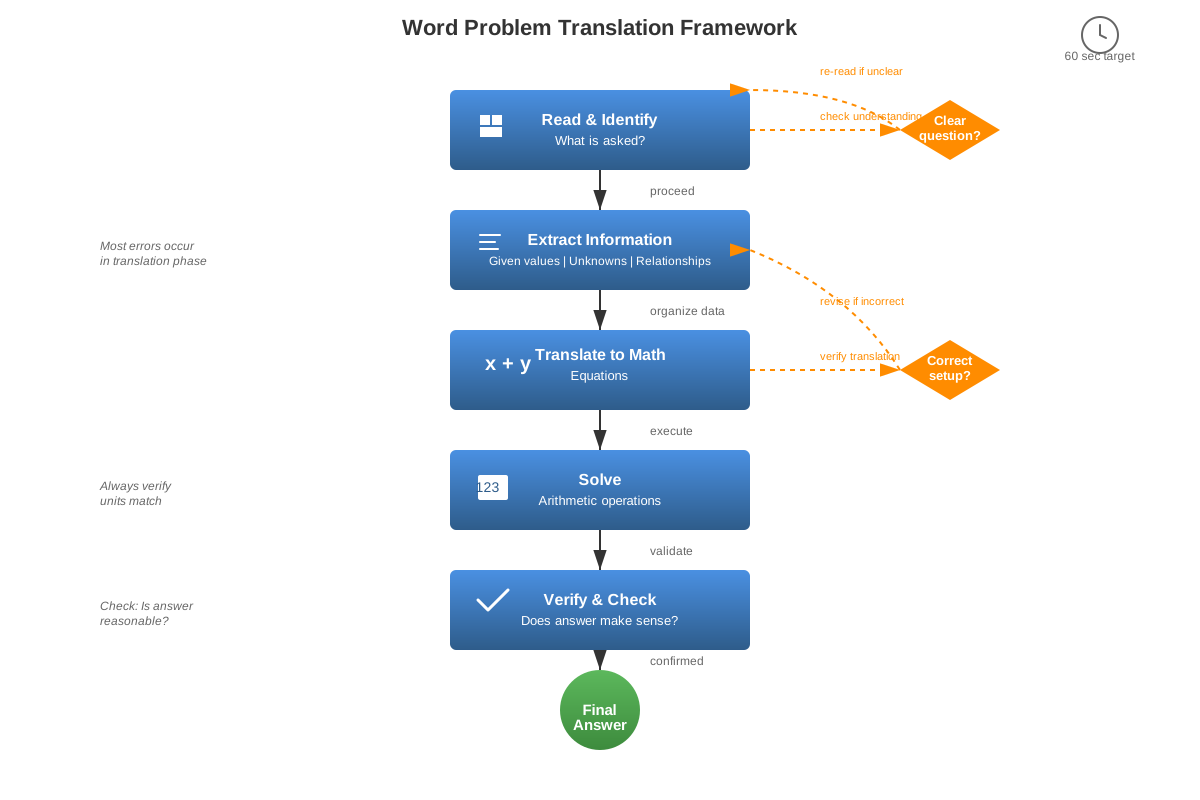
The Four-Step Solution Framework
- Read and Understand: Read the entire problem carefully, identifying what is being asked. Underline or note the specific question.
- Identify and Organize: List known quantities, unknown quantities, and relationships. Decide what to represent with variables if needed.
- Set Up and Solve: Translate the word problem into mathematical form and solve using appropriate arithmetic operations.
- Verify and Check: Ensure your answer makes logical sense in the original context and matches what the question asked for (not an intermediate value).
Working with Constraints and Conditions
Many GRE arithmetic word problems include constraints—conditions that limit possible solutions. For example: "The number of students is between 20 and 30" or "The total cost cannot exceed $500." These constraints help narrow solution spaces and often provide checking mechanisms. When a problem includes multiple constraints, list them explicitly and verify that your final answer satisfies all conditions.
Multi-Step Problems
Complex arithmetic word problems require multiple operations in sequence. The key is breaking them into manageable steps:
- Solve for intermediate values first
- Use those values in subsequent calculations
- Keep track of units throughout
- Ensure each step answers a clear sub-question
For example, if a problem asks for total profit after expenses and taxes, you might need to: (1) calculate revenue, (2) subtract expenses to find gross profit, (3) calculate tax on that profit, (4) subtract tax to find net profit.
Concept Relationships
The translation process serves as the foundation for all other concepts in arithmetic word problems. Once information is translated into mathematical form, the specific problem category (age, money, consecutive integers, etc.) determines which arithmetic operations and relationships apply. The four-step solution framework provides the procedural structure that encompasses both translation and category-specific strategies.
Constraints and conditions interact with the translation process by adding inequalities or additional equations to the problem setup. Multi-step problems represent the integration of all other concepts: they require translation, category recognition, systematic solving, and constraint checking across multiple linked calculations.
This topic connects to prerequisite knowledge by applying basic arithmetic operations within structured problem contexts. It leads forward to algebra word problems (where variables become more abstract), rate-time-distance problems (a specialized category), work problems (involving combined rates), and data interpretation (where word problem reasoning applies to graphs and tables).
Relationship Map:
Translation Process → Problem Category Recognition → Four-Step Framework Application → Constraint Verification → Solution. Simultaneously, Multi-Step Problems integrate all components: Translation → Step 1 Solution → Step 2 Translation → Step 2 Solution → Final Answer Verification.
High-Yield Facts
⭐ The question asked is not always the final calculation—read carefully to ensure you're answering what's actually requested, not just solving for the first variable you find.
⭐ "Less than" reverses order: "5 less than x" translates to x − 5, not 5 − x. This reversal is one of the most common translation errors.
⭐ "Of" typically means multiplication: "20% of 50" means 0.20 × 50. This applies to fractions and percentages.
⭐ Everyone ages at the same rate: In age problems, the age difference between two people remains constant over time.
⭐ Units must be consistent: If a rate is given in miles per hour and time in minutes, convert to matching units before calculating.
- Consecutive integers sum formula: For n consecutive integers starting at a, the sum is n × (first + last)/2.
- When a problem mentions "average," remember: Average = Sum/Count, which can be rearranged to Sum = Average × Count.
- In money problems, always distinguish between unit price and total cost—mixing these is a common error.
- Simple interest is calculated only on the principal, not on accumulated interest (unlike compound interest).
- If a problem seems to have insufficient information, look for implicit relationships or standard assumptions (e.g., a "dozen" means 12).
Quick check — test yourself on Arithmetic word problems so far.
Try Flashcards →Common Misconceptions
Misconception: "Less than" and "subtracted from" mean the same thing in translation.
Correction: These phrases have opposite orders. "5 less than x" is x − 5, while "x subtracted from 5" is 5 − x. Always pay attention to which quantity comes first in the English phrase.
Misconception: The first number you calculate is always the answer to the question.
Correction: Many GRE word problems require multiple steps, and the question may ask for a value that requires additional calculation beyond the first variable you solve for. Always reread the question after solving to confirm you're providing the requested value.
Misconception: All information provided in a word problem is necessary for the solution.
Correction: The GRE sometimes includes extraneous information to test whether you can identify relevant data. Not every number mentioned needs to be used in your calculation.
Misconception: Word problems always require setting up equations with variables.
Correction: Many arithmetic word problems can be solved more efficiently using logical reasoning or working backwards from answer choices, especially on multiple-choice questions. Don't default to algebraic setup if a more direct arithmetic approach exists.
Misconception: If the math works out, the answer must be correct.
Correction: An answer can be mathematically correct but contextually wrong (e.g., negative people, fractional items when only whole numbers make sense). Always verify that your answer makes logical sense in the real-world context of the problem.
Worked Examples
Example 1: Multi-Step Money Problem
Problem: A store sells notebooks for $3 each and pens for $2 each. If Sarah buys a total of 12 items (notebooks and pens) and spends exactly $31, how many notebooks did she buy?
Solution:
Step 1 - Read and Understand: We need to find the number of notebooks. We know total items = 12, total cost = $31, notebook price = $3, pen price = $2.
Step 2 - Identify and Organize:
- Let n = number of notebooks
- Then (12 − n) = number of pens (since total items = 12)
- Cost equation: 3n + 2(12 − n) = 31
Step 3 - Set Up and Solve:
3n + 2(12 − n) = 31
3n + 24 − 2n = 31
n + 24 = 31
n = 7
Step 4 - Verify and Check:
- Notebooks: 7 at $3 each = $21
- Pens: 5 at $2 each = $10
- Total: $21 + $10 = $31 ✓
- Total items: 7 + 5 = 12 ✓
Answer: Sarah bought 7 notebooks.
Connection to Learning Objectives: This problem demonstrates translation (converting the scenario into equations), identification (recognizing this as a system with two unknowns but one equation), and application (solving systematically and verifying the answer makes sense).
Example 2: Age Problem with Time Shift
Problem: John is currently twice as old as his sister Mary. In 6 years, John will be 1.5 times as old as Mary. How old is John now?
Solution:
Step 1 - Read and Understand: We need John's current age. We have two time periods (now and in 6 years) with different age relationships.
Step 2 - Identify and Organize:
Create a table:
| Person | Now | In 6 Years |
|---|---|---|
| John | 2M | 2M + 6 |
| Mary | M | M + 6 |
Where M = Mary's current age.
Step 3 - Set Up and Solve:
The relationship in 6 years: John's age = 1.5 × Mary's age
2M + 6 = 1.5(M + 6)
2M + 6 = 1.5M + 9
2M − 1.5M = 9 − 6
0.5M = 3
M = 6
Therefore, John's current age = 2M = 2(6) = 12
Step 4 - Verify and Check:
- Now: John is 12, Mary is 6. John is twice Mary's age. ✓
- In 6 years: John is 18, Mary is 12. 18 = 1.5 × 12. ✓
Answer: John is currently 12 years old.
Connection to Learning Objectives: This demonstrates the core strategy for age problems (using tables to organize information across time periods), shows how to translate "twice as old" and "1.5 times as old" into equations, and illustrates the importance of verification using both given conditions.
Exam Strategy
When approaching GRE arithmetic word problems, begin by reading the question stem first (the actual question being asked) before reading the setup. This focuses your attention on relevant information as you read through the problem. Underline or mentally note the specific quantity requested—this prevents the common error of solving for the wrong variable.
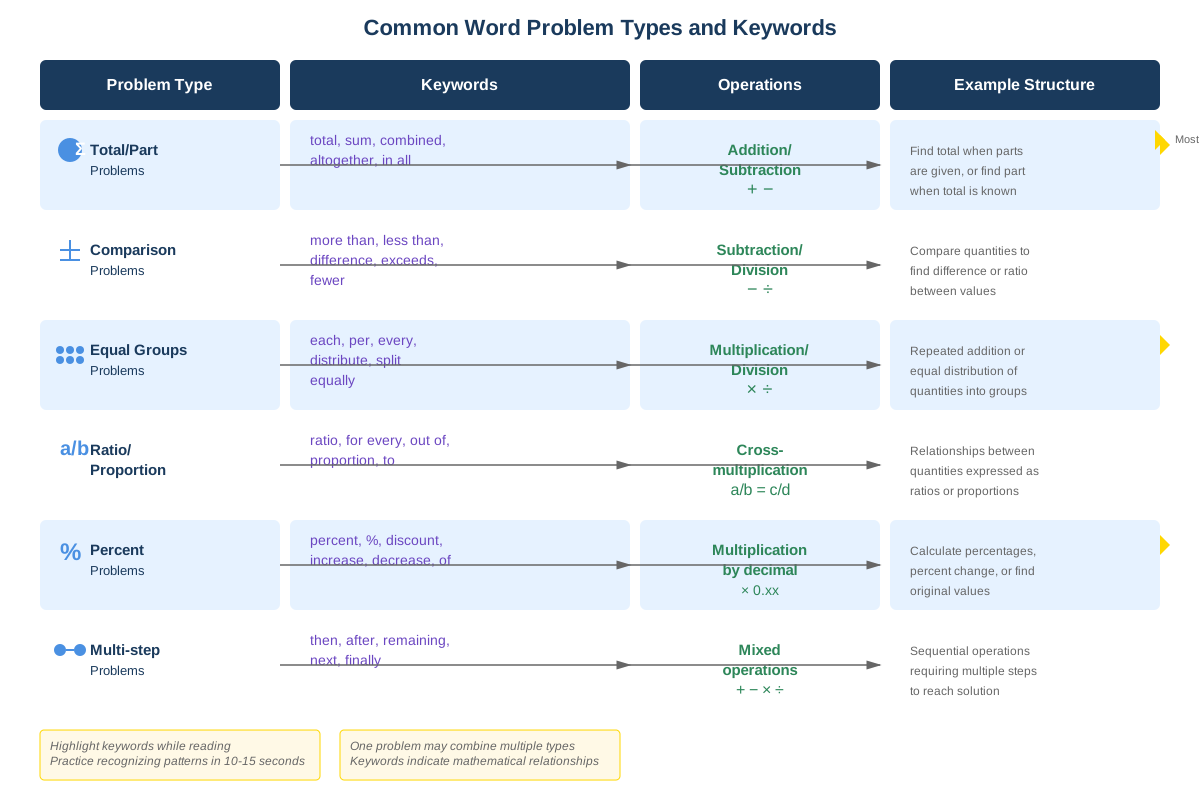
Trigger words to watch for:
- "At least," "at most," "no more than," "no less than" → indicate inequalities or constraints
- "Ratio," "proportion," "per" → suggest setting up fractional relationships
- "Total," "combined," "altogether" → indicate addition or summation
- "Remaining," "left over," "difference" → suggest subtraction
- "Each," "per," "apiece" → indicate multiplication or division
Process-of-elimination strategies:
- Eliminate answers that are contextually impossible (negative ages, fractional people when only whole numbers make sense)
- Use estimation to eliminate answers that are too large or too small
- For multiple-choice questions, consider working backwards from answer choices, especially when the problem involves finding a specific value that satisfies conditions
- Check units—eliminate answers with incorrect units or unreasonable magnitudes
Time allocation: Spend no more than 1.5-2 minutes on arithmetic word problems. If you haven't made progress after 1 minute, either guess strategically and move on, or try working backwards from answer choices. The translation and setup should take 30-45 seconds, solving 30-60 seconds, and verification 15-30 seconds.
Strategic approaches:
- For problems with multiple constraints, list all constraints explicitly and check each one
- When stuck, try plugging in simple numbers or using the answer choices
- If a problem involves percentages or fractions, consider choosing a convenient number (like 100) to make calculations easier
- Draw simple diagrams or tables for problems involving multiple people, items, or time periods
Memory Techniques
TRANSLATE mnemonic for the solution process:
- Thoroughly read the problem
- Recognize what's being asked
- Assign variables if needed
- Note all given information
- Set up equations or expressions
- Logically solve step-by-step
- Answer the actual question
- Test your answer for reasonableness
- Eliminate calculation errors
"LESS FLIPS": Remember that "less than" flips the order—"5 less than x" is x − 5, not 5 − x.
"OF = TIMES": Whenever you see "of" in a percentage or fraction context, replace it mentally with multiplication: "30% of 80" becomes "30% × 80."
Age Problem Visualization: Picture a timeline with "Now" in the middle, "Past" to the left, and "Future" to the right. The distance between any two people's ages stays constant as you move along the timeline.
The "Does This Make Sense?" Check: Before finalizing any answer, ask yourself: "Could this actually happen in real life?" This catches errors like negative quantities, impossibly large numbers, or fractional items that should be whole.
Summary
Arithmetic word problems on the GRE test the ability to translate real-world scenarios into mathematical expressions and solve them using basic operations. Success requires a systematic approach: carefully reading to identify what's being asked, organizing known and unknown information, translating words into mathematical relationships, solving step-by-step, and verifying that answers make contextual sense. The most common problem types include age relationships, money and pricing scenarios, consecutive integers, and simple interest calculations. The key to mastery is recognizing that these problems test reasoning and translation skills rather than computational complexity—the mathematics itself is straightforward, but the setup requires careful attention to language, relationships, and constraints. By applying the four-step framework consistently and watching for common trigger words, test-takers can efficiently and accurately solve these high-frequency GRE questions.
Key Takeaways
- Arithmetic word problems appear in 20-30% of GRE Quantitative questions, making them one of the highest-yield topics for focused study
- The primary challenge is translation—converting English descriptions into mathematical expressions—not the arithmetic itself
- Always identify what the question actually asks for before solving; many problems require multiple steps and ask for a value other than the first variable you calculate
- "Less than" reverses order (x − 5, not 5 − x), and "of" typically means multiplication in percentage and fraction contexts
- Verification is essential: check that your answer makes logical sense in the real-world context and satisfies all stated constraints
- Use tables or simple diagrams to organize information in problems involving multiple people, time periods, or categories
- Strategic guessing and working backwards from answer choices are valuable time-saving techniques when direct solving becomes complicated
Related Topics
Algebra Word Problems: Building on arithmetic word problems, these involve more abstract relationships and require setting up and solving equations with multiple variables. Mastering arithmetic word problems provides the translation foundation needed for algebraic scenarios.
Rate, Time, and Distance Problems: A specialized category of word problems using the relationship Distance = Rate × Time. The translation and setup skills from arithmetic word problems transfer directly to these more specific applications.
Work Problems: These involve combined rates (e.g., two people working together) and build on the proportional reasoning developed through arithmetic word problems.
Ratio and Proportion Problems: While ratios appear in arithmetic word problems, dedicated ratio problems involve more complex part-to-whole relationships and scaling, extending the foundational concepts covered here.
Data Interpretation: Word problem reasoning applies when extracting information from graphs and tables, making arithmetic word problems excellent preparation for this question type.
Practice CTA
Now that you've mastered the core concepts and strategies for arithmetic word problems, it's time to put your knowledge into action! Attempt the practice questions to reinforce your translation skills and solution framework. Work through the flashcards to internalize key trigger words and common problem patterns. Remember: arithmetic word problems reward systematic thinking and careful reading more than computational speed. Each practice problem you solve strengthens your pattern recognition and builds the confidence you need to tackle these high-frequency GRE questions efficiently. You've got this!
Sign up free to keep reading
Create a free AnvayaPrep account to finish this GRE guide on Arithmetic word problems — plus flashcards and practice questions.