Overview
Combinations represent one of the most frequently tested counting principles on the GRE Quantitative Reasoning section. At its core, combinations answer the question: "In how many ways can we select a group of items when the order of selection does not matter?" This concept differs fundamentally from permutations, where order is significant. Understanding when and how to apply combinations is essential for success on the GRE, as these problems appear regularly in both discrete quantitative comparison questions and problem-solving formats.
The GRE tests combinations in various contexts: selecting committee members from a larger group, choosing toppings for a meal, forming teams, or determining possible outcomes in probability scenarios. What makes gre combinations particularly challenging is that test-makers often disguise these problems within word problems that require careful analysis to identify the underlying counting structure. Students must recognize the key signal that order doesn't matter—whether you select person A then person B, or person B then person A, you've formed the same group.
Within the broader Data Analysis unit, combinations connect directly to probability calculations, set theory, and basic counting principles. Mastering combinations provides the foundation for understanding more complex probability scenarios and enhances overall quantitative reasoning skills. The mathematical elegance of combinations—expressed through the combination formula—allows test-takers to solve seemingly complex problems efficiently, often in under two minutes when the proper framework is applied.
Learning Objectives
- [ ] Identify when Combinations is being tested
- [ ] Explain the core rule or strategy behind Combinations
- [ ] Apply Combinations to GRE-style questions accurately
- [ ] Distinguish between situations requiring combinations versus permutations
- [ ] Calculate combinations using both the formula and logical reasoning methods
- [ ] Solve multi-step problems involving combinations with constraints
- [ ] Recognize and avoid common calculation errors in combination problems
Prerequisites
- Basic factorial notation: Understanding that n! = n × (n-1) × (n-2) × ... × 1 is essential for applying the combination formula
- Fundamental counting principle: Knowing how to multiply sequential choices provides the foundation for understanding why the combination formula works
- Basic algebra and fraction simplification: Combinations require simplifying expressions with factorials, demanding comfort with algebraic manipulation
- Permutations concept: While not strictly required, understanding permutations helps clarify when order matters versus when it doesn't
Why This Topic Matters
Combinations appear in approximately 10-15% of GRE Quantitative Reasoning questions, making them a high-yield topic for focused study. These problems frequently appear as medium to hard difficulty questions, offering opportunities to distinguish oneself in the competitive 160+ score range. The GRE tests combinations both directly (asking explicitly for the number of ways to select items) and indirectly (embedding combination logic within probability or data interpretation questions).
In real-world applications, combinations underpin decision-making in fields ranging from business (portfolio selection, team formation) to medicine (treatment combination protocols) to technology (network configurations, feature selection). Understanding combinations develops logical thinking skills that extend far beyond test-taking, enabling systematic analysis of choices and possibilities.
On the GRE, combinations typically appear in several formats: quantitative comparison questions asking students to compare two different selection scenarios, multiple-choice problem-solving questions requiring calculation of specific values, and data interpretation sets where combinations inform probability calculations. The topic also frequently appears in "select all that apply" questions, where understanding combinations helps determine how many valid answer combinations exist.
Core Concepts
The Fundamental Definition of Combinations
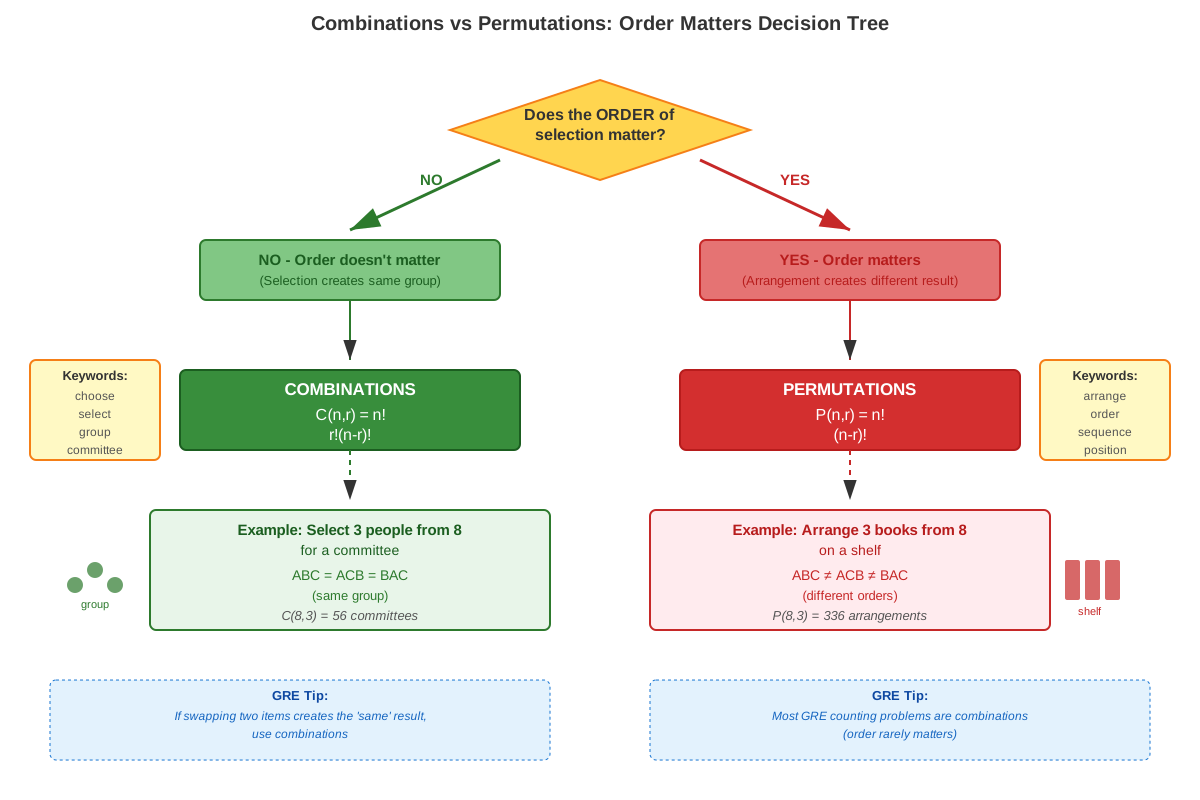
Combinations refer to the number of ways to select r items from a set of n distinct items when the order of selection does not matter. The key distinguishing feature is order-independence: selecting items {A, B, C} is identical to selecting {C, A, B} or any other arrangement of these three items. This contrasts sharply with permutations, where ABC differs from CAB.
The mathematical notation for combinations is C(n,r), often written as nCr or using the binomial coefficient notation:
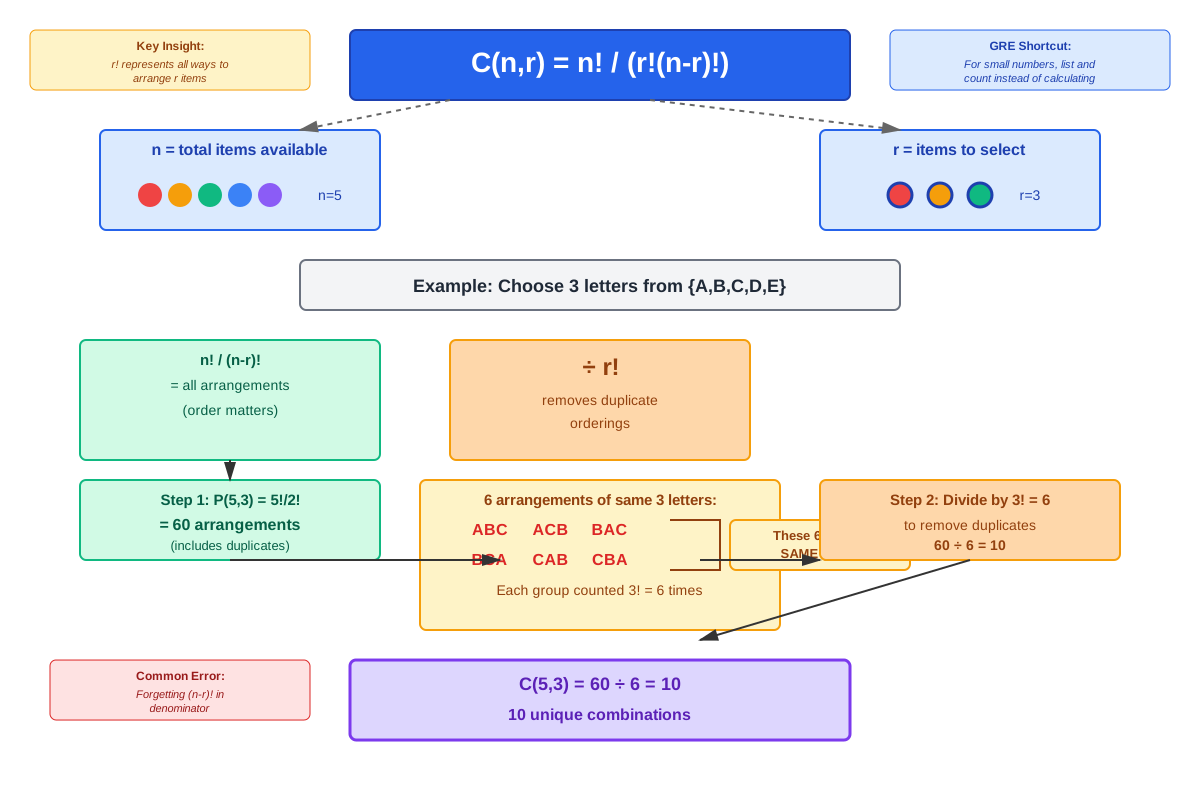
C(n,r) = (n choose r) = n! / (r!(n-r)!)Where:
- n = total number of items available
- r = number of items being selected
- ! denotes factorial (the product of all positive integers up to that number)
The Combination Formula Explained
The combination formula derives from a logical process. If we wanted to count arrangements (permutations), we would calculate n!/(n-r)!. However, since order doesn't matter in combinations, we must divide by r! to account for all the duplicate arrangements of the r selected items.
For example, when selecting 2 people from {A, B, C}:
- Permutations would count: AB, BA, AC, CA, BC, CB (6 arrangements)
- Combinations count: {A,B}, {A,C}, {B,C} (3 groups)
- Notice that 6 ÷ 2! = 6 ÷ 2 = 3
Calculating Combinations Efficiently
For GRE purposes, three calculation methods prove valuable:
Method 1: Direct Formula Application
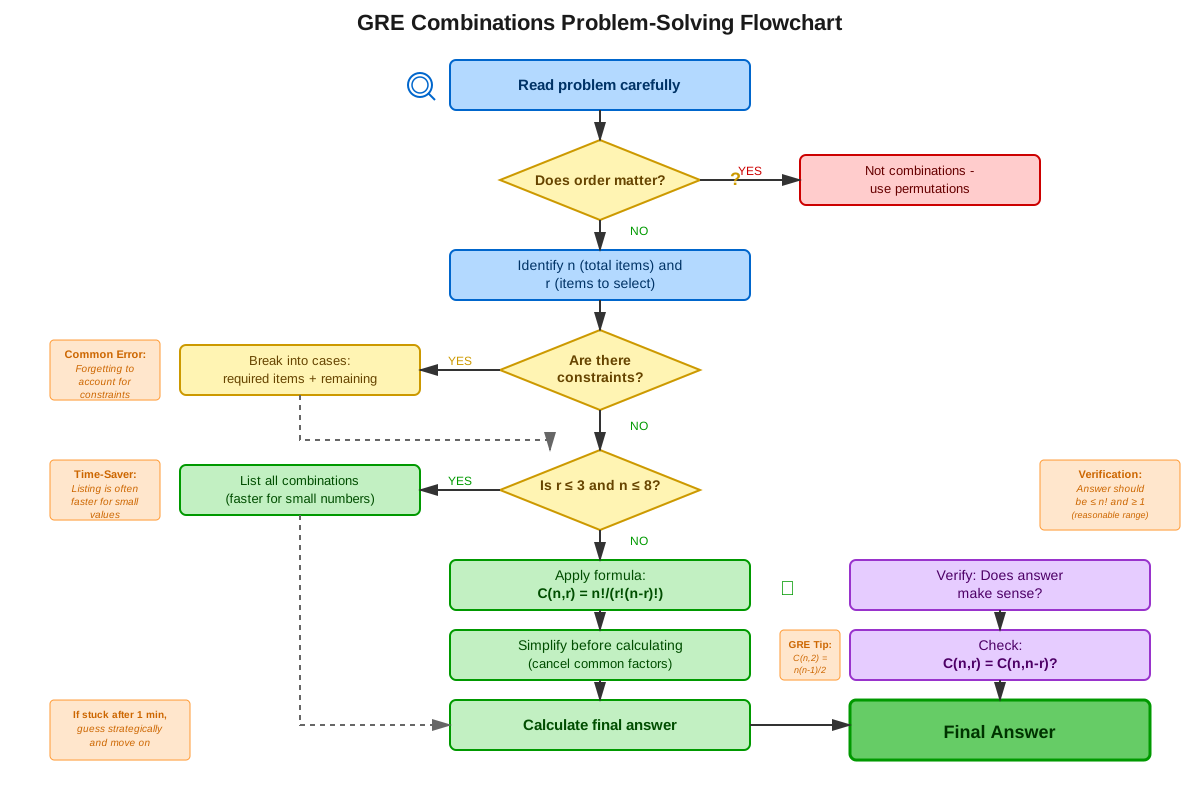
Apply C(n,r) = n!/(r!(n-r)!) directly, but simplify before calculating:
C(8,3) = 8!/(3!×5!) = (8×7×6)/(3×2×1) = 336/6 = 56Notice how we cancel the 5! in numerator and denominator before multiplying.
Method 2: Complementary Counting
Use the property C(n,r) = C(n,n-r). When r is large, calculate using n-r instead:
C(10,8) = C(10,2) = (10×9)/(2×1) = 45This saves significant calculation time.
Method 3: Small Number Enumeration
For very small values, listing all possibilities may be faster than formula application, particularly when n ≤ 5.
Special Cases and Properties
Several special cases appear frequently on the GRE:
| Case | Formula | Value | Interpretation |
|---|---|---|---|
| C(n,0) | n!/0!n! | 1 | One way to select nothing |
| C(n,1) | n!/1!(n-1)! | n | n ways to select one item |
| C(n,n) | n!/n!0! | 1 | One way to select everything |
| C(n,n-1) | n!/(n-1)!1! | n | n ways to leave out one item |
Combinations with Constraints
Many GRE problems add constraints that require multi-step reasoning:
Type 1: "At least" or "At most" constraints
These often require calculating multiple scenarios and adding results, or using complementary counting (total minus unwanted cases).
Type 2: Grouping constraints
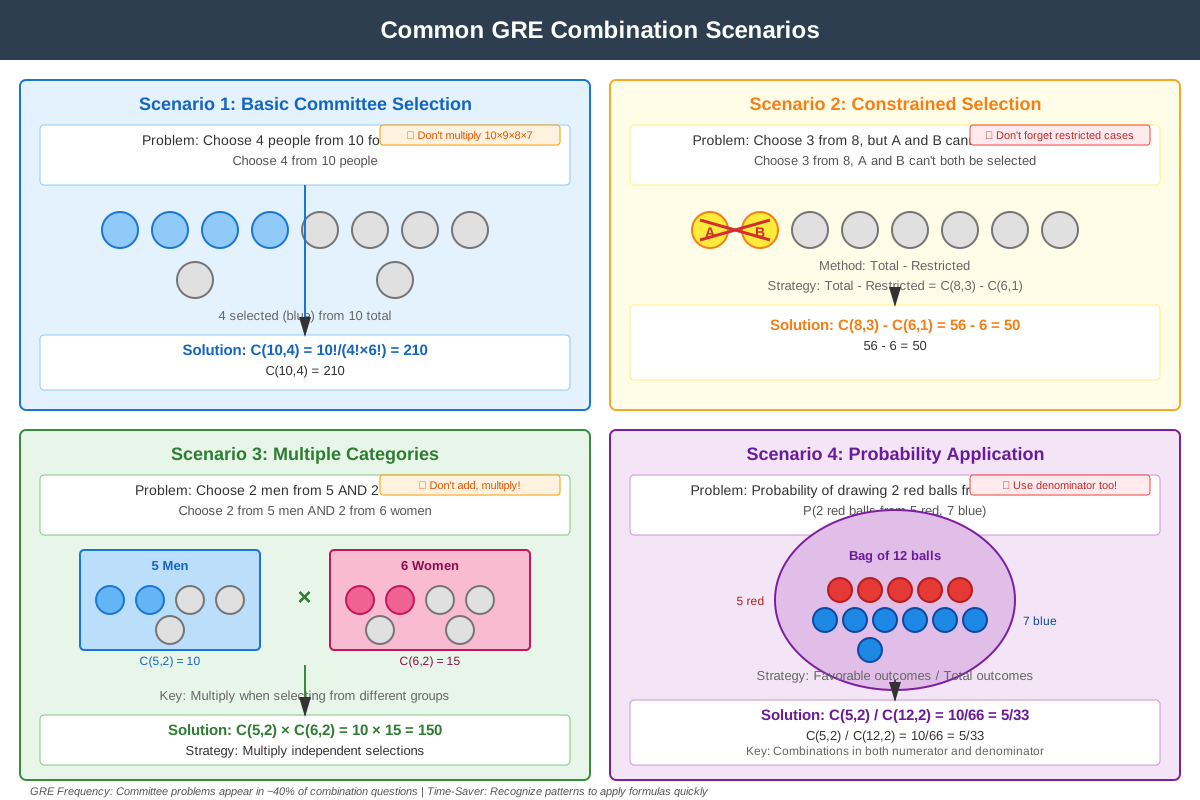
When items must be selected from distinct categories (e.g., "select 2 men and 3 women from a group of 5 men and 6 women"), multiply the combinations from each category:
C(5,2) × C(6,3)
Type 3: Exclusion constraints
When certain items cannot be selected together, calculate total combinations minus forbidden combinations.
Distinguishing Combinations from Permutations
The critical decision point in any counting problem is determining whether order matters:
Order MATTERS (use permutations):
- Arranging people in a line
- Assigning people to distinct positions
- Creating passwords or codes
- Race finishing positions
Order DOESN'T MATTER (use combinations):
- Selecting committee members
- Choosing pizza toppings
- Forming teams (when positions aren't assigned)
- Selecting cards from a deck
GRE Tip: If you can swap two items and the outcome remains fundamentally the same, use combinations.
Concept Relationships
The relationship between concepts within combinations follows a logical hierarchy:
Fundamental Counting Principle → provides the basis for → Factorial Notation → which enables → Permutation Formula → which when adjusted for order-independence yields → Combination Formula → which applies to → Selection Problems → which may involve → Constraints and Multi-step Reasoning
Combinations connect to prerequisite topics through factorial notation, which students must understand to apply the formula correctly. The fundamental counting principle (multiply the number of choices at each step) underlies why we divide by r! in the combination formula—we're removing the r! ways to arrange the selected items.
Looking forward, combinations enable more advanced topics including:
- Probability calculations: Many probability problems require combinations to count favorable outcomes
- Binomial probability: The binomial coefficient is literally the combination formula
- Set theory: Combinations help count subsets and power sets
- Pascal's Triangle: Each entry represents C(n,r) for specific values
The relationship between combinations and permutations is particularly important: Permutations = Combinations × r!, meaning every combination corresponds to r! different permutations.
Quick check — test yourself on Combinations so far.
Try Flashcards →High-Yield Facts
⭐ The combination formula is C(n,r) = n!/(r!(n-r)!), where n is the total items and r is the number selected
⭐ Order does not matter in combinations: selecting {A,B,C} is the same as selecting {C,B,A}
⭐ C(n,r) = C(n,n-r), allowing you to calculate using the smaller number for efficiency
⭐ When selecting from multiple distinct groups, multiply the combinations: C(n₁,r₁) × C(n₂,r₂)
⭐ C(n,0) = C(n,n) = 1 for any value of n
- C(n,1) = n and C(n,n-1) = n for any value of n
- The sum of all possible combinations from a set of n items equals 2ⁿ (the power set)
- When calculating by hand, cancel common factorial terms before multiplying to simplify computation
- "At least one" problems often solve more easily using complementary counting: Total - None
- Combinations appear in the binomial expansion coefficient for (a+b)ⁿ
- If a problem mentions "committee," "team," "group," or "selection," combinations are likely involved
- The number of handshakes among n people equals C(n,2) = n(n-1)/2
- Combinations with replacement follow a different formula: C(n+r-1,r)
Common Misconceptions
Misconception: The combination formula is n!/r! → Correction: The correct formula is n!/(r!(n-r)!). Students often forget to divide by (n-r)! as well, which leads to calculating permutations instead of combinations.
Misconception: C(10,3) and C(10,7) require different amounts of calculation → Correction: These are equal by the complementary property C(n,r) = C(n,n-r). Always calculate using the smaller number to save time: C(10,3) = C(10,7) = 120.
Misconception: When selecting 3 people from 5 men and 4 women, the answer is C(9,3) → Correction: This is only correct if there are no gender-specific constraints. If the problem specifies "2 men and 1 woman," the answer is C(5,2) × C(4,1) = 10 × 4 = 40.
Misconception: Selecting items with replacement uses the same formula as without replacement → Correction: Standard combinations assume selection without replacement. With replacement, use the formula C(n+r-1,r), which is significantly different.
Misconception: In "at least" problems, you must calculate every scenario separately → Correction: Often complementary counting is faster. For "at least one," calculate: Total combinations - C(n,0) = Total - 1.
Misconception: 0! equals 0 → Correction: By mathematical definition, 0! = 1. This is essential for evaluating C(n,0) and C(n,n) correctly.
Misconception: Combinations and permutations can be used interchangeably if you adjust the final answer → Correction: You must identify the correct approach from the start. Using the wrong formula leads to incorrect problem setup, especially in multi-step problems.
Worked Examples
Example 1: Basic Committee Selection
Problem: A company needs to form a 3-person committee from 8 employees. How many different committees can be formed?
Solution:
Step 1: Identify that this is a combination problem
The key phrase "form a committee" indicates that order doesn't matter. Selecting employees A, B, and C creates the same committee as selecting C, A, and B.
Step 2: Identify n and r
- n = 8 (total employees)
- r = 3 (committee size)
Step 3: Apply the combination formula
C(8,3) = 8!/(3!(8-3)!) = 8!/(3!×5!)Step 4: Simplify before calculating
C(8,3) = (8×7×6×5!)/(3!×5!) = (8×7×6)/(3×2×1) = 336/6 = 56Answer: 56 different committees can be formed.
Connection to Learning Objectives: This example demonstrates identifying when combinations is being tested (committee formation with no order), explaining the core strategy (using the formula with proper simplification), and applying it accurately to reach the correct answer.
Example 2: Combinations with Constraints
Problem: A restaurant offers 10 different toppings for pizza. A customer wants to order a pizza with exactly 4 toppings, but refuses to have both mushrooms and olives on the same pizza. How many different 4-topping combinations are possible?
Solution:
Step 1: Recognize the constraint
This is a combination problem with an exclusion constraint. We cannot simply calculate C(10,4) because some of those combinations would include both mushrooms and olives.
Step 2: Use complementary counting
Total valid combinations = All possible 4-topping combinations - Combinations with both mushrooms and olives
Step 3: Calculate all possible combinations
C(10,4) = 10!/(4!×6!) = (10×9×8×7)/(4×3×2×1) = 5040/24 = 210Step 4: Calculate forbidden combinations
If both mushrooms and olives must be included, we need to select 2 more toppings from the remaining 8:
C(8,2) = (8×7)/(2×1) = 56/2 = 28Step 5: Subtract to find valid combinations
Valid combinations = 210 - 28 = 182
Answer: 182 different 4-topping combinations are possible.
Connection to Learning Objectives: This example shows how to apply combinations to GRE-style questions with constraints, demonstrating multi-step problem-solving and the complementary counting strategy that frequently appears on the exam.
Exam Strategy
Identifying Combination Problems on the GRE
Watch for these trigger words and phrases:
- "Select," "choose," "pick"
- "Committee," "team," "group"
- "Combination" (obviously)
- "How many ways" when order is irrelevant
- "How many different groups"
Immediate Decision Framework
When encountering a counting problem, ask: "If I swap two items, does it create a different outcome?" If no, use combinations. If yes, use permutations.
Time-Saving Calculation Strategies
- Always use the complementary property: If calculating C(20,17), immediately convert to C(20,3)
- Cancel before multiplying: Write out the factorial expansion and cancel common terms
- Recognize common values: Memorize C(n,2) = n(n-1)/2 and C(n,3) = n(n-1)(n-2)/6
- For small numbers, enumerate: If n ≤ 5, listing possibilities may be faster than formula application
Process of Elimination Tips
- Eliminate answers that exceed the total number of permutations (combinations must be ≤ permutations)
- If the problem involves selecting from multiple groups, the answer often involves multiplication
- For "at least" problems, answers are typically close to but less than the total possible combinations
- Answers that equal simple factorials (like 24, 120, 720) often indicate a permutation problem, not combinations
Time Allocation
Allocate 1.5-2 minutes for straightforward combination problems and up to 2.5 minutes for problems with multiple constraints. If a problem requires more than three distinct calculations, consider whether there's a simpler approach using complementary counting.
Critical GRE Strategy: On quantitative comparison questions involving combinations, often you can determine the relationship without calculating exact values by comparing the structure of the formulas.
Memory Techniques
The "nCr" Mnemonic: No Care about oRder
This reminds you that combinations are used when you don't care about the order of selection.
The Formula Memory Device: "Numerator Full, Denominator Divided"
- Numerator gets the Full factorial expansion from n down to (n-r+1)
- Denominator gets Divided into two parts: r! and (n-r)!
The "Committee" Visualization
Whenever you see a combination problem, visualize people sitting around a circular table. No matter what order they sat down, once they're seated, it's the same committee. This reinforces that order doesn't matter.
The Complementary Counting Acronym: "BEST"
- Big number? Use the complement
- Evaluate n-r
- Smaller calculation saves time
- They're equal: C(n,r) = C(n,n-r)
Special Values Rhyme
"Zero or all, the answer is one; selecting just one, the answer is n"
This helps remember C(n,0) = C(n,n) = 1 and C(n,1) = n
Summary
Combinations represent a fundamental counting principle essential for GRE success, appearing in 10-15% of Quantitative Reasoning questions. The core concept is straightforward: combinations count the number of ways to select r items from n total items when order doesn't matter. The formula C(n,r) = n!/(r!(n-r)!) provides the mathematical framework, but successful application requires recognizing when to use combinations versus permutations, efficiently simplifying calculations, and handling constraints through multi-step reasoning. The complementary property C(n,r) = C(n,n-r) offers significant time savings on the exam. Most GRE combination problems involve either direct application of the formula, selection from multiple distinct groups (requiring multiplication of separate combinations), or constraint-based problems solved through complementary counting. Mastering combinations requires both conceptual understanding—knowing why order doesn't matter—and computational fluency with factorial manipulation. The ability to quickly identify combination problems through trigger words like "committee," "select," and "group," combined with efficient calculation strategies, enables test-takers to solve these high-yield problems accurately within the GRE's time constraints.
Key Takeaways
- Combinations apply when selecting items where order doesn't matter; if swapping two items creates the same outcome, use combinations
- The formula C(n,r) = n!/(r!(n-r)!) must be simplified by canceling common factorial terms before calculating
- Always use the complementary property C(n,r) = C(n,n-r) to minimize calculation when r > n/2
- Problems involving selection from multiple distinct groups require multiplying separate combinations: C(n₁,r₁) × C(n₂,r₂)
- Constraint problems often solve most efficiently using complementary counting: Total combinations minus forbidden combinations
- Memorize special cases: C(n,0) = C(n,n) = 1, C(n,1) = C(n,n-1) = n, and C(n,2) = n(n-1)/2
- Trigger words like "committee," "team," "select," and "choose" typically indicate combination problems on the GRE
Related Topics
Permutations: Understanding permutations deepens combination mastery by clarifying when order matters. The relationship Permutations = Combinations × r! connects these concepts mathematically.
Probability: Many probability problems require combinations to count favorable outcomes. Mastering combinations enables calculation of probabilities in card games, lottery scenarios, and selection problems.
Binomial Theorem: The coefficients in binomial expansions are combination values. Understanding C(n,r) provides the foundation for working with expressions like (a+b)ⁿ.
Pascal's Triangle: Each entry in Pascal's Triangle represents C(n,r) for specific values, offering a visual representation of combination relationships and patterns.
Set Theory and Subsets: Combinations count the number of r-element subsets of an n-element set, connecting counting principles to formal set theory.
Practice CTA
Now that you've mastered the core concepts of combinations, it's time to solidify your understanding through practice. Attempt the practice questions to test your ability to identify combination problems, apply the formula efficiently, and handle constraint-based scenarios. The flashcards will help you memorize key formulas and special cases for rapid recall during the exam. Remember: combinations appear frequently on the GRE, and consistent practice with these high-yield problems will significantly boost your Quantitative Reasoning score. Each problem you solve strengthens your pattern recognition and calculation speed—skills that translate directly to test-day success!
Sign up free to keep reading
Create a free AnvayaPrep account to finish this GRE guide on Combinations — plus flashcards and practice questions.