Overview
Expected value basics is a fundamental concept in probability and statistics that measures the average outcome one can anticipate from a random event or decision over the long run. On the GRE, this topic appears regularly in the Quantitative Reasoning section, particularly within Data Analysis questions. Understanding expected value allows test-takers to evaluate scenarios involving uncertainty, make predictions about probabilistic outcomes, and solve problems involving games of chance, investment decisions, and risk assessment.
The concept of GRE expected value basics bridges several mathematical domains. It combines probability theory with arithmetic operations, requiring students to multiply outcomes by their respective probabilities and sum the results. This topic is essential because it appears not only as standalone calculation problems but also embedded within word problems, data interpretation questions, and comparison questions that are signature formats of the GRE Quantitative section.
Mastering expected value basics provides a foundation for more advanced statistical concepts and demonstrates quantitative reasoning skills that the GRE specifically targets. Questions on this topic test whether students can identify relevant information, perform multi-step calculations accurately, and interpret results in context. The ability to quickly recognize when expected value is being tested and apply the appropriate formula can significantly improve both accuracy and time management during the exam.
Learning Objectives
- [ ] Identify when Expected value basics is being tested
- [ ] Explain the core rule or strategy behind Expected value basics
- [ ] Apply Expected value basics to GRE-style questions accurately
- [ ] Calculate expected values for discrete probability distributions with multiple outcomes
- [ ] Compare expected values to determine optimal decisions in probabilistic scenarios
- [ ] Interpret expected value results in real-world contexts and word problems
Prerequisites
- Basic probability concepts: Understanding how to calculate simple probabilities is essential since expected value requires multiplying each outcome by its probability
- Fraction and decimal operations: Expected value calculations frequently involve multiplying and adding fractions or decimals with precision
- Weighted averages: Expected value is conceptually similar to a weighted average where probabilities serve as weights
- Basic algebra: Solving for unknown values in expected value equations requires algebraic manipulation
Why This Topic Matters
Expected value has profound real-world applications across finance, insurance, game theory, business decision-making, and risk management. Insurance companies use expected value to set premiums, investors use it to evaluate potential returns, and businesses use it to make decisions under uncertainty. Understanding this concept enables rational decision-making when outcomes are uncertain but probabilities can be estimated.
On the GRE, expected value questions appear with moderate to high frequency, typically 1-2 questions per exam. These questions most commonly appear as:
- Problem Solving questions requiring direct calculation of expected value
- Quantitative Comparison questions asking students to compare expected values of different scenarios
- Data Interpretation questions where expected value must be calculated from tables or graphs
- Word problems involving games, investments, or probabilistic scenarios
The GRE favors expected value questions because they efficiently test multiple skills simultaneously: probability understanding, arithmetic accuracy, logical reasoning, and the ability to translate word problems into mathematical expressions. Questions often involve realistic scenarios like lottery tickets, game outcomes, investment returns, or quality control situations, making them excellent assessments of practical quantitative reasoning.
Core Concepts
Definition of Expected Value
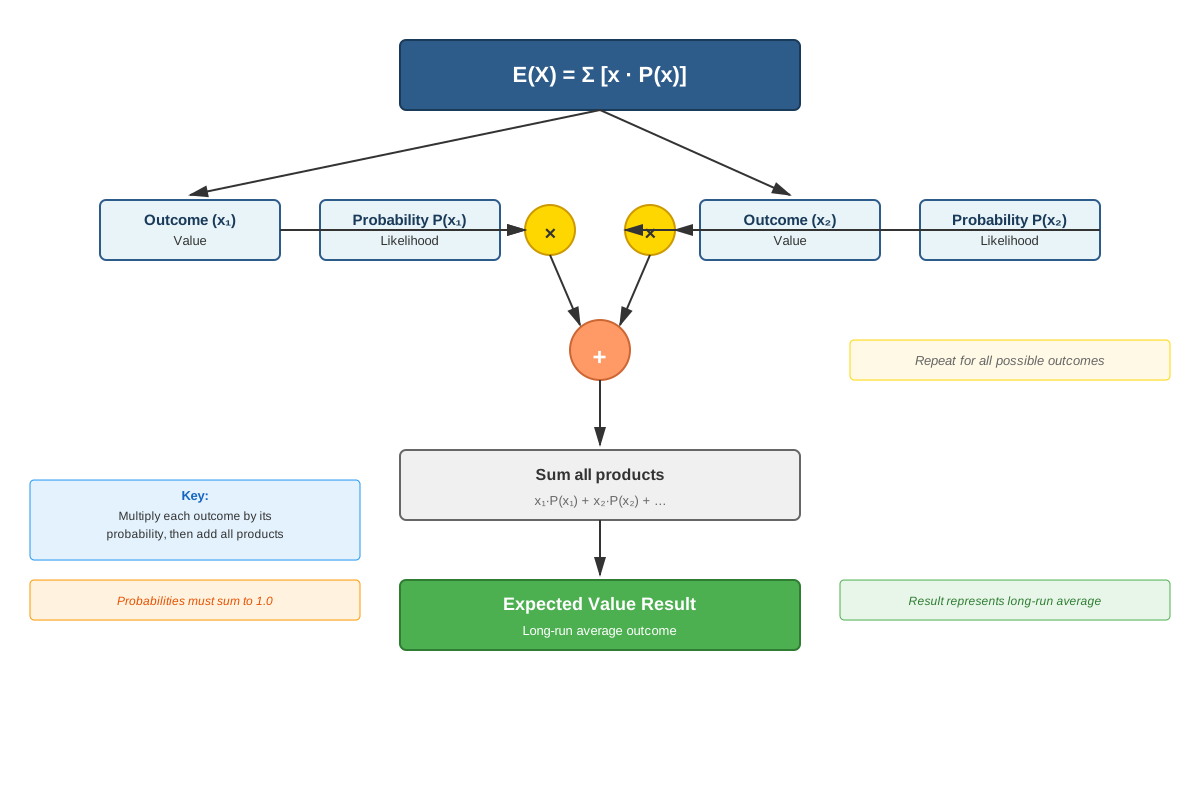
The expected value (often denoted as E(X) or EV) represents the theoretical average of all possible outcomes of a random variable, weighted by their probabilities. It answers the question: "If this random event were repeated many times, what would be the average result?"
The fundamental formula for expected value is:
E(X) = p₁ × x₁ + p₂ × x₂ + p₃ × x₃ + ... + pₙ × xₙWhere:
- x₁, x₂, x₃, ..., xₙ are the possible outcomes
- p₁, p₂, p₃, ..., pₙ are the probabilities of each outcome
- The sum of all probabilities equals 1 (p₁ + p₂ + ... + pₙ = 1)
Calculating Expected Value: Step-by-Step Process
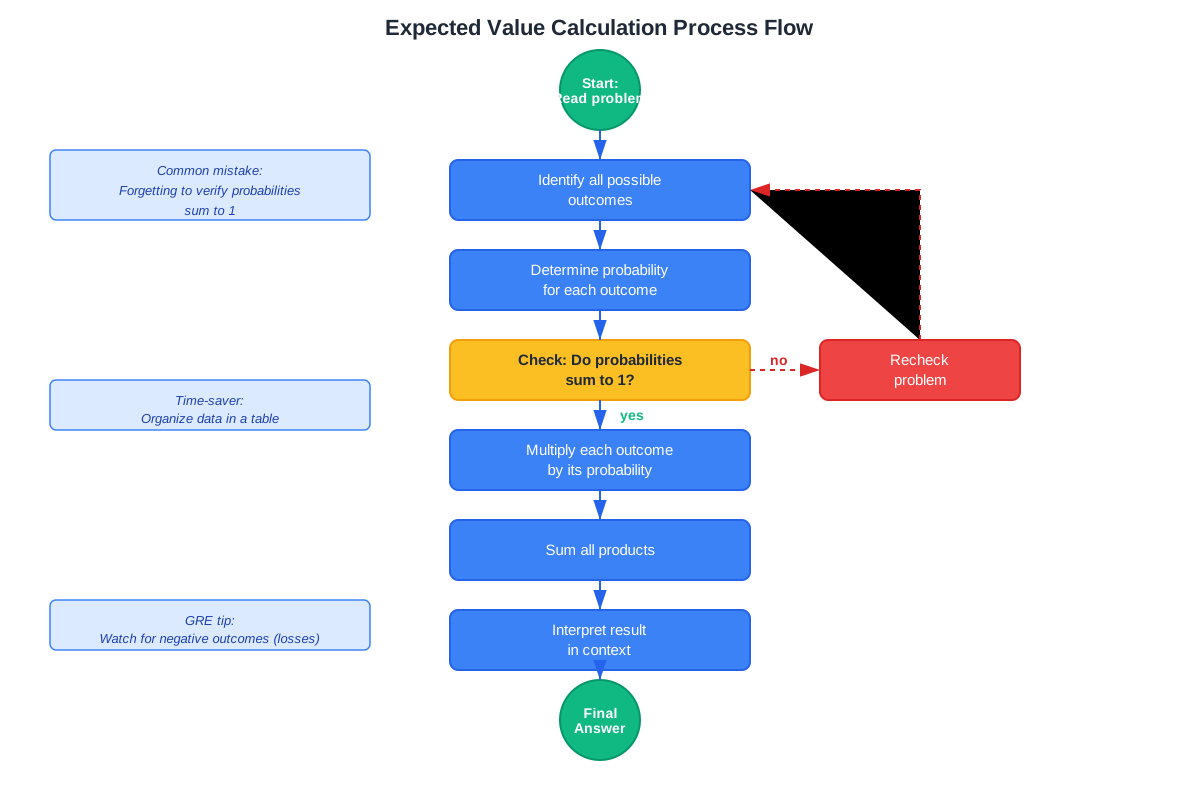
- Identify all possible outcomes: List every distinct result that could occur
- Determine the probability of each outcome: Ensure probabilities are expressed as decimals or fractions and sum to 1
- Multiply each outcome by its probability: Calculate the product for each outcome-probability pair
- Sum all products: Add all the products from step 3 to obtain the expected value
Expected Value in Gain/Loss Scenarios
Many GRE questions frame expected value in terms of financial gains and losses. In these scenarios:
- Positive outcomes represent gains (money won, profit earned)
- Negative outcomes represent losses (money lost, costs incurred)
- The expected value can be positive (net gain expected), negative (net loss expected), or zero (break-even)
For example, if a game costs $5 to play and offers a 20% chance of winning $30, the expected value calculation would be:
E(X) = 0.20 × ($30 - $5) + 0.80 × (-$5)
E(X) = 0.20 × $25 + 0.80 × (-$5)
E(X) = $5 - $4 = $1
The positive expected value of $1 indicates that, on average, a player would gain $1 per game over many plays.
Expected Value with Multiple Outcomes
GRE questions frequently involve scenarios with three or more possible outcomes. The process remains the same, but careful organization becomes crucial:
| Outcome | Value | Probability | Product |
|---|---|---|---|
| Outcome 1 | x₁ | p₁ | p₁ × x₁ |
| Outcome 2 | x₂ | p₂ | p₂ × x₂ |
| Outcome 3 | x₃ | p₃ | p₃ × x₃ |
| Expected Value | Sum = 1 | E(X) = Σ(pᵢ × xᵢ) |
Properties of Expected Value
Understanding these properties can simplify calculations and help verify answers:
- Linearity: E(aX + b) = aE(X) + b, where a and b are constants
- Additivity: E(X + Y) = E(X) + E(Y) for any random variables X and Y
- Constant multiplication: E(cX) = c × E(X), where c is a constant
- Expected value of a constant: E(c) = c
Interpreting Expected Value Results
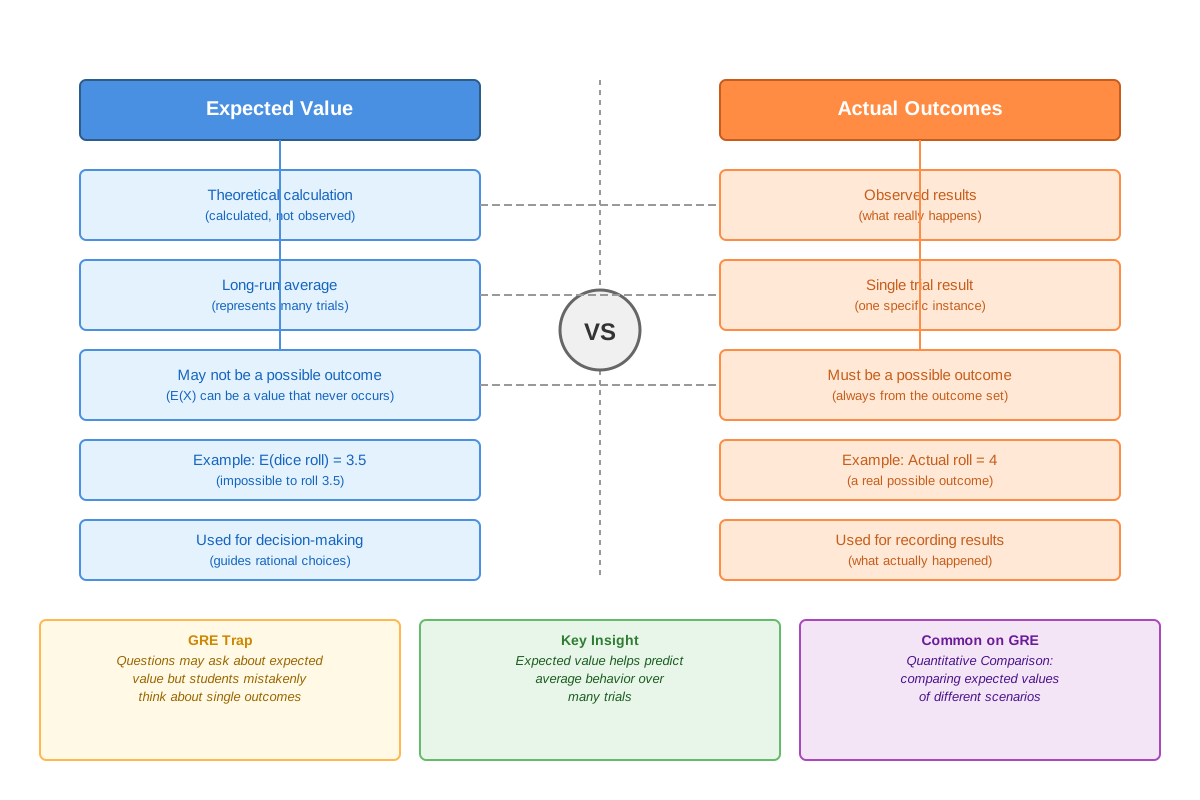
The expected value represents a long-run average, not a prediction of any single outcome. Key interpretations include:
- Expected value doesn't need to be a possible outcome: Rolling a fair six-sided die has an expected value of 3.5, even though rolling 3.5 is impossible
- Positive expected value: Indicates a favorable situation on average
- Negative expected value: Indicates an unfavorable situation on average
- Zero expected value: Indicates a fair game or break-even scenario
Expected Value in Decision-Making
When comparing multiple options, the option with the highest expected value is theoretically the best choice from a purely mathematical perspective. However, GRE questions may also test understanding that:
- Risk tolerance affects real-world decisions
- Expected value assumes many repetitions
- Other factors beyond expected value may influence rational decisions
Concept Relationships
Expected value basics connects multiple mathematical concepts into a unified framework. The relationship begins with probability theory → which provides the foundation for determining the likelihood of each outcome → these probabilities are then combined with arithmetic operations (multiplication and addition) → to produce a weighted average → that represents the expected value.
Within the topic itself, the concepts build hierarchically:
- Basic definition → calculation procedure → interpretation of results → application to decision-making
Expected value connects to prerequisite topics through:
- Probability fundamentals provide the probability values needed for calculations
- Weighted averages share the same mathematical structure (weights × values)
- Fractions and decimals are the computational tools for performing calculations
Expected value also serves as a gateway to more advanced topics:
- Variance and standard deviation measure spread around the expected value
- Risk analysis uses expected value as one component of decision-making
- Statistical inference relies on expected values of sampling distributions
The relationship between expected value and Quantitative Comparison questions is particularly important: students must recognize when comparing expected values provides the most efficient solution path rather than attempting to enumerate all possibilities.
High-Yield Facts
⭐ The expected value formula is E(X) = Σ(probability × outcome) for all possible outcomes
⭐ All probabilities in an expected value calculation must sum to exactly 1
⭐ Expected value can be a number that is not actually a possible outcome of the random variable
⭐ A positive expected value indicates a net gain on average; negative indicates a net loss
⭐ In gain/loss scenarios, remember to subtract the cost from winnings when calculating net outcomes
- Expected value represents a long-run average, not a prediction for a single trial
- When comparing two scenarios, the one with the higher expected value is mathematically superior
- Expected value is linear: E(aX + b) = aE(X) + b
- The expected value of a constant is that constant: E(5) = 5
- In fair games, the expected value equals zero (no advantage to either player)
- Multiplying all outcomes by a constant multiplies the expected value by that constant
- Expected value calculations require careful attention to positive and negative signs
- GRE questions often disguise expected value problems as word problems about games, investments, or quality control
- Creating a table with columns for outcomes, probabilities, and products helps organize complex calculations
- Always verify that your probability values are reasonable (between 0 and 1) before calculating
Quick check — test yourself on Expected value basics so far.
Try Flashcards →Common Misconceptions
Misconception: Expected value tells you what will happen on the next trial → Correction: Expected value represents the average outcome over many trials, not a prediction for any single event. You cannot roll 3.5 on a die, even though that's the expected value.
Misconception: The expected value must be one of the possible outcomes → Correction: Expected value is a weighted average and frequently falls between possible outcomes. For example, the expected value of flipping a coin (0 for tails, 1 for heads) is 0.5, which is not a possible outcome.
Misconception: In a game with a cost to play, the expected value is just the probability times the prize → Correction: You must account for the cost of playing. If a game costs $C to play and offers prize $P with probability p, the expected value is p(P - C) + (1-p)(-C), or more simply: pP - C.
Misconception: A higher probability always means a higher expected value → Correction: Expected value depends on both probability and outcome value. A low-probability event with a very large payoff can have a higher expected value than a high-probability event with a small payoff.
Misconception: If the expected value is positive, you will definitely make money → Correction: Positive expected value means you would make money on average over many trials. In any single trial or small number of trials, you could still lose money due to randomness.
Misconception: Expected values cannot be negative → Correction: Expected values can be negative, zero, or positive. Negative expected values indicate scenarios where losses are expected on average, such as most casino games from the player's perspective.
Worked Examples
Example 1: Lottery Ticket Expected Value
Problem: A lottery ticket costs $2. The ticket offers a 1 in 1,000 chance of winning $1,500, a 1 in 100 chance of winning $50, and otherwise wins nothing. What is the expected value of purchasing one ticket?
Solution:
Step 1: Identify all possible outcomes and their net values (accounting for the $2 cost):
- Win $1,500: Net gain = $1,500 - $2 = $1,498
- Win $50: Net gain = $50 - $2 = $48
- Win nothing: Net gain = $0 - $2 = -$2
Step 2: Determine probabilities:
- P(win $1,500) = 1/1,000 = 0.001
- P(win $50) = 1/100 = 0.01
- P(win nothing) = 1 - 0.001 - 0.01 = 0.989
Step 3: Calculate products:
- 0.001 × $1,498 = $1.498
- 0.01 × $48 = $0.48
- 0.989 × (-$2) = -$1.978
Step 4: Sum the products:
E(X) = $1.498 + $0.48 + (-$1.978) = $0
Interpretation: The expected value is $0, meaning this is a fair game. On average, over many purchases, a player would break even. This connects to Learning Objective 3 (applying expected value to GRE-style questions) and demonstrates the importance of including the cost in net outcome calculations.
Example 2: Investment Decision Comparison
Problem: An investor must choose between two options:
- Option A: 60% chance of gaining $800, 40% chance of losing $200
- Option B: 30% chance of gaining $1,500, 50% chance of gaining $300, 20% chance of losing $500
Which option has the higher expected value, and by how much?
Solution:
For Option A:
E(A) = 0.60 × $800 + 0.40 × (-$200)
E(A) = $480 + (-$80)
E(A) = $400
For Option B:
E(B) = 0.30 × $1,500 + 0.50 × $300 + 0.20 × (-$500)
E(B) = $450 + $150 + (-$100)
E(B) = $500
Comparison:
Option B has the higher expected value.
Difference = $500 - $400 = $100
Answer: Option B has an expected value $100 higher than Option A.
Interpretation: This problem demonstrates Learning Objective 5 (comparing expected values to determine optimal decisions). Even though Option A has a higher probability of a positive outcome (60% vs. 80% for Option B when combining the two positive outcomes), Option B has the higher expected value due to the larger potential gains. This illustrates why both probability and outcome magnitude matter.
Exam Strategy
Recognizing Expected Value Questions
Watch for these trigger words and phrases:
- "On average, how much..."
- "Expected gain/loss/profit/value"
- "Over many trials..."
- "What should one expect..."
- "Fair game" or "fair price"
- "Long-run average"
Systematic Approach
- Read carefully to identify: all possible outcomes, their values, and their probabilities
- Create a table or organized list: this prevents errors and makes verification easier
- Check probability sum: verify that all probabilities add to 1 before calculating
- Account for costs: in gain/loss scenarios, subtract costs from winnings to get net values
- Calculate methodically: multiply each probability by its outcome, then sum
- Interpret in context: ensure your answer makes logical sense for the scenario
Time Management
- Expected value calculations typically take 1.5-2.5 minutes on the GRE
- If a problem has more than 4 outcomes, consider whether there's a shortcut or pattern
- For Quantitative Comparison questions, sometimes you can determine which expected value is higher without calculating exact values
- Practice mental math for common fractions (1/2, 1/3, 1/4, 1/5) to save time
Process of Elimination Tips
For multiple-choice questions:
- Eliminate answers outside the range of possible outcomes (unless outcomes themselves are outside this range)
- Check sign: if all outcomes are positive, the expected value must be positive
- Use estimation: calculate approximate expected value to eliminate clearly wrong answers
- Verify reasonableness: an expected value should generally fall somewhere between the minimum and maximum outcomes (weighted toward more probable outcomes)
Common Traps to Avoid
- Don't forget to include all outcomes, especially "nothing happens" or "no win" scenarios
- Don't confuse probability with outcome value
- Don't forget to subtract costs in games or investments
- Don't round too early in multi-step calculations; maintain precision until the final answer
Memory Techniques
The "POMS" Mnemonic
Probabilities (list them)
Outcomes (identify them)
Multiply (each pair)
Sum (all products)
This four-step process ensures you never skip a crucial step in expected value calculations.
Visualization Strategy
Picture expected value as a balance scale where:
- Each outcome is a weight placed on the scale
- The size of each weight represents the outcome value
- The number of identical weights represents the probability
- The balance point is the expected value
This mental image helps understand why expected value doesn't need to be a possible outcome—it's the balance point, not necessarily where any weight sits.
The "Cost Comes Out" Reminder
For games with an entry cost, remember: "Cost Comes Out of every outcome"
This reminds you to subtract the cost from winnings (making it a net gain) AND to represent "losing" as negative the cost (not zero).
Formula Memory Aid
"Every Probability Pays"
This phrase reminds you that in the formula E(X) = Σ(p × x), Every outcome's Probability must be multiplied by its Payoff (outcome value), with no exceptions.
Summary
Expected value basics represents a fundamental tool for quantitative reasoning under uncertainty, calculating the long-run average outcome of a random variable by multiplying each possible outcome by its probability and summing the results. The core formula E(X) = Σ(probability × outcome) applies universally, whether dealing with simple two-outcome scenarios or complex multi-outcome situations. On the GRE, expected value questions test the ability to identify relevant information, perform accurate multi-step calculations, and interpret results in context. Success requires recognizing trigger words, systematically organizing information, carefully accounting for costs in gain/loss scenarios, and verifying that probabilities sum to one. The expected value need not be a possible outcome—it represents a theoretical average over many trials. Mastering this topic enables students to tackle probability-based word problems, make optimal decisions in Quantitative Comparison questions, and demonstrate the practical quantitative reasoning skills the GRE specifically targets.
Key Takeaways
- Expected value equals the sum of each outcome multiplied by its probability: E(X) = Σ(pᵢ × xᵢ)
- All probabilities must sum to exactly 1; if they don't, recheck your problem setup
- In cost-based scenarios, always subtract the cost from winnings to calculate net outcomes
- Expected value represents long-run average, not a prediction for any single trial
- The option with the highest expected value is mathematically optimal when comparing choices
- Expected value can be any real number—positive, negative, zero, or even impossible as an actual outcome
- Organize calculations using tables with columns for outcomes, probabilities, and products to minimize errors
Related Topics
Variance and Standard Deviation: After mastering expected value (the center of a distribution), the natural progression is understanding variance and standard deviation, which measure spread around that center. These concepts quantify risk and variability in probabilistic scenarios.
Probability Distributions: Expected value is a key parameter of probability distributions. Understanding discrete and continuous distributions deepens comprehension of how expected value functions in various contexts.
Decision Theory and Game Theory: Expected value serves as the foundation for more sophisticated decision-making frameworks that incorporate risk preferences, utility functions, and strategic interactions.
Statistical Inference: Sample means are used to estimate population expected values, connecting this topic to hypothesis testing and confidence intervals in advanced statistics.
Practice CTA
Now that you've mastered the fundamentals of expected value, it's time to solidify your understanding through active practice. Attempt the practice questions to apply these concepts to GRE-style problems, and use the flashcards to reinforce key formulas and definitions. Remember, expected value questions reward systematic thinking and careful calculation—skills that improve dramatically with deliberate practice. Each problem you solve strengthens your pattern recognition and computational speed, bringing you closer to your target GRE score. Start practicing now to transform this knowledge into test-day confidence!
Sign up free to keep reading
Create a free AnvayaPrep account to finish this GRE guide on Expected value basics — plus flashcards and practice questions.