Overview
Permutations represent one of the most frequently tested counting principles on the GRE Quantitative Reasoning section. At its core, a permutation answers the question: "In how many different ways can we arrange a set of items when the order matters?" This concept appears in approximately 5-8% of all GRE Quantitative questions and forms the foundation for more complex probability and combinatorics problems. Understanding permutations is essential not only for direct counting questions but also for recognizing when order-dependent arrangements are being tested in word problems, probability scenarios, and data analysis contexts.
The power of gre permutations lies in their systematic approach to counting without exhaustive enumeration. Rather than listing every possible arrangement—which becomes impractical with larger sets—permutations provide elegant formulas that calculate arrangements instantly. This efficiency is crucial on the GRE, where time management separates good scores from exceptional ones. Students who master permutations gain a significant advantage in the Data Analysis portion of the exam, as these problems often appear as medium-to-hard difficulty questions that can differentiate test-takers in the 160+ score range.
Permutations connect intimately with other Quantitative Reasoning concepts including combinations, probability, and basic counting principles. While combinations focus on selection without regard to order, permutations emphasize arrangement where position matters. This distinction becomes the cornerstone of solving complex GRE problems that blend multiple counting techniques. Additionally, permutations build upon fundamental multiplication principles and factorial notation, serving as a bridge between basic arithmetic operations and advanced statistical reasoning that appears throughout the exam.
Learning Objectives
- [ ] Identify when Permutations is being tested in GRE questions
- [ ] Explain the core rule or strategy behind Permutations
- [ ] Apply Permutations to GRE-style questions accurately
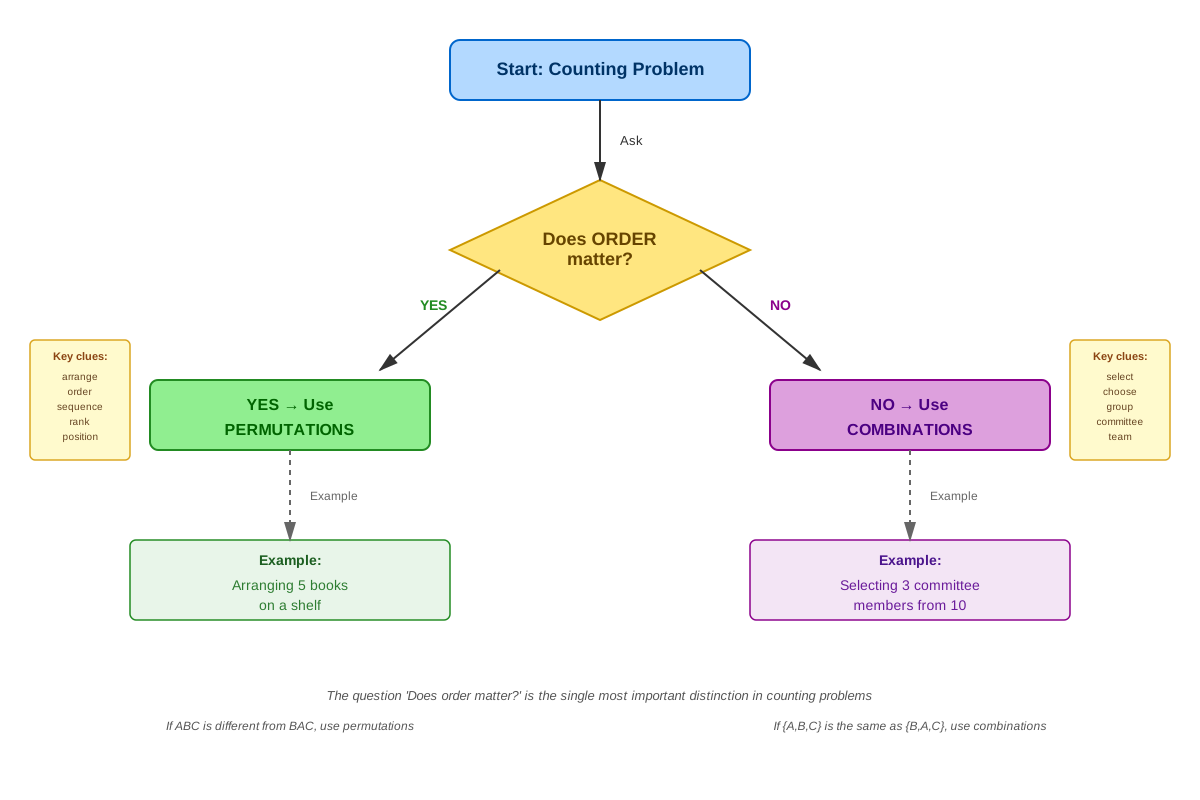
- [ ] Distinguish between permutation and combination scenarios based on problem context
- [ ] Calculate permutations with and without repetition using appropriate formulas
- [ ] Solve multi-step problems involving permutations combined with other counting principles
- [ ] Recognize and handle restricted permutation problems (e.g., items that must stay together or apart)
Prerequisites
- Factorial notation (n!): Understanding that n! = n × (n-1) × (n-2) × ... × 1 is essential since permutation formulas are expressed using factorials
- Basic multiplication principle: The foundation that if one event can occur in m ways and another in n ways, both can occur in m × n ways, which underlies all permutation calculations
- Set theory fundamentals: Knowing what constitutes a distinct element versus identical elements affects whether standard or modified permutation formulas apply
- Order of operations: Correctly evaluating expressions with factorials, division, and multiplication ensures accurate calculation of permutation values
Why This Topic Matters
Permutations appear in real-world contexts ranging from password security (how many unique 8-character passwords exist?) to scheduling problems (in how many ways can 5 people be seated in a row?) to tournament brackets and organizational hierarchies. The ability to count arrangements systematically is fundamental to fields including computer science, operations research, cryptography, and logistics. Beyond practical applications, permutations develop logical reasoning skills and pattern recognition that transfer to other analytical domains.
On the GRE specifically, permutation questions appear in multiple formats: direct calculation problems, word problems requiring translation into permutation notation, Quantitative Comparison questions asking students to compare two permutation expressions, and Data Interpretation questions where permutations help calculate probabilities. According to ETS data, approximately 2-3 questions per Quantitative section involve counting principles, with permutations representing the majority of these. These questions typically appear in the medium-to-hard difficulty range (difficulty level 3-5 out of 5), making them high-value targets for score improvement.
Common GRE manifestations include: arrangement problems ("How many ways can 7 books be arranged on a shelf?"), selection and arrangement problems ("How many 3-letter codes can be formed from 8 letters with no repetition?"), restricted arrangement problems ("How many ways can 6 people sit in a row if two specific people must sit together?"), and circular arrangement problems ("How many ways can 5 people be seated around a circular table?"). Recognizing these patterns allows students to quickly categorize problems and apply the appropriate solution strategy.
Core Concepts
The Fundamental Permutation Formula
A permutation is an arrangement of objects in a specific order. The defining characteristic that distinguishes permutations from other counting methods is that order matters—changing the sequence creates a different permutation. The basic permutation formula calculates the number of ways to arrange n distinct objects taken r at a time:
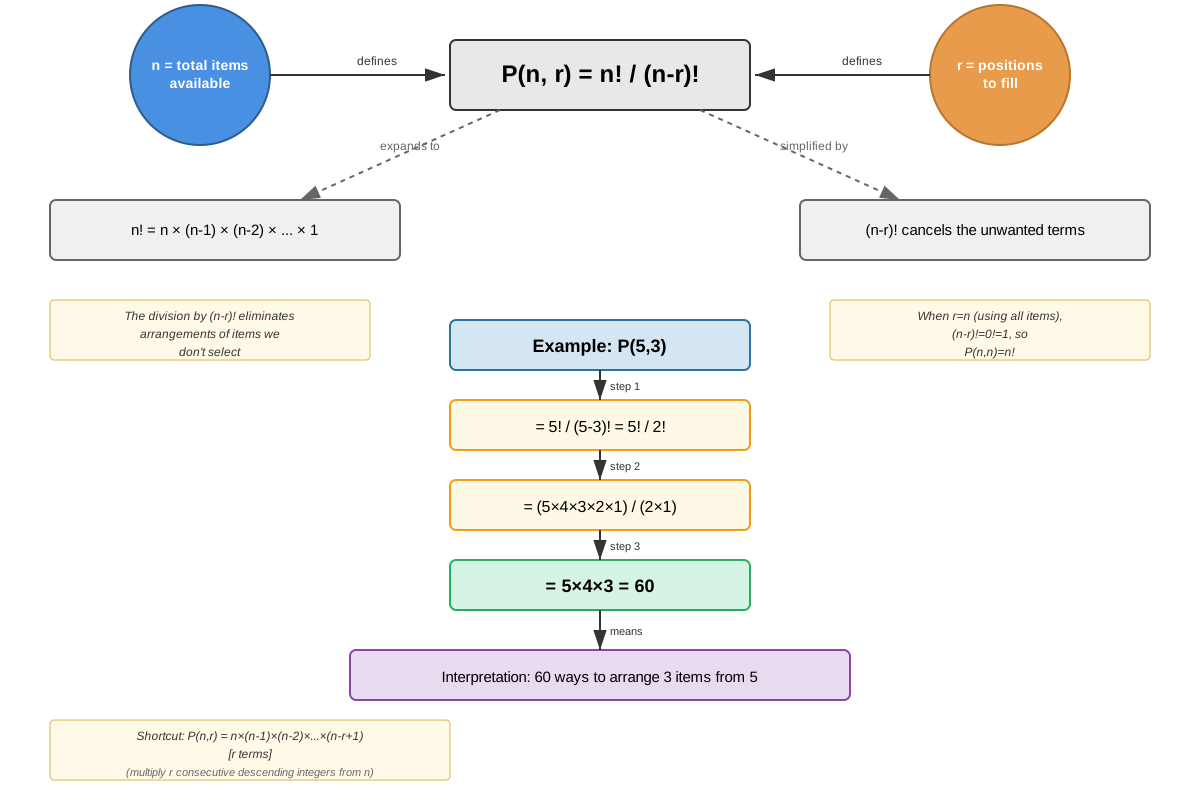
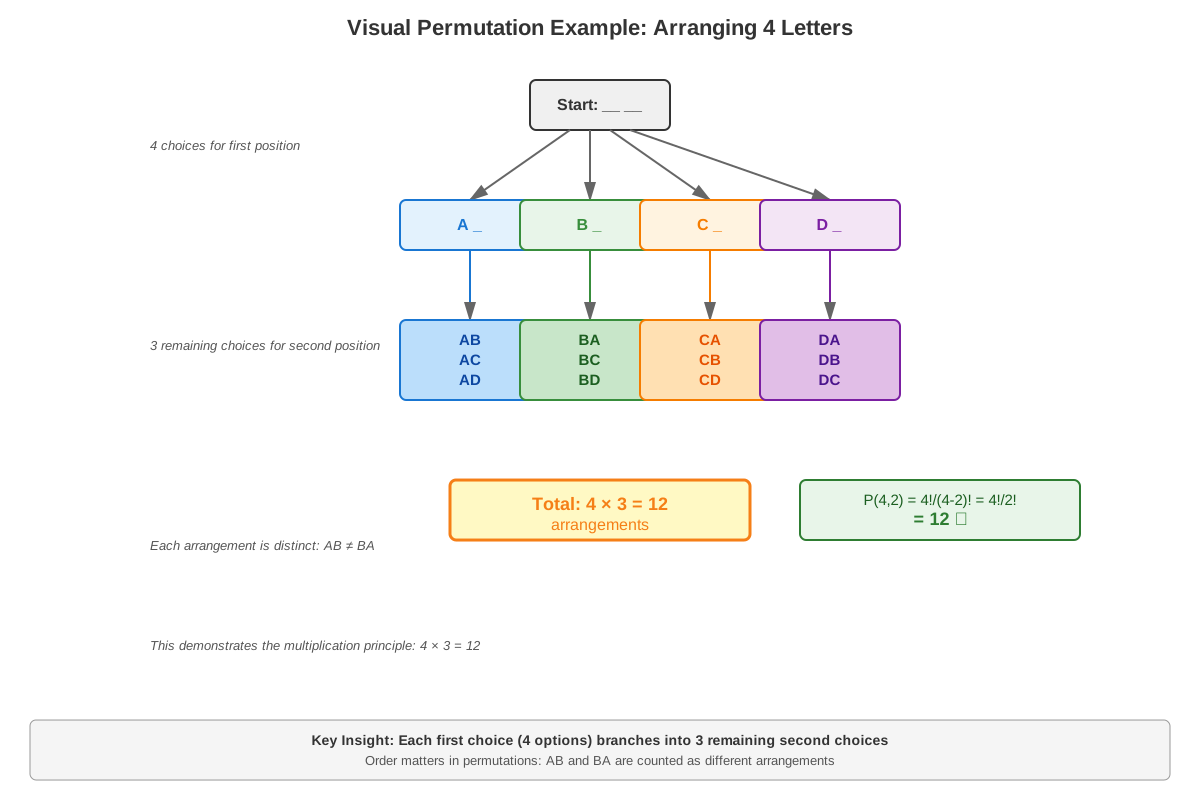
P(n,r) = n!/(n-r)!This formula can also be written as nPr or P^n_r depending on notation preferences. The logic behind this formula stems from the multiplication principle: when selecting and arranging r objects from n total objects, there are n choices for the first position, (n-1) choices for the second position, (n-2) for the third, and so on, until we've filled r positions. This gives us n × (n-1) × (n-2) × ... × (n-r+1), which equals n!/(n-r)!.
Example: How many 3-digit codes can be formed from the digits 1, 2, 3, 4, 5 if no digit can be repeated?
Using P(5,3) = 5!/(5-3)! = 5!/2! = (5 × 4 × 3 × 2 × 1)/(2 × 1) = 120/2 = 60 different codes.
Complete Permutations (All Objects)
When arranging all n objects from a set (rather than selecting r objects), the formula simplifies to:
P(n,n) = n!This represents the total number of ways to arrange n distinct objects in a line. The factorial grows extremely rapidly: 3! = 6, 4! = 24, 5! = 120, 6! = 720, 7! = 5,040. This rapid growth is important for GRE questions that ask students to compare permutation values or estimate magnitudes.
Example: In how many ways can 4 different books be arranged on a shelf?
P(4,4) = 4! = 4 × 3 × 2 × 1 = 24 ways.
Permutations with Repetition
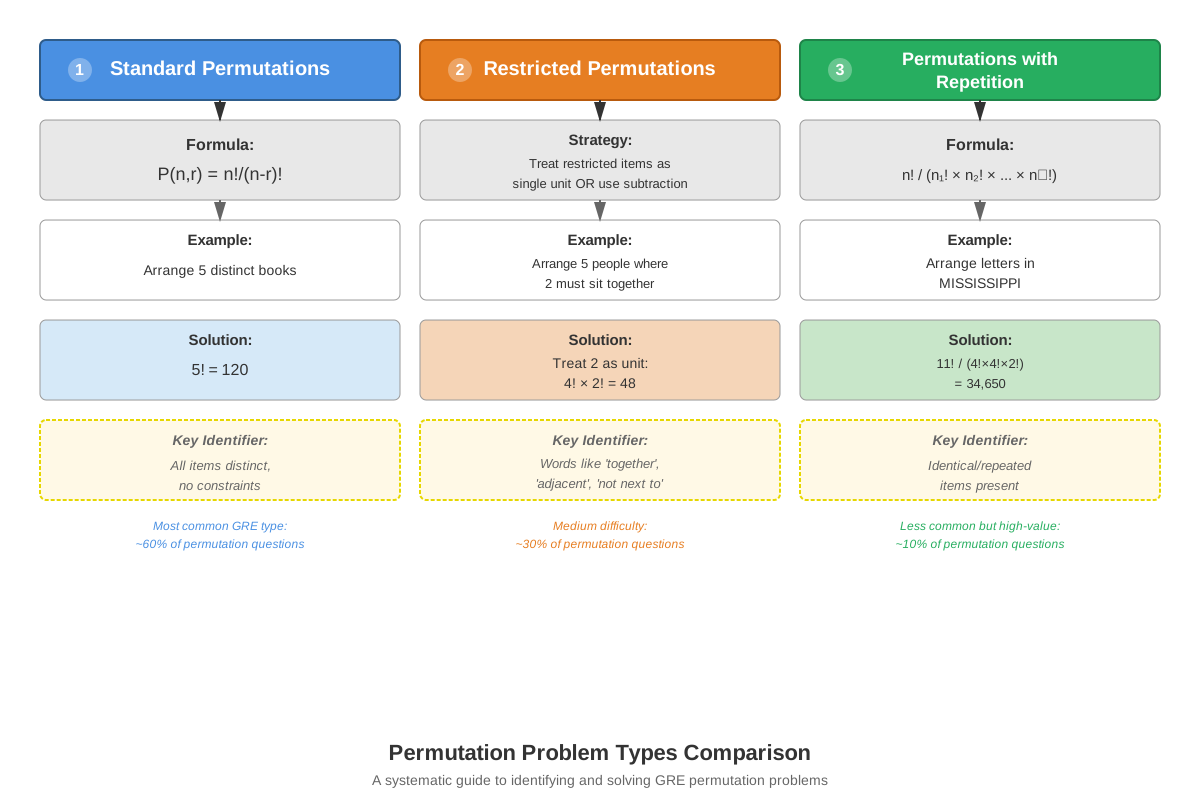
When objects are not all distinct—meaning some items are identical—the standard permutation formula overcounts arrangements. The formula for permutations of n objects where there are n₁ identical objects of type 1, n₂ identical objects of type 2, etc., is:
n!/(n₁! × n₂! × ... × nₖ!)The denominators account for the fact that swapping identical objects doesn't create a new arrangement.
Example: How many distinct arrangements can be made from the letters in the word "MISSISSIPPI"?
The word has 11 letters: 1 M, 4 I's, 4 S's, 2 P's.
Number of arrangements = 11!/(1! × 4! × 4! × 2!) = 39,916,800/(1 × 24 × 24 × 2) = 39,916,800/1,152 = 34,650.
Circular Permutations
When arranging objects in a circle rather than a line, rotations that look identical are considered the same arrangement. For n distinct objects arranged in a circle, the number of distinct arrangements is:
(n-1)!This formula accounts for the fact that in circular arrangements, there is no fixed starting point—rotating everyone one position clockwise produces the same circular arrangement.
Example: In how many ways can 5 people be seated around a circular table?
(5-1)! = 4! = 24 ways.
If the orientation matters (e.g., clockwise vs. counterclockwise arrangements are different), use (n-1)!. If reflections are considered identical, divide by 2: (n-1)!/2.
Restricted Permutations
Many GRE problems impose restrictions on arrangements, requiring modified approaches:
Objects that must stay together: Treat the grouped objects as a single unit, calculate arrangements of the units, then multiply by arrangements within the group.
Example: How many ways can 5 people stand in a row if 2 specific people must stand next to each other?
Treat the 2 people as 1 unit: now we have 4 units to arrange = 4! = 24 ways. The 2 people within their unit can be arranged in 2! = 2 ways. Total = 24 × 2 = 48 ways.
Objects that must stay apart: Calculate total arrangements, then subtract arrangements where the objects are together.
Fixed positions: If certain objects must occupy specific positions, fill those positions first, then arrange the remaining objects in the remaining positions.
The Multiplication Principle in Permutations
Complex permutation problems often require breaking the problem into stages and multiplying the number of choices at each stage. This slot method is particularly useful for GRE problems:
Example: How many 4-letter "words" (not necessarily real words) can be formed from the letters A, B, C, D, E, F if the first letter must be a vowel and no letter can be repeated?
- First position (must be vowel): 2 choices (A or E)
- Second position: 5 choices (any remaining letter)
- Third position: 4 choices (any remaining letter)
- Fourth position: 3 choices (any remaining letter)
Total = 2 × 5 × 4 × 3 = 120 words.
Permutations vs. Combinations
| Feature | Permutations | Combinations |
|---|---|---|
| Order matters? | Yes | No |
| Formula | P(n,r) = n!/(n-r)! | C(n,r) = n!/[r!(n-r)!] |
| Example | Arranging 3 books from 5 | Selecting 3 books from 5 |
| Result relationship | P(n,r) = r! × C(n,r) | C(n,r) = P(n,r)/r! |
| Typical keywords | Arrange, order, sequence, schedule | Choose, select, group, committee |
Understanding this distinction is crucial for GRE success, as many problems test whether students can identify which counting method applies.
Concept Relationships
The hierarchy of permutation concepts builds systematically: Basic multiplication principle → Simple permutations P(n,r) → Complete permutations (n!) → Permutations with restrictions (objects together/apart, fixed positions) → Permutations with repetition → Circular permutations. Each level adds complexity while maintaining the fundamental principle that order matters.
Permutations connect to combinations through the relationship P(n,r) = r! × C(n,r), meaning every permutation problem can be viewed as first selecting objects (combination) then arranging them (factorial). This relationship helps solve problems that blend selection and arrangement.
The connection to probability is direct: many probability problems require calculating favorable permutations divided by total permutations. For example, "What is the probability that when 5 people stand in a random line, two specific people stand next to each other?" requires calculating restricted permutations (favorable outcomes) divided by 5! (total outcomes).
Factorial notation serves as the mathematical foundation, while set theory determines whether objects are distinct or identical, affecting which formula applies. The multiplication principle underlies all permutation calculations, whether explicit (slot method) or implicit (within formulas).
Quick check — test yourself on Permutations so far.
Try Flashcards →High-Yield Facts
⭐ The fundamental permutation formula is P(n,r) = n!/(n-r)!, representing arrangements of r objects selected from n distinct objects
⭐ Order matters in permutations; if order doesn't matter, the problem involves combinations instead
⭐ When arranging all n objects, the formula simplifies to n!, which grows extremely rapidly (5! = 120, 6! = 720, 7! = 5,040)
⭐ For permutations with identical objects, divide n! by the factorial of each group of identical items: n!/(n₁! × n₂! × ... × nₖ!)
⭐ Circular permutations of n objects equal (n-1)! because rotations are considered identical
- When objects must stay together, treat them as a single unit, calculate arrangements, then multiply by internal arrangements
- When objects must stay apart, use total arrangements minus arrangements where they're together
- The slot method (filling positions sequentially) often provides the clearest solution path for complex restrictions
- P(n,r) always equals n × (n-1) × (n-2) × ... × (n-r+1), which is the expanded form of n!/(n-r)!
- For any n and r, P(n,r) ≥ C(n,r), with equality only when r = 1
- Zero factorial (0!) equals 1 by definition, which makes P(n,n) = n!/0! = n! work correctly
- Permutations with repetition allowed (objects can be reused) follow the formula n^r, not n!/(n-r)!
Common Misconceptions
Misconception: Permutations and combinations are the same thing, just different formulas.
Correction: The fundamental difference is whether order matters. In permutations, ABC and BAC are different arrangements; in combinations, they represent the same selection. Always ask: "Does the sequence/position matter?" If yes, use permutations.
Misconception: When calculating P(n,r), you can simply compute n!/r! instead of n!/(n-r)!.
Correction: The correct formula is P(n,r) = n!/(n-r)!, not n!/r!. For example, P(5,2) = 5!/3! = 20, not 5!/2! = 60. The denominator removes the factorial of the objects NOT selected.
Misconception: In circular permutations, the formula is n! just like linear arrangements.
Correction: Circular permutations use (n-1)! because rotations are identical. Fixing one person's position eliminates rotational redundancy, leaving (n-1) remaining positions to arrange.
Misconception: When some objects are identical, you can still use the standard n! formula.
Correction: Identical objects create overcounting. The word "BOOK" has 4 letters but only 4!/2! = 12 distinct arrangements (not 24) because the two O's are indistinguishable. Always divide by the factorial of each group of identical items.
Misconception: If two people must sit together, you just multiply the total arrangements by 2.
Correction: Treat the pair as one unit, reducing the problem size. For 5 people with 2 who must sit together: treat as 4 units → 4! arrangements, then multiply by 2! internal arrangements of the pair = 4! × 2! = 48, not 5! × 2 = 240.
Misconception: P(n,0) is undefined or equals 0.
Correction: P(n,0) = n!/(n-0)! = n!/n! = 1. There is exactly one way to arrange zero objects: do nothing. This edge case occasionally appears in GRE problems.
Misconception: Permutations with repetition allowed use the same formula as permutations without repetition.
Correction: When objects can be reused (repetition allowed), each position has n choices independently, giving n^r total arrangements. Without repetition, use P(n,r) = n!/(n-r)!. The GRE tests this distinction explicitly.
Worked Examples
Example 1: Multi-Stage Permutation with Restrictions
Problem: A password must consist of 5 characters: the first character must be a letter (A-Z), the next three characters must be digits (0-9), and the last character must be a special symbol from the set {!, @, #, $}. No character can be repeated within the password. How many different passwords are possible?
Solution:
This problem requires the slot method, filling each position according to its restrictions:
Position 1 (letter): 26 choices (A through Z)
Position 2 (digit): 10 choices (0 through 9)
Position 3 (digit): 9 choices (one digit already used in position 2, no repetition allowed)
Position 4 (digit): 8 choices (two digits already used)
Position 5 (special symbol): 4 choices (!, @, #, $)
By the multiplication principle:
Total passwords = 26 × 10 × 9 × 8 × 4 = 74,880
Key insight: This problem tests recognition that different character types have different pools, and the no-repetition rule only applies within each type (we can't reuse a digit, but we can use any letter regardless of which digits we chose).
Connection to learning objectives: This demonstrates applying permutations to GRE-style questions by breaking complex restrictions into sequential choices and using the multiplication principle.
Example 2: Permutations with Identical Objects
Problem: A bookshelf has space for 8 books. A student has 3 identical math books, 3 identical science books, and 2 identical history books. In how many distinct ways can all 8 books be arranged on the shelf?
Solution:
Since some books are identical, we use the permutation formula with repetition:
Total books: n = 8
Identical math books: n₁ = 3
Identical science books: n₂ = 3
Identical history books: n₃ = 2
Formula: n!/(n₁! × n₂! × n₃!)
Calculation:
= 8!/(3! × 3! × 2!)
= 40,320/(6 × 6 × 2)
= 40,320/72
= 560 distinct arrangements
Key insight: If all books were distinct, there would be 8! = 40,320 arrangements. The identical books reduce this by a factor of 3! × 3! × 2! = 72 because swapping identical books doesn't create new arrangements.
Alternative approach verification: We could think of this as choosing positions: "Which 3 positions get math books?" (C(8,3) ways), then "Which 3 of the remaining 5 positions get science books?" (C(5,3) ways), then "The last 2 positions get history books" (C(2,2) = 1 way).
C(8,3) × C(5,3) × C(2,2) = 56 × 10 × 1 = 560 ✓
Connection to learning objectives: This demonstrates explaining the core strategy (dividing by factorials of identical groups) and applying it accurately to calculate the answer.
Exam Strategy
Trigger words for permutations: "arrange," "order," "sequence," "schedule," "line up," "rank," "different ways," "codes," "passwords." When these appear, immediately consider whether order matters—if yes, think permutations.
Systematic approach:
- Identify the question type: Does order matter? (Yes → permutation; No → combination)
- Count total objects (n) and positions to fill (r)
- Check for restrictions: identical objects, circular arrangement, objects together/apart, fixed positions
- Choose the appropriate formula or method: standard P(n,r), permutation with repetition, slot method, or complementary counting
- Calculate carefully: factorial calculations grow large quickly; look for cancellation opportunities before multiplying
Process of elimination tips:
- If answer choices differ by factors of small factorials (2!, 3!, etc.), the problem likely involves identical objects or objects that must stay together
- Extremely large answers often indicate the problem wants n! (all arrangements) rather than P(n,r)
- If one answer is exactly r! times another, consider whether the problem is actually asking for combinations (the smaller value) or permutations (the larger value)
Time allocation: Straightforward permutation calculations should take 45-60 seconds. Problems with multiple restrictions may require 90-120 seconds. If a problem seems to require more than 2 minutes of calculation, reconsider the approach—there's likely a simpler method.
Common GRE traps:
- Mixing up P(n,r) = n!/(n-r)! with C(n,r) = n!/[r!(n-r)!]
- Forgetting to account for identical objects
- Using n! for circular arrangements instead of (n-1)!
- Not recognizing when repetition is allowed (use n^r) versus not allowed (use P(n,r))
Exam Tip: When stuck, try small numbers. If a problem asks about arranging 8 objects, test the logic with 3 objects first. The pattern often becomes clear with manageable numbers.
Memory Techniques
Permutation vs. Combination mnemonic: "Permutation = Position matters" (both start with P). Alternatively, "Combination = Choosing without Caring about order" (three C's).
Formula memory: Remember P(n,r) as "n down to (n-r+1)" → multiply n × (n-1) × (n-2) × ... until you've multiplied r terms. For P(5,3): 5 × 4 × 3 (three terms) = 60.
Circular permutation visualization: Imagine sitting at a round table. Fix yourself in one position (this eliminates rotational counting), then arrange the remaining (n-1) people → (n-1)!.
Identical objects acronym: DIVIDE - Distinct arrangements Involve Very Important Denominator Equals (factorial of identical groups). When you see identical objects, remember to DIVIDE.
Restriction strategy - "TAS":
- Together: Treat as one unit
- Apart: Total minus together
- Specific positions: Fill fixed positions first
Factorial growth memory: Remember the sequence 1, 2, 6, 24, 120, 720 (factorials 1! through 6!). Most GRE problems stay within this range, and recognizing these values speeds calculation verification.
Summary
Permutations provide a systematic method for counting arrangements when order matters, forming a critical component of GRE Quantitative Reasoning. The fundamental formula P(n,r) = n!/(n-r)! calculates arrangements of r objects selected from n distinct objects, while variations handle special cases: n! for complete arrangements, n!/(n₁!×n₂!×...×nₖ!) for identical objects, and (n-1)! for circular arrangements. Success on GRE permutation questions requires three core skills: recognizing when order matters (distinguishing permutations from combinations), selecting the appropriate formula based on problem constraints, and applying systematic strategies for restrictions like objects that must stay together or apart. The slot method—filling positions sequentially according to restrictions—often provides the clearest solution path for complex problems. Students must also avoid common pitfalls including confusing permutation and combination formulas, forgetting to account for identical objects, and misapplying circular permutation rules. Mastery of permutations enables efficient problem-solving on 5-8% of GRE Quantitative questions and provides the foundation for advanced probability and combinatorics concepts.
Key Takeaways
- Permutations count arrangements where order matters; the fundamental formula P(n,r) = n!/(n-r)! represents selecting and arranging r objects from n distinct objects
- Always ask "Does order matter?" to distinguish permutations (order matters) from combinations (order doesn't matter)—this is the most critical decision point
- When objects are identical, divide by the factorial of each group of identical items to avoid overcounting: n!/(n₁!×n₂!×...×nₖ!)
- Circular permutations use (n-1)! because rotations are considered identical arrangements
- For restrictions, use systematic strategies: objects together (treat as one unit), objects apart (total minus together), fixed positions (fill those first)
- The slot method (filling positions sequentially) provides a reliable approach for complex multi-stage permutation problems
- Factorial values grow rapidly (5! = 120, 6! = 720, 7! = 5,040), which helps estimate answer magnitudes and verify calculations
Related Topics
Combinations: The natural complement to permutations, combinations count selections where order doesn't matter. Mastering permutations makes learning combinations straightforward since C(n,r) = P(n,r)/r!. Together, these form the complete foundation of counting principles.
Probability: Many probability problems require permutations to count favorable and total outcomes. For example, calculating the probability of specific seating arrangements or password patterns directly applies permutation formulas.
Binomial Theorem: The coefficients in binomial expansions are combinations, but understanding the relationship between permutations and combinations clarifies why C(n,r) appears in the theorem.
Advanced Counting Principles: Topics like the Inclusion-Exclusion Principle and Pigeonhole Principle build on permutation and combination foundations, extending counting techniques to more complex scenarios.
Discrete Probability Distributions: Calculating probabilities for discrete random variables often involves permutations and combinations to determine the number of ways events can occur.
Practice CTA
Now that you've mastered the core concepts of permutations, it's time to solidify your understanding through active practice. Attempt the practice questions designed specifically to test the concepts covered in this guide—they mirror actual GRE question formats and difficulty levels. Use the flashcards to reinforce formulas and key distinctions, particularly the permutation versus combination decision framework. Remember, permutation problems reward systematic thinking and careful attention to restrictions. Each practice problem you solve builds pattern recognition that will save you valuable time on test day. You've built the foundation—now strengthen it through deliberate practice!
Sign up free to keep reading
Create a free AnvayaPrep account to finish this GRE guide on Permutations — plus flashcards and practice questions.