Overview
Conditional probability is a fundamental concept in probability theory that measures the likelihood of an event occurring given that another event has already occurred. On the GRE, this topic appears frequently in Quantitative Reasoning questions, often disguised within word problems involving surveys, medical testing, quality control scenarios, or demographic data. Understanding conditional probability is essential because it tests not only computational skills but also logical reasoning—the ability to recognize when information about one event changes the probability of another event.
The GRE tests conditional probability through various question formats, including multiple-choice questions, Quantitative Comparison questions, and Numeric Entry questions. These problems require students to distinguish between independent and dependent events, interpret complex probability scenarios, and apply formulas correctly under time pressure. Mastery of this topic directly impacts performance on Data Analysis questions, which constitute approximately 25% of the Quantitative Reasoning section.
GRE conditional probability questions connect to broader Quantitative Reasoning concepts including basic probability, set theory, ratios and proportions, and data interpretation. The topic serves as a bridge between pure mathematical computation and real-world reasoning, requiring students to translate verbal descriptions into mathematical relationships. Success with conditional probability demonstrates the analytical thinking skills that graduate programs value, making it both a high-yield test topic and an indicator of quantitative maturity.
Learning Objectives
- [ ] Identify when Conditional probability is being tested in GRE questions
- [ ] Explain the core rule or strategy behind Conditional probability
- [ ] Apply Conditional probability to GRE-style questions accurately
- [ ] Distinguish between P(A|B) and P(B|A) in problem contexts
- [ ] Calculate conditional probabilities using both the formula method and table/tree diagram methods
- [ ] Recognize when events are independent versus dependent and adjust calculations accordingly
- [ ] Solve multi-step conditional probability problems involving sequential events
Prerequisites
- Basic probability concepts: Understanding sample spaces, outcomes, and the fundamental probability formula P(Event) = (Favorable Outcomes)/(Total Outcomes) is essential for building conditional probability knowledge
- Set theory and Venn diagrams: Familiarity with intersections, unions, and complements helps visualize conditional probability relationships
- Fractions and ratios: Conditional probability calculations frequently involve fraction manipulation and ratio comparisons
- Data interpretation from tables: Many GRE conditional probability questions present information in two-way tables or charts that must be analyzed correctly
Why This Topic Matters
Conditional probability has extensive real-world applications across medicine (diagnostic test accuracy), business (market research and customer behavior), insurance (risk assessment), and scientific research (experimental design). Understanding how prior information affects probability calculations is fundamental to making informed decisions in uncertain situations. This practical relevance makes conditional probability a favorite topic for GRE test writers who want to assess quantitative reasoning in realistic contexts.
On the GRE, conditional probability appears in approximately 10-15% of Quantitative Reasoning questions, making it a high-frequency topic that cannot be ignored. Questions typically appear as word problems requiring 1-2 minutes to solve, though complex scenarios may require up to 3 minutes. The topic commonly appears in questions involving survey data, quality control scenarios, medical testing (sensitivity and specificity), demographic statistics, and game theory situations.
The GRE presents conditional probability through several common formats: two-way tables showing categorical data, tree diagrams describing sequential events, word problems describing dependent events, and scenarios requiring students to update probabilities based on new information. Questions may ask for direct probability calculations, comparisons between two conditional probabilities (Quantitative Comparison format), or the probability of compound events. Recognizing these patterns helps students quickly identify the appropriate solution strategy.
Core Concepts
Definition of Conditional Probability
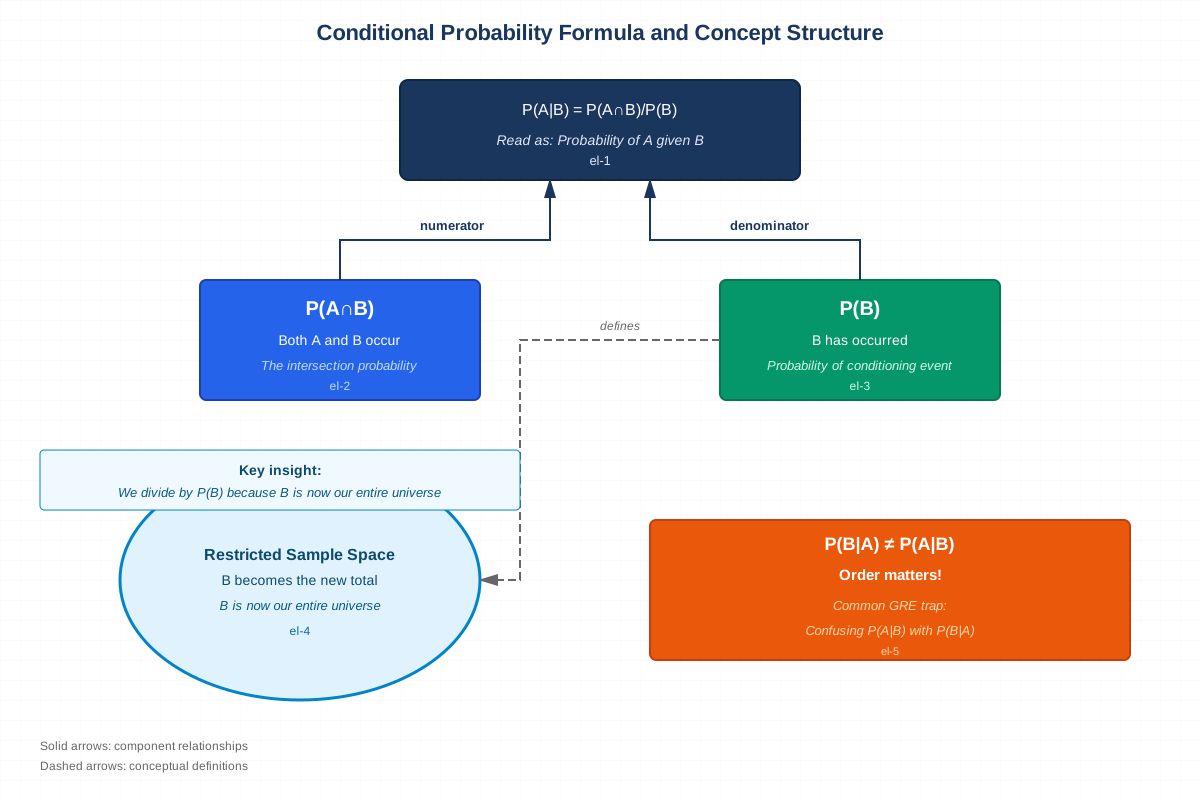
Conditional probability measures the probability of event A occurring given that event B has already occurred, denoted as P(A|B) and read as "the probability of A given B." This concept differs fundamentally from simple probability because it restricts the sample space to only those outcomes where event B has occurred. The formal definition uses the formula:
P(A|B) = P(A ∩ B) / P(B), where P(B) > 0In this formula, P(A ∩ B) represents the probability that both A and B occur (the intersection), and P(B) is the probability that B occurs. The division by P(B) effectively "rescales" the probability space to consider only scenarios where B has happened. This rescaling is the key conceptual insight: when we know B has occurred, we're no longer considering all possible outcomes, only those consistent with B.
The Conditional Probability Formula
The fundamental formula for conditional probability can be rearranged to yield the multiplication rule:
P(A ∩ B) = P(A|B) × P(B) = P(B|A) × P(A)This multiplication rule is particularly useful for calculating the probability of two events both occurring when you know conditional probabilities. On the GRE, students must recognize which form of the formula to apply based on what information the problem provides. If given P(A|B) and P(B), multiply them to find P(A ∩ B). If given P(A ∩ B) and P(B), divide to find P(A|B).
Two-Way Tables and Conditional Probability
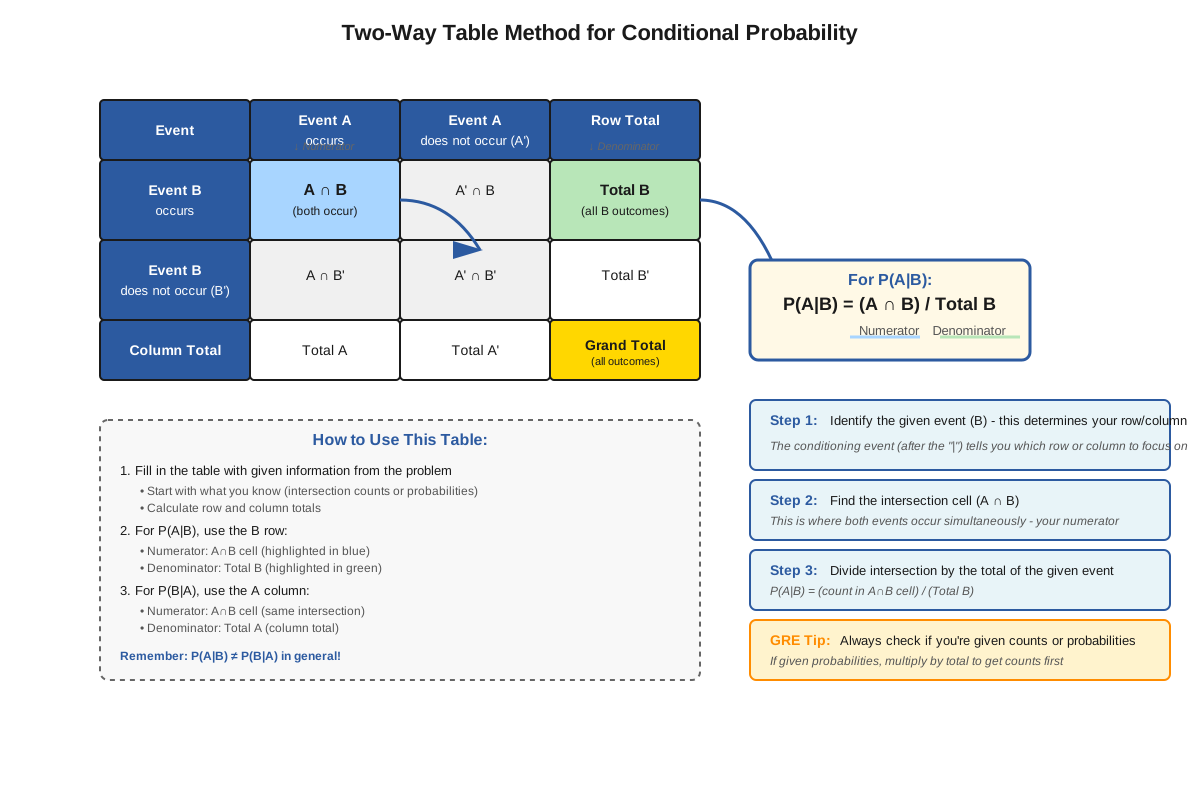
Many GRE conditional probability questions present data in two-way tables (also called contingency tables). These tables organize information about two categorical variables, showing counts or frequencies for each combination of categories. Consider this example structure:
| Event B | Event B' (not B) | Total | |
|---|---|---|---|
| Event A | 30 | 20 | 50 |
| Event A' (not A) | 10 | 40 | 50 |
| Total | 40 | 60 | 100 |
To find P(A|B) from this table, focus only on the "Event B" column. Among the 40 outcomes where B occurred, 30 also have A occurring. Therefore, P(A|B) = 30/40 = 3/4. The key strategy is to identify the correct "restricted sample space" (the column or row corresponding to the given condition) and then find the favorable outcomes within that restricted space.
Independent vs. Dependent Events
Events A and B are independent if the occurrence of one does not affect the probability of the other. Mathematically, A and B are independent if and only if:
P(A|B) = P(A) or equivalently P(A ∩ B) = P(A) × P(B)When events are independent, knowing that B occurred provides no information about A's likelihood. Conversely, events are dependent when P(A|B) ≠ P(A), meaning information about B changes our assessment of A's probability. The GRE frequently tests whether students can recognize independence and apply the appropriate calculation method.
Tree Diagrams for Sequential Events
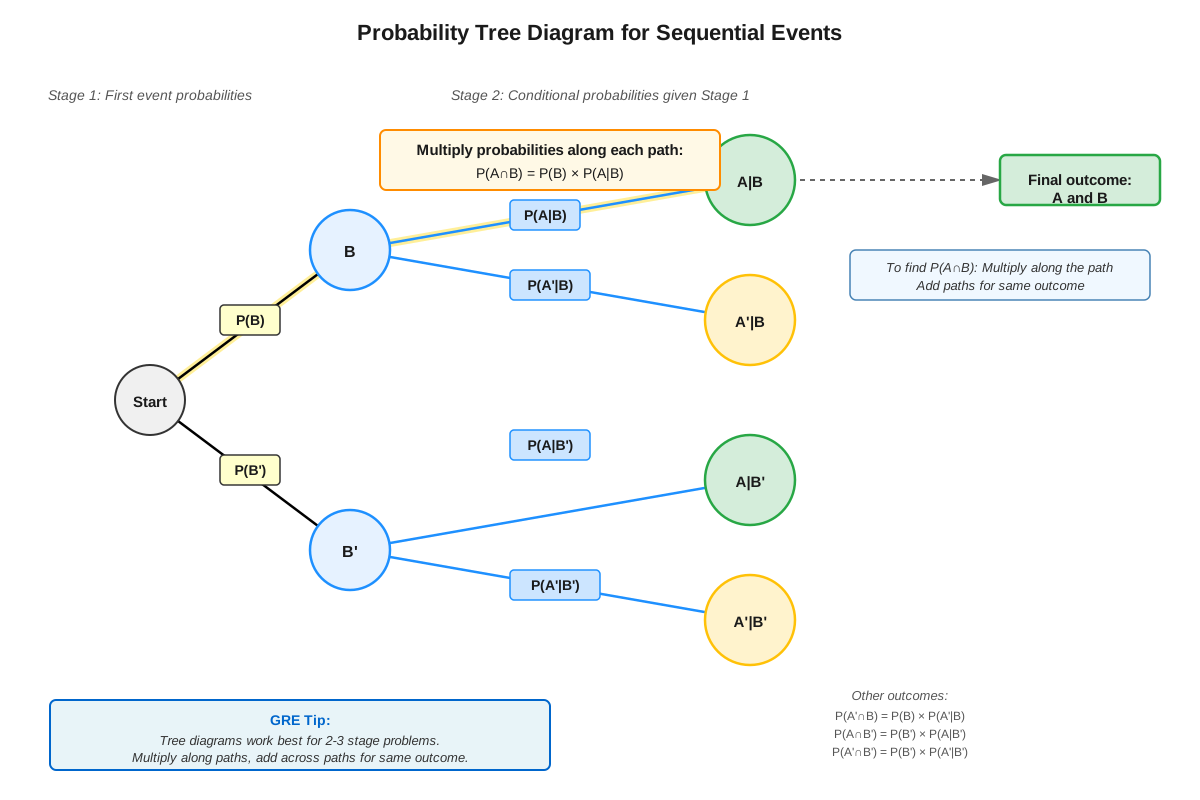
Tree diagrams provide a visual method for calculating conditional probabilities in sequential scenarios. Each branch represents a possible outcome, with probabilities labeled on the branches. To find the probability of a complete path through the tree, multiply the probabilities along that path. This method is particularly useful for problems involving multiple stages or repeated trials.
For example, if a problem describes drawing cards without replacement or testing multiple items from a batch, a tree diagram helps organize the conditional probabilities at each stage. The first set of branches shows initial probabilities, while subsequent branches show conditional probabilities given the previous outcome.
Bayes' Theorem (Conceptual Understanding)
While full Bayes' Theorem calculations rarely appear on the GRE, understanding the concept of "reversing" conditional probabilities is valuable. Bayes' Theorem relates P(A|B) to P(B|A):
P(A|B) = [P(B|A) × P(A)] / P(B)The GRE may present scenarios where you know P(B|A) but need P(A|B), requiring this reversal. Medical testing problems exemplify this: given the test's accuracy P(Positive|Disease) and disease prevalence P(Disease), find the probability someone has the disease given a positive test P(Disease|Positive).
Common Probability Notation
Understanding notation is crucial for correctly interpreting GRE questions:
- P(A|B): probability of A given B has occurred
- P(A ∩ B): probability of both A and B occurring (intersection)
- P(A ∪ B): probability of A or B or both occurring (union)
- P(A'): probability of A not occurring (complement)
- P(A) and P(B): marginal or unconditional probabilities
The vertical bar "|" specifically indicates conditional probability and should trigger recognition that the sample space has been restricted.
Concept Relationships
The core concepts within conditional probability form a logical hierarchy. The definition of conditional probability serves as the foundation, establishing the formula P(A|B) = P(A ∩ B) / P(B). This definition leads directly to the multiplication rule, which rearranges the formula to calculate joint probabilities. The multiplication rule then branches into two applications: calculating probabilities for dependent events (where conditional probabilities differ from marginal probabilities) and verifying independent events (where conditional probabilities equal marginal probabilities).
Two-way tables and tree diagrams represent practical tools for organizing information and calculating conditional probabilities without explicitly using formulas. Both methods implement the same underlying logic but suit different problem types—tables for static categorical data, trees for sequential events. These visualization methods connect back to the fundamental formula by making the restricted sample space visually apparent.
The relationship to prerequisite topics is direct: basic probability provides the foundation for understanding P(A) and P(B), while set theory explains intersections and unions that appear in the conditional probability formula. Fractions and ratios enable the arithmetic manipulations required for calculations. Looking forward, conditional probability connects to more advanced topics like expected value (where probabilities weight outcomes) and combinatorics (which may determine the counts used in probability calculations).
The conceptual flow follows this path: Basic Probability → Sample Spaces → Restricted Sample Spaces → Conditional Probability → Independence Testing → Sequential Events → Complex Multi-Stage Problems.
High-Yield Facts
⭐ The conditional probability formula is P(A|B) = P(A ∩ B) / P(B), where P(B) > 0
⭐ P(A|B) and P(B|A) are generally NOT equal—the order matters critically
⭐ For independent events, P(A|B) = P(A), meaning the condition provides no information
⭐ In two-way tables, find P(A|B) by dividing the intersection cell by the B row/column total
⭐ The multiplication rule states P(A ∩ B) = P(A|B) × P(B) = P(B|A) × P(A)
- When calculating conditional probability from a table, always use the restricted sample space (the total for the given condition) as the denominator
- For sequential events without replacement, probabilities change at each stage because the sample space shrinks
- The complement rule applies to conditional probabilities: P(A'|B) = 1 - P(A|B)
- Tree diagrams require multiplying along branches for path probabilities and adding across paths for total probabilities
- If P(A ∩ B) = P(A) × P(B), then A and B are independent, and all conditional probabilities equal marginal probabilities
- The sum of all conditional probabilities given the same condition must equal 1: P(A|B) + P(A'|B) = 1
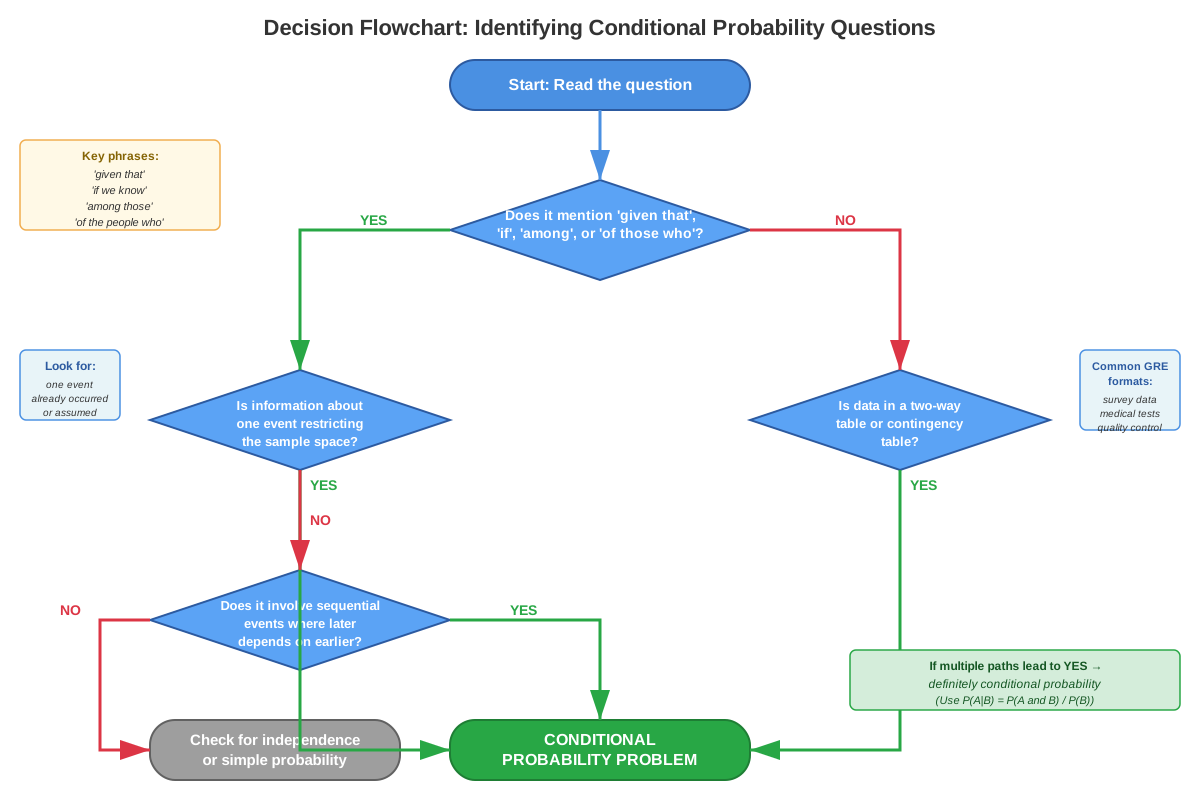
- Conditional probability problems often involve "given that" or "knowing that" language signaling the condition
Quick check — test yourself on Conditional probability so far.
Try Flashcards →Common Misconceptions
Misconception: P(A|B) and P(B|A) are the same thing → Correction: These represent fundamentally different probabilities. P(A|B) restricts the sample space to outcomes where B occurred and asks about A within that space, while P(B|A) does the reverse. For example, P(rain|clouds) differs dramatically from P(clouds|rain).
Misconception: When events are independent, their conditional probabilities are zero → Correction: Independence means P(A|B) = P(A), not that P(A|B) = 0. The condition doesn't eliminate the event; it simply provides no information about it. Zero probability would mean A never occurs when B occurs, which describes mutual exclusivity, not independence.
Misconception: In two-way tables, P(A|B) is found by dividing the A total by the B total → Correction: P(A|B) requires dividing the intersection (the cell where both A and B occur) by the B total. Using row/column totals without considering the intersection is a common calculation error that yields meaningless results.
Misconception: The multiplication rule P(A ∩ B) = P(A) × P(B) always applies → Correction: This simplified multiplication rule only applies when A and B are independent. For dependent events, you must use P(A ∩ B) = P(A|B) × P(B) or P(B|A) × P(A), incorporating the conditional probability.
Misconception: If P(A|B) is high, then P(B|A) must also be high → Correction: These probabilities can differ dramatically. Classic example: P(large vocabulary|college graduate) might be high, but P(college graduate|large vocabulary) could be much lower because many non-graduates have large vocabularies. The relationship depends on the base rates P(A) and P(B).
Misconception: Conditional probability only applies to time-ordered events where one happens before the other → Correction: Conditional probability describes informational relationships, not necessarily temporal ones. "Given that" means "restricting our attention to cases where" rather than "after this happened." Both events might occur simultaneously, or we might learn about them in reverse chronological order.
Worked Examples
Example 1: Two-Way Table Analysis
Problem: A company surveys 200 employees about remote work preferences. The results show:
| Prefers Remote | Prefers Office | Total | |
|---|---|---|---|
| Manager | 25 | 35 | 60 |
| Non-Manager | 95 | 45 | 140 |
| Total | 120 | 80 | 200 |
If an employee is randomly selected from those who prefer remote work, what is the probability that the employee is a manager?
Solution:
Step 1: Identify what we're looking for. The phrase "from those who prefer remote work" signals a conditional probability. We need P(Manager | Prefers Remote).
Step 2: Apply the conditional probability approach for tables. We restrict our sample space to the "Prefers Remote" column, which contains 120 employees total.
Step 3: Within this restricted sample space, identify how many are managers. The intersection of "Manager" and "Prefers Remote" is 25 employees.
Step 4: Calculate the conditional probability:
P(Manager | Prefers Remote) = 25/120 = 5/24Step 5: Verify the answer makes sense. About 21% of remote work preferrers are managers, which is reasonable given that 30% of all employees are managers (60/200). The conditional probability is lower than the overall proportion because managers disproportionately prefer office work.
Connection to Learning Objectives: This example demonstrates identifying conditional probability language ("from those who"), applying the table method, and calculating accurately.
Example 2: Sequential Events with Replacement vs. Without Replacement
Problem: A box contains 5 red marbles and 3 blue marbles.
Part A: If two marbles are drawn WITH replacement, what is the probability both are red?
Part B: If two marbles are drawn WITHOUT replacement, what is the probability both are red?
Solution for Part A (With Replacement):
Step 1: Recognize that with replacement, the draws are independent events. The first draw doesn't affect the second.
Step 2: Calculate P(Red on first draw) = 5/8
Step 3: Calculate P(Red on second draw) = 5/8 (same because the marble is replaced)
Step 4: Apply the multiplication rule for independent events:
P(Both Red) = P(Red first) × P(Red second) = 5/8 × 5/8 = 25/64Solution for Part B (Without Replacement):
Step 1: Recognize that without replacement, the draws are dependent events. The second probability depends on the first outcome.
Step 2: Calculate P(Red on first draw) = 5/8
Step 3: Calculate P(Red on second draw | Red on first draw). After removing one red marble, there are 4 red and 3 blue remaining (7 total). So P(Red second | Red first) = 4/7
Step 4: Apply the multiplication rule for dependent events:
P(Both Red) = P(Red first) × P(Red second | Red first) = 5/8 × 4/7 = 20/56 = 5/14Step 5: Compare the results. With replacement: 25/64 ≈ 0.391. Without replacement: 5/14 ≈ 0.357. The probability is lower without replacement because removing a red marble decreases the proportion of red marbles remaining.
Connection to Learning Objectives: This example illustrates distinguishing between independent and dependent events, applying conditional probability to sequential scenarios, and using the multiplication rule correctly in both cases.
Exam Strategy
When approaching GRE conditional probability questions, begin by identifying the trigger language that signals conditional probability: "given that," "knowing that," "among those who," "if we select from," "of those," or "restricting to." These phrases indicate that the sample space has been restricted, and you need P(A|B) rather than P(A).
Next, determine what information is provided and what you need to find. Write out the probability notation explicitly: if the problem states "among employees who work remotely, 60% are satisfied," translate this to P(Satisfied | Remote) = 0.6. This translation step prevents confusion between P(A|B) and P(B|A), one of the most common errors.
Choose your solution method based on how information is presented:
- If data appears in a two-way table, use the table method (intersection divided by condition total)
- If the problem describes sequential events, draw a tree diagram or use the multiplication rule
- If the problem provides P(A|B) and asks for P(B|A), recognize you may need to use Bayes' Theorem concepts or work through the definitions
For Quantitative Comparison questions involving conditional probability, avoid calculating both quantities if possible. Instead, look for logical relationships. For example, if comparing P(A|B) with P(A), determine whether B makes A more likely (dependent events) or has no effect (independent events). This qualitative reasoning can save significant time.
Time management: Allocate 1.5-2 minutes for straightforward conditional probability calculations and up to 3 minutes for complex multi-step problems. If a problem requires extensive calculation, ensure you're not missing a simpler logical approach. The GRE rewards efficient reasoning over brute-force computation.
Process of elimination works well when answer choices differ significantly in magnitude. Calculate a rough estimate first: if P(A|B) should be around 1/3, eliminate answers near 1/2 or 1/10 before performing exact calculations. For Quantitative Comparison, eliminate choices C and D if you can determine a definite relationship, even without exact values.
Memory Techniques
Mnemonic for the formula: "Conditional Divides Intersection By Condition" → P(A|B) = P(A ∩ B) / P(B). The vertical bar in P(A|B) can be visualized as a division symbol, reminding you to divide by the condition.
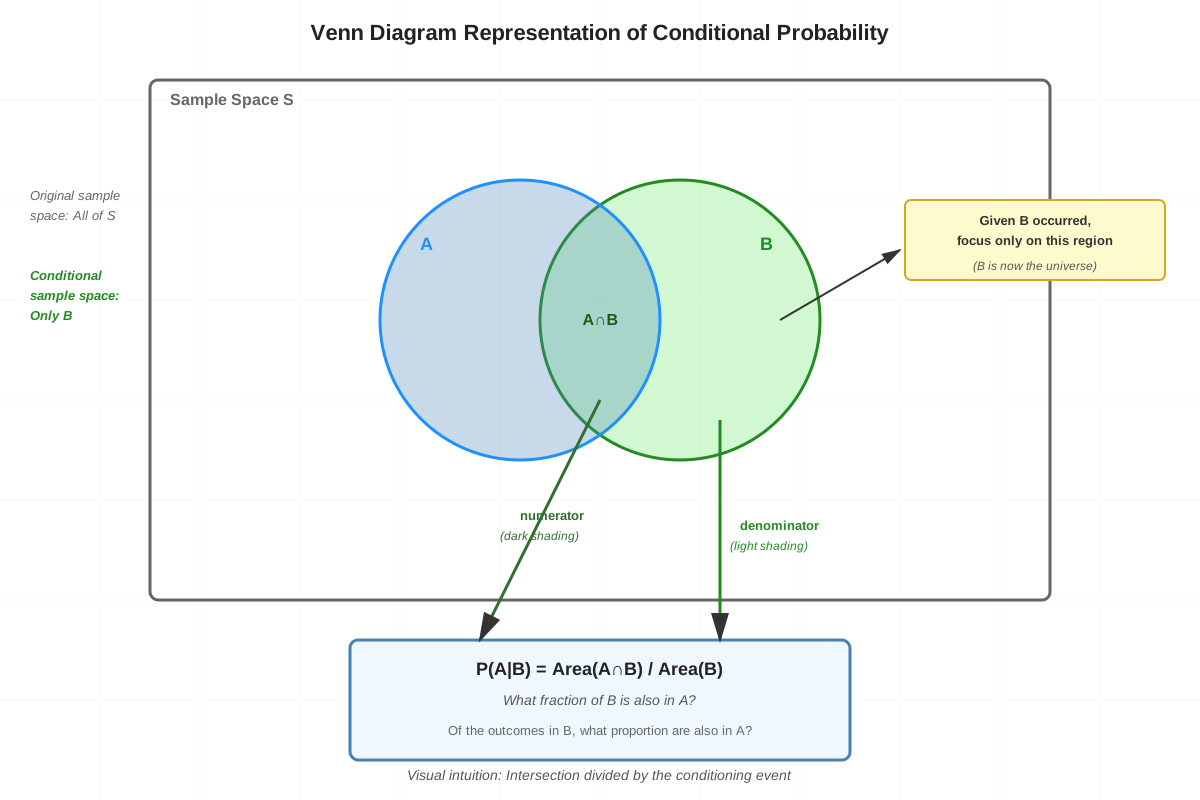
Visualization strategy: Picture conditional probability as "zooming in" on a Venn diagram. When calculating P(A|B), imagine the entire diagram shrinking to show only the B circle, then asking what fraction of this restricted view contains A. This mental image reinforces that the denominator changes from "all outcomes" to "outcomes in B."
Acronym for independence testing: SAME → "Same After Multiplying Events." If P(A|B) is the SAME as P(A), events are independent, and you can multiply marginal probabilities.
The "Given" Rule: Whenever you see "given," "among," or "of those," the word immediately following indicates what goes AFTER the vertical bar. "Given B" means P(?|B). This simple rule prevents reversing the condition and outcome.
Table Navigation: Remember "Row Restricts, Column Conditions" or vice versa depending on table orientation. If the condition is a row category, use that row total as the denominator. If it's a column category, use that column total.
Summary
Conditional probability measures the likelihood of an event given that another event has occurred, fundamentally changing the sample space from all possible outcomes to only those consistent with the given condition. The core formula P(A|B) = P(A ∩ B) / P(B) captures this restriction mathematically by dividing the joint probability by the condition's probability. On the GRE, conditional probability appears frequently in data analysis questions, typically presented through two-way tables, sequential event scenarios, or word problems requiring students to distinguish between P(A|B) and P(B|A). Mastery requires recognizing trigger language, correctly identifying the restricted sample space, applying the appropriate calculation method (formula, table, or tree diagram), and understanding the relationship between conditional probability and independence. Students must avoid common errors such as confusing P(A|B) with P(B|A), incorrectly applying the multiplication rule to dependent events, or misidentifying the denominator in table-based calculations. Success on GRE conditional probability questions demonstrates both computational accuracy and logical reasoning—the ability to translate complex verbal descriptions into precise mathematical relationships and interpret results in context.
Key Takeaways
- Conditional probability P(A|B) restricts the sample space to outcomes where B occurred, making it fundamentally different from P(A)
- The order matters critically: P(A|B) ≠ P(B|A) in general, and confusing these is the most common error
- For two-way tables, divide the intersection cell by the total for the given condition (row or column)
- Independent events satisfy P(A|B) = P(A), allowing the simplified multiplication rule P(A ∩ B) = P(A) × P(B)
- Trigger phrases like "given that," "among those who," and "of those" signal conditional probability
- The multiplication rule P(A ∩ B) = P(A|B) × P(B) applies to all events, dependent or independent
- Sequential events without replacement create dependent events where probabilities change at each stage
Related Topics
Basic Probability and Counting Principles: Mastering conditional probability enables progression to more complex probability scenarios involving combinations and permutations, where conditional reasoning determines which arrangements are valid.
Expected Value and Probability Distributions: Conditional probability forms the foundation for calculating expected values in scenarios where outcomes depend on prior events, essential for decision theory and risk analysis questions.
Statistical Independence and Correlation: Understanding when events are independent versus dependent connects to broader statistical concepts about relationships between variables, preparing students for data interpretation questions.
Bayes' Theorem and Diagnostic Testing: Advanced applications of conditional probability include medical testing scenarios, quality control, and updating probabilities based on new information—topics that occasionally appear in challenging GRE questions.
Practice CTA
Now that you've mastered the core concepts of conditional probability, it's time to solidify your understanding through practice. Attempt the practice questions to test your ability to identify conditional probability scenarios, apply the correct formulas, and avoid common pitfalls. Use the flashcards to reinforce key formulas and definitions until they become automatic. Remember, conditional probability is a high-yield GRE topic—investing time now will pay dividends on test day. Each practice problem you solve builds the pattern recognition and computational fluency needed to handle these questions confidently under time pressure. You've got this!
Sign up free to keep reading
Create a free AnvayaPrep account to finish this GRE guide on Conditional probability — plus flashcards and practice questions.