Overview
Mutually exclusive events represent a fundamental concept in probability theory that appears frequently on the GRE Quantitative Reasoning section. These events are defined by a simple but powerful characteristic: they cannot occur simultaneously. When two or more events are mutually exclusive, the occurrence of one event completely prevents the occurrence of the other(s). For example, when flipping a coin, getting heads and getting tails are mutually exclusive events—the coin cannot land on both sides at once. Understanding this concept is critical for correctly calculating probabilities in scenarios where multiple outcomes are possible but cannot happen together.
The GRE tests gre mutually exclusive events through various question formats, including probability calculations, data interpretation problems, and logical reasoning scenarios. Students must not only recognize when events are mutually exclusive but also apply the appropriate probability rules to solve complex problems efficiently. This topic frequently appears in combination with other probability concepts such as independent events, complementary events, and conditional probability, making it a cornerstone of data analysis questions on the exam.
Mastering mutually exclusive events provides the foundation for understanding more advanced probability concepts tested on the GRE. This topic connects directly to set theory, Venn diagrams, and the addition rule of probability. Students who thoroughly understand mutually exclusive events can more easily navigate compound probability questions, recognize when to add versus multiply probabilities, and avoid common calculation errors that result from confusing mutually exclusive events with independent events—two distinct concepts that test-takers often conflate.
Learning Objectives
- [ ] Identify when mutually exclusive events is being tested in GRE questions
- [ ] Explain the core rule or strategy behind mutually exclusive events
- [ ] Apply mutually exclusive events to GRE-style questions accurately
- [ ] Distinguish between mutually exclusive events and independent events
- [ ] Calculate probabilities using the addition rule for mutually exclusive events
- [ ] Recognize when events are NOT mutually exclusive and adjust calculations accordingly
- [ ] Solve multi-step probability problems involving both mutually exclusive and non-mutually exclusive events
Prerequisites
- Basic probability concepts: Understanding probability as a ratio of favorable outcomes to total possible outcomes is essential for applying mutually exclusive event rules
- Set theory fundamentals: Knowledge of sets, unions, and intersections helps visualize relationships between mutually exclusive events
- Fraction and decimal operations: Probability calculations require fluency with adding, subtracting, multiplying, and dividing fractions
- Basic logic: Recognizing "or" versus "and" statements is crucial for determining whether to add or multiply probabilities
Why This Topic Matters
Mutually exclusive events appear in approximately 8-12% of GRE Quantitative Reasoning questions, making them a high-yield topic for test preparation. These questions typically appear in the Data Analysis category, which comprises roughly 25% of the quantitative section. Understanding this concept can directly impact performance on 2-3 questions per exam, potentially adding 3-5 points to the scaled score.
In real-world applications, mutually exclusive events underpin decision-making in business, medicine, and engineering. Market analysts use this concept when evaluating competing product launches that cannot occur simultaneously. Medical researchers apply it when calculating the probability of different diagnoses that cannot coexist. Quality control engineers use mutually exclusive event analysis when assessing manufacturing defects that fall into distinct, non-overlapping categories.
On the GRE, mutually exclusive events commonly appear in several formats: word problems involving dice, cards, or spinners; data interpretation questions with tables or charts showing categorical data; and logical reasoning problems requiring students to determine whether outcomes can occur together. The exam often tests whether students can recognize that events are NOT mutually exclusive, requiring them to subtract the probability of overlap—a sophisticated application that distinguishes high scorers from average performers.
Core Concepts
Definition of Mutually Exclusive Events
Two or more events are mutually exclusive (also called disjoint events) if they cannot occur at the same time. Mathematically, events A and B are mutually exclusive if their intersection is empty: P(A ∩ B) = 0. This means there is zero probability that both events occur simultaneously.
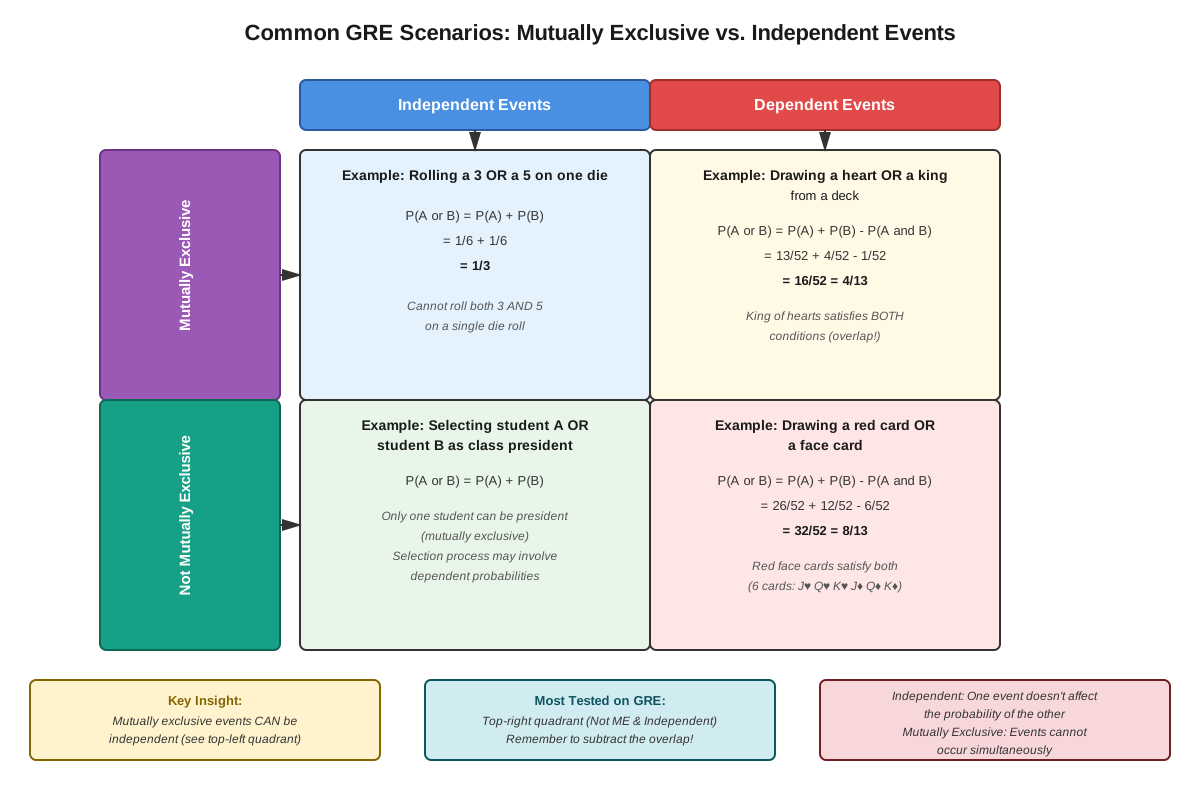
Consider rolling a standard six-sided die. The event "rolling a 2" and the event "rolling a 5" are mutually exclusive because a single roll cannot produce both numbers. However, the event "rolling an even number" and the event "rolling a number less than 4" are NOT mutually exclusive because rolling a 2 satisfies both conditions.
The Addition Rule for Mutually Exclusive Events
The fundamental rule for calculating probabilities with mutually exclusive events is the addition rule: If events A and B are mutually exclusive, then:
P(A or B) = P(A) + P(B)This rule extends to any number of mutually exclusive events:
P(A or B or C or ... or N) = P(A) + P(B) + P(C) + ... + P(N)For example, when drawing one card from a standard 52-card deck, the probability of drawing a heart OR a club is:
- P(heart) = 13/52
- P(club) = 13/52
- P(heart or club) = 13/52 + 13/52 = 26/52 = 1/2
These events are mutually exclusive because a single card cannot be both a heart and a club.
Contrast with Non-Mutually Exclusive Events
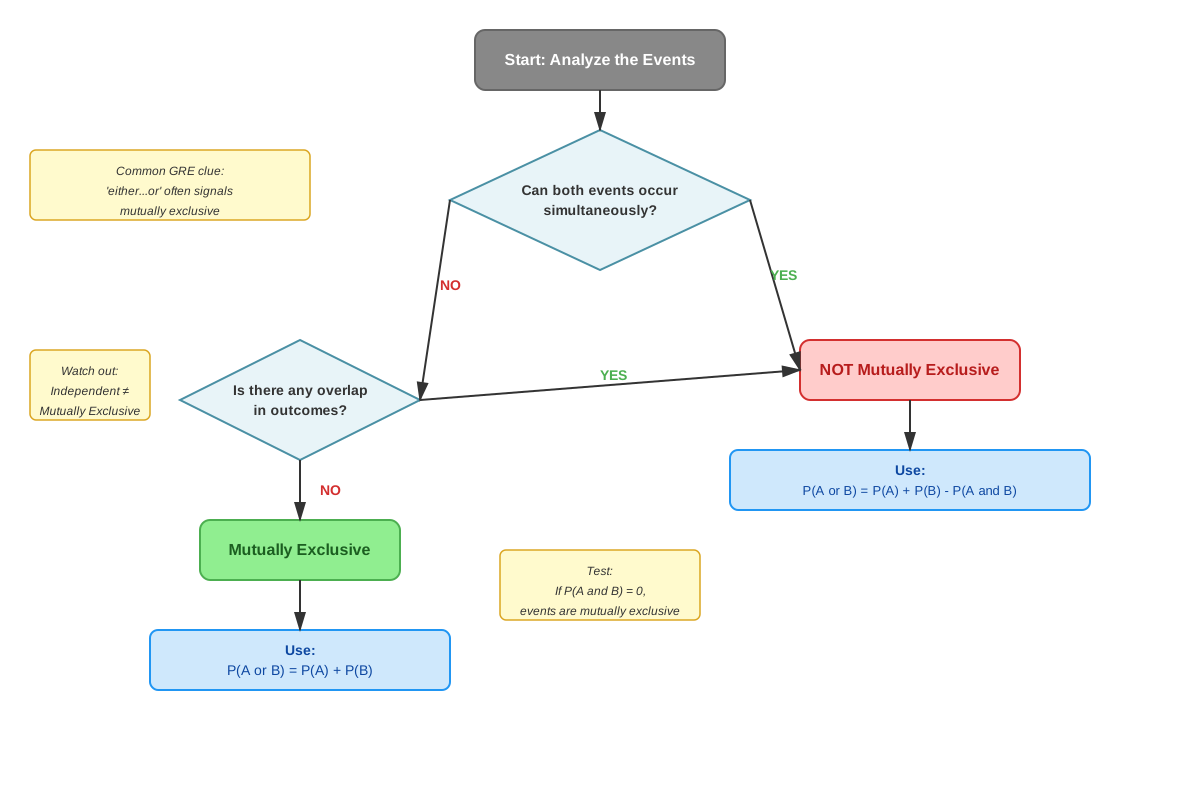
When events are NOT mutually exclusive, they can occur together, and the addition rule must be modified to avoid double-counting the overlap:
P(A or B) = P(A) + P(B) - P(A and B)This distinction is critical for GRE success. Consider drawing one card from a deck: the probability of drawing a heart OR a face card requires the modified formula because some cards are both hearts and face cards (Jack, Queen, King of hearts).
| Event Type | Can Occur Together? | Formula | Example |
|---|---|---|---|
| Mutually Exclusive | No | P(A or B) = P(A) + P(B) | Rolling a 2 or 5 on one die |
| Non-Mutually Exclusive | Yes | P(A or B) = P(A) + P(B) - P(A and B) | Drawing a heart or face card |
Identifying Mutually Exclusive Events
To determine whether events are mutually exclusive, ask: "Can both events happen at the same time in a single trial?" If the answer is no, they are mutually exclusive.
Mutually exclusive examples:
- Turning left or turning right at an intersection (assuming no U-turns)
- A student receiving an A or a B as a final grade (one grade per course)
- A product being defective or non-defective
- Winning first place or second place in a race (one person, one position)
NOT mutually exclusive examples:
- Being a student and being employed (can be both)
- Drawing a red card and drawing a king (red kings exist)
- Raining today and being cloudy today (rain requires clouds)
- Scoring above 160 on Verbal and above 160 on Quantitative (can achieve both)
Exhaustive and Mutually Exclusive Events
A set of events is exhaustive if at least one of them must occur. When events are both mutually exclusive AND exhaustive, their probabilities sum to 1. This property is particularly useful for checking calculations and solving problems involving complementary events.
For example, when rolling a die, the events "rolling 1, 2, 3, 4, 5, or 6" are mutually exclusive (only one number appears) and exhaustive (one of these must occur), so their probabilities sum to 1.
Multiple Mutually Exclusive Events
GRE questions often involve more than two mutually exclusive events. The key principle remains the same: add the individual probabilities. For instance, if a spinner has five equal sections colored red, blue, green, yellow, and orange, the probability of landing on red, blue, OR green is:
P(red or blue or green) = P(red) + P(blue) + P(green) = 1/5 + 1/5 + 1/5 = 3/5Concept Relationships
Mutually exclusive events form the foundation for understanding the addition rule of probability, which branches into two cases: the simple addition rule (for mutually exclusive events) and the general addition rule (for non-mutually exclusive events). This distinction is crucial because applying the wrong formula leads to incorrect answers.
The concept connects directly to complementary events, which are always mutually exclusive. If event A occurs, its complement A' cannot occur, making them mutually exclusive by definition. This relationship enables the useful formula P(A) + P(A') = 1, frequently tested on the GRE.
Mutually exclusive events must be carefully distinguished from independent events. These are separate concepts that students often confuse:
- Mutually exclusive → events cannot occur together → P(A and B) = 0
- Independent → one event's occurrence doesn't affect the other's probability → P(A and B) = P(A) × P(B)
Interestingly, mutually exclusive events (except when one has probability zero) are NEVER independent, because knowing one occurred tells you the other definitely did not occur.
Relationship map:
Probability Theory → Addition Rule → Mutually Exclusive Events (simple addition) vs. Non-Mutually Exclusive Events (subtract overlap) → Connects to Set Theory (empty intersection) → Relates to but differs from Independent Events (multiplication rule) → Special case includes Complementary Events (always mutually exclusive, sum to 1)
Quick check — test yourself on Mutually exclusive events so far.
Try Flashcards →High-Yield Facts
⭐ Mutually exclusive events cannot occur simultaneously; their intersection probability equals zero: P(A ∩ B) = 0
⭐ For mutually exclusive events, use simple addition: P(A or B) = P(A) + P(B)
⭐ Mutually exclusive events are NOT the same as independent events; they are distinct concepts
⭐ Complementary events are always mutually exclusive and their probabilities sum to 1
⭐ When events CAN occur together, subtract the overlap: P(A or B) = P(A) + P(B) - P(A and B)
- If two events are mutually exclusive and one occurs, the other definitely did not occur
- A set of mutually exclusive and exhaustive events has probabilities that sum to exactly 1
- The word "or" in probability typically signals addition, but only use simple addition when events are mutually exclusive
- Rolling different numbers on a single die roll always produces mutually exclusive events
- Drawing one card from a deck: different suits are mutually exclusive, but suit and rank may not be
- In Venn diagrams, mutually exclusive events are represented by non-overlapping circles
- Multiple mutually exclusive events follow the same rule: add all individual probabilities
- If P(A and B) > 0, then events A and B are definitely NOT mutually exclusive
Common Misconceptions
Misconception: Mutually exclusive and independent mean the same thing.
Correction: These are completely different concepts. Mutually exclusive means events cannot occur together (P(A and B) = 0). Independent means one event's occurrence doesn't affect the other's probability (P(A and B) = P(A) × P(B)). In fact, non-zero mutually exclusive events are always dependent, not independent.
Misconception: All probability problems involving "or" require simple addition of probabilities.
Correction: Only use P(A or B) = P(A) + P(B) when events are mutually exclusive. If events can occur together, you must subtract the overlap: P(A or B) = P(A) + P(B) - P(A and B). Always check whether events can occur simultaneously before choosing your formula.
Misconception: If two events are different, they must be mutually exclusive.
Correction: Events can be different yet still occur together. For example, "drawing a heart" and "drawing a king" are different events, but they can both occur (King of Hearts). Being different doesn't automatically make events mutually exclusive.
Misconception: When calculating P(A or B or C) for mutually exclusive events, you need to consider pairwise intersections.
Correction: For mutually exclusive events, simply add all probabilities: P(A or B or C) = P(A) + P(B) + P(C). The complex inclusion-exclusion principle only applies when events are NOT mutually exclusive.
Misconception: If events are mutually exclusive, their probabilities must be equal.
Correction: Mutually exclusive events can have any probabilities as long as they cannot occur together. For example, when rolling a die, "rolling a 1" (probability 1/6) and "rolling an even number" (probability 3/6) are mutually exclusive but have different probabilities.
Misconception: Complementary events and mutually exclusive events are the same thing.
Correction: All complementary events are mutually exclusive, but not all mutually exclusive events are complementary. Complementary events must also be exhaustive (cover all possibilities and sum to 1). Events A and B can be mutually exclusive without being complements if there are other possible outcomes.
Worked Examples
Example 1: Basic Mutually Exclusive Events
Problem: A bag contains 5 red marbles, 3 blue marbles, and 2 green marbles. If one marble is drawn randomly, what is the probability that it is either red or green?
Solution:
Step 1: Identify the events and determine if they are mutually exclusive.
- Event A: Drawing a red marble
- Event B: Drawing a green marble
- These events ARE mutually exclusive because a single marble cannot be both red and green simultaneously.
Step 2: Calculate individual probabilities.
- Total marbles = 5 + 3 + 2 = 10
- P(red) = 5/10 = 1/2
- P(green) = 2/10 = 1/5
Step 3: Apply the addition rule for mutually exclusive events.
- P(red or green) = P(red) + P(green)
- P(red or green) = 1/2 + 1/5
- P(red or green) = 5/10 + 2/10 = 7/10
Answer: 7/10 or 0.7
Connection to learning objectives: This example demonstrates identifying mutually exclusive events (different colors cannot occur on one marble) and applying the core addition rule accurately.
Example 2: Distinguishing Mutually Exclusive from Non-Mutually Exclusive
Problem: In a class of 30 students, 18 students play basketball, 12 students play soccer, and 5 students play both sports. If a student is selected randomly, what is the probability that the student plays basketball or soccer?
Solution:
Step 1: Identify the events and determine if they are mutually exclusive.
- Event A: Student plays basketball
- Event B: Student plays soccer
- These events are NOT mutually exclusive because 5 students play both sports (they can occur together).
Step 2: Calculate individual probabilities.
- P(basketball) = 18/30 = 3/5
- P(soccer) = 12/30 = 2/5
- P(both) = 5/30 = 1/6
Step 3: Apply the general addition rule (for non-mutually exclusive events).
- P(basketball or soccer) = P(basketball) + P(soccer) - P(both)
- P(basketball or soccer) = 18/30 + 12/30 - 5/30
- P(basketball or soccer) = 25/30 = 5/6
Common error to avoid: If you incorrectly assumed these events were mutually exclusive and used P(A or B) = P(A) + P(B), you would get 18/30 + 12/30 = 30/30 = 1, suggesting every student plays at least one sport. This contradicts the given information and demonstrates why recognizing non-mutually exclusive events is crucial.
Answer: 5/6 or approximately 0.833
Connection to learning objectives: This example shows how to distinguish between mutually exclusive and non-mutually exclusive events, and demonstrates when to adjust calculations by subtracting the overlap.
Exam Strategy
Trigger phrases: Watch for "or," "either...or," "cannot both occur," "different outcomes," and "one of the following" as signals that you may need to apply mutually exclusive event rules.
Step-by-step approach for GRE questions:
- Read carefully to identify all events: Underline or note each distinct event mentioned in the problem.
- Ask the critical question: "Can these events occur together in a single trial?" This determines whether events are mutually exclusive.
- Choose the correct formula:
- If mutually exclusive: P(A or B) = P(A) + P(B)
- If not mutually exclusive: P(A or B) = P(A) + P(B) - P(A and B)
- Calculate individual probabilities first: Find P(A) and P(B) separately before combining them.
- Check your answer: Does the probability fall between 0 and 1? For mutually exclusive events, is P(A or B) ≤ 1?
Process of elimination tips:
- Eliminate answer choices greater than 1 (impossible for probabilities)
- If you added probabilities and got a sum greater than 1, the events are likely NOT mutually exclusive
- For "or" questions with mutually exclusive events, the answer must be at least as large as the largest individual probability
- If answer choices include both P(A) + P(B) and P(A) + P(B) - something, the events are probably NOT mutually exclusive
Time allocation: Spend 15-20 seconds determining whether events are mutually exclusive before calculating. This prevents having to redo the entire problem. Most mutually exclusive event problems should take 60-90 seconds total.
Red flags that events are NOT mutually exclusive:
- The problem mentions overlap, intersection, or "both"
- Events involve different characteristics of the same item (e.g., color AND size)
- A Venn diagram shows overlapping regions
- The problem provides information about P(A and B)
Memory Techniques
Mnemonic for the key distinction: "ME = Must Exclude" (Mutually Exclusive means events Must Exclude each other)
Visualization strategy: Picture mutually exclusive events as separate islands with no bridge between them—you can be on one island or the other, but never both simultaneously. Non-mutually exclusive events are like overlapping circles where you can stand in the intersection.
Formula memory aid: "Mutually Exclusive = Simply Add" vs. "Overlap Exists = Subtract Intersection"
Acronym for checking: CAMO
- Can they occur together?
- Add if mutually exclusive
- Modify (subtract overlap) if not
- Outcome must be between 0 and 1
Physical gesture: When studying, hold up two separate fingers for mutually exclusive (cannot touch) versus interlocking fingers for non-mutually exclusive (can overlap). This kinesthetic memory aid helps during the exam.
Summary
Mutually exclusive events are outcomes that cannot occur simultaneously, forming a cornerstone concept in GRE probability questions. The defining characteristic is that P(A and B) = 0, meaning zero probability of both events occurring together. When events are mutually exclusive, calculating the probability of "A or B" requires simple addition: P(A or B) = P(A) + P(B). However, when events can occur together, the formula must account for overlap by subtracting P(A and B). The GRE frequently tests whether students can distinguish mutually exclusive from non-mutually exclusive events and from independent events—three distinct concepts that are commonly confused. Success requires carefully reading problems to determine whether events can occur together, selecting the appropriate formula, and executing calculations accurately. Complementary events represent a special case of mutually exclusive events that always sum to 1, providing a useful check for probability calculations.
Key Takeaways
- Mutually exclusive events cannot occur simultaneously; their intersection probability equals zero
- Use simple addition P(A or B) = P(A) + P(B) only when events are mutually exclusive
- Always ask "Can both happen together?" before choosing your calculation method
- Mutually exclusive ≠ independent; these are completely different probability concepts
- When events can overlap, subtract the intersection: P(A or B) = P(A) + P(B) - P(A and B)
- Complementary events are always mutually exclusive and sum to 1
- Watch for trigger words like "or," "either," and "cannot both occur" in GRE questions
Related Topics
Independent Events: Understanding how events can be unrelated in probability (one's occurrence doesn't affect the other's probability) builds on mutually exclusive concepts and helps avoid confusion between these distinct ideas.
Conditional Probability: Once you master mutually exclusive events, conditional probability extends your ability to calculate probabilities when additional information is known, frequently appearing alongside mutually exclusive event questions.
Complementary Events: A special case of mutually exclusive events where two outcomes cover all possibilities, essential for efficiently solving "at least one" probability problems.
Venn Diagrams and Set Theory: Visual representations of mutually exclusive and overlapping events help solidify understanding and provide problem-solving tools for complex probability scenarios.
The Multiplication Rule: After mastering when to add probabilities (mutually exclusive events), learning when to multiply probabilities (independent events occurring together) completes the fundamental probability toolkit for the GRE.
Practice CTA
Now that you understand mutually exclusive events, reinforce your mastery by attempting the practice questions designed specifically for this topic. Each question targets the key concepts and common traps that appear on the GRE. Use the flashcards to drill the critical distinctions between mutually exclusive, independent, and complementary events until recognition becomes automatic. Remember: the difference between a good score and a great score often comes down to correctly identifying whether events can occur together—a skill that improves dramatically with focused practice. You've built the foundation; now apply it to achieve your target score!
Sign up free to keep reading
Create a free AnvayaPrep account to finish this GRE guide on Mutually exclusive events — plus flashcards and practice questions.