Overview
Dependent events are a fundamental concept in probability theory that appears frequently on the GRE Quantitative Reasoning section. Unlike independent events where one outcome has no effect on another, dependent events are situations where the occurrence of one event directly affects the probability of another event occurring. Understanding this distinction is critical for solving a wide range of GRE probability problems, from simple card-drawing scenarios to complex multi-stage selection problems.
The GRE tests dependent events in various contexts, including drawing objects without replacement, conditional probability scenarios, and sequential selection problems. These questions often appear in both Quantitative Comparison and Problem Solving formats, requiring students to calculate compound probabilities accurately. Mastery of GRE dependent events is essential because these problems frequently combine multiple mathematical concepts, including fractions, ratios, and logical reasoning, making them high-value questions that can significantly impact your score.
This topic sits at the intersection of probability theory and combinatorics within the Data Analysis unit. It builds upon foundational probability concepts and connects to more advanced topics like conditional probability and combinatorial analysis. Students who master dependent events gain a powerful analytical framework for approaching complex multi-stage problems, which represents a significant portion of the probability questions on the GRE.
Learning Objectives
- [ ] Identify when Dependent events is being tested
- [ ] Explain the core rule or strategy behind Dependent events
- [ ] Apply Dependent events to GRE-style questions accurately
- [ ] Distinguish between dependent and independent events in various problem contexts
- [ ] Calculate compound probabilities for sequential dependent events using the multiplication rule
- [ ] Recognize and avoid common calculation errors when dealing with changing sample spaces
Prerequisites
- Basic probability concepts: Understanding probability as a ratio of favorable outcomes to total outcomes is essential for calculating individual event probabilities
- Fraction operations: Multiplying and simplifying fractions is required for computing compound probabilities in dependent event scenarios
- Combinatorics fundamentals: Knowledge of counting principles helps determine the number of possible outcomes in selection problems
- Set theory basics: Understanding how events relate to one another provides the conceptual foundation for dependent relationships
Why This Topic Matters
Dependent events represent real-world scenarios where outcomes are interconnected, making this concept highly practical beyond standardized testing. In everyday life, dependent events appear in quality control sampling, medical testing sequences, card games, and risk assessment. Understanding how one event influences another is fundamental to statistical reasoning and decision-making in fields ranging from finance to healthcare.
On the GRE, dependent events questions appear in approximately 15-20% of probability problems, making them a high-yield topic for test preparation. These questions typically appear as Problem Solving questions worth one point or as Quantitative Comparison questions requiring careful analysis. The Educational Testing Service (ETS) favors dependent events problems because they effectively test multiple skills simultaneously: probability calculation, logical reasoning, and attention to detail regarding changing conditions.
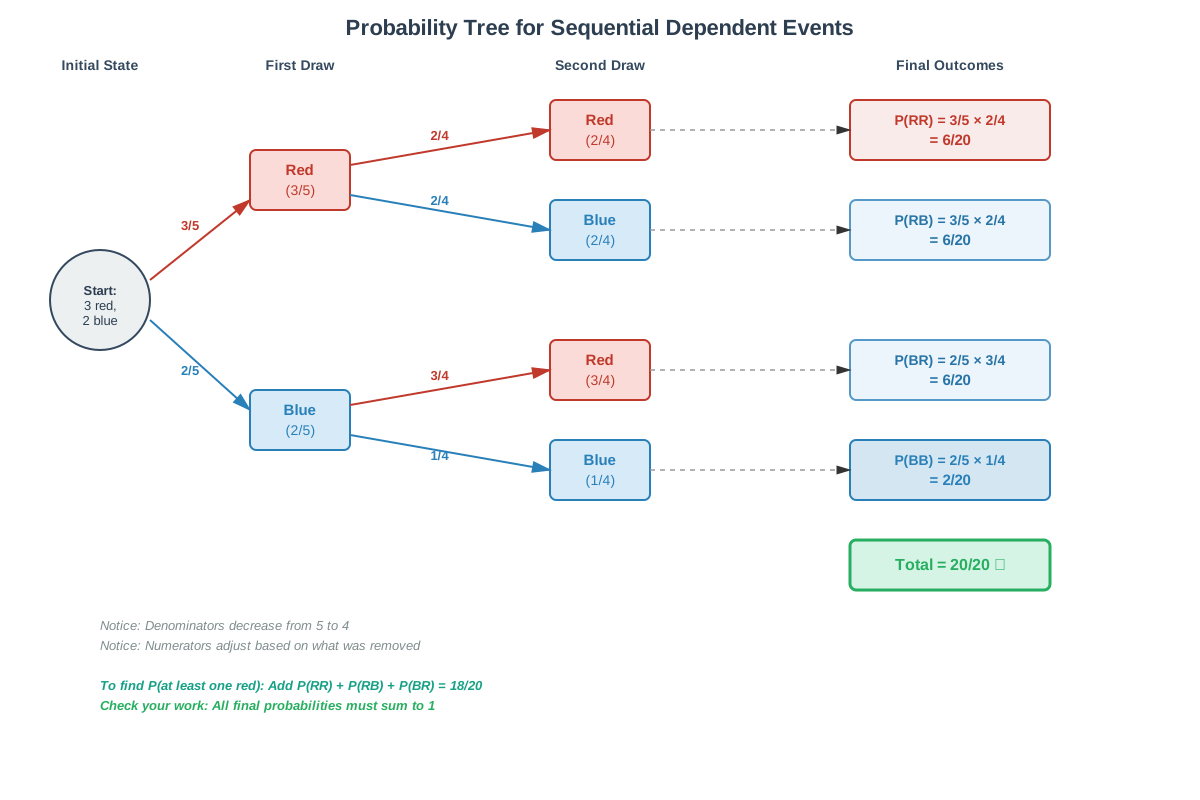
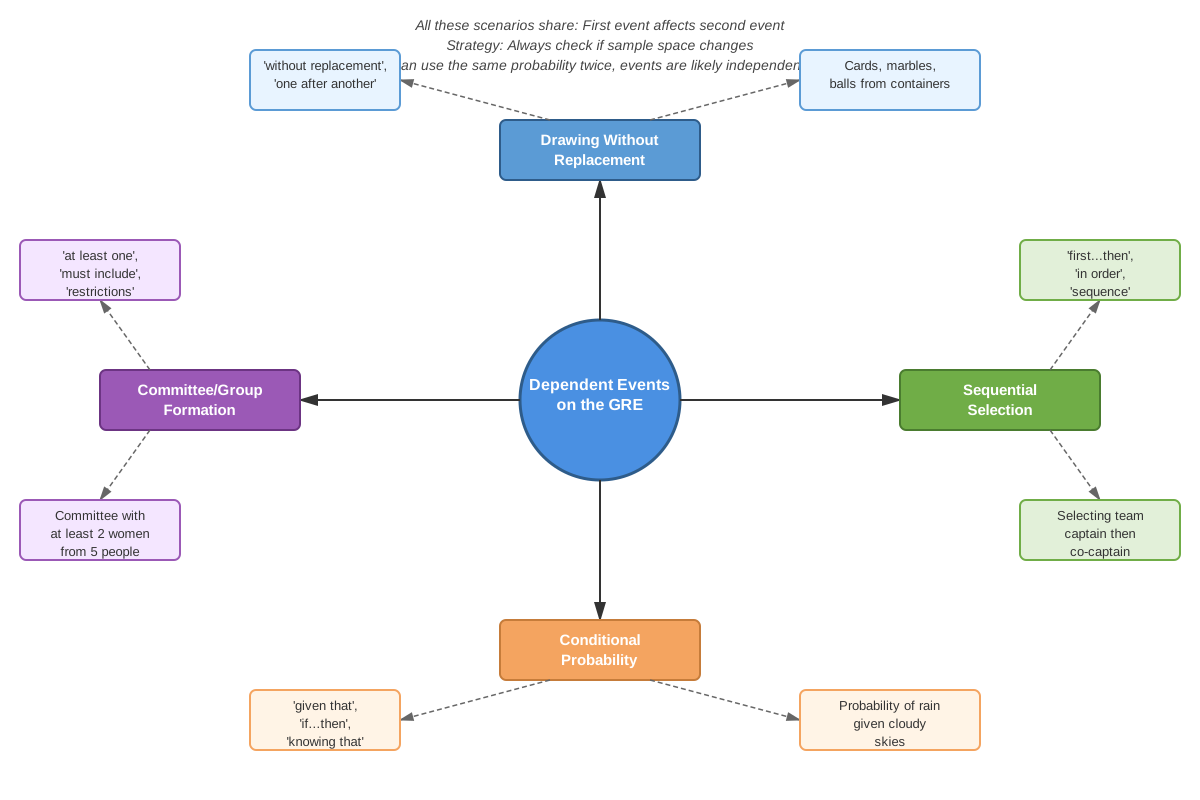
Common GRE presentations include drawing objects from a container without replacement, selecting committee members with restrictions, probability trees with sequential outcomes, and conditional probability scenarios. Questions often feature trigger phrases like "without replacement," "given that," "and then," or "one after another," signaling that events are dependent. Recognizing these patterns quickly allows test-takers to apply the correct probability framework and avoid the common error of treating dependent events as independent.
Core Concepts
Definition of Dependent Events
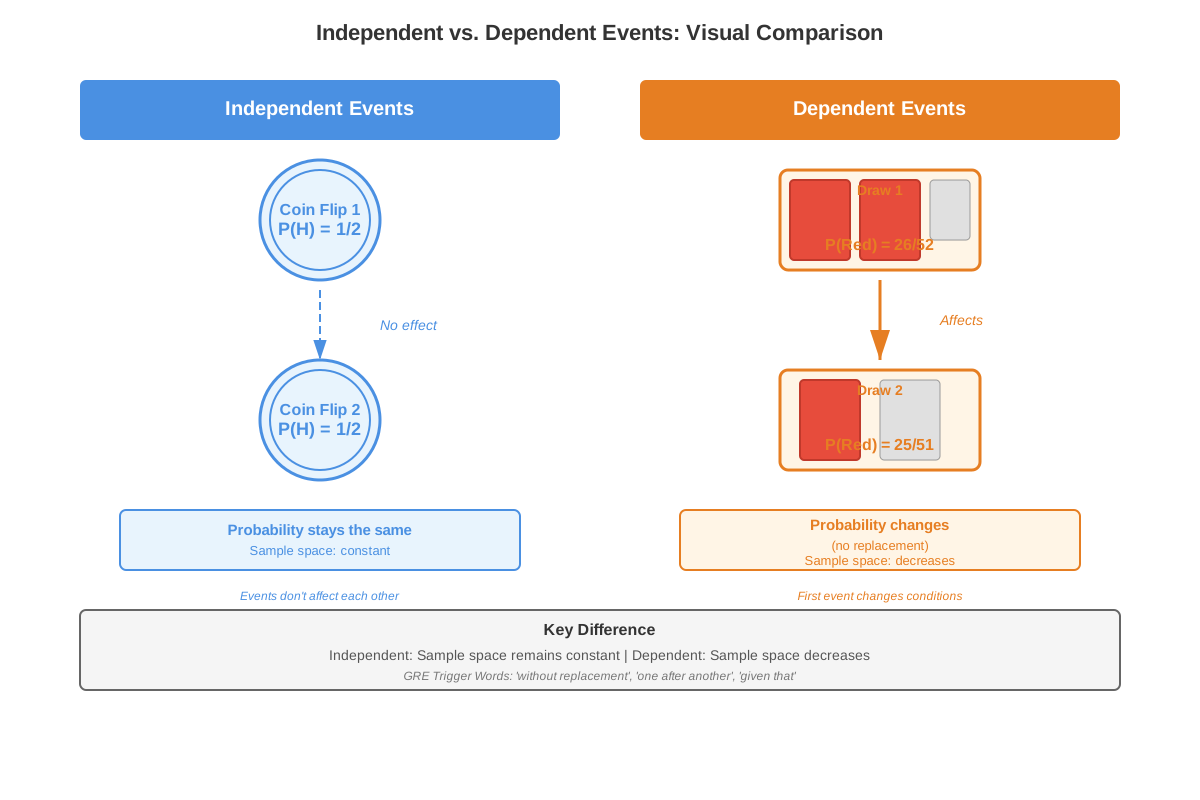
Dependent events are two or more events where the occurrence of one event affects the probability of the other event(s) occurring. Mathematically, events A and B are dependent if P(B|A) ≠ P(B), meaning the probability of B given that A has occurred differs from the probability of B occurring independently. This contrasts sharply with independent events, where P(B|A) = P(B).
The key characteristic of dependent events is that the sample space (the set of all possible outcomes) changes after the first event occurs. This change in the sample space directly impacts the probability calculations for subsequent events. For example, when drawing cards from a deck without replacement, each draw reduces the total number of cards available, fundamentally altering the probabilities for the next draw.
The Multiplication Rule for Dependent Events
The fundamental formula for calculating the probability of multiple dependent events occurring in sequence is:
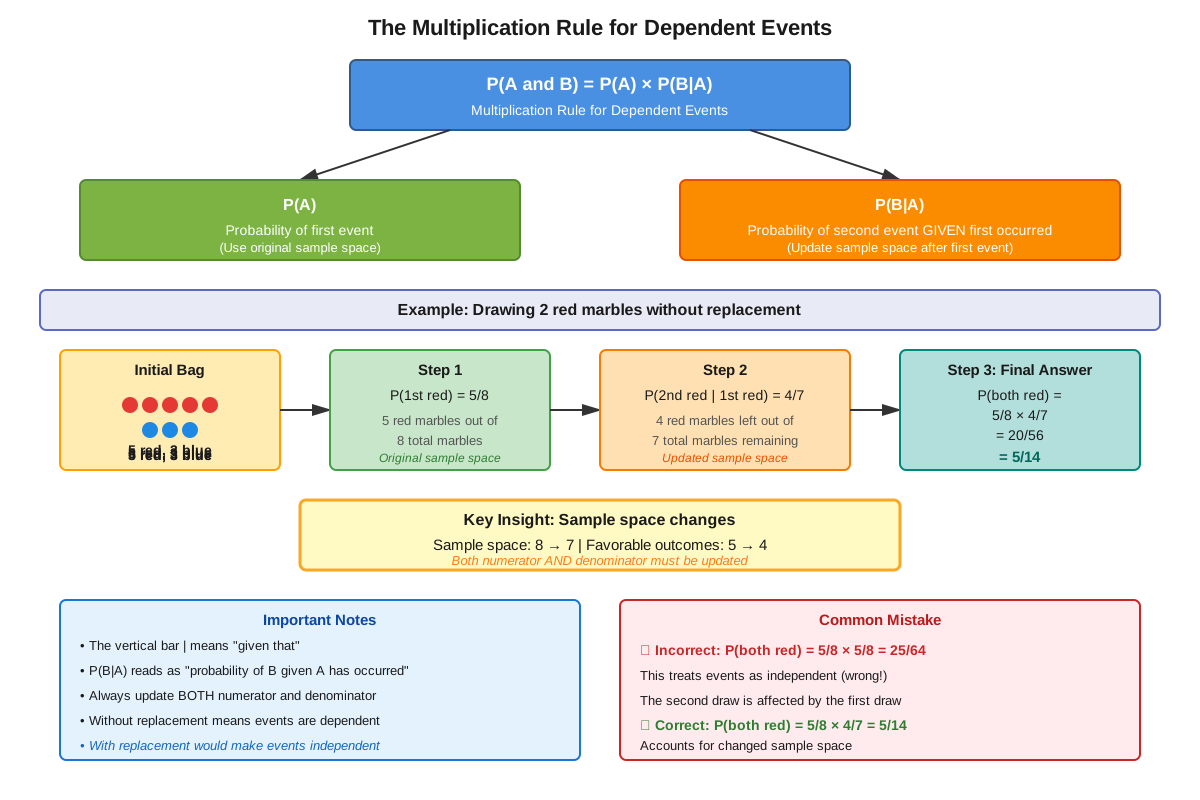
P(A and B) = P(A) × P(B|A)Where:
- P(A) is the probability of the first event
- P(B|A) is the conditional probability of event B occurring given that event A has already occurred
For three or more dependent events, this extends to:
P(A and B and C) = P(A) × P(B|A) × P(C|A and B)This multiplication rule is the cornerstone of solving dependent events problems on the GRE. The critical insight is that each subsequent probability must be calculated based on the new conditions created by previous events.
Without Replacement vs. With Replacement
The distinction between sampling with and without replacement is fundamental to identifying dependent events:
| Sampling Method | Events Type | Sample Space | Example |
|---|---|---|---|
| Without Replacement | Dependent | Decreases with each selection | Drawing cards from a deck and not returning them |
| With Replacement | Independent | Remains constant | Drawing cards, recording the result, and returning them before the next draw |
Without replacement scenarios are the most common context for dependent events on the GRE. Each selection permanently removes an item from the pool, reducing both the number of favorable outcomes and the total number of possible outcomes for subsequent selections.
Calculating Probabilities in Sequential Selections
When solving dependent events problems involving sequential selections, follow this systematic approach:
- Identify the first event: Calculate its probability using the initial sample space
- Adjust the sample space: Reduce both the total outcomes and (if applicable) favorable outcomes by the amount removed
- Calculate subsequent probabilities: Use the adjusted sample space for each following event
- Multiply all probabilities: Apply the multiplication rule to find the compound probability
For example, if selecting 2 red marbles from a bag containing 5 red and 3 blue marbles (8 total):
- First selection: P(Red₁) = 5/8
- After removing one red marble: 4 red and 3 blue remain (7 total)
- Second selection: P(Red₂|Red₁) = 4/7
- Combined probability: P(Red₁ and Red₂) = 5/8 × 4/7 = 20/56 = 5/14
Conditional Probability and Dependent Events
Conditional probability is intrinsically linked to dependent events. The notation P(B|A) reads as "the probability of B given A" and represents the probability of event B occurring under the condition that event A has already occurred. This is calculated as:
P(B|A) = P(A and B) / P(A)On the GRE, conditional probability questions often test whether students recognize that the given condition changes the sample space. The phrase "given that" or "if we know that" signals a conditional probability scenario where you must recalculate probabilities based on the new information.
Common GRE Scenarios for Dependent Events
Several standard scenarios repeatedly appear on the GRE:
Card Problems: Drawing multiple cards from a standard 52-card deck without replacement. These problems test understanding of how each draw affects subsequent probabilities.
Marble/Ball Problems: Selecting colored objects from a container without replacement. These straightforward scenarios allow clear demonstration of the multiplication rule.
Committee Selection: Choosing people for positions where order matters or where selections have restrictions (e.g., "at least one woman must be selected").
Defective Item Problems: Selecting items from a batch containing some defective units, often asking for the probability that both/all selected items are defective or non-defective.
Concept Relationships
The concept of dependent events builds directly upon basic probability principles, specifically the fundamental probability formula P(event) = favorable outcomes / total outcomes. Understanding this foundation is essential because dependent events simply apply this formula repeatedly while adjusting the numerator and denominator based on previous outcomes.
Dependent events connect strongly to conditional probability, which provides the mathematical framework for expressing how one event affects another. The relationship flows as: Basic Probability → Conditional Probability → Dependent Events → Complex Multi-Stage Problems. Each level adds sophistication to probability calculations.
Within the topic itself, the concepts relate as follows:
Sample Space Concept → Without Replacement Principle → Multiplication Rule → Sequential Probability Calculations
The sample space concept establishes that the set of possible outcomes can change. The without replacement principle explains why the sample space changes. The multiplication rule provides the method for calculating compound probabilities. Sequential probability calculations represent the application of all previous concepts to solve complete problems.
Dependent events also connect to combinatorics when problems ask about selecting groups rather than ordered sequences. Understanding when to use permutations versus combinations, combined with dependent probability calculations, enables solving complex selection problems that appear on the GRE.
High-Yield Facts
⭐ The probability of dependent events occurring together equals the probability of the first event multiplied by the conditional probability of the second event given the first has occurred: P(A and B) = P(A) × P(B|A)
⭐ "Without replacement" is the key phrase indicating dependent events in GRE problems
⭐ After each selection without replacement, both the numerator (favorable outcomes) and denominator (total outcomes) typically decrease by 1
⭐ Events are dependent if the occurrence of one event changes the probability of another event occurring
⭐ The sample space must be recalculated after each event in a dependent sequence
- For three dependent events: P(A and B and C) = P(A) × P(B|A) × P(C|A and B)
- Drawing cards from a standard deck without replacement always creates dependent events
- The probability of selecting all items of one type decreases with each selection as the proportion changes
- Dependent events problems often involve fractions that must be multiplied and then simplified
- The phrase "given that" signals conditional probability, which is closely related to dependent events
- Order matters in dependent events calculations when the problem specifies a sequence
- The complement rule (P(not A) = 1 - P(A)) can simplify dependent events calculations when finding "at least one" probabilities
Quick check — test yourself on Dependent events so far.
Try Flashcards →Common Misconceptions
Misconception: All sequential events are dependent events. → Correction: Events are only dependent if one event affects the probability of another. Sequential events with replacement (where items are returned to the sample space) remain independent because the sample space doesn't change.
Misconception: The denominator always decreases by 1 in dependent events. → Correction: While the total number of items (denominator) typically decreases by 1 with each selection without replacement, the numerator (favorable outcomes) only decreases if a favorable item was selected. If an unfavorable item is selected, the numerator stays the same while the denominator decreases.
Misconception: P(A and B) = P(A) + P(B) for dependent events. → Correction: The probability of both events occurring uses multiplication, not addition: P(A and B) = P(A) × P(B|A). Addition is used for mutually exclusive events when calculating "or" probabilities.
Misconception: Dependent events always have lower probabilities than independent events. → Correction: While dependent events often result in different probabilities than if the events were independent, they aren't necessarily lower. For example, drawing a second red marble after drawing a red marble from a mostly-red collection might have higher probability than if the events were independent.
Misconception: The order of events doesn't matter in dependent events calculations. → Correction: Order matters significantly in dependent events. Drawing a red marble then a blue marble has the same probability as drawing a blue then a red, but the calculation path differs: P(R then B) = P(R) × P(B|R) while P(B then R) = P(B) × P(R|B). These equal the same value but require different conditional probabilities.
Misconception: "At least one" problems require calculating all possible dependent event sequences. → Correction: For "at least one" problems, it's more efficient to use the complement: P(at least one) = 1 - P(none). This avoids calculating multiple dependent event sequences.
Worked Examples
Example 1: Classic Marble Selection
Problem: A bag contains 6 red marbles and 4 blue marbles. If two marbles are drawn randomly without replacement, what is the probability that both marbles are red?
Solution:
Step 1: Identify this as a dependent events problem. The key phrase "without replacement" indicates that the first draw affects the second draw.
Step 2: Calculate the probability of drawing a red marble first.
- Favorable outcomes: 6 red marbles
- Total outcomes: 10 marbles
- P(Red₁) = 6/10 = 3/5
Step 3: Adjust the sample space after the first draw. Since we drew a red marble:
- Red marbles remaining: 6 - 1 = 5
- Total marbles remaining: 10 - 1 = 9
Step 4: Calculate the conditional probability of drawing a second red marble.
- P(Red₂|Red₁) = 5/9
Step 5: Apply the multiplication rule for dependent events.
- P(Red₁ and Red₂) = P(Red₁) × P(Red₂|Red₁)
- P(Red₁ and Red₂) = 3/5 × 5/9 = 15/45 = 1/3
Answer: The probability that both marbles are red is 1/3.
Connection to Learning Objectives: This example demonstrates identifying dependent events (the "without replacement" trigger), applying the core multiplication rule, and accurately calculating compound probabilities by adjusting the sample space.
Example 2: Card Drawing with Multiple Conditions
Problem: From a standard 52-card deck, three cards are drawn without replacement. What is the probability that the first card is a heart, the second card is a spade, and the third card is also a spade?
Solution:
Step 1: Recognize the dependent events structure. Three sequential draws without replacement create a chain of dependent events.
Step 2: Calculate P(Heart on first draw).
- Hearts in deck: 13
- Total cards: 52
- P(H₁) = 13/52 = 1/4
Step 3: Adjust sample space after drawing a heart. The deck now has:
- Hearts: 12 (one removed)
- Spades: 13 (unchanged)
- Total cards: 51
Step 4: Calculate P(Spade on second draw | Heart on first draw).
- P(S₂|H₁) = 13/51
Step 5: Adjust sample space after drawing a spade. The deck now has:
- Hearts: 12 (unchanged from step 3)
- Spades: 12 (one removed)
- Total cards: 50
Step 6: Calculate P(Spade on third draw | Heart first and Spade second).
- P(S₃|H₁ and S₂) = 12/50 = 6/25
Step 7: Apply the multiplication rule for three dependent events.
- P(H₁ and S₂ and S₃) = P(H₁) × P(S₂|H₁) × P(S₃|H₁ and S₂)
- P(H₁ and S₂ and S₃) = 1/4 × 13/51 × 6/25
- P(H₁ and S₂ and S₃) = (1 × 13 × 6)/(4 × 51 × 25) = 78/5100 = 13/850
Answer: The probability is 13/850 (approximately 0.0153 or 1.53%).
Connection to Learning Objectives: This example shows how to extend the multiplication rule to three events, demonstrates careful tracking of the changing sample space, and illustrates a typical GRE-style card problem with multiple conditions.
Exam Strategy
When approaching GRE dependent events questions, implement this systematic strategy:
Trigger Word Recognition: Immediately flag questions containing "without replacement," "one after another," "then," "given that," or "first...second...third." These phrases almost always indicate dependent events. Conversely, "with replacement" or "independently" suggests independent events requiring different calculations.
Sample Space Tracking Method: Create a simple notation system to track changes. For example, write "6R, 4B (10 total)" initially, then "5R, 4B (9 total)" after drawing a red marble. This visual tracking prevents calculation errors and helps organize multi-step problems.
Process of Elimination for Quantitative Comparison: In Quantity A vs. Quantity B questions involving dependent events, look for whether one quantity properly accounts for the changing sample space while the other doesn't. Incorrect answers often treat dependent events as independent, making their probabilities too high.
Time Management: Allocate approximately 2 minutes for standard dependent events problems. If a problem requires more than three sequential events, consider whether there's a complementary approach (calculating "none" and subtracting from 1) that might be faster.
Verification Strategy: After calculating, perform a quick reasonableness check. For "both/all same type" problems, the probability should be less than the probability of selecting one of that type. If your answer violates this logic, recheck your sample space adjustments.
Common Trap Avoidance: GRE test-makers often include answer choices that result from treating dependent events as independent (multiplying initial probabilities without adjustment). If you see an answer choice that's suspiciously simple, verify that you've properly adjusted the sample space.
Exam Tip: When stuck between two answer choices, check whether you decreased both the numerator and denominator appropriately. A common error is decreasing only the denominator, leading to an incorrect answer that often appears among the choices.
Memory Techniques
DRAW Mnemonic for dependent events problem-solving:
- Determine if events are dependent (look for "without replacement")
- Record the initial sample space
- Adjust after each event
- Work through multiplication systematically
Visualization Strategy: Picture a physical container (bag, deck, box) and mentally remove items as you calculate. This concrete visualization helps prevent errors in tracking the changing sample space. Imagine literally taking a marble out of a bag—you can see there are fewer marbles remaining.
"Shrinking Pool" Mental Model: Think of the sample space as a pool that shrinks with each selection. Both the water level (total outcomes) and the number of fish of a certain color (favorable outcomes) decrease, but not always at the same rate.
Fraction Chain Memory Aid: Remember that dependent events create a "fraction chain" where each fraction gets smaller denominators: 6/10 × 5/9 × 4/8... The denominators decrease by 1 each time (assuming single selections), creating a predictable pattern.
Acronym for Conditional Probability: GIVEN = Gather Information, Verify the condition, Evaluate new sample space, Note the probability. This helps remember to recalculate based on the given condition.
Summary
Dependent events represent probability scenarios where one outcome affects the probability of subsequent outcomes, most commonly occurring in "without replacement" situations. The fundamental approach requires calculating the probability of the first event using the initial sample space, then adjusting both favorable and total outcomes before calculating each subsequent probability. The multiplication rule P(A and B) = P(A) × P(B|A) provides the mathematical framework for combining these probabilities. Success on GRE dependent events questions requires recognizing trigger phrases, systematically tracking the changing sample space, and avoiding the common error of treating dependent events as independent. This topic appears frequently on the GRE in various contexts including card problems, marble selections, and committee formations, making it a high-yield area for focused study. Mastery involves not just memorizing formulas but developing the analytical skill to recognize when and how the sample space changes with each event.
Key Takeaways
- Dependent events occur when one event affects the probability of another, typically in "without replacement" scenarios
- The multiplication rule P(A and B) = P(A) × P(B|A) is the core formula, where P(B|A) uses an adjusted sample space
- Both the numerator (favorable outcomes) and denominator (total outcomes) typically decrease after each selection
- Trigger phrases like "without replacement," "given that," and sequential language ("then," "next") signal dependent events
- The sample space must be recalculated after each event based on what was removed
- Dependent events problems require systematic tracking of changing conditions to avoid calculation errors
- Understanding the distinction between dependent and independent events is crucial for selecting the correct solution approach
Related Topics
Independent Events: Understanding how events that don't affect each other differ from dependent events provides essential contrast and helps identify which probability rules to apply in different scenarios.
Conditional Probability: This topic extends dependent events concepts by formalizing the mathematical relationship between events and introducing Bayes' theorem for more complex probability updates.
Combinatorics and Counting Principles: Mastering dependent events enables progression to problems involving permutations and combinations where order and selection restrictions create complex dependent relationships.
Probability Distributions: Advanced probability topics build on dependent events understanding, particularly in analyzing sequences of trials and understanding how probabilities evolve over multiple stages.
Expected Value: Combining dependent events probability calculations with expected value concepts allows solving complex decision-making problems that appear on the GRE.
Practice CTA
Now that you've mastered the core concepts of dependent events, it's time to solidify your understanding through active practice. Attempt the practice questions designed specifically for this topic, focusing on identifying trigger words and systematically applying the multiplication rule. Use the flashcards to reinforce key formulas and common scenarios until recognizing dependent events becomes automatic. Remember, the difference between a good GRE score and a great one often comes down to mastering high-yield topics like dependent events—your focused practice on this concept will pay dividends on test day. Challenge yourself to work through problems without looking back at the formulas, building the confidence and speed you'll need when facing these questions under timed conditions.
Sign up free to keep reading
Create a free AnvayaPrep account to finish this GRE guide on Dependent events — plus flashcards and practice questions.