Overview
Independent events form a cornerstone of probability theory tested extensively on the GRE Quantitative Reasoning section. At its core, the concept addresses a fundamental question: when does the outcome of one random event affect the probability of another? Understanding gre independent events enables test-takers to correctly calculate compound probabilities, avoid common traps in multi-stage probability problems, and confidently navigate Data Analysis questions that comprise approximately 25% of the Quantitative section.
The principle of independence states that two events are independent when the occurrence of one event does not change the probability of the other event occurring. This seemingly simple definition has profound implications for how probabilities combine. When events are independent, their joint probability equals the product of their individual probabilities—a rule that appears repeatedly across GRE probability questions. Mastering this concept prevents the most common error in probability: incorrectly multiplying probabilities when events are actually dependent, or conversely, failing to multiply when events truly are independent.
Within the broader landscape of Quantitative Reasoning, independent events connect directly to fundamental probability concepts, conditional probability, and combinatorics. The topic serves as a bridge between basic single-event probability calculations and more complex multi-stage probability scenarios. Questions involving independent events frequently appear alongside other Data Analysis topics such as frequency distributions, data interpretation, and statistical measures, making this knowledge essential for achieving competitive scores on the GRE.
Learning Objectives
- [ ] Identify when Independent events is being tested
- [ ] Explain the core rule or strategy behind Independent events
- [ ] Apply Independent events to GRE-style questions accurately
- [ ] Distinguish between independent and dependent events in complex scenarios
- [ ] Calculate compound probabilities for multiple independent events efficiently
- [ ] Recognize common GRE question patterns that test independence assumptions
- [ ] Evaluate whether the independence assumption is valid in real-world contexts
Prerequisites
- Basic probability concepts: Understanding that probability represents the ratio of favorable outcomes to total possible outcomes is essential for calculating individual event probabilities before applying independence rules
- Fraction and decimal operations: Multiplying fractions and converting between fractions, decimals, and percentages is necessary since independent event calculations require multiplication of probability values
- Set theory fundamentals: Recognizing outcomes, sample spaces, and events as sets helps visualize when events can occur simultaneously versus when they are mutually exclusive
- Basic algebra: Solving equations involving products and working with variables representing probabilities appears in more complex independent event problems
Why This Topic Matters
Independent events appear in numerous real-world contexts that make the concept both practically relevant and frequently tested. Weather forecasting, quality control in manufacturing, medical diagnostic testing, financial risk assessment, and game theory all rely on understanding when events influence each other versus when they occur independently. The ability to correctly identify independence allows for accurate risk calculation and decision-making under uncertainty.
On the GRE specifically, independent events questions appear in approximately 15-20% of Data Analysis problems, making this a high-yield topic for score improvement. The Educational Testing Service (ETS) consistently includes 2-4 questions per exam that directly test independence, with additional questions incorporating independence as part of more complex probability scenarios. These questions typically appear in both Quantitative Comparison and Problem Solving formats, with difficulty ranging from medium to hard.
Common GRE question patterns include: calculating the probability of multiple coin flips or dice rolls yielding specific outcomes; determining probabilities in scenarios involving random selection with replacement; analyzing success rates across independent trials; and word problems describing real-world situations where test-takers must first determine whether events are independent before calculating probabilities. The topic also appears in Data Interpretation sets where students must analyze tables or graphs showing independent categorical variables.
Core Concepts
Definition of Independent Events
Two events A and B are independent events if and only if the probability of event A occurring does not affect the probability of event B occurring, and vice versa. Mathematically, events A and B are independent when:
P(A and B) = P(A) × P(B)This multiplication rule represents the fundamental principle for calculating the probability that both independent events occur. Equivalently, independence can be defined using conditional probability: events A and B are independent if P(A|B) = P(A), meaning the probability of A given that B has occurred equals the probability of A without any knowledge of B.
The independence condition must hold in both directions—if A is independent of B, then B must be independent of A. This symmetry distinguishes independence from other probability relationships and ensures the multiplication rule applies regardless of the order in which events are considered.
The Multiplication Rule for Independent Events
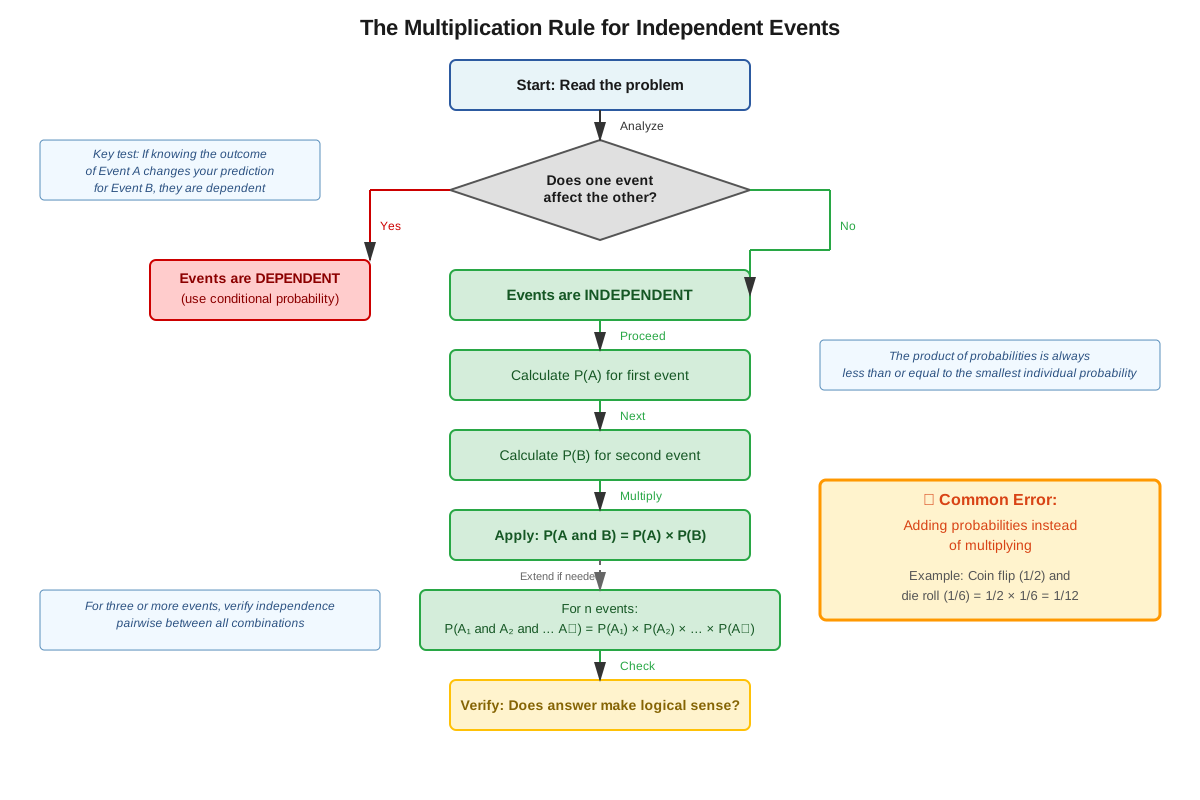
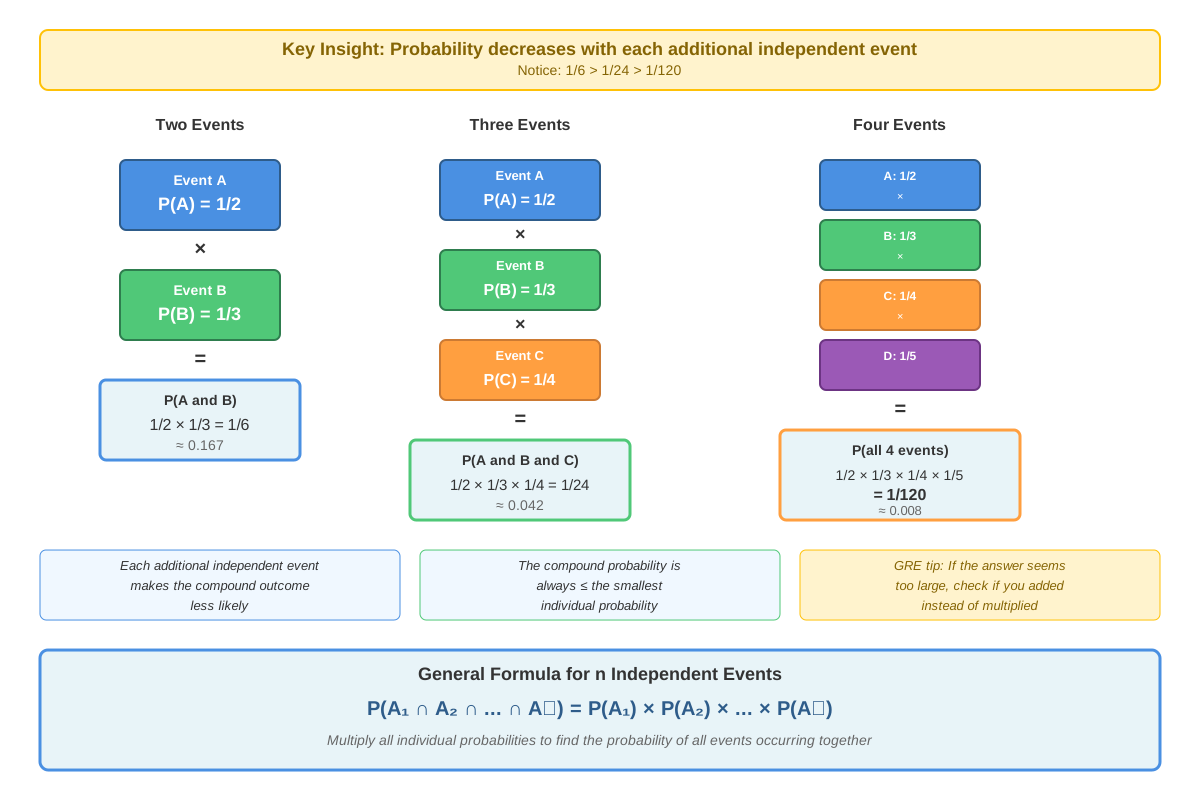
When dealing with multiple independent events, the probability that all events occur equals the product of their individual probabilities. For events A₁, A₂, A₃, ..., Aₙ that are mutually independent:
P(A₁ and A₂ and A₃ and ... and Aₙ) = P(A₁) × P(A₂) × P(A₃) × ... × P(Aₙ)This extension of the basic multiplication rule enables calculation of compound probabilities across any number of independent trials. For example, the probability of flipping a fair coin five times and getting heads every time equals (1/2)⁵ = 1/32, since each flip is independent with probability 1/2.
The multiplication rule applies only when events are truly independent. Using this rule with dependent events produces incorrect results—one of the most common errors on GRE probability questions.
Identifying Independence in GRE Contexts
Several scenarios reliably indicate independence on the GRE:
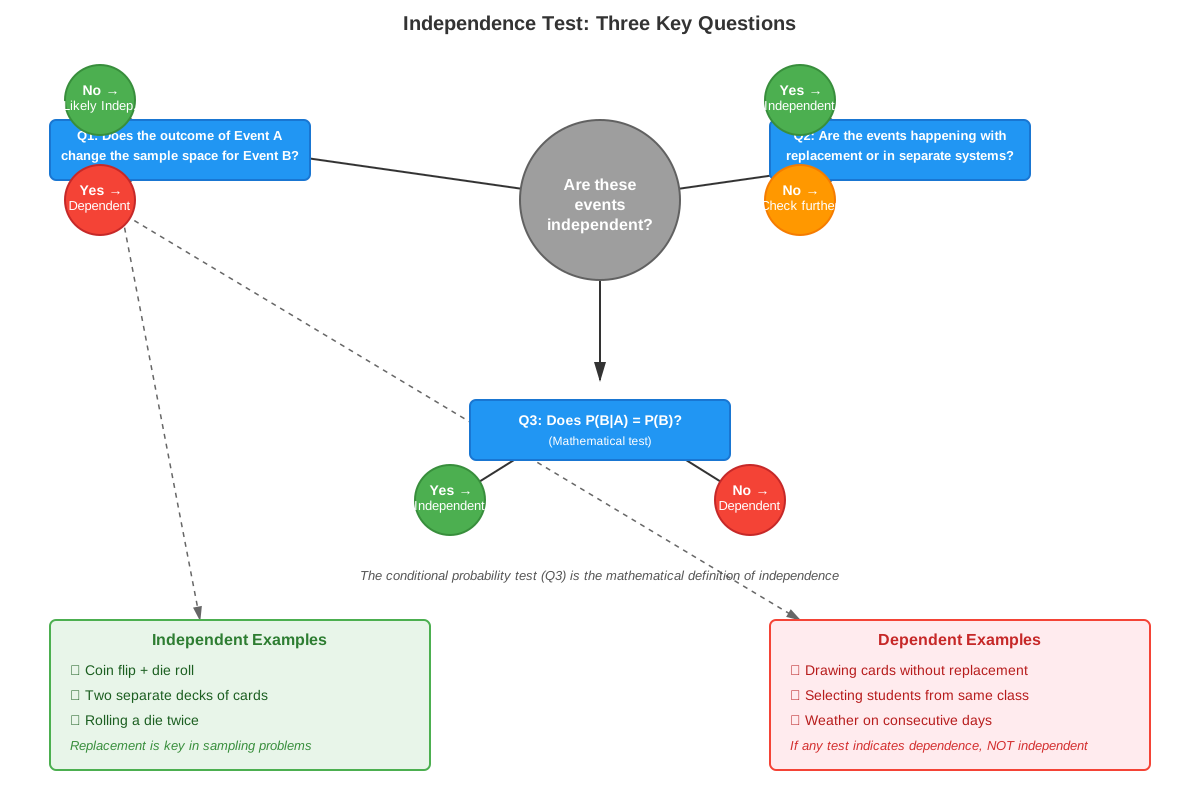
Random selection with replacement: When an item is selected from a group, its outcome recorded, and then returned before the next selection, successive selections are independent. The composition of the group remains unchanged between selections, so probabilities stay constant.
Separate random processes: Events occurring through completely separate mechanisms are typically independent. Rolling a die and flipping a coin represent independent events because the physical processes don't interact.
Repeated trials under identical conditions: When an experiment is repeated under the same conditions without any carryover effects, trials are independent. Each coin flip, each die roll, or each random selection from a large population represents an independent trial.
Explicitly stated independence: GRE questions sometimes directly state that events are independent, removing ambiguity about whether the multiplication rule applies.
Independence versus Mutual Exclusivity
A critical distinction exists between independent events and mutually exclusive events—concepts that students frequently confuse:
| Property | Independent Events | Mutually Exclusive Events |
|---|---|---|
| Definition | One event's occurrence doesn't affect the other's probability | Events cannot occur simultaneously |
| Mathematical condition | P(A and B) = P(A) × P(B) | P(A and B) = 0 |
| Can both occur? | Yes | No |
| Example | Rolling a 6 on a die AND flipping heads | Rolling a 6 AND rolling a 5 on the same die roll |
Mutually exclusive events are actually dependent—if one occurs, the probability of the other becomes zero. This dependence means the multiplication rule for independent events does not apply to mutually exclusive events.
Complementary Events and Independence
When working with independent events, the complement rule often simplifies calculations. If A and B are independent events, then:
- A and B' (not B) are independent
- A' (not A) and B are independent
- A' and B' are independent
This property proves particularly useful when calculating "at least one" probabilities. The probability that at least one of several independent events occurs often equals 1 minus the probability that none occur:
P(at least one event occurs) = 1 - P(all events fail)For independent events with individual success probabilities, this approach typically requires fewer calculations than summing all possible success combinations.
Common Independence Scenarios on the GRE
Coin flips and dice rolls: These classic probability examples always represent independent events. Each flip or roll has no memory of previous outcomes.
Drawing with replacement: When cards, balls, or other items are returned to the pool after selection, successive draws are independent.
Multiple choice guessing: When a test-taker randomly guesses on multiple unrelated questions, the correctness of each guess represents an independent event.
Manufacturing defects: When items are produced independently and the defect rate remains constant, whether each item is defective represents independent events.
Genetic inheritance: When genes are inherited independently (not linked on the same chromosome), offspring traits can be modeled as independent events.
Concept Relationships
The concept of independent events builds directly upon fundamental probability principles, particularly the definition of probability as favorable outcomes divided by total outcomes. This foundation enables calculation of individual event probabilities P(A) and P(B), which then combine through the multiplication rule when events are independent.
Independence connects intimately with conditional probability—the probability of one event given another has occurred. When P(A|B) = P(A), events are independent; when P(A|B) ≠ P(A), events are dependent. This relationship provides both a definition of independence and a test for determining whether events are independent in practice.
The relationship map flows as follows:
Basic Probability → enables calculation of → Individual Event Probabilities → which combine via → Multiplication Rule → when events satisfy → Independence Condition → which can be verified through → Conditional Probability → and extends to → Complement Rule Applications → enabling efficient solution of → Complex Multi-Stage Problems
Independent events also relate to combinatorics when calculating probabilities involving multiple trials. The number of ways independent events can combine (using counting principles) multiplied by the probability of each combination (using the multiplication rule) yields probabilities for complex scenarios.
Understanding independence proves essential for more advanced topics including binomial probability distributions, expected value calculations, and statistical inference—all of which assume independence among observations or trials.
High-Yield Facts
⭐ The multiplication rule: For independent events A and B, P(A and B) = P(A) × P(B)
⭐ Independence test: Events A and B are independent if and only if P(A|B) = P(A)
⭐ Replacement indicates independence: Random selection with replacement creates independent events; without replacement creates dependent events
⭐ Mutually exclusive events are NOT independent: If events cannot occur together, they are dependent (except when one has probability zero)
⭐ Complement rule for "at least one": P(at least one success) = 1 - P(all failures) when events are independent
- Separate physical processes (different coins, dice, spinners) always represent independent events
- The multiplication rule extends to any number of independent events: multiply all individual probabilities
- Independence is symmetric: if A is independent of B, then B is independent of A
- Repeated trials under identical conditions with no carryover effects are independent
- If events A and B are independent, then A and B', A' and B, and A' and B' are all independent pairs
- The probability of multiple independent events all occurring decreases rapidly as the number of events increases (products of fractions less than 1 become smaller)
- Independence assumptions must be verified or stated—never assume independence without justification
Quick check — test yourself on Independent events so far.
Try Flashcards →Common Misconceptions
Misconception: If two events are mutually exclusive, they must be independent since they don't affect each other.
Correction: Mutually exclusive events are actually dependent. If event A occurs, the probability of event B becomes zero, which clearly differs from B's original probability. Independence requires that one event's occurrence doesn't change the other's probability, but mutual exclusivity means one event's occurrence completely eliminates the other's possibility.
Misconception: The multiplication rule P(A and B) = P(A) × P(B) applies to all probability problems involving two events.
Correction: The multiplication rule applies only when events are independent. For dependent events, the correct formula is P(A and B) = P(A) × P(B|A), where P(B|A) represents the conditional probability of B given A. Using the independence formula for dependent events produces incorrect results.
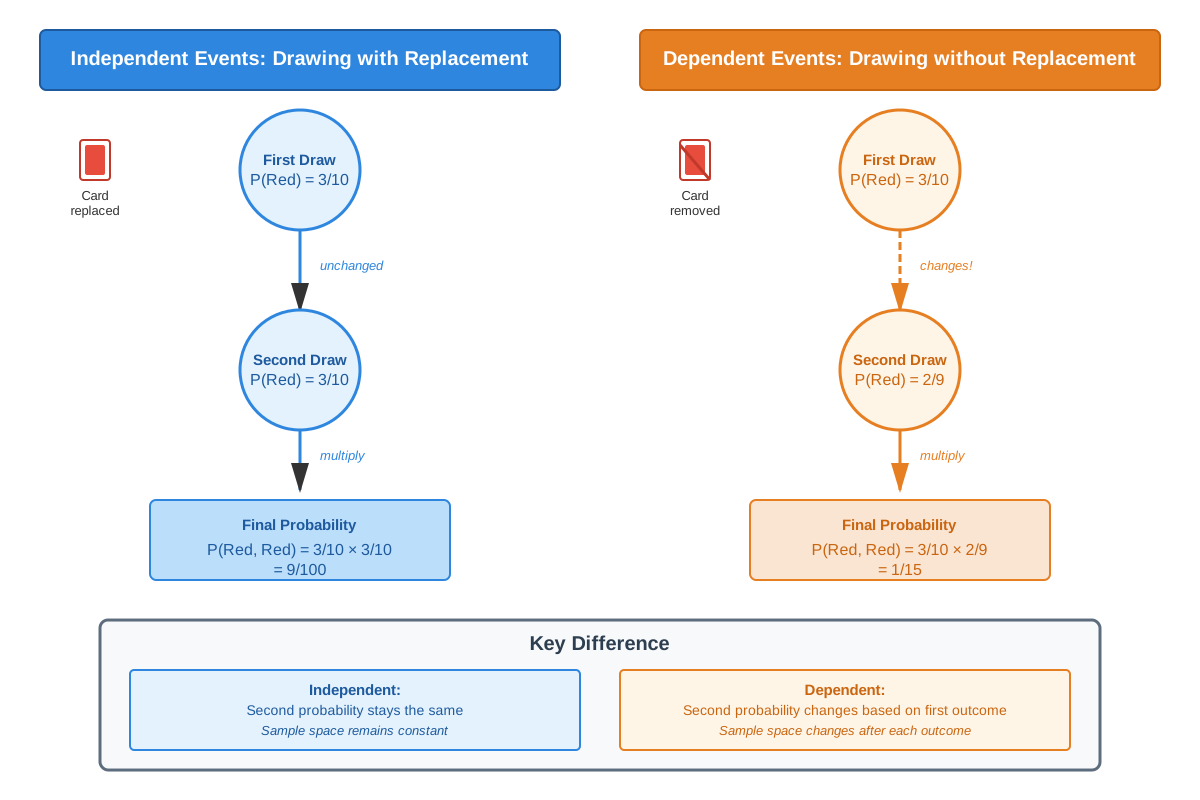
Misconception: Drawing two cards from a deck without replacement represents independent events because each draw is random.
Correction: Without replacement, the first draw changes the deck's composition, affecting probabilities for the second draw. If the first card is an ace, only 3 aces remain among 51 cards; if the first card isn't an ace, 4 aces remain among 51 cards. These different probabilities demonstrate dependence. Only drawing with replacement creates independence.
Misconception: If P(A and B) = 0, then events A and B are independent because they don't influence each other.
Correction: When P(A and B) = 0, events are mutually exclusive, not independent. For independence, we need P(A and B) = P(A) × P(B). If both P(A) and P(B) are greater than zero, their product is also greater than zero, so P(A and B) = 0 violates the independence condition.
Misconception: The probability of getting at least one heads in three coin flips equals 1/2 + 1/2 + 1/2 = 3/2.
Correction: Probabilities cannot exceed 1. The correct approach uses the complement: P(at least one heads) = 1 - P(all tails) = 1 - (1/2)³ = 1 - 1/8 = 7/8. Alternatively, enumerate all favorable outcomes, but never add probabilities beyond 1.
Misconception: If events happen at different times, they must be independent.
Correction: Timing alone doesn't determine independence. Events occurring at different times can still be dependent if earlier events affect later probabilities. For example, drawing cards sequentially without replacement involves events at different times that are dependent. Independence requires that one event's outcome doesn't change the other's probability, regardless of timing.
Worked Examples
Example 1: Multiple Independent Trials
Problem: A fair coin is flipped three times. What is the probability of getting exactly two heads?
Solution:
Step 1: Identify that coin flips are independent events. Each flip has probability 1/2 for heads and 1/2 for tails, regardless of previous outcomes.
Step 2: Determine all sequences with exactly two heads. Using H for heads and T for tails:
- HHT
- HTH
- THH
Step 3: Calculate the probability of each sequence using the multiplication rule for independent events.
For HHT: P(H) × P(H) × P(T) = 1/2 × 1/2 × 1/2 = 1/8
For HTH: P(H) × P(T) × P(H) = 1/2 × 1/2 × 1/2 = 1/8
For THH: P(T) × P(H) × P(H) = 1/2 × 1/2 × 1/2 = 1/8
Step 4: Since these sequences are mutually exclusive (only one can occur in any set of three flips), add their probabilities:
P(exactly two heads) = 1/8 + 1/8 + 1/8 = 3/8
Connection to learning objectives: This problem demonstrates identifying independent events (coin flips), applying the multiplication rule for independent events, and accurately calculating compound probabilities in a GRE-style question.
Example 2: Selection With and Without Replacement
Problem: A bag contains 5 red marbles and 3 blue marbles.
Part A: If two marbles are drawn with replacement, what is the probability both are red?
Part B: If two marbles are drawn without replacement, what is the probability both are red?
Solution:
Part A (with replacement):
Step 1: Recognize that replacement makes the draws independent events. The bag's composition returns to 5 red and 3 blue (8 total) before the second draw.
Step 2: Calculate individual probabilities:
- P(first marble is red) = 5/8
- P(second marble is red) = 5/8 (unchanged because of replacement)
Step 3: Apply the multiplication rule for independent events:
P(both red with replacement) = 5/8 × 5/8 = 25/64
Part B (without replacement):
Step 1: Recognize that without replacement, the draws are dependent events. The first draw changes the bag's composition for the second draw.
Step 2: Calculate probabilities:
- P(first marble is red) = 5/8
- P(second marble is red | first was red) = 4/7 (only 4 red remain among 7 total)
Step 3: Apply the multiplication rule for dependent events:
P(both red without replacement) = 5/8 × 4/7 = 20/56 = 5/14
Step 4: Compare results:
- With replacement (independent): 25/64 ≈ 0.391
- Without replacement (dependent): 5/14 ≈ 0.357
The probability is higher with replacement because the favorable ratio (5 red out of 8) is maintained for both draws.
Connection to learning objectives: This problem illustrates distinguishing between independent and dependent events, correctly identifying when the multiplication rule for independent events applies, and recognizing the key GRE trigger phrase "with replacement" that signals independence.
Exam Strategy
Trigger phrases for independent events: "with replacement," "each time," "independently," "separate," "unrelated," "does not affect," "repeated trials"
When approaching GRE questions involving independent events, follow this systematic process:
Step 1: Determine whether events are independent. Look for explicit statements of independence, replacement scenarios, or separate physical processes. If the question involves selection without replacement, conditional probabilities, or situations where one outcome affects another, events are likely dependent.
Step 2: Calculate individual probabilities. Before applying the multiplication rule, determine P(A), P(B), and probabilities for any other events involved. Verify these calculations carefully, as errors here propagate through the final answer.
Step 3: Apply the appropriate rule. For independent events, multiply probabilities directly. For dependent events, use conditional probability. Never assume independence without justification.
Step 4: Consider the complement approach. For "at least one" questions with independent events, calculating 1 - P(none occur) often proves faster than enumerating all success scenarios.
Process of elimination tips:
- Eliminate answers greater than 1 or less than 0 (impossible probabilities)
- For multiple independent events with probabilities less than 1, the compound probability must be less than any individual probability
- If events are clearly dependent but an answer choice uses simple multiplication of individual probabilities, eliminate it
- For "at least one" scenarios, the answer must be greater than the probability of exactly one success
Time allocation: Most independent events problems require 1.5-2 minutes. Spend 20-30 seconds identifying independence, 30-45 seconds calculating individual probabilities, and 30-45 seconds applying the multiplication rule and checking your answer. If a problem requires enumerating many cases, consider whether the complement approach offers a shortcut.
Quantitative Comparison strategy: When comparing probabilities involving independent events, sometimes you can determine the relationship without calculating exact values. If one scenario involves more independent events each with probability less than 1, its compound probability will be smaller (since multiplying by fractions less than 1 decreases the product).
Memory Techniques
Mnemonic for independence: "RISE" - Replacement, Independent processes, Separate mechanisms, Explicitly stated
This acronym captures the four most common ways GRE questions signal that events are independent.
Visualization for the multiplication rule: Picture a probability tree where each branch represents an independent event. The probability of reaching any endpoint equals the product of probabilities along the path. This visual reinforces that independent events combine through multiplication.
Acronym for independence testing: "PANDA" - P(A and B) = P(A) × P(B)
The word "and" embedded in "PANDA" reminds you that the multiplication rule calculates the probability of both events occurring together.
Memory aid for independence versus mutual exclusivity: Independent events can happen together (multiply probabilities). Mutually exclusive events exclude each other (cannot both occur). The words "together" and "exclude" capture the essential difference.
Complement rule mnemonic: "At least one = ALL but none"
For "at least one" problems with independent events, calculate 1 minus the probability that all events fail (none succeed).
Summary
Independent events represent a fundamental probability concept where one event's occurrence does not affect another event's probability. The defining property—P(A and B) = P(A) × P(B)—enables efficient calculation of compound probabilities across multiple trials or separate processes. GRE questions test this concept through scenarios involving coin flips, dice rolls, random selection with replacement, and other situations where events occur independently. Success requires distinguishing independent from dependent events, correctly applying the multiplication rule, and recognizing common question patterns. The complement approach (calculating 1 minus the probability of all failures) provides an efficient strategy for "at least one" problems. Understanding that mutually exclusive events are dependent, not independent, prevents a common error. Mastery of independent events enables accurate probability calculations and forms the foundation for more advanced statistical concepts tested on the GRE.
Key Takeaways
- Independent events satisfy P(A and B) = P(A) × P(B); one event's occurrence doesn't change the other's probability
- Random selection with replacement creates independent events; without replacement creates dependent events
- Mutually exclusive events are dependent, not independent, because one event's occurrence eliminates the other's possibility
- The complement rule P(at least one) = 1 - P(none) simplifies calculations for multiple independent events
- Always verify or identify independence before applying the multiplication rule—never assume it
- Trigger phrases like "with replacement," "independently," and "separate" signal independent events on the GRE
- The multiplication rule extends to any number of independent events by multiplying all individual probabilities
Related Topics
Conditional Probability: Understanding P(A|B) and how it differs from P(A) deepens comprehension of independence and enables solving dependent event problems. Mastering independent events provides the foundation for recognizing when conditional probability formulas are necessary.
Binomial Probability: This topic extends independent events to scenarios with repeated independent trials, each having two possible outcomes. The binomial formula builds directly on the multiplication rule for independent events.
Expected Value: Calculating expected values for multiple independent random variables requires understanding how independent probabilities combine, making this topic a natural progression from independent events.
Combinatorics and Counting Principles: Many probability problems require both counting favorable outcomes and applying independence rules, making these topics complementary skills for comprehensive GRE preparation.
Dependent Events and Conditional Probability: After mastering independent events, studying dependent events provides contrast and completes understanding of how events can relate to each other probabilistically.
Practice CTA
Now that you've mastered the core concepts of independent events, reinforce your understanding through active practice. Attempt the practice questions to apply the multiplication rule, distinguish independent from dependent scenarios, and build speed with GRE-style problems. Use the flashcards to memorize key formulas, trigger phrases, and common question patterns. Remember that probability mastery comes through repeated application—each practice problem strengthens your ability to recognize independence and calculate compound probabilities accurately. Your investment in practice now translates directly to points on test day. Begin your practice session with confidence, knowing you have the conceptual foundation to tackle any independent events question the GRE presents!
Sign up free to keep reading
Create a free AnvayaPrep account to finish this GRE guide on Independent events — plus flashcards and practice questions.