Overview
Set theory basics form a critical foundation for many quantitative reasoning problems on the GRE. At its core, set theory deals with collections of distinct objects (called elements) and the relationships between these collections. On the GRE, set theory questions typically involve analyzing groups of people, objects, or data points that share certain characteristics, determining overlaps between groups, and calculating totals based on inclusion-exclusion principles.
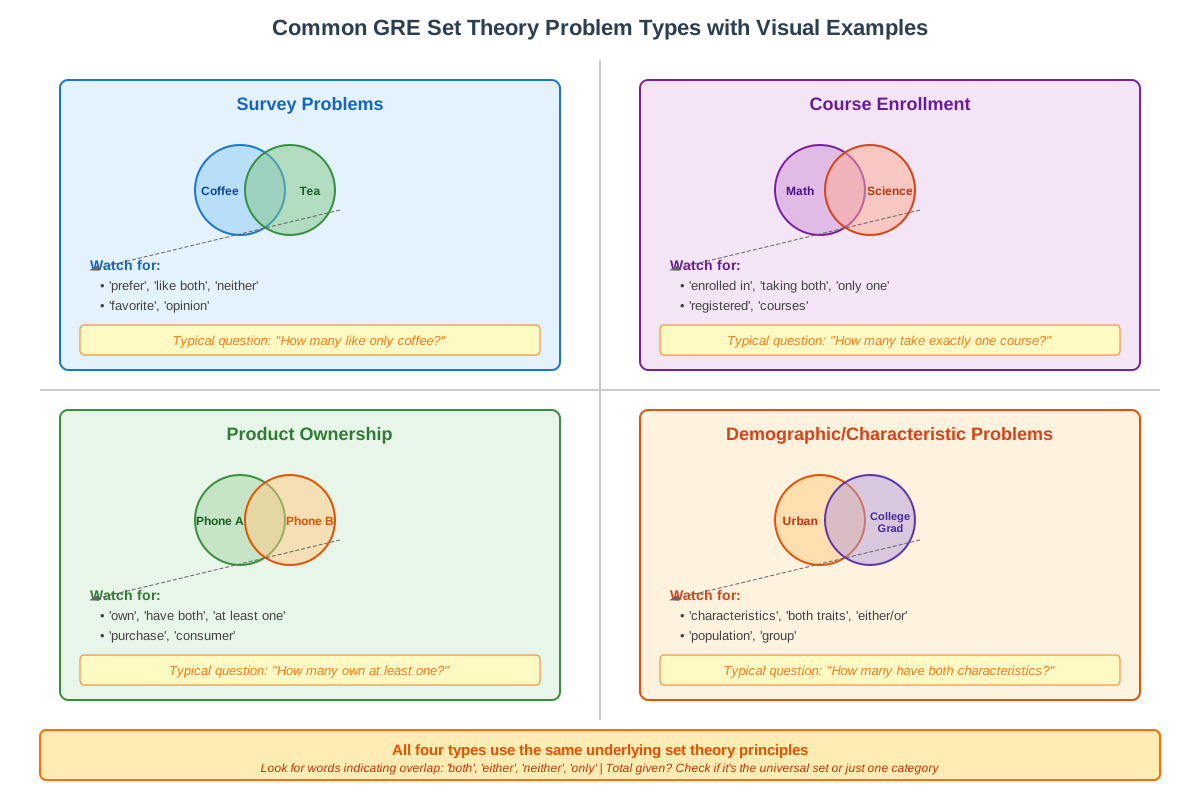
Understanding GRE set theory basics is essential because these concepts appear frequently in Data Analysis questions, often disguised within word problems about surveys, student enrollment, product preferences, or demographic data. The GRE tests your ability to organize information about overlapping groups, use Venn diagrams to visualize relationships, and apply formulas to calculate unions, intersections, and complements of sets. These questions require both conceptual understanding and computational accuracy under time pressure.
Set theory connects to broader Quantitative Reasoning skills including logical reasoning, probability, and data interpretation. Mastery of set theory enables students to tackle complex word problems systematically, break down multi-step calculations, and avoid common counting errors. The visual and analytical skills developed through set theory practice also enhance performance on other GRE question types involving categorization, data tables, and logical relationships.
Learning Objectives
- [ ] Identify when Set theory basics is being tested
- [ ] Explain the core rule or strategy behind Set theory basics
- [ ] Apply Set theory basics to GRE-style questions accurately
- [ ] Construct and interpret Venn diagrams for two-set and three-set problems
- [ ] Apply the inclusion-exclusion principle to calculate set unions and intersections
- [ ] Solve problems involving complements and universal sets efficiently
- [ ] Translate word problems into set notation and visual representations
Prerequisites
- Basic arithmetic operations: Essential for calculating totals, differences, and overlaps between sets
- Algebraic manipulation: Required for setting up and solving equations involving unknown set values
- Percentage calculations: Frequently needed when set problems involve proportions or survey data
- Logical reasoning: Necessary for understanding relationships between categories and making valid inferences
Why This Topic Matters
Set theory appears in approximately 10-15% of GRE Quantitative Reasoning questions, making it a high-yield topic for test preparation. These questions typically appear as word problems in both Quantitative Comparison and Problem Solving formats, often integrated with data interpretation passages or standalone scenarios.
In real-world applications, set theory underlies database queries, market research analysis, epidemiological studies, and business intelligence. Understanding how groups overlap helps professionals make data-driven decisions about target audiences, resource allocation, and strategic planning. The logical thinking skills developed through set theory practice transfer directly to analytical tasks in graduate school and professional settings.
On the GRE, set theory commonly appears in questions about:
- Survey results showing preferences across multiple categories
- Student enrollment in various courses or programs
- Product ownership or usage patterns among consumers
- Demographic data with overlapping characteristics
- Event attendance or participation statistics
- Medical studies tracking symptoms or treatments across patient groups
The GRE favors set theory questions because they efficiently test multiple skills simultaneously: reading comprehension, logical reasoning, arithmetic accuracy, and the ability to organize complex information systematically.
Core Concepts
Sets and Elements
A set is a well-defined collection of distinct objects, called elements or members. Sets are typically denoted by capital letters (A, B, C) and their elements by lowercase letters or numbers. The notation "x ∈ A" means "x is an element of set A," while "x ∉ A" means "x is not an element of set A."
The cardinality of a set, denoted |A| or n(A), represents the number of elements in that set. For example, if A = {2, 4, 6, 8}, then |A| = 4. On the GRE, you'll primarily work with finite sets where counting elements is straightforward.
The universal set (U) contains all elements under consideration in a particular problem. The empty set (∅ or { }) contains no elements and has cardinality zero. Understanding these foundational concepts allows you to categorize information correctly and set up problems accurately.
Union and Intersection
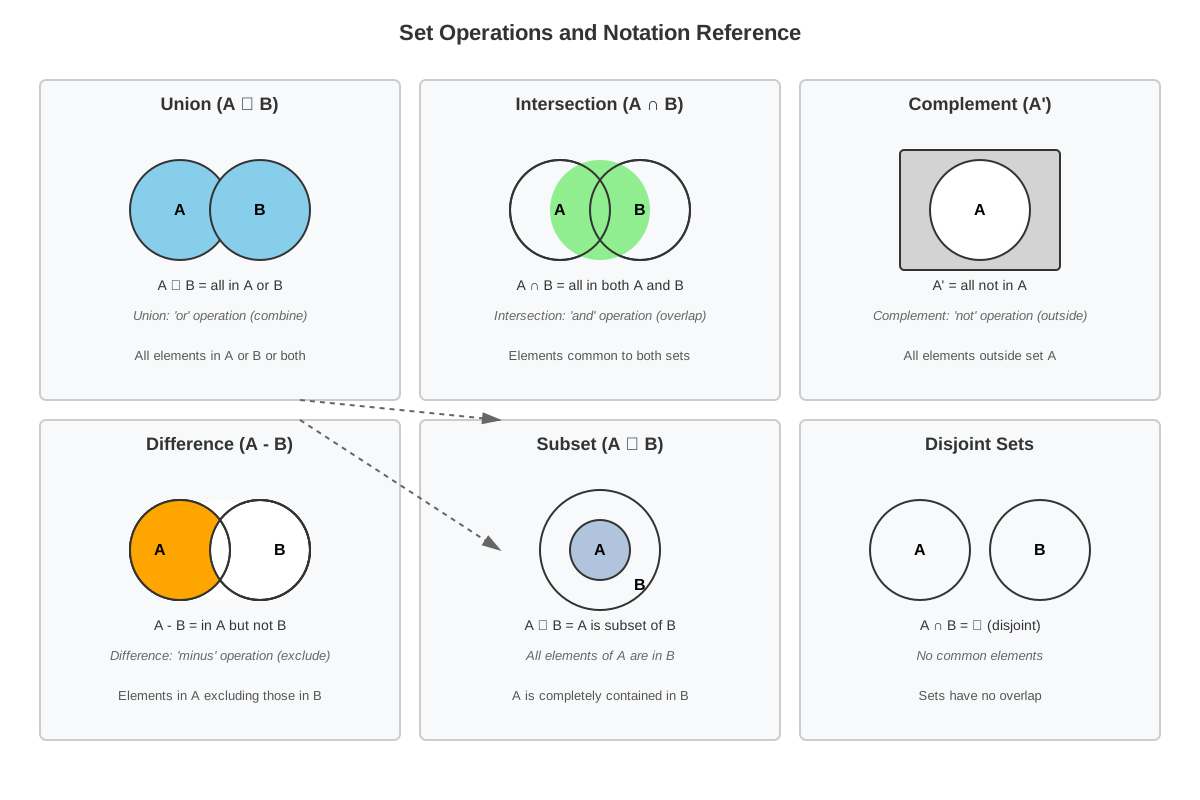
The union of two sets A and B, written A ∪ B, contains all elements that belong to A, to B, or to both. Think of union as combining sets using "or" logic. For example, if A = {1, 2, 3} and B = {3, 4, 5}, then A ∪ B = {1, 2, 3, 4, 5}. Note that elements appearing in both sets are listed only once in the union.
The intersection of two sets A and B, written A ∩ B, contains only elements that belong to both A and B simultaneously. Think of intersection as finding common elements using "and" logic. Using the same example, A ∩ B = {3} because only 3 appears in both sets.
Two sets are disjoint or mutually exclusive if their intersection is empty (A ∩ B = ∅), meaning they share no common elements. Recognizing disjoint sets simplifies calculations because there's no overlap to account for.
The Inclusion-Exclusion Principle
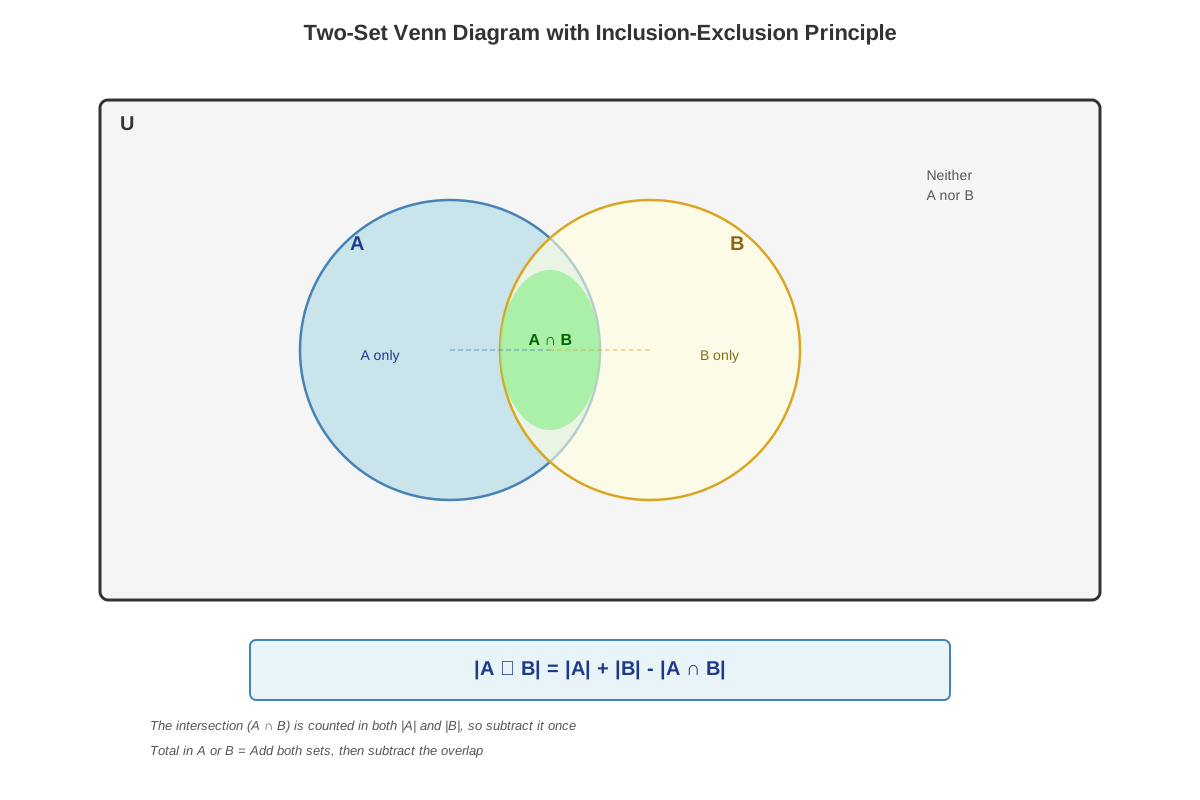
The inclusion-exclusion principle is the most important formula for GRE set theory problems. For two sets A and B:
|A ∪ B| = |A| + |B| - |A ∩ B|This formula states that to find the total number of elements in either set A or set B (or both), you add the individual set sizes but must subtract the intersection to avoid counting overlapping elements twice.
For three sets A, B, and C, the formula extends to:
|A ∪ B ∪ C| = |A| + |B| + |C| - |A ∩ B| - |A ∩ C| - |B ∩ C| + |A ∩ B ∩ C|This three-set formula adds all individual sets, subtracts all two-way intersections (to correct for double-counting), then adds back the three-way intersection (which was subtracted too many times). While three-set problems appear less frequently on the GRE, understanding this pattern demonstrates mastery of the underlying logic.
Complement of a Set
The complement of set A, written A' or Ac, contains all elements in the universal set U that are not in A. The relationship is:
|A'| = |U| - |A|Complement problems often involve phrases like "neither A nor B" or "none of the above." For two sets, the complement of their union represents elements in neither set:
|(A ∪ B)'| = |U| - |A ∪ B|Understanding complements allows you to approach problems from multiple angles, often simplifying calculations by working with smaller numbers.
Venn Diagrams
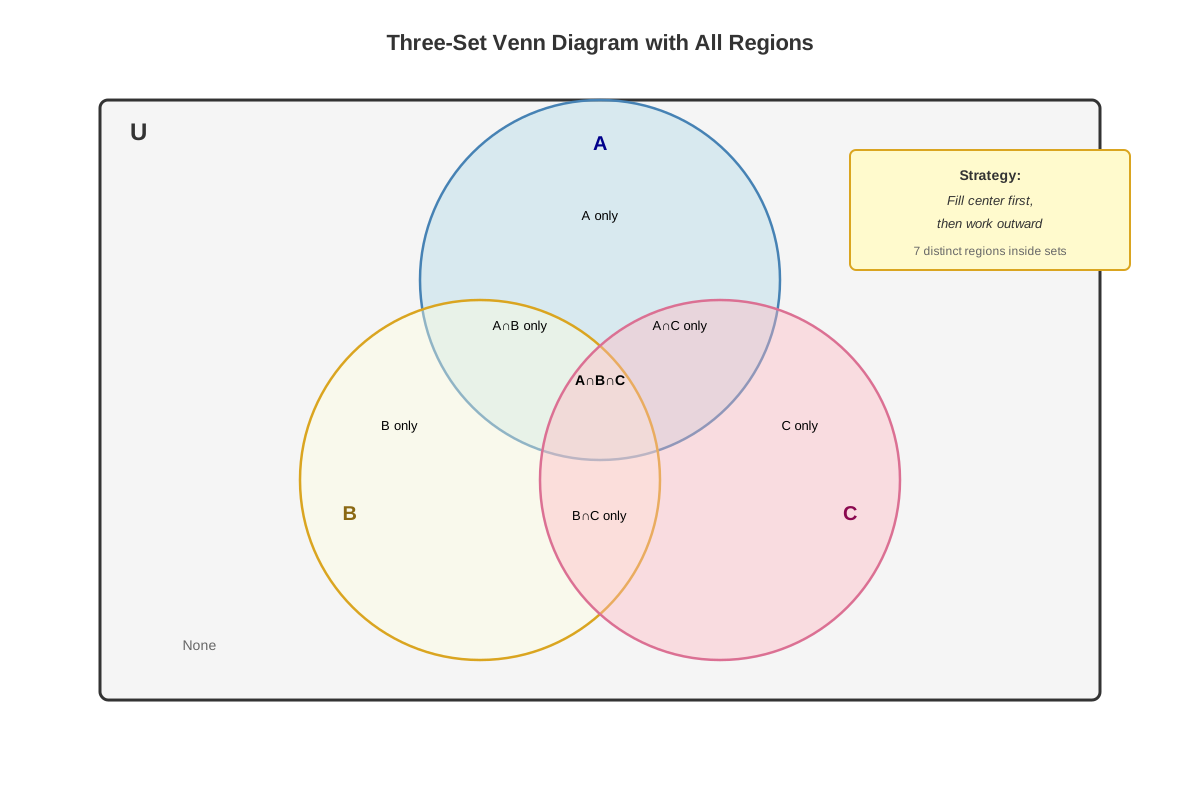
Venn diagrams provide visual representations of set relationships using overlapping circles. Each circle represents a set, and the overlapping regions show intersections. The rectangle containing all circles represents the universal set.
For two-set problems, a Venn diagram has four distinct regions:
- Elements only in A (not in B)
- Elements only in B (not in A)
- Elements in both A and B (the intersection)
- Elements in neither A nor B (outside both circles but inside the universal set)
For three-set problems, there are eight distinct regions, including areas where all three sets overlap, where exactly two sets overlap, where only one set exists, and where no sets exist.
Constructing Venn diagrams systematically helps organize information, identify what's being asked, and avoid counting errors. The GRE often provides information that must be translated into a diagram before calculations can proceed.
Set Difference
The difference of sets A and B, written A - B or A \ B, contains elements that are in A but not in B. This can be expressed as:
A - B = A ∩ B'The cardinality formula is:
|A - B| = |A| - |A ∩ B|Set difference problems often involve phrases like "only A" or "A but not B." Recognizing these trigger phrases helps you identify which calculation is needed.
Symmetric Difference
The symmetric difference of sets A and B, written A Δ B, contains elements in either A or B but not in both. This represents the union minus the intersection:
A Δ B = (A ∪ B) - (A ∩ B)While less common on the GRE, symmetric difference appears in problems asking for "exactly one" category or "either but not both."
Concept Relationships
Set theory concepts build hierarchically and interconnect systematically. Elements combine to form sets, which serve as the basic units for all other operations. Union and intersection represent the two fundamental ways sets can combine, with union being inclusive (or) and intersection being restrictive (and).
The inclusion-exclusion principle emerges directly from the relationship between union and intersection, providing the computational framework for avoiding double-counting. This principle → enables → accurate calculation of combined groups → which connects to → complement operations that identify what's excluded rather than included.
Venn diagrams serve as the visual bridge connecting all concepts, translating abstract set notation into spatial relationships that make problem-solving more intuitive. Diagrams → facilitate → identification of set differences and symmetric differences → which represent → specialized applications of union, intersection, and complement operations.
The universal set provides context for all other sets, establishing boundaries that make complement calculations possible. This hierarchical structure (universal set → individual sets → operations on sets → visual representations) mirrors how GRE problems present information: starting with a total population, defining subgroups, describing relationships, and asking for specific calculations.
Understanding these relationships allows you to approach problems flexibly, choosing the most efficient path to the solution. For example, calculating "neither A nor B" can be done directly using complements or indirectly by subtracting "A or B" from the universal set—both methods rely on understanding how concepts interconnect.
Quick check — test yourself on Set theory basics so far.
Try Flashcards →High-Yield Facts
⭐ The inclusion-exclusion principle for two sets is: |A ∪ B| = |A| + |B| - |A ∩ B|
⭐ Elements in "neither A nor B" equals the universal set minus the union: |U| - |A ∪ B|
⭐ Elements in "only A" (not in B) equals |A| - |A ∩ B|
⭐ When sets are disjoint (mutually exclusive), |A ∪ B| = |A| + |B| because |A ∩ B| = 0
⭐ In a two-set Venn diagram, there are exactly four distinct regions to account for
- The complement of set A contains all universal set elements not in A: |A'| = |U| - |A|
- Elements in "at least one" of the sets equals the union |A ∪ B|
- Elements in "both" sets equals the intersection |A ∩ B|
- For three sets, the three-way intersection must be added back after subtracting pairwise intersections
- The sum of all distinct regions in a Venn diagram equals the universal set cardinality
- Set operations follow specific order: calculate intersections before unions when applying inclusion-exclusion
- "Exactly one" category equals (|A| + |B|) - 2|A ∩ B| for two sets
- The maximum possible intersection of two sets equals the smaller set's cardinality: |A ∩ B| ≤ min(|A|, |B|)
Common Misconceptions
Misconception: Adding set sizes directly gives the union without considering overlap.
Correction: You must subtract the intersection to avoid counting shared elements twice. Always apply the inclusion-exclusion principle: |A ∪ B| = |A| + |B| - |A ∩ B|.
Misconception: "Neither A nor B" means the same as "not in A and not in B separately."
Correction: "Neither A nor B" means elements outside the union of both sets: |(A ∪ B)'| = |U| - |A ∪ B|. This is different from calculating complements separately.
Misconception: In three-set problems, subtracting all pairwise intersections is sufficient.
Correction: You must add back the three-way intersection because it gets subtracted three times (once in each pairwise intersection) but should only be subtracted once.
Misconception: "Only A" means the same as "in A."
Correction: "Only A" specifically excludes elements that are also in B, so it equals A - B or |A| - |A ∩ B|. "In A" includes all elements of A, including those shared with B.
Misconception: The universal set is always explicitly stated in problems.
Correction: Often you must determine the universal set from context. Look for phrases like "total surveyed," "all students," or "entire population" to identify the universal set size.
Misconception: Venn diagram regions can be filled in any order.
Correction: Start with the innermost intersection (where all sets overlap), then work outward to two-way intersections, then to exclusive regions. This systematic approach prevents errors.
Misconception: If two sets have no explicit intersection mentioned, they must be disjoint.
Correction: Never assume sets are disjoint unless explicitly stated or logically necessary. Always account for possible overlap unless the problem indicates otherwise.
Worked Examples
Example 1: Two-Set Survey Problem
Problem: In a survey of 100 students, 65 students study Mathematics, 48 students study Physics, and 30 students study both subjects. How many students study neither Mathematics nor Physics?
Solution:
Step 1: Identify the given information and define sets.
- Universal set U (all students): |U| = 100
- Set M (Mathematics students): |M| = 65
- Set P (Physics students): |P| = 48
- Intersection (both subjects): |M ∩ P| = 30
Step 2: Apply the inclusion-exclusion principle to find students studying at least one subject.
|M ∪ P| = |M| + |P| - |M ∩ P|
|M ∪ P| = 65 + 48 - 30 = 83
Step 3: Calculate students studying neither subject using the complement.
|(M ∪ P)'| = |U| - |M ∪ P|
|(M ∪ P)'| = 100 - 83 = 17Answer: 17 students study neither Mathematics nor Physics.
Connection to Learning Objectives: This problem demonstrates identifying set theory testing (survey with overlapping categories), applying the core inclusion-exclusion strategy, and accurately solving a GRE-style question. The systematic approach—define sets, apply formulas, calculate complements—exemplifies the methodology needed for exam success.
Example 2: Three-Set Problem with Missing Information
Problem: Among 200 employees, 120 speak Spanish, 90 speak French, and 70 speak German. Additionally, 50 speak both Spanish and French, 40 speak both Spanish and German, and 30 speak both French and German. If 20 employees speak all three languages, how many employees speak none of these languages?
Solution:
Step 1: Define sets and given information.
- Universal set: |U| = 200
- Spanish: |S| = 120
- French: |F| = 90
- German: |G| = 70
- Spanish and French: |S ∩ F| = 50
- Spanish and German: |S ∩ G| = 40
- French and German: |F ∩ G| = 30
- All three: |S ∩ F ∩ G| = 20
Step 2: Apply the three-set inclusion-exclusion principle.
|S ∪ F ∪ G| = |S| + |F| + |G| - |S ∩ F| - |S ∩ G| - |F ∩ G| + |S ∩ F ∩ G|
|S ∪ F ∪ G| = 120 + 90 + 70 - 50 - 40 - 30 + 20
|S ∪ F ∪ G| = 280 - 120 + 20 = 180
Step 3: Calculate employees speaking none of the languages.
|(S ∪ F ∪ G)'| = |U| - |S ∪ F ∪ G|
|(S ∪ F ∪ G)'| = 200 - 180 = 20Answer: 20 employees speak none of these languages.
Connection to Learning Objectives: This advanced problem requires constructing a mental three-set Venn diagram, applying the extended inclusion-exclusion principle accurately, and managing multiple pieces of information systematically. Notice how adding back the three-way intersection is crucial—forgetting this step would yield an incorrect answer of 160 instead of 180 for the union.
Exam Strategy
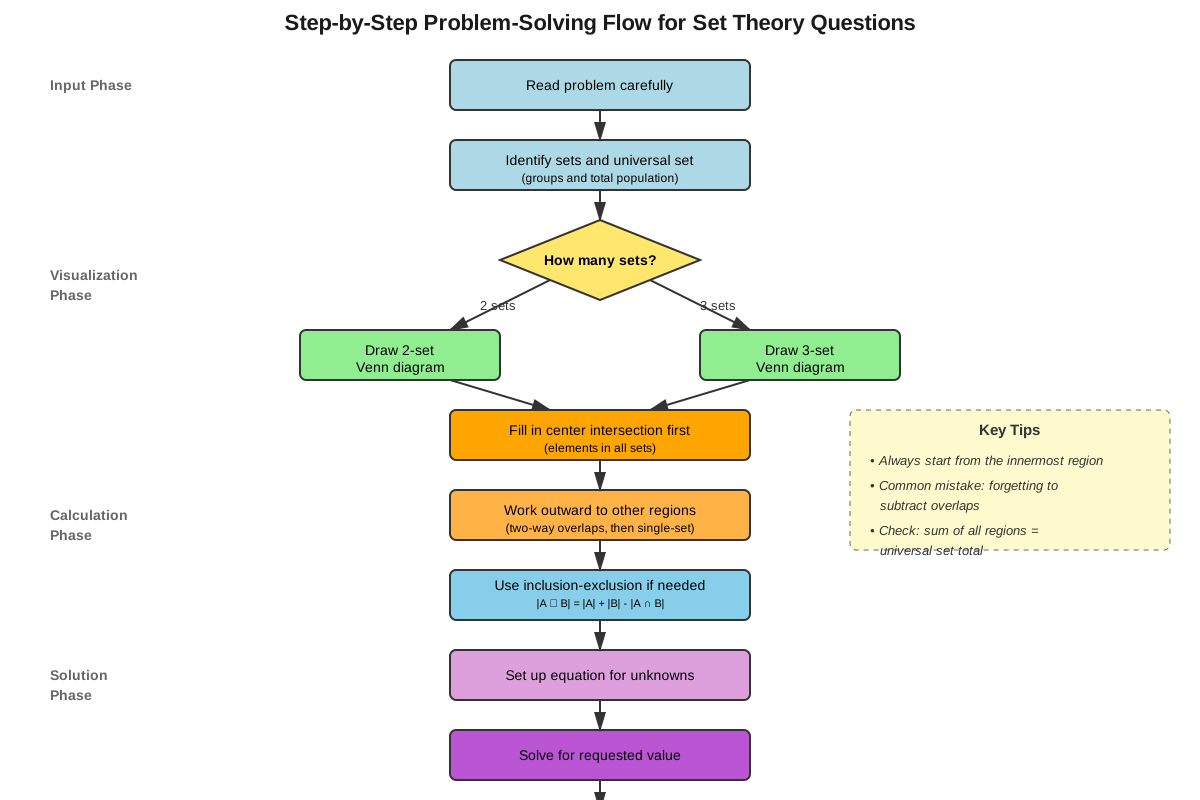
When approaching GRE set theory questions, follow this systematic process:
Step 1: Identify the universal set. Look for the total population, complete survey size, or overall group being discussed. This number anchors all other calculations.
Step 2: Recognize trigger phrases that indicate specific set operations:
- "At least one" → union (A ∪ B)
- "Both" or "all" → intersection (A ∩ B)
- "Only A" or "exclusively A" → set difference (A - B)
- "Neither" or "none" → complement of union
- "Exactly one" → symmetric difference or (|A| + |B|) - 2|A ∩ B|
Step 3: Draw a Venn diagram even if the problem doesn't explicitly request one. Visual organization prevents errors and clarifies what's being asked. Label all regions systematically.
Step 4: Fill in the diagram strategically. Start with the innermost intersection (where all sets overlap), then work outward. This prevents double-counting and ensures accuracy.
Step 5: Set up equations using the inclusion-exclusion principle. Write out the formula explicitly rather than calculating mentally to avoid arithmetic errors under time pressure.
Step 6: Verify your answer by checking that all regions sum to the universal set. This quick validation catches calculation mistakes.
Time Management Tip: Allocate 2-2.5 minutes for two-set problems and 3-3.5 minutes for three-set problems. If a problem seems overly complex, mark it for review and return after completing easier questions.
Process of Elimination Strategies:
- Eliminate answer choices greater than the universal set (impossible)
- Eliminate choices less than the largest individual set minus all others (too small)
- For "neither" questions, eliminate choices greater than the universal set minus the smallest individual set
- Check extreme cases: if sets were completely overlapping or completely disjoint, which answers become impossible?
Memory Techniques
Mnemonic for Inclusion-Exclusion: "Add Individuals, Subtract Overlaps" (AISO)
- Add all individual set sizes
- Identify what you're finding (union, intersection, etc.)
- Subtract intersections to remove double-counting
- Obtain the final answer by adding back over-subtracted regions (for three sets)
Visualization Strategy: Picture Venn diagrams as overlapping spotlights on a stage. Each spotlight (set) illuminates certain performers (elements). Where spotlights overlap, performers are illuminated by multiple lights (intersections). The entire stage is the universal set, and dark areas represent complements.
Acronym for Problem-Solving Steps: DIVIDE
- Define all sets clearly
- Identify the universal set
- Visualize with a Venn diagram
- Insert known values starting from the center
- Determine what's being asked
- Execute calculations using inclusion-exclusion
Memory Aid for "Neither": Think "Neither = Not in uNioN" (three N's). This reminds you that "neither A nor B" means outside the union, calculated as |U| - |A ∪ B|.
Summary
Set theory basics provide essential tools for organizing and analyzing overlapping groups on the GRE. The fundamental concepts—sets, elements, unions, intersections, and complements—combine through the inclusion-exclusion principle to solve complex counting problems. For two sets, remember that |A ∪ B| = |A| + |B| - |A ∩ B|, which prevents double-counting shared elements. Venn diagrams translate abstract relationships into visual representations, making problem-solving more intuitive and accurate. The universal set establishes boundaries for all calculations, enabling complement operations that identify elements outside specified groups. Three-set problems extend these principles by requiring additional corrections for multiple overlaps. Success on GRE set theory questions depends on systematic approaches: identifying the universal set, recognizing trigger phrases, constructing diagrams, filling regions strategically, and applying formulas carefully. These skills transfer across various question formats, from survey analysis to demographic studies, making set theory a high-yield topic for test preparation.
Key Takeaways
- The inclusion-exclusion principle (|A ∪ B| = |A| + |B| - |A ∩ B|) is the cornerstone formula for avoiding double-counting in overlapping sets
- Always draw Venn diagrams to organize information visually, starting from the innermost intersection and working outward
- "Neither A nor B" equals the universal set minus the union: |U| - |A ∪ B|
- Recognize trigger phrases: "at least one" (union), "both" (intersection), "only A" (set difference), "neither" (complement)
- For three-set problems, remember to add back the three-way intersection after subtracting pairwise intersections
- Verify answers by ensuring all Venn diagram regions sum to the universal set
- Set theory appears in 10-15% of GRE Quantitative questions, making it a high-priority topic for focused practice
Related Topics
Probability and Counting Principles: Set theory provides the foundation for calculating probabilities of compound events. Understanding unions and intersections directly translates to "or" and "and" probability rules. Mastering set theory enables progression to more complex probability scenarios.
Data Interpretation: Many data interpretation passages present information about overlapping categories in tables or graphs. Set theory skills allow you to extract, organize, and analyze this information efficiently, particularly when dealing with survey results or demographic breakdowns.
Logic and Categorical Reasoning: The logical structure of set relationships (subset, superset, disjoint sets) connects to formal logic concepts. This relationship strengthens analytical reasoning skills applicable across the GRE Verbal and Quantitative sections.
Combinatorics: Advanced counting problems often require set theory to organize possibilities and avoid overcounting. The inclusion-exclusion principle extends to counting permutations and combinations with restrictions.
Practice CTA
Now that you've mastered the core concepts of set theory basics, it's time to solidify your understanding through active practice. Attempt the practice questions to apply the inclusion-exclusion principle, construct Venn diagrams, and solve GRE-style problems under timed conditions. Use the flashcards to reinforce key formulas, trigger phrases, and problem-solving strategies until they become automatic. Remember: set theory questions are highly predictable once you recognize the patterns—consistent practice transforms these medium-difficulty problems into reliable point-scorers on test day. Your investment in mastering this high-yield topic will pay dividends across multiple question types throughout the Quantitative Reasoning section!
Sign up free to keep reading
Create a free AnvayaPrep account to finish this GRE guide on Set theory basics — plus flashcards and practice questions.