Overview
The counting principle, also known as the fundamental counting principle or multiplication principle, is one of the most powerful and frequently tested concepts in GRE Quantitative Reasoning. This principle provides a systematic method for determining the total number of possible outcomes when multiple independent choices or events occur in sequence. Rather than listing every possible combination—which becomes impractical or impossible for complex scenarios—the counting principle allows test-takers to calculate outcomes efficiently through multiplication.
Understanding the GRE counting principle is essential because it forms the foundation for more advanced probability and combinatorics questions. On the GRE, counting principle questions appear regularly in the Data Analysis section and often combine with other mathematical concepts such as probability, permutations, and combinations. These questions test not only computational ability but also logical reasoning and the capacity to break down complex scenarios into manageable sequential decisions.
The counting principle connects to broader Quantitative Reasoning concepts by serving as a bridge between basic arithmetic operations and sophisticated probability calculations. It reinforces multiplicative thinking and helps students recognize when events are independent versus dependent. Mastery of this topic enables efficient problem-solving across various question types, from straightforward arrangement problems to complex multi-stage decision scenarios that appear in both discrete quantitative questions and data interpretation sets.
Learning Objectives
- [ ] Identify when Counting principle is being tested in GRE questions
- [ ] Explain the core rule or strategy behind Counting principle
- [ ] Apply Counting principle to GRE-style questions accurately
- [ ] Distinguish between scenarios requiring the counting principle versus other combinatorial methods
- [ ] Solve multi-stage counting problems involving restrictions or constraints
- [ ] Recognize and avoid common calculation errors in counting principle applications
- [ ] Integrate counting principle with probability calculations when required
Prerequisites
- Basic multiplication and division: The counting principle fundamentally relies on multiplying the number of choices at each stage, making arithmetic fluency essential
- Understanding of independent events: Recognizing when choices don't affect subsequent options is crucial for correct application
- Set theory basics: Familiarity with distinct elements and categories helps in identifying the number of choices at each decision point
- Exponent rules: Some counting problems involve repeated choices, requiring understanding of powers and exponential notation
Why This Topic Matters
The counting principle appears in approximately 10-15% of GRE Quantitative Reasoning questions, making it a high-yield topic for test preparation. Questions testing this concept appear across multiple formats: quantitative comparison questions, multiple-choice questions with single or multiple answers, and numeric entry questions. The principle often appears embedded within word problems involving arrangements, selections, password creation, route planning, and probability scenarios.
In real-world applications, the counting principle underlies decision-making in computer science (algorithm analysis), business (product configuration options), genetics (trait combinations), and cryptography (password security). Understanding how quickly possibilities multiply helps in fields ranging from logistics planning to risk assessment.
On the GRE specifically, counting principle questions serve as discriminators between average and high-scoring test-takers. These questions reward systematic thinking and punish hasty assumptions. They frequently appear in the harder second quantitative section for students performing well, and they often combine with other concepts like probability or constraints, creating medium-to-difficult questions that test deeper mathematical reasoning rather than mere formula memorization.
Core Concepts
The Fundamental Counting Principle
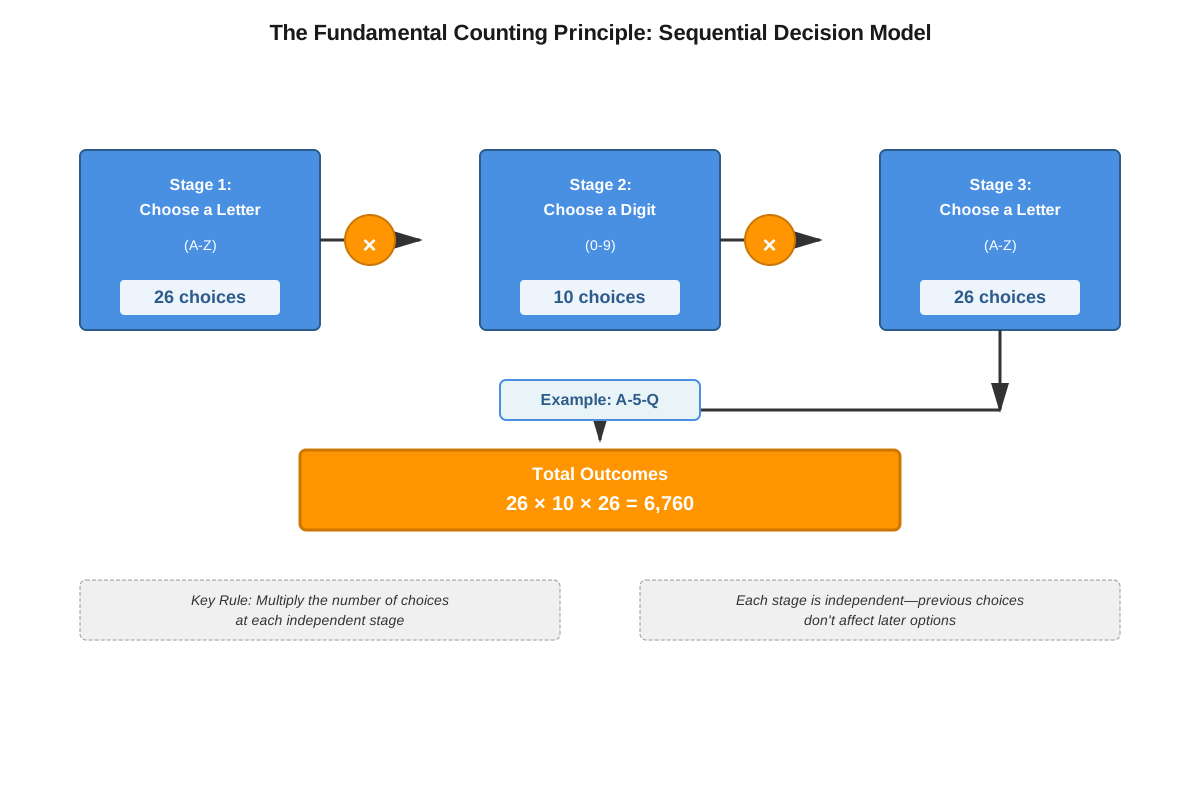
The counting principle states that if one event can occur in m ways and a second independent event can occur in n ways, then the two events together can occur in m × n ways. This principle extends to any number of sequential events: if there are k events that can occur in n₁, n₂, n₃, ..., nₖ ways respectively, the total number of outcomes is the product n₁ × n₂ × n₃ × ... × nₖ.
The key requirement is independence: each choice must not reduce or alter the available options for subsequent choices. When this condition holds, multiplication gives the total number of distinct outcomes.
Sequential Decision-Making
Counting principle problems involve breaking down a complex scenario into a sequence of individual decisions or stages. At each stage, determine how many options are available, then multiply these numbers together.
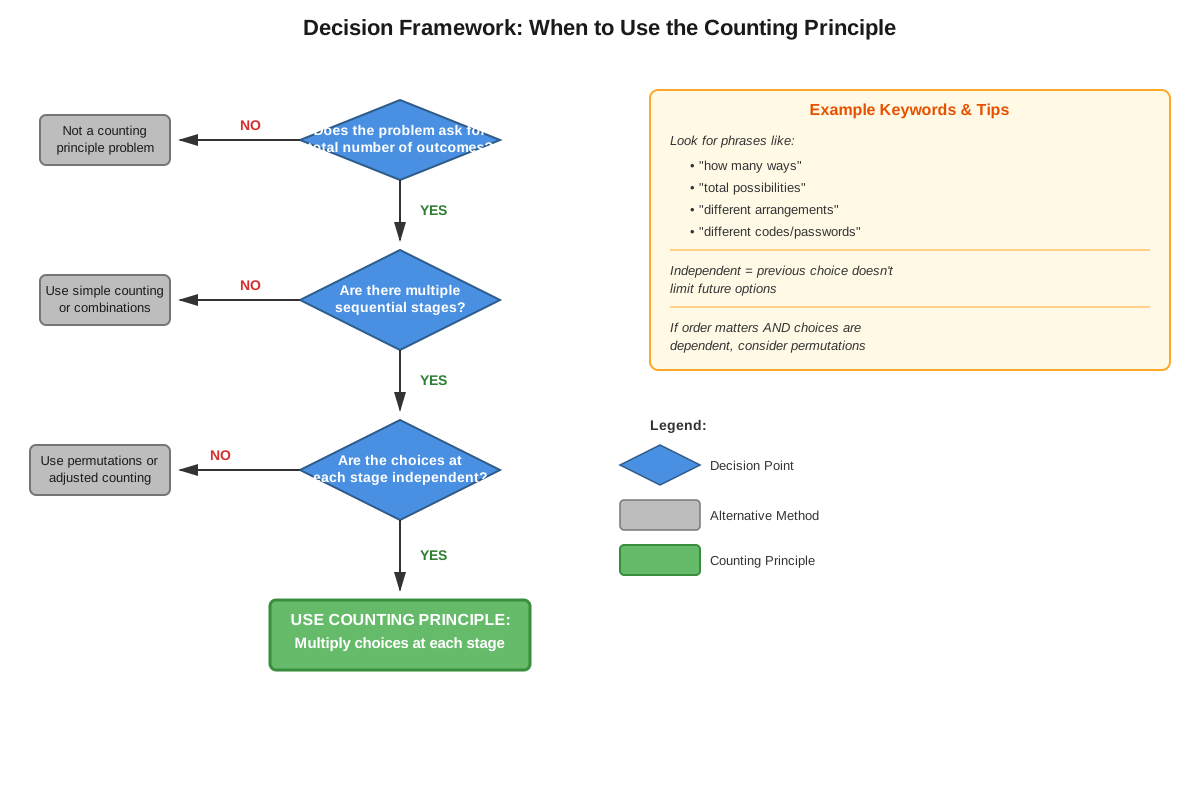
Steps for applying the counting principle:
- Identify all decision points or stages in the problem
- Determine the number of available choices at each stage
- Verify that choices are independent (or account for dependencies)
- Multiply the number of choices across all stages
- Check whether any restrictions or special conditions apply
Simple Applications
Consider a restaurant menu offering 4 appetizers, 6 main courses, and 3 desserts. To find the number of complete three-course meals possible, apply the counting principle:
Total meals = 4 × 6 × 3 = 72Each choice (appetizer, main course, dessert) is independent—selecting one appetizer doesn't limit which main course can be chosen. This independence makes the counting principle applicable.
Problems with Restrictions
Many GRE questions introduce constraints or restrictions that modify the straightforward application. Common restriction types include:
- Position-specific requirements: Certain choices must occupy specific positions
- Exclusion rules: Certain combinations are forbidden
- Mandatory inclusions: Specific elements must be included
- Dependent choices: Later choices depend on earlier selections
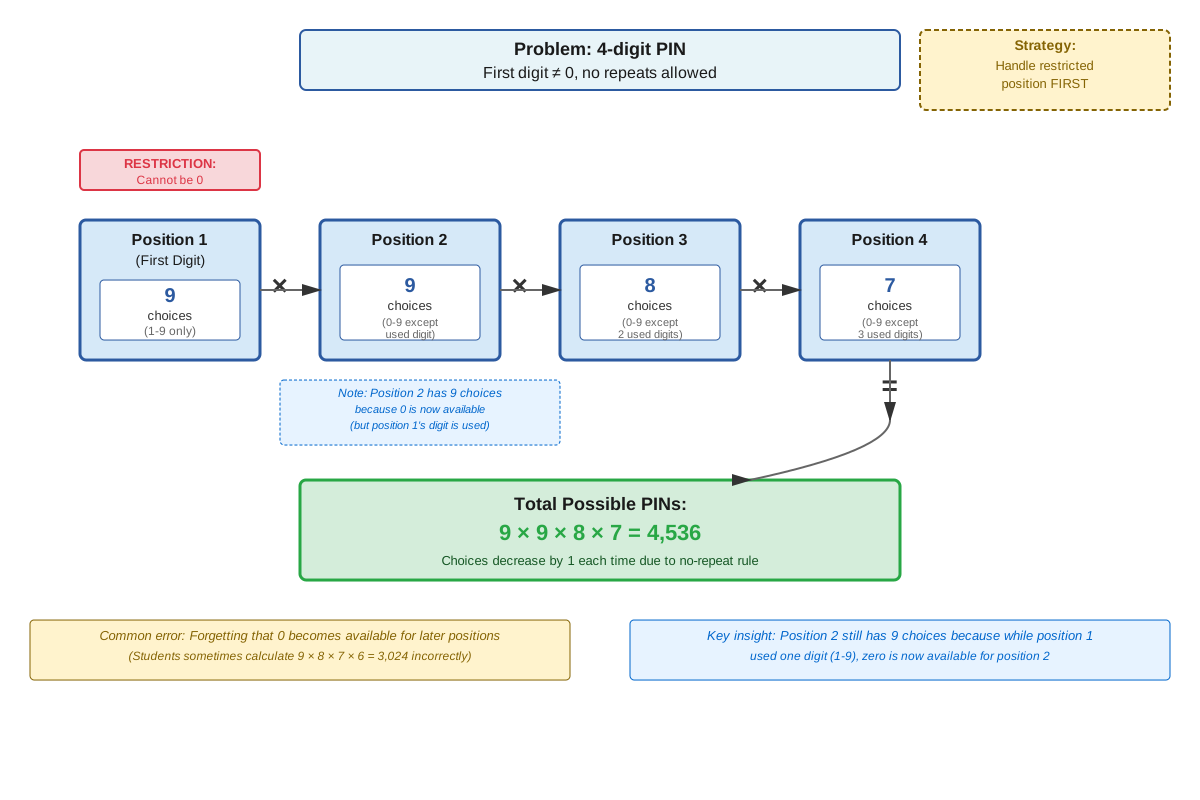
When restrictions exist, handle the most restrictive choice first, then proceed to less restrictive choices.
Example with restriction: How many three-digit numbers can be formed using digits 1-5 without repetition, where the first digit must be odd?
- First digit (most restrictive): Must be odd (1, 3, or 5) → 3 choices
- Second digit: Any remaining digit except the one used → 4 choices
- Third digit: Any remaining digit except the two used → 3 choices
Total = 3 × 4 × 3 = 36Distinguishing from Permutations and Combinations
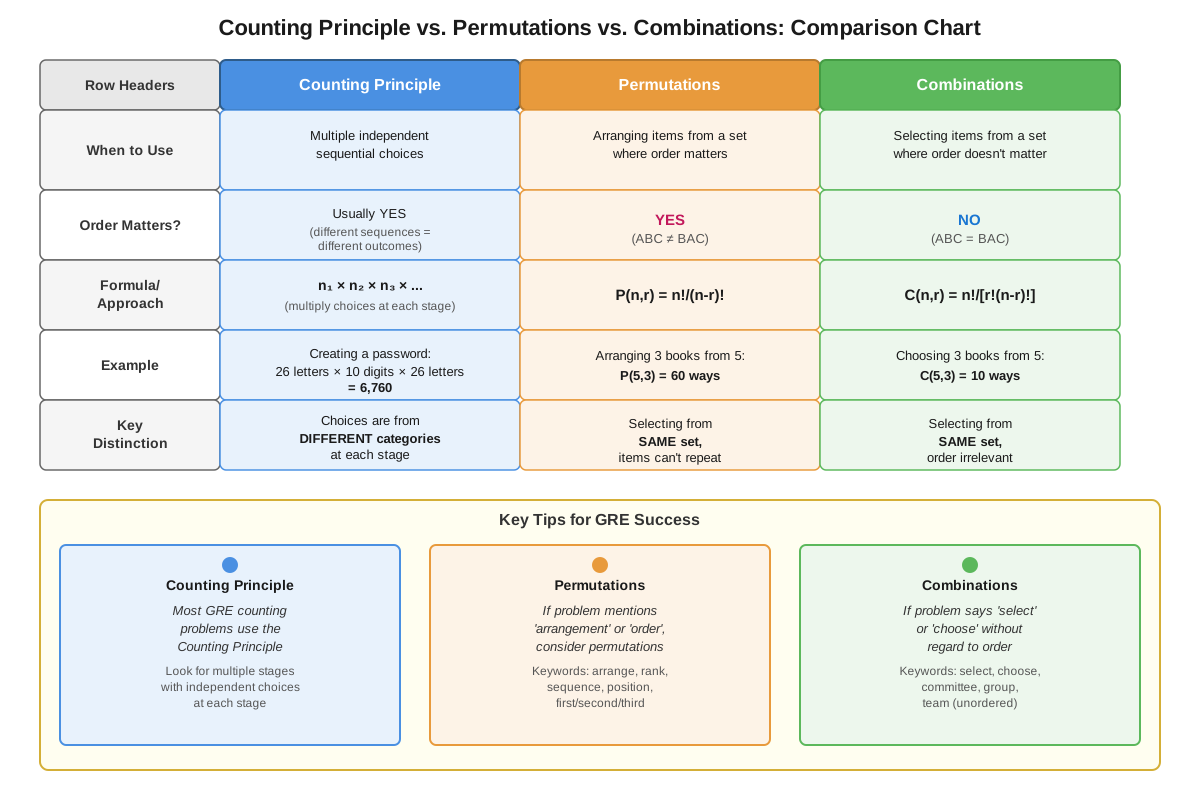
| Concept | When to Use | Formula Structure | Order Matters? |
|---|---|---|---|
| Counting Principle | Sequential independent choices | n₁ × n₂ × n₃ × ... | Depends on context |
| Permutations | Arranging items from a set | P(n,r) = n!/(n-r)! | Yes |
| Combinations | Selecting items without regard to order | C(n,r) = n!/[r!(n-r)!] | No |
The counting principle is more fundamental and flexible. It applies when making a series of choices where each stage has a clear number of options. Permutations and combinations are specialized formulas for specific selection scenarios.
Repeated Choices vs. Non-Repeated Choices
With repetition allowed: If choices can be repeated (like digits in a PIN where the same digit can appear multiple times), each stage maintains the same number of options.
Example: Four-digit PIN using digits 0-9 with repetition allowed:
Total = 10 × 10 × 10 × 10 = 10⁴ = 10,000Without repetition: If each choice removes an option from subsequent stages, the number of available choices decreases at each step.
Example: Four-digit PIN using digits 0-9 without repetition:
Total = 10 × 9 × 8 × 7 = 5,040Multi-Category Problems
Some problems involve multiple independent categories where choices within each category follow the counting principle, but the categories themselves represent different scenarios.
Example: A password requires exactly one uppercase letter, one lowercase letter, and one digit. If there are 26 uppercase letters, 26 lowercase letters, and 10 digits, and order matters:
Total = 26 × 26 × 10 = 6,760However, if the order of these three characters can vary, multiply by the number of arrangements (3! = 6):
Total = 6,760 × 6 = 40,560Complementary Counting
Sometimes calculating the complement (what you don't want) is easier than direct counting. Use the formula:
Desired outcomes = Total outcomes - Undesired outcomesExample: How many four-letter "words" (arrangements) using A-Z contain at least one vowel?
Direct counting is complex, but complementary counting is straightforward:
- Total four-letter arrangements: 26⁴ = 456,976
- Arrangements with no vowels (21 consonants only): 21⁴ = 194,481
- Arrangements with at least one vowel: 456,976 - 194,481 = 262,495
Concept Relationships
The counting principle serves as the foundational concept from which more specialized counting methods derive. Sequential decision-making → applies → counting principle → which forms the basis for → permutations (when all items from a set are arranged) and combinations (when order doesn't matter).
Within counting principle problems, restriction handling → modifies → basic multiplication approach → by requiring → strategic ordering of decisions. The concept of independence → determines → whether multiplication applies → and connects to → probability of independent events.
The counting principle also connects to prerequisite knowledge: basic multiplication → enables → calculation of total outcomes, while understanding of independent events → ensures → correct application of multiplication rule. When combined with probability, the counting principle provides the denominator (total possible outcomes) for probability calculations: counting principle → determines → sample space size → which enables → probability computation.
The relationship between repetition-allowed and repetition-forbidden scenarios demonstrates how constraints → reduce → available choices at each stage → thereby decreasing → total outcomes. This connects to the broader concept that restrictions → require → modified counting strategies → such as → complementary counting or case-by-case analysis.
High-Yield Facts
⭐ The counting principle multiplies the number of independent choices at each sequential stage to find total outcomes
⭐ When repetition is allowed, each stage maintains the same number of choices; without repetition, available choices decrease at each stage
⭐ Handle the most restrictive condition first when solving problems with constraints
⭐ The counting principle applies only when choices are independent—when one choice doesn't affect the options available for subsequent choices
⭐ Complementary counting (total minus unwanted) is often faster than direct counting for "at least one" problems
- The counting principle is more fundamental than permutation and combination formulas and can solve a broader range of problems
- Position-specific restrictions should be addressed before general position choices
- When order matters in a problem, the counting principle typically applies; when order doesn't matter, combinations may be more appropriate
- Multi-stage problems require identifying each decision point and determining available options at each stage
- The counting principle can be combined with addition when dealing with mutually exclusive scenarios (either/or situations)
- Zero is a valid choice in many counting problems unless explicitly excluded (important for digit problems)
- The phrase "without replacement" signals that repetition is not allowed and available choices decrease
Quick check — test yourself on Counting principle so far.
Try Flashcards →Common Misconceptions
Misconception: The counting principle applies to all selection problems regardless of whether order matters.
Correction: The counting principle naturally accounts for order in sequential decisions. When order doesn't matter (like selecting committee members), combinations formulas are more appropriate, though the counting principle can still be used with additional division to remove duplicate orderings.
Misconception: When a problem says "at least one," multiply the probabilities of each individual case.
Correction: "At least one" problems are most efficiently solved using complementary counting: calculate the total outcomes, subtract the cases with zero of the desired element, rather than adding up cases with exactly one, exactly two, etc.
Misconception: In problems without repetition, the number of choices remains constant at each stage.
Correction: Without repetition, each choice removes one option from the pool, so available choices decrease by one at each subsequent stage (e.g., 10 × 9 × 8 × 7, not 10 × 10 × 10 × 10).
Misconception: All restrictions should be handled at the end of the calculation.
Correction: Restrictions should be incorporated during the counting process, typically by addressing the most restrictive positions first, then counting remaining options for less restrictive positions.
Misconception: The counting principle and probability are unrelated concepts.
Correction: The counting principle often provides the denominator (total possible outcomes) for probability calculations. Probability = (favorable outcomes)/(total outcomes), where both numerator and denominator may require the counting principle.
Misconception: When digits 0-9 are available, there are always 10 choices for each position.
Correction: Context matters—for the first digit of a standard number, 0 typically cannot be used (numbers don't start with 0), reducing choices to 9. Always read whether 0 is a valid choice for each position.
Worked Examples
Example 1: License Plate Problem with Restrictions
Problem: A state issues license plates with 3 letters followed by 3 digits. Letters can be A-Z and digits can be 0-9. How many different license plates are possible if:
- Repetition of letters and digits is allowed
- The first letter cannot be O or I (to avoid confusion with 0 and 1)
- The first digit cannot be 0
Solution:
Step 1: Identify the decision stages
- Position 1: First letter (restricted)
- Position 2: Second letter (unrestricted)
- Position 3: Third letter (unrestricted)
- Position 4: First digit (restricted)
- Position 5: Second digit (unrestricted)
- Position 6: Third digit (unrestricted)
Step 2: Count choices at each stage
- Position 1: 26 total letters - 2 excluded (O and I) = 24 choices
- Position 2: 26 choices (all letters allowed, repetition permitted)
- Position 3: 26 choices
- Position 4: 10 digits - 1 excluded (0) = 9 choices
- Position 5: 10 choices (all digits allowed, repetition permitted)
- Position 6: 10 choices
Step 3: Apply the counting principle
Total = 24 × 26 × 26 × 9 × 10 × 10
Total = 24 × 676 × 900
Total = 14,601,600Answer: 14,601,600 different license plates are possible.
Connection to learning objectives: This problem demonstrates identifying when the counting principle applies (sequential independent choices), handling restrictions (excluded letters and digits), and applying the principle accurately with multiple stages.
Example 2: Committee Formation with Constraints
Problem: A company needs to form a 3-person committee consisting of 1 manager and 2 employees. There are 5 managers and 8 employees available. Additionally, if Manager A is selected, Employee X cannot be on the committee (they don't work well together). How many different committees can be formed?
Solution:
This problem requires case-by-case analysis due to the conditional restriction.
Step 1: Identify cases
- Case 1: Manager A is selected
- Case 2: Manager A is not selected
Case 1: Manager A is selected
- Manager position: 1 choice (Manager A)
- Employee positions: Choose 2 from 7 employees (excluding Employee X)
- Number of ways to choose 2 employees from 7: C(7,2) = 7!/(2!×5!) = 21
Case 1 total: 1 × 21 = 21 committees
Case 2: Manager A is not selected
- Manager position: 4 choices (any of the other 4 managers)
- Employee positions: Choose 2 from all 8 employees
- Number of ways to choose 2 employees from 8: C(8,2) = 8!/(2!×6!) = 28
Case 2 total: 4 × 28 = 112 committees
Step 2: Add mutually exclusive cases
Total committees = 21 + 112 = 133Answer: 133 different committees can be formed.
Connection to learning objectives: This example shows how to identify counting principle applications within combination problems, handle conditional restrictions through case analysis, and integrate multiple counting methods. The counting principle applies to the manager selection (sequential choice), while combinations handle the employee selection (order doesn't matter).
Exam Strategy
Trigger phrases: Watch for "how many ways," "how many different," "how many possible," "arrangements," "outcomes," "combinations" (in casual usage, not technical), and "selections" in sequential contexts.
Approach strategy for GRE counting questions:
- Read carefully for restrictions: Underline or note any constraints, exclusions, or special conditions before beginning calculations
- Diagram the stages: Quickly sketch blanks or boxes representing each decision point
- Identify the most restrictive stage: Start with positions that have the fewest options or most constraints
- Check for independence: Verify that each choice doesn't affect subsequent options (or adjust if it does)
- Calculate systematically: Work through stages in order, writing the multiplication expression before computing
Process of elimination tips:
- Eliminate answer choices that are sums when the problem requires multiplication (or vice versa)
- If repetition is not allowed, eliminate answers that would result from keeping choices constant (e.g., eliminate 10⁴ if the answer should be 10×9×8×7)
- For "at least one" problems, eliminate answers that seem too small—they likely represent only one specific case rather than all cases
- Check whether answer choices are reasonable in magnitude: if choosing 3 items from 10, answers in the thousands are likely wrong
Time allocation advice:
- Spend 15-20 seconds identifying all stages and restrictions before calculating
- For complex problems with multiple cases, quickly estimate whether case-by-case analysis or complementary counting will be faster
- Don't get stuck on one approach—if direct counting seems overwhelming, try complementary counting
- Budget approximately 2 minutes for straightforward counting principle questions, 2.5-3 minutes for problems with complex restrictions
Common question variations:
- Quantitative comparison: Often compares scenarios with different restrictions; focus on how restrictions affect the number of choices
- Multiple answer: May ask which statements about counting scenarios are true; evaluate each independently
- Data interpretation integration: May provide a table or chart with category information, then ask counting questions about combinations
Memory Techniques
Mnemonic for problem-solving steps: "DISCO"
- Diagram the stages (draw blanks for each position)
- Identify restrictions (note constraints)
- Start with most restrictive (handle hardest first)
- Count choices at each stage (determine options)
- Operate with multiplication (apply counting principle)
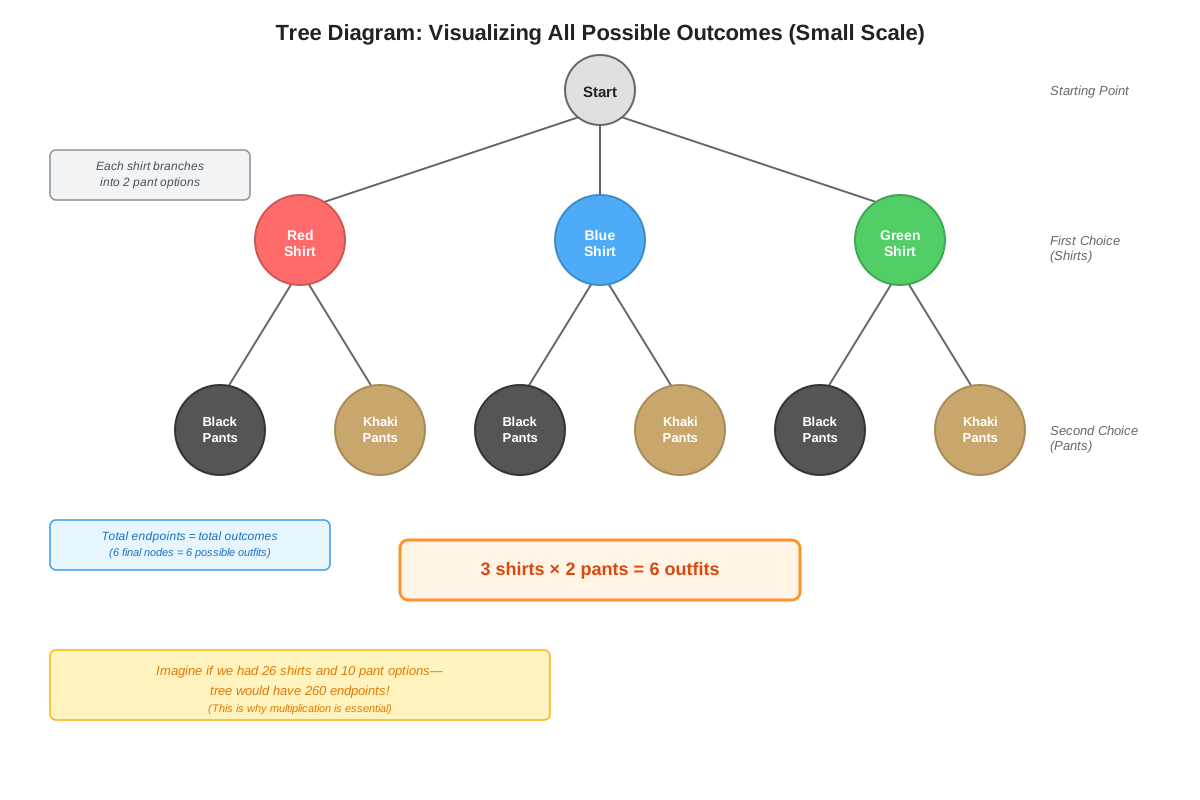
Visualization strategy: Picture a tree diagram where each branch represents a choice. The counting principle multiplies the number of branches at each level. When repetition isn't allowed, visualize branches being "pruned" (removed) after each choice.
Acronym for restriction types: "PERM"
- Position-specific (certain items must go in certain spots)
- Exclusion (certain combinations forbidden)
- Repetition rules (allowed or not allowed)
- Mandatory inclusion (certain items must be included)
Memory aid for repetition:
- "Repetition Allowed = Constant Choices" (each stage has same number)
- "No Repetition = Decreasing Choices" (each stage has one fewer option)
Complementary counting reminder: "At least one? Think: ALL minus NONE"
Summary
The counting principle is a fundamental multiplicative method for determining total outcomes when multiple independent sequential choices occur. By identifying decision stages, counting available options at each stage, and multiplying these numbers, test-takers can efficiently solve complex counting problems without exhaustive enumeration. The principle requires that choices be independent—each selection must not alter the options available for subsequent selections. GRE questions frequently introduce restrictions such as position-specific requirements, exclusion rules, or repetition constraints that modify the basic application. Success requires systematic problem decomposition: diagram the stages, identify and handle restrictions (starting with the most limiting), verify independence, and multiply the choices. The counting principle connects to broader mathematical concepts including probability (providing sample space size), permutations (specialized arrangements), and combinations (selections without order). Distinguishing when to apply the counting principle versus other methods depends on recognizing whether the problem involves sequential independent choices. Complementary counting—calculating total outcomes minus unwanted outcomes—often provides the most efficient solution path for "at least one" scenarios. Mastery of this high-yield topic enables confident, accurate problem-solving across numerous GRE question types.
Key Takeaways
- The counting principle multiplies the number of independent choices at sequential stages to determine total possible outcomes
- Always handle the most restrictive conditions first, then proceed to less restrictive choices
- Repetition allowed means constant choices at each stage; no repetition means decreasing choices
- Use complementary counting (total minus unwanted) for "at least one" problems rather than adding individual cases
- The counting principle applies when choices are independent and sequential; combinations apply when order doesn't matter
- Restrictions and constraints must be incorporated during counting, not after—they fundamentally change the number of available choices
- Systematic problem decomposition (identify stages, count options, verify independence, multiply) prevents errors and saves time
Related Topics
Permutations: Building on the counting principle, permutations provide formulas for arranging items from a set when order matters. Mastering the counting principle makes permutation concepts more intuitive since permutations represent specialized applications of sequential counting.
Combinations: While the counting principle accounts for order in sequential decisions, combinations handle selection scenarios where order is irrelevant. Understanding when to apply each method is crucial for GRE success.
Probability: The counting principle provides the foundation for calculating probabilities by determining both total possible outcomes (denominator) and favorable outcomes (numerator). Many GRE probability questions require counting principle applications.
Sets and Venn Diagrams: When counting problems involve overlapping categories or multiple conditions, set theory and Venn diagrams help organize information before applying the counting principle.
Factorial Notation: Advanced counting problems often involve factorials, which represent the counting principle applied to arranging all items in a set. Understanding n! as n × (n-1) × (n-2) × ... × 1 connects directly to counting principle logic.
Practice CTA
Now that you've mastered the fundamental concepts and strategies behind the counting principle, it's time to reinforce your learning through active practice. Attempt the practice questions to apply these concepts to GRE-style problems, and use the flashcards to cement high-yield facts and common patterns in your memory. Remember: the counting principle rewards systematic thinking and careful attention to restrictions—skills that improve rapidly with deliberate practice. Each problem you solve strengthens your pattern recognition and builds the confidence needed for test day success. Start practicing now to transform this knowledge into automatic, accurate problem-solving ability!
Sign up free to keep reading
Create a free AnvayaPrep account to finish this GRE guide on Counting principle — plus flashcards and practice questions.