Overview
Method of reasoning questions represent one of the most sophisticated question types in GRE Verbal Reasoning's Critical Reasoning section. These questions ask test-takers to analyze how an argument is constructed rather than what the argument concludes or whether it's valid. Instead of evaluating the strength of evidence or identifying assumptions, students must describe the argumentative technique, logical structure, or persuasive strategy an author employs. This requires a meta-cognitive skill: stepping back from the content to observe the architecture of reasoning itself.
Understanding GRE method of reasoning questions is essential because they appear regularly on the exam and demand a unique analytical approach. While assumption and strengthen/weaken questions focus on logical gaps and evidence quality, method of reasoning questions test whether students can recognize patterns of argumentation—such as analogical reasoning, counterexample deployment, or hypothesis elimination. These questions reward students who can think abstractly about logical structures and match specific arguments to general descriptions of reasoning techniques.
Method of reasoning questions connect deeply to other Critical Reasoning concepts within Verbal Reasoning. They build upon foundational skills in argument structure identification (premise recognition, conclusion identification) while requiring more sophisticated pattern recognition than basic argument analysis. Mastering this topic enhances performance on parallel reasoning questions, strengthens overall logical analysis skills, and develops the abstract thinking necessary for tackling complex Reading Comprehension passages that employ sophisticated argumentative strategies.
Learning Objectives
- [ ] Identify when Method of reasoning is being tested
- [ ] Explain the core rule or strategy behind Method of reasoning
- [ ] Apply Method of reasoning to GRE-style questions accurately
- [ ] Distinguish between different types of reasoning methods (analogy, counterexample, elimination, etc.)
- [ ] Match abstract descriptions of reasoning patterns to concrete argument examples
- [ ] Eliminate incorrect answer choices that describe content rather than method
- [ ] Recognize common reasoning structures within 30 seconds of reading a stimulus
Prerequisites
- Argument structure identification: Understanding premises, conclusions, and intermediate claims is essential because method of reasoning questions require recognizing these components before analyzing how they relate.
- Basic logical relationships: Familiarity with cause-and-effect, correlation, conditional statements, and evidence-conclusion connections enables recognition of how these relationships function as reasoning methods.
- Critical Reasoning question types: Exposure to assumption, strengthen, and weaken questions provides context for understanding how method questions differ in their analytical demands.
Why This Topic Matters
Method of reasoning questions test a critical real-world skill: the ability to analyze how people argue, not just what they argue. In professional contexts—from evaluating business proposals to assessing scientific claims—understanding argumentative techniques helps identify persuasive strategies, recognize rhetorical patterns, and communicate more effectively. Legal professionals, researchers, and business analysts regularly employ this meta-analytical skill to deconstruct complex arguments and understand persuasive mechanisms.
On the GRE, method of reasoning questions typically appear 1-2 times per Verbal Reasoning section, representing approximately 10-15% of Critical Reasoning questions. While less frequent than assumption or strengthen/weaken questions, they carry equal weight in scoring and often prove challenging for unprepared students. These questions appear in both short-argument formats (2-4 sentences) and occasionally within Reading Comprehension passages when asking about an author's argumentative technique.
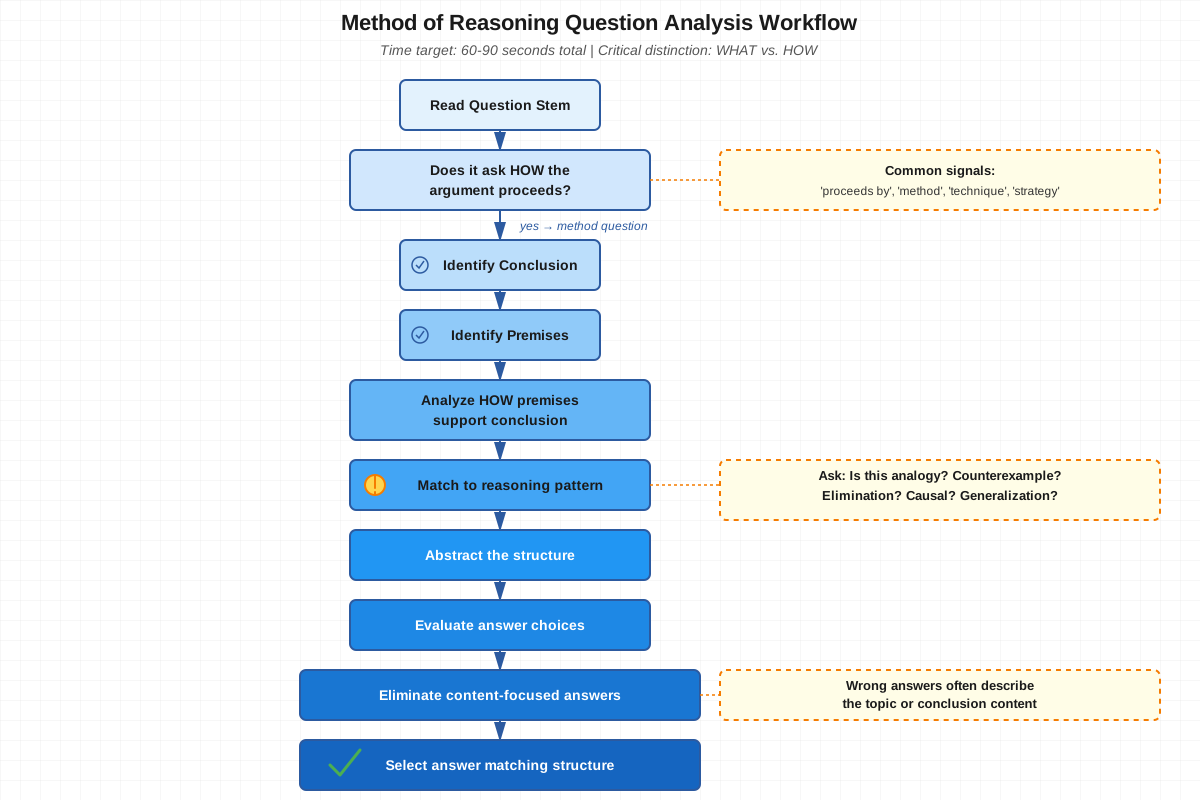
The GRE presents method of reasoning questions in several characteristic ways: asking how an author responds to a position, describing the role of a specific statement, identifying the technique used to support a conclusion, or characterizing the overall argumentative strategy. Question stems typically include phrases like "proceeds by," "employs which technique," "responds to the claim by," or "the argument does which of the following." Recognizing these linguistic markers helps students quickly identify when method analysis is required.
Core Concepts
Understanding Method vs. Content
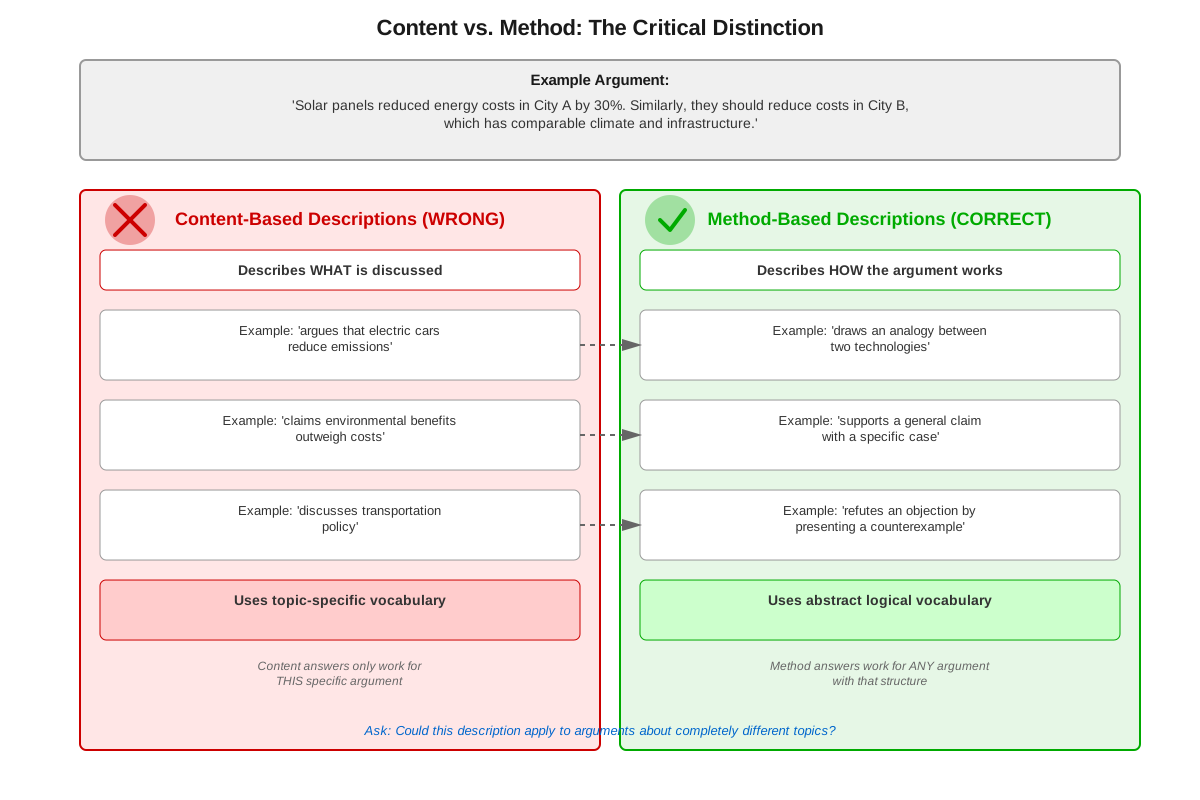
The fundamental distinction in method of reasoning questions separates what an argument says (content) from how it argues (method). Content refers to the specific subject matter, facts, and claims—for example, "The company's profits increased due to marketing changes." Method refers to the logical technique employed—for example, "establishes a causal relationship between two correlated phenomena."
Students must train themselves to abstract away from specific details and recognize the underlying logical architecture. This requires reading arguments twice: first for comprehension, second for structural analysis. The correct answer to a method question should accurately describe the reasoning pattern while remaining general enough to apply to arguments about entirely different topics.
Common Reasoning Methods
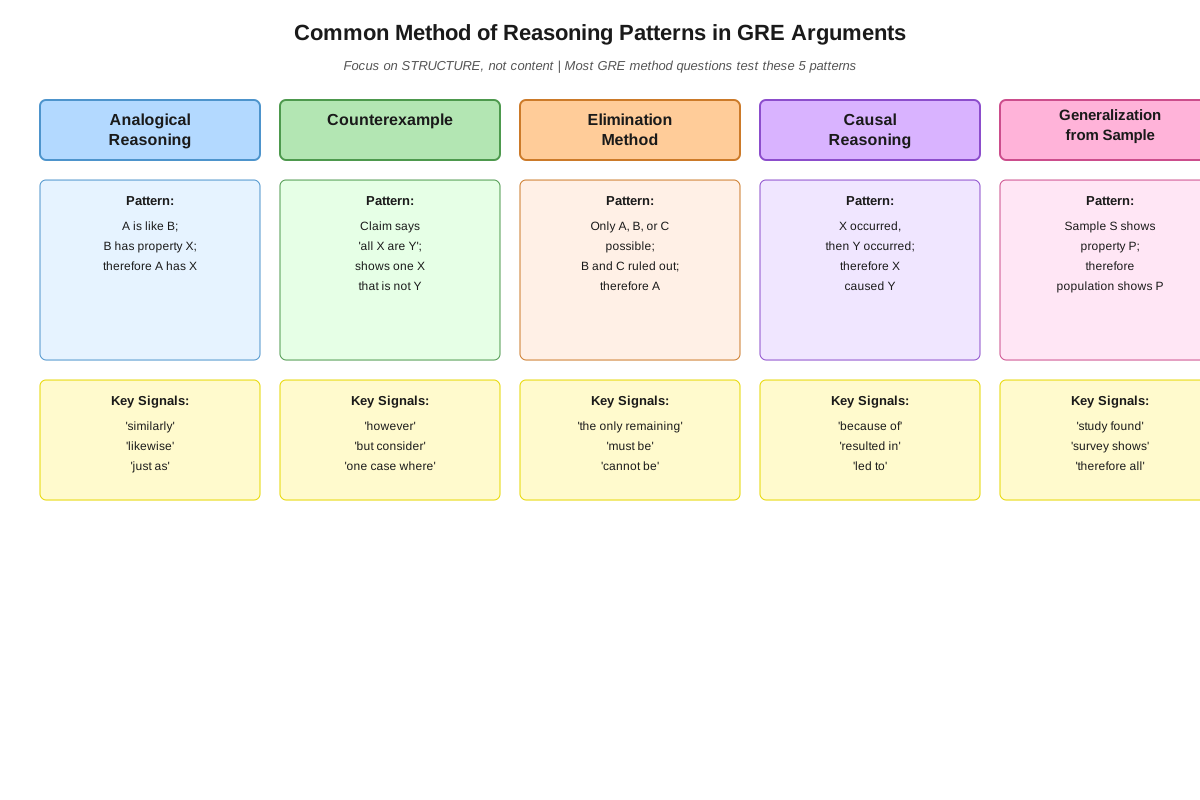
Analogical reasoning involves drawing parallels between two situations to suggest that what's true in one case applies to another. The argument structure follows this pattern: Situation A has characteristics X, Y, Z and outcome O; Situation B shares characteristics X, Y, Z; therefore, Situation B will likely have outcome O. GRE questions testing this method often use answer choices like "draws a parallel between two cases" or "uses an analogy to support the conclusion."
Counterexample deployment refutes a general claim by providing a specific instance that contradicts it. If someone argues "All X are Y," a counterexample shows at least one X that is not Y, thereby disproving the universal claim. This method appears frequently when arguments respond to opposing positions. Answer choices might describe this as "challenges a generalization by citing an exception" or "undermines a claim by providing a contradictory case."
Elimination reasoning (also called disjunctive syllogism) establishes a conclusion by systematically ruling out alternatives. The structure presents multiple possibilities, eliminates all but one, and concludes the remaining option must be true. This method assumes the initial list of possibilities is exhaustive. GRE answer choices describe this as "eliminates alternative explanations" or "establishes a conclusion by ruling out competing hypotheses."
Causal reasoning establishes or challenges cause-and-effect relationships. Arguments might claim X causes Y based on correlation, temporal sequence, or mechanism explanation. Conversely, arguments might challenge causal claims by suggesting alternative causes, reversed causation, or mere correlation. Method questions about causal reasoning test whether students recognize when arguments are "establishing a causal connection," "challenging a causal inference," or "proposing an alternative explanation."
Appeal to authority or expertise supports claims by citing expert opinion, research findings, or authoritative sources. The reasoning assumes that experts in a field provide reliable information within their domain. Answer choices might describe this as "supports the conclusion by citing expert testimony" or "relies on authoritative sources to establish credibility."
Reductio ad absurdum (reduction to absurdity) demonstrates that a position is false by showing it leads to absurd, contradictory, or unacceptable consequences. The structure assumes the opposing position, derives logical implications, shows these implications are untenable, and concludes the original position must be false. This sophisticated technique appears in answer choices as "demonstrates that accepting the opposing view leads to an unacceptable conclusion" or "refutes a position by showing its logical consequences are contradictory."
Identifying Method Question Stems
Method of reasoning questions use distinctive language that signals the analytical task. Common question stems include:
- "The argument proceeds by..."
- "Which of the following describes the technique used..."
- "The author responds to the position by..."
- "The argument employs which of the following methods..."
- "The claim that [specific statement] functions in the argument to..."
- "The argument does which of the following?"
Recognizing these stems immediately alerts students to focus on argumentative structure rather than content evaluation, assumption identification, or logical validity.
The Role of Specific Statements
A subset of method questions asks about the function or role of a particular statement within an argument. These questions require identifying whether a statement serves as:
- The main conclusion
- A subsidiary conclusion (intermediate claim)
- Evidence supporting the conclusion
- Background information or context
- An opposing position the argument refutes
- A concession acknowledged before presenting counterargument
- An assumption made explicit
Students must trace logical relationships: Does this statement support something else, or is it supported by other statements? Does it represent the author's position or an opposing view being addressed?
Concept Relationships
Method of reasoning questions integrate multiple Critical Reasoning skills into a unified analytical task. The relationship flows as follows:
Argument Structure Identification → Premise-Conclusion Recognition → Relationship Analysis → Pattern Abstraction → Method Description
Students first identify the argument's components (premises, conclusion, background), then analyze how these components relate logically (does evidence support? does it refute? does it provide analogy?), and finally abstract this specific relationship into a general reasoning pattern (analogical reasoning, counterexample, etc.).
Method questions connect to assumption questions because recognizing reasoning methods helps identify what must be assumed. For example, analogical reasoning assumes relevant similarity between compared cases; elimination reasoning assumes the list of possibilities is complete. Understanding these connections deepens comprehension of both question types.
The relationship to parallel reasoning questions is particularly strong. Both question types require pattern recognition and abstraction from content. Method questions ask "What pattern does this argument use?" while parallel reasoning asks "Which other argument uses the same pattern?" Mastering method analysis directly improves parallel reasoning performance.
Within method questions themselves, concepts connect hierarchically: General Method Recognition (Is this analogy? Elimination? Counterexample?) → Specific Technique Identification (How exactly is the analogy deployed? What alternatives are eliminated?) → Answer Choice Matching (Which description accurately captures this specific technique?).
High-Yield Facts
⭐ Method questions ask HOW an argument reasons, not WHETHER the reasoning is valid or WHAT assumptions it makes.
⭐ The correct answer must describe the logical structure, not summarize the content or conclusion.
⭐ Common reasoning methods include: analogy, counterexample, elimination, causal reasoning, appeal to authority, and reductio ad absurdum.
⭐ Question stems containing "proceeds by," "employs which technique," or "responds by" signal method questions.
⭐ Incorrect answers often describe the argument's content, conclusion, or subject matter rather than its reasoning method.
- Method questions typically appear 1-2 times per Verbal Reasoning section on the GRE.
- Analogical reasoning assumes relevant similarity between the compared situations.
- Counterexamples refute universal claims ("all," "every," "never") but not qualified claims ("most," "some").
- Elimination reasoning requires that all possibilities be considered; overlooked alternatives weaken this method.
- When a question asks about a specific statement's role, trace what it supports and what supports it.
- Causal reasoning can establish causation, challenge it, or propose alternative causes—each represents a different method.
- Reductio ad absurdum temporarily accepts an opposing position to show it leads to contradiction.
- The same argument content can be described at different levels of abstraction; choose the most precise description.
- Background information and context-setting statements don't function as premises or conclusions.
- Method questions reward abstract thinking—students must mentally "zoom out" from specific details.
Quick check — test yourself on Method of reasoning so far.
Try Flashcards →Common Misconceptions
Misconception: Method questions ask whether an argument is logically valid or strong.
Correction: Method questions are purely descriptive, asking how the argument is structured, not whether it succeeds. An argument using analogical reasoning might be weak, but if the question asks about method, "uses an analogy" is correct regardless of the argument's quality.
Misconception: The correct answer should mention the specific subject matter of the argument.
Correction: Correct answers describe reasoning patterns abstractly. If an argument about marketing uses a counterexample, the answer should say "refutes a claim by providing a contradictory instance," not "discusses marketing strategies" or "mentions advertising campaigns."
Misconception: All premises function the same way in an argument.
Correction: Different premises serve different roles. Some provide direct evidence for the conclusion, others establish background, some present opposing views to be refuted, and others function as intermediate conclusions. Method questions about specific statements require distinguishing these roles.
Misconception: Longer, more complex answer choices are more likely to be correct.
Correction: GRE answer choices vary in length for stylistic reasons, not as difficulty indicators. The correct answer is the most accurate description, whether brief or detailed. Many incorrect answers use complex language to describe the wrong method.
Misconception: If an argument mentions an expert or study, it must be "appealing to authority."
Correction: Simply mentioning an expert doesn't constitute appeal to authority as a reasoning method. The argument must rely on the expert's credibility as the primary support for its conclusion. If the argument presents the expert's evidence and reasoning, it's using that evidence directly, not appealing to authority.
Misconception: Identifying the conclusion is sufficient for answering method questions.
Correction: While finding the conclusion is necessary, method questions require analyzing the relationship between premises and conclusion—the path of reasoning, not just the destination. Two arguments can reach identical conclusions using entirely different methods.
Worked Examples
Example 1: Counterexample Method
Argument: "City planners claim that increasing parking fees always reduces downtown traffic congestion. However, when Riverside City doubled parking fees last year, downtown traffic actually increased by 15%. Therefore, the planners' claim is questionable."
Question: The argument proceeds by which of the following methods?
Answer Choices:
A) Proposing an alternative explanation for an observed phenomenon
B) Challenging a generalization by citing a case that contradicts it
C) Drawing an analogy between two similar situations
D) Establishing a causal relationship through statistical evidence
E) Appealing to expert opinion to support a conclusion
Analysis:
Step 1: Identify the argument structure
- Opposing claim: "Increasing parking fees always reduces traffic congestion"
- Evidence: Riverside City's experience contradicts this (fees increased, traffic increased)
- Conclusion: The claim is questionable
Step 2: Recognize the reasoning method
The argument takes a universal claim ("always reduces") and presents a specific instance where the claimed relationship didn't hold. This is classic counterexample reasoning—using a single contradictory case to challenge a generalization.
Step 3: Eliminate incorrect answers
- (A) describes proposing alternative explanations, but the argument doesn't explain why traffic increased, only that it did
- (C) describes analogy, but no parallel situation is drawn
- (D) describes establishing causation, but the argument challenges rather than establishes a causal claim
- (E) describes appeal to authority, but no experts are cited
Step 4: Confirm the correct answer
(B) accurately describes the method: the argument challenges a generalization (the "always" claim) by citing a contradictory case (Riverside City).
Connection to Learning Objectives: This example demonstrates identifying method questions (objective 1), recognizing counterexample reasoning (objective 4), and eliminating content-focused wrong answers (objective 6).
Example 2: Elimination Reasoning
Argument: "The ancient Khazar civilization disappeared suddenly around 1000 CE. Archaeologists have found no evidence of natural disaster, foreign invasion, or epidemic disease during this period. The most likely explanation is internal political collapse, as this is the only remaining plausible cause of such rapid societal disintegration."
Question: The argument employs which of the following techniques?
Answer Choices:
A) Uses historical analogy to support a hypothesis
B) Establishes a conclusion by systematically ruling out alternative explanations
C) Challenges conventional wisdom by presenting new evidence
D) Draws a causal inference from correlational data
E) Supports a claim by citing expert archaeological consensus
Analysis:
Step 1: Identify the argument structure
- Conclusion: Internal political collapse caused the Khazar disappearance
- Evidence: No evidence for natural disaster, invasion, or disease
- Reasoning: These alternatives are eliminated, leaving political collapse
Step 2: Recognize the reasoning method
The argument presents multiple possible explanations (disaster, invasion, disease, political collapse), eliminates all but one, and concludes the remaining explanation must be correct. This is elimination reasoning or disjunctive syllogism.
Step 3: Evaluate answer choices
- (A) mentions analogy, but no parallel civilization is discussed
- (B) accurately describes the elimination method used
- (C) suggests challenging conventional wisdom, but the argument doesn't present itself as contrarian
- (D) describes causal inference from correlation, but the argument doesn't establish correlation between variables
- (E) mentions expert consensus, but the argument presents evidence, not authority
Step 4: Confirm and note assumptions
(B) is correct. Note that this reasoning method assumes the list of possibilities is exhaustive—a potential weakness, but not relevant to describing the method itself.
Connection to Learning Objectives: This example shows applying method analysis to GRE-style questions (objective 3), distinguishing elimination reasoning from other methods (objective 4), and matching abstract descriptions to concrete arguments (objective 5).
Exam Strategy
Approaching Method Questions Systematically
When encountering a method of reasoning question, follow this four-step process:
- Identify the question type through stem language ("proceeds by," "employs which technique," "responds by")
- Map the argument structure by identifying conclusion, premises, and any opposing positions
- Describe the method in your own words before looking at answer choices ("This uses a counterexample" or "This eliminates alternatives")
- Match your description to answer choices, eliminating those that describe content rather than method
Trigger Words and Phrases
Watch for these linguistic markers in question stems:
- "Proceeds by" → method question
- "Technique employed" → method question
- "Responds to [position] by" → method question, likely involving refutation
- "The role of [statement]" → method question about specific statement function
- "Does which of the following" → potentially method question (check answer choices)
In answer choices, these phrases indicate correct method descriptions:
- "Challenges/refutes by..."
- "Establishes by..."
- "Draws a parallel/analogy..."
- "Eliminates alternatives..."
- "Cites evidence that..."
- "Proposes an explanation..."
Process of Elimination Tips
Eliminate answers that:
- Describe the argument's subject matter or specific content
- Mention the conclusion without describing how it's reached
- Describe reasoning methods not present in the argument
- Confuse premises with conclusions or vice versa
- Describe what the argument should do rather than what it does
Favor answers that:
- Use abstract, general language applicable to arguments about any topic
- Accurately describe the logical relationship between premises and conclusion
- Match the specific reasoning pattern you identified
- Correctly identify whether the argument supports, challenges, or explains something
Time Allocation
Spend approximately 90-120 seconds on method questions:
- 20-30 seconds: Read and understand the argument
- 15-20 seconds: Identify the reasoning method
- 30-50 seconds: Evaluate answer choices
- 10-20 seconds: Confirm and select
Method questions often require slightly more time than assumption questions because they demand structural analysis rather than gap-finding. However, with practice, pattern recognition becomes faster, allowing efficient processing.
Exam Tip: If stuck between two answer choices, check whether each describes HOW the argument reasons or WHAT it concludes. The "how" description is almost always correct for method questions.
Memory Techniques
RACE Mnemonic for Common Methods
Refutation (counterexample, reductio ad absurdum)
Analogy (parallel cases, similar situations)
Causation (establishing or challenging cause-effect)
Elimination (ruling out alternatives)
When analyzing an argument, mentally run through RACE to quickly identify which method applies.
The "Zoom Out" Visualization
Imagine reading the argument through a camera lens. First, you're zoomed in on the specific details (content). Then zoom out until you see only the structural skeleton—the pattern of reasoning. This mental image helps shift from content focus to method focus.
Function Finder for Statement Roles
When asked about a specific statement's role, use this decision tree:
- Does anything support this statement? → If no, it's a premise or background
- Does this statement support the main conclusion? → If yes, it's a premise
- Does this statement support something that supports the conclusion? → If yes, it's an intermediate conclusion
- Does this represent the author's view? → If no, it's an opposing position
The "Different Topic Test"
To verify an answer choice describes method rather than content, mentally substitute a completely different topic. If the description still makes sense, it's properly abstract. For example, "challenges a generalization by citing an exception" works for arguments about parking fees, ancient civilizations, or medical treatments—confirming it describes method, not content.
Summary
Method of reasoning questions test the sophisticated skill of analyzing argumentative structure rather than content or validity. These questions require students to identify how arguments proceed—whether through analogy, counterexample, elimination, causal reasoning, or other techniques—and match these patterns to abstract descriptions. Success depends on distinguishing method from content, recognizing common reasoning patterns, and selecting answer choices that describe logical structure rather than subject matter. The key analytical shift involves "zooming out" from specific details to observe the architecture of reasoning itself. Students must identify question type through characteristic stems ("proceeds by," "employs which technique"), map argument structure, describe the method abstractly, and eliminate answers that focus on content rather than reasoning pattern. Mastering this topic enhances overall Critical Reasoning performance, strengthens abstract thinking skills, and provides tools for analyzing sophisticated arguments across all GRE Verbal Reasoning contexts.
Key Takeaways
- Method questions ask HOW an argument reasons, requiring structural analysis rather than content evaluation or validity assessment
- Common reasoning methods include analogy, counterexample, elimination, causal reasoning, appeal to authority, and reductio ad absurdum
- Correct answers describe logical patterns abstractly, using language applicable to arguments about any topic
- Question stems containing "proceeds by," "employs which technique," or "responds by" signal method questions
- The systematic approach involves: identify question type → map structure → describe method → match to answer choices
- Incorrect answers typically describe content, conclusions, or subject matter rather than reasoning patterns
- Practice abstracting from specific details to recognize underlying logical architecture across diverse argument topics
Related Topics
Parallel Reasoning Questions: These questions ask students to identify arguments using the same reasoning method as a given argument, directly applying method recognition skills to match logical patterns across different content areas.
Argument Structure Analysis: Deeper study of how premises, conclusions, and intermediate claims relate provides the foundation for sophisticated method analysis and enhances performance on all Critical Reasoning question types.
Logical Fallacies: Understanding flawed reasoning patterns (ad hominem, false dilemma, slippery slope) complements method analysis by showing how reasoning can go wrong, enriching overall logical analysis skills.
Role of Statement Questions: A specialized subset of method questions focusing specifically on identifying what function particular statements serve within arguments, requiring precise understanding of logical relationships.
Strengthen and Weaken Questions: While these evaluate argument quality rather than describe method, understanding reasoning methods helps identify what would strengthen or weaken specific argumentative techniques.
Practice CTA
Now that you've mastered the core concepts of method of reasoning questions, it's time to cement your understanding through active practice. Work through the practice questions to apply these strategies to authentic GRE-style problems, and use the flashcards to reinforce pattern recognition for common reasoning methods. Remember: method analysis is a skill that improves dramatically with deliberate practice. Each question you analyze strengthens your ability to recognize logical patterns quickly and accurately—a skill that will serve you throughout the Verbal Reasoning section and beyond. You've built the foundation; now make it automatic through consistent application!
Sign up free to keep reading
Create a free AnvayaPrep account to finish this GRE guide on Method of reasoning — plus flashcards and practice questions.