Overview
Assumptions represent one of the most critical and frequently tested concepts in GRE Verbal Reasoning, particularly within the Critical Reasoning question type. An assumption is an unstated premise that must be true for an argument's conclusion to logically follow from its stated evidence. Unlike premises that are explicitly provided in the passage, assumptions exist in the logical gap between what is said and what is concluded. Mastering the identification and evaluation of assumptions is essential because these questions test a student's ability to deconstruct arguments, identify logical dependencies, and recognize what information an author takes for granted without stating it directly.
Understanding GRE assumptions requires developing a sophisticated analytical framework that goes beyond surface-level reading. When an author presents an argument, they rarely state every single piece of information needed to support their conclusion. Instead, they rely on unstated beliefs, connections, or facts that bridge the evidence to the conclusion. The GRE tests whether students can identify these hidden logical links and evaluate how they affect argument strength. This skill is fundamental not only for dedicated assumption questions but also for strengthen/weaken questions, evaluate-the-argument questions, and inference questions.
Within the broader landscape of Verbal Reasoning, assumption questions connect directly to argument structure analysis, logical reasoning, and critical thinking skills. They require students to understand how conclusions are built from premises, how evidence supports claims, and where logical vulnerabilities exist. This topic serves as a foundation for more advanced critical reasoning skills, including identifying flaws, evaluating evidence quality, and predicting how new information would affect an argument's validity.
Learning Objectives
- [ ] Identify when Assumptions is being tested in GRE questions
- [ ] Explain the core rule or strategy behind Assumptions
- [ ] Apply Assumptions to GRE-style questions accurately
- [ ] Distinguish between necessary assumptions and sufficient assumptions
- [ ] Use the negation test to verify whether an identified assumption is necessary
- [ ] Recognize common assumption patterns that appear repeatedly on the GRE
- [ ] Evaluate how assumptions create logical vulnerabilities in arguments
Prerequisites
- Basic argument structure: Understanding the difference between premises (evidence) and conclusions (claims) is essential because assumptions bridge these two components
- Logical reasoning fundamentals: Familiarity with cause-and-effect relationships, conditional statements, and basic logical connectors helps identify where assumptions hide
- Reading comprehension skills: The ability to distinguish between what is explicitly stated and what is implied enables students to spot the gaps where assumptions exist
- Vocabulary knowledge: Understanding argument-related terminology (inference, implication, premise, conclusion) provides the conceptual framework for assumption analysis
Why This Topic Matters
Assumption questions appear with remarkable frequency on the GRE, typically comprising 15-25% of all Critical Reasoning questions in the Verbal Reasoning section. This high representation makes assumptions one of the most important topics to master for score optimization. Beyond raw frequency, assumption questions serve as gatekeepers—students who cannot reliably identify assumptions will struggle with the entire Critical Reasoning question family, including strengthen, weaken, evaluate, and flaw questions.
In real-world applications, the ability to identify assumptions is fundamental to critical thinking across all professional and academic domains. Scientists must recognize assumptions underlying research methodologies, business professionals must identify assumptions in strategic plans and financial projections, and policymakers must evaluate assumptions embedded in proposed legislation. The GRE tests this skill because graduate-level work demands the ability to analyze arguments critically, identify unstated premises, and evaluate logical soundness.
On the exam, assumption questions typically appear in several formats: "Which of the following is an assumption on which the argument depends?" or "The argument assumes which of the following?" or "The conclusion drawn above depends on which assumption?" These questions may also appear indirectly in strengthen/weaken formats where identifying the assumption is the first step toward determining what would support or undermine the argument. Passages testing assumptions range from 3-6 sentences and cover diverse topics including business decisions, scientific findings, policy recommendations, and historical analyses.
Core Concepts
What Is an Assumption?
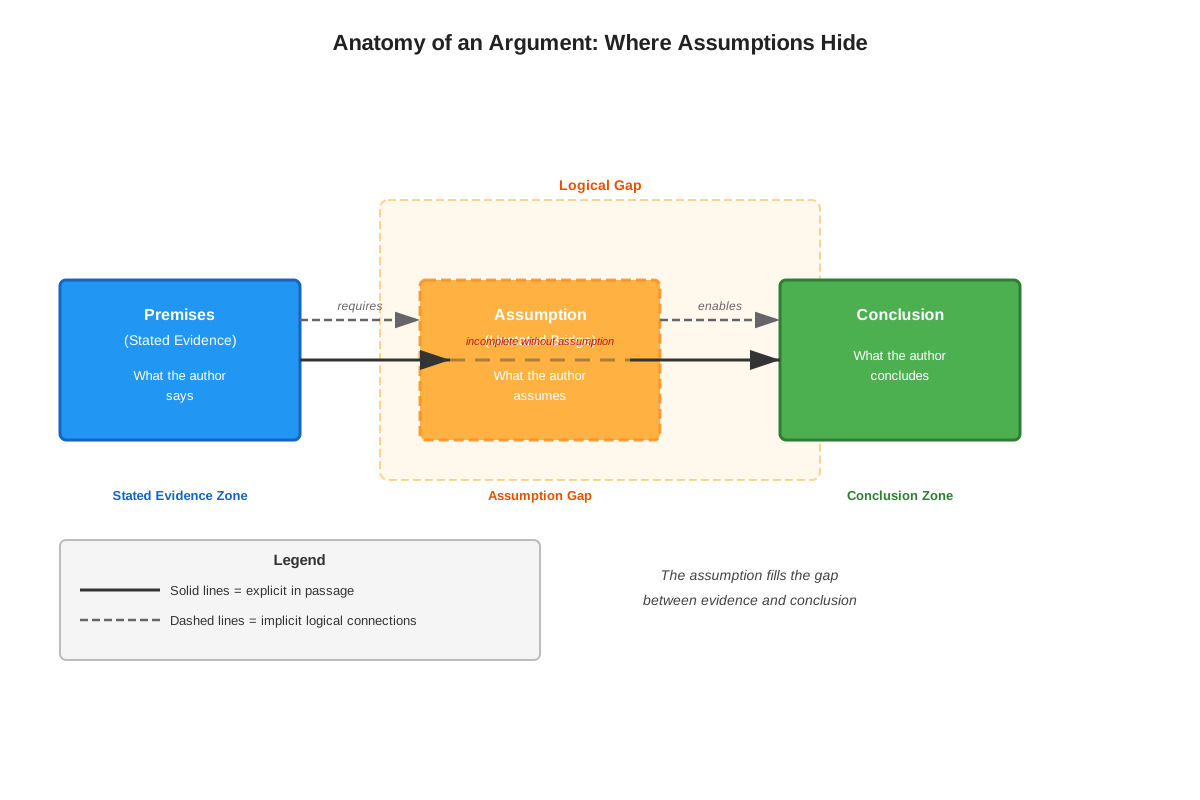
An assumption is an unstated premise that must be true for an argument's conclusion to be logically valid based on the given evidence. Assumptions function as invisible bridges connecting the explicit premises to the conclusion. Without these bridges, the argument collapses because the logical connection between evidence and conclusion disappears. On the GRE, recognizing assumptions requires identifying what the author believes to be true but has not explicitly stated in the passage.
Consider this simple example: "Sales increased after we hired a new marketing director. Therefore, the new marketing director caused the sales increase." The stated premise is that sales increased after the hiring. The conclusion is that the new director caused this increase. The assumption—unstated but necessary—is that no other factors could have caused the sales increase during this period. The author assumes away alternative explanations without acknowledging them.
Types of Assumptions
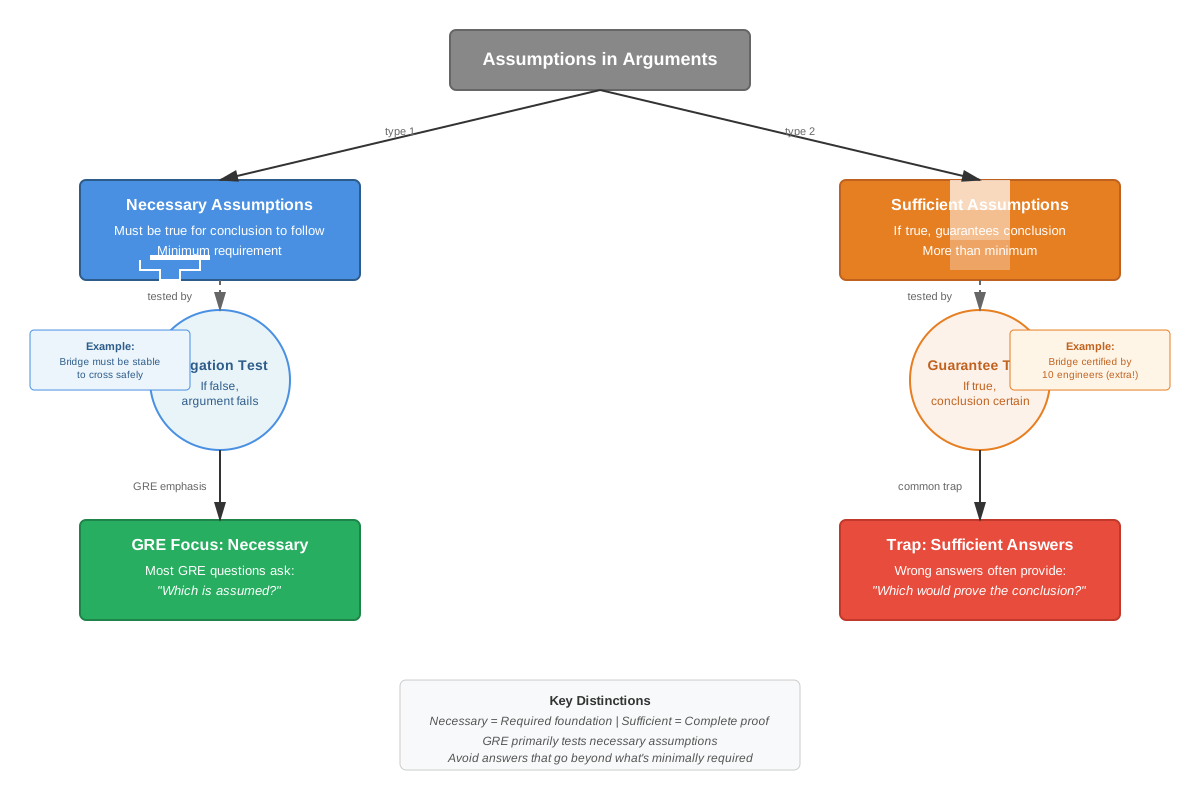
Necessary assumptions are conditions that must be true for the conclusion to hold. If a necessary assumption is false, the argument completely fails. These are the minimum requirements for the argument's logical validity. The GRE primarily tests necessary assumptions because they represent the argument's fundamental dependencies.
Sufficient assumptions are conditions that, if true, would guarantee the conclusion's validity. However, they often provide more information than minimally required. While sufficient assumptions can support an argument, they typically go beyond what the argument actually depends upon. The GRE occasionally includes sufficient assumptions as incorrect answer choices to trap students who don't distinguish between "what would help the argument" and "what the argument requires."
| Assumption Type | Definition | Test Method | GRE Frequency |
|---|---|---|---|
| Necessary | Must be true for conclusion to follow | Negation test | Very High |
| Sufficient | Guarantees conclusion if true | Logical adequacy | Low (usually distractors) |
The Assumption Gap
Every argument with an assumption contains a logical gap—a space between the evidence presented and the conclusion drawn. This gap exists because the author has made a logical leap without providing all the connecting information. Identifying the assumption gap requires analyzing what information would need to be true to make the leap from premises to conclusion legitimate.
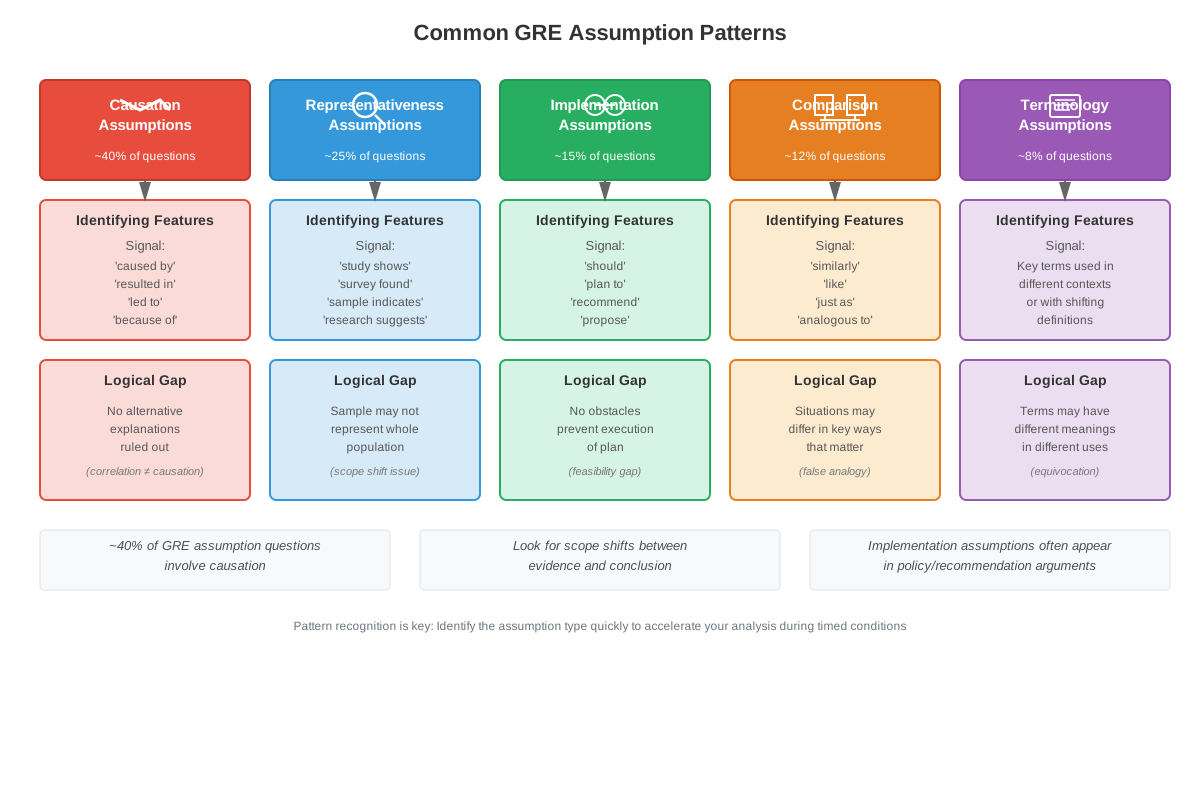
The assumption gap typically appears in several common patterns:
- Causal gaps: The evidence shows correlation or sequence, but the conclusion claims causation
- Representativeness gaps: The evidence comes from a sample or specific case, but the conclusion generalizes
- Comparison gaps: The conclusion compares two things, but the evidence doesn't establish comparability
- Implementation gaps: The evidence shows a plan or intention, but the conclusion assumes successful execution
- Scope gaps: The evidence addresses one aspect, but the conclusion extends to a broader scope
The Negation Test
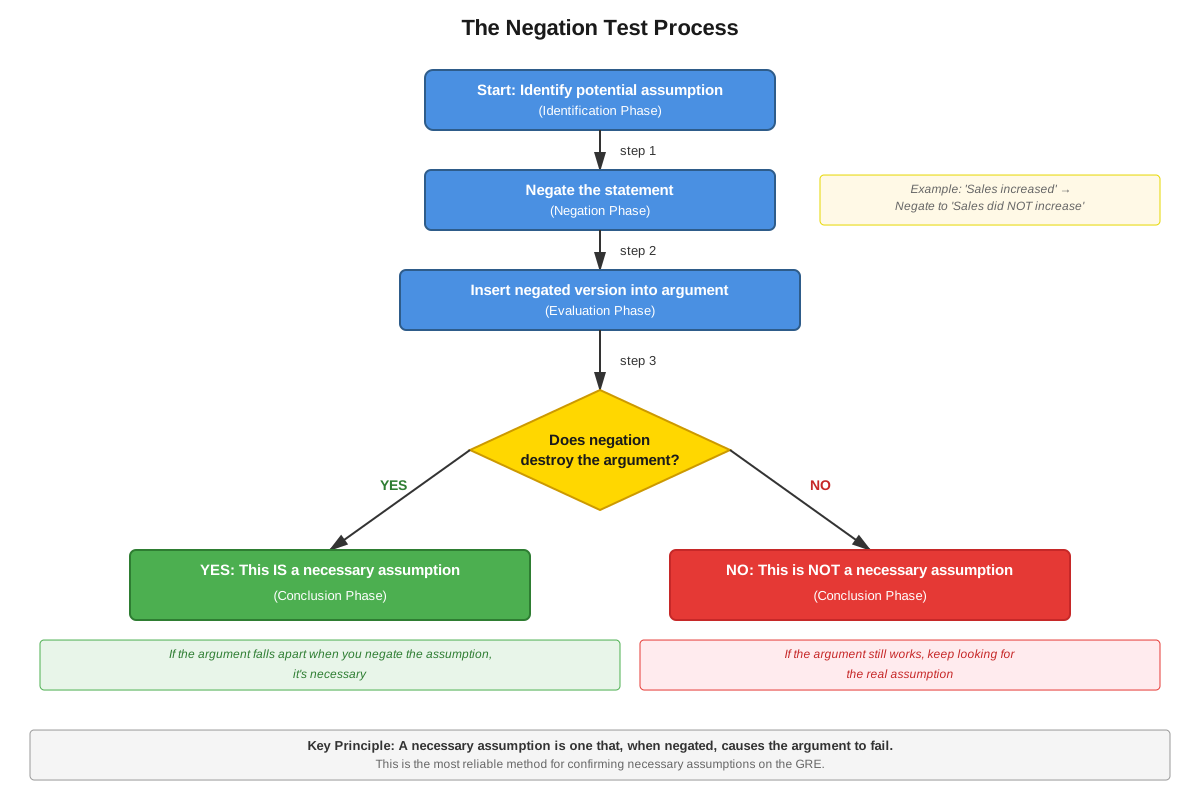
The negation test is the most reliable method for verifying whether a statement is a necessary assumption. To apply this test, negate the statement being evaluated (make it false or opposite) and determine whether this negation destroys the argument. If negating the statement causes the argument to fall apart, then the statement is indeed a necessary assumption. If the argument still holds after negation, the statement is not necessary.
For example, consider the argument: "Company profits increased after implementing remote work. Therefore, remote work improved profitability." A potential assumption is: "No other factors significantly affected profitability during this period." Applying the negation test: "Other factors DID significantly affect profitability during this period." If this negation is true, the conclusion that remote work improved profitability becomes unsupported—we cannot attribute the profit increase to remote work if other factors were also at play. Since the negation destroys the argument, the original statement is a necessary assumption.
Common Assumption Patterns on the GRE
Causation assumptions appear when an argument concludes that X causes Y based on evidence showing correlation, temporal sequence, or association. The assumption is that no alternative causes, reverse causation, or confounding variables explain the relationship. These are among the most frequent assumption types on the GRE.
Comparison assumptions emerge when arguments compare two or more things without establishing that they are comparable in relevant ways. The assumption is that the things being compared are similar enough in important respects to make the comparison valid.
Feasibility assumptions occur when arguments propose plans or solutions without addressing whether implementation is possible. The assumption is that no practical obstacles prevent execution, that necessary resources exist, and that the plan will work as intended.
Representativeness assumptions appear when arguments generalize from limited evidence. The assumption is that the sample, case, or example is representative of the broader population or situation being discussed.
Term shift assumptions happen when an argument uses related but distinct concepts interchangeably. The assumption is that these concepts are equivalent or that what applies to one applies to the other.
Concept Relationships
The core concepts within assumption analysis form an interconnected system. The assumption gap is the fundamental concept—it represents the space where assumptions exist. Identifying this gap requires understanding argument structure (premises and conclusions), which is prerequisite knowledge. Once the gap is identified, students must determine what type of assumption fills it (causal, comparison, feasibility, etc.). The negation test serves as the verification tool, confirming whether an identified assumption is truly necessary.
This topic connects directly to other Critical Reasoning question types. Strengthen questions ask what would support an argument—often by confirming an assumption. Weaken questions ask what would undermine an argument—often by showing an assumption is false. Evaluate questions ask what information would help assess an argument—often by testing whether an assumption holds. Flaw questions ask what's wrong with an argument—often that it relies on an unwarranted assumption.
The relationship map flows as follows: Argument Structure → Identify Conclusion and Premises → Locate Assumption Gap → Determine Assumption Type → Apply Negation Test → Verify Necessary Assumption → Use for Strengthen/Weaken/Evaluate Questions.
High-Yield Facts
⭐ An assumption is an unstated premise that must be true for the argument's conclusion to follow logically from its evidence
⭐ The negation test is the most reliable way to verify a necessary assumption: if negating a statement destroys the argument, that statement is a necessary assumption
⭐ Causal assumptions are the most common type on the GRE, appearing when arguments conclude causation from correlation or temporal sequence
⭐ Necessary assumptions are minimal requirements; sufficient assumptions provide more than required and often appear as incorrect answer choices
⭐ The assumption gap exists between the evidence presented and the conclusion drawn—this is where assumptions hide
- Comparison assumptions emerge when arguments compare entities without establishing their comparability in relevant dimensions
- Representativeness assumptions appear when arguments generalize from limited samples or specific cases to broader populations
- Feasibility assumptions occur when arguments propose plans without addressing implementation obstacles or resource requirements
- Term shift assumptions happen when arguments treat related but distinct concepts as equivalent without justification
- Correct assumption answers often feel obvious once identified because they state what the argument clearly depends upon but doesn't say
- Incorrect assumption answers frequently include statements that would strengthen the argument but aren't strictly necessary for it
- Scope mismatches are common in wrong answers—statements that are too broad or too narrow relative to the argument's actual scope
Quick check — test yourself on Assumptions so far.
Try Flashcards →Common Misconceptions
Misconception: Any statement that would help the argument is a correct answer to an assumption question → Correction: Assumption questions specifically ask for necessary assumptions—what the argument depends upon, not just what would support it. A statement can strengthen an argument without being necessary for it. Use the negation test to distinguish necessary assumptions from merely helpful information.
Misconception: Assumptions are always completely unstated in the passage → Correction: While assumptions are not explicitly stated as premises, the passage often contains clues pointing toward them. The argument's structure, word choice, and logical leaps indicate what assumptions exist. Students should look for gaps between evidence and conclusion rather than expecting assumptions to be entirely absent from the text.
Misconception: The longest or most complex answer choice is usually correct → Correction: Correct assumption answers are often simple, direct statements that clearly bridge the gap between premises and conclusion. The GRE frequently includes complex, wordy answer choices as distractors. Focus on logical necessity rather than answer length or sophistication.
Misconception: If an assumption is true, it proves the conclusion → Correction: Necessary assumptions are minimum requirements, not proof. Even if all necessary assumptions hold, the conclusion might still be false due to other factors. Assumptions make the argument logically valid (conclusion follows from premises) but don't guarantee the conclusion is actually true in reality.
Misconception: Assumptions only appear in dedicated "assumption questions" → Correction: Understanding assumptions is essential for strengthen, weaken, evaluate, and flaw questions as well. These question types all require identifying what the argument assumes before determining how new information affects it. Assumption analysis is a foundational skill for all Critical Reasoning questions.
Misconception: Extreme language in answer choices always indicates incorrect answers → Correction: While extreme language often signals wrong answers in other question types, necessary assumptions sometimes require definitive statements. If an argument truly depends on something being completely true or entirely absent, the correct assumption may use strong language. Evaluate based on logical necessity, not language strength alone.
Worked Examples
Example 1: Causal Assumption
Passage: "After the city installed new LED streetlights throughout downtown, nighttime crime rates decreased by 15%. The new lighting system has clearly made the downtown area safer."
Question: The argument depends on which of the following assumptions?
Analysis Process:
- Identify the conclusion: The new lighting system made downtown safer
- Identify the evidence: Crime rates decreased 15% after LED installation
- Locate the assumption gap: The evidence shows temporal sequence (after installation, crime decreased), but the conclusion claims causation (lighting caused the decrease)
- Determine assumption type: This is a causal assumption—the argument assumes the lighting caused the crime reduction
- Identify what must be true: No other factors caused the crime decrease during this period
Correct Answer: "No other significant changes that might affect crime rates occurred in the downtown area during the period when the new lights were installed."
Negation Test Verification: If we negate this—"Other significant changes that might affect crime rates DID occur during this period"—the argument falls apart. We could no longer attribute the crime decrease to the lighting because other factors might have caused it. Since negation destroys the argument, this is indeed a necessary assumption.
Connection to Learning Objectives: This example demonstrates identifying when assumptions are tested (causal relationship question), explaining the core strategy (finding the gap between correlation and causation), and applying the negation test to verify the assumption.
Example 2: Comparison Assumption
Passage: "Employees at Company A report higher job satisfaction than employees at Company B. Company A offers flexible work schedules while Company B requires fixed office hours. Therefore, flexible work schedules lead to higher job satisfaction."
Question: Which of the following is an assumption required by the argument?
Analysis Process:
- Identify the conclusion: Flexible schedules lead to higher job satisfaction
- Identify the evidence: Company A (flexible) has higher satisfaction than Company B (fixed hours)
- Locate the assumption gap: The argument compares two companies but doesn't establish whether they're comparable in other relevant ways
- Determine assumption type: This is a comparison assumption—the argument assumes the companies are similar except for scheduling
- Identify what must be true: No other significant differences between the companies explain the satisfaction gap
Correct Answer: "Company A and Company B are similar in other respects that significantly affect employee job satisfaction."
Negation Test Verification: If we negate this—"Company A and Company B differ in other significant respects that affect job satisfaction"—the argument collapses. The satisfaction difference might result from these other factors (salary, management, culture, etc.) rather than scheduling flexibility. Since negation destroys the argument, this is a necessary assumption.
Why Wrong Answers Fail:
- "Flexible schedules are the most important factor in job satisfaction" → Too strong; the argument only needs flexibility to be A factor, not THE most important factor
- "All employees prefer flexible schedules" → Too broad; the argument only needs the comparison between these two companies to hold, not a universal preference
- "Company B should adopt flexible schedules" → This is a recommendation, not an assumption the argument depends upon
Connection to Learning Objectives: This example shows how to identify comparison assumptions, apply the negation test, and distinguish necessary assumptions from sufficient ones or recommendations.
Exam Strategy
When approaching assumption questions on the GRE, follow this systematic process:
Step 1: Identify the question type. Look for trigger phrases: "assumes," "assumption," "depends on," "presupposes," or "takes for granted." These signal that you need to find an unstated premise rather than strengthen, weaken, or infer.
Step 2: Deconstruct the argument. Clearly identify the conclusion (what the author is trying to prove) and the premises (the evidence provided). The conclusion often appears at the beginning or end of the passage and may be signaled by words like "therefore," "thus," "consequently," or "clearly."
Step 3: Locate the assumption gap. Ask yourself: "What logical leap does the author make? What must be true for this conclusion to follow from this evidence?" Look for shifts in scope, causal claims based on correlation, comparisons without established comparability, or generalizations from limited evidence.
Step 4: Predict the assumption. Before looking at answer choices, formulate your own answer to what the argument assumes. This prediction prevents you from being swayed by attractive but incorrect options.
Step 5: Evaluate answer choices using the negation test. For each promising answer, negate it and ask whether the negation destroys the argument. The correct answer will fail this test—its negation will make the argument fall apart.
Exam Tip: Trigger words that signal assumption gaps include "therefore" (causal leap), "clearly" (unstated reasoning), "must" (certainty without full evidence), and "will" (prediction without established basis).
Time allocation: Spend approximately 1.5-2 minutes per assumption question. Allocate 30 seconds to reading and deconstructing the argument, 30 seconds to identifying the gap and predicting the assumption, and 60-90 seconds to evaluating answer choices.
Process of elimination strategies specific to assumptions:
- Eliminate answers that restate premises already in the argument—assumptions are unstated
- Eliminate answers that address irrelevant scope (different time period, different population, different aspect than the argument discusses)
- Eliminate answers that would strengthen the argument but aren't necessary (sufficient vs. necessary distinction)
- Eliminate answers that make the argument weaker or introduce new problems
- Be cautious with extreme language, but don't automatically eliminate it—some necessary assumptions require definitive statements
Memory Techniques
CCRFS Mnemonic for the five most common assumption types:
- Causal (correlation doesn't prove causation)
- Comparison (entities must be comparable)
- Representativeness (sample must represent population)
- Feasibility (plans must be implementable)
- Scope shift (terms must mean the same thing)
The Bridge Visualization: Picture the argument as two cliffs—the premise cliff and the conclusion cliff. The assumption is the invisible bridge connecting them. If the bridge collapses (assumption is false), you cannot get from premise to conclusion. This mental image helps identify what must exist to make the logical journey possible.
The Negation Flip: Remember "NOT = KNOT" (Negation Of Truth = Knots up the argument). If negating a statement ties the argument in knots (makes it fail), that statement is a necessary assumption.
The GAPS Acronym for finding assumption gaps:
- Generalization (from specific to broad)
- Alternative causes (ruling out other explanations)
- Plan implementation (assuming feasibility)
- Similarity (assuming comparability)
Summary
Assumptions represent unstated premises that arguments depend upon to reach their conclusions. Mastering assumption questions requires understanding that these logical bridges connect explicit evidence to stated conclusions, and identifying them demands recognizing gaps in reasoning. The negation test serves as the primary verification tool—if negating a statement destroys the argument, that statement is a necessary assumption. The GRE primarily tests five assumption patterns: causal (ruling out alternative explanations), comparison (establishing comparability), representativeness (ensuring samples reflect populations), feasibility (confirming implementation possibility), and scope shifts (maintaining consistent meaning). Success on assumption questions requires systematic deconstruction of arguments, identification of logical gaps, prediction before viewing answer choices, and rigorous application of the negation test. This skill forms the foundation for all Critical Reasoning question types, making it one of the highest-yield topics for GRE preparation.
Key Takeaways
- Assumptions are unstated premises that must be true for an argument's conclusion to follow logically from its evidence—they bridge the gap between what's said and what's concluded
- The negation test is the gold standard for verifying necessary assumptions: negate the statement and see if the argument collapses
- Causal assumptions (ruling out alternative explanations) are the most frequently tested type on the GRE
- Necessary assumptions are minimal requirements the argument depends upon; sufficient assumptions provide more than required and often appear as wrong answers
- Systematic approach wins: identify conclusion and premises, locate the assumption gap, predict the assumption, then evaluate choices using negation
- Assumption mastery enables success across all Critical Reasoning question types, including strengthen, weaken, evaluate, and flaw questions
- Common wrong answers include restated premises, irrelevant scope, and statements that help but aren't necessary
Related Topics
Strengthen and Weaken Questions: These question types build directly on assumption identification. Strengthening an argument often means confirming an assumption, while weakening it means showing an assumption is false. Mastering assumptions makes these questions significantly easier.
Argument Structure and Conclusion Identification: Understanding how arguments are constructed—with premises supporting conclusions—is essential for finding assumption gaps. This foundational skill enables all advanced Critical Reasoning work.
Logical Fallacies: Many assumptions represent logical fallacies (post hoc ergo propter hoc for causal assumptions, hasty generalization for representativeness assumptions). Studying fallacies provides additional frameworks for identifying assumption patterns.
Evaluate-the-Argument Questions: These questions ask what information would help assess an argument's validity. The answer typically involves testing whether a key assumption holds true, making assumption identification the critical first step.
Inference Questions: While inference questions ask what must be true based on the passage, assumption questions ask what must be true for the passage's conclusion to hold. Understanding the distinction and relationship between these question types sharpens analytical precision.
Practice CTA
Now that you've mastered the conceptual framework for identifying and analyzing assumptions, it's time to put these skills into practice. Attempt the practice questions to apply the negation test, identify assumption gaps, and distinguish necessary from sufficient assumptions in realistic GRE scenarios. Use the flashcards to reinforce the five common assumption patterns and key strategies. Remember: assumption questions are among the highest-yield topics on the GRE—every minute spent practicing this skill directly translates to points on test day. Your ability to see what arguments leave unsaid is what separates good scores from great ones.
Sign up free to keep reading
Create a free AnvayaPrep account to finish this GRE guide on Assumptions — plus flashcards and practice questions.