Overview
In GRE Verbal Reasoning, understanding premises forms the foundation of success in Critical Reasoning questions. Premises are the statements, facts, or evidence that an argument uses to support its conclusion. They represent the "building blocks" of logical reasoning—the information presented as true or accepted for the purpose of the argument. On the GRE, the ability to identify, analyze, and evaluate premises separates high scorers from average performers, as approximately 30-40% of Verbal Reasoning questions directly or indirectly test this skill.
GRE premises appear most frequently in argument analysis questions, where test-takers must strengthen, weaken, evaluate, or identify assumptions within arguments. These questions require students to distinguish between what an argument claims (the conclusion) and what evidence it provides (the premises). Mastering premises enables students to deconstruct complex arguments efficiently, recognize logical gaps, and predict what additional information would affect an argument's validity. This skill extends beyond isolated Critical Reasoning questions—it enhances performance on Reading Comprehension passages where authors build cases through layered evidence.
The relationship between premises and other Verbal Reasoning concepts is hierarchical and interconnected. Premises serve as the evidentiary foundation upon which conclusions rest, while assumptions act as unstated premises that bridge logical gaps. Understanding premises is prerequisite knowledge for analyzing argument structure, identifying logical fallacies, and evaluating reasoning quality. Without the ability to accurately identify premises, students cannot effectively tackle questions about assumptions, inferences, or argument evaluation—making this topic absolutely essential for GRE success.
Learning Objectives
- [ ] Identify when Premises is being tested in GRE questions
- [ ] Explain the core rule or strategy behind Premises
- [ ] Apply Premises to GRE-style questions accurately
- [ ] Distinguish premises from conclusions, assumptions, and background information in complex arguments
- [ ] Evaluate the relevance and sufficiency of premises in supporting a given conclusion
- [ ] Recognize indicator words and structural patterns that signal premises in written arguments
Prerequisites
- Basic sentence structure and grammar: Understanding subject-verb relationships and clause structure enables accurate parsing of argumentative statements
- Logical connectors and transition words: Familiarity with words like "because," "since," and "therefore" helps identify relationships between statements
- Reading comprehension fundamentals: The ability to extract main ideas and supporting details from passages provides the foundation for argument analysis
- Basic understanding of cause-and-effect relationships: Recognizing how one event or fact can support or lead to another is essential for premise identification
Why This Topic Matters
Understanding premises has profound real-world applications beyond standardized testing. In professional contexts, evaluating the evidence supporting business proposals, legal arguments, scientific claims, and policy recommendations requires the ability to identify and assess premises. Medical professionals evaluate premises when considering diagnostic evidence; lawyers construct cases by presenting premises that support legal conclusions; business analysts assess whether data (premises) adequately supports strategic recommendations. This skill represents fundamental critical thinking applicable across all knowledge domains.
On the GRE specifically, premises appear in approximately 8-12 questions per Verbal Reasoning section. They feature prominently in:
- Argument Analysis questions (Strengthen/Weaken): 40-50% of these questions
- Assumption questions: 100% require premise identification as a prerequisite skill
- Evaluate the Argument questions: 70-80% test understanding of premise sufficiency
- Reading Comprehension inference questions: 20-30% require distinguishing stated premises from unstated conclusions
Common manifestations in exam passages include scientific studies citing experimental data as premises, business scenarios presenting market research as evidence, historical arguments using documented events as support, and policy debates offering statistical information as justification. The GRE frequently embeds premises within complex sentence structures, uses subtle indicator words, or presents multiple premises that collectively support a conclusion—testing whether students can parse sophisticated argumentative writing under time pressure.
Core Concepts
Definition and Function of Premises
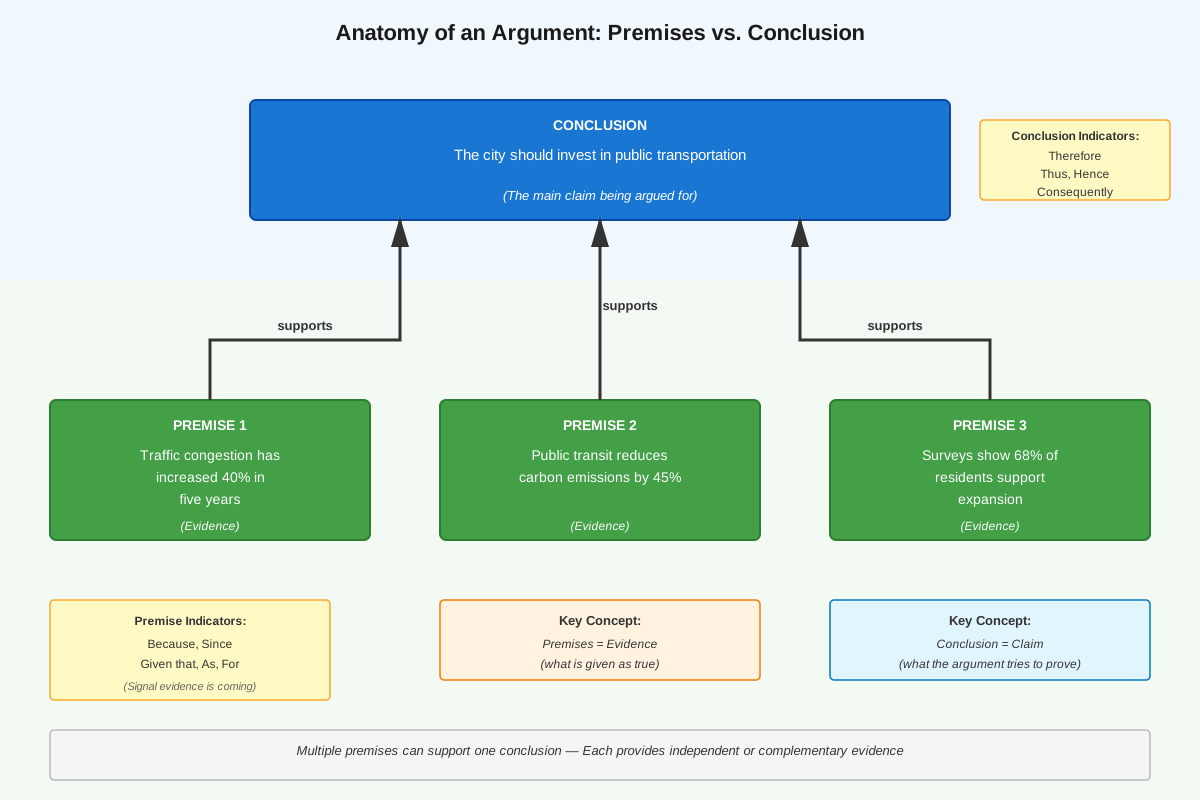
A premise is a statement offered as evidence or reason to support a conclusion within an argument. Premises function as the informational foundation that makes a conclusion seem reasonable, probable, or justified. In formal logic, premises are propositions assumed to be true for the purpose of the argument, regardless of their actual truth value in reality. On the GRE, premises typically present facts, statistics, observations, expert opinions, research findings, or generally accepted principles.
The functional relationship between premises and conclusions follows a support structure: premises provide the "why" or "how" that justifies the "what" of the conclusion. Multiple premises often work together cumulatively—each adding evidential weight to make the conclusion more persuasive. Understanding this support relationship is crucial because GRE questions frequently ask students to identify what would strengthen (add supporting premises) or weaken (undermine existing premises) an argument.
Identifying Premises: Indicator Words and Structural Patterns
Premises are often signaled by indicator words—linguistic markers that flag evidential statements. Common premise indicators include:
| Premise Indicators | Example Usage |
|---|---|
| because, since, for | "The policy will succeed because similar programs worked elsewhere" |
| given that, seeing that | "Given that enrollment has declined, budget cuts are necessary" |
| as indicated by, as shown by | "Profits increased, as shown by quarterly reports" |
| the reason is that | "Sales dropped; the reason is that competitors lowered prices" |
| may be inferred from | "Success may be inferred from customer satisfaction scores" |
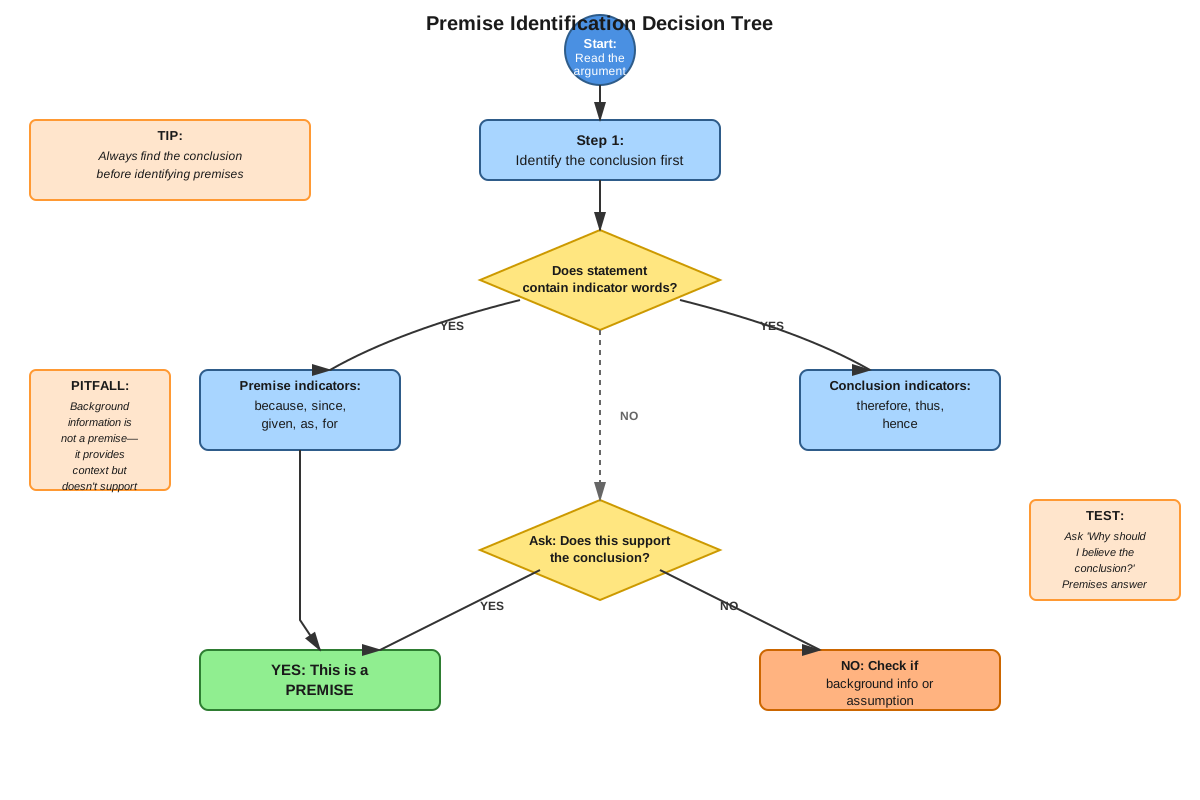
However, not all premises include indicator words. In many GRE passages, premises appear without explicit markers, requiring students to identify them through structural analysis. The key question to ask: "What evidence or reasons does the author provide to support the main claim?" Statements answering this question function as premises, regardless of linguistic indicators.
Distinguishing Premises from Other Argument Components
A critical skill tested on the GRE involves distinguishing premises from conclusions, assumptions, and background information:
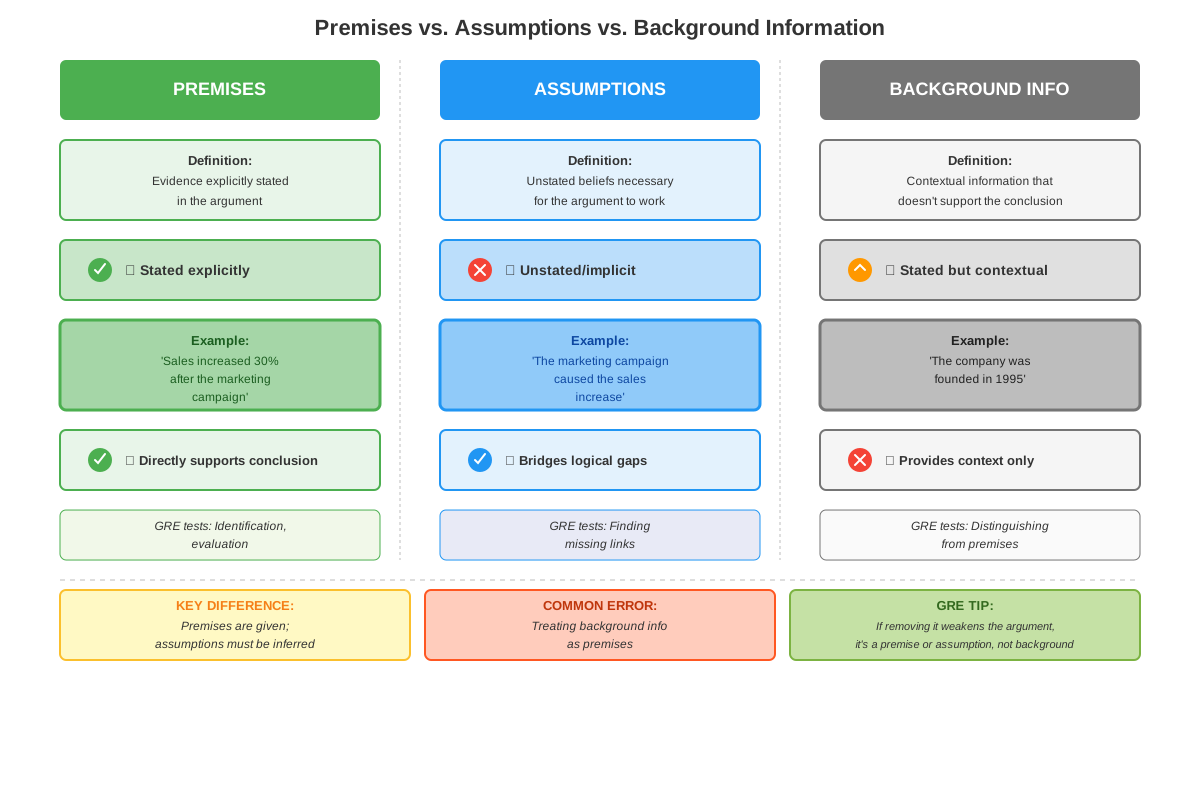
Premises vs. Conclusions: While premises support, conclusions are supported. The "therefore test" helps: if a statement logically follows "therefore," it's likely a conclusion; if it logically precedes "because," it's likely a premise. Consider: "Sales increased 20% [premise] therefore the marketing campaign succeeded [conclusion]."
Premises vs. Assumptions: Premises are explicitly stated; assumptions are unstated premises necessary for the argument's logic. If information appears in the text, it's a premise. If it must be true for the argument to work but isn't mentioned, it's an assumption. Example: Premise: "This medication reduced symptoms in clinical trials." Unstated assumption: "Clinical trial conditions resemble real-world usage."
Premises vs. Background Information: Background provides context without directly supporting the conclusion. Premises offer specific evidence for the claim. Background: "The company was founded in 1995." Premise: "The company's revenue grew 15% annually for five years." The revenue growth directly supports a conclusion about company success; the founding date merely provides context.
Types of Premises on the GRE
The GRE employs various premise types, each requiring slightly different analytical approaches:
Factual/Statistical Premises: Present data, measurements, or quantifiable information. Example: "Unemployment decreased from 8% to 5% over three years." These premises are evaluated based on relevance, representativeness, and sufficiency.
Causal Premises: Establish cause-effect relationships. Example: "Implementing flexible work schedules led to 30% higher employee retention." GRE questions often test whether the causal relationship is justified or whether alternative explanations exist.
Analogical Premises: Draw comparisons to support conclusions. Example: "City A's traffic reduction program succeeded; therefore, City B should implement the same program." The strength depends on similarity between compared cases.
Authority-Based Premises: Cite expert opinions or authoritative sources. Example: "Leading economists predict inflation will decrease." Strength depends on expert credibility and consensus.
Definitional Premises: Establish meanings or classifications. Example: "Sustainable practices are those that meet present needs without compromising future generations." These premises set frameworks for subsequent reasoning.
Evaluating Premise Quality
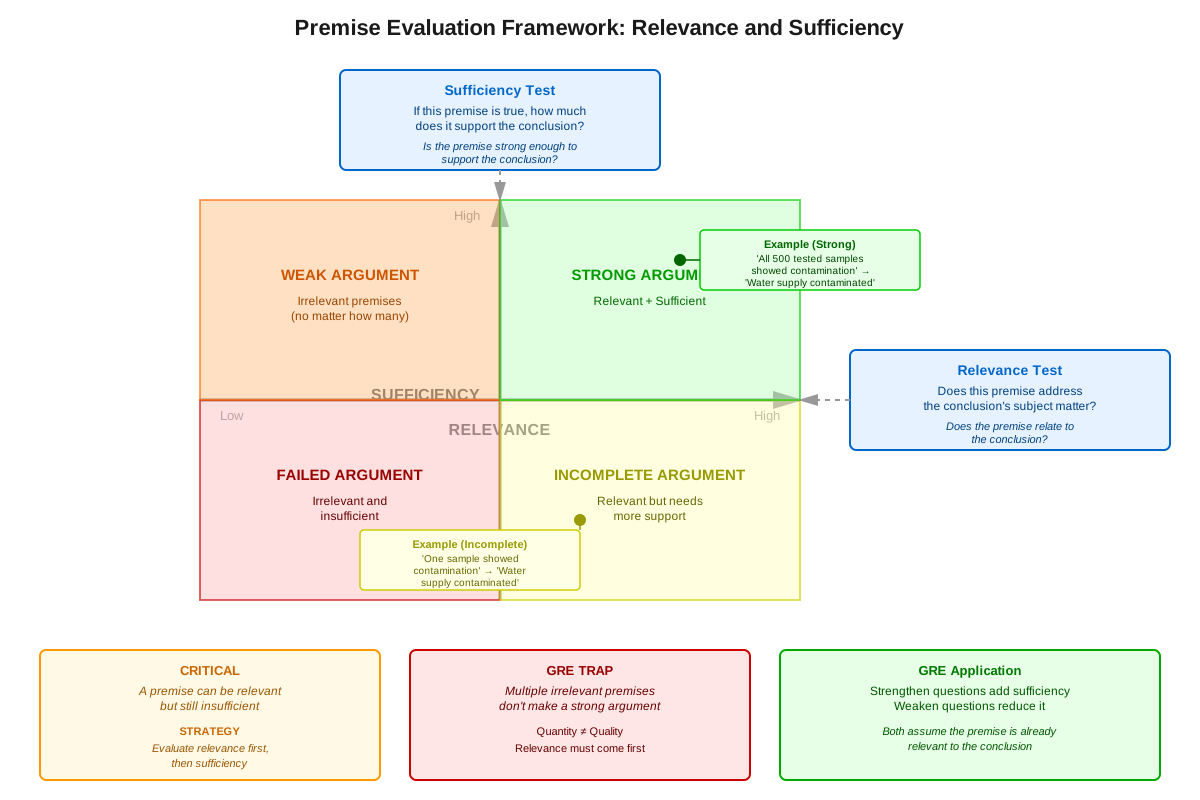
Not all premises equally support conclusions. The GRE frequently tests whether students recognize strong versus weak evidential support. Key evaluation criteria include:
- Relevance: Does the premise actually relate to the conclusion? Irrelevant premises, however true, provide no logical support.
- Sufficiency: Does the premise (or premise set) provide adequate support? A single anecdote rarely suffices for broad generalizations.
- Accuracy: Is the premise factually correct? (On the GRE, assume stated premises are accurate unless the question specifically asks about this.)
- Representativeness: Do sample-based premises reflect the broader population? A study of 20 college students may not support conclusions about all adults.
- Recency: For time-sensitive topics, are premises current? Five-year-old technology data may not support conclusions about current trends.
Multiple Premises and Argument Structure
Complex GRE arguments typically employ multiple premises working in concert. Understanding how premises interact strengthens argument analysis:
Independent Premises: Each separately supports the conclusion. If one fails, others still provide support. Example: "We should expand operations because (1) demand increased 40%, and (2) competitors are expanding, and (3) we have available capital."
Dependent Premises: Work together; removing one undermines the argument. Example: "All managers have MBAs [Premise 1]. Sarah is a manager [Premise 2]. Therefore, Sarah has an MBA [Conclusion]." Both premises are necessary.
Chained Premises: One premise's conclusion becomes another's premise, creating reasoning chains. Example: "Exercise improves cardiovascular health [P1] → Cardiovascular health extends lifespan [P2] → Therefore, exercise extends lifespan [C]."
Concept Relationships
The concept of premises sits at the center of a network of interconnected critical reasoning elements. Premises → support → Conclusions represents the most fundamental relationship: premises provide the evidential foundation that makes conclusions credible. This support relationship is directional and hierarchical—conclusions depend on premises, not vice versa.
Premises + Assumptions → Complete Argument: Assumptions function as unstated premises that bridge logical gaps between stated premises and conclusions. Identifying premises is the first step toward recognizing what assumptions must be true for the argument to hold. For example, if a premise states "Sales increased after the advertising campaign" and the conclusion claims "The advertising campaign caused increased sales," the assumption (unstated premise) is "No other factors caused the sales increase."
Premises ← evaluated by → Evidence Quality Standards: The strength of premises determines argument strength. This connects premise identification to broader concepts of logical reasoning, statistical validity, and critical thinking. Understanding premises enables evaluation of whether evidence is relevant, sufficient, and representative.
Premises → enable → Argument Deconstruction: Mastering premise identification allows students to break down complex arguments into component parts, making questions about strengthening, weakening, or evaluating arguments more manageable. This skill progression flows: identify premises → understand argument structure → evaluate logical soundness → predict what would affect the argument.
The relationship to prerequisite knowledge is equally important: Reading Comprehension → enables → Premise Identification → enables → Advanced Critical Reasoning. Students must first comprehend what a passage states before identifying which statements function as premises, which then enables sophisticated argument analysis.
High-Yield Facts
⭐ Premises are explicitly stated evidence or reasons that support a conclusion; if it's not stated in the text, it's not a premise—it's an assumption.
⭐ Common premise indicators include "because," "since," "given that," "as indicated by," and "for the reason that"—but many premises lack indicator words.
⭐ The "why test" identifies premises: ask "Why should I believe the conclusion?" Statements answering this question are premises.
⭐ Multiple premises can work independently (each separately supports the conclusion) or dependently (must work together to provide support).
⭐ Premises must be relevant to the conclusion to provide logical support; irrelevant facts, however true, are not effective premises.
- Premises are assumed true for the purpose of argument analysis on the GRE; questions rarely ask whether premises are factually accurate.
- Background information provides context but doesn't directly support the conclusion; premises provide specific evidence for the claim.
- Statistical and factual premises are evaluated based on representativeness, sample size, and recency—not just their existence.
- Analogical premises (comparisons) are only strong when the compared situations share relevant similarities.
- Causal premises establish cause-effect relationships but may be vulnerable to alternative explanations or confounding variables.
⭐ Strengthening questions ask for additional premises that support the conclusion; weakening questions ask for information that undermines existing premises or introduces counterevidence.
- Authority-based premises derive strength from expert credibility, relevant expertise, and consensus among authorities.
- Chained reasoning uses one premise's conclusion as another premise, creating multi-step arguments common in complex GRE passages.
- Premise sufficiency refers to whether the evidence provided adequately supports the conclusion's scope and strength.
- Identifying all premises in an argument is prerequisite to recognizing logical gaps and unstated assumptions.
Quick check — test yourself on Premises so far.
Try Flashcards →Common Misconceptions
Misconception: All statements before "therefore" or "thus" are premises. → Correction: Conclusion indicators help identify conclusions, but premise location varies. Conclusions can appear at the beginning, middle, or end of arguments. Some passages state the conclusion first, then provide supporting premises. Always identify the main claim first, then determine what supports it, regardless of statement order.
Misconception: Longer, more detailed statements are always premises while short statements are conclusions. → Correction: Statement length doesn't determine function. A single word ("Why? Economics.") can be a premise, while a lengthy statement can be a conclusion. Function within the argument's logical structure—not length or complexity—determines whether a statement is a premise.
Misconception: If a statement is true, it's a good premise for any related conclusion. → Correction: Premises must be relevant and sufficient, not merely true. A true but irrelevant fact provides no logical support. "The sky is blue" is true but doesn't support "Therefore, we should increase marketing budgets." Relevance to the specific conclusion is essential.
Misconception: Background information and premises are the same thing. → Correction: Background provides context; premises provide evidence. "The company was founded in 1985" is background. "The company's revenue increased 40% last year" is a premise if it supports a conclusion about company success. Background sets the stage; premises build the case.
Misconception: Every sentence in an argument is either a premise or a conclusion. → Correction: Arguments contain multiple components: background information, definitions, clarifications, concessions, and rhetorical questions alongside premises and conclusions. Not every statement functions as evidence. Some sentences merely explain terms, acknowledge counterarguments, or provide context without directly supporting the main claim.
Misconception: Assumptions and premises are interchangeable terms. → Correction: Premises are stated; assumptions are unstated. This distinction is crucial for GRE assumption questions. If you can point to text that explicitly states the information, it's a premise. If the information must be true for the argument to work but isn't mentioned, it's an assumption. Confusing these leads to incorrect answers on assumption-identification questions.
Misconception: Identifying premises is only important for specific "identify the premise" questions. → Correction: Premise identification is foundational for virtually all Critical Reasoning question types. Strengthen/weaken questions require understanding what premises currently support the conclusion. Assumption questions require identifying gaps between stated premises and conclusions. Evaluation questions ask what information would help assess premise adequacy. Mastering premise identification improves performance across all argument-based questions.
Worked Examples
Example 1: Identifying Premises in a Business Argument
Passage: "TechCorp should expand into the Asian market. The company's revenue growth has slowed to 2% annually in North America, while Asian markets are experiencing 15% annual growth in the technology sector. Additionally, TechCorp's main competitor recently announced successful expansion into three Asian countries, reporting a 30% increase in overall profits. Given that TechCorp has the financial resources for international expansion, entering Asian markets represents the best growth opportunity."
Question: Which of the following are premises in this argument?
Analysis Process:
Step 1: Identify the conclusion. The main claim is "TechCorp should expand into the Asian market" (first sentence) and "entering Asian markets represents the best growth opportunity" (final sentence). These are what the argument is trying to prove.
Step 2: Apply the "why test." Why should TechCorp expand into Asian markets? The passage provides several reasons:
Premise 1: "The company's revenue growth has slowed to 2% annually in North America" - This provides evidence of limited domestic opportunity.
Premise 2: "Asian markets are experiencing 15% annual growth in the technology sector" - This establishes attractive growth potential in the target market.
Premise 3: "TechCorp's main competitor recently announced successful expansion into three Asian countries, reporting a 30% increase in overall profits" - This provides analogical evidence that similar companies can succeed in Asian markets.
Premise 4: "TechCorp has the financial resources for international expansion" - This establishes feasibility.
Step 3: Distinguish from other elements. "Given that" in the final sentence is a premise indicator. All four identified statements directly support the conclusion that expansion is advisable.
Connection to Learning Objectives: This example demonstrates how to identify when premises are being tested (recognizing that the question asks about argument structure), explains the core strategy (using the "why test" and identifying support relationships), and applies the concept to a GRE-style business scenario.
Example 2: Evaluating Premise Strength in a Scientific Argument
Passage: "Recent research suggests that daily meditation reduces workplace stress. A study of 50 employees at a technology company found that those who meditated for 20 minutes daily reported 35% lower stress levels after eight weeks compared to non-meditating colleagues. Therefore, all companies should implement mandatory meditation programs to improve employee wellbeing."
Question: The argument's reasoning is most vulnerable to criticism on which grounds?
Analysis Process:
Step 1: Identify the premises and conclusion.
- Conclusion: "All companies should implement mandatory meditation programs to improve employee wellbeing"
- Premise: "A study of 50 employees at a technology company found that those who meditated for 20 minutes daily reported 35% lower stress levels after eight weeks compared to non-meditating colleagues"
Step 2: Evaluate premise quality using the criteria from Core Concepts:
Relevance: The premise is relevant—it directly relates meditation to stress reduction.
Sufficiency: This is problematic. The premise involves:
- Small sample size (50 employees)
- Single company (technology sector only)
- Self-reported stress (subjective measure)
- Specific context (technology workers)
The conclusion claims "all companies" should implement programs, but the premise only supports claims about technology company employees who voluntarily meditate.
Representativeness: The sample (technology employees) may not represent all industries, job types, or employee populations.
Step 3: Identify the logical gap. The premise doesn't establish that:
- Results generalize beyond technology companies
- Mandatory programs would achieve the same results as voluntary participation
- Meditation is the best or only solution for workplace stress
- The benefits outweigh implementation costs
Answer: The argument is most vulnerable to criticism because it generalizes from a limited study of voluntary participants in one industry to a recommendation for mandatory programs across all companies. The premise, while providing some support, is insufficient for the broad conclusion.
Connection to Learning Objectives: This example shows how to apply premise concepts to evaluate argument quality, demonstrating that identifying premises is only the first step—assessing their adequacy for supporting the conclusion is equally important for GRE success.
Exam Strategy
Approaching Premise-Related Questions
When encountering GRE questions testing premise identification or evaluation, follow this systematic approach:
- Read the conclusion first: Identify what the argument is trying to prove before analyzing the evidence. This provides context for evaluating which statements function as premises.
- Apply indicator word recognition: Scan for "because," "since," "given that," and similar markers, but don't rely exclusively on them—many premises lack indicators.
- Use the "why/how test": Ask "Why should I believe this conclusion?" or "How does the author support this claim?" Statements answering these questions are premises.
- Map the argument structure: Mentally (or on scratch paper) outline: Premise 1 + Premise 2 + Premise 3 → Conclusion. This visualization clarifies relationships.
Trigger Words and Phrases
Premise indicators to watch for:
- "because," "since," "for," "as"
- "given that," "seeing that," "in light of"
- "as indicated by," "as evidenced by," "as shown by"
- "the reason is," "for the reason that"
- "may be inferred from," "may be derived from"
- "in view of the fact that"
Conclusion indicators (help identify what premises support):
- "therefore," "thus," "hence," "consequently"
- "it follows that," "we can conclude that"
- "suggests that," "indicates that," "shows that"
- "so," "accordingly," "as a result"
Exam Tip: When a question asks "Which of the following, if true, would strengthen the argument?" it's asking for an additional premise. When it asks "The argument depends on which assumption?" it's asking for an unstated premise.
Process-of-Elimination Strategies
For premise identification questions:
Eliminate answer choices that:
- Restate the conclusion (conclusions aren't premises)
- Introduce new topics unrelated to the argument's scope
- Contradict stated information in the passage
- Represent assumptions (unstated) rather than stated premises
- Provide background without supporting the specific conclusion
Prioritize answer choices that:
- Directly answer "why" the conclusion should be believed
- Contain factual, evidential, or statistical information
- Appear in the passage before or after premise indicators
- Establish cause-effect relationships, comparisons, or authoritative support
Time Allocation
For a typical Critical Reasoning question involving premises:
- 15-20 seconds: Read and identify the conclusion
- 30-40 seconds: Identify premises and map argument structure
- 20-30 seconds: Read and evaluate answer choices
- 10-15 seconds: Confirm selection and move forward
Don't spend excessive time on premise identification—it should become rapid with practice. If struggling to identify premises after 45 seconds, use the elimination strategy and make an educated guess to preserve time for other questions.
Exam Tip: On strengthen/weaken questions, incorrect answer choices often present irrelevant facts (true statements that don't affect the argument). Always ask: "Does this information actually impact the relationship between the stated premises and conclusion?"
Memory Techniques
The "WISER" Mnemonic for Premise Identification
Why is the conclusion true? (Premises answer this)
Indicator words signal premises (because, since, given that)
Support flows from premises to conclusion (directional relationship)
Evidence, facts, and data typically function as premises
Reasons and rationales are premise functions
The "PRESS" Framework for Premise Evaluation
Pertinent: Is the premise relevant to this specific conclusion?
Representative: Does the sample/data represent the broader claim?
Explicit: Is it stated (premise) or unstated (assumption)?
Sufficient: Does it provide adequate support for the conclusion's scope?
Sound: Is the reasoning from premise to conclusion logical?
Visualization Strategy
Picture arguments as buildings:
- Foundation = Premises (supporting structure)
- Building = Conclusion (what's supported)
- Hidden supports = Assumptions (unstated premises)
- Cracks in foundation = Weak or insufficient premises
When analyzing arguments, visualize whether the foundation (premises) adequately supports the building (conclusion). This mental image helps assess argument strength quickly.
The "Because Test" Shortcut
Insert "because" before each statement. If the sentence makes logical sense with "because" preceding it and the conclusion following it, you've identified a premise:
"[Conclusion] because [this statement]"
Example: "We should hire more staff because customer complaints increased 40%." The statement after "because" is a premise.
Summary
Premises represent the foundational evidence, facts, and reasons that arguments use to support conclusions. On the GRE, identifying and evaluating premises is essential for success across multiple question types, including strengthen/weaken questions, assumption identification, and argument evaluation. Premises are explicitly stated in the passage (distinguishing them from unstated assumptions) and can be identified through indicator words like "because" and "since," though many premises lack such markers. The most reliable identification method involves asking "Why should I believe the conclusion?" or "What evidence supports this claim?"—statements answering these questions function as premises. Effective premise analysis requires distinguishing premises from conclusions, background information, and assumptions, then evaluating whether the premises provide relevant, sufficient, and representative support for the conclusion's scope. Multiple premises may work independently or dependently, and their collective strength determines argument quality. Mastering premise identification enables students to deconstruct complex arguments efficiently, recognize logical gaps, and accurately answer the 8-12 premise-related questions typically appearing in each GRE Verbal Reasoning section.
Key Takeaways
- Premises are explicitly stated evidence or reasons supporting a conclusion; they answer "why" the conclusion should be believed and form the argument's evidential foundation
- Indicator words like "because," "since," and "given that" often signal premises, but many premises appear without markers, requiring structural analysis through the "why test"
- Distinguish premises from conclusions (what's supported vs. what supports), assumptions (stated vs. unstated), and background (context vs. evidence) to accurately analyze argument structure
- Premise quality depends on relevance, sufficiency, and representativeness—not all stated premises equally support their conclusions, and GRE questions frequently test this evaluation skill
- Multiple premises can work independently (each separately supports the conclusion) or dependently (must work together), affecting how strengthening or weakening information impacts the argument
- Premise identification is foundational for all Critical Reasoning question types, including strengthen/weaken, assumption, and evaluation questions—making it a high-yield skill for GRE success
- Systematic approach matters: identify the conclusion first, then determine what evidence supports it, map the argument structure, and evaluate premise adequacy before selecting answers
Related Topics
Conclusions: Understanding what arguments claim (conclusions) is the natural complement to identifying what supports those claims (premises). Mastering premises enables more sophisticated conclusion analysis.
Assumptions: Unstated premises that bridge logical gaps between stated premises and conclusions. Once students can identify stated premises, recognizing what's missing (assumptions) becomes more accessible.
Argument Structure: The overall organization of claims, evidence, and reasoning. Premise identification is the first step toward analyzing complete argument architecture.
Strengthen and Weaken Questions: These question types directly test premise understanding by asking what additional evidence (premises) would support or undermine arguments.
Logical Fallacies: Many fallacies involve premise problems—irrelevant premises, insufficient premises, or faulty relationships between premises and conclusions. Understanding premises enables fallacy recognition.
Inference Questions: Drawing valid conclusions from stated premises requires first identifying what information the passage actually provides as evidence.
Practice CTA
Now that you understand how to identify, analyze, and evaluate premises in GRE arguments, it's time to apply these skills to authentic practice questions. The concepts covered here—premise identification, evaluation criteria, and strategic approaches—will become automatic only through deliberate practice. Challenge yourself with the practice questions and flashcards designed specifically for this topic. Pay special attention to questions where you must distinguish premises from other argument components or evaluate whether premises adequately support conclusions. Remember: every expert test-taker once struggled with these concepts, but consistent practice transforms premise analysis from a challenging task into an automatic skill. Your investment in mastering this foundational concept will pay dividends across all Critical Reasoning question types. Start practicing now—your GRE success depends on it!
Sign up free to keep reading
Create a free AnvayaPrep account to finish this GRE guide on Premises — plus flashcards and practice questions.