Overview
Flaw questions represent one of the most critical question types within the GRE Verbal Reasoning section's Critical Reasoning component. These questions assess a test-taker's ability to identify logical weaknesses, gaps in reasoning, or problematic assumptions within an argument. Unlike questions that ask you to strengthen or weaken an argument, flaw questions require you to recognize what is already wrong with the reasoning presented. Mastering this question type is essential because it directly tests your analytical thinking skills—the very foundation of graduate-level academic work.
On the GRE, GRE flaw questions typically present a short argument (usually 3-5 sentences) followed by a question stem that asks you to identify the reasoning error. These questions might be phrased as "Which of the following indicates a flaw in the reasoning above?" or "The argument is vulnerable to criticism because it..." Understanding how to quickly identify common logical fallacies and reasoning errors will significantly improve your performance on these high-value questions, which appear regularly throughout the Verbal Reasoning section.
The ability to identify flaws in reasoning connects directly to other Critical Reasoning question types, including assumption questions, strengthen/weaken questions, and evaluation questions. In fact, understanding flaws is foundational to all critical reasoning work: you cannot effectively strengthen an argument without knowing where it's weak, and you cannot identify necessary assumptions without recognizing gaps in logic. This makes flaw questions a cornerstone skill that enhances performance across the entire Verbal Reasoning section and prepares you for the analytical demands of graduate school.
Learning Objectives
- [ ] Identify when Flaw questions is being tested
- [ ] Explain the core rule or strategy behind Flaw questions
- [ ] Apply Flaw questions to GRE-style questions accurately
- [ ] Categorize common logical fallacies that appear in GRE arguments
- [ ] Distinguish between flaws in evidence and flaws in reasoning
- [ ] Predict the type of flaw present before reviewing answer choices
- [ ] Eliminate answer choices that describe valid reasoning or irrelevant issues
Prerequisites
- Basic argument structure: Understanding premises, conclusions, and how they connect is essential because flaw questions require you to analyze the relationship between evidence and claims
- Logical reasoning fundamentals: Familiarity with valid and invalid reasoning patterns helps you quickly recognize when an argument has gone astray
- Reading comprehension skills: The ability to parse complex sentences and identify an author's main point is necessary before you can critique the reasoning
- Assumption identification: Recognizing unstated premises is closely related to identifying flaws, as many flaws involve problematic assumptions
Why This Topic Matters
In real-world contexts, the ability to identify flawed reasoning is invaluable for graduate students and professionals. Whether evaluating research methodologies, assessing policy proposals, or making business decisions, the skill of spotting logical weaknesses prevents costly errors and strengthens your own argumentation. This critical thinking ability distinguishes exceptional graduate students from average ones, as it enables you to engage meaningfully with complex academic literature and contribute original insights to your field.
On the GRE specifically, flaw questions appear with high frequency—typically 2-4 questions per Verbal Reasoning section. This represents approximately 15-20% of all Critical Reasoning questions, making it one of the most commonly tested question types. The GRE favors certain flaw types, particularly causal reasoning errors, sampling problems, and comparison flaws, which means focused preparation yields significant score improvements. These questions often appear in the middle-to-difficult range of question difficulty, serving as key differentiators between good and excellent scores.
Flaw questions commonly appear in passages discussing scientific studies, business decisions, policy recommendations, and historical analyses. The GRE frequently presents arguments that confuse correlation with causation, make unwarranted generalizations from limited samples, or assume that what's true of parts must be true of the whole. Recognizing these patterns allows you to approach each question with a strategic framework rather than analyzing each argument from scratch.
Core Concepts
Understanding Flaw Questions
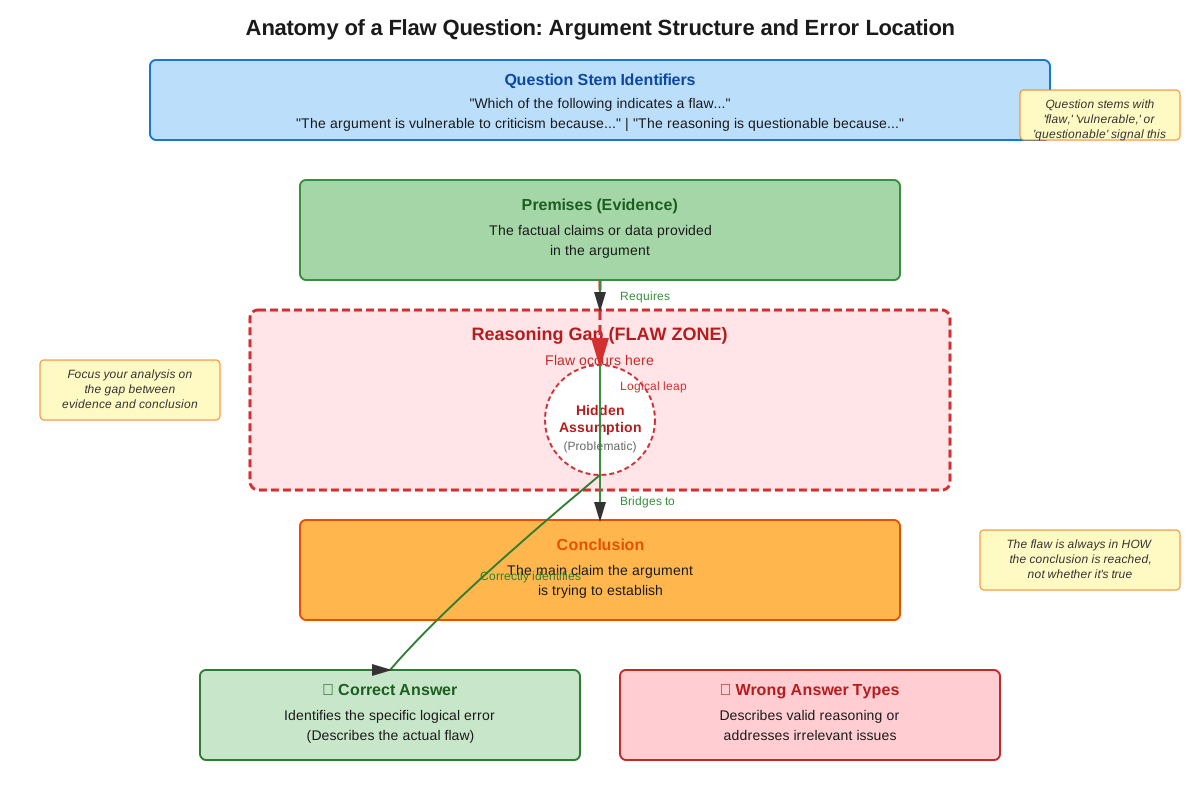
A flaw in logical reasoning is a gap, error, or weakness in the connection between an argument's premises and its conclusion. The argument may contain true premises yet still reach an unjustified conclusion due to faulty reasoning. Flaw questions ask you to identify this specific error in logic. The key distinction is that you're not evaluating whether the conclusion is true or false in reality—you're evaluating whether the reasoning process is sound.
Flaw questions differ from other Critical Reasoning types in an important way: the flaw already exists in the argument. You're not being asked to introduce new information (as in strengthen/weaken questions) or to identify what must be assumed (as in assumption questions). Instead, you're diagnosing what's already wrong with the reasoning as presented.
Common Question Stems
Recognizing flaw questions quickly is essential for efficient test-taking. These questions typically use one of several standard phrasings:
- "The reasoning in the argument is flawed because..."
- "Which of the following indicates a flaw in the reasoning above?"
- "The argument is vulnerable to criticism on the grounds that it..."
- "A weakness in the argument is that it..."
- "The argument is questionable because it..."
- "The reasoning above is most susceptible to criticism because..."
Major Categories of Logical Flaws
Causal Reasoning Flaws
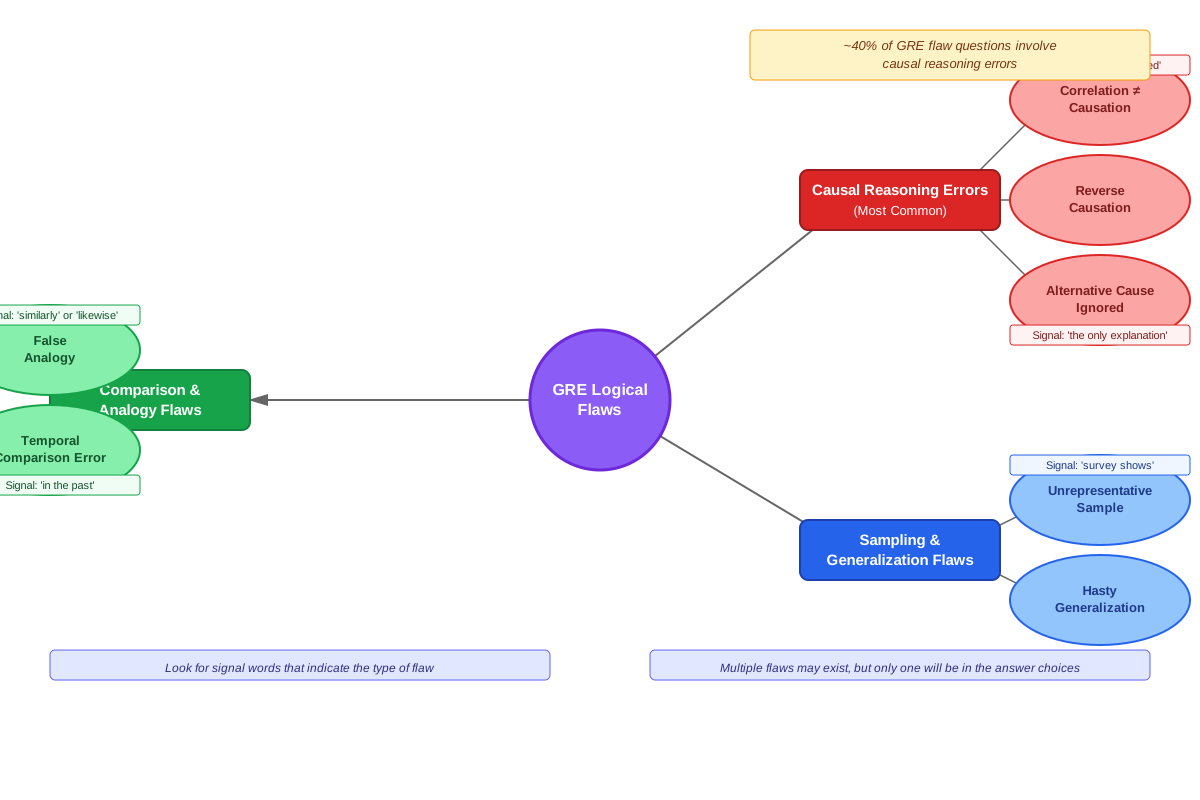
Causal reasoning errors represent the most frequently tested flaw type on the GRE. These occur when an argument incorrectly establishes or assumes a cause-and-effect relationship. The most common variant is correlation-causation confusion, where an argument observes that two things occur together and concludes that one causes the other, without ruling out alternative explanations.
For example: "Sales of ice cream and drowning deaths both increase in summer. Therefore, ice cream consumption causes drowning." This argument confuses correlation with causation—a third factor (warm weather) causes both phenomena.
Other causal flaws include:
- Reversed causation: Assuming A causes B when B actually causes A
- Ignoring alternative causes: Failing to consider other factors that might explain the effect
- Assuming a single cause: Concluding one factor is responsible when multiple factors contribute
Sampling and Generalization Flaws
Sampling flaws occur when an argument draws conclusions about a large group based on evidence from an unrepresentative or insufficient sample. The GRE frequently tests whether test-takers can recognize when a sample is too small, biased, or otherwise inadequate to support a broad conclusion.
Common sampling errors include:
- Unrepresentative sample: Drawing conclusions about all college students based only on Ivy League students
- Sample size too small: Concluding a medication is safe based on testing with only 10 people
- Self-selected sample: Surveying only volunteers and generalizing to everyone
- Hasty generalization: Making sweeping claims from limited evidence
Comparison and Analogy Flaws
Comparison flaws arise when an argument treats two different things as equivalent without establishing their relevant similarity. The argument might compare percentages to raw numbers, compare groups with different baseline characteristics, or assume that what works in one context will work in another.
Examples include:
- Comparing percentage increases without considering absolute numbers
- Assuming strategies successful in one industry will work in another
- Comparing groups without accounting for relevant differences
Circular Reasoning
Circular reasoning (also called begging the question) occurs when an argument's conclusion is essentially a restatement of its premise. The argument assumes what it's trying to prove, offering no independent support for the conclusion.
Example: "This law is fair because it treats everyone equally, and any law that treats everyone equally is fair." The premise and conclusion say the same thing in different words.
Equivocation
Equivocation involves using a key term with different meanings at different points in the argument. This creates an illusion of logical connection when none exists.
Example: "All banks are beside rivers. Therefore, you should keep your money in a bank beside a river." The word "bank" shifts meaning from financial institution to riverbank.
Ad Hominem Attacks
Ad hominem flaws occur when an argument attacks the person making a claim rather than addressing the claim itself. The argument suggests that because the source is flawed, the argument must be wrong—but the merit of an argument is independent of who makes it.
False Dichotomy
A false dichotomy (or false dilemma) presents only two options when more alternatives exist. The argument forces a choice between extremes while ignoring middle ground or other possibilities.
Example: "Either we ban all cars or accept polluted air forever." This ignores options like emission standards, electric vehicles, or public transportation.
Structural Elements of Flaw Analysis
| Element | Description | What to Look For |
|---|---|---|
| Premise | The evidence provided | Is it relevant? Sufficient? Representative? |
| Conclusion | The claim being made | Does it go beyond what the evidence supports? |
| Gap | The logical space between premise and conclusion | What assumption bridges this gap? Is it warranted? |
| Scope Shift | Changes in subject matter or degree | Does the conclusion discuss something different from the premises? |
Concept Relationships
The various flaw types interconnect in important ways. Causal reasoning flaws often involve sampling problems—for instance, an argument might conclude that X causes Y based on an unrepresentative sample, combining both flaw types. Similarly, comparison flaws frequently involve scope shifts, where the conclusion discusses a different population or context than the premises established.
Understanding flaws connects directly to assumption identification: every flaw represents a problematic assumption. A causal reasoning flaw assumes that correlation implies causation; a sampling flaw assumes the sample is representative. This relationship flows as: Identify the flaw → Recognize the problematic assumption → Understand what would strengthen or weaken the argument.
The relationship map for flaw questions follows this pattern:
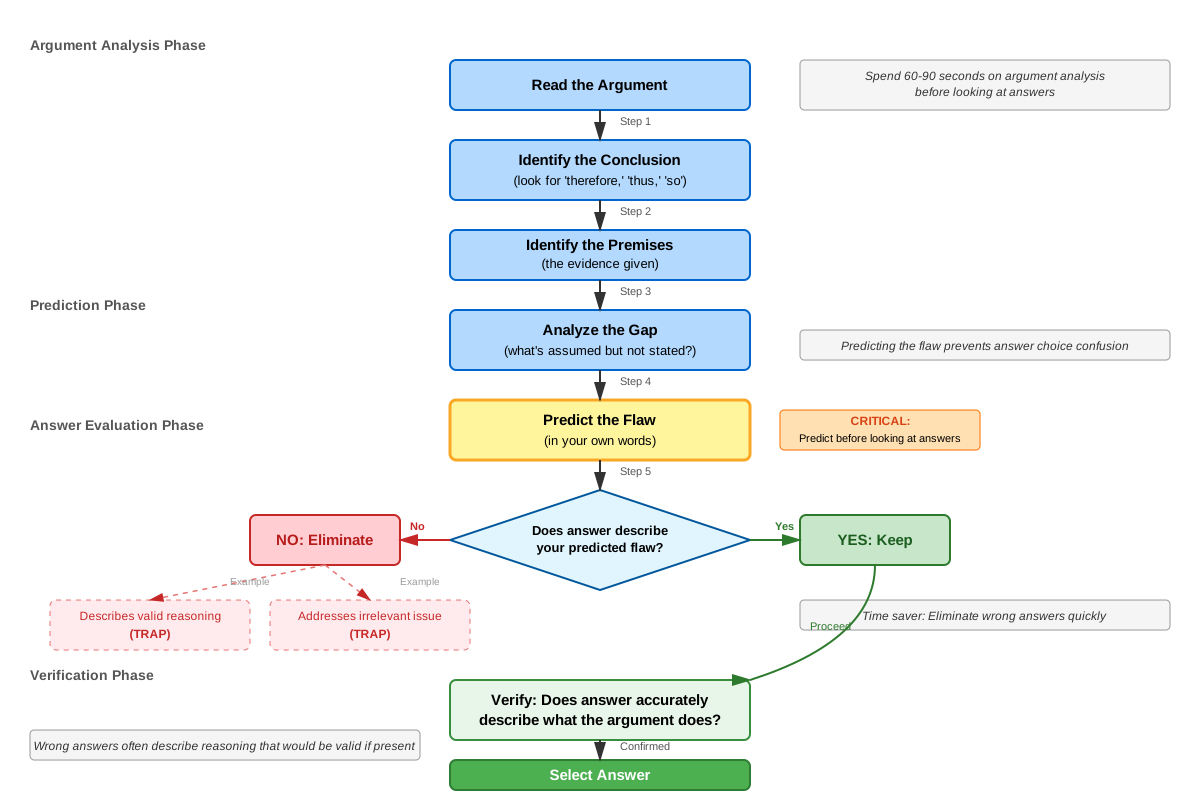
Argument Structure Analysis → Identify Conclusion and Premises → Locate the Logical Gap → Categorize the Flaw Type → Match to Answer Choice → Eliminate Answers Describing Valid Reasoning
This process also connects to strengthen/weaken questions: once you identify a flaw, you know what information would weaken the argument further (evidence highlighting the flaw) or strengthen it (evidence addressing the flaw). Understanding flaws thus serves as the foundation for multiple question types within Critical Reasoning.
High-Yield Facts
⭐ Causal reasoning flaws are the most frequently tested flaw type on the GRE, appearing in approximately 30-40% of all flaw questions
⭐ The correct answer to a flaw question must describe something actually present in the argument, not something the argument failed to do (unless the question specifically asks about an omission)
⭐ Correlation does not imply causation—arguments that observe two phenomena occurring together and conclude one causes the other commit a logical flaw
⭐ Sampling flaws occur when conclusions about a large group are based on an unrepresentative, biased, or insufficient sample
⭐ Scope shifts between premises and conclusion are a major red flag—watch for conclusions that discuss different subjects, time periods, or populations than the evidence
- Circular reasoning provides no new support for the conclusion because the premise and conclusion say essentially the same thing
- Ad hominem attacks are flawed because the merit of an argument is independent of the person making it
- False dichotomies ignore middle ground and alternative options, forcing an artificial choice between extremes
- Equivocation uses the same word with different meanings, creating an illusion of logical connection
- Comparison flaws treat different things as equivalent without establishing relevant similarity
- Arguments that assume what's true of parts must be true of the whole (or vice versa) commit a composition/division fallacy
Quick check — test yourself on Flaw questions so far.
Try Flashcards →Common Misconceptions
Misconception: A flaw question is asking whether the conclusion is true or false in reality.
Correction: Flaw questions assess the logical connection between premises and conclusion, not the factual truth of the conclusion. An argument can have true premises and a true conclusion yet still be logically flawed.
Misconception: If an argument doesn't consider alternative explanations, that's always the flaw.
Correction: While failing to consider alternatives is sometimes the flaw (especially in causal arguments), not every argument is required to address all possibilities. The flaw must be something that actually undermines the specific reasoning presented.
Misconception: The longest or most complex answer choice is usually correct.
Correction: The GRE often includes verbose answer choices that sound sophisticated but don't accurately describe the argument's flaw. The correct answer precisely identifies the logical error, regardless of length.
Misconception: Flaw questions and assumption questions are essentially the same.
Correction: While related, these question types differ: flaw questions ask you to identify what's wrong with the reasoning, while assumption questions ask what must be true for the reasoning to work. A flaw is a problem; an assumption is a necessary condition.
Misconception: If the argument's evidence is weak or questionable, that's automatically the flaw.
Correction: Flaw questions focus on reasoning errors, not evidence quality. Unless the question specifically asks about the evidence, the flaw typically lies in how the argument moves from premises to conclusion, not in the premises themselves.
Misconception: The correct answer will always use technical logical terminology like "ad hominem" or "false dichotomy."
Correction: The GRE typically describes flaws in plain language rather than using formal logical terms. The correct answer might say "attacks the character of those who disagree" rather than "commits an ad hominem fallacy."
Worked Examples
Example 1: Causal Reasoning Flaw
Argument: "A recent study found that students who eat breakfast before school have higher test scores than students who skip breakfast. Therefore, eating breakfast causes improved academic performance. Schools should require all students to eat breakfast to raise test scores."
Question: The reasoning in the argument is flawed because it:
Step 1 - Identify the Conclusion: The conclusion is that eating breakfast causes improved academic performance, and schools should require breakfast.
Step 2 - Identify the Premises: The evidence is that students who eat breakfast have higher test scores than those who don't.
Step 3 - Locate the Gap: The argument observes a correlation (breakfast-eaters score higher) and concludes causation (breakfast causes higher scores). This is a classic causal reasoning flaw.
Step 4 - Consider Alternative Explanations: Could other factors explain both breakfast-eating and higher scores? Perhaps students from more stable home environments both eat breakfast regularly and perform better academically. Perhaps more motivated students take better care of themselves generally, including eating breakfast. The argument doesn't rule out these alternatives.
Step 5 - Predict the Flaw: The argument confuses correlation with causation and fails to consider alternative explanations for the observed relationship.
Correct Answer: "fails to consider that the correlation between eating breakfast and higher test scores might be explained by other factors that influence both breakfast habits and academic performance"
Why This Connects to Learning Objectives: This example demonstrates how to identify when flaw questions are being tested (the question stem asks about flawed reasoning), explains the core strategy (identifying the gap between correlation and causation), and shows how to apply this to a GRE-style question.
Example 2: Sampling Flaw
Argument: "A survey of 50 members of the university's debate team found that 80% plan to attend law school. This demonstrates that most university students are interested in legal careers. The university should expand its pre-law program to accommodate this widespread interest."
Question: Which of the following indicates a flaw in the reasoning above?
Step 1 - Identify the Conclusion: The conclusion is that most university students are interested in legal careers, and the university should expand pre-law programs.
Step 2 - Identify the Premises: The evidence is a survey of 50 debate team members, 80% of whom plan to attend law school.
Step 3 - Identify the Scope Shift: Notice the shift from "debate team members" (the sample) to "university students" (the conclusion group). This is a major red flag.
Step 4 - Evaluate the Sample: Is the debate team representative of all university students? Almost certainly not. Debate team members likely have specific interests and skills that make them more inclined toward law school than the average student. The sample is biased.
Step 5 - Predict the Flaw: The argument generalizes from an unrepresentative sample to a much broader population.
Correct Answer: "assumes that debate team members are representative of university students generally, when they may have atypical career interests"
Why This Connects to Learning Objectives: This example shows how to identify sampling flaws (a specific flaw category), demonstrates the strategy of looking for scope shifts between premises and conclusion, and illustrates how to match the identified flaw to the correct answer choice.
Exam Strategy
Systematic Approach to Flaw Questions
- Read the question stem first to confirm it's a flaw question and note any specific focus (e.g., "vulnerable to criticism on which grounds")
- Read the argument actively, identifying the conclusion (often signaled by "therefore," "thus," "consequently") and premises
- Pause before looking at answer choices and articulate the flaw in your own words—this prevents answer choices from confusing you
- Look for common flaw patterns: causal reasoning errors, sampling problems, scope shifts, and comparison issues account for the majority of GRE flaw questions
- Eliminate answer choices systematically:
- Eliminate choices that describe valid reasoning
- Eliminate choices that describe flaws not present in the argument
- Eliminate choices that are too vague or general
- Eliminate choices that describe what the argument failed to do (unless that's specifically what's being asked)
Trigger Words and Phrases
In the argument, watch for:
- Causal language: "causes," "leads to," "results in," "is responsible for," "produces"—these often signal causal reasoning that may be flawed
- Generalization indicators: "all," "most," "generally," "typically"—these may signal overgeneralization from limited evidence
- Comparison markers: "more than," "less than," "better," "worse"—these may signal comparison flaws
- Certainty language: "must," "proves," "demonstrates conclusively"—strong conclusions often outpace the evidence
In answer choices, watch for:
- "Fails to consider": Often correct for causal reasoning flaws that ignore alternative explanations
- "Assumes without warrant": Often correct for identifying problematic assumptions
- "Treats... as if...": Often correct for comparison or equivocation flaws
- "Generalizes from": Often correct for sampling flaws
Process of Elimination Tips
Eliminate answers that:
- Describe reasoning that would actually strengthen the argument
- Mention concepts not discussed in the argument
- Are too vague to be useful (e.g., "relies on questionable evidence" without specifying what's questionable)
- Describe what the argument "fails to do" when the argument isn't required to do that thing
- Use extreme language that doesn't match the argument's actual error
Time Allocation
Spend approximately 60-90 seconds per flaw question:
- 15-20 seconds reading and understanding the argument
- 10-15 seconds identifying the flaw before looking at choices
- 30-45 seconds evaluating answer choices
- 5-10 seconds confirming your selection
If you can identify the flaw before reading answer choices, you'll move through the question much faster and with greater confidence.
Memory Techniques
The CASC Mnemonic for Common Flaws
Causal reasoning errors (correlation ≠ causation)
Analogy and comparison flaws (treating different things as equivalent)
Sampling problems (unrepresentative or insufficient samples)
Circular reasoning (conclusion restates premise)
Visualization Strategy: The Bridge Metaphor
Visualize an argument as a bridge from premises (one side) to conclusion (other side). The flaw is a gap or weakness in the bridge. Ask yourself:
- Is the bridge too narrow (insufficient evidence)?
- Does it connect the wrong places (scope shift)?
- Is it built on faulty assumptions (problematic reasoning)?
- Does it ignore other possible bridges (alternative explanations)?
The "So What?" Test
When you identify the conclusion, ask "So what? Why does that follow?" If you can think of reasons why it might not follow, you've likely identified the flaw. This technique helps you spot gaps in reasoning quickly.
The Alternative Explanation Acronym: COAST
When evaluating causal arguments, check for:
Coincidence (random chance)
Other causes (alternative explanations)
Actually reversed (effect and cause are backwards)
Sample problems (unrepresentative data)
Third factor (something else causes both)
Summary
Flaw questions assess your ability to identify logical weaknesses in arguments, making them a cornerstone of GRE Critical Reasoning. These questions present an argument with a reasoning error and ask you to identify what's wrong with the logic. The most commonly tested flaws involve causal reasoning (especially confusing correlation with causation), sampling problems (generalizing from unrepresentative or insufficient samples), comparison errors (treating different things as equivalent), and scope shifts (conclusions that go beyond what the premises establish). Success on flaw questions requires a systematic approach: identify the conclusion and premises, locate the logical gap, categorize the flaw type, and match it to the answer choice that precisely describes the error. The key insight is that you're evaluating the reasoning process, not the factual truth of the conclusion. By learning to recognize common flaw patterns and practicing the systematic approach, you can quickly and accurately answer these high-value questions, significantly improving your Verbal Reasoning score.
Key Takeaways
- Flaw questions ask you to identify what's already wrong with an argument's reasoning, not to introduce new information or evaluate factual truth
- Causal reasoning flaws are the most frequently tested type—always consider whether an argument confuses correlation with causation or ignores alternative explanations
- Scope shifts between premises and conclusion are major red flags—watch for conclusions that discuss different subjects, populations, or time periods than the evidence
- Identify the flaw in your own words before reading answer choices to avoid being misled by attractive but incorrect options
- Sampling flaws occur when arguments generalize from unrepresentative, biased, or insufficient samples to broader populations
- The correct answer must describe a flaw actually present in the argument, not just any logical error that could theoretically exist
- Systematic elimination of wrong answers is as important as identifying the right answer—remove choices describing valid reasoning, absent flaws, or irrelevant issues
Related Topics
Assumption Questions: Understanding flaws directly enables you to identify assumptions, since every flaw represents a problematic assumption. Mastering flaw questions makes assumption questions significantly easier.
Strengthen and Weaken Questions: Once you can identify an argument's flaw, you know exactly what information would weaken it further (evidence highlighting the flaw) or strengthen it (evidence addressing the flaw).
Evaluate Questions: These ask what information would be most useful in assessing an argument—which is essentially asking what would help determine whether a potential flaw is actually problematic.
Parallel Reasoning Questions: Identifying the logical structure of flawed arguments helps you recognize parallel structures in other arguments, even when the content differs.
Formal Logic: Deeper study of formal logical fallacies and valid argument forms provides a theoretical foundation for the practical skills tested in flaw questions.
Practice CTA
Now that you understand the core concepts and strategies for flaw questions, it's time to put your knowledge into practice. Attempt the practice questions to reinforce these concepts and build your pattern recognition skills. Each question you work through strengthens your ability to quickly identify flaws under timed conditions. Remember, flaw questions are highly learnable—with focused practice, you can master this question type and significantly boost your Verbal Reasoning score. The flashcards will help you memorize common flaw types and trigger words, making your approach even more efficient. You've built the foundation; now build the skill through deliberate practice!
Sign up free to keep reading
Create a free AnvayaPrep account to finish this GRE guide on Flaw questions — plus flashcards and practice questions.