Overview
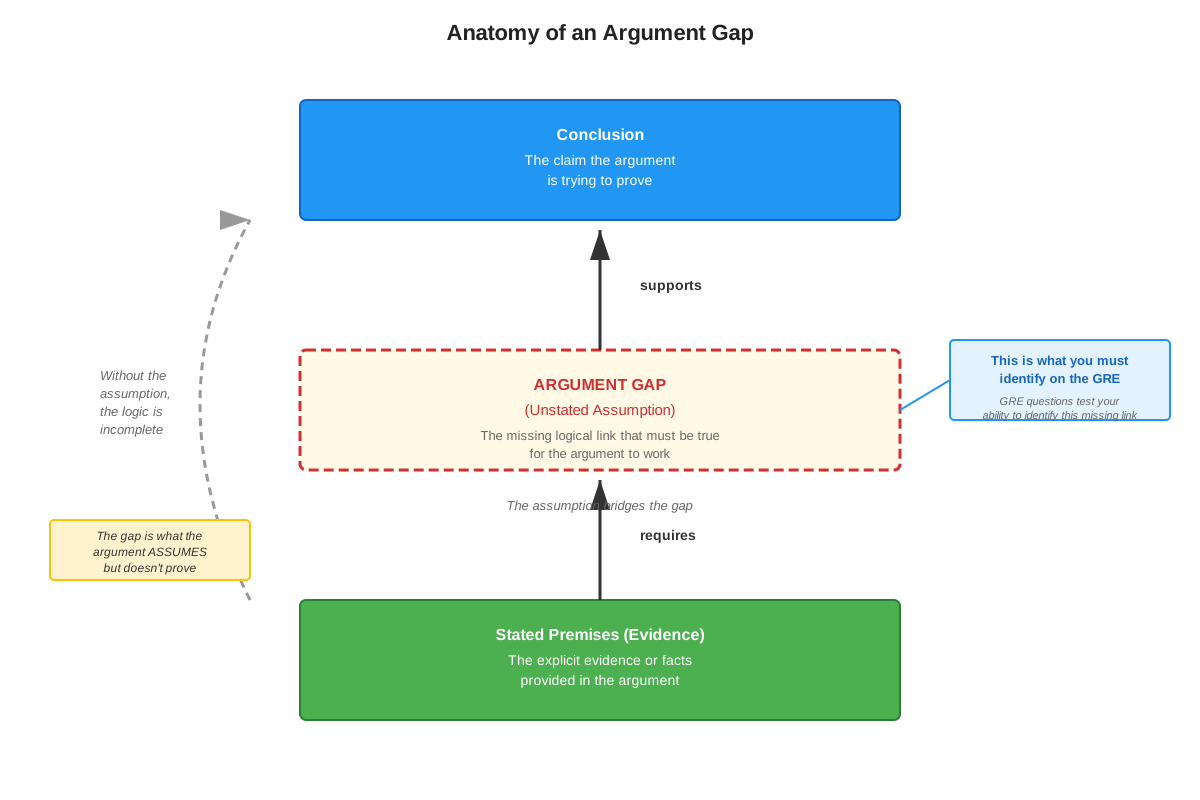
Argument gaps represent one of the most critical and frequently tested concepts in GRE Verbal Reasoning, particularly within the Analytical Writing and Reading Comprehension sections. An argument gap refers to the logical space between an argument's premises (evidence) and its conclusion—the unstated assumptions that must be true for the reasoning to hold. Understanding gre argument gaps is essential because the GRE consistently tests whether students can identify flawed reasoning, recognize missing links in logic, and evaluate the strength of arguments.
The ability to spot argument gaps is fundamental to critical thinking and appears across multiple question types on the GRE. In "Analyze an Argument" essay tasks, test-takers must identify and explain the gaps in a given argument. In Reading Comprehension, questions frequently ask students to identify assumptions, strengthen or weaken arguments, or recognize logical flaws—all of which require understanding where gaps exist in reasoning. The GRE rewards students who can quickly identify what an author has assumed but not proven, what evidence would be necessary to support a conclusion, and what alternative explanations might undermine an argument.
Within the broader context of Verbal Reasoning, argument gaps connect directly to logical structure analysis, assumption identification, and evidence evaluation. Mastering this topic enables students to approach GRE passages more strategically, moving beyond surface-level comprehension to analyze the underlying logical architecture of arguments. This skill differentiates high-scoring test-takers from average performers, as it requires active, critical engagement with text rather than passive reading.
Learning Objectives
- [ ] Identify when Argument gaps is being tested in GRE questions
- [ ] Explain the core rule or strategy behind Argument gaps
- [ ] Apply Argument gaps to GRE-style questions accurately
- [ ] Distinguish between stated premises and unstated assumptions in arguments
- [ ] Evaluate which pieces of evidence would close or widen specific argument gaps
- [ ] Recognize the most common types of logical gaps that appear on the GRE
- [ ] Construct effective responses to "Analyze an Argument" prompts by systematically identifying gaps
Prerequisites
- Basic logical reasoning: Understanding of premises, conclusions, and how arguments are structured is essential for identifying where gaps occur in the logical chain.
- Reading comprehension fundamentals: The ability to identify main ideas, supporting details, and author's purpose provides the foundation for deeper critical analysis.
- Familiarity with argument structure: Recognizing indicator words (therefore, because, since, thus) helps distinguish between evidence and conclusions, making gaps more visible.
- Understanding of causation vs. correlation: Many argument gaps involve unwarranted causal claims, so distinguishing these concepts is crucial.
Why This Topic Matters
Argument gaps appear in approximately 30-40% of GRE Verbal Reasoning questions, making this one of the highest-yield topics for test preparation. The concept manifests across multiple question formats: "weaken the argument" questions, "assumption" questions, "strengthen the argument" questions, and "evaluate the argument" questions all fundamentally test the ability to identify and work with logical gaps. In the Analytical Writing section, the "Analyze an Argument" task explicitly requires students to identify and explain multiple gaps in reasoning.
Beyond the exam, the ability to identify argument gaps represents a fundamental critical thinking skill applicable to professional, academic, and personal decision-making. Evaluating business proposals, assessing research claims, analyzing policy arguments, and making informed consumer choices all require the ability to spot unstated assumptions and missing evidence. Legal reasoning, medical diagnosis, scientific research, and strategic planning all depend on identifying gaps between evidence and conclusions.
On the GRE, argument gaps typically appear in passages discussing studies, surveys, business decisions, policy recommendations, or causal explanations. Common formats include arguments that recommend a course of action based on limited evidence, explanations that attribute an effect to a single cause without ruling out alternatives, or predictions based on past trends without considering changed circumstances. Recognizing these patterns allows test-takers to anticipate where gaps will likely appear and approach questions more efficiently.
Core Concepts
What Are Argument Gaps?
An argument gap is the logical distance between what an argument explicitly states (its premises or evidence) and what it claims to prove (its conclusion). Every argument relies on unstated assumptions—propositions that must be true for the reasoning to be valid but that the author has not explicitly defended or proven. These assumptions represent the "gaps" in the argument's logical structure.
Consider this simple example: "Sales of ice cream increased this month. Therefore, the new advertising campaign was successful." The gap here is enormous: the argument assumes that the advertising campaign caused the sales increase, ignoring alternative explanations (warmer weather, competitor closures, price reductions, etc.). The unstated assumption—that no other factors could explain the sales increase—represents the argument gap.
The Anatomy of Logical Gaps
Understanding argument gaps requires recognizing the three-part structure of arguments:
- Premises: The evidence, facts, or observations the argument presents
- Assumptions: The unstated beliefs or propositions that connect premises to conclusions
- Conclusions: The claims the argument attempts to prove or recommend
The gap exists in the space occupied by assumptions. Strong arguments minimize gaps by providing comprehensive evidence and explicitly addressing potential objections. Weak arguments—the type the GRE presents for analysis—contain large gaps that make the reasoning vulnerable to criticism.
Common Types of Argument Gaps
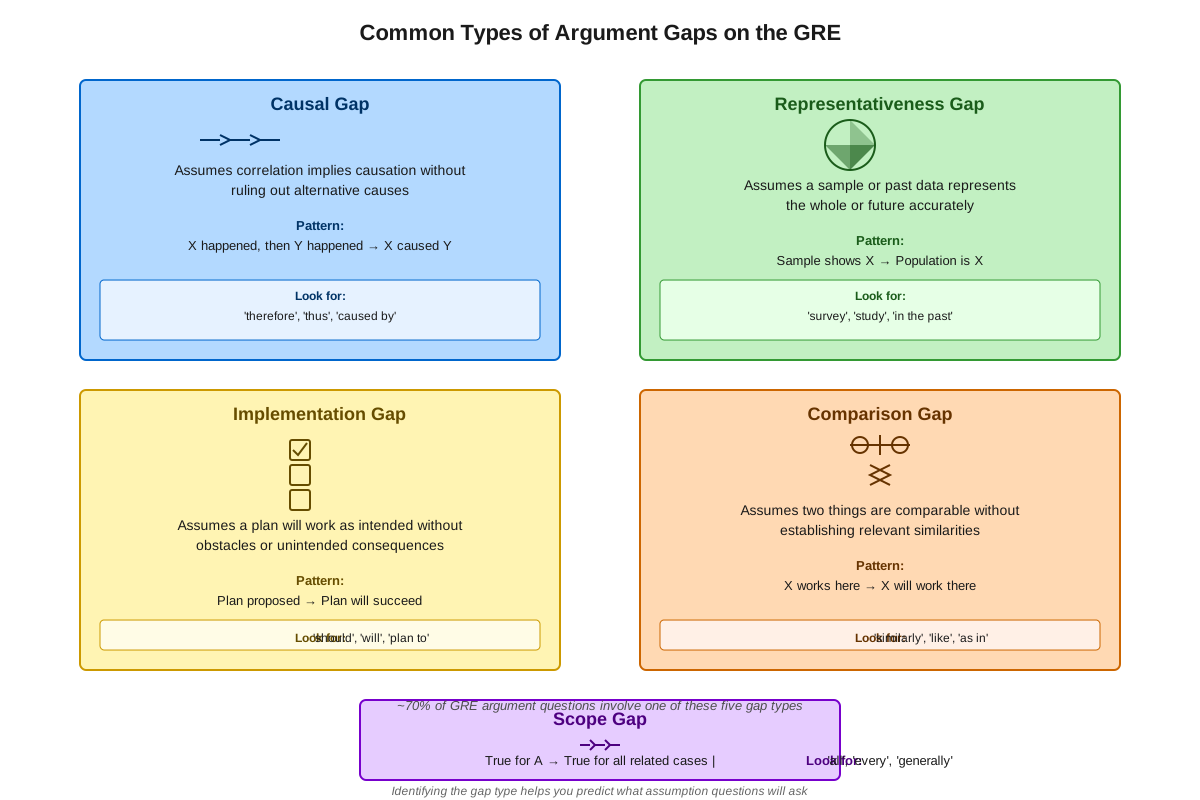
Causal Gaps occur when arguments claim that one event caused another without ruling out alternative explanations or establishing a causal mechanism. These are among the most frequent gaps on the GRE. The argument assumes a causal relationship exists when only correlation has been demonstrated, or it assumes a specific cause while ignoring other plausible factors.
Representativeness Gaps appear when arguments generalize from a sample to a broader population without establishing that the sample is representative. For example, an argument might cite a survey of current customers to make claims about potential customers, assuming without justification that these groups have similar preferences.
Comparison Gaps emerge when arguments compare two things while assuming they are sufficiently similar in relevant respects. An argument might recommend adopting a policy because it worked in another city, assuming without evidence that the cities face similar circumstances.
Implementation Gaps occur in arguments recommending actions. The argument assumes that the recommended action can be successfully implemented, that it won't have negative side effects, and that the benefits will outweigh the costs—all without providing evidence for these assumptions.
Temporal Gaps appear when arguments assume that conditions observed in the past will continue into the future, or that a trend will persist without change. These arguments fail to consider that circumstances might change in ways that affect the conclusion.
Identifying Gaps: The Systematic Approach
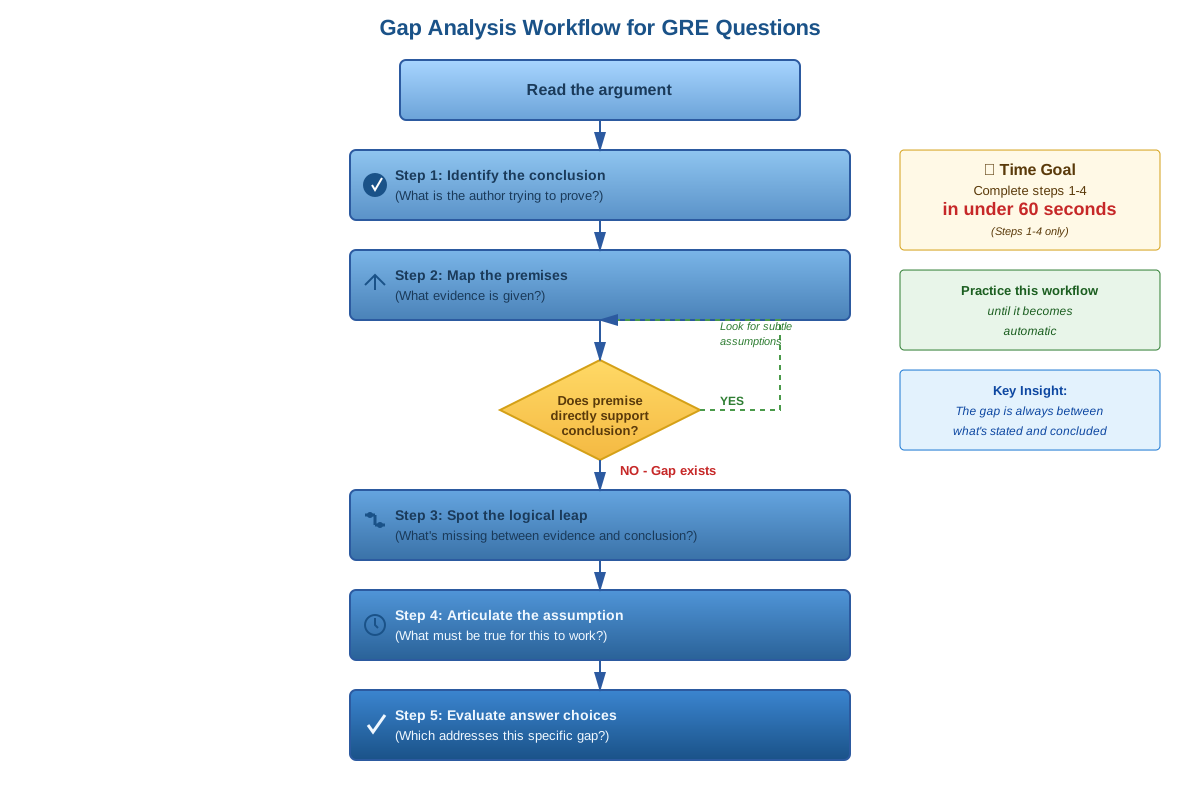
| Step | Action | Purpose |
|---|---|---|
| 1 | Identify the conclusion | Determine what the argument is trying to prove |
| 2 | Identify the premises | List all evidence explicitly provided |
| 3 | Map the logical connection | Ask: "What must be true for this evidence to support this conclusion?" |
| 4 | Articulate assumptions | State the unstated beliefs bridging premises to conclusion |
| 5 | Evaluate vulnerability | Consider what evidence would weaken or strengthen the argument |
The Necessity Test for Assumptions
To determine whether something is truly an assumption (and thus a potential gap), apply the necessity test: If the assumption were false, would the argument fall apart? If yes, it's a necessary assumption and represents a genuine gap. If the argument could still hold even if the assumption were false, it's not a necessary assumption.
For example, in the ice cream argument above, is it a necessary assumption that weather didn't change? Yes—if weather became significantly warmer, that alone could explain the sales increase, making the advertising campaign unnecessary to explain the outcome. Therefore, "weather conditions remained constant" is a necessary assumption and represents a gap.
Gap Size and Argument Strength
Not all gaps are equal. Some arguments contain small, reasonable gaps—assumptions so likely to be true that they barely weaken the argument. Others contain enormous gaps that make the reasoning highly suspect. The GRE typically presents arguments with substantial gaps, as these provide more material for analysis and discussion.
A large gap exists when the assumption is questionable, when alternative explanations are readily available, or when the evidence provided is tangentially related to the conclusion. A small gap exists when the assumption is highly plausible, when the evidence directly supports the conclusion, or when alternative explanations are unlikely.
Concept Relationships
Argument gaps connect intimately with several other critical reasoning concepts. Assumptions are the substance that fills (or fails to fill) argument gaps—identifying gaps and identifying assumptions are essentially two perspectives on the same analytical task. When a question asks for an assumption, it's asking what would close a gap in the reasoning.
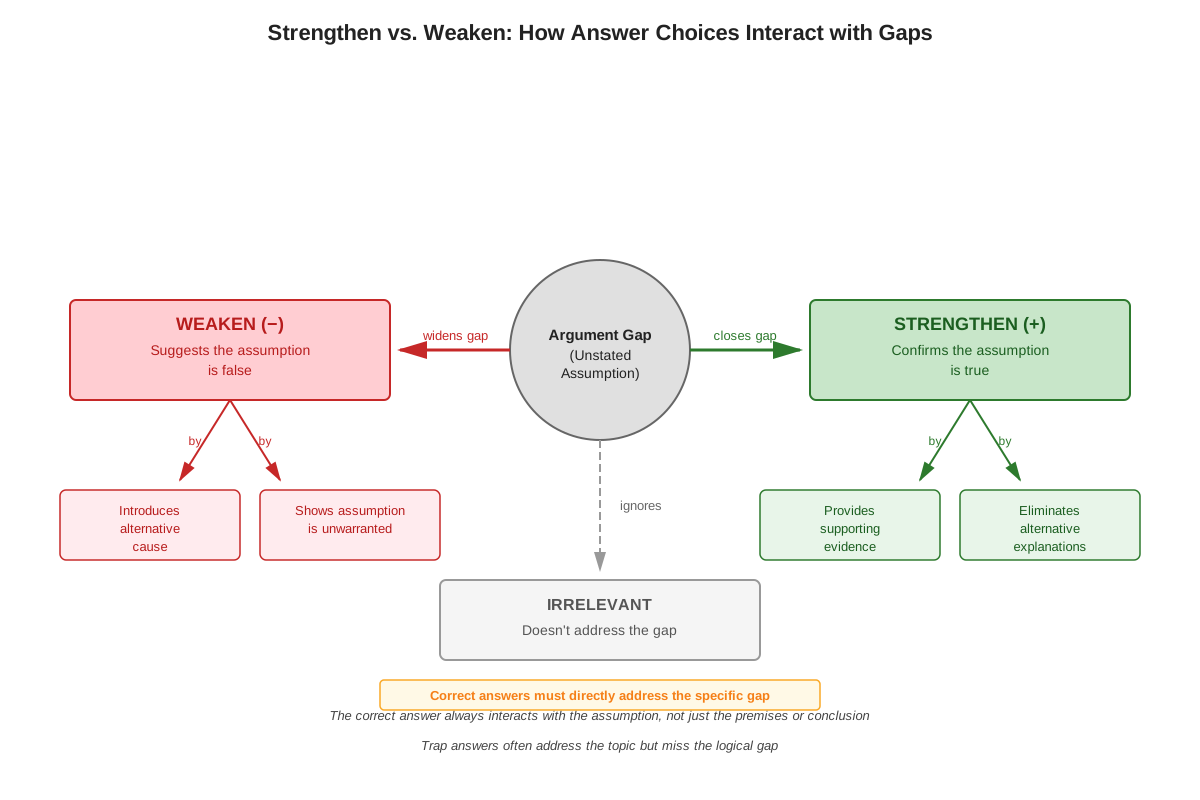
Evidence evaluation directly relates to gap analysis: determining whether evidence is relevant and sufficient requires understanding what gaps exist between that evidence and the conclusion. Strong evidence closes gaps; weak evidence leaves them open. Similarly, strengthening and weakening arguments involves either closing gaps (strengthening) or widening them (weakening). Evidence that addresses an assumption closes a gap and strengthens the argument; evidence that undermines an assumption widens a gap and weakens the argument.
The relationship flows as follows: Argument Structure → Gap Identification → Assumption Recognition → Evidence Evaluation → Argument Assessment. Each step builds on the previous one, with gap identification serving as the crucial middle step that enables both assumption recognition and evidence evaluation.
Understanding logical fallacies also connects to gap analysis, as many common fallacies are simply named types of argument gaps. Post hoc ergo propter hoc (after this, therefore because of this) is a causal gap. Hasty generalization is a representativeness gap. False analogy is a comparison gap. Learning to identify gaps provides a systematic framework for recognizing these and other logical errors.
High-Yield Facts
⭐ Argument gaps are unstated assumptions that must be true for an argument's reasoning to be valid.
⭐ The GRE most frequently tests causal gaps, where arguments assume causation from correlation or ignore alternative explanations.
⭐ Every "assumption" question is fundamentally asking you to identify what would close a gap in the argument.
⭐ Weaken questions ask for evidence that widens a gap; strengthen questions ask for evidence that closes a gap.
⭐ The larger the gap between premises and conclusion, the weaker the argument and the more vulnerable it is to criticism.
- Representativeness gaps appear when arguments generalize from unrepresentative samples to broader populations.
- Comparison gaps occur when arguments assume two situations are analogous without establishing relevant similarities.
- Implementation gaps exist when arguments recommend actions without considering feasibility, costs, or side effects.
- Temporal gaps appear when arguments assume past conditions or trends will continue unchanged into the future.
- The necessity test helps identify true assumptions: if the assumption were false, would the argument collapse?
⭐ Most GRE arguments contain multiple gaps, and high-scoring responses to "Analyze an Argument" tasks identify several distinct gaps.
- Scope shifts between premises and conclusions often signal gaps (e.g., evidence about one group used to conclude about a different group).
- Arguments that rely on surveys or studies often contain gaps about sample representativeness, response rates, or question design.
- Economic arguments frequently contain gaps about whether financial benefits will outweigh costs or whether people will respond to incentives as predicted.
- Arguments making predictions contain gaps about whether current conditions will persist and whether unforeseen factors might intervene.
Quick check — test yourself on Argument gaps so far.
Try Flashcards →Common Misconceptions
Misconception: Every unstated piece of information is an argument gap. → Correction: Only unstated assumptions that are necessary for the reasoning to work represent true gaps. Many unstated facts are irrelevant to the argument's logic. The necessity test helps distinguish genuine assumptions from irrelevant information.
Misconception: Identifying gaps means finding factual errors in the argument. → Correction: Argument gaps are about logical structure, not factual accuracy. An argument can contain entirely true premises and still have large gaps if those premises don't adequately support the conclusion. The GRE tests logical reasoning, not factual knowledge.
Misconception: Closing one gap makes an argument strong. → Correction: Most GRE arguments contain multiple significant gaps. Addressing one assumption strengthens the argument but rarely makes it conclusive. High-quality analysis identifies several distinct gaps and explains how each one weakens the reasoning.
Misconception: Gaps only appear in obviously flawed arguments. → Correction: All arguments contain some gaps—even strong arguments rest on assumptions. The difference is that strong arguments rest on highly plausible assumptions while weak arguments rest on questionable ones. The GRE presents arguments with particularly large or questionable gaps.
Misconception: The correct answer to an assumption question must be something the author would agree with. → Correction: Necessary assumptions are often things the author hasn't considered or would prefer not to acknowledge. The correct answer identifies what must be true for the logic to work, regardless of whether the author explicitly endorses it.
Misconception: Longer, more complex arguments have more gaps than shorter arguments. → Correction: Argument length doesn't determine gap size. A brief argument can contain enormous gaps, while a longer argument might carefully address potential objections. Gap size depends on the relationship between evidence and conclusion, not word count.
Misconception: Personal agreement or disagreement with the conclusion helps identify gaps. → Correction: Personal opinions are irrelevant to gap analysis. The task is to evaluate the logical structure objectively, identifying where the reasoning fails to connect premises to conclusions regardless of whether the conclusion seems intuitively correct.
Worked Examples
Example 1: Business Recommendation Argument
Argument: "The Riverside Restaurant's profits declined by 15% last year. During the same period, the restaurant reduced its menu from 40 items to 25 items. To increase profits, the restaurant should restore its full 40-item menu."
Analysis:
Step 1 - Identify the conclusion: The restaurant should restore its full 40-item menu (to increase profits).
Step 2 - Identify the premises:
- Profits declined 15% last year
- Menu was reduced from 40 to 25 items during that period
Step 3 - Identify the gaps:
Causal Gap: The argument assumes the menu reduction caused the profit decline. However, correlation doesn't establish causation. Many alternative explanations could account for declining profits: increased competition, economic downturn in the area, rising food costs, negative reviews, management changes, or declining food quality. The argument provides no evidence that the menu reduction specifically caused the profit decline rather than merely coinciding with it.
Implementation Gap: The argument assumes that restoring the full menu will reverse the profit decline. This assumes that: (1) customers actually want more menu options, (2) the restaurant can profitably prepare 40 items, (3) the additional menu items won't increase costs more than revenue, and (4) whatever caused the profit decline won't continue to affect the restaurant even with the expanded menu.
Temporal Gap: The argument assumes that conditions that existed when the 40-item menu was previously profitable still exist. Customer preferences, competition, costs, and market conditions may have changed, making the larger menu no longer viable.
Evidence that would close gaps: Information showing that customer complaints specifically mentioned limited menu options, data indicating that competitors with larger menus are more profitable, or evidence that the restaurant's costs decreased when the menu was reduced (suggesting the smaller menu wasn't the problem).
Example 2: Survey-Based Argument
Argument: "A survey of 500 Mountainview residents found that 65% support building a new sports stadium. Therefore, the city council should approve the stadium construction project."
Analysis:
Step 1 - Identify the conclusion: The city council should approve the stadium construction.
Step 2 - Identify the premises: A survey showed 65% of 500 residents support the stadium.
Step 3 - Identify the gaps:
Representativeness Gap: The argument assumes the 500 surveyed residents represent the broader population whose views matter. Key questions: How were these 500 selected? Were they randomly chosen or self-selected? Do they represent the demographic and geographic diversity of Mountainview? If the survey was conducted at sporting events or in sports-oriented neighborhoods, the sample might overrepresent stadium supporters.
Response Rate Gap: The argument doesn't address who chose not to respond. If the survey had a low response rate, those who responded might differ systematically from non-respondents. People with strong opinions (especially supporters) might be more likely to respond.
Question Design Gap: The argument assumes the survey question was neutrally worded and that respondents understood what they were supporting. If the question emphasized benefits without mentioning costs, or if it didn't specify the stadium's location, funding source, or impact on taxes, respondents might not have been making an informed judgment.
Implementation Gap: Even if 65% support the idea in principle, the argument assumes this support would persist through actual implementation. It doesn't address whether support would continue if residents learned about specific costs, tax increases, traffic impacts, or alternative uses for the funds.
Scope Gap: The argument shifts from "residents support" to "council should approve." This assumes that majority support is sufficient justification for approval, ignoring other relevant factors like financial feasibility, environmental impact, legal constraints, or the rights and concerns of the 35% who oppose the project.
Evidence that would close gaps: Information about survey methodology, response rates, question wording, whether respondents were informed about costs and alternatives, and whether the 500 surveyed were demographically representative of the city's population.
Exam Strategy
When approaching GRE questions testing argument gaps, follow this systematic process:
For "Assumption" Questions: Read the argument and immediately ask, "What must be true for this conclusion to follow from this evidence?" Look for scope shifts between premises and conclusion—these almost always signal gaps. The correct answer will be something that, if false, would destroy the argument. Use the negation test: negate each answer choice and ask whether the negated version would weaken the argument. The correct assumption, when negated, will severely damage or destroy the argument.
For "Weaken" Questions: Identify the argument's gaps first, then look for answer choices that exploit those gaps. The correct answer will typically provide evidence that an assumption is false or questionable. Watch for answers that present alternative explanations (for causal arguments), show the sample is unrepresentative (for generalization arguments), or reveal relevant differences (for comparison arguments).
For "Strengthen" Questions: Again, identify gaps first. The correct answer will provide evidence that closes a gap by supporting an assumption. Be wary of answers that support the conclusion directly without addressing the logical gap—these are often trap answers. The correct answer strengthens the connection between premises and conclusion.
Trigger Words and Phrases:
- "Therefore," "thus," "consequently" → Signal conclusions; ask what assumptions connect evidence to this conclusion
- "Because," "since," "given that" → Signal premises; ask whether these actually support the conclusion
- "Will," "would," "should" → Signal predictions or recommendations; look for temporal or implementation gaps
- "Survey," "study," "poll" → Look for representativeness and methodology gaps
- "Caused," "resulted in," "led to" → Look for causal gaps and alternative explanations
- "Similar to," "like," "as in" → Look for comparison gaps
Time Management: Spend 15-20 seconds identifying the argument's structure and main gap before looking at answer choices. This upfront investment prevents wasting time on attractive but incorrect answers. For "Analyze an Argument" essays, spend 2-3 minutes outlining the major gaps before writing.
Process of Elimination: Eliminate answers that are irrelevant to the logical connection between premises and conclusion, even if they're related to the topic. Eliminate answers that address minor points while ignoring major gaps. For assumption questions, eliminate answers that, if false, wouldn't significantly damage the argument.
Memory Techniques
CARTI Mnemonic for common gap types:
- Causal gaps (correlation ≠ causation)
- Analogy/comparison gaps (assuming similarity)
- Representativeness gaps (sample ≠ population)
- Temporal gaps (past ≠ future)
- Implementation gaps (plan ≠ reality)
The Bridge Visualization: Picture the argument as a bridge. Premises are one side, the conclusion is the other side. Assumptions are the bridge supports. Ask: "What supports are missing? Where would this bridge collapse?" This visualization helps identify where the logical structure is weakest.
The "So What?" Test: After reading the premises, ask "So what?" before looking at the conclusion. If your reaction is "that doesn't necessarily mean anything specific," you've identified a gap. The conclusion should feel like a logical next step, not a leap.
The Alternative Explanation Game: For any causal claim, immediately generate 2-3 alternative explanations. This trains your mind to automatically spot causal gaps. For example, if an argument says "X happened, then Y happened, so X caused Y," immediately think: "What else could have caused Y?"
Scope Shift Scanner: Train yourself to notice when the conclusion uses different terms or refers to a different group than the premises. Underline or circle key terms in premises and conclusion. If they don't match, you've found a scope gap.
Summary
Argument gaps represent the logical space between an argument's evidence and its conclusion—the unstated assumptions that must be true for the reasoning to be valid. Mastering gap identification is essential for GRE success because it underlies assumption questions, strengthen/weaken questions, and the "Analyze an Argument" essay task. The most common gap types include causal gaps (assuming causation from correlation), representativeness gaps (generalizing from unrepresentative samples), comparison gaps (assuming similarity without justification), implementation gaps (ignoring practical obstacles), and temporal gaps (assuming conditions won't change). Effective gap analysis requires systematically identifying premises and conclusions, determining what must be true to connect them, and evaluating how vulnerable the argument is to criticism. Strong GRE performance depends on quickly recognizing these patterns and understanding that most arguments contain multiple significant gaps that can be exploited through careful analysis.
Key Takeaways
- Argument gaps are unstated assumptions—the logical bridges between evidence and conclusions that arguments fail to explicitly establish or defend
- Causal gaps are the most frequently tested type on the GRE, appearing when arguments claim causation without ruling out alternative explanations
- Every assumption question fundamentally asks you to identify what would close a gap in the argument's reasoning
- Identifying gaps requires systematic analysis: isolate the conclusion, list the premises, and ask what must be true to connect them
- Scope shifts between premises and conclusions almost always signal significant gaps and provide clues to the correct answer
- The necessity test distinguishes real assumptions from irrelevant information: if the assumption were false, would the argument collapse?
- Most GRE arguments contain multiple gaps, and comprehensive analysis identifies several distinct logical weaknesses rather than focusing on just one
Related Topics
Logical Fallacies: Understanding named fallacies (post hoc ergo propter hoc, hasty generalization, false analogy, etc.) provides specific examples of common argument gaps and helps recognize patterns more quickly.
Formal Logic and Conditional Reasoning: Mastering if-then statements, necessary and sufficient conditions, and logical operators enables more sophisticated analysis of argument structure and gaps.
Evidence Evaluation: Building on gap identification, this topic explores how to assess whether evidence is relevant, sufficient, and reliable—skills that depend on understanding what gaps exist in reasoning.
Argument Construction: Learning to build strong arguments by anticipating and addressing potential gaps improves both analytical and writing skills for the GRE.
Reading Comprehension Advanced Techniques: Gap analysis enhances overall reading comprehension by training students to read critically and evaluate claims rather than passively absorbing information.
Practice CTA
Now that you understand how to identify and analyze argument gaps, it's time to apply these skills to actual GRE-style questions. The practice questions and flashcards will help you recognize gap patterns quickly and develop the automatic analytical reflexes that lead to high scores. Remember: gap identification is a skill that improves dramatically with practice. Each question you analyze strengthens your ability to spot logical weaknesses instantly. Approach the practice materials systematically, using the strategies and frameworks you've learned, and you'll see rapid improvement in your critical reasoning performance. Your investment in mastering this high-yield topic will pay dividends across multiple question types on test day!
Sign up free to keep reading
Create a free AnvayaPrep account to finish this GRE guide on Argument gaps — plus flashcards and practice questions.