Overview
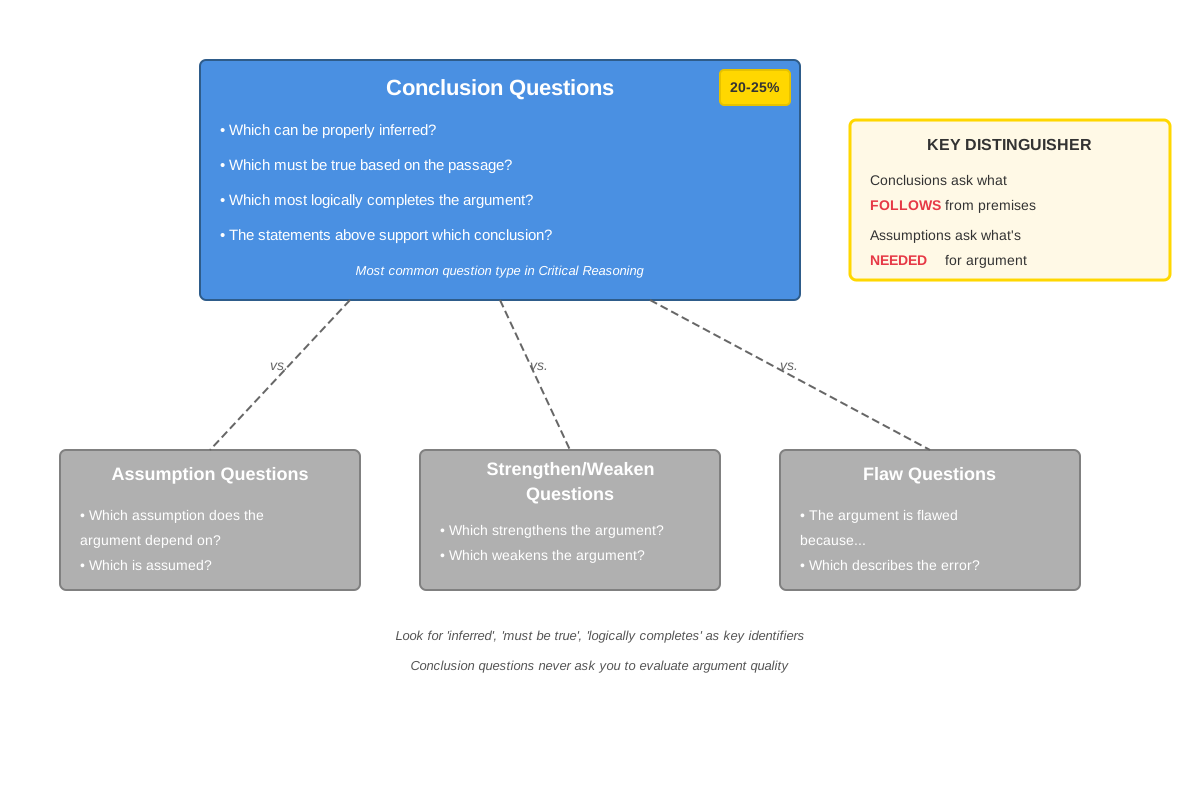
Conclusions questions represent one of the most frequently tested question types in GRE Verbal Reasoning's Critical Reasoning section. These questions assess a test-taker's ability to identify what logically follows from a given set of premises or statements. Unlike assumption questions that ask what must be true for an argument to work, or strengthen/weaken questions that evaluate argument support, conclusion questions require identifying what can be properly inferred or deduced from the information provided. Mastering GRE conclusions questions is essential because they appear in approximately 20-25% of all Critical Reasoning questions and directly test logical reasoning skills that graduate programs value highly.
The fundamental challenge of conclusions questions lies in distinguishing between what must be true based on the passage versus what might be true or seems plausible. Many test-takers struggle because they bring outside knowledge, make unwarranted assumptions, or select answers that go beyond what the passage actually supports. Success requires disciplined, text-based reasoning where every element of the correct answer must be directly supported by or logically derivable from the given information.
Within the broader Verbal Reasoning framework, conclusions questions connect intimately with other Critical Reasoning question types. They share the foundational skill of argument analysis with assumption questions, the evidence evaluation skills tested in strengthen/weaken questions, and the logical structure recognition required for flaw questions. Understanding conclusions thoroughly creates a strong foundation for mastering all Critical Reasoning question types, as the ability to determine what follows logically from given premises underlies virtually all analytical reasoning tasks on the GRE.
Learning Objectives
- [ ] Identify when Conclusions is being tested
- [ ] Explain the core rule or strategy behind Conclusions
- [ ] Apply Conclusions to GRE-style questions accurately
- [ ] Distinguish between valid inferences and statements that go beyond textual support
- [ ] Recognize common wrong answer patterns in conclusions questions
- [ ] Evaluate answer choices systematically using the "must be true" standard
- [ ] Identify conclusion indicator words and structural patterns in passages
Prerequisites
- Basic logical reasoning: Understanding of premises, conclusions, and how arguments are structured is essential for recognizing what information serves as evidence versus what needs to be inferred
- Reading comprehension fundamentals: Ability to parse complex sentences and identify main ideas ensures accurate understanding of the passage before attempting to draw conclusions
- Familiarity with GRE question formats: Knowledge of how Critical Reasoning questions are presented helps distinguish conclusions questions from other question types quickly
Why This Topic Matters
In real-world contexts, the ability to draw valid conclusions from given information is fundamental to academic research, professional decision-making, and everyday problem-solving. Graduate students must constantly evaluate evidence, determine what follows from research findings, and avoid overreaching their data—precisely the skills that conclusions questions assess. Legal professionals, scientists, business analysts, and policy makers all rely on this capacity to distinguish between what evidence actually supports versus what merely seems plausible.
On the GRE specifically, conclusions questions appear with high frequency across both the Verbal Reasoning sections. Test-takers can expect to encounter 2-4 conclusions questions per exam, making them one of the most common Critical Reasoning question types. These questions typically appear in several formats: direct inference questions ("Which of the following can be properly inferred?"), completion questions ("Which of the following most logically completes the passage?"), and "must be true" questions ("If the statements above are true, which of the following must also be true?").
The exam tests conclusions through passages ranging from 3-6 sentences covering diverse topics including scientific research, business scenarios, historical events, and social phenomena. The passages often contain conditional statements, quantitative comparisons, causal relationships, or categorical claims that require careful logical analysis. Understanding how to navigate these various presentation formats while maintaining rigorous logical standards directly impacts overall Verbal Reasoning scores.
Core Concepts
The "Must Be True" Standard
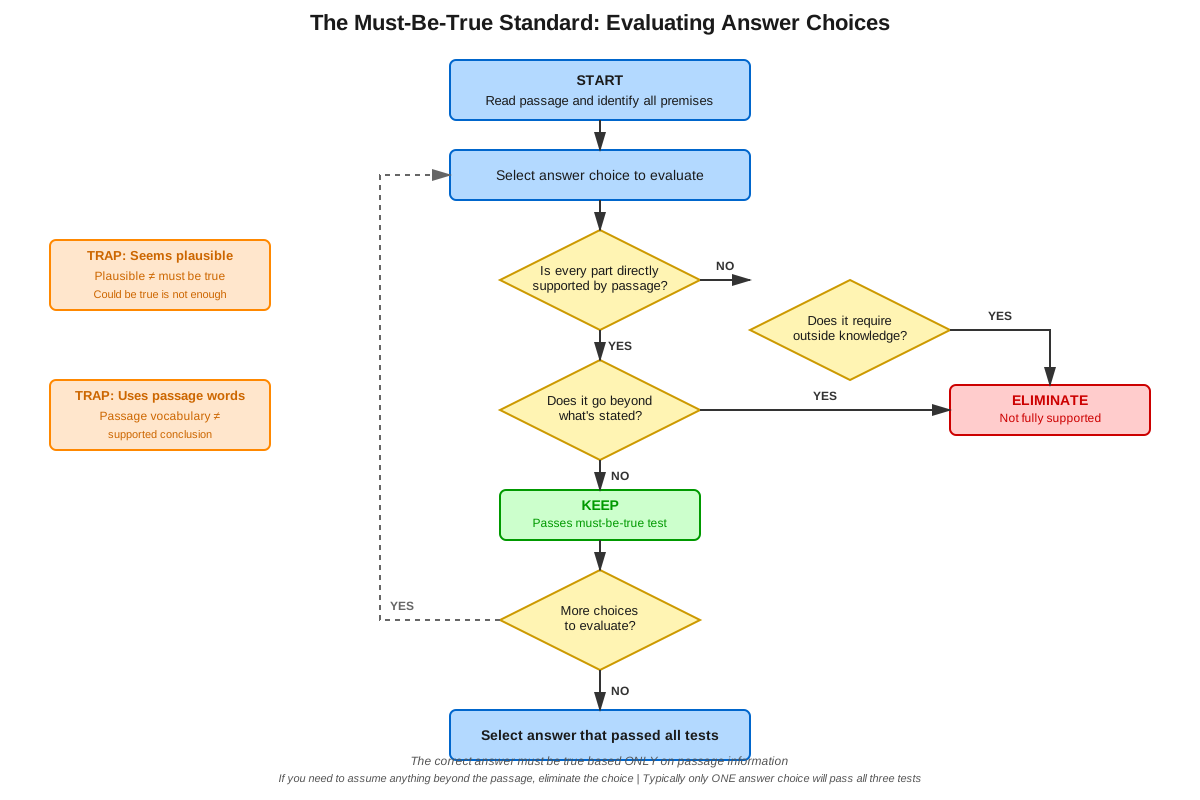
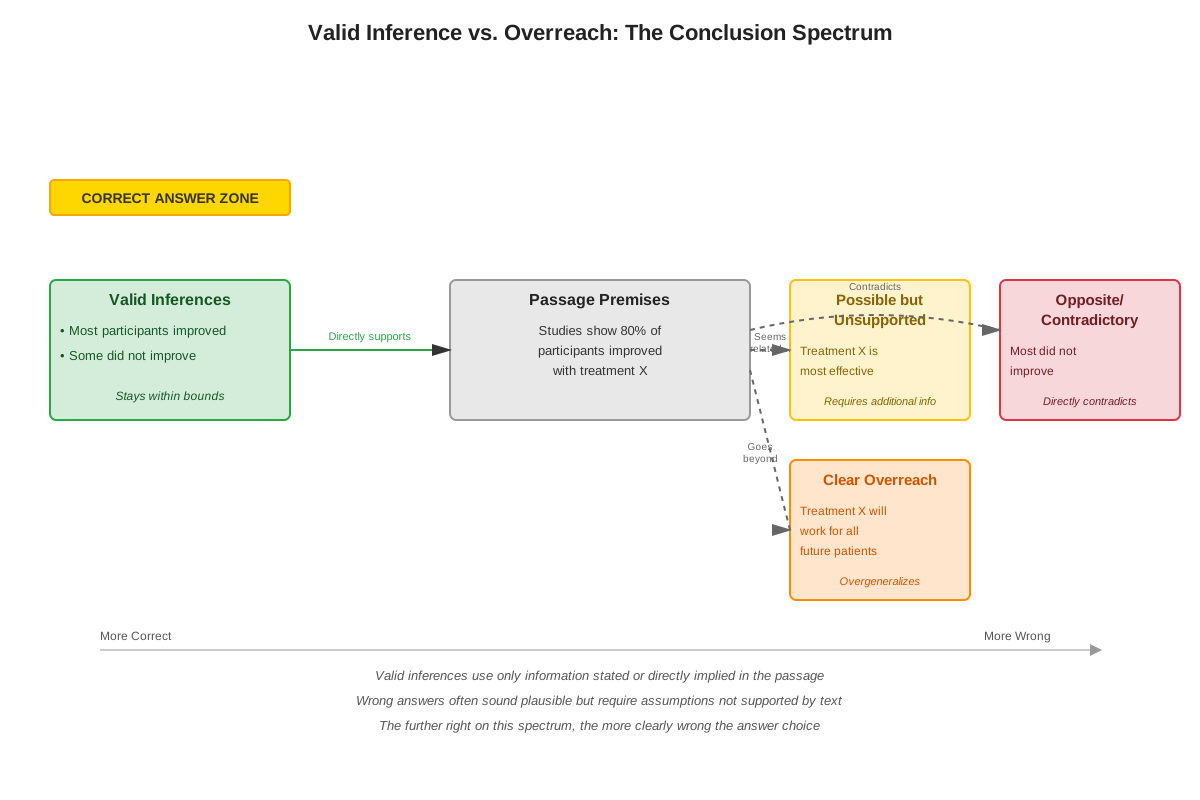
The foundational principle of conclusions questions is the "must be true" standard. A valid conclusion must be necessarily true if all the premises in the passage are accepted as true. This differs fundamentally from "could be true" or "is likely true." The correct answer to a conclusions question cannot require any additional assumptions, outside knowledge, or speculative leaps beyond what the passage explicitly states or directly implies.
Consider this distinction: If a passage states "All graduate students in the program study statistics," and "Maria is a graduate student in the program," then "Maria studies statistics" must be true. However, "Maria enjoys statistics" or "Maria will use statistics in her career" might be true but are not necessary conclusions—they require assumptions about Maria's preferences or future that the passage doesn't support.
Types of Valid Inferences
GRE conclusions questions test several categories of logical inference:
Definitional inferences follow directly from the meaning of terms used. If the passage states "The organism is a mammal," one can validly infer "The organism is warm-blooded" because being warm-blooded is definitional to mammals.
Quantitative inferences derive from numerical or comparative relationships. When a passage states "Company A's revenue exceeds Company B's revenue, and Company B's revenue exceeds Company C's revenue," the valid inference is "Company A's revenue exceeds Company C's revenue."
Conditional inferences follow from if-then relationships. Given "If the temperature drops below freezing, the pipes will burst," and "The temperature dropped below freezing," the necessary conclusion is "The pipes will burst" (modus ponens). Conversely, if "The pipes did not burst," then "The temperature did not drop below freezing" (modus tollens).
Negative inferences derive from what cannot be true given the premises. If a passage states "No students who failed the midterm passed the course," and "James passed the course," then "James did not fail the midterm" must be true.
Conclusion Indicator Language
Recognizing when conclusions are being tested begins with identifying characteristic question stems:
- "Which of the following can be properly inferred from the passage?"
- "If the statements above are true, which of the following must also be true?"
- "The statements above, if true, best support which of the following conclusions?"
- "Which of the following conclusions is best supported by the passage?"
- "The information above most strongly supports which of the following?"
These phrasings signal that the task is identifying what logically follows from given premises rather than evaluating argument structure, identifying assumptions, or strengthening/weakening reasoning.
The Scope Principle
A critical concept in conclusions questions is scope—the range of topics, entities, or claims that the passage actually addresses. Valid conclusions must remain within the passage's scope. If a passage discusses "the effects of sleep deprivation on college students," a conclusion about "the effects of sleep deprivation on all adults" exceeds the scope. Similarly, if premises address correlation, conclusions cannot claim causation without additional support.
Scope violations represent the most common wrong answer type. Test-makers deliberately craft attractive wrong answers that introduce new concepts, expand the population discussed, shift timeframes, or make stronger claims than the evidence supports.
Logical Connectives and Their Implications
Understanding logical relationships is essential for drawing valid conclusions:
| Logical Structure | Example | Valid Inference |
|---|---|---|
| All A are B | All doctors are professionals | If X is a doctor, X is a professional |
| No A are B | No reptiles are mammals | If X is a reptile, X is not a mammal |
| Some A are B | Some students are athletes | At least one student is an athlete |
| If A, then B | If it rains, the game is cancelled | Rain → cancellation (not cancellation → no rain) |
| A only if B | Admission only if test score above 300 | Admission → score above 300 |
The Contrapositive Relationship
A sophisticated inference type frequently tested involves the contrapositive. For any conditional statement "If A, then B," the contrapositive "If not B, then not A" is logically equivalent and always valid. However, the converse "If B, then A" and inverse "If not A, then not B" are not valid inferences.
Example: "If a student receives a scholarship, that student has a GPA above 3.5"
- Valid contrapositive: "If a student does not have a GPA above 3.5, that student did not receive a scholarship"
- Invalid converse: "If a student has a GPA above 3.5, that student received a scholarship"
Concept Relationships
The concepts within conclusions questions form an interconnected logical framework. The "must be true" standard serves as the overarching principle that governs all valid inferences. This standard directly determines which types of valid inferences are acceptable—definitional, quantitative, conditional, and negative inferences all meet the "must be true" test because they follow necessarily from the premises.
The scope principle acts as a constraint on the "must be true" standard, ensuring that conclusions remain bounded by what the passage actually addresses. Scope violations occur when test-takers make valid logical moves but apply them beyond the passage's domain. For instance, a quantitative inference might be logically sound but exceed scope if it extends from a specific population to a general one.
Logical connectives and conditional relationships provide the structural mechanisms through which valid inferences are generated. Understanding these structures enables recognition of contrapositive relationships, which represent a specific application of conditional logic. The relationship flows: Logical connectives → Conditional statements → Contrapositive inferences → Valid conclusions within scope → Meeting the "must be true" standard.
Conclusion indicator language connects to all other concepts by signaling which analytical framework to apply. Recognizing these indicators triggers the application of the "must be true" standard and activates attention to scope boundaries and logical structures.
High-Yield Facts
⭐ The correct answer to a conclusions question must be true if all premises are true—no exceptions or qualifications
⭐ Conclusions questions never require outside knowledge; everything needed is in the passage
⭐ The most common wrong answers exceed the scope of the passage by introducing new concepts or expanding claims
⭐ Conditional statements (if-then) allow inference of the contrapositive but not the converse
⭐ "Some" means "at least one" in formal logic—it does not mean "most" or imply any specific proportion
- "Must be true" is a stronger standard than "could be true" or "likely to be true"
- Correlation statements in premises do not support causal conclusions without additional evidence
- Quantitative comparisons can be chained: if A > B and B > C, then A > C
- Negative statements ("no," "none," "never") generate strong inferences about what cannot be true
- Temporal scope matters: conclusions about the past cannot be drawn from premises only about the present
- The phrase "best supported" still requires the answer to be necessarily true, not merely plausible
- Extreme language in answer choices ("always," "never," "all," "none") is often unsupported unless the passage uses equally extreme language
Quick check — test yourself on Conclusions so far.
Try Flashcards →Common Misconceptions
Misconception: If an answer choice seems reasonable or likely based on common sense, it's probably correct.
Correction: Conclusions questions test logical necessity, not plausibility. The correct answer must be provable from the passage alone, regardless of whether it seems intuitive. Many wrong answers are deliberately designed to sound reasonable while lacking textual support.
Misconception: "Some" means "most" or "many."
Correction: In formal logic, "some" means only "at least one." A statement like "Some birds can fly" is true even if 99% of birds can fly or if only one species can fly. Never infer quantity beyond what "some" minimally requires.
Misconception: If a passage states "If A, then B," you can conclude "If B, then A."
Correction: This confuses a conditional with its converse. Only the contrapositive ("If not B, then not A") is valid. The converse requires additional information not provided by the original conditional.
Misconception: Correlation mentioned in the passage supports causal conclusions.
Correction: Correlation and causation are logically distinct. If a passage states "Students who study more tend to score higher," you cannot conclude "Studying more causes higher scores" without additional evidence ruling out alternative explanations.
Misconception: The correct answer will introduce new, interesting information not explicitly mentioned in the passage.
Correction: Valid conclusions typically feel somewhat redundant or obvious because they must follow directly from stated premises. Answers that introduce genuinely new concepts almost always exceed scope.
Misconception: Longer, more complex answer choices are more likely to be correct.
Correction: Answer length has no correlation with correctness. Test-makers often make wrong answers longer to seem more sophisticated or to hide scope violations in additional clauses.
Misconception: If four answer choices are clearly wrong, the remaining choice must be correct even if it seems imperfect.
Correction: While process of elimination is valuable, the correct answer must still meet the "must be true" standard independently. If no answer seems fully supported, re-read the passage for missed information rather than settling for the "least wrong" option.
Worked Examples
Example 1: Conditional Logic and Contrapositive
Passage: "The university requires all students receiving merit scholarships to maintain a GPA of at least 3.5. Students who fail to maintain this GPA have their scholarships revoked. Jennifer's scholarship was not revoked this semester."
Question: Which of the following can be properly inferred from the passage?
Answer Choices:
A) Jennifer received a merit scholarship
B) Jennifer maintained a GPA of at least 3.5 this semester
C) If Jennifer received a merit scholarship, she maintained a GPA of at least 3.5
D) Jennifer's GPA this semester was higher than last semester
E) Most students maintain the required GPA
Solution Process:
First, identify the logical structure. The passage establishes: "If merit scholarship, then must maintain 3.5 GPA" and "If fail to maintain 3.5 GPA, then scholarship revoked." The contrapositive of the second statement is: "If scholarship not revoked, then maintained 3.5 GPA."
We're told Jennifer's scholarship was not revoked. However, this doesn't tell us whether Jennifer has a merit scholarship at all—she might not have one, in which case the revocation rules don't apply to her.
Evaluating each choice:
Choice A: Unsupported. We know only that her scholarship (if she has one) wasn't revoked. She might not have a merit scholarship.
Choice B: Unsupported for the same reason. If Jennifer doesn't have a merit scholarship, the GPA requirement doesn't apply to her, and we can't infer her actual GPA.
Choice C: This is a conditional statement: "If Jennifer received a merit scholarship, then she maintained a GPA of at least 3.5." This must be true. Why? If Jennifer has a merit scholarship and her scholarship wasn't revoked, then by contrapositive logic, she must have maintained the required GPA. If she didn't have a merit scholarship, the conditional is vacuously true (a conditional with a false antecedent is true). Either way, this statement must be true.
Choice D: Introduces temporal comparison not mentioned in the passage—exceeds scope.
Choice E: Makes a quantitative claim ("most") unsupported by the passage—exceeds scope.
Correct Answer: C
This example demonstrates how conditional logic and contrapositive reasoning generate valid inferences, and how the correct answer must be true regardless of which scenario applies.
Example 2: Scope and Quantitative Reasoning
Passage: "A recent study of 500 adults in urban areas found that those who commuted more than one hour daily reported higher stress levels than those with shorter commutes. The study also found that among long-distance commuters, those who used public transportation reported lower stress levels than those who drove personal vehicles."
Question: If the statements above are true, which of the following must also be true?
Answer Choices:
A) Long commutes cause increased stress in all adults
B) Among the urban adults studied, some who used public transportation for long commutes reported lower stress than some who drove personal vehicles for long commutes
C) Adults in rural areas experience less commute-related stress than urban adults
D) Reducing commute time will reduce stress levels for all workers
E) Public transportation is superior to personal vehicles for stress reduction
Solution Process:
Identify the scope: 500 urban adults in one study. The passage makes comparative claims within this group.
Choice A: Violates scope in multiple ways. First, the study shows correlation, not causation. Second, it extends from "urban adults in the study" to "all adults." Third, it changes "higher stress levels" (comparative) to a claim about causation. Wrong.
Choice B: This carefully remains within scope. The passage states that among long-distance commuters in the study, public transportation users reported lower stress than drivers. This necessarily means at least some public transportation users reported lower stress than at least some drivers. The word "some" appropriately captures the minimum inference supported. This must be true.
Choice C: Introduces rural areas, which are completely outside the passage's scope. Wrong.
Choice D: Makes a causal claim ("will reduce") unsupported by correlational data, and extends to "all workers" beyond the study population. Wrong.
Choice E: Makes a general evaluative claim ("superior") that exceeds what the comparative data supports and extends beyond the specific context of commute-related stress. Wrong.
Correct Answer: B
This example illustrates how scope boundaries eliminate wrong answers and how careful use of quantifiers ("some") allows valid inferences from comparative data.
Exam Strategy
When approaching GRE conclusions questions, implement this systematic process:
Step 1: Identify the question type by reading the question stem first. Look for phrases like "properly inferred," "must be true," "best supported," or "logically follows." This confirms you're applying conclusions methodology rather than assumption or strengthen/weaken strategies.
Step 2: Read the passage carefully and identify the logical structure. Note conditional statements, quantitative comparisons, categorical claims, and scope boundaries. Underline or mentally note key logical connectives ("all," "some," "if," "only if," "no").
Step 3: Predict the scope of valid conclusions before looking at answer choices. Ask yourself: What topics does this passage actually address? What populations or timeframes? What strength of claims does it make?
Step 4: Evaluate each answer choice using the "must be true" test. For each choice, ask: "If everything in the passage is true, must this answer be true?" If you can imagine any scenario where the passage is true but the answer is false, eliminate it.
Step 5: Watch for scope violations. Eliminate answers that:
- Introduce new concepts not mentioned in the passage
- Extend from specific to general populations
- Claim causation when only correlation is established
- Use stronger language than the passage supports
- Make temporal claims beyond the passage's timeframe
Trigger words to watch for in passages:
- Conditional indicators: "if," "when," "whenever," "only if," "provided that," "unless"
- Universal quantifiers: "all," "every," "each," "any," "always"
- Existential quantifiers: "some," "several," "many," "most"
- Negative quantifiers: "no," "none," "never," "not any"
- Comparative terms: "more than," "less than," "higher," "lower," "exceeds"
Time allocation: Spend 60-90 seconds reading and analyzing the passage, then 30-45 seconds evaluating answer choices. If you're stuck between two answers, re-check each against the passage text rather than relying on intuition. Conclusions questions reward careful, methodical analysis over speed.
Process of elimination tips specific to conclusions:
- Eliminate any answer requiring outside knowledge first
- Next, eliminate scope violations (usually 2-3 wrong answers)
- Then eliminate answers that confuse correlation with causation
- Finally, check remaining answers for logical validity using the "must be true" standard
Memory Techniques
SCOPE Mnemonic for evaluating answer choices:
- Stay within passage boundaries
- Causation requires explicit support
- Outside knowledge is never needed
- Premises must fully support the conclusion
- Extreme language needs extreme passage support
"Must Be True = No Way False": When evaluating an answer, flip the test. If you can imagine any scenario where the passage is true but the answer is false, it's wrong. The correct answer has "no way" to be false given true premises.
The Contrapositive Flip: Visualize conditional statements as arrows: "If A → B" means "If not B → not A." When you see "if-then," mentally draw the arrow and its reverse to identify valid inferences.
Quantifier Hierarchy: Remember the strength order:
- Strongest: "All," "Every," "Always," "None," "Never"
- Medium: "Most," "Many," "Usually"
- Weakest: "Some," "Several," "At least one"
Conclusions can move from stronger to weaker quantifiers but never from weaker to stronger without additional support.
The "Boring Answer" Principle: Valid conclusions often feel obvious or redundant because they must follow directly from premises. If an answer seems to add genuinely new, interesting information, it probably exceeds scope. The correct answer is frequently the "boring" one that closely restates or combines passage information.
Summary
Conclusions questions test the ability to identify what must be true given a set of premises, requiring strict adherence to the "must be true" standard without introducing assumptions or outside knowledge. Success depends on recognizing logical structures including conditional statements, quantitative relationships, and categorical claims, then drawing only those inferences that remain within the passage's scope. The most common errors involve selecting answers that exceed scope by introducing new concepts, confusing correlation with causation, or making stronger claims than the evidence supports. Valid inferences include definitional conclusions, quantitative comparisons, conditional relationships and their contrapositives, and negative inferences about what cannot be true. Mastering conclusions questions requires systematic evaluation of answer choices against passage text, careful attention to logical connectives and quantifiers, and disciplined rejection of answers that seem plausible but lack necessary textual support. The correct answer will always be provable from the passage alone and typically feels somewhat obvious or redundant precisely because it follows directly from stated premises.
Key Takeaways
- The "must be true" standard is absolute: correct answers must be necessarily true if all premises are true, with no exceptions
- Scope violations represent the most common wrong answer type—always verify that conclusions remain within passage boundaries
- Conditional statements allow inference of the contrapositive but never the converse without additional support
- "Some" means only "at least one" in formal logic; never infer "most" or any specific proportion
- Correlation in premises does not support causal conclusions without explicit additional evidence
- Valid conclusions often feel obvious or redundant because they follow directly from premises
- Eliminate answers requiring outside knowledge, exceeding scope, or confusing correlation with causation before fine-tuning between remaining choices
Related Topics
Assumptions in Critical Reasoning: While conclusions questions ask what must be true given the premises, assumption questions ask what must be true for the argument to work. Mastering conclusions provides the logical foundation for identifying unstated premises that arguments depend upon.
Strengthen and Weaken Questions: These question types require understanding what would make a conclusion more or less likely to be true. The inference skills developed through conclusions questions directly enable evaluation of evidence that supports or undermines arguments.
Logical Reasoning Flaws: Recognizing valid inferences helps identify invalid ones. Many logical flaws involve drawing conclusions that don't follow from premises—essentially, scope violations and failed "must be true" tests.
Reading Comprehension Inference Questions: The same logical principles governing Critical Reasoning conclusions apply to inference questions in longer Reading Comprehension passages, making conclusions mastery transferable across Verbal Reasoning question types.
Practice CTA
Now that you understand the core principles of conclusions questions, it's time to apply these strategies to actual GRE-style practice questions. Work through the practice set systematically, using the step-by-step approach outlined in the Exam Strategy section. Pay special attention to identifying scope boundaries and testing each answer with the "must be true" standard. Review the flashcards to reinforce key concepts like contrapositive relationships and common scope violations. Remember: conclusions questions reward careful, methodical analysis—every minute spent mastering this high-frequency question type directly improves your Verbal Reasoning score. You've built the foundation; now strengthen it through deliberate practice!
Sign up free to keep reading
Create a free AnvayaPrep account to finish this GRE guide on Conclusions — plus flashcards and practice questions.