Overview
Main conclusion questions represent one of the most frequently tested question types in the GRE Verbal Reasoning section's Critical Reasoning component. These questions assess a test-taker's ability to identify the primary claim or central argument that an author is attempting to establish in a passage. Unlike questions that ask about supporting evidence, assumptions, or logical flaws, main conclusion questions require students to distinguish between the author's ultimate point and the various premises, examples, and subsidiary claims used to support that point.
Understanding GRE main conclusion questions is essential because they test fundamental reading comprehension and analytical reasoning skills that underpin success across the entire Verbal Reasoning section. The ability to identify a main conclusion requires recognizing argument structure, distinguishing between evidence and claims, and understanding how different parts of a passage work together to support a central thesis. This skill directly transfers to Reading Comprehension passages, where identifying the author's primary purpose or main idea follows similar logical principles.
Main conclusion questions typically appear 2-4 times per GRE Verbal section and are considered medium-difficulty questions that separate average scorers from high performers. Mastering this question type provides a significant strategic advantage because these questions, when approached systematically, can be answered with high accuracy and efficiency. The skills developed through practicing main conclusion identification also enhance performance on strengthen/weaken questions, assumption questions, and inference questions—making this topic a cornerstone of Critical Reasoning preparation.
Learning Objectives
- [ ] Identify when Main conclusion questions is being tested
- [ ] Explain the core rule or strategy behind Main conclusion questions
- [ ] Apply Main conclusion questions to GRE-style questions accurately
- [ ] Distinguish between main conclusions and intermediate conclusions within complex arguments
- [ ] Recognize and interpret conclusion indicator words and phrases in various contexts
- [ ] Evaluate answer choices systematically to eliminate premises, evidence, and background information
- [ ] Construct argument maps that visually represent the relationship between premises and conclusions
Prerequisites
- Basic argument structure: Understanding that arguments consist of premises (evidence) and conclusions (claims) is fundamental to identifying which statement represents the main point.
- Reading comprehension fundamentals: The ability to parse complex sentences and identify relationships between ideas enables accurate conclusion identification.
- Logical reasoning vocabulary: Familiarity with terms like "claim," "evidence," "support," and "inference" provides the conceptual framework for analyzing argument structure.
- Sentence relationship recognition: Understanding how sentences connect through cause-effect, contrast, and support relationships helps distinguish conclusions from supporting material.
Why This Topic Matters
Main conclusion questions test a critical thinking skill that extends far beyond standardized testing. In academic settings, professional environments, and everyday decision-making, the ability to identify the central claim someone is making—separate from their supporting evidence—is essential for effective communication, persuasion, and analysis. This skill enables readers to quickly grasp the essence of complex arguments, evaluate the strength of reasoning, and respond appropriately to claims.
On the GRE specifically, main conclusion questions appear with high frequency, typically comprising 15-20% of all Critical Reasoning questions. Each Verbal Reasoning section contains approximately 2-3 main conclusion questions, making them one of the most common question types alongside strengthen/weaken questions. These questions carry the same weight as all other Verbal Reasoning questions, and because they follow predictable patterns, they represent high-yield opportunities for score improvement.
Main conclusion questions appear in several recognizable formats on the exam. The most common question stems include: "Which of the following most accurately expresses the main conclusion of the argument?" "The argument is structured to lead to which of the following conclusions?" and "The claim that [specific statement] plays which of the following roles in the argument?" Understanding these variations and the underlying skill they test ensures consistent performance across all manifestations of this question type.
Core Concepts
Understanding Argument Structure
Every argument presented in GRE Critical Reasoning follows a basic structure: premises (statements offered as evidence or reasons) support a conclusion (the main claim the author wants you to accept). The main conclusion is the ultimate point the author is trying to establish—the "so what?" of the entire argument. All other statements in the argument, regardless of how they're phrased, exist to support this central claim.
Consider this fundamental distinction: premises answer the question "Why should I believe this?" while the conclusion answers "What should I believe?" In well-constructed arguments, premises provide reasons, evidence, examples, or facts, while the conclusion presents the claim that these reasons are meant to establish. The main conclusion is never offered as support for another claim within the argument—it is the final destination of the logical reasoning.
Conclusion Indicators and Premise Indicators
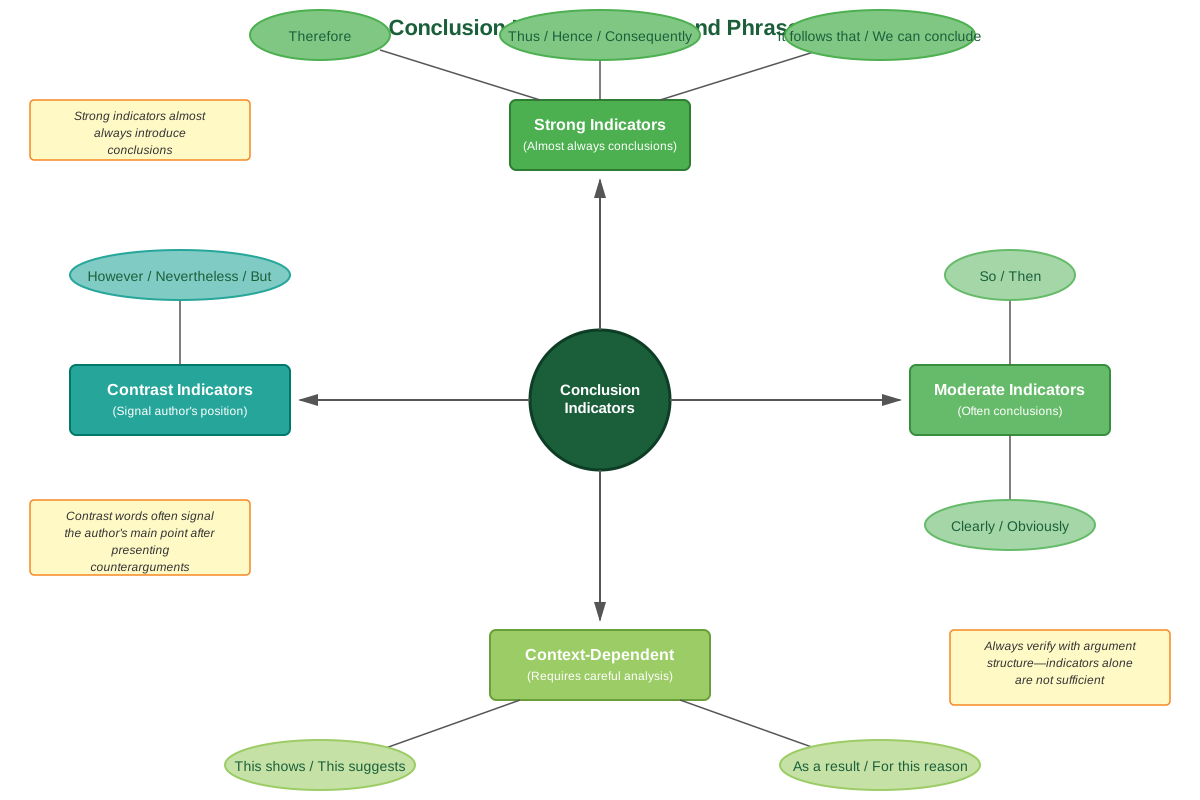
Conclusion indicators are words and phrases that signal a conclusion is about to be stated. Recognizing these indicators dramatically improves accuracy on main conclusion questions. Common conclusion indicators include:
- Therefore
- Thus
- Hence
- Consequently
- So
- It follows that
- This shows that
- This demonstrates that
- This proves that
- We can conclude that
- The point is that
- This means that
Premise indicators, conversely, signal that evidence or support is being provided. These include:
- Because
- Since
- For
- Given that
- As indicated by
- The reason is that
- For the reason that
- May be inferred from
- As shown by
- In light of
Understanding these indicators helps quickly map argument structure, though it's crucial to note that not all arguments use explicit indicators, and some complex arguments may contain multiple indicator words.
Main Conclusions vs. Intermediate Conclusions
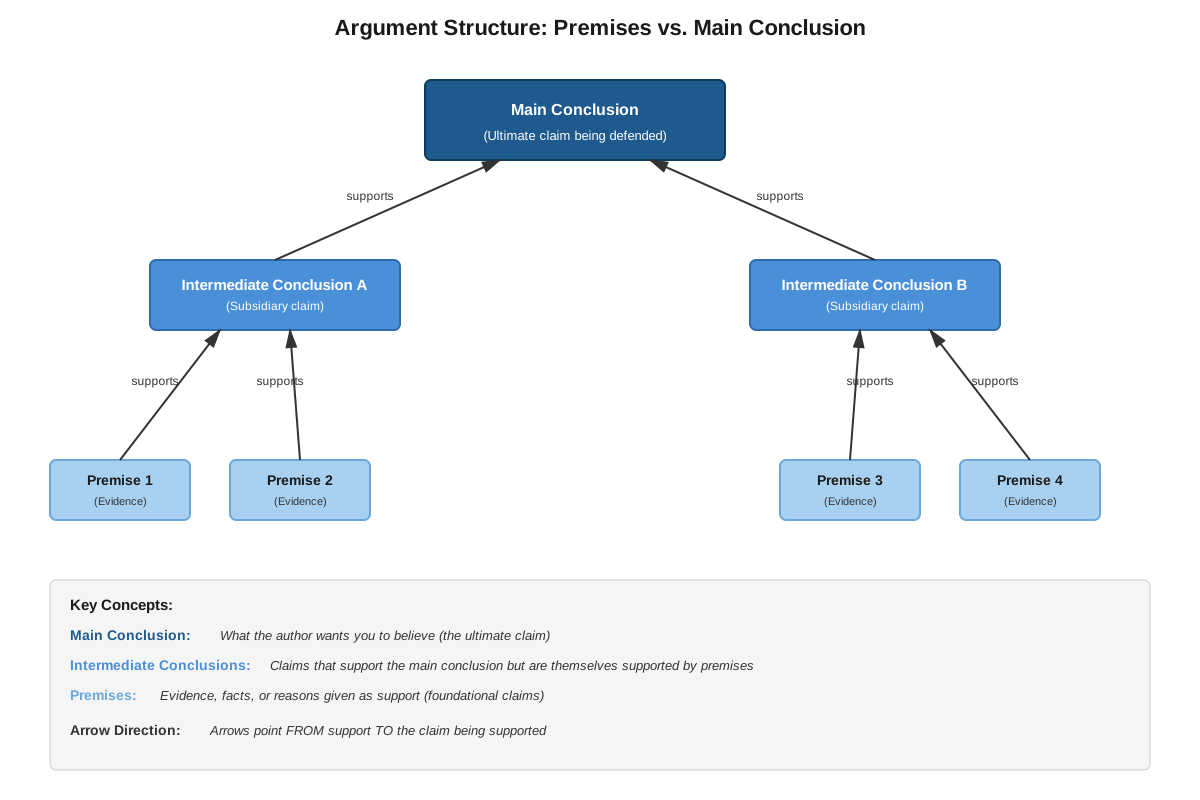
Complex arguments often contain intermediate conclusions (also called subsidiary conclusions)—claims that are supported by some premises but themselves serve as premises for the main conclusion. This creates a chain of reasoning: Evidence → Intermediate Conclusion → Main Conclusion.
For example: "Studies show that regular exercise reduces stress hormones (premise). Therefore, exercise improves mental health (intermediate conclusion). Consequently, employers should provide gym memberships to employees (main conclusion)."
The intermediate conclusion is both supported by evidence AND supports another claim. The main conclusion is supported but supports nothing else—it's the ultimate point. On the GRE, wrong answer choices frequently present intermediate conclusions as if they were main conclusions, making this distinction critical.
The "Therefore Test"
A reliable strategy for identifying main conclusions is the "Therefore Test": mentally place "therefore" before each statement in the argument and ask whether the other statements support it. The statement that is best supported by all other statements, without itself supporting anything else, is the main conclusion.
This test works because conclusions are, by definition, the claims that follow from the evidence. If you can say "All these other statements, therefore [this statement]" and it makes logical sense, you've likely identified the conclusion.
Structural Positions of Conclusions
Contrary to what many students assume, main conclusions do NOT always appear at the end of arguments. On the GRE, conclusions appear in various positions:
| Position | Frequency | Example Structure |
|---|---|---|
| End | 40% | Premise. Premise. Therefore, conclusion. |
| Beginning | 30% | Conclusion. This is because premise. Premise. |
| Middle | 20% | Premise. Therefore, conclusion. Additional premise supports this. |
| Implied | 10% | Premises only; conclusion must be inferred |
This distribution means students must analyze argument structure rather than simply selecting the last sentence as the conclusion.
Background Information vs. Conclusion
Arguments often begin with context or background information—statements that set the stage but are neither premises nor conclusions. For example: "The pharmaceutical industry has grown rapidly over the past decade" might introduce an argument without being part of the logical structure. Distinguishing background from conclusions requires asking: "Is this statement being argued for, or is it just providing context?"
Background information is typically presented as accepted fact, doesn't require support, and isn't supported by other statements in the argument. Conclusions, by contrast, are claims the author is actively trying to establish through reasoning.
Concept Relationships
The concepts within main conclusion questions form an interconnected hierarchy. At the foundation lies argument structure recognition—the ability to identify that arguments consist of premises and conclusions. This foundational skill enables indicator word recognition, which serves as a shortcut for mapping argument structure quickly. Both of these skills feed into the ability to distinguish main from intermediate conclusions, which represents a more sophisticated level of analysis.
The relationship flows as follows:
Argument Structure Recognition → Indicator Word Identification → Premise/Conclusion Distinction → Main vs. Intermediate Conclusion Differentiation → Accurate Answer Selection
This topic connects directly to prerequisite knowledge of basic reading comprehension, as understanding sentence relationships and paragraph structure provides the foundation for analyzing argument structure. Main conclusion identification also serves as a prerequisite for more advanced Critical Reasoning question types: strengthen/weaken questions require knowing what claim you're strengthening or weakening, assumption questions ask what's needed to support the conclusion, and evaluation questions ask what information would help assess the conclusion's validity.
The "Therefore Test" and structural position awareness work together synergistically—when indicator words are absent or ambiguous, structural analysis becomes essential, and vice versa. Understanding that conclusions can appear anywhere in an argument prevents over-reliance on position-based shortcuts and forces deeper structural analysis.
High-Yield Facts
⭐ The main conclusion is the claim that all other statements in the argument work to support; it never serves as evidence for another claim within the same argument.
⭐ Conclusion indicators (therefore, thus, hence, consequently) signal that a conclusion follows, but their presence doesn't guarantee the statement is the MAIN conclusion—it could be intermediate.
⭐ Main conclusions appear in the final sentence only about 40% of the time on the GRE; they frequently appear at the beginning or middle of arguments.
⭐ The "Therefore Test" is the most reliable method: the statement that makes sense when all other statements are placed before it with "therefore" is the main conclusion.
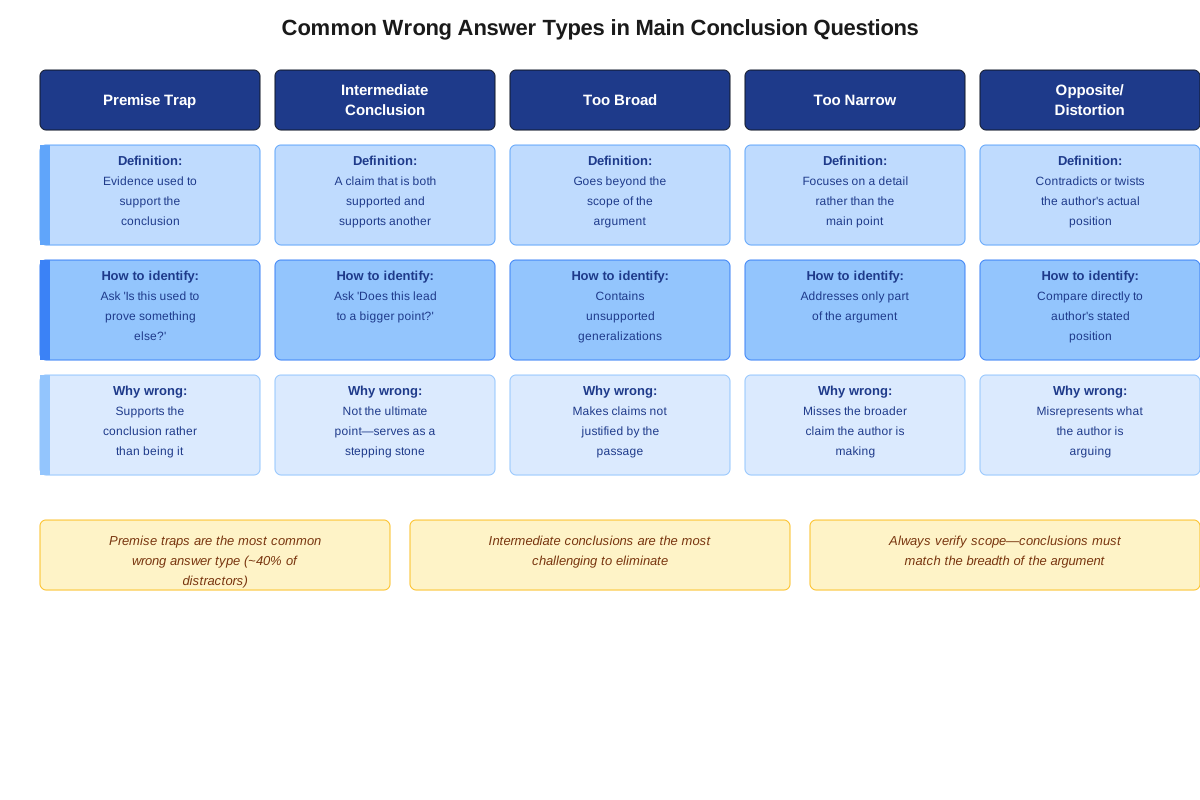
⭐ Wrong answer choices in main conclusion questions typically include premises, intermediate conclusions, or background information—rarely completely unrelated statements.
- Premise indicators (because, since, for) signal that evidence is being provided, helping identify what is NOT the conclusion.
- Intermediate conclusions are both supported by evidence AND support the main conclusion, creating a chain of reasoning.
- Some arguments present the conclusion first, then provide supporting evidence—this structure is common in persuasive writing.
- Background information or context statements are neither premises nor conclusions; they set the stage without participating in the logical structure.
- Complex arguments may contain multiple premises supporting a single conclusion, or multiple premises supporting intermediate conclusions that support the main conclusion.
- The main conclusion answers "What is the author trying to convince me of?" while premises answer "Why should I believe it?"
- Rephrasing or paraphrasing the conclusion is common in answer choices—the correct answer may not use the exact wording from the passage.
Quick check — test yourself on Main conclusion questions so far.
Try Flashcards →Common Misconceptions
Misconception: The main conclusion is always the last sentence of the argument.
Correction: Main conclusions appear in various positions—beginning, middle, or end. Approximately 60% of GRE arguments place the conclusion somewhere other than the final sentence. Always analyze the logical structure rather than relying on position.
Misconception: Any statement with "therefore" or "thus" is automatically the main conclusion.
Correction: Conclusion indicators signal that a conclusion follows, but that conclusion might be intermediate rather than main. Some arguments contain multiple "therefore" statements, with only one representing the ultimate point. Always apply the Therefore Test to verify which conclusion is supported by all other statements.
Misconception: The longest or most complex sentence is usually the main conclusion.
Correction: Sentence length and complexity have no correlation with whether a statement is the main conclusion. Premises often contain detailed evidence, statistics, or examples that make them longer than the conclusion. Focus on logical function, not sentence structure.
Misconception: If a statement seems important or interesting, it must be the conclusion.
Correction: Premises often contain striking facts, surprising statistics, or compelling examples that draw attention. The main conclusion might be a relatively straightforward claim supported by these interesting premises. Importance and interest don't determine logical function.
Misconception: Every argument has only one conclusion.
Correction: While every argument has only one MAIN conclusion, complex arguments often contain intermediate conclusions that serve as stepping stones in the reasoning. The main conclusion is distinguished by being the ultimate point that is supported but doesn't support anything else.
Misconception: The main conclusion must be explicitly stated in the passage.
Correction: While most GRE arguments explicitly state their main conclusion, some require inference. In these cases, the conclusion is the claim that logically follows from all the stated premises, even if not directly articulated.
Worked Examples
Example 1: Standard Structure with Conclusion at End
Passage: "Recent studies have shown that employees who work from home report 25% higher job satisfaction than those who work in traditional offices. Additionally, remote workers demonstrate 15% higher productivity on measurable tasks. Companies that have implemented remote work policies have also seen a 30% reduction in employee turnover. Therefore, businesses seeking to improve both employee satisfaction and company performance should adopt flexible remote work policies."
Question: Which of the following most accurately expresses the main conclusion of the argument?
Answer Choices:
(A) Remote workers are more productive than office workers.
(B) Employee turnover is reduced when companies allow remote work.
(C) Businesses should adopt flexible remote work policies to improve satisfaction and performance.
(D) Studies show that remote work has multiple benefits.
(E) Job satisfaction is higher among remote workers than office workers.
Analysis:
Step 1: Identify conclusion indicators. The word "Therefore" appears before the final sentence, signaling a conclusion.
Step 2: Apply the Therefore Test. Can we say: "Studies show higher satisfaction, productivity, and lower turnover, THEREFORE businesses should adopt remote work policies"? Yes—this makes logical sense. The statistics support the recommendation.
Step 3: Test other statements. Can we say: "Businesses should adopt remote work policies, THEREFORE remote workers are more productive"? No—this reverses the logical flow. The productivity statistic supports the recommendation, not vice versa.
Step 4: Evaluate answer choices:
- (A) is a premise—evidence supporting the conclusion
- (B) is a premise—another piece of supporting evidence
- (C) matches the conclusion identified through the Therefore Test
- (D) is too vague and describes the premises generally rather than stating the specific conclusion
- (E) is a premise—the first piece of evidence provided
Correct Answer: (C)
Connection to Learning Objectives: This example demonstrates identifying when main conclusion questions are being tested (the question stem asks for "the main conclusion"), applying the core strategy (the Therefore Test), and accurately selecting the answer that represents the ultimate claim rather than supporting evidence.
Example 2: Conclusion at Beginning with Intermediate Conclusion
Passage: "Urban planners should prioritize the development of public parks in low-income neighborhoods. Research indicates that access to green spaces reduces stress and improves mental health outcomes. Since mental health issues disproportionately affect low-income communities due to various socioeconomic stressors, these neighborhoods would benefit most from park development. Furthermore, property values in areas surrounding new parks typically increase by 10-15%, which could help revitalize economically disadvantaged areas."
Question: The claim that mental health issues disproportionately affect low-income communities plays which of the following roles in the argument?
Answer Choices:
(A) It is the main conclusion of the argument.
(B) It is an intermediate conclusion that supports the main conclusion.
(C) It is a premise that directly supports the main conclusion.
(D) It is background information that provides context.
(E) It is an assumption upon which the argument depends.
Analysis:
Step 1: Identify the main conclusion. The first sentence states what "should" happen—a recommendation. Testing with Therefore: "Green spaces improve mental health, mental health issues affect low-income communities disproportionately, and property values increase, THEREFORE urban planners should prioritize parks in low-income neighborhoods." This works logically.
Step 2: Analyze the target claim. "Mental health issues disproportionately affect low-income communities" is introduced with "Since," a premise indicator. However, it's supported by the previous sentence about green spaces reducing stress. This makes it an intermediate conclusion: it's supported by evidence (green spaces help mental health) AND it supports another claim (therefore these neighborhoods need parks most).
Step 3: Map the argument structure:
- Premise: Green spaces reduce stress and improve mental health
- Intermediate Conclusion: Mental health issues disproportionately affect low-income communities (introduced with "Since" but supported by the previous premise)
- Additional Premise: Property values increase near parks
- Main Conclusion: Urban planners should prioritize parks in low-income neighborhoods
Step 4: Evaluate answer choices:
- (A) is incorrect—this is not the ultimate point
- (B) is correct—it's both supported by evidence and supports the main conclusion
- (C) is incorrect—it's not a direct premise; it's itself a conclusion drawn from evidence
- (D) is incorrect—it's not just context; it plays an active role in the reasoning
- (E) is incorrect—it's explicitly stated, not assumed
Correct Answer: (B)
Connection to Learning Objectives: This example demonstrates the ability to distinguish between main and intermediate conclusions, recognize that indicator words don't always signal main conclusions, and understand complex argument structures where claims serve dual roles.
Exam Strategy
When approaching main conclusion questions on the GRE, follow this systematic process:
Step 1: Identify the question type (5 seconds). Look for trigger phrases: "main conclusion," "main point," "argument is structured to lead to," or "role in the argument." This identification tells you to focus on argument structure rather than content evaluation.
Step 2: Read actively for structure (30-45 seconds). As you read the passage, mark or mentally note:
- Conclusion indicators (therefore, thus, hence)
- Premise indicators (because, since, for)
- Opinion words (should, must, ought to, likely)
- Factual statements vs. claims
Step 3: Apply the Therefore Test (15 seconds). Mentally construct: "[All other statements], therefore [candidate conclusion]." The statement that is best supported by everything else, without supporting anything else, is the main conclusion.
Step 4: Predict the answer (10 seconds). Before looking at choices, articulate the main conclusion in your own words. This prevents answer choices from influencing your analysis.
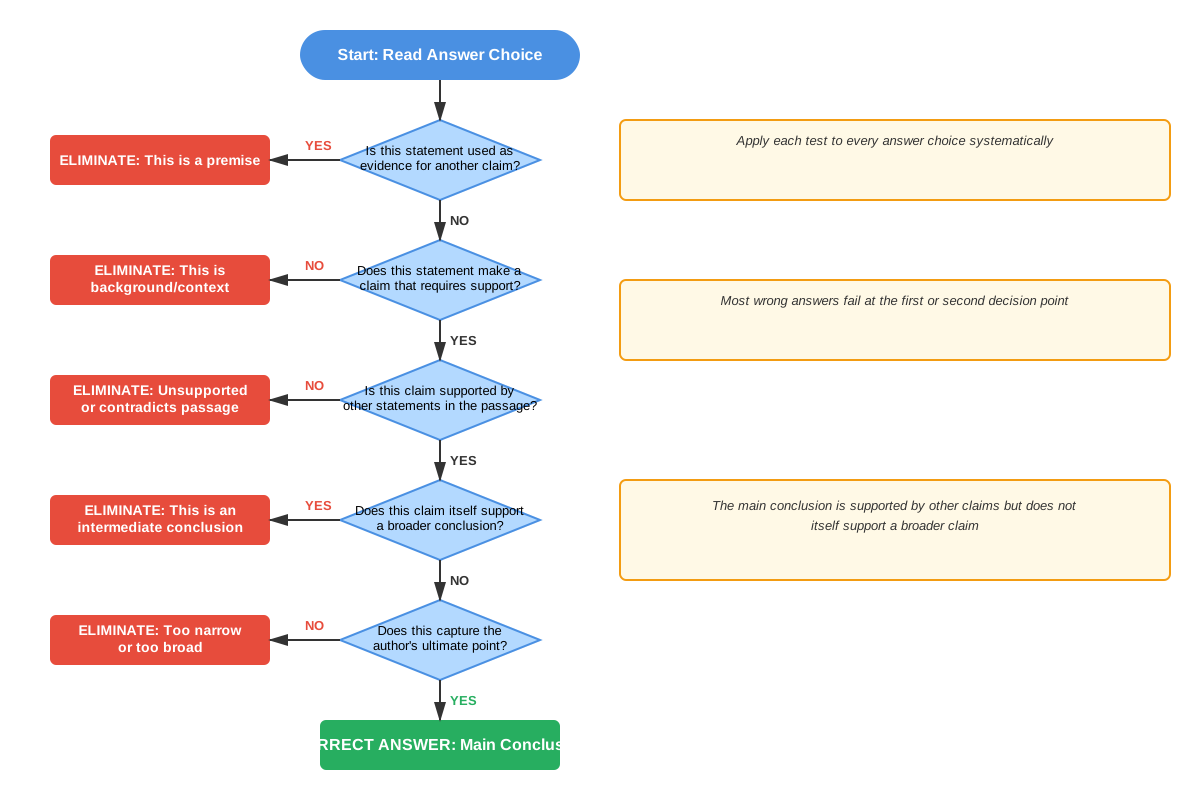
Step 5: Eliminate systematically (20-30 seconds):
- Eliminate premises (statements that provide evidence or reasons)
- Eliminate background information (context that isn't argued for)
- Eliminate intermediate conclusions (claims that support another claim)
- Eliminate statements not present in the argument
Exam Tip: If two answer choices seem equally valid, one is likely the main conclusion and the other is an intermediate conclusion. Ask: "Which one is the ultimate point, and which one serves as a stepping stone to that point?"
Time allocation: Spend approximately 90 seconds total on main conclusion questions. They should be among your faster questions because they follow predictable patterns and don't require outside knowledge or complex logical evaluation.
Trigger words to watch for in question stems:
- "Main conclusion"
- "Main point"
- "Primary conclusion"
- "Argument is structured to lead to"
- "Role in the argument" (when asking about a specific claim)
- "Most accurately expresses the conclusion"
Red flags in answer choices:
- Choices that are too specific (often premises with detailed evidence)
- Choices that are too broad (often background or context)
- Choices that introduce new information not in the passage
- Choices that reverse the logical relationship (making premises into conclusions)
Memory Techniques
TIPS Acronym for Main Conclusion Identification:
- Therefore Test: Apply "therefore" before each statement
- Indicators: Look for conclusion and premise indicators
- Position: Don't assume conclusions are always last
- Support: The conclusion is supported by everything else but supports nothing
Visualization Strategy: Picture the argument as a pyramid. Premises are the base blocks, intermediate conclusions are middle blocks, and the main conclusion is the capstone at the top. Everything below supports what's above, and the top supports nothing—it's the ultimate point.
Indicator Word Mnemonic:
"The CATS" for conclusion indicators:
- Therefore
- Consequently
- Accordingly
- Thus
- So
"Best Friends" for premise indicators:
- Because
- For
- Since
Role Reversal Technique: When stuck between two answer choices, try reversing them: "If A were the conclusion, would B support it? If B were the conclusion, would A support it?" The correct relationship reveals the true conclusion.
The "So What?" Question: After reading the argument, ask "So what is the author's ultimate point?" The answer to this question, stripped of supporting details, is the main conclusion.
Summary
Main conclusion questions test the fundamental skill of identifying the central claim an argument is designed to establish. Success requires understanding that arguments consist of premises (evidence) supporting conclusions (claims), with the main conclusion being the ultimate point that is supported by all other statements but supports nothing else within the argument. The most reliable identification strategy is the Therefore Test: the statement that makes logical sense when all other statements precede it with "therefore" is the main conclusion. Students must recognize that conclusions appear in various structural positions—beginning, middle, or end—and that conclusion indicators like "therefore" and "thus" may signal intermediate rather than main conclusions. Effective answer selection requires systematically eliminating premises, background information, and intermediate conclusions while recognizing that correct answers may paraphrase rather than quote the conclusion directly. Mastering this question type provides a foundation for all other Critical Reasoning questions and represents a high-yield opportunity for score improvement given the predictable patterns and systematic approach that ensures consistent accuracy.
Key Takeaways
- The main conclusion is the ultimate claim supported by all other statements in the argument; it never serves as evidence for another claim within the same argument.
- The Therefore Test is the most reliable identification method: place "therefore" before each statement and determine which one is best supported by all others.
- Main conclusions appear in various positions (beginning, middle, or end) in approximately equal distribution; never assume the last sentence is automatically the conclusion.
- Conclusion indicators (therefore, thus, hence) signal conclusions but don't guarantee they're the MAIN conclusion—always verify by checking whether the statement supports anything else.
- Wrong answers typically include premises (evidence), intermediate conclusions (claims that both receive and provide support), or background information (context that isn't argued for).
- Intermediate conclusions are distinguished from main conclusions by serving dual roles: they're supported by some premises and support the main conclusion.
- Systematic elimination of premises and background information before evaluating remaining choices dramatically improves accuracy and efficiency.
Related Topics
Assumption Questions: After mastering main conclusion identification, assumption questions become more accessible because they ask what unstated premise is necessary for the conclusion to follow logically. Understanding what the conclusion is enables accurate identification of what must be true for that conclusion to be valid.
Strengthen and Weaken Questions: These questions require identifying the main conclusion first, then evaluating which answer choice makes that conclusion more or less likely to be true. Main conclusion identification is a prerequisite skill for these question types.
Argument Structure Questions: These questions ask about the role specific statements play in arguments—whether they're premises, conclusions, counterarguments, or examples. The skills developed through main conclusion practice directly transfer to these more complex structural analysis questions.
Inference Questions: While inference questions ask what must be true based on the passage rather than identifying stated conclusions, the logical reasoning skills developed through main conclusion practice enhance inference accuracy.
Practice CTA
Now that you've mastered the core concepts and strategies for main conclusion questions, it's time to apply this knowledge to authentic GRE-style practice questions. The systematic approach you've learned—identifying indicators, applying the Therefore Test, and eliminating wrong answer types—will become automatic through deliberate practice. Challenge yourself with the practice questions and flashcards to reinforce these high-yield concepts. Remember: main conclusion questions are among the most predictable and learnable question types on the GRE, making them an excellent opportunity to build confidence and improve your score. Each practice question you complete strengthens your pattern recognition and speeds up your analysis, bringing you closer to your target score.
Sign up free to keep reading
Create a free AnvayaPrep account to finish this GRE guide on Main conclusion questions — plus flashcards and practice questions.