Overview
Resolve the paradox questions represent a distinctive and frequently tested question type within GRE Verbal Reasoning's Critical Reasoning section. These questions present students with an apparent contradiction, inconsistency, or surprising result within a short passage, then ask them to identify which answer choice best explains, reconciles, or resolves the seeming conflict. Unlike strengthen or weaken questions that ask students to support or undermine an argument, paradox questions require identifying information that makes two seemingly incompatible facts logically compatible.
The ability to resolve the paradox is essential for GRE success because it tests multiple cognitive skills simultaneously: reading comprehension, logical reasoning, pattern recognition, and the capacity to think beyond surface-level contradictions. These questions typically appear 1-3 times per Verbal Reasoning section and are considered medium-to-high difficulty because they require students to hold multiple pieces of information in working memory while evaluating how new information might bridge the logical gap between them. Students who master this question type demonstrate sophisticated analytical thinking—the ability to see that what appears contradictory often simply requires additional context or a missing piece of information.
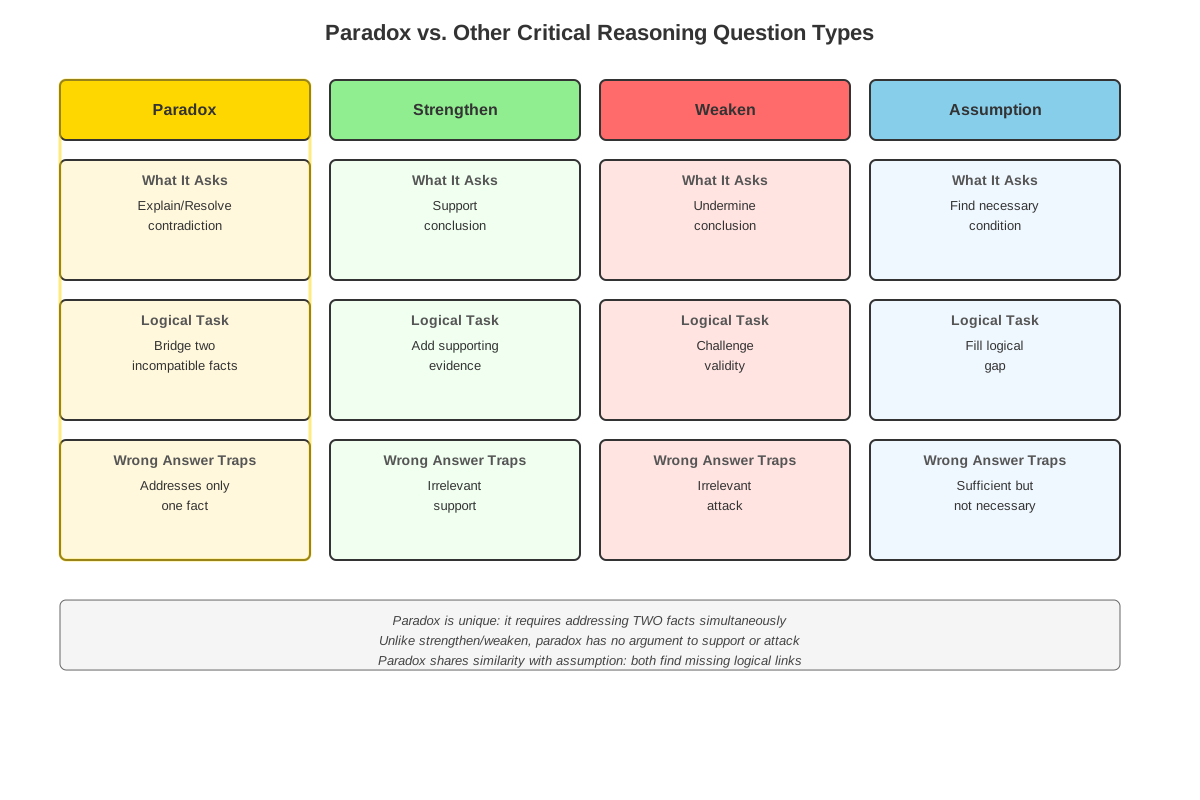
Within the broader landscape of Verbal Reasoning, GRE resolve the paradox questions occupy a unique position. They share DNA with assumption questions (both involve identifying missing logical links) and strengthen questions (both require finding supporting information), yet they differ fundamentally in purpose. While assumption questions seek necessary conditions for an argument's validity and strengthen questions seek evidence that makes a conclusion more likely, paradox questions seek explanatory information that transforms apparent contradiction into logical coherence. Mastering this question type builds critical thinking skills applicable across all Critical Reasoning question types and enhances overall performance on complex reading comprehension passages.
Learning Objectives
- [ ] Identify when Resolve the paradox is being tested
- [ ] Explain the core rule or strategy behind Resolve the paradox
- [ ] Apply Resolve the paradox to GRE-style questions accurately
- [ ] Distinguish paradox questions from strengthen, weaken, and assumption questions
- [ ] Recognize the structural components of a paradox (the two conflicting elements)
- [ ] Evaluate answer choices systematically using the "addresses both sides" criterion
- [ ] Eliminate answer choices that explain only one side of the paradox or introduce irrelevant information
Prerequisites
- Basic logical reasoning skills: Understanding cause-and-effect relationships and conditional logic is essential for evaluating how new information might reconcile conflicting facts
- Argument structure recognition: Students must identify premises, conclusions, and evidence within short passages to locate the paradoxical elements
- Reading comprehension fundamentals: The ability to extract main ideas and supporting details quickly enables efficient identification of the contradiction
- Familiarity with Critical Reasoning question types: Understanding the broader landscape of CR questions helps students recognize the unique demands of paradox questions
Why This Topic Matters
In real-world contexts, the ability to resolve apparent contradictions is fundamental to scientific thinking, business analysis, and everyday problem-solving. When research findings seem to conflict, when market data appears inconsistent, or when personal observations don't align with expectations, the skill of identifying explanatory factors becomes invaluable. This cognitive ability—seeking the missing piece that makes seemingly incompatible information coherent—distinguishes sophisticated thinkers from those who simply accept surface-level contradictions as mysteries.
On the GRE specifically, paradox questions appear with notable frequency. Test-takers can expect to encounter 1-3 such questions per Verbal Reasoning section, making them a high-yield study focus. These questions typically carry the same weight as other Critical Reasoning questions but often prove more challenging because they require a different cognitive approach than the more common strengthen/weaken question types. According to test preparation data, students who specifically practice paradox questions improve their overall Verbal Reasoning scores by an average of 2-3 points, as the skills transfer to other question types.
Paradox questions commonly appear in passages discussing business trends (e.g., "Despite increased advertising spending, sales declined"), scientific phenomena (e.g., "Although the treatment was effective in trials, patient outcomes worsened"), social patterns (e.g., "Even as education levels rose, literacy rates fell"), or economic situations (e.g., "While unemployment decreased, consumer spending dropped"). The GRE favors paradoxes that require domain-general reasoning rather than specialized knowledge, ensuring that the test measures analytical ability rather than content expertise.
Core Concepts
What Constitutes a Paradox
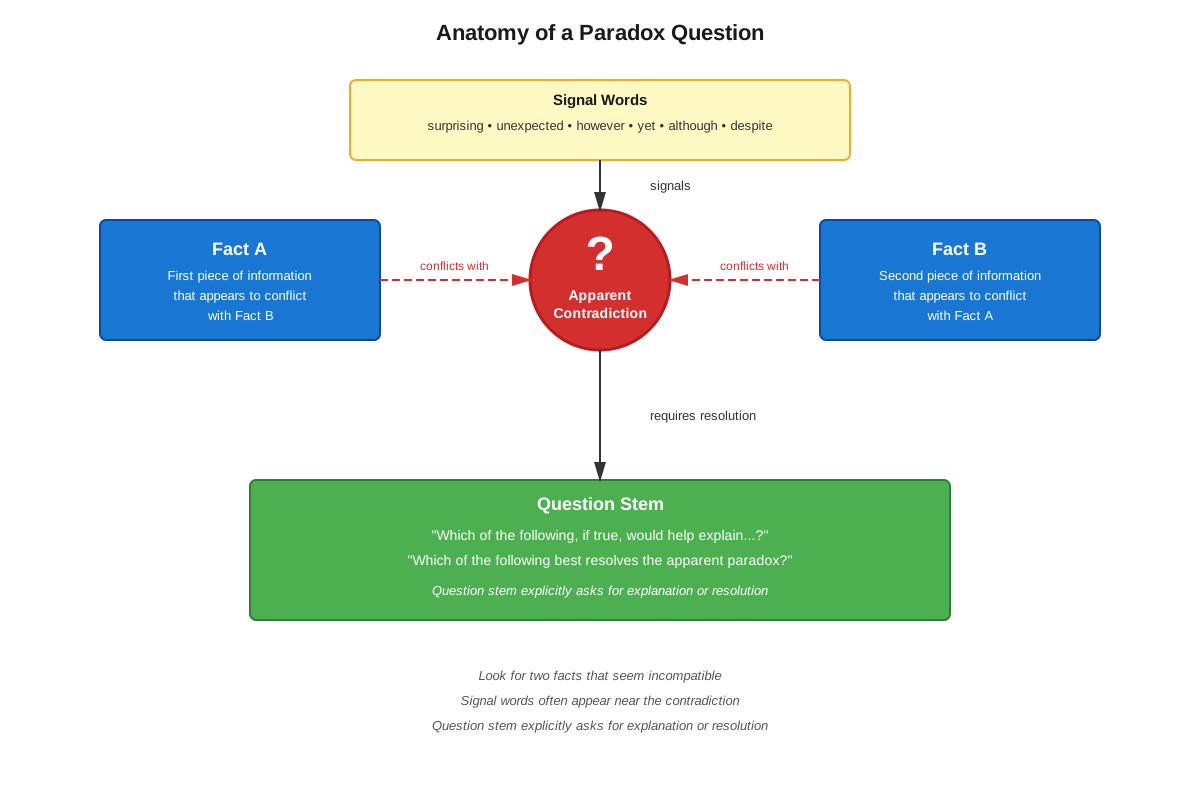
A paradox in GRE Critical Reasoning is not a true logical impossibility but rather an apparent contradiction—a situation where two facts, observations, or outcomes seem incompatible based on common expectations or typical patterns. The passage presents Fact A and Fact B, which appear to conflict because our normal understanding suggests that if A is true, B should not be true (or vice versa). The key word here is "apparent": the contradiction exists only because we lack a crucial piece of information that would explain how both facts can coexist.
For example, consider: "Restaurant X raised its prices by 30%, yet customer traffic increased significantly." This seems paradoxical because we typically expect higher prices to reduce demand. However, the contradiction is only apparent—perhaps the price increase signaled higher quality, or perhaps competitors closed, or perhaps the restaurant relocated to a better area. The paradox exists in the gap between expectation and reality.
The Two-Part Structure
Every paradox question contains two essential components that students must identify:
- The Expected Outcome or Normal Pattern: What we would typically anticipate given certain conditions
- The Actual Outcome or Surprising Result: What actually happened, which contradicts the expectation
Recognizing this structure is crucial because the correct answer must address BOTH components. A common trap in wrong answer choices is providing information that explains only one side of the paradox while ignoring the other. Students should physically mark or mentally note these two components when reading the passage.
| Component | Characteristics | Example |
|---|---|---|
| Expected Pattern | Based on common sense, typical causation, or stated conditions | "Higher prices typically reduce demand" |
| Surprising Result | The actual outcome that contradicts the expectation | "Yet demand increased" |
| The Gap | The missing explanation that reconciles both | "What factor makes both facts compatible?" |
The Resolution Mechanism
To resolve the paradox, an answer choice must provide information that explains how both seemingly contradictory facts can be simultaneously true. The resolution typically works through one of several mechanisms:
Mechanism 1: Introducing a Confounding Variable - A third factor affects the situation in a way that explains the unexpected outcome. Example: "The price increase coincided with a major competitor going out of business."
Mechanism 2: Revealing a Hidden Distinction - The two facts apply to different subgroups, time periods, or contexts. Example: "While overall prices increased 30%, prices for the most popular items actually decreased."
Mechanism 3: Clarifying Causation - The relationship between the facts is different than initially assumed. Example: "The restaurant raised prices because customer traffic had already begun increasing due to positive reviews."
Mechanism 4: Providing Missing Context - Additional background information changes the interpretation. Example: "The 30% price increase brought prices in line with competitors who had always charged more."
Question Stem Recognition
Paradox questions use distinctive language that signals their unique purpose. Students should train themselves to recognize these trigger phrases:
- "Which of the following, if true, most helps to explain the surprising result?"
- "Which of the following, if true, most helps to resolve the apparent discrepancy?"
- "Which of the following, if true, best reconciles the seemingly contradictory findings?"
- "Which of the following most helps to account for the unexpected outcome?"
- "Which of the following, if true, contributes most to an explanation of the paradox?"
The key words—explain, resolve, reconcile, account for—all indicate that the question seeks explanatory information rather than supporting or undermining evidence. Unlike strengthen questions that ask what makes a conclusion more likely true, paradox questions ask what makes an apparent contradiction understandable.
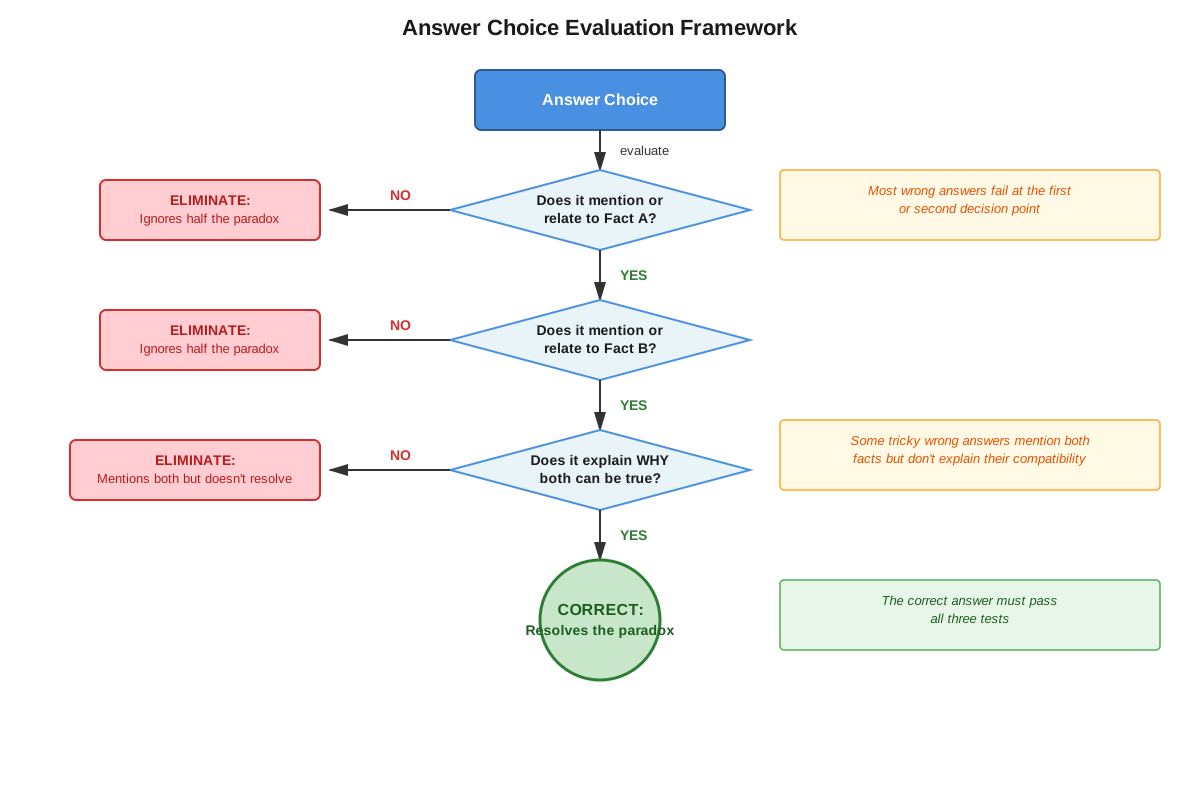
The "Addresses Both Sides" Test
The most powerful evaluation criterion for paradox questions is asking: "Does this answer choice address BOTH sides of the paradox?" The correct answer must acknowledge and incorporate both the expected pattern and the surprising result. Wrong answers typically fall into these categories:
- One-sided explanations: Address only the surprising result without acknowledging why it's surprising
- Irrelevant information: Provide facts that don't connect to either side of the paradox
- Strengtheners/Weakeners: Support or undermine one fact rather than explaining how both coexist
- Partial explanations: Move toward resolution but don't fully bridge the gap
When evaluating answer choices, students should mentally insert each option into the passage and ask: "If this were true, would I still find the situation paradoxical?" If the answer is yes, the choice doesn't resolve the paradox.
Common Paradox Patterns on the GRE
Certain paradox structures appear repeatedly on the GRE:
- Effort vs. Outcome: Increased effort/investment produces decreased results
- Correlation vs. Expectation: Two variables move in unexpected directions relative to each other
- Intention vs. Effect: Actions designed to produce one outcome produce the opposite
- Temporal Paradox: Conditions improve/worsen while related metrics move oppositely
- Comparative Paradox: Similar entities produce different outcomes under similar conditions
Recognizing these patterns helps students quickly identify the paradoxical elements and anticipate what type of resolution might work.
Concept Relationships
The skill of resolving paradoxes connects intimately with other Critical Reasoning question types through a web of logical relationships. Paradox questions share foundational elements with assumption questions—both require identifying missing information that bridges logical gaps. However, while assumption questions seek necessary conditions for an argument's validity, paradox questions seek sufficient explanatory information for reconciling apparent contradictions.
The relationship flows as follows: Argument Structure Recognition → enables → Identifying Premises and Conclusions → which supports → Recognizing Gaps in Logic → which manifests differently in → Assumption Questions (finding necessary conditions) versus Paradox Questions (finding explanatory factors) versus Strengthen/Weaken Questions (finding supporting/undermining evidence).
Paradox resolution also connects to inference questions through the skill of drawing logical conclusions from given information. When students resolve a paradox, they're essentially inferring what must be true to make the situation coherent. Additionally, the careful reading required for paradox questions strengthens performance on reading comprehension passages, particularly those presenting competing viewpoints or unexpected research findings.
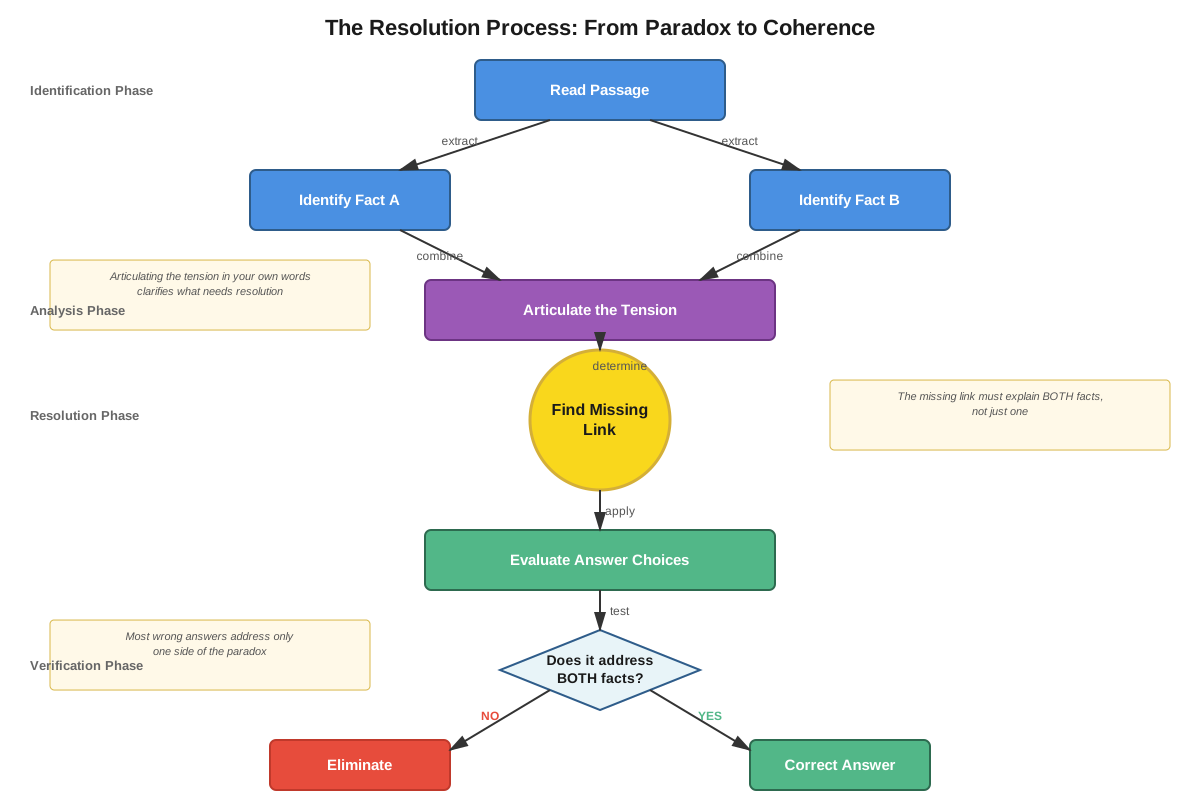
Within the paradox question type itself, concepts build hierarchically: Recognizing Question Stems → enables → Identifying the Two-Part Structure → which allows → Applying the "Addresses Both Sides" Test → which facilitates → Systematic Answer Choice Elimination → ultimately leading to → Selecting the Correct Resolution.
High-Yield Facts
⭐ Paradox questions ask for explanatory information that reconciles apparent contradictions, not evidence that strengthens or weakens an argument
⭐ The correct answer must address BOTH sides of the paradox—the expected pattern and the surprising result
⭐ Common question stem triggers include "explain," "resolve," "reconcile," "account for," and "explain the discrepancy"
⭐ Wrong answers often explain only one side of the paradox while ignoring the other side
⭐ The paradox is "apparent," not actual—there's always a logical explanation that makes both facts compatible
- Paradox questions typically appear 1-3 times per Verbal Reasoning section on the GRE
- The resolution often involves introducing a confounding variable, revealing a hidden distinction, clarifying causation, or providing missing context
- Students should physically identify and mark the two conflicting elements before reading answer choices
- Unlike assumption questions, paradox resolutions don't need to be "necessary"—they just need to provide a plausible explanation
⭐ Time-efficient strategy: eliminate answers that address only one side before carefully evaluating remaining choices
- Paradox passages are typically shorter (2-4 sentences) than other Critical Reasoning passages
- The correct answer often introduces new information not mentioned in the passage—this is expected and appropriate
- Paradoxes frequently involve business trends, scientific findings, social patterns, or economic data
- Students should avoid bringing outside knowledge to "resolve" the paradox—the answer must come from the choices provided
- Practice identifying paradoxes in real-world contexts (news articles, research summaries) to strengthen recognition skills
Quick check — test yourself on Resolve the paradox so far.
Try Flashcards →Common Misconceptions
Misconception: Paradox questions are asking which answer choice is most likely to be true in the real world → Correction: Paradox questions ask which answer choice, if true, would best explain the apparent contradiction. All answer choices should be evaluated as if they are true; the question is which one resolves the paradox most effectively.
Misconception: The correct answer must prove that no contradiction exists → Correction: The correct answer need only provide a plausible explanation that makes both facts logically compatible. It doesn't need to eliminate all possible doubt or prove definitively that the situation makes sense.
Misconception: Paradox questions are the same as strengthen questions → Correction: Strengthen questions ask for evidence that makes a conclusion more likely true, while paradox questions ask for information that explains how two seemingly incompatible facts can coexist. Strengthen questions support an argument; paradox questions explain a situation.
Misconception: The correct answer will always introduce completely new information → Correction: While the correct answer often introduces new factors, it might also clarify, specify, or provide context for information already mentioned in the passage. The key is whether it bridges the logical gap, not whether it's entirely novel.
Misconception: If an answer choice addresses the surprising result, it resolves the paradox → Correction: An answer choice must address BOTH the expected pattern and the surprising result. Simply explaining why the surprising result occurred, without acknowledging why it's surprising given the circumstances, doesn't resolve the paradox.
Misconception: Longer, more detailed answer choices are more likely to be correct → Correction: Answer choice length has no correlation with correctness in paradox questions. The correct answer might be concise and direct, while wrong answers might include irrelevant details that make them longer without making them more explanatory.
Misconception: The paradox must involve a logical impossibility → Correction: GRE paradoxes involve apparent contradictions based on violated expectations, not true logical impossibilities. The situation is surprising or counterintuitive, not actually impossible.
Worked Examples
Example 1: Business Paradox
Passage: "TechStart Inc. implemented a generous work-from-home policy, allowing employees to work remotely up to four days per week. Despite predictions that this flexibility would improve employee satisfaction, the company's annual employee satisfaction survey showed a significant decline in satisfaction scores compared to the previous year."
Question: Which of the following, if true, most helps to explain the unexpected survey results?
Answer Choices:
(A) Employees who work from home more than three days per week report feeling disconnected from company culture and isolated from colleagues
(B) TechStart Inc.'s competitors have implemented even more generous remote work policies
(C) The company's revenue increased by 15% during the year the new policy was implemented
(D) Many employees had requested work-from-home options in previous satisfaction surveys
(E) The annual satisfaction survey had a higher response rate than in previous years
Step 1: Identify the Two-Part Structure
- Expected Pattern: Generous work-from-home policy → improved employee satisfaction
- Surprising Result: Employee satisfaction actually declined
Step 2: Apply the "Addresses Both Sides" Test
(A) ADDRESSES BOTH SIDES - Acknowledges that the policy provided flexibility (expected to improve satisfaction) but explains that it created isolation and disconnection (explaining why satisfaction declined instead). This bridges the gap perfectly.
(B) Addresses only one side - This might explain why satisfaction didn't improve as much as hoped, but doesn't explain why it actually declined. Employees could still be more satisfied than before even if competitors offer more.
(C) Irrelevant - Revenue increase doesn't connect to the satisfaction paradox. Employees could be dissatisfied regardless of company financial performance.
(D) One-sided - This explains why the policy was expected to improve satisfaction but doesn't explain why it failed to do so or why satisfaction declined.
(E) Potentially misleading - Higher response rate might change the sample, but this doesn't explain the actual decline in satisfaction among respondents. It's a methodological point, not an explanation of the paradox.
Correct Answer: (A)
Connection to Learning Objectives: This example demonstrates how to identify the paradox structure (expected improvement vs. actual decline), apply systematic evaluation (the "addresses both sides" test), and eliminate answers that explain only one component or introduce irrelevant information.
Example 2: Scientific Paradox
Passage: "Researchers studying the effectiveness of a new diabetes medication found that patients who took the medication as prescribed showed significant improvement in blood sugar control. However, when the medication was made available to the general public, population-level diabetes outcomes did not improve and, in some regions, actually worsened."
Question: Which of the following, if true, best reconciles the seemingly contradictory findings?
Answer Choices:
(A) The medication was more expensive than previous diabetes treatments
(B) Patients in the research study received intensive monitoring and support that is not typically available in standard clinical practice
(C) The medication had fewer side effects than earlier diabetes treatments
(D) Diabetes rates have been increasing in the general population over the past decade
(E) The research study included patients with various stages of diabetes severity
Step 1: Identify the Paradox
- Expected Pattern: Medication effective in trials → should improve population outcomes
- Surprising Result: Population outcomes didn't improve or worsened
Step 2: Evaluate Each Choice
(A) Addresses cost but doesn't explain the paradox - Even if expensive, the medication should still improve outcomes for those who take it. This doesn't explain why population outcomes worsened.
(B) ADDRESSES BOTH SIDES - Explains why the medication worked in trials (intensive support) and why it didn't translate to population improvement (that support isn't available in real-world settings). The medication's effectiveness was partially due to factors beyond the medication itself.
(C) One-sided - Fewer side effects would make the medication more likely to improve population outcomes, not less likely. This deepens rather than resolves the paradox.
(D) Provides context but doesn't resolve the paradox - Rising diabetes rates might explain why outcomes didn't improve as much as hoped, but doesn't explain why they worsened in some regions despite an effective medication becoming available.
(E) Irrelevant to the paradox - The diversity of the study population would typically make results more generalizable, not less. This doesn't explain the trial-to-population gap.
Correct Answer: (B)
Connection to Learning Objectives: This example illustrates a common GRE paradox pattern (trial success vs. real-world failure) and demonstrates how the correct answer introduces a confounding variable (the intensive support) that explains both why the trial succeeded and why population outcomes didn't improve.
Exam Strategy
Systematic Approach to Paradox Questions
Step 1: Recognize the Question Type (5-10 seconds)
Scan the question stem for trigger words: "explain," "resolve," "reconcile," "account for." Once identified as a paradox question, shift into the appropriate mental framework—you're looking for explanatory information, not supporting evidence.
Step 2: Identify and Mark the Paradox (15-20 seconds)
Read the passage carefully and physically mark or mentally note:
- The expected pattern or normal outcome (often signaled by words like "typically," "usually," "expected," "predicted")
- The surprising result (often signaled by "however," "yet," "despite," "although," "surprisingly")
Exam Tip: Use your scratch paper to write "Expected:" and "Actual:" with brief notes. This external memory aid prevents confusion when evaluating answer choices.
Step 3: Predict the Resolution Type (5-10 seconds)
Before reading answer choices, briefly consider what type of information would bridge the gap. Is this likely a confounding variable situation? A hidden distinction? A causation clarification? This prediction helps you recognize the correct answer more quickly.
Step 4: Eliminate One-Sided Answers (20-30 seconds)
Quickly eliminate answer choices that:
- Address only the expected pattern without explaining the surprising result
- Address only the surprising result without acknowledging why it's surprising
- Introduce completely irrelevant information
- Deepen the paradox rather than resolve it
This typically eliminates 2-3 answer choices immediately.
Step 5: Apply the "Addresses Both Sides" Test (20-30 seconds)
For remaining choices, mentally insert each into the passage and ask: "If this were true, would both facts make sense together?" The correct answer should make you think, "Ah, that explains it!"
Trigger Words and Phrases
In Question Stems:
- "explain the surprising result"
- "resolve the apparent discrepancy/contradiction/paradox"
- "reconcile the findings"
- "account for the unexpected outcome"
- "help explain why"
In Passages (Signaling the Paradox):
- "However," "Yet," "Nevertheless," "Nonetheless" (introducing the surprising result)
- "Despite," "Although," "Even though" (contrasting expected and actual)
- "Surprisingly," "Unexpectedly," "Paradoxically" (explicitly flagging the contradiction)
- "Predicted," "Expected," "Anticipated" (establishing the expected pattern)
Time Allocation
Paradox questions should take approximately 60-90 seconds total:
- 15-20 seconds: Reading and understanding the passage
- 10-15 seconds: Identifying the paradox structure
- 30-45 seconds: Evaluating answer choices
- 5-10 seconds: Final verification
If you find yourself spending more than 90 seconds, you may be overthinking. Trust the "addresses both sides" test and move forward.
Process of Elimination Tips
Eliminate answers that:
- Simply restate information from the passage without adding explanatory value
- Strengthen one side of the paradox (making it more extreme) rather than explaining it
- Introduce new paradoxes or complications
- Require multiple additional assumptions to work as explanations
- Focus on methodology or measurement rather than substance (unless the paradox is explicitly about measurement)
Keep answers that:
- Introduce a third factor that affects the situation
- Reveal a distinction between groups, time periods, or contexts
- Clarify the causal relationship between the facts
- Provide context that changes interpretation
Memory Techniques
The BOTH Acronym
Bridge the gap between facts
Outcome and expectation must both be addressed
Third factor often provides the explanation
How do both facts coexist? Ask this question
Visualization Strategy
Picture the paradox as two puzzle pieces that don't seem to fit together. The correct answer is the missing piece that connects them. When evaluating answer choices, visualize whether each choice creates that connection or just describes one of the existing pieces.
The "Surprise Test" Mnemonic
Spot the surprising result
Understand the expected pattern
Recognize both must be addressed
Predict what might explain it
Reject one-sided answers
Insert remaining choices mentally
Select the one that eliminates surprise
Explanation, not evidence, is the goal
The Two-Column Technique
When practicing, create two columns on your scratch paper:
Expected          |  Actual
------------------|------------------
[Normal pattern]  |  [Surprising result]
Then evaluate each answer choice by asking: "Does this connect both columns?"
Paradox Pattern Recognition Rhyme
"When effort rises but results fall down,
Or success appears where failure's found,
Look for the factor that's not been told,
That makes both facts fit in the fold."
This rhyme helps remember that paradoxes involve violated expectations and that resolution requires new information.
Summary
Resolve the paradox questions test the ability to identify and explain apparent contradictions within GRE Critical Reasoning passages. These questions present two facts that seem incompatible based on normal expectations or typical patterns, then ask test-takers to select the answer choice that best explains how both facts can be simultaneously true. Success requires recognizing the two-part structure of every paradox—the expected pattern and the surprising result—and systematically evaluating answer choices using the "addresses both sides" criterion. The correct answer must acknowledge both components of the paradox and provide information that bridges the logical gap between them, typically through introducing a confounding variable, revealing a hidden distinction, clarifying causation, or providing missing context. Unlike strengthen or weaken questions that seek supporting or undermining evidence, paradox questions seek explanatory information that transforms apparent contradiction into logical coherence. Mastery involves recognizing distinctive question stem language, efficiently identifying the paradoxical elements, eliminating one-sided or irrelevant answer choices, and selecting the option that makes both facts understandable within a coherent framework.
Key Takeaways
- Paradox questions ask for explanations, not evidence—the goal is to reconcile apparent contradictions, not to prove or disprove arguments
- The correct answer must address BOTH the expected pattern and the surprising result—this is the single most important evaluation criterion
- Recognize trigger words in question stems ("explain," "resolve," "reconcile," "account for") to identify paradox questions quickly
- Eliminate one-sided answers first—choices that explain only one component of the paradox cannot be correct
- The paradox is apparent, not actual—there's always a logical explanation that makes both facts compatible
- Common resolution mechanisms include confounding variables, hidden distinctions, causation clarification, and missing context
- Time management is crucial—spend 60-90 seconds per question, using systematic evaluation rather than prolonged deliberation
Related Topics
Assumption Questions: These questions also involve identifying missing logical links, but seek necessary conditions for argument validity rather than explanatory factors for apparent contradictions. Mastering paradox questions builds skills directly applicable to assumption questions.
Strengthen and Weaken Questions: Understanding how to resolve paradoxes enhances the ability to evaluate evidence in strengthen/weaken questions, as both require assessing how new information affects logical relationships.
Inference Questions: The skill of drawing logical conclusions from given information, developed through paradox practice, transfers directly to inference questions where test-takers must determine what must be true based on passage content.
Reading Comprehension - Competing Viewpoints: Complex RC passages often present seemingly contradictory research findings or opposing theories. The analytical skills developed through paradox questions help students navigate these passages more effectively.
Causal Reasoning: Many paradoxes involve violated causal expectations. Studying paradox resolution deepens understanding of causation, correlation, and confounding variables—concepts that appear throughout Verbal Reasoning.
Practice CTA
Now that you've mastered the core concepts and strategies for resolve the paradox questions, it's time to put your knowledge into action. Work through the practice questions systematically, applying the "addresses both sides" test and the elimination strategies you've learned. Use the flashcards to reinforce trigger words and common paradox patterns until recognition becomes automatic. Remember: paradox questions are highly learnable—consistent practice with these specific strategies typically yields rapid improvement. Each practice question you complete strengthens your pattern recognition and builds the confidence needed to tackle these questions efficiently on test day. You've got this!
Sign up free to keep reading
Create a free AnvayaPrep account to finish this GRE guide on Resolve the paradox — plus flashcards and practice questions.