Overview
GRE critical reasoning pacing is one of the most underestimated yet crucial skills for achieving a competitive Verbal Reasoning score. While many test-takers focus exclusively on content mastery—learning to identify assumptions, strengthen arguments, or spot logical flaws—they often neglect the strategic time management required to execute these skills under exam pressure. The GRE Verbal Reasoning section presents 20 questions across two sections, with approximately 30 minutes per section. Within this constrained timeframe, critical reasoning questions demand not only analytical precision but also disciplined pacing to ensure every question receives adequate attention without sacrificing accuracy for speed.
Effective pacing in critical reasoning goes beyond simply watching the clock. It involves recognizing question types instantly, allocating appropriate time based on difficulty and question format, knowing when to skip and return to challenging items, and maintaining cognitive stamina throughout the section. Students who master gre critical reasoning pacing develop an internal rhythm that allows them to work efficiently through straightforward questions while reserving mental resources for more complex reasoning tasks. This strategic approach prevents the common pitfall of spending excessive time on a single difficult question at the expense of easier points later in the section.
Understanding critical reasoning pacing is essential because it directly impacts performance across all Verbal Reasoning question types. Reading comprehension, text completion, and sentence equivalence questions all benefit from the time management principles established through critical reasoning practice. Moreover, the analytical skills required for critical reasoning—identifying conclusions, evaluating evidence, and recognizing logical structures—form the foundation for approaching the entire Verbal section strategically. Students who develop strong pacing habits in critical reasoning naturally transfer these skills to other question types, creating a comprehensive approach to time management that maximizes their overall Verbal Reasoning score.
Learning Objectives
- [ ] Identify when GRE critical reasoning pacing is being tested
- [ ] Explain the core rule or strategy behind GRE critical reasoning pacing
- [ ] Apply GRE critical reasoning pacing to GRE-style questions accurately
- [ ] Determine optimal time allocation for different critical reasoning question types
- [ ] Recognize warning signs of pacing problems during practice and actual test conditions
- [ ] Implement recovery strategies when falling behind the target pace
- [ ] Develop a personalized pacing plan based on individual strengths and weaknesses
Prerequisites
- Basic understanding of GRE Verbal Reasoning structure: Knowledge of section timing, question distribution, and scoring methodology provides the foundation for developing effective pacing strategies
- Familiarity with critical reasoning question types: Recognizing strengthen, weaken, assumption, inference, and evaluation questions enables quick categorization and appropriate time allocation
- Fundamental logical reasoning skills: Understanding arguments, premises, and conclusions allows students to work efficiently rather than struggling with basic comprehension
- Experience with timed practice: Previous exposure to working under time constraints helps students assess their baseline pacing and identify areas requiring improvement
Why This Topic Matters
Critical reasoning pacing directly influences GRE performance in ways that extend far beyond simply finishing the section on time. Research on standardized testing consistently demonstrates that students who manage time effectively score significantly higher than equally knowledgeable peers who struggle with pacing. The psychological impact of time pressure can impair decision-making, increase anxiety, and lead to careless errors even on questions within a student's capability range. Conversely, students who develop confident pacing strategies experience reduced test anxiety, maintain better focus throughout the section, and make more accurate judgments about when to invest additional time versus when to make an educated guess and move forward.
On the GRE Verbal Reasoning section, critical reasoning questions typically appear interspersed with reading comprehension and vocabulary-based questions. While the exact number varies due to the adaptive nature of the test, students can expect approximately 4-6 critical reasoning questions per 20-question section. These questions often require 60-90 seconds each for optimal performance, though this varies based on argument complexity and question type. The adaptive algorithm means that pacing problems early in a section can cascade into more significant issues, as students may face more difficult questions while already behind schedule. Understanding gre gre critical reasoning pacing enables test-takers to maintain consistent performance regardless of question difficulty or position within the section.
Critical reasoning pacing challenges manifest in several common patterns on the GRE. Students frequently encounter dense, multi-sentence arguments that require careful reading and analysis, creating temptation to re-read multiple times. Question stems may contain complex instructions requiring precise interpretation. Answer choices often include subtle distinctions that demand thoughtful evaluation. Additionally, the computer-based format prevents skimming ahead to gauge upcoming question difficulty, making real-time pacing decisions more challenging. Students who master pacing strategies learn to navigate these challenges systematically, maintaining efficiency without sacrificing the careful analysis that critical reasoning questions demand.
Core Concepts
The Time Budget Framework
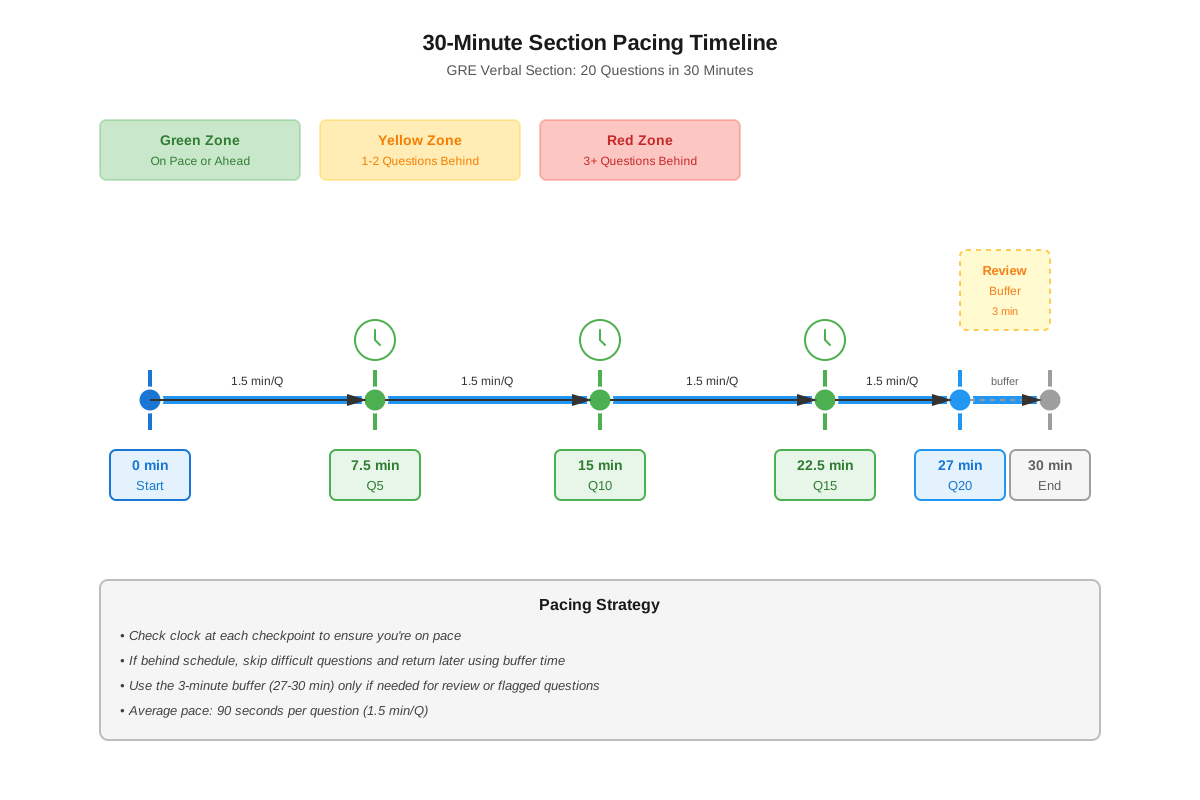
The foundation of effective gre critical reasoning pacing begins with establishing a clear time budget for the entire Verbal Reasoning section. With approximately 30 minutes for 20 questions, students have an average of 90 seconds per question. However, this average masks significant variation in optimal time allocation. Reading comprehension passages with multiple questions require upfront time investment in passage reading, while critical reasoning questions demand focused analysis of shorter arguments. A strategic time budget allocates approximately 60-75 seconds for straightforward critical reasoning questions, 90-120 seconds for complex reasoning tasks, and reserves 2-3 minutes as a buffer for unexpected challenges or final review.
Creating a personalized time budget requires honest assessment of individual strengths and weaknesses. Students who excel at quickly identifying argument structures may complete some critical reasoning questions in 45-60 seconds, creating additional time for challenging reading comprehension passages. Conversely, students who struggle with formal logic may need to allocate extra time for assumption and inference questions while working more quickly through strengthen/weaken questions. The key principle is intentional allocation rather than reactive time management—deciding in advance how to distribute available time rather than discovering too late that time has been exhausted.
Question Type Recognition and Time Allocation
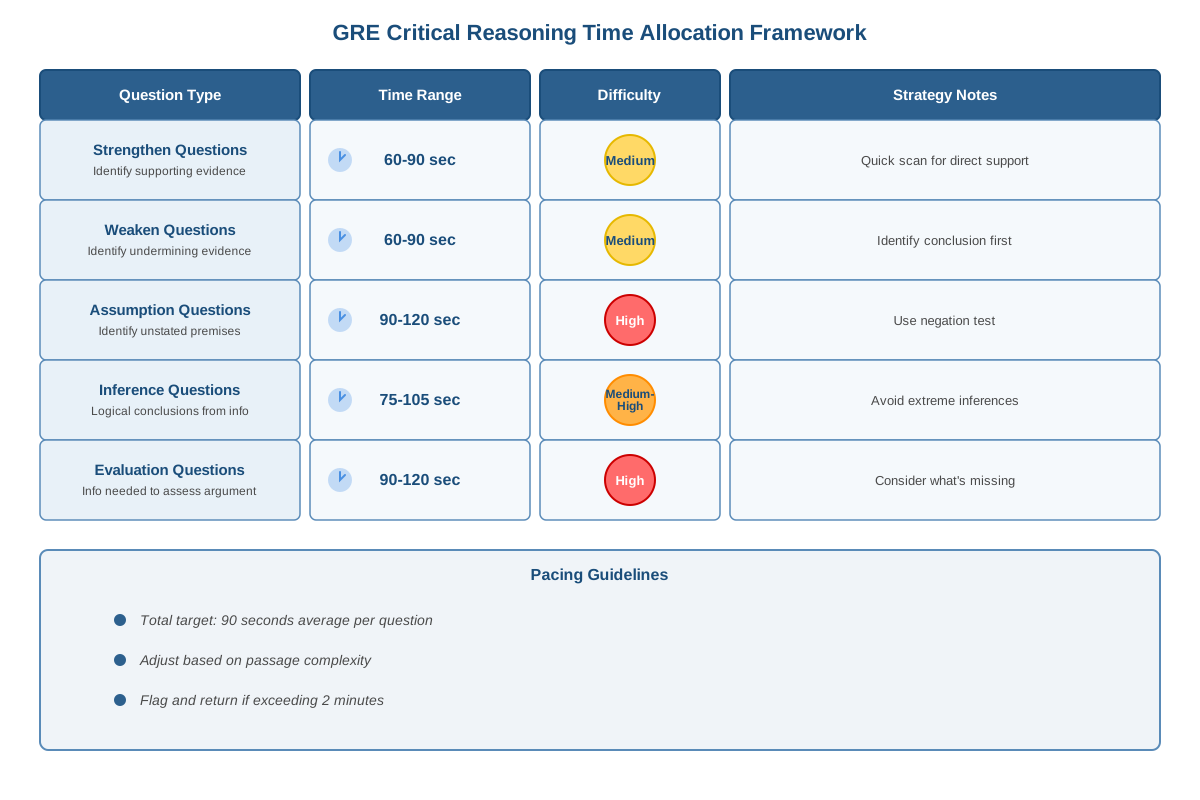
Different critical reasoning question types require varying amounts of time and cognitive effort. Strengthen and weaken questions typically require 60-75 seconds, as they involve identifying the argument's conclusion and determining which answer choice most impacts the reasoning. Assumption questions often demand 75-90 seconds because they require recognizing unstated premises that bridge gaps in the argument's logic. Inference questions can range from 60-90 seconds depending on whether they involve straightforward logical deductions or complex conditional reasoning. Evaluation questions frequently require 90-120 seconds as they demand identifying what additional information would help assess the argument's validity.
| Question Type | Average Time | Key Pacing Consideration |
|---|---|---|
| Strengthen/Weaken | 60-75 seconds | Quick conclusion identification is crucial |
| Assumption | 75-90 seconds | Gap analysis requires careful thought |
| Inference | 60-90 seconds | Varies significantly with complexity |
| Evaluation | 90-120 seconds | Often requires considering multiple scenarios |
| Paradox/Explain | 75-90 seconds | Requires identifying the apparent contradiction |
Recognizing question type instantly upon reading the question stem enables immediate mental preparation for the appropriate analytical approach. This recognition should occur within 5-10 seconds, allowing the majority of allocated time for actual reasoning rather than orientation. Students who practice question type identification develop automatic pattern recognition, reducing cognitive load and improving overall efficiency.
The Two-Pass Strategy
One of the most effective pacing techniques for critical reasoning involves the two-pass strategy: completing all questions within reach on the first pass, marking challenging questions for return, and using remaining time for focused effort on difficult items. This approach prevents the common mistake of investing excessive time in a single difficult question while easier questions remain unattempted. On the first pass, students should aim to complete questions where they can identify the correct answer with reasonable confidence within the standard time allocation. Questions that appear unusually complex, contain unfamiliar terminology, or trigger uncertainty should be marked for return rather than consuming disproportionate time.
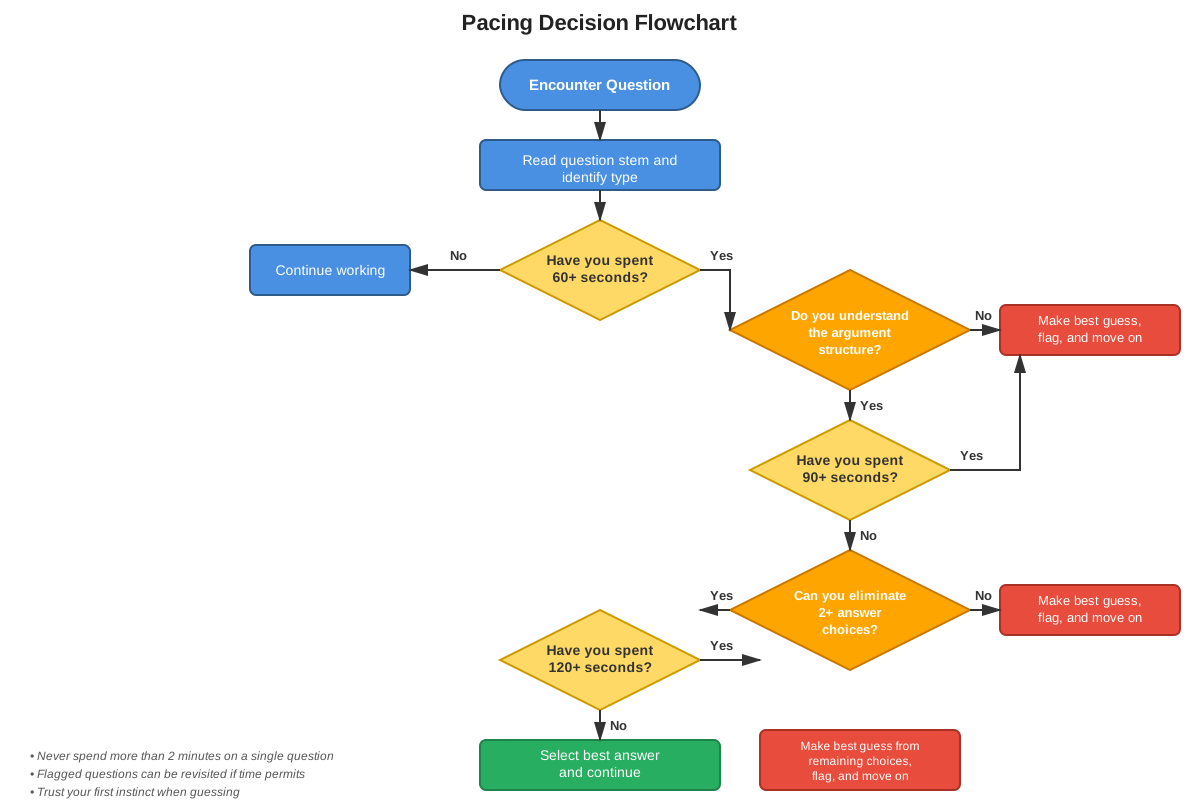
The two-pass strategy requires discipline to execute effectively. Students must resist the perfectionist impulse to solve every question immediately and develop comfort with strategic skipping. The key decision point occurs around 90 seconds into a question: if a clear path to the answer hasn't emerged, marking the question and moving forward typically yields better overall results than continuing to struggle. This approach ensures that all questions receive at least initial consideration and prevents the scenario where time expires with questions left completely unattempted. During the second pass, students can allocate remaining time strategically, potentially investing 2-3 minutes in a particularly challenging question without jeopardizing overall section completion.
Argument Analysis Efficiency
Efficient argument analysis forms the core of effective critical reasoning pacing. Rather than reading arguments multiple times or analyzing every detail, skilled test-takers employ a structured reading approach that identifies essential elements quickly. This involves: (1) reading the question stem first to understand the task, (2) reading the argument with purpose, actively identifying the conclusion and primary evidence, (3) anticipating the answer before reviewing choices, and (4) evaluating answer choices systematically. This sequence typically requires 40-50 seconds, leaving 20-40 seconds for answer choice evaluation and final selection.
The structured reading approach prevents common time-wasting behaviors such as passive reading, re-reading without purpose, or evaluating answer choices without first understanding the argument's structure. By reading the question stem first, students prime their minds to notice relevant information while reading the argument. Actively identifying the conclusion—often signaled by indicator words like "therefore," "thus," or "consequently"—provides immediate focus for analysis. Anticipating the answer creates a mental benchmark against which to evaluate choices, accelerating the elimination process and increasing confidence in the final selection.
Pacing Checkpoints and Adjustment
Maintaining effective pacing requires periodic assessment and real-time adjustment. Strategic pacing checkpoints at the 10-minute and 20-minute marks enable students to gauge progress and modify their approach if necessary. At the 10-minute checkpoint, students should have completed approximately 6-7 questions, ensuring they're on track to finish the section with time for review. At the 20-minute checkpoint, approximately 13-14 questions should be complete, leaving 10 minutes for the final questions and any marked items requiring return.
When pacing checkpoints reveal that a student is behind schedule, several adjustment strategies can restore appropriate timing. First, reduce re-reading by trusting initial comprehension and moving forward with available information. Second, accelerate answer choice elimination by quickly discarding obviously incorrect options rather than carefully considering every choice. Third, make educated guesses on remaining difficult questions rather than investing additional time with diminishing returns. Fourth, accept that some questions may require guessing to preserve time for questions where the student has stronger capability. These adjustments should be implemented gradually rather than creating panic, maintaining focus on maximizing overall section performance rather than perfecting individual questions.
Cognitive Stamina and Sustained Performance
Critical reasoning pacing extends beyond mechanical time management to encompass cognitive stamina—the ability to maintain analytical precision throughout the entire section. Mental fatigue typically increases as the section progresses, making later questions feel more difficult even when they're objectively similar to earlier items. Effective pacing strategies account for this fatigue by front-loading effort on complex questions when mental resources are fresh, while reserving straightforward questions for later when fatigue may impair performance on more demanding tasks.
Building cognitive stamina requires practice under realistic conditions. Students should regularly complete full-length Verbal Reasoning sections under timed conditions rather than practicing questions in isolation. This builds the mental endurance necessary for sustained performance and helps identify the specific point in the section where fatigue typically emerges. Additionally, developing efficient analytical processes reduces cognitive load, allowing students to maintain performance even as mental resources diminish. Automated pattern recognition, practiced elimination strategies, and confident decision-making all contribute to preserving cognitive resources throughout the section.
Concept Relationships
The concepts within critical reasoning pacing form an interconnected system where each element supports and reinforces the others. The Time Budget Framework provides the overarching structure within which all other pacing strategies operate, establishing the quantitative parameters that guide decision-making. This framework directly enables the Two-Pass Strategy, as students can only make informed skip decisions when they understand their overall time constraints and target completion rates. The Two-Pass Strategy, in turn, depends on Question Type Recognition, since students must quickly assess whether a question falls within their capability range or warrants deferral.
Argument Analysis Efficiency serves as the execution mechanism that makes the time budget achievable. Without efficient analytical processes, even the best strategic framework cannot overcome the time required for inefficient reading and reasoning. This efficiency directly impacts Cognitive Stamina, as inefficient processes consume mental resources more rapidly, accelerating fatigue. Conversely, automated and efficient processes preserve cognitive resources, enabling sustained performance throughout the section.
Pacing Checkpoints function as the feedback mechanism that connects planning to execution, allowing real-time adjustment when actual performance deviates from the planned time budget. These checkpoints inform decisions about when to implement the Two-Pass Strategy more aggressively or when to accelerate Argument Analysis processes to restore appropriate timing.
The relationship map flows as follows: Time Budget Framework → Question Type Recognition → Argument Analysis Efficiency → Two-Pass Strategy → Pacing Checkpoints → Cognitive Stamina → Sustained Performance. Each element builds upon previous concepts while enabling subsequent strategies, creating a comprehensive approach to critical reasoning pacing.
High-Yield Facts
⭐ The average time per question in Verbal Reasoning is 90 seconds, but critical reasoning questions should target 60-90 seconds to allow time for reading comprehension passages
⭐ Reading the question stem before the argument reduces total time by 10-15 seconds per question by enabling focused, purposeful reading
⭐ Students who implement a two-pass strategy score an average of 2-3 points higher than those who attempt every question in order
⭐ The first 5-10 seconds of a critical reasoning question should be spent identifying question type, which determines the appropriate analytical approach
⭐ Pacing checkpoints at 10 and 20 minutes enable real-time adjustment before timing problems become unrecoverable
- Questions appearing after the 15-minute mark are statistically more likely to be answered incorrectly due to cognitive fatigue, regardless of objective difficulty
- Spending more than 2 minutes on a single critical reasoning question typically indicates diminishing returns and suggests moving forward
- The computer-adaptive algorithm means that pacing problems early in the section can result in easier questions later, creating a compounding effect on scores
- Students who practice under timed conditions at least 10 times before the exam demonstrate significantly better pacing than those who primarily practice untimed
- Effective pacing strategies can improve Verbal Reasoning scores by 3-5 points even without additional content knowledge
Quick check — test yourself on GRE critical reasoning pacing so far.
Try Flashcards →Common Misconceptions
Misconception: Spending more time on each question always leads to higher accuracy → Correction: Research demonstrates that accuracy peaks at the optimal time allocation (60-90 seconds for most critical reasoning questions) and actually declines with excessive time investment due to overthinking, second-guessing, and mental fatigue. Beyond the optimal time threshold, additional seconds yield diminishing returns.
Misconception: Strong test-takers never skip questions and always work in order → Correction: The highest-scoring students strategically skip challenging questions on the first pass, ensuring they capture all accessible points before investing time in difficult items. Working strictly in order often results in time expiring with easier questions unattempted.
Misconception: Pacing is only about speed and requires rushing through questions → Correction: Effective pacing balances speed with accuracy through efficiency rather than rushing. The goal is eliminating wasted time (re-reading, passive reading, unfocused analysis) while maintaining careful reasoning on essential elements. Rushing typically increases errors without proportional time savings.
Misconception: The same pacing strategy works for all question types → Correction: Different critical reasoning question types require different time allocations and analytical approaches. Assumption questions typically require more time than strengthen/weaken questions, and inference questions vary significantly in complexity. Effective pacing involves adjusting time allocation based on question type recognition.
Misconception: Pacing problems can be solved during the actual exam through willpower → Correction: Effective pacing requires practiced habits and automated processes that cannot be developed under exam pressure. Students must build pacing skills through repeated timed practice, creating automatic behaviors that function reliably during the high-stress exam environment.
Misconception: Checking the clock frequently improves time management → Correction: Excessive clock-checking increases anxiety and disrupts focus without improving pacing. Strategic checkpoints at predetermined intervals (10 and 20 minutes) provide necessary feedback without the cognitive disruption of constant time monitoring.
Worked Examples
Example 1: Implementing the Two-Pass Strategy
Scenario: A student is 12 minutes into a Verbal Reasoning section and has completed 6 questions. Question 7 presents a complex argument about economic policy with an evaluation question asking what information would be most useful in assessing the argument. After 60 seconds of analysis, the student has eliminated two answer choices but remains uncertain between the remaining three options.
Analysis and Decision Process:
- Checkpoint Assessment (5 seconds): At 12 minutes with 6 questions complete, the student is slightly behind the target pace of 6-7 questions. This indicates the need for efficient handling of the current question.
- Time Investment Evaluation (5 seconds): The student has already invested 60 seconds and eliminated two choices. Evaluation questions typically require 90-120 seconds, suggesting 30-60 seconds remain in the optimal time window.
- Confidence Assessment (5 seconds): Uncertainty among three remaining choices suggests this question falls outside the student's immediate capability range. The probability of selecting the correct answer through additional analysis versus making an educated guess must be weighed against time costs.
- Strategic Decision (5 seconds): Given the slightly behind-pace status and moderate uncertainty, the student should invest an additional 20-30 seconds attempting to identify the correct answer. If clarity doesn't emerge within this window, the student should make an educated guess among the remaining choices, mark the question for potential return, and move forward.
- Execution (20 seconds): The student re-reads the question stem to ensure understanding of what "most useful information" means in this context, then evaluates the three remaining choices specifically against this criterion. One choice emerges as more directly addressing the argument's central assumption.
- Selection and Progress (5 seconds): The student selects the identified answer with moderate confidence and moves to question 8, having invested a total of 100 seconds—within the appropriate range for evaluation questions.
Outcome: By implementing disciplined time management with a clear decision framework, the student maintained appropriate pacing while giving the question adequate attention. If clarity hadn't emerged within the additional 20-30 seconds, marking and moving forward would have prevented the common mistake of investing 2-3 minutes with diminishing returns.
Example 2: Recovering from Behind-Pace Status
Scenario: A student reaches the 20-minute checkpoint and has completed only 11 questions, placing them approximately 2-3 questions behind target pace. The remaining 10 minutes must accommodate 9 questions, requiring faster-than-average completion to finish the section.
Analysis and Recovery Strategy:
- Situation Assessment (10 seconds): The student recognizes the behind-pace status and calculates that the remaining questions must average approximately 65 seconds each to complete the section, compared to the typical 90-second average. This requires immediate implementation of acceleration strategies.
- Strategy Adjustment (10 seconds): The student commits to the following modifications: (a) eliminate re-reading unless absolutely necessary, (b) trust initial comprehension and move forward with available information, (c) accelerate answer choice elimination by quickly discarding obviously incorrect options, (d) make educated guesses on questions where uncertainty persists after initial analysis rather than investing additional time.
- Execution on Question 12 (55 seconds): The student encounters a strengthen question. Reading the question stem first (5 seconds), they identify the task. Reading the argument (25 seconds), they identify the conclusion and primary evidence. Anticipating what would strengthen the argument (10 seconds), they form a mental prediction. Evaluating answer choices (15 seconds), they quickly eliminate three obviously incorrect options and select between the remaining two based on which better matches their prediction, choosing the stronger option without extensive deliberation.
- Execution on Question 13 (50 seconds): An inference question appears. Following the same efficient process, the student identifies what must be true based on the argument (5 seconds for question stem, 20 seconds for argument, 10 seconds for anticipation, 15 seconds for choice evaluation). When uncertainty arises between two choices, the student makes an educated guess rather than investing additional time, maintaining the accelerated pace.
- Continued Execution (Questions 14-17, averaging 60 seconds each): By maintaining disciplined efficiency and trusting initial analysis, the student completes four more questions in 4 minutes, bringing total progress to 17 questions at the 26-minute mark.
- Final Questions (Questions 18-20, 4 minutes total): With 4 minutes remaining for 3 questions, the student has successfully recovered to appropriate pacing, allowing 75-90 seconds per question for the final items.
Outcome: Through immediate recognition of pacing problems and systematic implementation of acceleration strategies, the student recovered from a significant timing deficit without resorting to random guessing or leaving questions unattempted. The key was accepting slightly reduced confidence on individual questions (making educated guesses after initial analysis rather than extended deliberation) to preserve overall section completion and maximize total points.
Exam Strategy
Trigger Recognition and Immediate Response
Successful critical reasoning pacing begins with instant recognition of question type through trigger words and phrases in the question stem. Strengthen questions typically include phrases like "most strengthens," "provides the most support," or "best justifies." Weaken questions use "most undermines," "casts doubt on," or "calls into question." Assumption questions ask what is "assumed," "presupposed," or "taken for granted." Inference questions inquire what "must be true," "can be properly inferred," or "follows logically." Evaluation questions ask what information would be "most useful in evaluating" or "most important to know." Recognizing these triggers within 5 seconds enables immediate mental preparation for the appropriate analytical approach.
Upon identifying question type, students should immediately activate the corresponding analytical framework. For strengthen/weaken questions, focus on identifying the conclusion and determining what would make it more or less likely to be true. For assumption questions, look for gaps between premises and conclusion. For inference questions, identify what must be true based solely on the information provided. This immediate activation prevents wasted time on unfocused reading and ensures efficient analysis.
Process of Elimination Optimization
Effective pacing requires strategic answer choice elimination that balances thoroughness with efficiency. Rather than carefully considering every answer choice equally, skilled test-takers quickly identify and eliminate obviously incorrect options, then invest time distinguishing among remaining choices. The optimal sequence involves: (1) rapid scan of all five choices (10-15 seconds) to identify any obviously incorrect options, (2) immediate elimination of clearly wrong answers, (3) focused evaluation of remaining choices against the question's specific requirements.
Common elimination criteria include: answers that contradict information in the argument, answers that address irrelevant issues, answers that move in the wrong direction (strengthening when the question asks for weakening), answers that are too extreme or absolute, and answers that introduce new topics not connected to the argument's reasoning. Developing automatic recognition of these patterns accelerates elimination and preserves time for distinguishing between more subtle options.
Time Allocation Decision Framework
Students should implement a decision framework for real-time time allocation choices. At 60 seconds into a question, assess confidence level: if a clear answer has emerged, select and move forward; if reasonable progress has been made but uncertainty remains, invest an additional 20-30 seconds; if minimal progress has occurred, make an educated guess and mark for potential return. At 90 seconds, unless the question is nearly solved, make a selection and move forward. At 120 seconds, always make a selection regardless of confidence level, as additional time investment rarely yields proportional returns.
This framework prevents the common mistake of continuing to work on a question simply because time has already been invested (the sunk cost fallacy). Each time allocation decision should be based on prospective returns—the likelihood that additional time will lead to the correct answer—rather than retrospective investment. Students who implement this framework consistently maintain better overall pacing and achieve higher section scores.
Buffer Time Management
Strategic pacing includes creating and preserving buffer time—extra minutes beyond the minimum required for section completion. A well-executed pacing plan should create 2-3 minutes of buffer time through efficient question completion. This buffer serves multiple purposes: allowing return to marked questions, providing time for educated guessing on particularly difficult items, enabling final review of flagged answers, and reducing anxiety by preventing the pressure of working until the final second.
Buffer time should be created through consistent efficiency across all questions rather than rushing through specific items. Saving 10-15 seconds per question through efficient processes (reading question stems first, focused argument analysis, rapid elimination of obviously incorrect choices) accumulates to significant buffer time without requiring rushed work that increases error rates. Students should view buffer time creation as a primary pacing goal, recognizing that this flexibility enables better overall performance.
Memory Techniques
The PACE Acronym for Real-Time Pacing
Prioritize question type recognition (5-10 seconds)
Analyze argument structure efficiently (40-50 seconds)
Choose through systematic elimination (20-30 seconds)
Evaluate time investment at 60-second checkpoint
This acronym provides a memorable framework for the optimal question approach sequence, ensuring students maintain efficient processes under exam pressure.
The 10-20-30 Checkpoint System
Remember pacing checkpoints through the simple sequence 10-20-30: at 10 minutes, complete 6-7 questions; at 20 minutes, complete 13-14 questions; at 30 minutes, complete all 20 questions. This creates an easy-to-remember rhythm that enables quick assessment of pacing status without complex calculations during the exam.
The Two-Minute Rule Visualization
Visualize a red line at the two-minute mark for any single question. When approaching this line, imagine it as a boundary that should rarely be crossed. This mental image creates an automatic warning system that triggers the decision to make a selection and move forward, preventing excessive time investment in individual questions.
The Question Type Time Map
Create a mental map associating question types with time ranges:
- Strengthen/Weaken: Think "60-75" (seconds)
- Assumption: Think "75-90"
- Inference: Think "60-90"
- Evaluation: Think "90-120"
Rehearsing these associations during practice creates automatic time expectations that guide real-time pacing decisions during the exam.
Summary
GRE critical reasoning pacing represents the strategic time management framework that enables test-takers to maximize Verbal Reasoning performance by balancing speed, accuracy, and cognitive stamina throughout the section. Effective pacing begins with establishing a clear time budget that allocates approximately 60-90 seconds per critical reasoning question while reserving buffer time for challenging items and final review. Success requires instant question type recognition, efficient argument analysis through structured reading processes, and disciplined implementation of the two-pass strategy to ensure all accessible questions are completed before investing disproportionate time in difficult items. Strategic pacing checkpoints at 10 and 20 minutes enable real-time adjustment when actual performance deviates from planned timing, while acceleration strategies provide tools for recovering from behind-pace status. Students who master critical reasoning pacing develop automated processes that reduce cognitive load, preserve mental resources, and enable sustained analytical performance throughout the entire section, ultimately achieving higher scores through strategic time management rather than rushed work or incomplete sections.
Key Takeaways
- Effective GRE critical reasoning pacing targets 60-90 seconds per question through efficient processes rather than rushed work, creating buffer time for challenging items and final review
- Reading question stems before arguments saves 10-15 seconds per question by enabling focused, purposeful reading that identifies relevant information immediately
- The two-pass strategy—completing accessible questions first and returning to difficult items with remaining time—prevents the common mistake of investing excessive time in single questions while easier points remain uncaptured
- Strategic pacing checkpoints at 10 minutes (6-7 questions complete) and 20 minutes (13-14 questions complete) enable real-time adjustment before timing problems become unrecoverable
- Question type recognition within 5-10 seconds activates the appropriate analytical framework, ensuring efficient analysis tailored to each question's specific requirements
- Time investment decisions should be based on prospective returns rather than sunk costs, with clear decision points at 60, 90, and 120 seconds guiding selection and forward progress
- Building cognitive stamina through regular full-length timed practice creates the mental endurance necessary for sustained analytical performance throughout the entire Verbal Reasoning section
Related Topics
Reading Comprehension Pacing: Mastering critical reasoning pacing provides the foundation for managing time across longer reading comprehension passages, as the same principles of efficient analysis, strategic skipping, and checkpoint monitoring apply to passage-based questions. Understanding how to allocate time for argument analysis transfers directly to allocating time for passage reading and question completion.
Adaptive Test Strategy: Critical reasoning pacing skills enable effective navigation of the GRE's computer-adaptive algorithm, as maintaining consistent performance across questions ensures appropriate difficulty progression and maximizes scoring potential. Students who master pacing can focus cognitive resources on content rather than time anxiety.
Verbal Reasoning Section Strategy: The comprehensive time management framework developed through critical reasoning pacing extends to managing the entire Verbal Reasoning section, including text completion and sentence equivalence questions. Mastering pacing in one question type creates transferable skills that improve overall section performance.
Test Anxiety Management: Effective pacing strategies directly reduce test anxiety by creating confidence in time management and preventing the panic that arises from falling behind schedule. Students who develop strong pacing skills experience lower stress levels and better cognitive performance during the exam.
Practice CTA
Now that you understand the strategic framework for GRE critical reasoning pacing, it's time to build these skills through deliberate practice. Begin by completing the practice questions associated with this topic under timed conditions, implementing the two-pass strategy and checkpoint monitoring system. Use the flashcards to reinforce question type recognition and time allocation guidelines until these patterns become automatic. Remember that effective pacing is a skill developed through consistent practice rather than innate ability—every timed practice session builds the habits and confidence necessary for optimal exam performance. Your investment in mastering pacing will yield returns across the entire Verbal Reasoning section, making this one of the highest-value skills you can develop in your GRE preparation.
Sign up free to keep reading
Create a free AnvayaPrep account to finish this GRE guide on GRE critical reasoning pacing — plus flashcards and practice questions.