Overview
Argument prediction is a critical skill tested extensively on the GRE Verbal Reasoning section, particularly within Reading Comprehension and Critical Reasoning questions. This technique involves anticipating the logical structure, conclusion, or direction of an argument before examining all answer choices. By developing strong argument prediction abilities, test-takers can significantly improve both their accuracy and speed when tackling complex passages and question stems.
The GRE frequently presents arguments with missing components—whether conclusions, assumptions, or supporting evidence—and expects students to identify what logically must come next or what the author is building toward. Rather than passively reading through arguments and then evaluating answer choices one by one, skilled test-takers actively engage with the text, formulating their own predictions about the argument's trajectory. This proactive approach reduces susceptibility to trap answers and increases confidence in selecting correct responses.
Within the broader landscape of Verbal Reasoning, argument prediction serves as a foundational skill that connects to assumption identification, logical structure analysis, and inference-making. It requires synthesizing information from premises, recognizing rhetorical patterns, and understanding how authors construct persuasive reasoning. Mastering this topic enhances performance not only on explicit "complete the argument" questions but also on strengthen/weaken questions, assumption questions, and inference questions where understanding the argument's logical flow is paramount.
Learning Objectives
- [ ] Identify when Argument prediction is being tested
- [ ] Explain the core rule or strategy behind Argument prediction
- [ ] Apply Argument prediction to GRE-style questions accurately
- [ ] Distinguish between valid and invalid logical progressions in arguments
- [ ] Formulate precise predictions before reviewing answer choices
- [ ] Recognize common argument structures and their typical conclusions
- [ ] Evaluate how well answer choices match predicted logical outcomes
Prerequisites
- Basic logical reasoning: Understanding premises, conclusions, and how evidence supports claims is essential for predicting where arguments lead
- Argument structure identification: Recognizing the components of arguments (claim, evidence, assumption) enables accurate prediction of missing elements
- Reading comprehension fundamentals: The ability to extract main ideas and author's purpose provides the foundation for anticipating argumentative direction
- Familiarity with logical connectors: Understanding transition words (therefore, however, because) helps identify the relationship between argument components
Why This Topic Matters
In professional and academic contexts, the ability to predict where arguments are heading demonstrates critical thinking mastery. Lawyers anticipate opposing counsel's reasoning, researchers predict experimental conclusions from methodology, and business analysts forecast recommendations from data trends. This skill reflects genuine intellectual agility that extends far beyond test-taking.
On the GRE specifically, gre argument prediction appears in approximately 30-40% of Verbal Reasoning questions across multiple question types. Text Completion questions with argumentative passages, Reading Comprehension inference questions, and Critical Reasoning questions all reward students who can anticipate logical progressions. Questions explicitly asking students to "complete the passage" or identify "which statement most logically follows" directly test this skill, while many other question types indirectly benefit from strong prediction abilities.
The GRE presents argument prediction challenges in several formats: passages with blank spaces requiring logical completion, questions asking for the "most logical conclusion," prompts requesting identification of assumptions (which requires predicting what unstated premise connects evidence to conclusion), and strengthen/weaken questions (where predicting the argument's vulnerable points guides answer selection). Recognizing these varied manifestations ensures comprehensive preparation.
Core Concepts
The Fundamentals of Argument Prediction
Argument prediction is the systematic process of formulating expectations about an argument's direction, conclusion, or missing components based on available evidence and logical structure. Rather than approaching arguments as passive readers, effective test-takers become active predictors who engage with the text's logical architecture. This approach transforms test-taking from a reactive process of evaluating given options into a proactive process of hypothesis formation and confirmation.
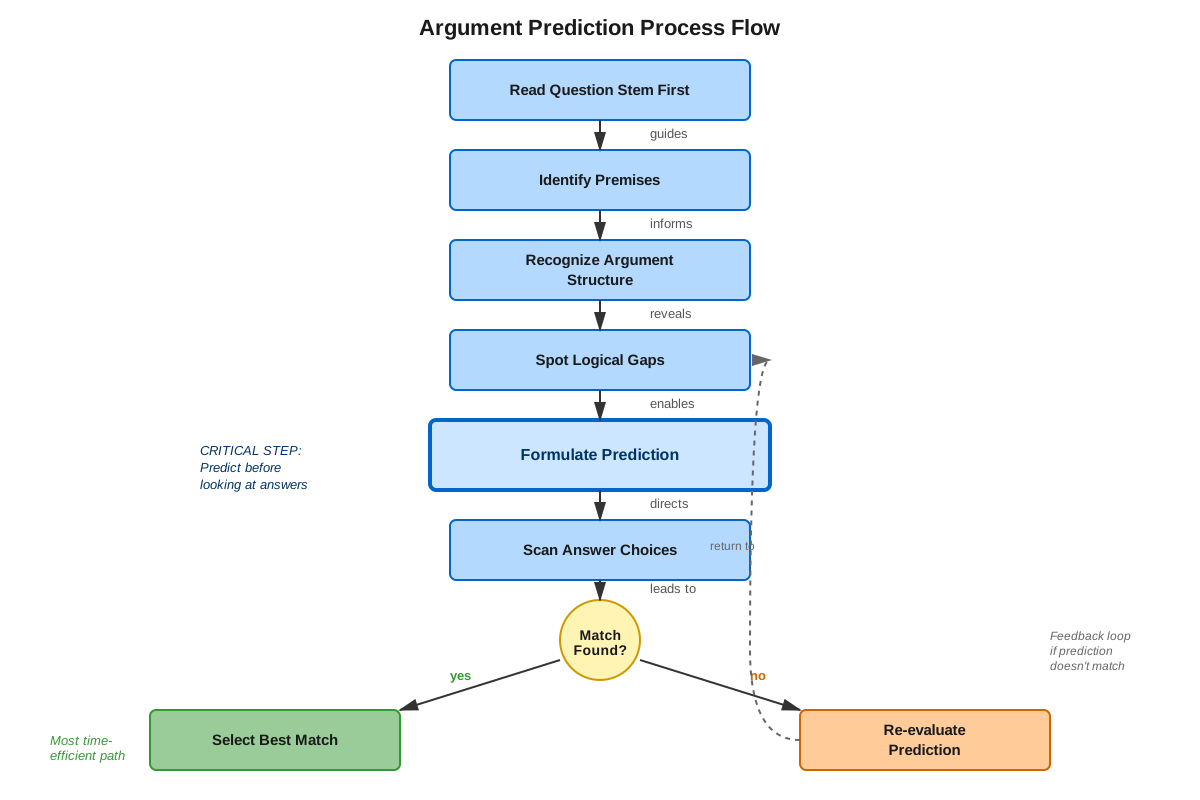
The core mechanism involves three sequential steps: (1) identifying the argument's existing components and their relationships, (2) recognizing the logical pattern or structure being employed, and (3) determining what element would most naturally complete or continue that pattern. This process mirrors how skilled readers naturally anticipate where sentences and paragraphs are heading, but applies that intuition systematically to logical structures.
Identifying Argument Components
Before predicting where an argument leads, students must accurately identify what components are already present. Arguments typically contain:
- Premises: Factual statements or evidence presented as support
- Conclusions: Claims the author wants the reader to accept
- Assumptions: Unstated beliefs connecting premises to conclusions
- Counterarguments: Opposing viewpoints the author may address
- Qualifiers: Limitations or conditions on the argument's scope
When a GRE question presents an incomplete argument, determining which component is missing guides prediction. If premises are present but no conclusion appears, predict a claim those premises would support. If a conclusion exists but seems inadequately supported, predict an assumption or additional premise that would strengthen the logical connection.
Common Argument Structures
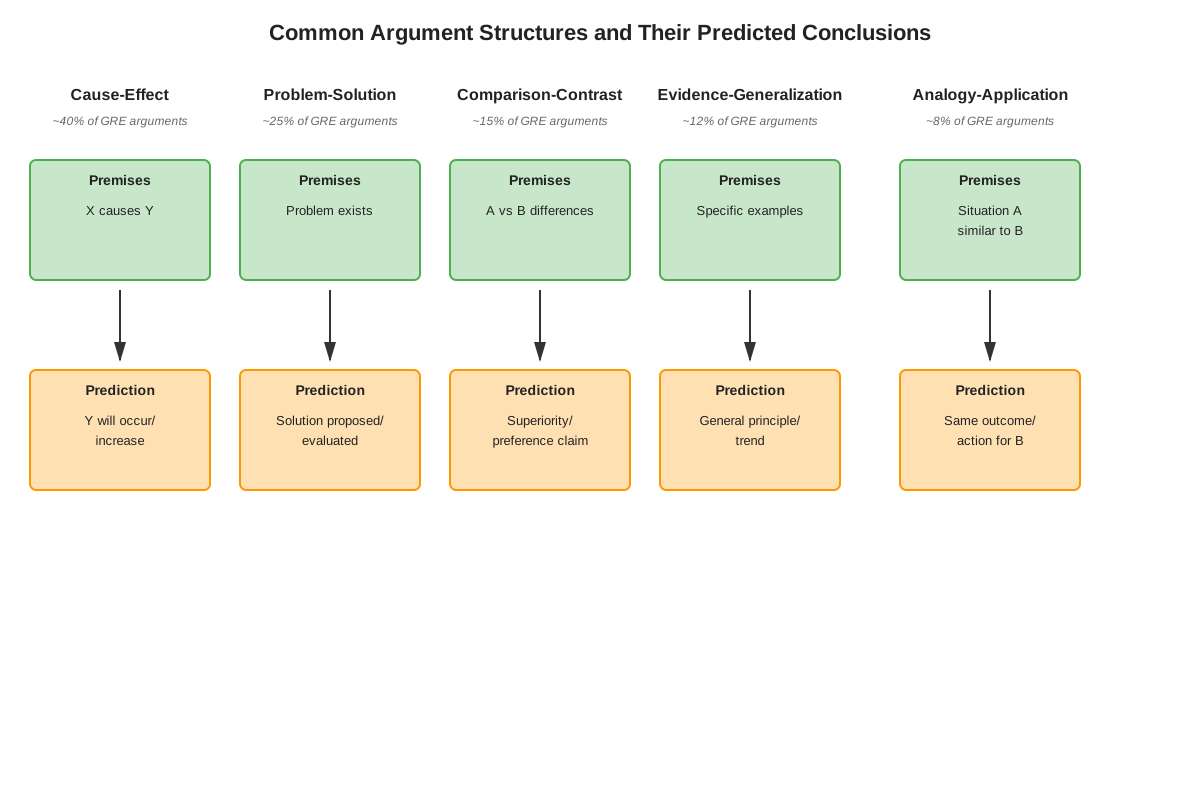
Recognizing recurring argument patterns dramatically improves prediction accuracy. The GRE frequently employs these structures:
| Argument Structure | Pattern | Prediction Strategy |
|---|---|---|
| Causal Argument | X causes Y; Y occurred | Predict conclusion that X occurred or should be addressed |
| Analogy Argument | A is like B; B has property X | Predict conclusion that A has property X |
| Statistical Argument | Survey/study shows trend | Predict conclusion generalizing or explaining the trend |
| Problem-Solution | Problem described with evidence | Predict solution addressing the problem's root cause |
| Comparison Argument | Two things contrasted on multiple dimensions | Predict conclusion favoring one based on comparison |
The Prediction Process
Effective argument prediction follows a systematic approach:
- Read actively for structure: Identify the argument's backbone—what is being claimed and what supports it
- Note logical connectors: Words like "therefore," "because," "however," and "consequently" signal relationships between components
- Identify the gap: Determine what's missing—is it a conclusion, a premise, an assumption, or a qualification?
- Consider the argument's scope: Predictions must match the specificity and domain of the existing argument
- Formulate your prediction: Before looking at answer choices, articulate in your own words what should come next
- Match, don't force: Find the answer choice that best aligns with your prediction, remaining flexible if no perfect match exists
Scope and Specificity in Predictions
A critical aspect of accurate prediction involves matching the scope of existing argument components. If premises discuss "some companies in the technology sector," a valid conclusion cannot claim "all businesses worldwide." The GRE frequently includes trap answers that are logically related to the argument but inappropriately broad or narrow.
Similarly, predictions must maintain appropriate specificity. If an argument presents detailed evidence about a particular phenomenon, the conclusion should address that specific phenomenon, not make vague generalizations. Conversely, if premises establish broad patterns, the conclusion should reflect that generality rather than making overly specific claims.
Logical Validity vs. Factual Truth
When predicting argument components, focus on logical validity—whether the predicted element follows logically from what's given—rather than factual truth. The GRE tests reasoning ability, not subject-matter expertise. An argument about a fictional scenario still has logical structure, and predictions should complete that structure coherently regardless of real-world accuracy.
This distinction is crucial because trap answers often present factually true statements that don't logically follow from the argument's premises. A statement can be true in reality but irrelevant or illogical within the argument's specific context.
Concept Relationships
The concepts within argument prediction form an interconnected system where each element supports the others. Identifying argument components serves as the foundation, enabling recognition of argument structures, which in turn guides the prediction process. Understanding scope and specificity refines predictions generated through this process, while distinguishing logical validity from factual truth prevents common errors throughout.
This topic connects directly to prerequisite knowledge of basic logical reasoning—the ability to identify premises and conclusions enables component identification. Argument structure recognition builds on familiarity with logical connectors, as these transition words signal which structure is being employed.
Argument prediction also enables progression to more advanced Critical Reasoning topics. Mastering prediction facilitates assumption identification (predicting what unstated premise connects evidence to conclusion), strengthen/weaken questions (predicting what information would support or undermine the argument), and evaluation questions (predicting what information would help assess the argument's validity).
Relationship Map:
Logical Reasoning Fundamentals → Argument Component Identification → Argument Structure Recognition → Systematic Prediction Process → Scope/Specificity Refinement → Accurate Answer Selection → Advanced Critical Reasoning Skills
High-Yield Facts
⭐ Argument prediction requires formulating your own answer before examining choices, reducing susceptibility to trap answers
⭐ The scope of your prediction must precisely match the scope of the argument's premises—neither broader nor narrower
⭐ Logical connectors (therefore, because, however, thus) are critical signals indicating the relationship between argument components
⭐ When premises establish a causal relationship, conclusions typically recommend action addressing that cause or predict effects
⭐ The GRE rewards logical validity over factual truth—focus on what follows from the argument, not what's true in reality
- Arguments with statistical evidence typically conclude with generalizations or explanations of the observed pattern
- Analogy-based arguments predict that compared entities share additional properties beyond those explicitly mentioned
- When an argument presents a problem with supporting evidence, the conclusion typically proposes a solution targeting the problem's root cause
- Predictions must maintain consistency with any qualifiers or limitations present in the premises
- Trap answers often present statements that are topically related but logically disconnected from the argument's structure
Quick check — test yourself on Argument prediction so far.
Try Flashcards →Common Misconceptions
Misconception: Argument prediction means guessing what the author will say based on the topic. → Correction: Argument prediction is a systematic logical process based on the structure and relationships within the argument, not intuition about subject matter. The prediction must follow logically from the specific premises given, regardless of what might generally be true about the topic.
Misconception: The correct answer will always match your prediction exactly. → Correction: While predictions guide answer selection, the correct choice may be phrased differently than anticipated. Look for answers that capture the logical essence of your prediction even if the wording varies. Flexibility is essential—your prediction is a tool, not a rigid requirement.
Misconception: Longer, more detailed answer choices are more likely to be correct. → Correction: The GRE includes verbose trap answers that seem comprehensive but don't logically follow from the argument. Correct answers may be concise. Evaluate based on logical fit with your prediction, not length or apparent sophistication.
Misconception: If an answer choice states something true, it's probably correct. → Correction: Factual accuracy is irrelevant if the statement doesn't logically follow from the argument's premises. The GRE tests reasoning, not knowledge. A true statement that doesn't complete the argument's logical structure is incorrect.
Misconception: You should read all answer choices before making a prediction. → Correction: Reading answer choices before predicting allows them to influence your thinking and increases vulnerability to trap answers. Always formulate your prediction first, then evaluate choices against that prediction.
Misconception: Argument prediction only applies to "complete the passage" questions. → Correction: While most directly applicable to completion questions, prediction skills enhance performance on assumption questions, strengthen/weaken questions, inference questions, and even some Reading Comprehension questions. The underlying skill—anticipating logical progression—has broad applicability.
Worked Examples
Example 1: Causal Argument Completion
Question Stem:
"Recent studies have shown that employees who work in offices with natural lighting report 15% higher job satisfaction than those in offices with only artificial lighting. Additionally, these employees take fewer sick days and demonstrate higher productivity metrics. The company should therefore _____________."
Step 1 - Identify Components:
- Premises: Natural lighting correlates with higher satisfaction, fewer sick days, and higher productivity
- Structure: Causal/correlational evidence leading to recommendation
- Missing: Conclusion recommending action
Step 2 - Recognize Structure:
This is a problem-solution argument where evidence establishes benefits of a condition, leading to a recommendation to implement that condition.
Step 3 - Consider Scope:
The evidence specifically concerns natural lighting in offices and its effects on employees. The conclusion should recommend action related to office lighting, not broader workplace changes.
Step 4 - Formulate Prediction:
"The company should increase natural lighting in its offices" or "invest in office designs that maximize natural light exposure."
Step 5 - Evaluate Answer Choices:
A) "hire more employees to increase overall productivity" - Incorrect: Addresses productivity but ignores the causal factor (natural lighting) established in premises
B) "invest in renovating office spaces to maximize natural lighting" - Correct: Directly addresses the causal factor, matches scope, and follows logically from the evidence
C) "conduct further research on workplace satisfaction factors" - Incorrect: Too tentative; the evidence already establishes the relationship, so action is warranted
D) "reduce artificial lighting costs to improve budget efficiency" - Incorrect: Focuses on cost rather than the employee benefits established in premises
E) "implement comprehensive wellness programs for all staff" - Incorrect: Too broad; doesn't specifically address the natural lighting factor identified in evidence
Connection to Learning Objectives: This example demonstrates identifying when prediction is tested (completion question), applying the core strategy (systematic component analysis), and accurately selecting answers matching predictions.
Example 2: Assumption-Based Prediction
Question Stem:
"The city council argues that installing speed cameras at major intersections will reduce traffic accidents. They cite data showing that cities with speed cameras have 20% fewer accidents than cities without them. However, this argument assumes that _____________."
Step 1 - Identify Components:
- Premise: Cities with speed cameras have fewer accidents
- Conclusion: Installing speed cameras will reduce accidents in this city
- Missing: Assumption connecting the correlation to causation
Step 2 - Recognize Structure:
This is a causal argument based on correlational data. The gap between correlation (cities with cameras have fewer accidents) and causation (cameras will cause fewer accidents here) requires an assumption.
Step 3 - Identify the Logical Gap:
The argument jumps from "cities with cameras have fewer accidents" to "cameras will reduce accidents here." What must be true for this reasoning to work? The cameras must be the cause of the reduction, not some other factor.
Step 4 - Formulate Prediction:
"The speed cameras caused the reduction in accidents rather than some other factor" or "cities with cameras aren't different in other ways that might explain fewer accidents."
Step 5 - Evaluate Answer Choices:
A) "speed cameras are cost-effective compared to other safety measures" - Incorrect: Addresses cost-benefit, not the logical connection between cameras and accident reduction
B) "drivers in this city exceed speed limits at rates similar to drivers in other cities" - Incorrect: While somewhat relevant, doesn't address the core assumption about causation
C) "the reduction in accidents in cities with cameras is attributable to the cameras rather than other factors" - Correct: Directly addresses the causal assumption needed to connect the evidence to the conclusion
D) "traffic accidents are a significant problem requiring immediate intervention" - Incorrect: Addresses problem severity, not the logical connection in the argument
E) "speed cameras can accurately detect vehicles exceeding speed limits" - Incorrect: Addresses camera functionality, not whether they cause accident reduction
Connection to Learning Objectives: This example shows how prediction applies beyond simple completion questions to assumption identification, requiring students to predict what unstated premise makes the argument logically valid.
Exam Strategy
Approaching Argument Prediction Questions
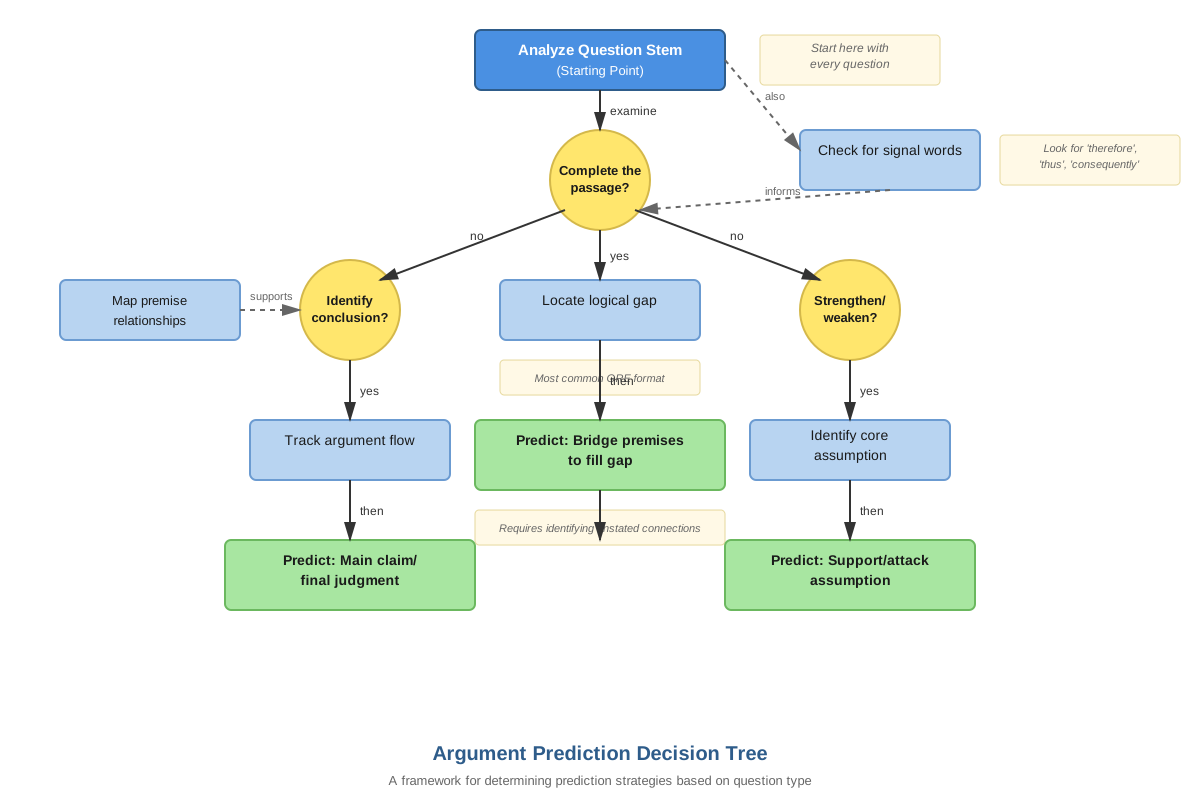
When encountering questions testing argument prediction, follow this systematic approach:
- Identify the question type: Look for phrases like "most logically completes," "which of the following can be concluded," "the argument assumes," or "which statement would most strengthen/weaken"
- Cover the answer choices: Physically cover them with your hand or paper to prevent premature influence on your thinking
- Read actively for structure: As you read, mentally note "this is evidence," "this is the claim," "this is a counterargument," etc.
- Pause before the blank or question: Take 5-10 seconds to formulate your prediction in your own words
- Write down your prediction: If using scratch paper, jot a brief version of your predicted answer
- Evaluate systematically: Uncover answer choices one at a time, immediately eliminating those that don't match your prediction's logical structure
Trigger Words and Phrases
Watch for these signals indicating argument prediction is being tested:
Completion indicators: "most logically completes," "which conclusion," "the passage is structured to lead to," "the author is primarily concerned with establishing"
Assumption indicators: "assumes," "depends on the assumption," "presupposes," "takes for granted"
Inference indicators: "can be inferred," "suggests," "implies," "most strongly supports"
Logical relationship indicators: "therefore," "thus," "consequently," "it follows that," "which means"
Process of Elimination Tips
- Eliminate scope mismatches first: Remove answers that are too broad or too narrow compared to the argument's premises
- Remove factually true but logically irrelevant options: Don't be seduced by statements that sound correct but don't follow from the argument
- Identify premise restaters: Answers that merely repeat information already stated aren't conclusions or completions
- Watch for extreme language: Words like "always," "never," "only," or "must" often signal incorrect answers unless the premises justify such certainty
- Beware of topic traps: Answers that discuss the same general topic but don't logically follow from the specific argument structure
Time Allocation
For argument prediction questions, allocate approximately:
- 30-45 seconds: Initial reading and structure identification
- 10-15 seconds: Formulating your prediction
- 30-45 seconds: Evaluating answer choices
- Total: 70-105 seconds per question
This timing ensures adequate prediction formulation without excessive deliberation. If you cannot formulate a clear prediction within 15 seconds, proceed to answer choices but remain vigilant for trap answers.
Memory Techniques
The SCOPE Acronym
Remember to check prediction SCOPE:
- Specificity matches premises
- Causation vs. correlation distinguished
- Outcome logically follows from evidence
- Premises all incorporated
- Extremes avoided unless justified
The Prediction Priority Sequence
Remember: "Structure Before Substance"
Visualize the argument as a building: identify the foundation (premises), recognize the architectural style (argument structure), then predict what completes the structure (conclusion). Don't focus on the building materials (specific content) until you understand the architecture (logical structure).
The Three-Question Filter
Before selecting an answer, mentally ask:
- "Does this follow?" (logical validity)
- "Does this fit?" (scope matching)
- "Does this finish?" (completeness)
If the answer to all three is "yes," select that choice confidently.
Visualization Strategy
Picture the argument as a bridge with the premises on one side and the conclusion on the other. Your prediction identifies what structural element (beam, cable, support) completes the bridge. Answer choices are different materials—select the one that actually completes the structure, not just something that could be used in bridge-building generally.
Summary
Argument prediction is a systematic approach to anticipating the logical direction, conclusion, or missing components of arguments presented on the GRE Verbal Reasoning section. By actively engaging with argument structure rather than passively reading, test-takers formulate predictions before examining answer choices, significantly reducing vulnerability to trap answers and improving both accuracy and efficiency. The core strategy involves identifying existing argument components, recognizing common structural patterns (causal, analogical, statistical, problem-solution, comparison), and determining what element would most naturally complete the logical progression. Critical considerations include maintaining appropriate scope and specificity, distinguishing logical validity from factual truth, and systematically evaluating answer choices against formulated predictions. This skill applies across multiple question types including text completion, assumption identification, inference questions, and strengthen/weaken questions, making it one of the highest-yield techniques for GRE Verbal Reasoning success.
Key Takeaways
- Always formulate your own prediction before examining answer choices to avoid being influenced by trap answers designed to seem plausible
- Match the scope precisely—predictions must be neither broader nor narrower than the argument's premises warrant
- Focus on logical validity, not factual truth—the correct answer follows logically from the argument regardless of real-world accuracy
- Recognize common argument structures (causal, analogy, statistical, problem-solution) to predict typical conclusions for each pattern
- Use logical connectors as roadmaps—words like "therefore," "because," and "however" signal relationships between argument components
- Distinguish between topical relevance and logical connection—correct answers must logically follow from premises, not merely discuss related topics
- Apply prediction skills broadly—this technique enhances performance on completion questions, assumption questions, inference questions, and strengthen/weaken questions
Related Topics
Assumption Identification: Building directly on argument prediction, this topic focuses specifically on identifying unstated premises that connect evidence to conclusions. Mastering prediction enables students to anticipate what assumptions arguments require.
Strengthen and Weaken Questions: These question types require predicting what information would support or undermine an argument's reasoning. Strong prediction skills allow test-takers to anticipate vulnerable points in arguments before evaluating answer choices.
Logical Fallacies: Understanding common reasoning errors complements prediction skills by helping students recognize when arguments make invalid logical leaps, enabling more accurate predictions about what would make arguments valid.
Inference Questions: While prediction focuses on completing arguments, inference questions require predicting what must be true based on given information. The underlying skill—anticipating logical consequences—transfers directly.
Argument Structure Analysis: This advanced topic involves diagramming complex arguments with multiple premises, sub-conclusions, and counterarguments. Prediction skills provide the foundation for this more sophisticated structural analysis.
Practice CTA
Now that you understand the systematic approach to argument prediction, it's time to apply these strategies to actual GRE-style questions. The practice questions and flashcards will reinforce your ability to identify argument structures, formulate accurate predictions, and select correct answers confidently. Remember: prediction is a skill that improves dramatically with deliberate practice. Each question you work through strengthens your pattern recognition and logical reasoning abilities. Approach the practice materials actively, formulating predictions before looking at answer choices, and you'll see measurable improvement in both accuracy and speed. Your investment in mastering this high-yield skill will pay dividends across the entire Verbal Reasoning section!
Sign up free to keep reading
Create a free AnvayaPrep account to finish this GRE guide on Argument prediction — plus flashcards and practice questions.