Overview
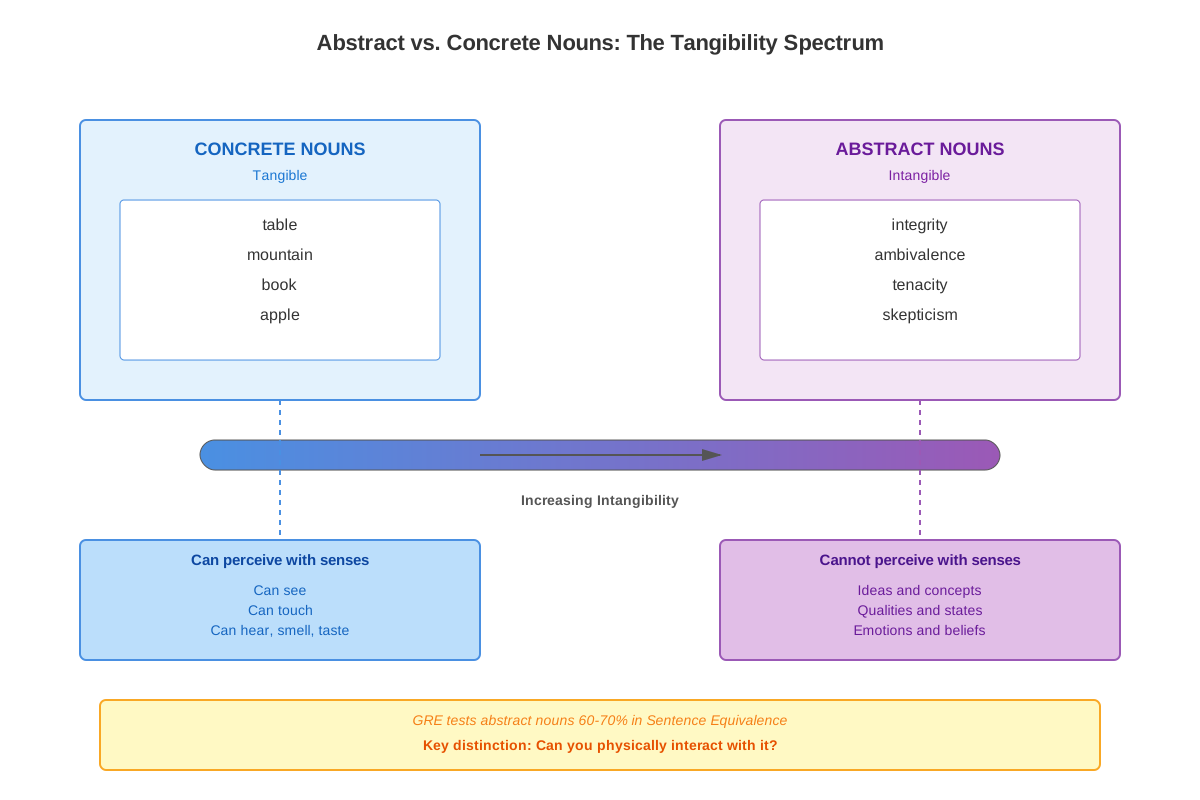
Abstract nouns represent one of the most challenging vocabulary categories tested on the GRE Verbal Reasoning section, particularly within Sentence Equivalence questions. Unlike concrete nouns that refer to tangible objects you can perceive with your senses (like "table" or "mountain"), abstract nouns denote intangible concepts, qualities, states, or ideas—things like "integrity," "ambivalence," or "tenacity." The GRE frequently tests your ability to recognize and correctly use abstract nouns because they require sophisticated vocabulary knowledge and the ability to understand nuanced conceptual relationships within complex sentences.
Mastering gre abstract nouns is essential because these words form the backbone of academic and intellectual discourse—the very register of language the GRE aims to assess. Sentence Equivalence questions often hinge on selecting two abstract nouns that create sentences with equivalent meanings, requiring you to distinguish between closely related concepts like "skepticism" versus "cynicism" or "prudence" versus "parsimony." The test-makers deliberately choose abstract nouns with overlapping semantic fields to challenge your precision in vocabulary usage.
Within the broader Verbal Reasoning landscape, abstract noun mastery connects directly to Reading Comprehension (where understanding abstract concepts aids passage analysis), Text Completion (where abstract nouns frequently fill blanks), and overall vocabulary development. This topic serves as a bridge between pure vocabulary memorization and contextual application, demanding that you understand not just definitions but also connotations, usage patterns, and the subtle distinctions that separate synonyms. Success with abstract nouns signals the kind of linguistic sophistication that correlates strongly with high GRE Verbal scores.
Learning Objectives
- [ ] Identify when Abstract nouns is being tested in GRE Sentence Equivalence and Text Completion questions
- [ ] Explain the core rule or strategy behind Abstract nouns recognition and selection
- [ ] Apply Abstract nouns to GRE-style questions accurately by selecting semantically equivalent pairs
- [ ] Distinguish between abstract nouns with similar but non-equivalent meanings in test contexts
- [ ] Analyze sentence context to determine which abstract noun best captures the intended meaning
- [ ] Evaluate answer choices by testing whether abstract nouns maintain logical consistency within sentences
- [ ] Generate mental associations between abstract nouns and their typical contextual triggers
Prerequisites
- Basic parts of speech identification: Understanding what nouns are and how they function in sentences is fundamental to recognizing abstract nouns as a distinct category
- Intermediate vocabulary foundation: Familiarity with approximately 1000-1500 common GRE words provides the baseline from which to build abstract noun mastery
- Sentence structure comprehension: Ability to parse complex sentences and identify subject-verb-object relationships helps determine where abstract nouns fit logically
- Context clue recognition: Skill in using surrounding words to infer meaning is essential since abstract nouns often appear in contexts that define or constrain their meaning
Why This Topic Matters
Abstract nouns represent the language of ideas, and the GRE is fundamentally a test of your ability to engage with complex ideas expressed through sophisticated vocabulary. In academic settings, research papers, scholarly articles, and intellectual discourse rely heavily on abstract nouns to discuss theories, qualities, processes, and conceptual frameworks. Your facility with these terms directly predicts your readiness for graduate-level reading and writing.
From an exam statistics perspective, abstract nouns appear in approximately 60-70% of Sentence Equivalence questions and 40-50% of Text Completion questions on the GRE. They are particularly prevalent in questions rated as medium to hard difficulty. The Educational Testing Service (ETS) favors abstract nouns because they allow for the creation of questions that test genuine vocabulary depth rather than simple word recognition. A student might recognize the word "parsimony" but fail to distinguish it from "frugality" or "austerity" in a specific context—this nuanced understanding is what the GRE assesses.
Common manifestations in exam passages include: abstract nouns describing character traits or motivations in literary analysis contexts; abstract nouns denoting scientific or philosophical concepts in academic passages; abstract nouns expressing attitudes, emotions, or intellectual stances in argumentative texts; and abstract nouns representing processes, states, or conditions in descriptive or explanatory writing. The ability to quickly identify and correctly interpret these terms can mean the difference between a score in the 150s versus the 160s on the Verbal section.
Core Concepts
Definition and Characteristics of Abstract Nouns
Abstract nouns are words that name intangible concepts—ideas, qualities, emotions, states, or conditions that cannot be perceived through the five senses. Unlike concrete nouns (dog, building, coffee), abstract nouns refer to things that exist conceptually rather than physically. Examples include "democracy," "courage," "hypothesis," "melancholy," and "precedent."
The defining characteristics of abstract nouns include:
- Intangibility: Cannot be touched, seen, heard, smelled, or tasted
- Conceptual nature: Represent ideas or mental constructs
- Derivation patterns: Often formed from adjectives (brave → bravery) or verbs (deceive → deception)
- Context-dependency: Meaning often clarified or constrained by surrounding words
- Gradability: Many can exist in degrees (great courage vs. slight courage)
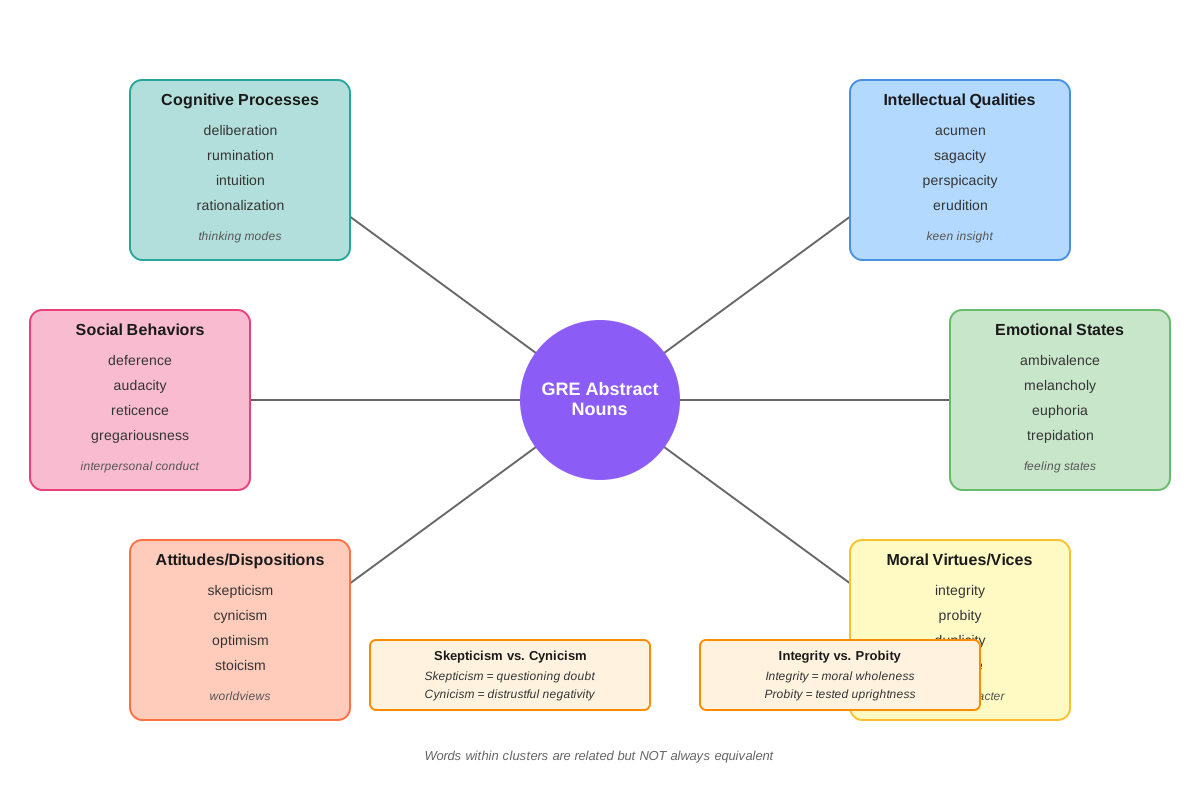
Categories of GRE Abstract Nouns
Understanding the major categories helps organize your vocabulary study and recognition patterns:
| Category | Definition | GRE Examples |
|---|---|---|
| Emotions/Feelings | Internal psychological states | anguish, elation, trepidation, melancholy, euphoria |
| Qualities/Traits | Characteristics or attributes | tenacity, integrity, audacity, sagacity, duplicity |
| States/Conditions | Ways of being or existing | equilibrium, stasis, turmoil, prosperity, adversity |
| Processes | Actions or changes conceptualized as things | evolution, deterioration, proliferation, synthesis |
| Relationships | Connections between entities | correlation, dichotomy, juxtaposition, affinity |
| Intellectual Concepts | Ideas from academic domains | paradigm, hypothesis, axiom, paradox, theorem |
| Social/Political Concepts | Organizational or governance ideas | hegemony, autonomy, bureaucracy, meritocracy |
| Attitudes/Stances | Mental positions or orientations | skepticism, cynicism, optimism, pragmatism |
Semantic Fields and Near-Synonyms
The GRE exploits the fact that abstract nouns often cluster in semantic fields—groups of related words that share conceptual territory but differ in connotation, intensity, or specific application. Consider the semantic field around "carefulness":
- Prudence: Careful, sensible judgment in practical matters
- Caution: Alertness to potential danger or problems
- Circumspection: Careful consideration of circumstances and consequences
- Wariness: Suspicious or distrustful carefulness
- Vigilance: Sustained, watchful attention
In a Sentence Equivalence question, you must select the pair that creates truly equivalent meanings. "Prudence" and "circumspection" might work as equivalents in a sentence about financial planning, while "caution" and "wariness" might be equivalent in a sentence about approaching a potentially dangerous situation.
Connotation and Register
Abstract nouns carry connotative weight beyond their denotative meanings. Consider:
- Thrift (positive): Wise economy in resource management
- Frugality (neutral to positive): Careful spending, avoiding waste
- Parsimony (neutral to negative): Extreme unwillingness to spend
- Stinginess (negative): Ungenerous reluctance to give or spend
The GRE tests whether you recognize these connotative differences. A sentence praising someone's financial management would accept "thrift" or "frugality" but not "parsimony" or "stinginess."
Contextual Determination
Abstract nouns rarely appear in isolation on the GRE. The surrounding context provides crucial clues:
- Modifying adjectives: "Reckless abandon" vs. "calculated restraint"
- Prepositional phrases: "Skepticism about claims" vs. "enthusiasm for innovation"
- Verb relationships: "Demonstrated integrity" vs. "feigned concern"
- Parallel structures: "Neither the _____ of the optimist nor the _____ of the pessimist"
Successful test-takers read the entire sentence, identify the logical relationship being expressed, and select abstract nouns that fit both the semantic requirement and the grammatical structure.
Derivational Morphology
Many abstract nouns follow predictable formation patterns from other parts of speech:
From adjectives (adding suffixes):
- -ity: complex → complexity, authentic → authenticity
- -ness: aware → awareness, bold → boldness
- -cy: accurate → accuracy, private → privacy
From verbs:
- -tion/-sion: evolve → evolution, comprehend → comprehension
- -ment: achieve → achievement, develop → development
- -ance/-ence: resist → resistance, persist → persistence
Recognizing these patterns helps you identify abstract nouns quickly and understand their relationship to root words you may already know.
Concept Relationships
The concepts within abstract noun mastery form an interconnected web. Definition and characteristics serve as the foundation, establishing what abstract nouns are and how they differ from concrete nouns. This foundational understanding → enables recognition → of abstract nouns in test questions.
Categories of abstract nouns provide an organizational framework that → facilitates systematic vocabulary building → which in turn supports semantic field navigation. Understanding that words cluster in related groups helps you → distinguish near-synonyms → which is essential for contextual determination.
Connotation and register knowledge → refines your semantic field understanding → allowing you to select not just related words but truly equivalent ones. Meanwhile, derivational morphology → connects to your existing vocabulary → expanding your abstract noun recognition through word family relationships.
All these concepts converge in the practical skill of contextual determination, where you synthesize category knowledge, semantic distinctions, connotative awareness, and morphological insights to select the correct answer pair in Sentence Equivalence questions.
This topic connects to prerequisite knowledge of basic vocabulary and sentence structure, building upon them to create more sophisticated analytical skills. It also relates forward to Reading Comprehension (where abstract concepts pervade academic passages) and Text Completion (where similar vocabulary precision is required).
High-Yield Facts
⭐ Abstract nouns appear in 60-70% of GRE Sentence Equivalence questions, making them the most frequently tested noun category.
⭐ Semantic equivalence requires matching both denotation AND connotation—words with similar dictionary definitions may not be interchangeable if they carry different emotional or evaluative weight.
⭐ The GRE favors abstract nouns in the 3-6 frequency band (moderately uncommon words), not the most obscure vocabulary, making strategic study highly effective.
⭐ Context clues within the sentence typically constrain meaning to one specific sense of a potentially ambiguous abstract noun.
⭐ Near-synonym traps are the most common wrong answer type—words that are related but not equivalent in the specific sentence context.
- Abstract nouns derived from the same root word (e.g., "comprehension" and "comprehensiveness") often appear as trap answers because they look similar but have distinct meanings.
- Positive and negative versions of similar concepts (optimism/pessimism, confidence/arrogance) frequently appear together as answer choices to test connotation awareness.
- Abstract nouns describing intellectual stances (skepticism, empiricism, pragmatism) are particularly common in science and philosophy passages.
- The GRE often pairs abstract nouns with specific prepositions (affinity for, aversion to, propensity toward) that signal meaning.
- Sentence Equivalence questions with abstract nouns typically have 3-4 words from the same semantic field, requiring fine discrimination rather than basic vocabulary knowledge.
Quick check — test yourself on Abstract nouns so far.
Try Flashcards →Common Misconceptions
Misconception: Abstract nouns are simply "hard vocabulary words" that need to be memorized without understanding their relationships.
Correction: Abstract nouns exist in semantic networks where understanding relationships between related terms is more valuable than isolated memorization. Studying words in clusters (e.g., all words related to "carefulness" or "deception") builds the comparative knowledge the GRE actually tests.
Misconception: If two abstract nouns are synonyms in the thesaurus, they will work as correct answers in Sentence Equivalence.
Correction: Thesaurus synonyms often differ in connotation, register, or specific application. "Parsimony" and "thrift" are thesaurus synonyms, but "Her _____ allowed her to save enough for retirement" would accept "thrift" but not "parsimony" (which implies excessive or ungenerous saving).
Misconception: The most sophisticated or unusual-sounding abstract noun is usually correct.
Correction: The GRE tests precision, not obscurity. The correct answer fits the specific context perfectly, even if it's a more common word. Test-takers who automatically select the most impressive-sounding option often fall for trap answers.
Misconception: Abstract nouns have single, fixed meanings that apply in all contexts.
Correction: Many abstract nouns are polysemous (having multiple related meanings). "Resolution" can mean determination, a formal decision, or the solving of a problem. Context determines which meaning applies, and the GRE exploits this ambiguity.
Misconception: If you don't immediately know an abstract noun, you should skip it and guess.
Correction: Morphological analysis (breaking words into roots, prefixes, suffixes) and contextual reasoning can often lead you to the correct answer even with unfamiliar words. "Pusillanimity" might be unfamiliar, but recognizing "pusill-" relates to weakness and "-animity" to spirit/mind can help you infer it means "lack of courage."
Misconception: Sentence Equivalence questions always have one "obviously right" pair of abstract nouns.
Correction: The GRE deliberately creates questions where multiple pairs might seem plausible on first reading. Careful attention to subtle contextual clues (modifiers, tone, logical relationships) is necessary to identify the truly equivalent pair.
Worked Examples
Example 1: Distinguishing Near-Synonyms
Question: The scientist's _____ prevented her from accepting the new theory without substantial empirical evidence.
(A) skepticism
(B) cynicism
(C) wariness
(D) incredulity
(E) dubiety
(F) pessimism
Step 1: Analyze the context
The sentence describes someone who won't accept a theory without evidence. This is a neutral or positive trait in a scientist—it's about intellectual rigor, not negative attitude.
Step 2: Eliminate based on connotation
- (B) cynicism: Too negative; implies distrust of motives, not just evidence
- (F) pessimism: About expecting negative outcomes, not about evidence standards
- (D) incredulity: Too strong; means "inability to believe," not just "requiring evidence"
Step 3: Examine remaining options
- (A) skepticism: Questioning attitude requiring evidence before belief ✓
- (C) wariness: Caution, but more about danger than intellectual standards
- (E) dubiety: State of doubt or uncertainty ✓
Step 4: Test equivalence
"Skepticism" and "dubiety" both create sentences meaning the scientist requires evidence before accepting claims. "Wariness" suggests fear or suspicion rather than intellectual standards.
Answer: (A) and (E)
Connection to learning objectives: This example demonstrates identifying when abstract nouns are tested (recognizing the blank requires a noun describing an intellectual stance), explaining the strategy (analyzing connotation and context), and applying knowledge accurately (distinguishing between closely related terms).
Example 2: Using Context Clues
Question: Despite the committee's initial _____, the proposal eventually gained support once its financial benefits became apparent.
(A) enthusiasm
(B) resistance
(C) apathy
(D) opposition
(E) indifference
(F) hostility
Step 1: Identify logical structure
"Despite" signals contrast. The proposal "eventually gained support," so initially there must have been lack of support or negative response.
Step 2: Eliminate positive/neutral terms
- (A) enthusiasm: Positive, doesn't contrast with "gained support"
Step 3: Analyze intensity and connotation
- (B) resistance: Opposition to something, moderate intensity ✓
- (C) apathy: Lack of interest or concern ✓
- (D) opposition: Active resistance, similar to (B) ✓
- (E) indifference: Lack of interest, similar to (C) ✓
- (F) hostility: Strong antagonism, very negative
Step 4: Test for true equivalence
The sentence says support was gained "once financial benefits became apparent." This suggests the initial problem was lack of information, not strong antagonism.
- (C) apathy and (E) indifference both mean lack of interest—these are true synonyms ✓
- (B) resistance and (D) opposition are similar but "opposition" is slightly stronger
- (F) hostility is too intense for a context where minds were changed by information
Step 5: Verify with sentence substitution
"Despite the committee's initial apathy/indifference..." Both work perfectly and create equivalent meanings. The financial benefits overcame their lack of interest.
Answer: (C) and (E)
Connection to learning objectives: This demonstrates using context clues (the "despite" contrast and "once benefits became apparent" explanation) to determine which abstract nouns fit, and distinguishing between similar terms (resistance/opposition vs. apathy/indifference) based on subtle contextual requirements.
Exam Strategy
Recognition Triggers
Watch for these signals that abstract nouns are being tested:
- Sentence Equivalence questions with answer choices ending in common abstract noun suffixes (-tion, -ness, -ity, -ism, -ance/-ence, -cy)
- Blanks preceded by possessive pronouns or articles ("his _____," "the _____," "an _____")
- Sentences discussing character traits, emotions, intellectual positions, or conceptual relationships
- Context clues using "lack of," "characterized by," "demonstrated," or "exhibited"
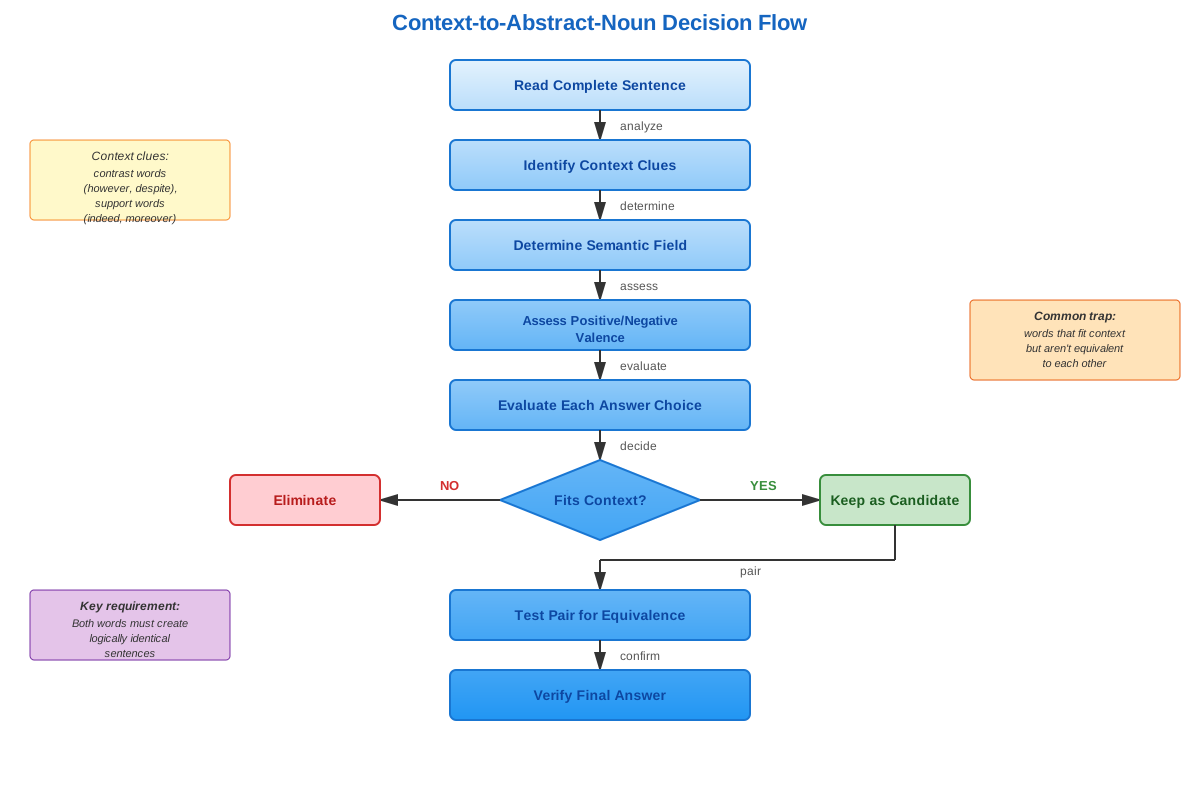
Systematic Approach
- Read the complete sentence first before looking at answer choices—understanding the full context is essential
- Identify the logical relationship the blank must fulfill (cause, effect, contrast, example, etc.)
- Predict the general meaning needed (positive/negative, strong/weak, specific semantic field)
- Eliminate based on connotation before worrying about fine distinctions
- Test remaining pairs by substituting both words and checking for equivalent meaning
- Verify with context clues—modifiers, prepositions, and surrounding words should work equally well with both selected words
Process of Elimination Tips
First pass—eliminate obvious mismatches:
- Words with wrong connotation (positive when negative is needed)
- Words from wrong semantic category (emotion when intellectual stance is needed)
- Words too extreme or too weak for the context
Second pass—test potential pairs:
- Identify which words could plausibly work alone
- Look for true synonym pairs among remaining options
- Be suspicious of "near-synonym traps"—words that are related but not equivalent
Third pass—verify with substitution:
- Read the sentence with each word of your selected pair
- Confirm both create logical, equivalent sentences
- Check that all modifiers and context clues work with both words
Time Allocation
For Sentence Equivalence questions with abstract nouns:
- 30-45 seconds: Initial read and prediction
- 30-45 seconds: Elimination and pair identification
- 15-30 seconds: Verification
- Total: 75-120 seconds per question
Don't rush the verification step—abstract noun questions reward careful analysis, and the time invested prevents careless errors.
Exam Tip: If you're stuck between two pairs, look for the pair where both words have the SAME connotation (both neutral, both slightly negative, etc.). The correct pair will match in emotional tone, not just general meaning.
Memory Techniques
Semantic Field Mapping
Create mental maps of related abstract nouns organized by intensity and connotation:
Carefulness Spectrum (negative → neutral → positive):
- Timidity → Caution → Prudence → Circumspection
- Wariness → Vigilance → Attentiveness
Confidence Spectrum (negative → neutral → positive):
- Arrogance → Hubris → Pride → Confidence → Self-assurance
- Presumptuousness → Boldness → Audacity
The SCAN Method for Abstract Nouns
Semantic field: What category does this word belong to?
Connotation: Positive, negative, or neutral?
Application: What contexts typically use this word?
Near-synonyms: What similar words must I distinguish this from?
Root Word Associations
Connect abstract nouns to their roots for better retention:
- Tenacity ← tenere (to hold) → "holding on firmly" → persistence
- Veracity ← verus (true) → "truthfulness"
- Sagacity ← sagax (wise) → "wisdom, keen judgment"
- Audacity ← audere (to dare) → "bold daring"
Connotation Color Coding
Mentally assign colors to connotations:
- 🟢 Green = positive (integrity, benevolence, sagacity)
- 🟡 Yellow = neutral (observation, analysis, methodology)
- 🔴 Red = negative (duplicity, malevolence, obstinacy)
This visual association helps you quickly eliminate wrong-connotation answers.
The "Character Trait" Mnemonic
For personality-related abstract nouns, imagine specific fictional or historical figures who embody each trait:
- Tenacity: Think of someone who never gives up
- Duplicity: Think of a character known for deception
- Magnanimity: Think of a generous, forgiving leader
Concrete associations make abstract concepts more memorable.
Summary
Abstract nouns represent intangible concepts—qualities, emotions, states, processes, and ideas—that form the sophisticated vocabulary tested extensively on the GRE Verbal Reasoning section. Success with abstract nouns requires understanding not just individual word definitions but the semantic fields in which related words cluster, the connotative differences that distinguish near-synonyms, and the contextual clues that determine which specific meaning applies in a given sentence. The GRE tests abstract nouns primarily through Sentence Equivalence questions that require selecting two words creating equivalent meanings, deliberately including trap answers that are related but not truly synonymous in context. Mastery involves systematic analysis: reading complete sentences for context, identifying logical relationships, eliminating based on connotation and semantic fit, testing potential pairs for true equivalence, and verifying that both selected words work identically with all contextual elements. The most effective study approach organizes abstract nouns into categories and semantic fields rather than treating them as isolated vocabulary items, building the comparative knowledge that enables the fine discriminations the GRE demands.
Key Takeaways
- Abstract nouns name intangible concepts (qualities, emotions, states, ideas) and appear in 60-70% of Sentence Equivalence questions, making them the highest-yield vocabulary category for GRE preparation
- Semantic equivalence requires matching both denotation and connotation—words must be true synonyms in the specific sentence context, not just related terms from the same semantic field
- Context clues are decisive: modifiers, prepositions, logical relationships, and tone indicators constrain meaning and reveal which abstract nouns fit precisely
- Near-synonym traps are the most common wrong answers—the GRE deliberately includes related words that don't create equivalent sentences to test your ability to make fine distinctions
- Systematic elimination and verification prevent errors: analyze connotation first, identify potential pairs second, and always verify by substituting both words to confirm equivalent meaning
- Studying words in semantic clusters (groups of related abstract nouns) is more effective than isolated memorization because it builds the comparative knowledge the test actually assesses
- Morphological analysis helps with unfamiliar words: recognizing roots, prefixes, and suffixes allows you to infer meanings and make educated guesses even with vocabulary gaps
Related Topics
Text Completion with Abstract Nouns: While this guide focuses on Sentence Equivalence, abstract nouns appear equally frequently in Text Completion questions, where you must select single words that fit multi-blank sentences. Mastering abstract nouns in Sentence Equivalence builds the vocabulary foundation for Text Completion success.
Concrete vs. Abstract Noun Distinctions: Understanding the full spectrum from concrete to abstract helps with metaphorical language and figurative usage in Reading Comprehension passages, where abstract concepts are often explained through concrete examples.
Adjective-Noun Collocations: Many abstract nouns pair with specific adjectives ("abject poverty," "tacit approval," "wanton destruction"). Studying these collocations enhances both your recognition speed and your ability to use context clues.
Verbal Root Analysis: Deepening your knowledge of Latin and Greek roots that form abstract nouns expands your vocabulary exponentially and improves your ability to decode unfamiliar words under test conditions.
Reading Comprehension Vocabulary in Context: The abstract nouns mastered here appear throughout GRE reading passages. This topic enables progression toward understanding complex academic prose where abstract concepts are central.
Practice CTA
Now that you've mastered the core concepts of abstract nouns, it's time to cement your knowledge through active practice. Attempt the practice questions designed specifically for this topic—they'll challenge you to apply the strategies you've learned and refine your ability to distinguish between near-synonyms in realistic GRE contexts. Use the flashcards to build automatic recognition of high-frequency abstract nouns and their connotations. Remember: vocabulary mastery comes from repeated exposure and application, not passive reading. Each practice question you work through strengthens the neural pathways that will fire automatically on test day, giving you the confidence and speed to excel on even the most challenging Sentence Equivalence questions. Your investment in deliberate practice now will pay dividends in your Verbal Reasoning score!
Sign up free to keep reading
Create a free AnvayaPrep account to finish this GRE guide on Abstract nouns — plus flashcards and practice questions.