Overview
Contextual equivalence is one of the most critical skills tested in the GRE Verbal Reasoning section, particularly within Sentence Equivalence questions. This concept requires test-takers to identify two answer choices that, when inserted into a sentence, produce completed sentences that are alike in meaning. The challenge lies not merely in finding synonyms, but in selecting words that create equivalent meanings within the specific context of the sentence. Unlike simple vocabulary matching, GRE contextual equivalence demands that students understand how words interact with surrounding text to produce parallel semantic outcomes.
Mastering contextual equivalence is essential because it appears in every Sentence Equivalence question on the GRE, which constitutes approximately one-third of all Verbal Reasoning questions. Students who fail to grasp this concept often fall into the trap of selecting synonyms that don't fit the sentence's logic or choosing words that fit individually but don't create equivalent meanings. The ability to recognize contextual equivalence separates high scorers from average performers, as it requires simultaneous attention to vocabulary, logic, and semantic nuance.
Within the broader landscape of GRE Verbal Reasoning, contextual equivalence bridges vocabulary knowledge and reading comprehension. It requires the same careful attention to tone, connotation, and logical relationships that students apply in Text Completion and Reading Comprehension questions. However, it adds the unique challenge of ensuring that two different words produce sentences with the same essential meaning—a skill that tests both linguistic precision and logical reasoning under time pressure.
Learning Objectives
- [ ] Identify when Contextual equivalence is being tested
- [ ] Explain the core rule or strategy behind Contextual equivalence
- [ ] Apply Contextual equivalence to GRE-style questions accurately
- [ ] Distinguish between simple synonyms and contextually equivalent word pairs
- [ ] Evaluate whether two completed sentences convey the same essential meaning
- [ ] Recognize common traps that exploit superficial synonym relationships without contextual fit
Prerequisites
- Advanced vocabulary knowledge: Understanding word meanings, connotations, and usage patterns is fundamental to selecting contextually appropriate answers
- Sentence structure comprehension: Recognizing how different parts of a sentence relate logically enables accurate prediction of missing words
- Basic synonym and antonym relationships: Familiarity with word relationships provides a starting point, though contextual equivalence requires deeper analysis
- Logical reasoning skills: The ability to follow cause-effect relationships and logical connections within sentences is essential for evaluating meaning equivalence
Why This Topic Matters
Contextual equivalence represents a sophisticated language skill with real-world applications beyond standardized testing. In professional writing, legal documents, academic papers, and business communications, the ability to express the same idea using different words while maintaining precise meaning is invaluable. This skill enables effective paraphrasing, helps avoid plagiarism, and allows writers to adjust tone and style while preserving content accuracy.
On the GRE specifically, Sentence Equivalence questions appear approximately 4-5 times per Verbal Reasoning section, accounting for roughly 25-30% of the section score. These questions are considered medium to high difficulty, with the hardest versions appearing in the second Verbal section for test-takers who perform well on the first section. The ETS (Educational Testing Service) specifically designs these questions to test whether students can move beyond superficial vocabulary knowledge to demonstrate genuine understanding of how words function in context.
Contextual equivalence appears in the GRE through sentences that contain a single blank and six answer choices, from which students must select exactly two words that create sentences alike in meaning. These sentences typically feature complex logical structures, including contrast relationships, cause-effect patterns, parallel constructions, and nuanced descriptions. The test frequently includes "trap" answer choices that are synonyms of each other but don't fit the context, or words that fit the context individually but don't create equivalent meanings when paired.
Core Concepts
The Fundamental Principle of Contextual Equivalence
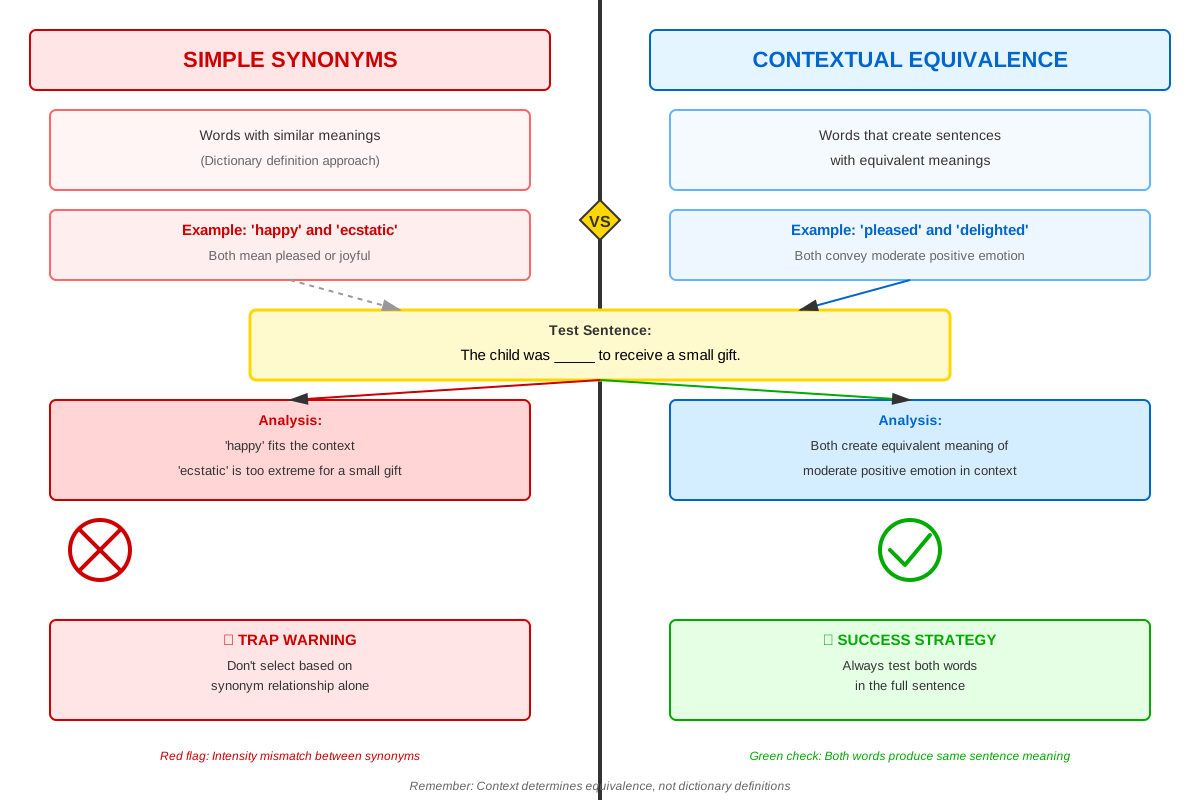
Contextual equivalence requires that two different words, when substituted into the same sentence, produce completed sentences that convey essentially the same meaning. This goes beyond simple synonym matching because words that are synonyms in isolation may not be interchangeable in a specific context. For example, "happy" and "ecstatic" are synonyms, but in the sentence "The diplomat's _____ response avoided offending either party," only "measured" or "diplomatic" would work—not emotional descriptors, regardless of their synonym relationships.
The core principle involves three simultaneous requirements:
- Each selected word must fit the grammatical structure of the sentence
- Each selected word must align with the logical meaning and tone of the sentence
- The two selected words must produce sentences with equivalent overall meanings
Context Clues and Logical Indicators
Successful application of contextual equivalence depends on identifying context clues within the sentence that constrain word choice. These clues include:
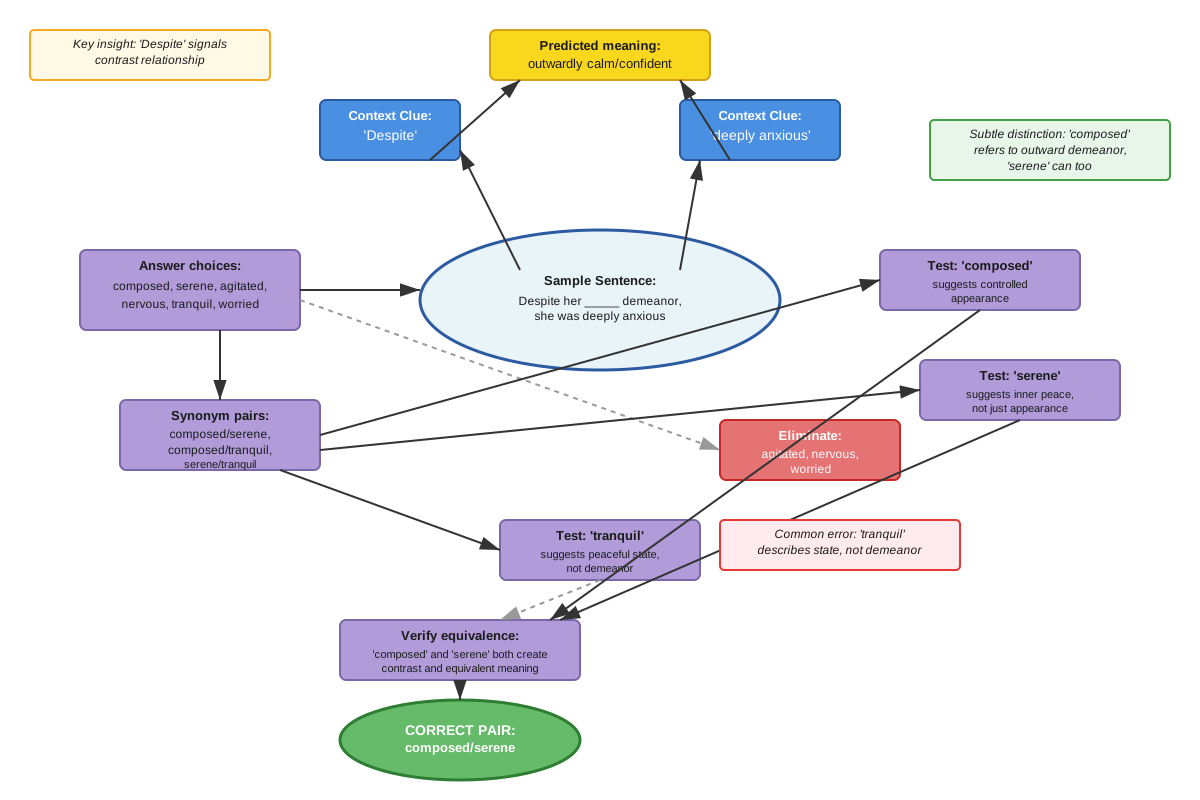
- Contrast indicators: Words like "although," "despite," "however," and "yet" signal that the blank should contain a word opposite to another concept in the sentence
- Support indicators: Words like "because," "since," "therefore," and "thus" indicate the blank should reinforce or explain another part of the sentence
- Parallel structure: When a sentence contains lists or comparisons, the blank often needs to match the pattern or tone of other elements
- Tone markers: Adjectives, adverbs, and descriptive phrases establish whether the blank requires a positive, negative, or neutral word
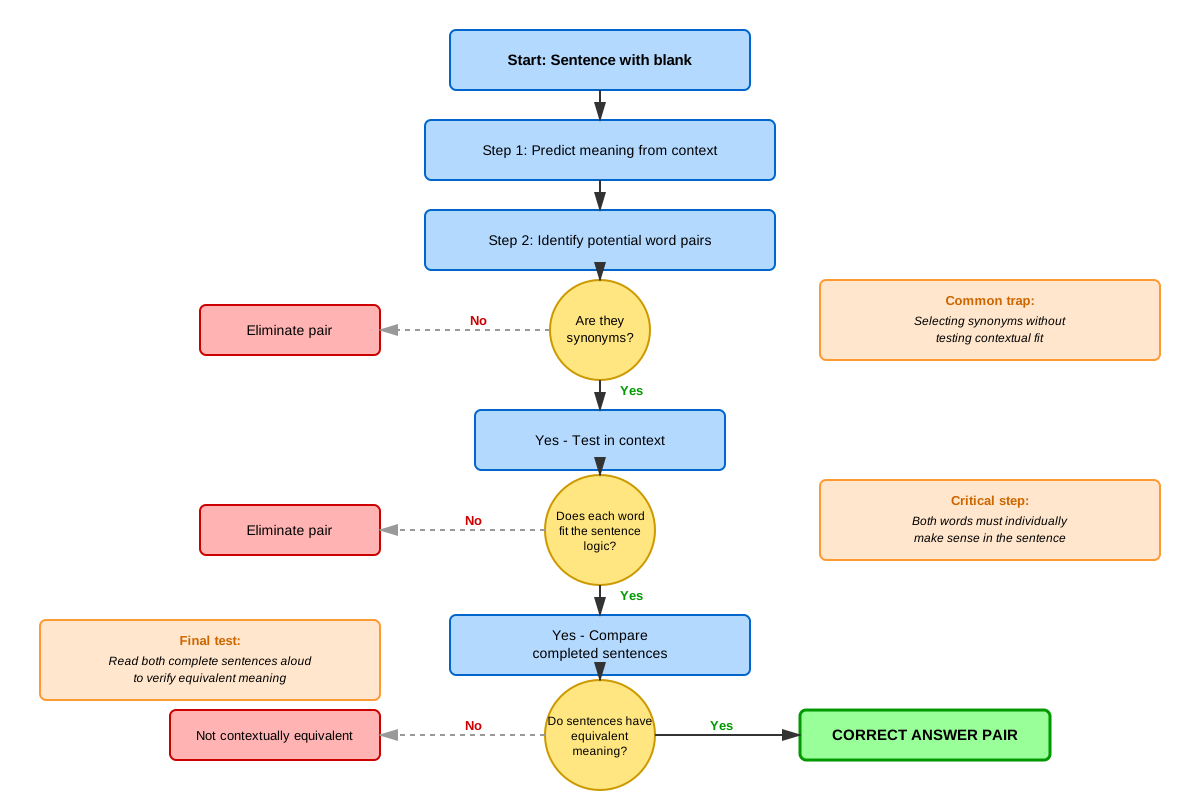
The Two-Step Verification Process
Applying contextual equivalence effectively requires a systematic approach:
Step 1: Predict the meaning
Before looking at answer choices, read the sentence carefully and predict what type of word would logically complete it. Consider the sentence's overall meaning, tone, and logical structure. This prediction doesn't need to be a specific word—it can be a concept like "something negative about the politician's behavior" or "a word meaning to make worse."
Step 2: Test for equivalence
After identifying two words that fit your prediction, create two complete sentences by substituting each word individually. Read both sentences and ask: "Do these sentences mean essentially the same thing?" If the answer is yes, you've found contextual equivalence. If the meanings differ in any significant way, continue searching.
Distinguishing Synonyms from Contextual Equivalents
A critical distinction exists between words that are synonyms and words that are contextually equivalent in a specific sentence:
| Relationship Type | Definition | Example |
|---|---|---|
| Synonyms | Words with similar meanings in general usage | "intelligent" and "smart" |
| Contextual Equivalents | Words that create equivalent sentence meanings in a specific context | In "The _____ student," both "intelligent" and "smart" work; in "The _____ decision," both "intelligent" and "wise" work, but "smart" may not |
| Non-equivalent Synonyms | Words that are synonyms but don't create equivalent meanings in context | "Thin" and "slender" are synonyms, but in "The evidence was _____," only "thin" works to mean "weak" |
Common Sentence Structures in Contextual Equivalence Questions
GRE Sentence Equivalence questions frequently employ specific sentence structures:
Cause-and-effect structures: "Because of the scientist's _____ methodology, her results were questioned by peers." The blank must describe a methodology that logically leads to questioned results (perhaps "sloppy" and "careless").
Contrast structures: "Although the CEO appeared _____ in public, colleagues knew her to be quite anxious." The blank needs a word opposite to "anxious" (perhaps "confident" and "assured").
Descriptive elaboration: "The professor's lectures were so _____ that students often left more confused than when they arrived." The blank requires words describing lectures that cause confusion (perhaps "convoluted" and "abstruse").
The Role of Connotation in Equivalence
Connotation—the emotional or cultural associations of a word beyond its literal definition—plays a crucial role in contextual equivalence. Two words might have similar denotations (literal meanings) but different connotations, which can prevent them from being contextually equivalent. For instance, "frugal" and "cheap" both relate to spending little money, but "frugal" carries positive connotations of wise money management, while "cheap" often implies excessive stinginess or poor quality. In a sentence praising someone's financial habits, only "frugal" would work; in a sentence criticizing someone, only "cheap" might fit.
Concept Relationships
The concepts within contextual equivalence form an interconnected system where each element supports the others. Context clues serve as the foundation, providing the logical and semantic constraints that determine which words can fit. These clues feed into the prediction process, where students formulate expectations about the blank's meaning. The prediction then guides answer choice evaluation, where students test whether words fit both individually and as pairs. Finally, connotation awareness and synonym distinction act as filters, helping students avoid trap answers that seem correct superficially but fail the equivalence test.
Contextual equivalence connects to prerequisite topics through multiple pathways: Vocabulary knowledge → provides the raw material of word meanings → enables contextual equivalence → which requires sentence structure comprehension → to identify logical relationships → that determine context clues → which guide word selection.
The relationship map flows as follows:
Sentence Analysis → identifies → Context Clues → constrain → Meaning Prediction → guides → Answer Evaluation → requires → Synonym Distinction → leads to → Equivalence Verification → produces → Correct Answer Pair
High-Yield Facts
⭐ Contextual equivalence requires that two words create sentences with the same essential meaning, not just that the two words are synonyms of each other.
⭐ Approximately 25-30% of GRE Verbal Reasoning questions test contextual equivalence through Sentence Equivalence format.
⭐ The most common trap in Sentence Equivalence questions is selecting two synonyms that fit individually but don't create equivalent sentence meanings.
⭐ Context clues such as contrast indicators (although, despite, however) and support indicators (because, therefore, thus) are essential for predicting the blank's meaning.
⭐ Both selected words must match the sentence's tone and connotation, not just its literal meaning.
- Sentence Equivalence questions always have exactly six answer choices and require selecting exactly two correct answers.
- Words with similar denotations but different connotations (like "frugal" vs. "cheap") are rarely contextually equivalent.
- The correct answer pair will produce sentences that could be used interchangeably in the same context without changing meaning.
- Predicting the blank's meaning before reviewing answer choices significantly improves accuracy and speed.
- If only one word seems to fit perfectly, re-examine the sentence—there must be a second word that creates equivalent meaning.
- Parallel structure in sentences often signals that the blank should match the grammatical form or semantic category of another element.
Quick check — test yourself on Contextual equivalence so far.
Try Flashcards →Common Misconceptions
Misconception: Any two synonyms from the answer choices will be the correct answer.
Correction: Synonyms must create contextually equivalent sentences, not just be related in meaning. The GRE frequently includes synonym pairs as trap answers that don't fit the sentence's specific context or don't produce equivalent meanings when substituted.
Misconception: If a word fits the blank logically, it must be one of the correct answers.
Correction: A word can fit the sentence perfectly but still be incorrect if there's no other answer choice that creates an equivalent meaning. Both words must work individually AND produce equivalent sentences together.
Misconception: The two correct answers will always be perfect synonyms in all contexts.
Correction: The correct answers need only be equivalent within the specific sentence context. They may have different meanings in other contexts or different connotations, as long as they produce equivalent meanings in the given sentence.
Misconception: Longer or more complex words are more likely to be correct answers.
Correction: The GRE tests contextual understanding, not vocabulary difficulty. Simple words can be correct answers if they create contextual equivalence, and complex words can be trap answers if they don't fit the context despite sounding sophisticated.
Misconception: If two words have opposite meanings, they cannot both be correct.
Correction: While rare, sentences with double negatives or complex logical structures might require words that seem opposite but create equivalent meanings. For example, "not uncommon" and "typical" could both work in certain contexts.
Misconception: The sentence will always contain obvious context clues.
Correction: Some high-difficulty Sentence Equivalence questions feature subtle context clues requiring careful analysis of tone, logical relationships, and connotation. Students must read actively and consider multiple aspects of the sentence simultaneously.
Worked Examples
Example 1: Contrast Structure
Question: "Although the restaurant's décor was _____, the quality of the food more than compensated for the ambiance."
Answer Choices:
A) elegant
B) sparse
C) austere
D) lavish
E) ornate
F) impressive
Step 1: Analyze context clues
The word "Although" signals a contrast relationship. The phrase "more than compensated for" suggests that the décor was somehow lacking or negative, since the food had to compensate for it.
Step 2: Predict meaning
The blank needs a word with negative connotations about the décor—something that would require compensation. We're looking for words meaning "plain," "lacking," or "unimpressive."
Step 3: Evaluate answer choices
- A) elegant - positive, doesn't need compensation ✗
- B) sparse - negative, means lacking decoration ✓
- C) austere - negative, means severely simple ✓
- D) lavish - positive, doesn't need compensation ✗
- E) ornate - positive, doesn't need compensation ✗
- F) impressive - positive, doesn't need compensation ✗
Step 4: Verify equivalence
"Although the restaurant's décor was sparse, the quality of the food more than compensated for the ambiance."
"Although the restaurant's décor was austere, the quality of the food more than compensated for the ambiance."
Both sentences convey the same essential meaning: the décor was plain/simple/lacking, but the food was good enough to make up for it. Answers: B and C
Connection to learning objectives: This example demonstrates identifying when contextual equivalence is tested (contrast structure with "although"), explaining the core strategy (analyzing context clues and predicting meaning), and applying the concept accurately (selecting words that create equivalent meanings, not just synonyms).
Example 2: Cause-Effect Structure
Question: "The politician's _____ remarks during the debate alienated moderate voters who had previously supported her campaign."
Answer Choices:
A) inflammatory
B) measured
C) provocative
D) conciliatory
E) diplomatic
F) thoughtful
Step 1: Analyze context clues
The phrase "alienated moderate voters" indicates a negative outcome. The word "previously supported" suggests these voters changed their opinion because of the remarks. This is a cause-effect relationship where the remarks caused alienation.
Step 2: Predict meaning
The blank needs words describing remarks that would cause moderate voters to feel alienated—likely something extreme, offensive, or divisive. We're looking for words with negative connotations suggesting controversy or extremism.
Step 3: Evaluate answer choices
- A) inflammatory - negative, means provoking anger ✓
- B) measured - positive, means careful and moderate ✗
- C) provocative - negative, means deliberately causing controversy ✓
- D) conciliatory - positive, means promoting peace ✗
- E) diplomatic - positive, means tactful ✗
- F) thoughtful - positive, means considerate ✗
Step 4: Verify equivalence
"The politician's inflammatory remarks during the debate alienated moderate voters who had previously supported her campaign."
"The politician's provocative remarks during the debate alienated moderate voters who had previously supported her campaign."
Both sentences convey that the politician said something controversial or extreme that caused moderate voters to withdraw support. The essential meaning is equivalent. Answers: A and C
Connection to learning objectives: This example shows how to identify cause-effect structures as tests of contextual equivalence, apply the strategy of matching tone and connotation (both words must be negative to cause alienation), and verify that different words produce equivalent overall meanings.
Exam Strategy
Primary Strategy: Always predict the blank's meaning before looking at answer choices. This prevents being swayed by attractive but incorrect options and focuses attention on the sentence's logical requirements.
When approaching GRE Sentence Equivalence questions, follow this systematic process:
Time allocation: Spend 60-90 seconds per Sentence Equivalence question. Allocate 20-30 seconds to reading and analyzing the sentence, 20-30 seconds to evaluating answer choices, and 20-30 seconds to verifying equivalence.
Trigger words to watch for:
- Contrast indicators: although, despite, however, yet, while, whereas, nevertheless
- Support indicators: because, since, therefore, thus, consequently, accordingly
- Intensifiers: very, extremely, particularly, especially, remarkably
- Qualifiers: somewhat, rather, relatively, fairly, quite
Process-of-elimination approach:
- Eliminate words that don't fit the context: Remove any answer choices that contradict the sentence's logic or tone, regardless of their relationships to other words.
- Eliminate words with wrong connotations: If the sentence requires a positive word, eliminate all negative options, and vice versa.
- Test remaining pairs for equivalence: Among words that fit individually, test pairs to see which creates equivalent meanings. Often, only one pair will work.
- Beware of synonym traps: If you identify two synonyms quickly, verify they actually fit the sentence before selecting them. The GRE often includes synonym pairs as distractors.
Advanced techniques:
- Substitute both words and read aloud mentally: This helps catch subtle meaning differences that might not be apparent when just considering words in isolation.
- Look for parallel structure: If the sentence contains a list or comparison, the blank often needs to match the grammatical form or semantic category of other elements.
- Consider degree and intensity: Words might be similar but differ in intensity (e.g., "concerned" vs. "alarmed"). Ensure both selected words match the sentence's intensity level.
- Trust logical analysis over vocabulary intuition: If logical analysis suggests two words that don't seem like obvious synonyms, trust the logic. Contextual equivalence doesn't require perfect synonymy.
Memory Techniques
PACE Acronym for Sentence Analysis:
- Predict the meaning before looking at choices
- Analyze context clues (contrast, support, tone)
- Check that both words fit individually
- Ensure the completed sentences are equivalent
The "Twin Sentence" Visualization:
Imagine creating two identical twins from the original sentence. Each twin gets one of your selected words. If the twins can say the same thing at a party and mean exactly the same thing, you've found contextual equivalence. If one twin would be saying something slightly different, keep searching.
Connotation Color Coding:
Mentally assign colors to connotations: green for positive, red for negative, yellow for neutral. The sentence's context will suggest a color, and both correct answers must match that color. This prevents mixing positive and negative words.
The "Swap Test" Mnemonic:
Remember: "SWAP - Same Words, Alternate Positions = Perfect equivalence." If you can swap the two words into each other's positions in different sentences and maintain the same meaning, they're contextually equivalent.
Context Clue Categories - "CAST":
- Contrast words (although, despite, however)
- Agreement words (and, also, similarly)
- Support words (because, therefore, thus)
- Tone markers (adjectives, adverbs, descriptive phrases)
Summary
Contextual equivalence is the foundational skill for GRE Sentence Equivalence questions, requiring students to select two words that create sentences with equivalent meanings within a specific context. Success depends on moving beyond simple synonym recognition to understand how words interact with surrounding text to produce parallel semantic outcomes. The core strategy involves analyzing context clues, predicting the blank's meaning before reviewing choices, and verifying that both selected words produce sentences that could be used interchangeably. Students must distinguish between words that are synonyms in general usage and words that are equivalent in the specific sentence context, paying careful attention to connotation, tone, and logical relationships. Common traps include selecting synonyms that don't fit the context or choosing words that fit individually but don't create equivalent meanings together. Mastery requires systematic application of the two-step verification process: first ensuring each word fits the sentence's logic and tone, then confirming that the completed sentences convey essentially the same meaning.
Key Takeaways
- Contextual equivalence requires equivalent sentence meanings, not just synonym relationships between answer choices
- Always predict the blank's meaning using context clues before evaluating answer choices
- Both selected words must match the sentence's tone, connotation, and logical structure
- The most common trap is selecting synonyms that don't create equivalent meanings in the specific context
- Verify equivalence by mentally reading both completed sentences and confirming they mean the same thing
- Context clues (contrast indicators, support indicators, tone markers) are essential for accurate prediction
- Approximately 25-30% of Verbal Reasoning questions test this skill, making it high-yield for score improvement
Related Topics
Text Completion (Single Blank): While similar to Sentence Equivalence, single-blank Text Completion requires finding only one correct answer rather than two equivalent answers. Mastering contextual equivalence provides the analytical skills needed for Text Completion questions.
Text Completion (Multiple Blanks): These questions extend the principles of contextual equivalence across multiple blanks, requiring students to understand how word choices in different positions interact to create coherent meaning.
Reading Comprehension - Vocabulary in Context: The skill of determining word meaning from context, tested in Reading Comprehension questions, relies on the same context clue analysis used in contextual equivalence.
Vocabulary Building: A robust vocabulary foundation enables faster recognition of potential answer pairs and more accurate evaluation of connotation and tone differences.
Logical Reasoning: Understanding cause-effect relationships, contrast structures, and parallel constructions—all essential for contextual equivalence—transfers directly to logical reasoning tasks throughout the Verbal section.
Practice CTA
Now that you understand the principles of contextual equivalence, it's time to reinforce your learning through active practice. Attempt the practice questions designed for this topic, focusing on applying the systematic approach outlined in this guide. Use the flashcards to strengthen your recognition of context clues and common sentence structures. Remember that contextual equivalence is a skill that improves dramatically with deliberate practice—each question you work through builds your ability to recognize patterns and avoid common traps. Your investment in mastering this high-yield topic will pay dividends across the entire Verbal Reasoning section. Start practicing now to transform your understanding into exam-day performance!
Sign up free to keep reading
Create a free AnvayaPrep account to finish this GRE guide on Contextual equivalence — plus flashcards and practice questions.