Overview
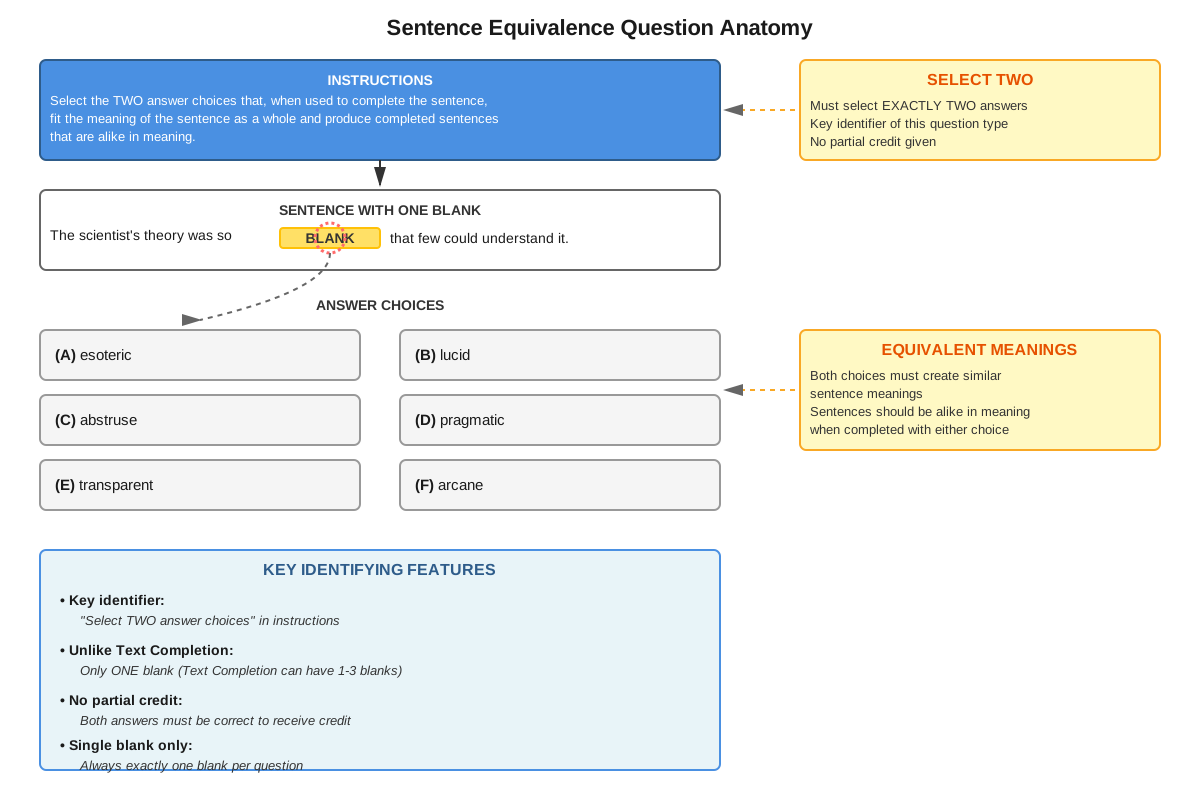
Sentence equivalence basics form one of the two primary question types in the GRE Verbal Reasoning section, alongside Text Completion. These questions present a single sentence with one blank and ask test-takers to select two answer choices that, when inserted into the blank, produce sentences that are both logically complete and similar in meaning. Unlike traditional synonym questions, sentence equivalence requires understanding context, nuance, and the precise relationship between words and their surrounding text. Mastering this question type is non-negotiable for achieving a competitive GRE score, as it appears consistently throughout the exam and tests multiple verbal skills simultaneously.
The GRE sentence equivalence basics encompass understanding the fundamental structure of these questions, recognizing the logical relationships within sentences, and developing a systematic approach to answer selection. Each sentence equivalence question provides six answer choices, from which exactly two must be selected to create equivalent meanings. This format tests vocabulary knowledge, reading comprehension, and the ability to discern subtle differences in word meaning and connotation. The questions are designed to penalize partial knowledge—selecting only one correct answer yields no points, making strategic thinking essential.
Within the broader Verbal Reasoning framework, sentence equivalence questions bridge vocabulary mastery and contextual reading comprehension. They require less extensive reading than Reading Comprehension passages but demand more precise vocabulary knowledge than simple definition matching. Success with sentence equivalence directly supports performance on Text Completion questions, as both question types assess the ability to understand logical flow, recognize semantic relationships, and select contextually appropriate words. The skills developed through sentence equivalence practice—particularly the ability to predict meaning before viewing answer choices—transfer directly to all other verbal question types.
Learning Objectives
- [ ] Identify when Sentence equivalence basics is being tested
- [ ] Explain the core rule or strategy behind Sentence equivalence basics
- [ ] Apply Sentence equivalence basics to GRE-style questions accurately
- [ ] Distinguish between synonyms that create equivalent sentence meanings versus those that merely share dictionary definitions
- [ ] Develop a systematic pre-reading strategy to predict blank content before examining answer choices
- [ ] Recognize and avoid common trap answers that exploit superficial word associations
Prerequisites
- Fundamental vocabulary knowledge: Understanding basic word definitions and parts of speech enables recognition of contextually appropriate answer choices
- Sentence structure comprehension: Identifying subjects, verbs, objects, and modifying phrases helps determine what type of word logically fits the blank
- Basic logical reasoning: Recognizing cause-effect relationships, contrasts, and continuations within sentences is essential for predicting blank content
- Synonym and antonym recognition: Distinguishing between words with similar versus opposite meanings forms the foundation for identifying equivalent answer pairs
Why This Topic Matters
Sentence equivalence questions constitute approximately one-third of all Verbal Reasoning questions on the GRE, appearing 4-6 times per 20-question verbal section. This frequency makes them high-impact questions that significantly influence overall verbal scores. Unlike Reading Comprehension, which can be time-intensive, sentence equivalence questions offer opportunities for efficient point accumulation when approached systematically. Test-takers who master sentence equivalence basics often complete these questions in 60-90 seconds each, creating time reserves for more challenging passages.
Beyond the exam context, the skills developed through sentence equivalence practice have real-world applications in academic writing, professional communication, and critical reading. The ability to recognize precise word meanings in context, distinguish between subtle semantic differences, and maintain logical consistency across sentence structures directly supports graduate-level coursework. These questions mirror the type of careful reading and precise expression required in research papers, grant proposals, and professional correspondence.
On the GRE, sentence equivalence questions typically test mid-to-high-frequency vocabulary in context, making them more predictable than the most obscure Text Completion questions. Common patterns include sentences with contrast indicators (however, although, despite), cause-effect relationships (because, therefore, consequently), and descriptive passages requiring adjectives or adverbs that match specific tones. Recognizing these patterns enables strategic prediction and efficient answer elimination, transforming sentence equivalence from a vocabulary test into a logical reasoning exercise.
Core Concepts
The Fundamental Structure
Sentence equivalence questions present a single sentence containing one blank, followed by six answer choices labeled A through F. The instructions require selecting exactly two choices that both complete the sentence logically and create sentences similar in meaning. This "similar in meaning" requirement distinguishes sentence equivalence from simple fill-in-the-blank exercises. The two correct answers must be near-synonyms in the specific context of the sentence, even if they have different meanings in other contexts.
The scoring mechanism penalizes partial knowledge: selecting only one correct answer or one correct and one incorrect answer yields zero points. This all-or-nothing approach means that guessing randomly provides a 1-in-15 chance of success (since there are 15 possible two-answer combinations from six choices). Strategic elimination and context-based prediction dramatically improve these odds.
Context Clues and Prediction Strategy
The most powerful approach to sentence equivalence involves predicting the blank's content before examining answer choices. This prediction need not be a specific word—a general concept, tone, or direction suffices. For example, if a sentence reads "Despite his reputation for frugality, the executive's spending habits were surprisingly _____," the context clues "despite" (contrast indicator) and "frugality" (thriftiness) suggest the blank requires a word meaning "extravagant" or "wasteful."
Context clues fall into several categories:
- Contrast indicators: however, although, despite, yet, nevertheless, while
- Continuation indicators: and, moreover, furthermore, similarly, likewise
- Cause-effect indicators: because, therefore, thus, consequently, since
- Definition/restatement: semicolons, colons, "in other words," "that is"
- Example indicators: such as, for instance, including
Identifying these structural signals helps determine whether the blank should align with or oppose surrounding ideas. A sentence with "although" typically requires a word that contrasts with another part of the sentence, while "furthermore" suggests continuation of an established idea.
The Equivalence Requirement
The term "similar in meaning" requires careful interpretation. The two correct answers must create sentences that convey essentially the same message, not merely sentences that are both grammatically correct or logically plausible. Consider this example:
"The professor's lecture was so _____ that students struggled to remain attentive."
Possible answers might include: tedious, complex, brief, monotonous, fascinating, challenging
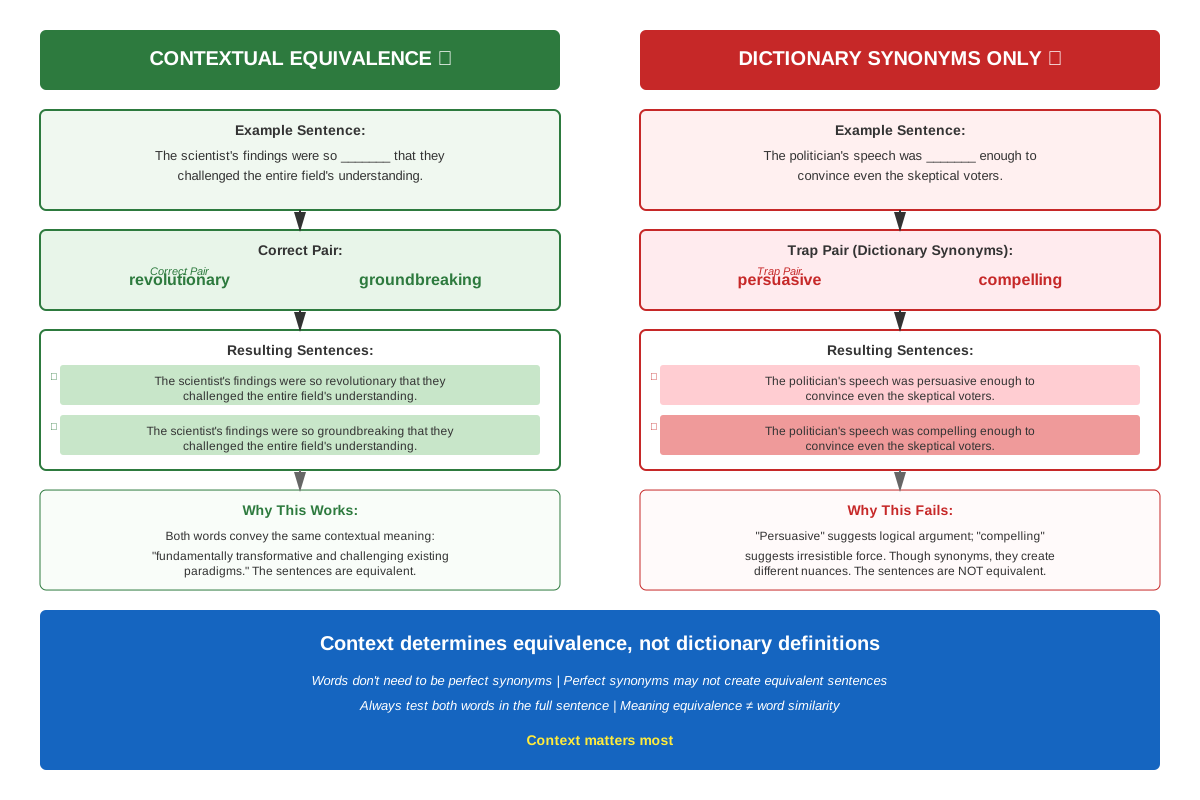
Both "tedious" and "monotonous" would create equivalent meanings (boring quality causing inattention). Both "complex" and "challenging" are synonyms but would not create equivalent sentences in this context—complexity might cause confusion rather than inattention. "Brief" and "fascinating" would create logical sentences but don't pair with anything to create equivalence.
Trap Answer Patterns
The GRE deliberately includes trap answers that exploit common errors:
| Trap Type | Description | Example |
|---|---|---|
| Synonym without context fit | Words that are synonyms in general but don't both fit the sentence | "Happy" and "content" when the sentence requires negative words |
| Partial context match | Words that relate to the topic but don't complete the logic | Using "scientific" when "skeptical" is needed in a sentence about research |
| Opposite pairs | Antonyms that both fit grammatically but create opposite meanings | "Praised" and "criticized" both fit but don't create equivalence |
| Register mismatch | Words with correct meaning but inappropriate formality level | Using "mad" instead of "irate" in a formal context |
Systematic Elimination Process
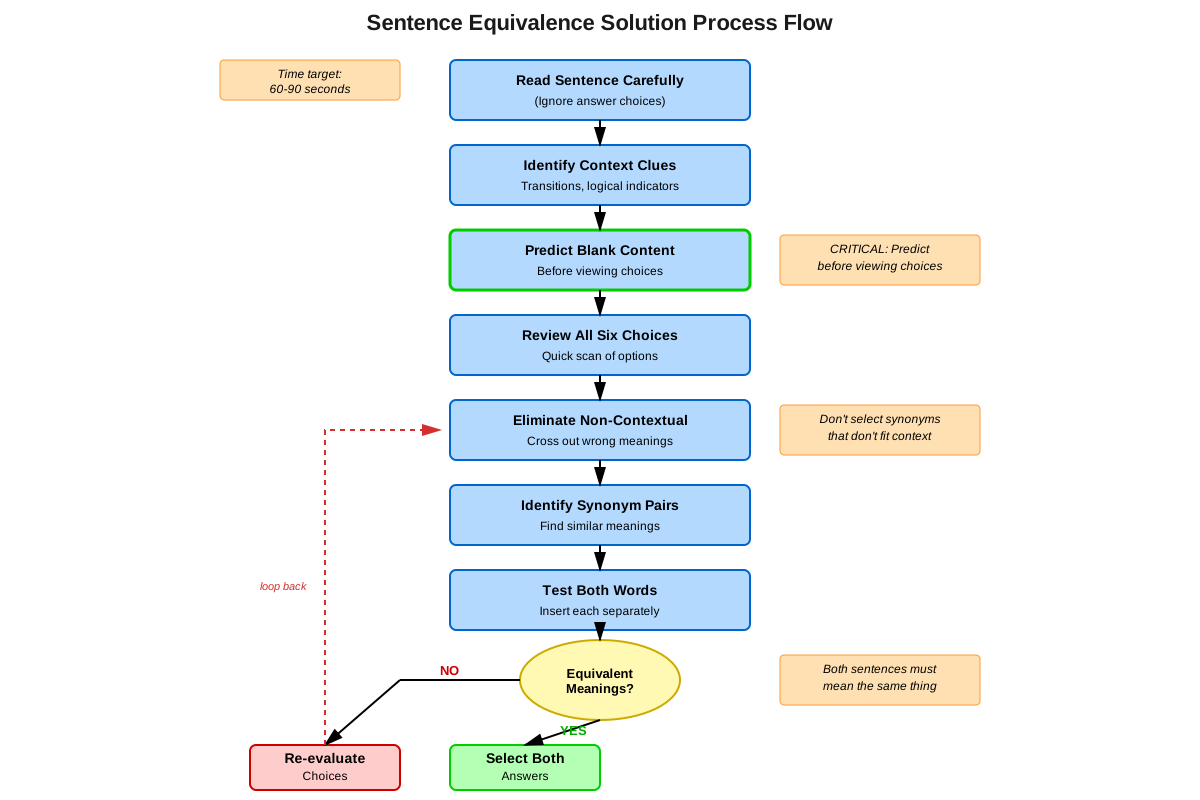
Effective sentence equivalence requires a methodical approach:
- Read the entire sentence without looking at answer choices
- Identify context clues and structural signals
- Predict the general meaning, tone, or direction needed
- Scan answer choices for words matching the prediction
- Test both words in the sentence to verify equivalent meanings
- Eliminate answers that don't match prediction or don't pair
- Verify that remaining pair creates truly equivalent sentences
This process prevents premature commitment to attractive but incorrect answers and ensures both logical completion and meaning equivalence.
Part of Speech Considerations
The blank's position determines what part of speech is required. Answer choices always share the same part of speech, but recognizing whether the sentence needs an adjective, verb, adverb, or noun helps narrow possibilities:
- Adjectives typically follow linking verbs (was, seemed, appeared) or precede nouns
- Verbs follow subjects and may be modified by adverbs
- Adverbs often end in -ly and modify verbs, adjectives, or other adverbs
- Nouns follow articles (a, an, the) or possessives
Understanding grammatical function helps eliminate semantically possible but grammatically incorrect answers.
Concept Relationships
The core concepts in sentence equivalence form an interconnected system where each element supports the others. Context clue identification → enables → accurate prediction → which guides → strategic answer selection → leading to → efficient elimination → resulting in → correct equivalence determination. This linear progression represents the ideal problem-solving sequence.
The equivalence requirement sits at the center of all other concepts, as it defines the ultimate goal. Both context clue analysis and prediction strategy serve this requirement by helping identify which answer pairs create truly similar meanings rather than merely plausible sentences. The trap answer patterns represent violations of the equivalence requirement, making recognition of these patterns essential for avoiding incorrect selections.
Systematic elimination connects to prerequisite vocabulary knowledge—the broader one's vocabulary, the more efficiently elimination proceeds. However, even with limited vocabulary, understanding context clues and the equivalence requirement enables strategic guessing by eliminating answers that clearly don't fit the sentence's logical direction. This relationship demonstrates how strategic thinking can partially compensate for vocabulary gaps, though vocabulary expansion remains the most reliable path to consistent success.
High-Yield Facts
⭐ Sentence equivalence questions require selecting exactly two answers that create sentences similar in meaning—partial credit is never awarded
⭐ The two correct answers must be near-synonyms in the specific context of the sentence, not necessarily in all contexts
⭐ Predicting the blank's meaning before examining answer choices dramatically improves accuracy and speed
⭐ Contrast indicators (despite, although, however) signal that the blank should oppose another part of the sentence
⭐ Continuation indicators (moreover, furthermore, similarly) signal that the blank should align with surrounding ideas
- Sentence equivalence questions appear 4-6 times per 20-question verbal section, constituting approximately one-third of verbal questions
- All six answer choices share the same part of speech, making grammatical fit alone insufficient for answer selection
- Trap answers often include synonym pairs that don't both fit the sentence's specific context
- Semicolons and colons frequently signal definition or restatement relationships that clarify blank meaning
- Words with extreme connotations (always, never, completely) rarely appear as correct answers unless the sentence explicitly supports such intensity
Quick check — test yourself on Sentence equivalence basics so far.
Try Flashcards →Common Misconceptions
Misconception: Any two synonyms from the answer choices will be correct if they both fit the sentence grammatically. → Correction: The two correct answers must create sentences that are similar in meaning to each other, not just individually plausible. Both "praised" and "criticized" might fit grammatically, but they create opposite meanings and therefore cannot both be correct.
Misconception: If two words are synonyms in the dictionary, they will work as correct answers in any sentence equivalence question. → Correction: Words must be synonyms in the specific context of the sentence. "Bright" and "intelligent" are synonyms when describing people but not when describing lights. Context determines whether synonyms create equivalent meanings.
Misconception: The correct answers will always be the most difficult or obscure vocabulary words among the choices. → Correction: Correct answers span all difficulty levels. Sometimes the correct pair consists of relatively common words, while obscure vocabulary serves as trap answers. Difficulty varies by question, and context fit matters more than word complexity.
Misconception: Reading the sentence once is sufficient to understand what the blank requires. → Correction: Sentence equivalence questions often contain subtle context clues that become apparent only upon careful reading. Structural signals like "although" or "therefore" fundamentally change what type of word fits logically. Multiple readings ensure no critical clues are missed.
Misconception: If one answer choice seems perfect for the blank, finding a synonym for it among the remaining choices will yield the second correct answer. → Correction: This approach can work but risks confirmation bias. A better strategy involves predicting the blank's meaning independently, then finding two answers that match the prediction. This prevents forcing a pairing with an initially attractive but ultimately incorrect answer.
Misconception: Sentence equivalence questions test only vocabulary knowledge. → Correction: These questions test vocabulary, reading comprehension, logical reasoning, and the ability to recognize semantic relationships. Strong vocabulary helps but cannot substitute for careful context analysis and understanding of logical sentence structure.
Worked Examples
Example 1: Contrast Indicator Pattern
Question: Although the restaurant's décor was _____, the quality of the cuisine more than compensated for the uninspiring atmosphere.
Answer Choices:
A. elegant
B. austere
C. sparse
D. lavish
E. ornate
F. impressive
Solution Process:
Step 1 - Read and identify context clues: The sentence contains "although" (contrast indicator) and "uninspiring atmosphere" (negative description). The phrase "more than compensated" suggests the food quality offset a deficiency.
Step 2 - Predict the blank: The blank should describe the décor negatively, contrasting with the positive cuisine quality. We need words meaning "plain," "unimpressive," or "minimal."
Step 3 - Evaluate answer choices:
- A (elegant) - positive, opposite of prediction
- B (austere) - means severely simple or plain, matches prediction
- C (sparse) - means scanty or minimal, matches prediction
- D (lavish) - means luxurious, opposite of prediction
- E (ornate) - means elaborately decorated, opposite of prediction
- F (impressive) - positive, opposite of prediction
Step 4 - Test equivalence: "Although the restaurant's décor was austere..." and "Although the restaurant's décor was sparse..." both create sentences meaning the décor was plain/minimal, which the food quality compensated for. These create equivalent meanings.
Step 5 - Verify: Both B and C fit the contrast structure (plain décor versus excellent food) and create similar overall meanings.
Correct Answers: B and C
Learning Objective Connection: This example demonstrates identifying context clues (contrast indicator), predicting blank content, and verifying that selected answers create equivalent meanings.
Example 2: Cause-Effect Pattern
Question: The scientist's methodology was so _____ that other researchers found it nearly impossible to replicate her experimental results.
Answer Choices:
A. rigorous
B. idiosyncratic
C. conventional
D. peculiar
E. systematic
F. transparent
Solution Process:
Step 1 - Identify context clues: "So...that" indicates a cause-effect relationship. The effect is that replication was "nearly impossible." This suggests the methodology had qualities that made it difficult for others to follow.
Step 2 - Predict the blank: We need words meaning "unusual," "unique," or "difficult to follow"—qualities that would make replication challenging.
Step 3 - Evaluate answer choices:
- A (rigorous) - means thorough/strict; rigorous methods should be easier to replicate, not harder (opposite of prediction)
- B (idiosyncratic) - means peculiar to an individual, matches prediction perfectly
- C (conventional) - means standard/traditional; conventional methods are easy to replicate (opposite)
- D (peculiar) - means strange/unusual, matches prediction
- E (systematic) - means methodical/organized; systematic methods should be easier to replicate (opposite)
- F (transparent) - means clear/obvious; transparent methods are easy to replicate (opposite)
Step 4 - Test equivalence: "The methodology was so idiosyncratic..." and "The methodology was so peculiar..." both convey that the methodology was unusual/unique in ways that made replication difficult. These create equivalent meanings.
Step 5 - Verify trap answers: Notice that A (rigorous) and E (systematic) are synonyms but would create sentences opposite to the intended meaning—rigorous, systematic methods should be easier, not harder, to replicate. This demonstrates why context matters more than dictionary synonyms.
Correct Answers: B and D
Learning Objective Connection: This example shows how cause-effect relationships guide prediction and how trap answers (rigorous/systematic) can be synonyms that don't fit the specific context.
Exam Strategy
Approaching Sentence Equivalence Questions
Time allocation: Spend 60-90 seconds per sentence equivalence question. This allows 15-20 seconds for reading and prediction, 30-45 seconds for answer evaluation, and 15-30 seconds for verification. If a question exceeds 90 seconds, mark it for review and move forward to prevent time pressure on subsequent questions.
Trigger words to watch for:
- Contrast: although, despite, however, yet, nevertheless, while, whereas
- Continuation: moreover, furthermore, similarly, likewise, additionally
- Cause-effect: because, therefore, thus, consequently, since, so...that
- Definition: semicolon, colon, "in other words," "that is," "namely"
- Emphasis: indeed, in fact, certainly, particularly, especially
Exam Tip: When you see a contrast indicator, immediately identify what is being contrasted. The blank will typically oppose or differ from the contrasted element.
Process-of-Elimination Strategy
First elimination pass: Remove answers that clearly don't match your prediction's direction (positive vs. negative, action vs. state, etc.). This typically eliminates 2-3 choices immediately.
Second elimination pass: Among remaining choices, eliminate words that don't fit the sentence's register (formality level) or intensity. If the sentence describes a mild situation, eliminate extreme words; if it describes an extreme situation, eliminate mild words.
Third elimination pass: Test remaining answers in pairs. If two words are synonyms but only one fits the sentence context, eliminate both—they cannot be the correct pair if they don't both work.
Exam Tip: If you've narrowed to three possible answers, test all three pairwise combinations (A+B, A+C, B+C) to determine which pair creates the most equivalent meanings.
When Vocabulary Limits You
If you encounter unfamiliar words, use these strategies:
- Word roots and affixes: Break down unfamiliar words into recognizable parts (prefixes, roots, suffixes)
- Positive/negative determination: Even without knowing precise meanings, determine whether unfamiliar words have positive or negative connotations
- Elimination by known words: If you can confidently eliminate 3-4 choices, the remaining pair may be correct even if you don't know both words
- Strategic guessing: If you must guess, select two words that "feel" similar in tone and register
Verification Checklist
Before finalizing your answer, verify:
- [ ] Both selected words fit the sentence grammatically
- [ ] Both selected words match the logical direction indicated by context clues
- [ ] The two complete sentences convey similar overall meanings
- [ ] No other pair of answers creates more equivalent meanings
- [ ] You haven't fallen for a trap answer pattern (synonym without context fit, opposite pair, etc.)
Memory Techniques
PREDICT mnemonic for the systematic approach:
- Pause and read the entire sentence
- Recognize context clues and structural signals
- Estimate the blank's meaning before viewing choices
- Determine which answers match your prediction
- Inspect both words in the sentence
- Confirm equivalent meanings
- Test for trap answer patterns
Contrast vs. Continuation visualization: Picture a road that either turns (contrast indicators like "although," "despite") or continues straight (continuation indicators like "moreover," "furthermore"). This visual helps quickly determine whether the blank should oppose or align with surrounding ideas.
The Synonym Trap reminder: "Dictionary twins aren't always sentence twins." This phrase reinforces that dictionary synonyms don't automatically create equivalent sentence meanings—context determines equivalence.
CASE acronym for context clue categories:
- Contrast (although, despite, however)
- Agreement/continuation (moreover, similarly)
- Sequence/cause-effect (because, therefore)
- Explanation/definition (semicolon, colon, "that is")
Summary
Sentence equivalence basics form a critical component of GRE Verbal Reasoning success, requiring test-takers to select two answer choices from six options that both complete a sentence logically and create equivalent meanings. Mastery depends on systematic approach: reading carefully to identify context clues, predicting the blank's meaning before examining choices, evaluating answers against the prediction, and verifying that the selected pair creates truly similar meanings. Context clues—particularly contrast indicators (although, despite), continuation signals (moreover, furthermore), and cause-effect markers (because, therefore)—guide accurate prediction. The equivalence requirement means that dictionary synonyms don't automatically qualify as correct answers; words must be synonyms in the specific sentence context. Common traps include synonym pairs that don't both fit contextually, opposite pairs that both fit grammatically, and words that relate to the topic without completing the logic. Strategic elimination, part-of-speech awareness, and careful verification distinguish successful test-takers from those who rely solely on vocabulary recognition. With practice, sentence equivalence questions become opportunities for efficient point accumulation, typically requiring 60-90 seconds each when approached systematically.
Key Takeaways
- Sentence equivalence requires selecting exactly two answers that create sentences similar in meaning—no partial credit is awarded
- Always predict the blank's meaning before examining answer choices to avoid trap answers and improve efficiency
- Context clues (contrast, continuation, cause-effect indicators) are more important than vocabulary knowledge alone
- The two correct answers must be near-synonyms in the specific sentence context, not necessarily in all contexts
- Systematic elimination (by direction, register, intensity, then equivalence testing) dramatically improves accuracy
- Common traps include synonym pairs that don't both fit contextually and opposite pairs that both fit grammatically
- Verification is essential—test both selected words in the sentence and confirm they create equivalent overall meanings
Related Topics
Text Completion (Single Blank): Shares the prediction and context clue strategies used in sentence equivalence but requires selecting only one answer. Mastering sentence equivalence provides a foundation for text completion success.
Text Completion (Multiple Blanks): Extends sentence equivalence skills to passages with two or three blanks, requiring understanding of how multiple word choices interact to create coherent meaning.
Vocabulary in Context (Reading Comprehension): Applies the contextual word meaning skills developed through sentence equivalence to longer passages where word choice affects interpretation.
Advanced Vocabulary Building: Expanding vocabulary knowledge directly improves sentence equivalence performance by increasing the number of answer choices you can confidently evaluate.
Logical Reasoning and Argument Structure: Understanding how sentences build logical relationships supports both sentence equivalence and reading comprehension by clarifying how ideas connect.
Practice CTA
Now that you've mastered the fundamentals of sentence equivalence, it's time to apply these strategies to actual GRE-style questions. The practice questions and flashcards will reinforce your ability to identify context clues, predict blank meanings, and select truly equivalent answer pairs. Remember: sentence equivalence rewards systematic thinking over pure vocabulary memorization. Each practice question is an opportunity to refine your approach and build the confidence needed for test day success. Start practicing now to transform these concepts into automatic, efficient problem-solving skills!
Sign up free to keep reading
Create a free AnvayaPrep account to finish this GRE guide on Sentence equivalence basics — plus flashcards and practice questions.