Overview
Near synonym pairs are the cornerstone of success on GRE Sentence Equivalence questions, representing one of the most predictable and high-yield patterns tested in the Verbal Reasoning section. Unlike traditional synonym questions that demand exact matches, GRE near synonym pairs require test-takers to identify two answer choices that, when substituted into a sentence, produce sentences with essentially the same meaning—even if the words themselves aren't perfect synonyms in isolation. This nuanced distinction separates high scorers from average performers, as it demands both vocabulary depth and contextual reasoning skills.
The GRE explicitly designs Sentence Equivalence questions to test whether students can recognize words that function synonymously within a specific context. This means that two words might be near synonyms in one sentence but not in another, depending on the precise meaning required by the context. Mastering this skill requires moving beyond rote memorization of synonym lists and developing the ability to analyze how words interact with their surrounding context. The test-makers deliberately include trap answers—words that seem synonymous in general usage but don't fit the specific contextual requirements of the sentence.
Understanding near synonym pairs connects directly to broader Verbal Reasoning competencies, including vocabulary in context, nuanced word meaning, and logical sentence completion. This topic serves as a bridge between pure vocabulary knowledge and reading comprehension, requiring students to synthesize multiple skills simultaneously. Success with near synonym pairs also reinforces critical thinking patterns applicable to Text Completion questions and Reading Comprehension passages, making it a foundational skill that amplifies performance across the entire Verbal section.
Learning Objectives
- [ ] Identify when Near synonym pairs is being tested in Sentence Equivalence questions
- [ ] Explain the core rule or strategy behind Near synonym pairs selection
- [ ] Apply Near synonym pairs recognition to GRE-style questions accurately
- [ ] Distinguish between true near synonyms and deceptive partial synonyms in context
- [ ] Evaluate answer choices by testing both words in the sentence to verify equivalent meaning
- [ ] Recognize common near synonym pair patterns that frequently appear on the GRE
- [ ] Eliminate trap answers that share semantic fields but don't produce equivalent sentences
Prerequisites
- Advanced vocabulary knowledge: Understanding approximately 3,000+ GRE-level words provides the foundation for recognizing subtle distinctions between near synonyms
- Contextual reading skills: The ability to determine word meaning from context is essential, as near synonyms must fit the specific sentence requirements
- Basic sentence structure comprehension: Recognizing how words function grammatically (nouns, verbs, adjectives, adverbs) helps identify which words can legitimately substitute for each other
- Familiarity with Sentence Equivalence format: Understanding that exactly two answers must be selected and that both must produce equivalent meanings
Why This Topic Matters
Near synonym pairs appear in every single Sentence Equivalence question on the GRE, making this topic unavoidable and critically important. The Verbal Reasoning section typically contains 4-5 Sentence Equivalence questions per section, and each question requires identifying the correct near synonym pair from six answer choices. This represents approximately 20-25% of the total Verbal score, making it one of the highest-yield topics for focused study.
In real-world applications, the skill of identifying near synonyms translates directly to professional and academic writing, where precision in word choice determines clarity and credibility. Graduate-level coursework demands the ability to understand subtle distinctions in terminology, recognize when different authors use different terms for the same concept, and express ideas with nuanced vocabulary. Legal documents, scientific papers, and policy analyses all require readers to recognize when different phrasings convey equivalent meanings.
On the GRE specifically, near synonym pairs appear exclusively in Sentence Equivalence questions, which present a single sentence with one blank and six answer choices. The instructions explicitly state that test-takers must select two answers that both complete the sentence and produce sentences with the same meaning. The test-makers design these questions to include several types of trap answers: words that fit the sentence but have no synonym partner among the choices, words that are synonyms in general but don't fit this specific context, and words that create grammatically correct but semantically different sentences. Recognizing authentic near synonym pairs requires filtering through these deliberate distractors.
Core Concepts
Definition and Characteristics of Near Synonym Pairs
Near synonym pairs are two words that, when substituted into the same sentence blank, produce sentences that are equivalent in meaning, even though the words themselves may not be perfect synonyms in all contexts. The critical distinction is that these words must be synonymous for the specific sentence at hand, not necessarily in every possible usage. For example, "meticulous" and "painstaking" function as near synonyms when describing careful work, but they wouldn't be interchangeable in all contexts where either word might appear.
The GRE tests near synonyms rather than exact synonyms because exact synonyms are rare in English. Most words carry subtle connotations, register differences (formal vs. informal), or usage patterns that distinguish them. Near synonyms share core meaning components sufficient to make the completed sentences equivalent, even if the words differ in secondary characteristics. This design tests deeper vocabulary knowledge and contextual reasoning rather than simple memorization.
The Equivalence Requirement
The fundamental rule governing near synonym pairs is that both selected words must produce sentences with equivalent meaning—not just similar meaning, but meaning so close that the sentences could be used interchangeably. This is a stricter standard than many test-takers initially realize. Consider these examples:
Acceptable equivalence: "The scientist's _____ approach to data collection ensured reliable results."
- "systematic" and "methodical" → Both produce sentences meaning the approach was organized and thorough
Insufficient equivalence: "The politician's speech was _____ and failed to inspire voters."
- "boring" and "brief" → Both could fit grammatically, but they create different meanings (one about quality, one about length)
The equivalence requirement means that after selecting two answers, a test-taker should be able to read both completed sentences and find them essentially interchangeable. If one sentence suggests a different tone, intensity, or specific meaning than the other, the pair is incorrect.
Contextual Synonymy vs. General Synonymy
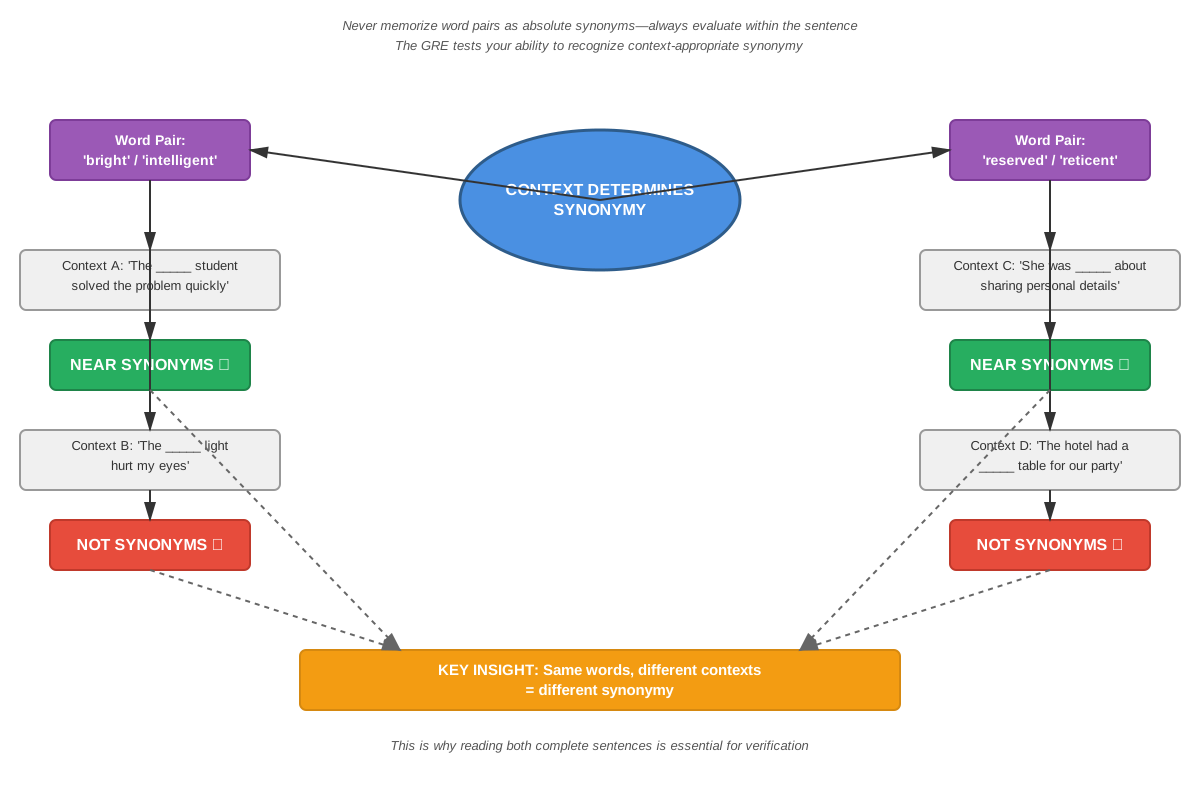
A crucial concept for GRE success is understanding that words functioning as near synonyms in one context may not be synonymous in another. The sentence context determines which aspects of word meaning are relevant. Consider the word "reserved":
Context 1: "Despite her accomplishments, she remained _____ at social gatherings."
- Near synonym: "reticent" (both mean quiet/restrained in social situations)
Context 2: "The conference room has been _____ for the board meeting."
- Near synonym: "booked" (both mean set aside for a purpose)
The same word "reserved" requires different near synonym partners depending on context. This principle explains why memorizing synonym lists without understanding contextual application provides limited GRE benefit. Test-takers must read the sentence carefully to determine which meaning dimension is relevant.
The Process of Elimination Strategy
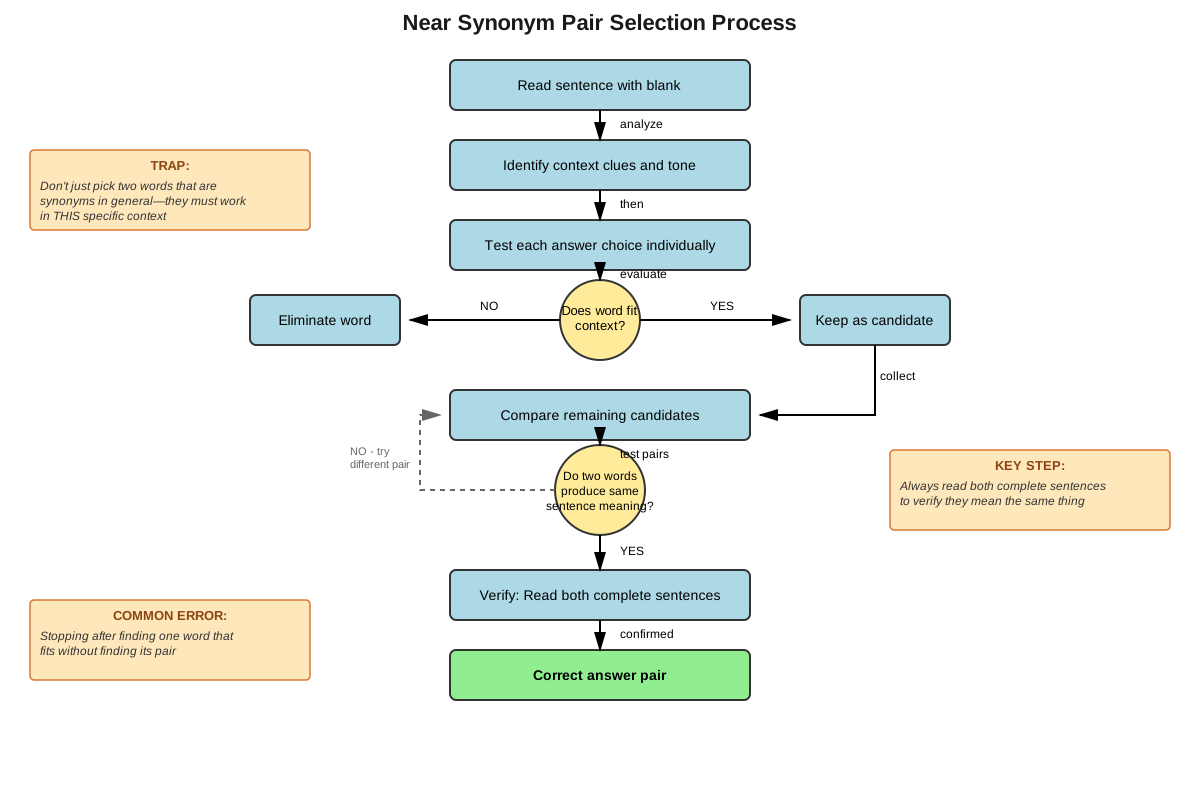
Identifying near synonym pairs involves a systematic elimination process:
- Read the sentence completely to understand the required meaning
- Predict the general type of word needed (positive/negative, concrete/abstract, etc.)
- Scan all six choices for potential synonym pairs
- Test each potential pair by substituting both words into the sentence
- Verify equivalence by confirming both sentences mean the same thing
- Eliminate non-pairs including words that fit alone but lack partners
This process differs from Text Completion strategy because the answer choices themselves provide critical information. Unlike Text Completion, where each blank is solved somewhat independently, Sentence Equivalence requires finding the relationship between two answer choices.
Common Near Synonym Pair Categories
Certain types of near synonym pairs appear frequently on the GRE:
| Category | Example Pair | Shared Meaning |
|---|---|---|
| Intensity modifiers | "extremely" / "exceedingly" | Very high degree |
| Negative qualities | "obstinate" / "intransigent" | Stubbornly unwilling to change |
| Positive qualities | "astute" / "shrewd" | Cleverly perceptive |
| Scarcity/abundance | "copious" / "abundant" | Large in quantity |
| Deception | "duplicitous" / "deceitful" | Dishonest or two-faced |
| Complexity | "convoluted" / "labyrinthine" | Complicated and difficult to follow |
| Brevity | "concise" / "succinct" | Brief and to the point |
| Hostility | "acrimonious" / "caustic" | Harsh and bitter in tone |
Familiarizing yourself with these common categories helps pattern recognition during the exam, though each question must still be evaluated individually based on context.
Trap Answer Patterns
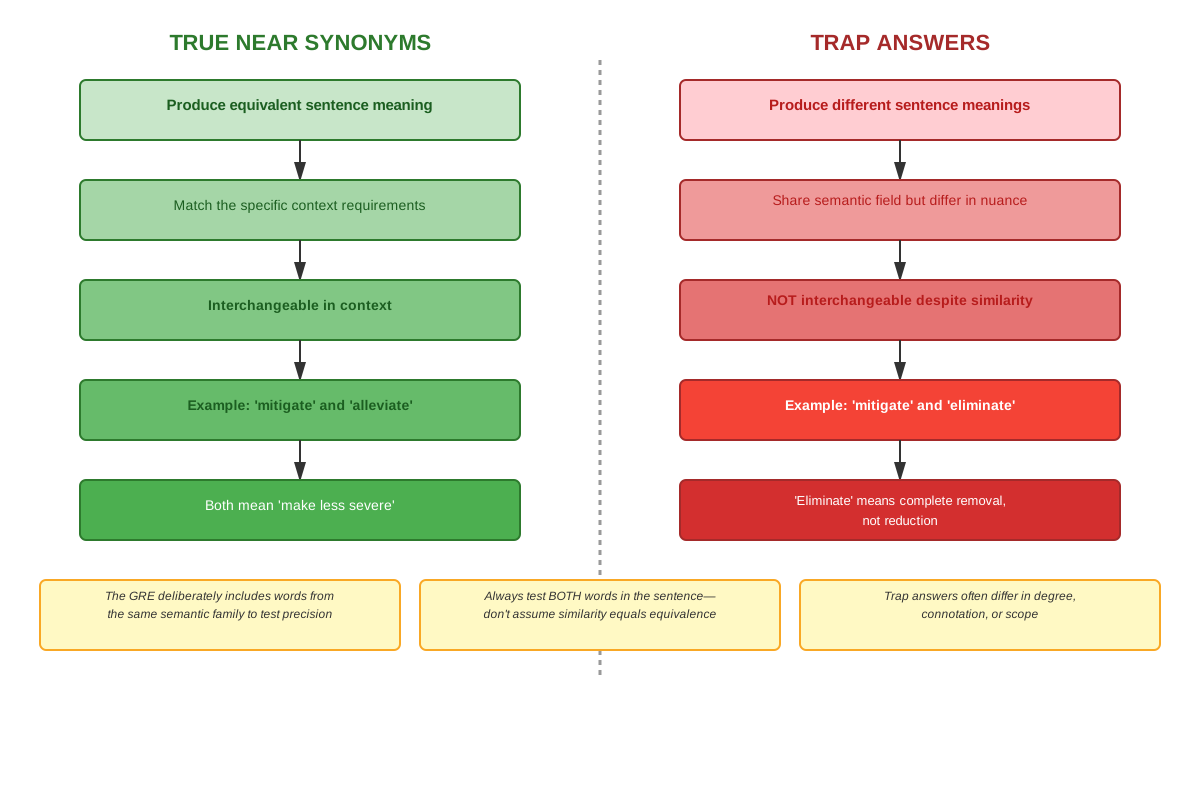
The GRE deliberately includes several types of trap answers designed to catch test-takers who don't carefully verify equivalence:
Semantic field traps: Words related to the same general topic but with different specific meanings (e.g., "angry" and "sad" are both emotions but aren't synonymous)
Partial synonym traps: Words that overlap in some meanings but not in the meaning required by the sentence context
Tone mismatch traps: Words with similar denotations but different connotations (formal vs. informal, technical vs. colloquial)
Grammatical fit traps: Words that complete the sentence grammatically but create a different meaning
Antonym traps: Words opposite in meaning to the correct answer, included to test careful reading
Recognizing these patterns helps test-takers avoid common errors and focus attention on genuine near synonym pairs.
Concept Relationships
The concept of near synonym pairs builds directly on vocabulary knowledge—without knowing what words mean, identifying synonymous relationships becomes impossible. However, vocabulary alone is insufficient; contextual reading skills determine which aspects of word meaning are relevant in a specific sentence. These two prerequisites combine to enable near synonym identification.
Within the topic itself, the concepts form a logical progression: understanding the definition of near synonyms → recognizing the equivalence requirement → distinguishing contextual from general synonymy → applying systematic elimination strategies → recognizing common patterns and avoiding traps. Each concept depends on the previous ones, creating a hierarchical knowledge structure.
The relationship map flows as follows:
Vocabulary Knowledge + Contextual Reading → Understanding Near Synonym Definition → Recognizing Equivalence Requirement → Distinguishing Contextual Synonymy → Applying Elimination Strategy → Identifying Common Patterns → Avoiding Trap Answers → Correct Answer Selection
This topic also connects forward to broader Verbal Reasoning skills. Success with near synonym pairs reinforces vocabulary retention (seeing words in context aids memory), improves reading comprehension (by focusing attention on precise meaning), and develops logical reasoning (by requiring verification of equivalence). These skills transfer directly to Text Completion questions, where contextual word choice is similarly critical, and to Reading Comprehension, where recognizing paraphrasing and equivalent expressions aids understanding.
High-Yield Facts
⭐ Sentence Equivalence questions always require selecting exactly two answers that produce equivalent meaning—selecting only one correct word or two words that don't create equivalent sentences results in zero points for that question.
⭐ Near synonyms must be contextually equivalent in the specific sentence, not necessarily synonymous in all possible contexts—the sentence determines which meaning dimensions matter.
⭐ Both selected words must fit the sentence's logic, grammar, and tone while producing the same overall meaning—grammatical fit alone is insufficient.
⭐ The GRE includes trap answers that fit the sentence but have no synonym partner among the choices—every correct answer must have exactly one partner.
⭐ Testing both words by reading the complete sentence with each substitution is essential for verifying equivalence—mental substitution without full sentence reading often misses subtle meaning differences.
- Common near synonym pairs often involve words with similar prefixes or roots (e.g., "circumspect" / "cautious" both relate to carefulness).
- Words that are antonyms of each other occasionally appear as trap answers to test careful reading.
- The correct near synonym pair typically shares the same part of speech and similar register (formality level).
- Approximately 30-40% of Sentence Equivalence questions feature near synonym pairs from the "negative quality" or "criticism" semantic category.
- Near synonym pairs may differ in intensity while still producing equivalent meaning in context (e.g., "unusual" and "anomalous" differ in formality but can be contextually equivalent).
- The sentence context often provides clues about whether a positive or negative word is needed, helping narrow the search for synonym pairs.
- Words appearing in the same answer choice position across multiple practice questions are not more likely to be correct—position is randomized.
Quick check — test yourself on Near synonym pairs so far.
Try Flashcards →Common Misconceptions
Misconception: Any two words that are synonyms in a thesaurus will work as near synonym pairs on the GRE.
Correction: Thesaurus synonyms often include words with overlapping but not equivalent meanings. GRE near synonym pairs must produce sentences with the same meaning in the specific context provided, which is a stricter standard than general synonymy.
Misconception: If a word fits the sentence perfectly, it must be one of the correct answers.
Correction: The GRE deliberately includes words that fit the sentence well but have no synonym partner among the answer choices. A word can only be correct if it has exactly one partner that produces an equivalent sentence.
Misconception: Near synonym pairs must have similar word forms or share roots.
Correction: While some near synonym pairs share linguistic features, many correct pairs come from completely different etymological origins (e.g., "stubborn" from Old English and "obstinate" from Latin). Similarity in form is not required for functional synonymy.
Misconception: The two correct answers will always be adjacent or in predictable positions.
Correction: The GRE randomizes answer choice positions. Correct near synonym pairs can appear in any two of the six positions, and their placement provides no information about correctness.
Misconception: Words with opposite meanings can never both be correct answers.
Correction: While rare, some sentences contain negation or complex logic where two words that seem opposite in isolation actually produce equivalent meaning in context. For example, "not uncommon" and "frequent" can be contextually equivalent despite "uncommon" and "frequent" being antonyms.
Misconception: Selecting two words that create similar but not identical meanings will receive partial credit.
Correction: Sentence Equivalence questions are scored all-or-nothing. Selecting two words that create similar but non-equivalent sentences receives zero points, the same as selecting two completely wrong answers.
Misconception: The correct answers will always be the most difficult or obscure vocabulary words.
Correction: Correct near synonym pairs range from common to advanced vocabulary. Sometimes the correct pair consists of relatively simple words, while more impressive-sounding words serve as traps. Difficulty level doesn't indicate correctness.
Worked Examples
Example 1: Identifying Near Synonyms in Context
Question: The professor's lecture was so _____ that even students who typically struggled with the material found it easy to understand.
(A) abstruse
(B) lucid
(C) pedantic
(D) perspicuous
(E) convoluted
(F) dogmatic
Step 1: Analyze the sentence context
The sentence indicates the lecture had a quality that made difficult material "easy to understand." The word "even" emphasizes that typically struggling students could understand, suggesting the lecture was exceptionally clear. We need a positive word meaning "clear" or "easy to understand."
Step 2: Evaluate each answer choice
- (A) abstruse: means difficult to understand—opposite of what we need
- (B) lucid: means clear and easy to understand—fits perfectly
- (C) pedantic: means overly concerned with minor details—doesn't relate to clarity
- (D) perspicuous: means clearly expressed and easily understood—fits perfectly
- (E) convoluted: means complicated and difficult to follow—opposite of what we need
- (F) dogmatic: means asserting opinions in an authoritative manner—doesn't relate to clarity
Step 3: Identify potential pairs
Both (B) lucid and (D) perspicuous mean "clear and easy to understand." Let's verify they produce equivalent sentences:
- "The professor's lecture was so lucid that even students who typically struggled with the material found it easy to understand."
- "The professor's lecture was so perspicuous that even students who typically struggled with the material found it easy to understand."
Both sentences convey identical meaning: the lecture's clarity made it accessible to all students.
Step 4: Verify no other pairs exist
- (A) and (E) are both negative but aren't synonymous (abstruse = unclear, convoluted = overly complex)
- (C) and (F) both relate to teaching style but aren't synonymous (pedantic = overly detailed, dogmatic = authoritative)
Answer: (B) and (D)
Learning objective connection: This example demonstrates identifying when near synonym pairs are being tested (recognizing Sentence Equivalence format), explaining the core strategy (finding contextually equivalent words), and applying the concept accurately (selecting lucid and perspicuous as the correct pair).
Example 2: Avoiding Trap Answers
Question: Despite the committee's efforts to remain impartial, their final report was _____ toward the interests of the largest donors.
(A) biased
(B) partial
(C) objective
(D) indifferent
(E) neutral
(F) apathetic
Step 1: Analyze the sentence context
The word "Despite" signals contrast—the committee tried to be impartial but failed. The report favored donor interests, meaning it was not impartial. We need a word meaning "favoring one side" or "not impartial."
Step 2: Evaluate each answer choice
- (A) biased: means unfairly prejudiced toward one side—fits the context
- (B) partial: can mean "favoring one side" or "incomplete"—potentially fits
- (C) objective: means impartial and unbiased—opposite of what we need
- (D) indifferent: means having no particular interest—doesn't fit
- (E) neutral: means impartial—opposite of what we need
- (F) apathetic: means showing no interest or enthusiasm—doesn't fit
Step 3: Test potential pairs carefully
(A) biased and (B) partial seem like candidates. Let's test them:
- "Despite the committee's efforts to remain impartial, their final report was biased toward the interests of the largest donors."
- "Despite the committee's efforts to remain impartial, their final report was partial toward the interests of the largest donors."
Both sentences work grammatically and seem to convey that the report favored donors. However, we need to verify this is the only possible pair.
Step 4: Check for other possibilities
Wait—could (C), (D), (E), or (F) pair with each other?
- (C) objective and (E) neutral are near synonyms meaning "impartial"
- But these create the opposite meaning from what the sentence requires (the "Despite" indicates the report was NOT impartial)
Step 5: Verify the correct pair
(A) biased and (B) partial are indeed near synonyms in this context, both indicating the report favored one side over others. The sentence structure with "Despite" confirms we need words meaning "not impartial."
Answer: (A) and (B)
Trap analysis: This question includes a sophisticated trap—(C) objective and (E) neutral are genuine near synonyms, but they create the wrong meaning for this sentence. Test-takers who don't carefully read the "Despite" contrast might select these words because they relate to the topic of impartiality. This example illustrates why testing both words in the complete sentence is essential.
Learning objective connection: This example demonstrates distinguishing between true near synonyms and deceptive partial synonyms (objective/neutral are synonyms but wrong for this context), and recognizing common trap patterns (including a synonym pair that fits the topic but not the specific sentence logic).
Exam Strategy
Systematic Approach to Sentence Equivalence Questions
When encountering a Sentence Equivalence question, follow this proven sequence:
- Read the entire sentence first without looking at answer choices—develop an independent sense of what type of word is needed
- Note the sentence's tone and logic—is it positive, negative, contrasting, or supporting?
- Identify trigger words like "although," "despite," "because," or "therefore" that signal logical relationships
- Predict a word or concept that would fit the blank before examining choices
- Scan all six choices quickly to identify potential synonym pairs
- Test your top candidate pair by substituting each word and reading the complete sentence
- Verify equivalence by confirming both sentences mean the same thing
- Eliminate and reconsider if your first choice doesn't work
Trigger Words and Phrases
Certain words in Sentence Equivalence questions provide crucial logical clues:
Contrast triggers (the blank will oppose or differ from another part of the sentence):
- although, though, despite, in spite of, while, whereas, however, yet, nevertheless
Support triggers (the blank will align with or reinforce another part of the sentence):
- because, since, therefore, thus, consequently, indeed, in fact
Comparison triggers (the blank relates to a similarity or difference):
- similarly, likewise, in contrast, unlike, as...as
Intensity triggers (the blank involves degree or extent):
- so...that, such...that, extremely, particularly, especially
Recognizing these triggers helps predict whether the blank requires a positive or negative word, and whether it should align with or contrast against other sentence elements.
Process of Elimination Techniques
Effective elimination strategies specific to near synonym pairs:
Eliminate words without partners first: If a word seems to fit the sentence but no other choice is synonymous with it, eliminate it immediately. Every correct answer must have exactly one partner.
Eliminate based on positive/negative mismatch: If the sentence clearly requires a negative word (criticism, problem, deficiency), eliminate all positive words and vice versa.
Eliminate grammatical mismatches: If the blank requires an adjective, eliminate nouns, verbs, and adverbs. Part of speech must match.
Eliminate tone mismatches: If the sentence is formal and academic, eliminate colloquial or informal words that would create tonal inconsistency.
Use extreme words cautiously: Words like "always," "never," "completely," or "absolutely" are rarely correct unless the sentence context specifically supports such absolute statements.
Time Allocation
Sentence Equivalence questions should take approximately 1-1.5 minutes each. This breaks down as:
- 15-20 seconds: Reading and understanding the sentence
- 20-30 seconds: Scanning choices and identifying potential pairs
- 20-30 seconds: Testing the most promising pair
- 10-15 seconds: Verifying equivalence and confirming selection
If a question exceeds 2 minutes, make your best educated guess and move forward. The GRE rewards efficient time management—spending excessive time on one question reduces time available for others.
Exam Tip: If you identify a strong near synonym pair quickly, don't second-guess yourself by overthinking. Trust your vocabulary knowledge and contextual reading. The most common error is changing a correct answer to an incorrect one during review.
Memory Techniques
The "CONTEXT" Mnemonic
Remember the essential steps for near synonym identification:
Complete the sentence reading first
Observe trigger words and logical structure
Note the required tone (positive/negative)
Test potential pairs by substitution
Evaluate equivalence of both sentences
X-out (eliminate) words without partners
Trust your verification process
Visualization Strategy: The Synonym Bridge
Visualize the sentence as a bridge with a gap (the blank). The two correct answers are two identical support beams that can each hold the bridge equally well. If one beam is stronger or weaker than the other, or if they're shaped differently, the bridge won't be equivalent—you need two beams of equal strength and function. This mental image reinforces that both words must produce equivalent meaning.
Common Pair Patterns Acronym: "SCANDI"
Remember frequent near synonym pair categories with SCANDI:
Scarcity/abundance pairs (copious/abundant, meager/scant)
Complexity pairs (convoluted/labyrinthine, intricate/elaborate)
Animosity pairs (acrimonious/caustic, hostile/antagonistic)
Negative quality pairs (obstinate/intransigent, pedantic/didactic)
Deception pairs (duplicitous/deceitful, disingenuous/insincere)
Intensity pairs (extremely/exceedingly, barely/scarcely)
The "Read It Twice" Rule
Create a habit: after selecting your two answers, read the sentence aloud (mentally) with each word substituted. If you can't hear any meaningful difference between the two sentences, you've found the correct pair. If one sentence sounds even slightly different in meaning, reconsider your choices.
Summary
Near synonym pairs form the foundation of GRE Sentence Equivalence questions, requiring test-takers to identify two words that produce sentences with equivalent meaning when substituted into a blank. Success demands understanding that synonymy is contextual—words must be equivalent in the specific sentence provided, not necessarily in all possible uses. The systematic approach involves reading the complete sentence, identifying logical triggers, predicting the needed word type, scanning for potential pairs, testing both substitutions, and verifying equivalence. Common trap answers include words that fit the sentence but lack synonym partners, words that are generally synonymous but not in the required context, and words that create similar but non-equivalent meanings. The GRE tests this skill in 4-5 questions per Verbal section, making it a high-yield topic worth mastering. Effective preparation involves building vocabulary knowledge, practicing contextual reading, recognizing common near synonym pair patterns, and developing systematic verification habits that prevent careless errors.
Key Takeaways
- Near synonym pairs must produce equivalent meaning in the specific sentence context, not just be synonyms in general usage—context determines which meaning dimensions matter
- Every correct answer has exactly one partner—words that fit the sentence but lack a synonym among the choices cannot be correct
- Systematic verification is essential: read the complete sentence with each word substituted to confirm both sentences mean the same thing
- Trigger words like "although," "despite," "because," and "therefore" provide crucial clues about whether the blank should contrast with or support other sentence elements
- Common trap answers include semantic field traps (related words that aren't synonymous), partial synonym traps (words synonymous in some contexts but not this one), and tone mismatches
- Sentence Equivalence questions are scored all-or-nothing—selecting one correct word and one incorrect word yields zero points, making verification critical
- Time management matters: spend 1-1.5 minutes per question, and if you identify a strong pair quickly, trust your knowledge rather than overthinking
Related Topics
Text Completion (Single Blank): Mastering near synonym pairs strengthens single-blank Text Completion skills by reinforcing contextual word choice and precise meaning analysis. The same vocabulary and context-reading skills apply, though Text Completion requires selecting only one answer.
Text Completion (Multiple Blank): Understanding how words interact with sentence context prepares students for multiple-blank questions where word choices must work together coherently. Near synonym recognition helps identify when different blanks require related or contrasting words.
Vocabulary in Context (Reading Comprehension): The skill of determining word meaning from context transfers directly to Reading Comprehension questions that ask about word usage in passages. Recognizing near synonyms helps identify paraphrasing and equivalent expressions.
Advanced Vocabulary Building: Success with near synonym pairs motivates deeper vocabulary study, moving beyond simple definitions to understanding connotations, register, and contextual usage patterns. This advanced vocabulary knowledge benefits all Verbal question types.
Logical Reasoning and Sentence Structure: Analyzing how sentence elements relate logically (contrast, support, cause-effect) applies to both Sentence Equivalence and Reading Comprehension argument analysis questions.
Practice CTA
Now that you've mastered the concepts behind near synonym pairs, it's time to apply this knowledge! Attempt the practice questions to test your ability to identify contextually equivalent words under timed conditions. Use the flashcards to reinforce common near synonym pairs and build the vocabulary foundation essential for quick recognition. Remember: consistent practice with immediate feedback is the most effective way to transform conceptual understanding into automatic test-day performance. Each practice question you complete strengthens your pattern recognition and builds the confidence needed to tackle Sentence Equivalence questions efficiently. You've built the knowledge—now build the skill through deliberate practice!
Sign up free to keep reading
Create a free AnvayaPrep account to finish this GRE guide on Near synonym pairs — plus flashcards and practice questions.