Overview
Logical clue identification is a foundational skill for mastering GRE Sentence Equivalence questions and represents one of the most reliable pathways to improving Verbal Reasoning scores. This technique involves systematically scanning sentences to locate words, phrases, or structural elements that reveal the relationship between ideas and signal what type of word must fill the blank. Rather than relying on intuition or vocabulary knowledge alone, logical clue identification transforms sentence completion into a methodical process where the sentence itself provides explicit guidance about the correct answer.
On the GRE, gre logical clue identification serves as the bridge between reading comprehension and vocabulary application. Every well-constructed Sentence Equivalence question contains deliberate clues embedded within its structure—transition words, contrasting ideas, cause-and-effect relationships, or descriptive phrases that constrain the meaning of the missing word. Students who master this skill can often determine whether a blank requires a positive or negative word, an intensifying or moderating term, or a word expressing similarity versus contrast, even before examining the answer choices. This predictive capability dramatically increases accuracy and reduces the cognitive load of evaluating six answer options under time pressure.
The relationship between logical clue identification and broader Verbal Reasoning concepts is symbiotic. Strong reading comprehension skills enable faster clue detection, while vocabulary knowledge allows students to recognize when answer choices match the predicted meaning. However, logical clue identification occupies a unique middle position: it provides structure to vocabulary application and focuses reading comprehension on the most relevant textual elements. Students who develop systematic clue-identification habits perform better not only on Sentence Equivalence but also on Text Completion questions, where similar logical relationships govern blank-filling strategies.
Learning Objectives
- [ ] Identify when Logical clue identification is being tested
- [ ] Explain the core rule or strategy behind Logical clue identification
- [ ] Apply Logical clue identification to GRE-style questions accurately
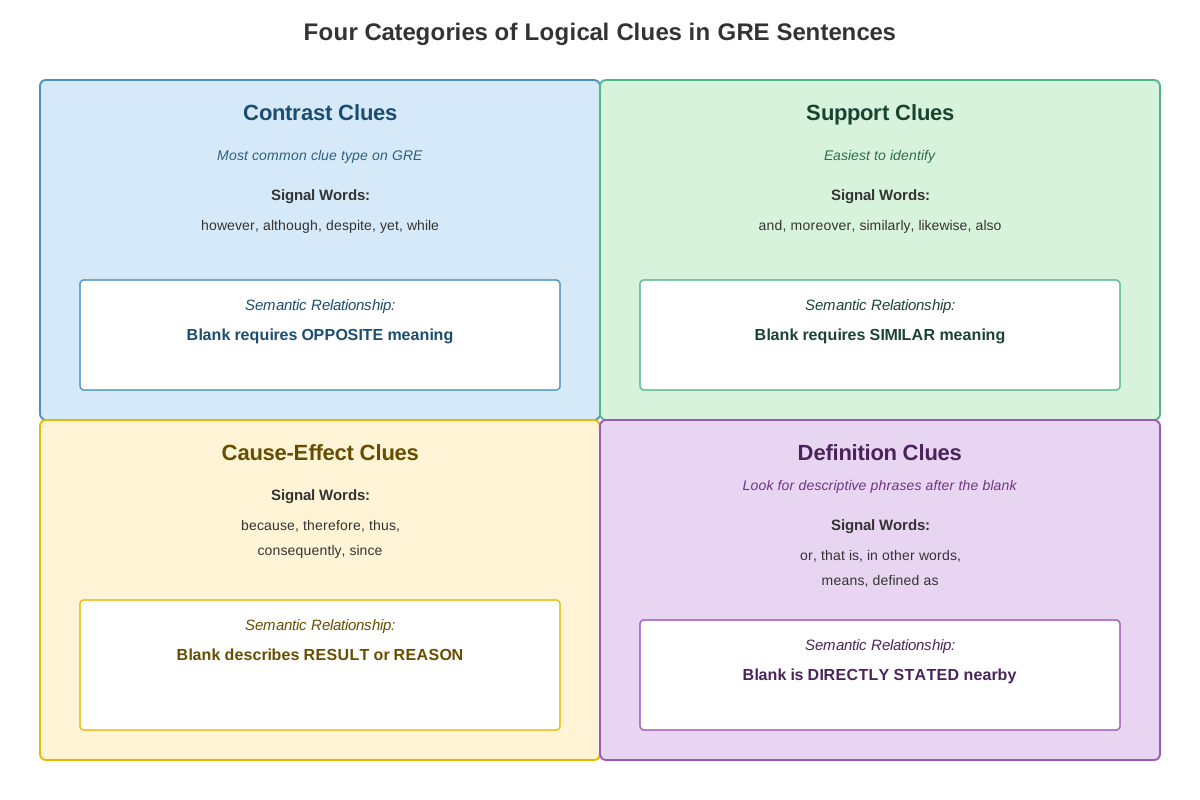
- [ ] Distinguish between different categories of logical clues (contrast, support, cause-effect, definition)
- [ ] Predict the semantic charge (positive/negative) and intensity of missing words based on identified clues
- [ ] Evaluate answer choices systematically by comparing them against identified clues rather than general sentence meaning
Prerequisites
- Basic sentence structure understanding: Recognizing subjects, verbs, objects, and modifying phrases enables students to parse complex GRE sentences and locate where clues reside in relation to blanks.
- Familiarity with transition words: Knowledge of common transitions (however, moreover, although, because) provides the foundation for recognizing the most explicit category of logical clues.
- Intermediate vocabulary: While logical clue identification reduces vocabulary dependence, students must still understand the words in the sentence itself to interpret clues correctly.
- Reading comprehension fundamentals: The ability to extract main ideas and understand relationships between clauses ensures students can follow the logical flow that clues reveal.
Why This Topic Matters
Logical clue identification represents the single most efficient strategy for improving Sentence Equivalence performance because it addresses the fundamental challenge these questions pose: selecting two words that both complete the sentence coherently and create sentences with equivalent meaning. Without systematic clue identification, students resort to testing each answer choice individually—a time-consuming approach prone to errors when multiple options seem plausible. By contrast, students who identify clues first can often eliminate four of six choices immediately and focus their attention on distinguishing between the remaining candidates.
Exam statistics underscore the importance of this skill. Sentence Equivalence questions constitute approximately 40% of Verbal Reasoning questions on the GRE, with each section containing 4-5 such questions. Research on GRE performance patterns reveals that students who employ systematic clue-identification strategies score an average of 3-4 points higher on the Verbal Reasoning scale (out of 170) compared to those relying primarily on vocabulary knowledge. Furthermore, logical clue identification skills transfer directly to Text Completion questions, which comprise another 40% of Verbal Reasoning content, making this technique relevant to roughly 80% of the exam's vocabulary-focused questions.
Common manifestations of logical clue identification on the GRE include sentences with explicit contrast markers ("Although the scientist's methods were _____, her conclusions proved sound"), causal relationships ("The politician's _____ rhetoric alienated moderate voters, costing him the election"), definitional structures ("Known for her _____, the author rarely revised her first drafts"), and parallel construction ("The executive's _____ management style—characterized by micromanagement and constant oversight—stifled creativity"). Each pattern provides specific, actionable information about the blank's meaning, but only students trained in clue identification can reliably extract and apply this information under test conditions.
Core Concepts
Definition and Mechanism of Logical Clues
A logical clue is any textual element within a sentence that constrains or reveals the meaning of a blank through semantic, syntactic, or rhetorical relationships. These clues function as directional signals, indicating whether the blank should align with (support) or oppose (contrast) other ideas in the sentence. The mechanism operates through semantic coherence—the principle that well-formed sentences maintain consistent logical relationships between their components. When a sentence states "Despite her _____ demeanor, she was actually quite friendly," the word "Despite" creates a contrast relationship, while "actually quite friendly" provides the contrasting content, together signaling that the blank must mean something opposite to "friendly."
Logical clues operate at multiple linguistic levels simultaneously. At the lexical level, individual words like "but," "although," or "because" explicitly signal relationships. At the phrasal level, expressions like "far from," "anything but," or "on the contrary" indicate contrast or negation. At the clausal level, entire phrases may describe characteristics that the blank must either match or oppose. Effective clue identification requires scanning all these levels systematically, as GRE questions often embed clues at multiple points within a sentence.
Categories of Logical Clues
| Clue Category | Function | Common Indicators | Example |
|---|---|---|---|
| Contrast Clues | Signal that the blank opposes another idea | although, despite, however, yet, but, while, whereas, nevertheless | "Though typically _____, the professor was animated during today's lecture." |
| Support Clues | Indicate the blank reinforces or extends another idea | and, moreover, furthermore, indeed, in fact, similarly | "The artist's work was _____ and demonstrated exceptional technical skill." |
| Cause-Effect Clues | Show the blank is either a cause or consequence | because, since, therefore, thus, consequently, as a result | "Because of the drought's _____ effects, the region's agriculture collapsed." |
| Definition Clues | Provide direct explanation or restatement | known as, defined as, that is, in other words, characterized by | "The phenomenon, _____ by its sudden onset, surprised researchers." |
| Degree/Intensity Clues | Specify whether the blank should intensify or moderate | extremely, somewhat, rather, quite, barely, hardly | "The critic's review was not merely negative but utterly _____." |
Contrast Clues: The Most Common Pattern
Contrast clues appear in approximately 45% of Sentence Equivalence questions, making them the highest-yield pattern to master. These clues establish that the blank must express an idea opposite to or different from another element in the sentence. The most explicit contrast clues are subordinating conjunctions like "although," "though," "while," and "whereas," which grammatically link contrasting clauses. For example: "Although the medication was _____, it produced severe side effects" signals that the blank must contrast with "severe side effects," suggesting something positive like "effective" or "beneficial."
More subtle contrast clues include adversative transitions ("however," "nevertheless," "nonetheless"), contrastive phrases ("far from," "anything but," "contrary to"), and semantic oppositions embedded in the sentence's content. Consider: "The diplomat's public statements were conciliatory, but her private communications revealed a more _____ attitude." Here, "but" provides the explicit contrast marker, while "conciliatory" provides the contrasting content, together indicating the blank needs a word meaning "aggressive" or "hostile."
A critical refinement in identifying contrast clues involves recognizing double contrasts, where two contrast markers appear in the same sentence. In such cases, the contrasts cancel each other out, creating a support relationship. Example: "Despite his reputation for being inflexible, the manager was not _____ in his approach to the crisis." The word "Despite" creates one contrast, while "not" creates another, meaning the blank should actually support "inflexible" rather than oppose it—the correct answer would be something like "rigid" or "unyielding."
Support Clues: Reinforcement and Extension
Support clues indicate that the blank should align with, reinforce, or extend an idea already present in the sentence. These clues appear through additive transitions ("and," "moreover," "furthermore"), intensifiers ("even," "indeed," "in fact"), and parallel structures where the blank occupies a position grammatically or semantically parallel to another element. For instance: "The researcher's methodology was rigorous, and her analysis was equally _____." The parallel structure ("methodology was X, and analysis was Y") combined with "equally" signals that the blank should support "rigorous" with a synonym like "thorough" or "meticulous."
Support clues also manifest through elaboration patterns, where a sentence provides specific examples or details that the blank must encompass or summarize. Example: "The committee's decision was _____, taking into account economic factors, environmental concerns, and community input." The detailed list following the blank suggests it should mean something like "comprehensive" or "thorough"—words that capture the idea of considering multiple factors.
An important subcategory involves definitional support, where the sentence essentially defines what the blank must mean through apposition, relative clauses, or explanatory phrases. Consider: "The scientist's approach, characterized by careful observation and repeated testing, was decidedly _____." The phrase "characterized by careful observation and repeated testing" directly describes the blank, indicating it should mean "empirical" or "methodical."
Cause-Effect Clues: Logical Consequences
Cause-effect clues establish that the blank either causes or results from another situation described in the sentence. These relationships appear through causal conjunctions ("because," "since," "as"), result indicators ("therefore," "thus," "consequently," "as a result"), and implicit causal relationships embedded in the sentence's logic. Example: "Because the evidence was _____, the jury reached a verdict quickly." The causal structure indicates that some quality of the evidence (the cause) led to a quick verdict (the effect), suggesting the blank should mean "clear," "compelling," or "conclusive."
Reverse cause-effect patterns, where the blank describes an effect rather than a cause, require careful attention to sentence structure. Consider: "The prolonged drought left the landscape _____, with vegetation withered and streams dried." Here, "left the landscape" signals that the blank describes the effect of the drought, and the subsequent description ("vegetation withered and streams dried") provides specific details that the blank must summarize, pointing toward words like "barren" or "desolate."
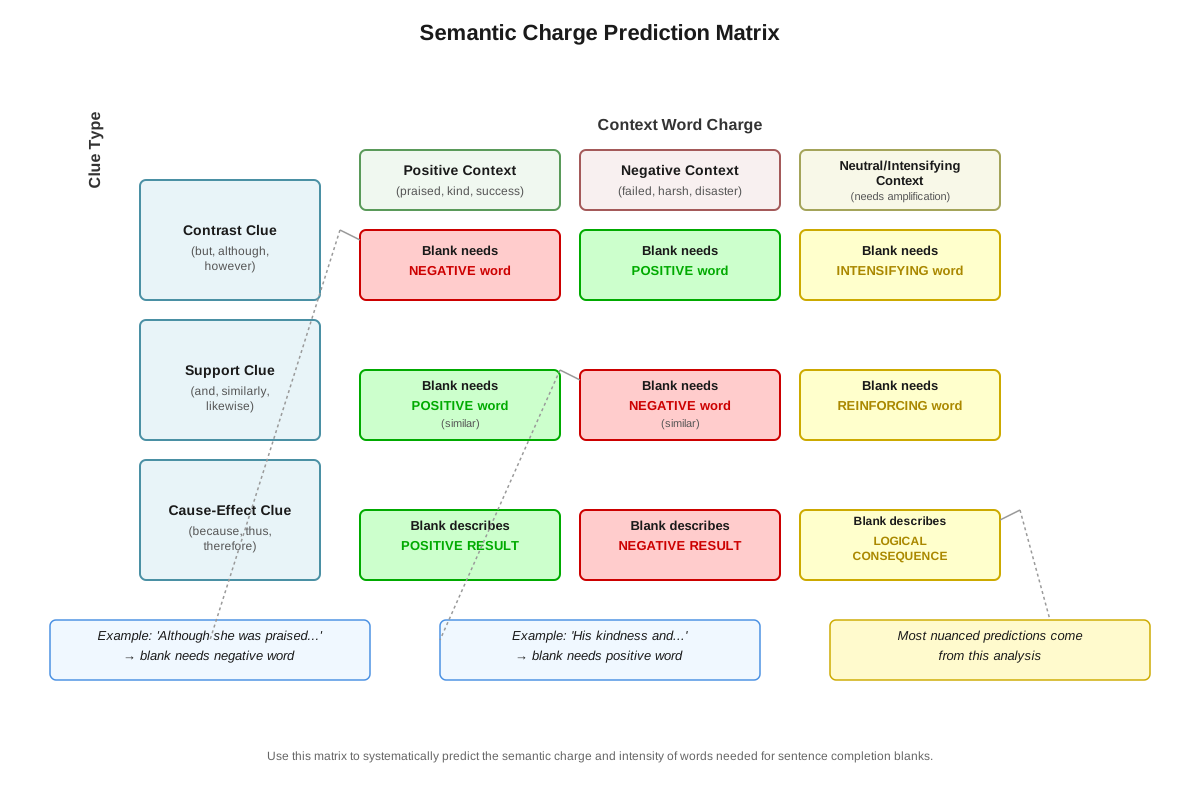
Semantic Charge and Intensity Prediction
Beyond determining whether a blank should support or contrast with other ideas, effective logical clue identification involves predicting the semantic charge (positive, negative, or neutral) and intensity (strong, moderate, or weak) of the missing word. Charge prediction relies on identifying emotionally or evaluatively loaded words in the sentence. If a sentence describes something as "beneficial," "successful," or "admirable," a blank in a support relationship should have positive charge; if in a contrast relationship, negative charge.
Intensity prediction draws on degree modifiers ("extremely," "somewhat," "rather"), comparative structures ("more than," "less than"), and intensifying phrases ("not merely X but Y"). Example: "The critic's assessment was not just negative but _____, attacking every aspect of the performance." The phrase "not just negative but" signals that the blank must be more intense than "negative," pointing toward words like "scathing" or "vitriolic" rather than milder options like "unfavorable" or "critical."
Concept Relationships
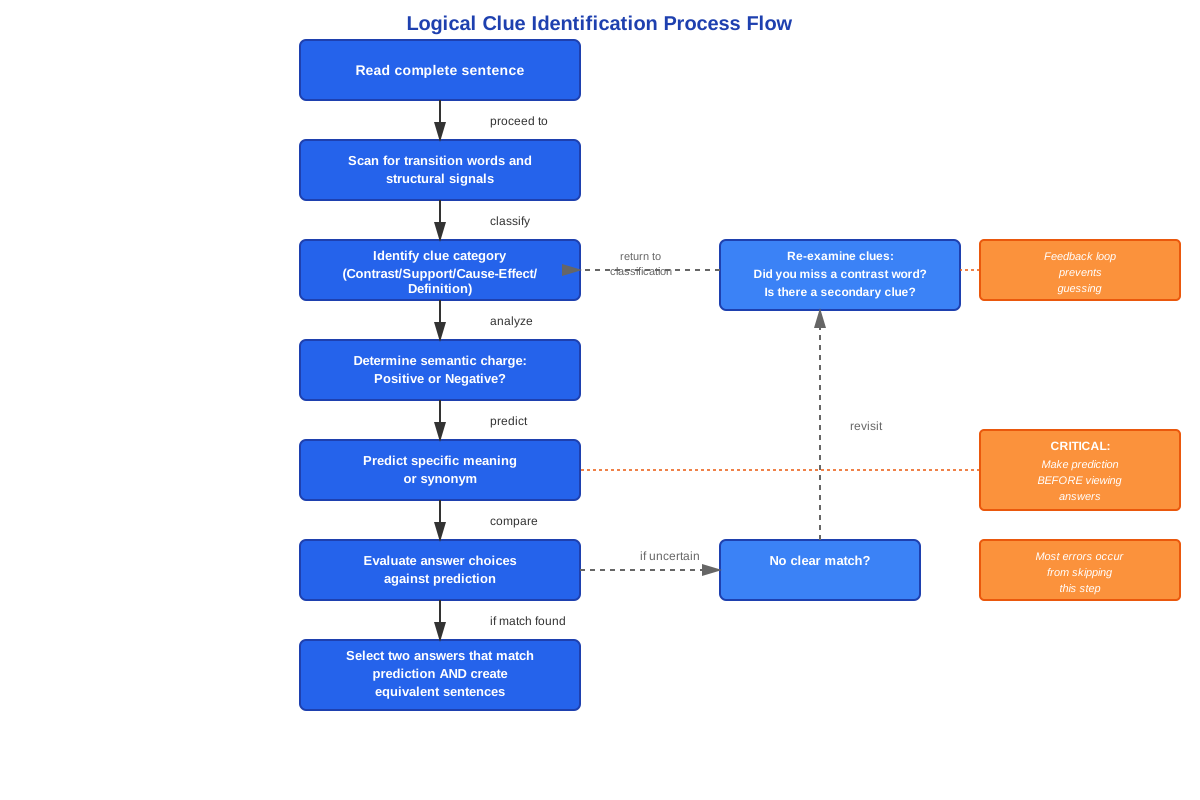
The concepts within logical clue identification form a hierarchical structure where basic clue recognition (identifying that a clue exists) → clue categorization (determining whether it signals contrast, support, cause-effect, or definition) → semantic prediction (using the clue to predict the blank's meaning, charge, and intensity) → answer evaluation (systematically comparing answer choices against the prediction). Each step depends on the previous one, and skipping steps—such as jumping directly from recognizing a clue to evaluating answers without making a prediction—significantly reduces accuracy.
The relationship between logical clue identification and prerequisite knowledge operates bidirectionally. Strong vocabulary knowledge enhances clue identification by enabling students to recognize the semantic charge and intensity of words that serve as clue content (the contrasting or supporting ideas). Conversely, systematic clue identification reduces vocabulary dependence by providing structural guidance that narrows the range of possible meanings for the blank, allowing students to select correct answers even when they don't know all the answer choices.
Logical clue identification connects forward to advanced Sentence Equivalence strategies, particularly answer pair prediction (identifying which two answer choices are synonyms before checking whether they fit the sentence) and elimination strategies (systematically removing answers that contradict identified clues). The skill also transfers directly to Text Completion questions, where the same clue categories appear but students must select only one answer per blank rather than two equivalent answers.
Quick check — test yourself on Logical clue identification so far.
Try Flashcards →High-Yield Facts
⭐ Contrast clues appear in approximately 45% of Sentence Equivalence questions, making them the most frequently tested logical relationship on the GRE.
⭐ The words "although," "despite," "however," and "but" account for over 60% of explicit contrast clues in official GRE questions.
⭐ Double contrast markers (e.g., "Despite... not...") create support relationships, not contrast relationships, because the two contrasts cancel each other out.
⭐ Parallel grammatical structures (e.g., "X was A, and Y was B") typically signal support relationships, indicating the blank should align with the parallel element.
⭐ When a sentence provides specific examples or details after the blank, those details define what the blank must mean, creating a definitional support relationship.
- Approximately 30% of Sentence Equivalence questions contain multiple clues that must be synthesized to determine the blank's meaning.
- Cause-effect clues often appear without explicit markers like "because," requiring students to infer the causal relationship from sentence logic.
- Degree modifiers ("extremely," "somewhat," "rather") appear in roughly 20% of questions and are critical for distinguishing between answer choices with similar meanings but different intensities.
- The phrase "far from" creates a contrast relationship equivalent to "not" or "opposite of," despite not being a traditional contrast marker.
- When a blank appears early in a sentence, clues typically appear later; when a blank appears late, clues typically appear earlier—scanning the entire sentence is essential.
- Semicolons often separate parallel or contrasting ideas, making them structural clues about the relationship between clauses.
- Negative words ("not," "never," "rarely," "hardly") reverse the expected relationship, turning support clues into contrast clues and vice versa.
Common Misconceptions
Misconception: Logical clues always appear immediately adjacent to the blank.
Correction: Clues can appear anywhere in the sentence—at the beginning, middle, or end—and may be separated from the blank by multiple clauses. Effective clue identification requires scanning the entire sentence systematically rather than focusing only on words near the blank.
Misconception: The word "and" always signals a support relationship.
Correction: While "and" typically indicates support, it can connect contrasting ideas when combined with other elements. For example, "The proposal was ambitious and _____, promising much but delivering little" uses "and" to connect two ideas, but the phrase "promising much but delivering little" reveals that the blank should be negative (like "unrealistic"), creating a contrast with the positive connotation of "ambitious."
Misconception: If a sentence contains a contrast clue, the blank must be the opposite of every other word in the sentence.
Correction: Contrast clues establish a relationship between the blank and a specific element in the sentence, not all elements. Students must identify which particular word, phrase, or idea the blank contrasts with, as sentences often contain multiple ideas with different relationships to the blank.
Misconception: Logical clue identification is only useful when vocabulary knowledge is weak.
Correction: Even students with strong vocabularies benefit from systematic clue identification because it provides a methodical framework for eliminating incorrect answers and distinguishing between synonyms with subtle meaning differences. The strategy enhances accuracy and speed regardless of vocabulary level.
Misconception: The longest or most complex sentence element is always the most important clue.
Correction: Clue importance depends on logical function, not length or complexity. A single word like "but" or "despite" often provides more decisive information about the blank than a lengthy descriptive phrase. Effective clue identification prioritizes structural markers (transitions, conjunctions) before considering content-based clues.
Misconception: If two answer choices are synonyms, they must be correct for Sentence Equivalence questions.
Correction: While Sentence Equivalence requires selecting two words that create equivalent meanings, those words must also fit the logical clues in the sentence. Synonym pairs that contradict identified clues are incorrect, even though they're synonyms. The correct approach is to use clues to predict meaning first, then identify which synonym pair matches that prediction.
Worked Examples
Example 1: Contrast Clue with Definitional Support
Question: "Although the technology was _____, characterized by frequent malfunctions and user complaints, the company continued to market it aggressively."
Step 1 - Identify clues: The word "Although" immediately signals a contrast relationship. The phrase "characterized by frequent malfunctions and user complaints" provides definitional support, describing the blank directly.
Step 2 - Determine what the blank contrasts with: The contrast is between the technology's quality (the blank) and the company's action ("continued to market it aggressively"). The aggressive marketing suggests confidence or positive expectations, so the blank must describe something negative about the technology that contrasts with this confidence.
Step 3 - Use the definitional clue: The phrase "characterized by frequent malfunctions and user complaints" directly defines the blank. It must mean something like "unreliable," "problematic," or "defective."
Step 4 - Predict semantic charge and intensity: The blank must be negative (due to "malfunctions and user complaints") and moderately to strongly negative (since the problems are "frequent").
Step 5 - Evaluate answer choices: Correct answers would be synonyms meaning "unreliable" or "problematic," such as "flawed" and "defective." Incorrect answers might include positive words (contradicting the definitional clue), neutral words (not matching the negative charge), or negative words with wrong meanings (e.g., "expensive" is negative but doesn't relate to malfunctions).
Connection to learning objectives: This example demonstrates identifying when logical clue identification is tested (the presence of "Although" and a descriptive phrase), explaining the strategy (using contrast and definitional clues together), and applying it systematically to predict the answer.
Example 2: Double Contrast with Intensity Clue
Question: "Despite the manager's reputation for being lenient, her response to the violation was not _____, but rather demonstrated unexpected severity."
Step 1 - Identify clues: "Despite" creates the first contrast. "Not" creates a second contrast. "But rather demonstrated unexpected severity" provides contrasting content and an intensity clue.
Step 2 - Analyze the double contrast: "Despite" suggests the blank should contrast with "lenient." However, "not" reverses this relationship, meaning the blank should actually support "lenient" (the two contrasts cancel out). But we must also consider the second part of the sentence.
Step 3 - Resolve the apparent contradiction: The sentence structure is "Despite X, her response was not _____, but rather Y." This means the blank should be what we'd expect given X (lenient), but the reality was Y (severe). So the blank should support "lenient" and contrast with "severe."
Step 4 - Predict meaning: The blank should mean something like "mild," "permissive," or "tolerant"—words that align with "lenient" and oppose "severity."
Step 5 - Evaluate answer choices: Correct answers would be synonyms meaning "mild" or "permissive," such as "indulgent" and "forbearing." Common trap answers might include words meaning "severe" (misunderstanding the double contrast) or words meaning "lenient" but with wrong intensity.
Connection to learning objectives: This example illustrates a more complex application of logical clue identification, requiring students to recognize how multiple clues interact and to avoid the common error of treating each contrast marker independently.
Exam Strategy
Primary Strategy: Always identify and mark logical clues before reading answer choices. This prevents answer choices from biasing interpretation and ensures predictions are based on sentence structure rather than answer availability.
Systematic Approach for Sentence Equivalence Questions:
- Read the entire sentence once without looking at answer choices, focusing on understanding the overall meaning and structure.
- Scan for explicit clue markers (although, despite, however, because, and, etc.) and circle or mentally note them.
- Identify the relationship between the blank and other sentence elements (contrast, support, cause-effect, or definition).
- Locate the specific content that the blank must relate to (the word, phrase, or idea being contrasted with or supported).
- Predict the semantic charge (positive, negative, neutral) and intensity (strong, moderate, weak) of the blank.
- Formulate a prediction word or phrase that captures the blank's meaning based on identified clues.
- Evaluate answer choices by comparing each to your prediction, eliminating those that contradict identified clues.
- Identify synonym pairs among remaining choices and select the pair that best matches your prediction.
Trigger words and phrases to watch for:
- Contrast triggers: although, though, despite, in spite of, while, whereas, however, nevertheless, nonetheless, yet, but, rather than, instead of, far from, anything but, on the contrary
- Support triggers: and, moreover, furthermore, additionally, indeed, in fact, similarly, likewise, as well as, not only... but also
- Cause-effect triggers: because, since, as, for, therefore, thus, hence, consequently, as a result, so, leading to, resulting in
- Definition triggers: that is, in other words, known as, defined as, characterized by, meaning, specifically, namely
- Intensity triggers: extremely, very, quite, rather, somewhat, slightly, barely, hardly, not merely... but, not just... but
Process-of-elimination tips:
- Eliminate any answer choice that contradicts the semantic charge (positive/negative) indicated by clues.
- Remove choices that have the right charge but wrong intensity (e.g., "annoyed" when clues indicate extreme negativity).
- Eliminate words that don't form a logical relationship with the identified clue content.
- When two answer choices are synonyms but don't fit the clues, eliminate both—Sentence Equivalence requires both correctness and equivalence.
- If you've identified a clear contrast clue but an answer choice supports rather than contrasts (or vice versa), eliminate it immediately.
Time allocation advice: Spend 15-20 seconds on clue identification and prediction, then 20-30 seconds evaluating answer choices. This front-loaded approach (more time on analysis, less on answer evaluation) increases accuracy and actually saves time by reducing the need to re-read the sentence or reconsider eliminated choices. For questions where clues are ambiguous or multiple clues seem to conflict, allocate an additional 10-15 seconds to resolve the ambiguity before proceeding to answer choices.
Memory Techniques
CASED Mnemonic for the five main clue categories:
- Contrast (although, despite, however, but)
- Additive/Support (and, moreover, furthermore)
- Sequence/Cause-Effect (because, therefore, consequently)
- Explanation/Definition (that is, characterized by, known as)
- Degree/Intensity (extremely, somewhat, barely)
Visualization Strategy: Picture logical clues as directional arrows. Contrast clues are arrows pointing in opposite directions (←→), support clues are arrows pointing in the same direction (→→), and cause-effect clues are arrows showing one thing leading to another (→). When reading a sentence, mentally draw these arrows between the blank and related content to visualize the logical relationship.
The "But Test": When uncertain whether a clue signals contrast or support, try inserting "but" between the blank and the related content. If "but" makes sense, it's a contrast relationship; if "but" sounds wrong and "and" sounds right, it's a support relationship.
Charge Color Coding: Mentally assign colors to semantic charges—green for positive, red for negative, gray for neutral. As you identify clues, visualize the blank's color based on the predicted charge. This creates a visual memory aid that helps during answer evaluation.
The Three-Question Framework: For every sentence, ask: (1) What type of relationship exists? (2) What specific content does the blank relate to? (3) What charge and intensity does the blank need? Memorizing these three questions creates a consistent analytical routine that becomes automatic with practice.
Summary
Logical clue identification transforms GRE Sentence Equivalence questions from vocabulary challenges into systematic logical puzzles. By recognizing that every well-constructed sentence contains deliberate markers—contrast indicators, support signals, cause-effect relationships, or definitional phrases—students can predict the meaning, semantic charge, and intensity of missing words before examining answer choices. The five primary clue categories (contrast, support, cause-effect, definition, and degree/intensity) account for virtually all logical relationships tested on the GRE, with contrast clues appearing most frequently. Mastery requires moving beyond simple clue recognition to systematic application: identifying all clues in a sentence, determining which specific content the blank relates to, predicting the blank's characteristics, and then evaluating answer choices against this prediction rather than against general sentence meaning. This approach not only increases accuracy but also improves efficiency by providing a structured framework that reduces cognitive load and enables faster elimination of incorrect answers. Students who internalize this systematic process consistently outperform those relying primarily on vocabulary knowledge or intuitive sentence completion.
Key Takeaways
- Logical clue identification is the highest-yield strategy for Sentence Equivalence, appearing in virtually every question and providing systematic guidance for answer selection.
- The five main clue categories—contrast, support, cause-effect, definition, and degree/intensity—cover all logical relationships tested on the GRE, with contrast clues being most common.
- Always identify and analyze clues before reading answer choices to prevent answer options from biasing interpretation and to ensure predictions are based on sentence structure.
- Contrast markers like "although," "despite," "however," and "but" are the most explicit and reliable clues, but subtle contrast indicators (far from, anything but) and double contrasts require careful attention.
- Semantic charge (positive/negative) and intensity (strong/moderate/weak) prediction are essential refinements that enable students to distinguish between answer choices with similar meanings.
- Clues can appear anywhere in a sentence, not just near the blank, requiring systematic scanning of the entire sentence structure.
- The systematic approach—identify clues, determine relationships, predict meaning, evaluate answers—becomes faster and more automatic with practice, ultimately saving time while increasing accuracy.
Related Topics
Text Completion Strategy: Logical clue identification applies directly to Text Completion questions, which use the same clue categories but require selecting only one answer per blank rather than two equivalent answers. Mastering clue identification in Sentence Equivalence provides the foundation for advanced Text Completion techniques.
Vocabulary in Context: Understanding how logical clues constrain word meaning connects to the broader skill of determining word meaning from context in Reading Comprehension passages, where similar contrast and support relationships operate at the paragraph and passage level.
Sentence Structure Analysis: Deeper understanding of grammatical structures—subordinate clauses, parallel construction, appositive phrases—enhances clue identification by revealing how sentence architecture creates logical relationships.
Synonym Recognition: Since Sentence Equivalence requires identifying synonym pairs, developing systematic approaches to recognizing synonyms with subtle meaning differences complements logical clue identification and improves answer selection accuracy.
Practice CTA
Now that you understand the systematic approach to logical clue identification, it's time to apply these strategies to actual GRE-style questions. The practice questions and flashcards that follow are specifically designed to reinforce the clue categories, prediction techniques, and evaluation strategies covered in this guide. Approach each practice question methodically: identify clues first, make predictions second, and evaluate answers last. With consistent practice, this systematic approach will become automatic, transforming Sentence Equivalence from a challenging question type into a reliable source of points on test day. Remember, every expert test-taker started exactly where you are now—the difference is deliberate practice with proven strategies.
Sign up free to keep reading
Create a free AnvayaPrep account to finish this GRE guide on Logical clue identification — plus flashcards and practice questions.