Overview
Tone prediction is a critical skill for success on the GRE Verbal Reasoning section, particularly within Sentence Equivalence questions. This technique involves analyzing the emotional quality, attitude, or evaluative stance conveyed by a sentence, then selecting answer choices that maintain consistency with that established tone. The ability to accurately predict and match tone separates high-scoring test-takers from those who struggle with nuanced vocabulary questions.
On the GRE, gre tone prediction serves as a powerful elimination strategy that allows students to narrow answer choices before even considering precise definitions. By identifying whether a sentence expresses positive, negative, neutral, critical, admiring, or ambivalent sentiment, test-takers can immediately eliminate options that clash with the established emotional register. This approach is particularly valuable when facing unfamiliar vocabulary, as tone often provides sufficient context to make educated selections even without knowing every word's exact meaning.
Within the broader landscape of Verbal Reasoning, tone prediction connects intimately with context clue analysis, connotation awareness, and logical coherence. It represents the intersection of reading comprehension and vocabulary knowledge, requiring students to synthesize multiple textual signals—including descriptive adjectives, transition words, and structural patterns—to determine the author's attitude. Mastering this skill enhances performance not only on Sentence Equivalence questions but also on Text Completion and Reading Comprehension passages where understanding authorial stance proves essential.
Learning Objectives
- [ ] Identify when Tone prediction is being tested in GRE Sentence Equivalence questions
- [ ] Explain the core rule or strategy behind Tone prediction
- [ ] Apply Tone prediction to GRE-style questions accurately
- [ ] Distinguish between subtle gradations of tone (mildly positive vs. enthusiastically positive, critical vs. hostile)
- [ ] Recognize tone indicators embedded in sentence structure, transition words, and descriptive language
- [ ] Combine tone prediction with other context clue strategies for maximum accuracy
- [ ] Evaluate answer choices for tonal consistency even when vocabulary is partially unfamiliar
Prerequisites
- Basic vocabulary knowledge: Understanding common positive and negative connotations enables initial tone categorization
- Sentence structure comprehension: Recognizing how clauses relate helps identify contrasting or supporting tones
- Context clue familiarity: Tone prediction builds upon the ability to extract meaning from surrounding words
- Logical reasoning skills: Determining tone requires inference about the author's intended message and attitude
Why This Topic Matters
Tone prediction represents one of the highest-yield strategies for GRE Verbal Reasoning success. Research on GRE question patterns reveals that approximately 60-70% of Sentence Equivalence questions can be approached effectively through tone analysis, making this skill indispensable for efficient test-taking. Unlike pure vocabulary memorization, which requires learning thousands of words, tone prediction provides a systematic framework that works across diverse question types.
In real-world applications, the ability to discern tone translates directly to critical reading skills essential for graduate-level academic work. Graduate students must regularly evaluate scholarly arguments, distinguish between neutral reporting and biased commentary, and recognize subtle rhetorical moves in academic discourse. The GRE tests this skill because it predicts success in navigating complex academic texts where authorial stance significantly impacts interpretation.
On the exam itself, tone prediction appears most frequently in Sentence Equivalence questions where two answer choices must create sentences with equivalent meaning. These questions often feature sentences with clear emotional valence—describing something as problematic, praising an achievement, or expressing ambivalence about a situation. The test-makers deliberately include answer choices with incorrect tones as attractive distractors, knowing that students who focus solely on semantic similarity without considering tone will select mismatched pairs. Additionally, tone awareness proves valuable in Text Completion questions where blank placement within evaluative contexts requires tonal consistency, and in Reading Comprehension questions asking about the author's attitude or purpose.
Core Concepts
Understanding Tone Categories
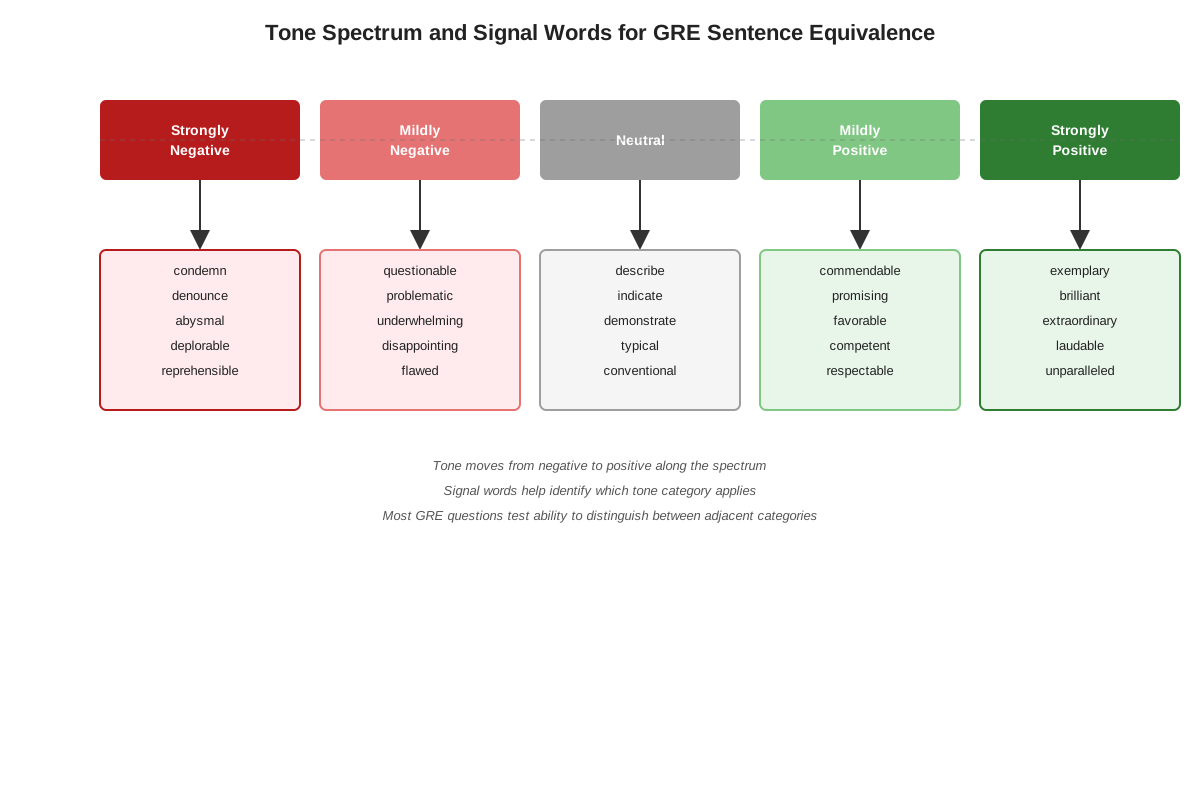
Tone refers to the author's attitude toward the subject matter, conveyed through word choice, sentence structure, and rhetorical devices. On the GRE, tone typically falls into several broad categories that students must recognize instantly:
Positive tone indicates approval, admiration, enthusiasm, or favorable evaluation. Words like "commendable," "exemplary," "laudable," and "praiseworthy" signal positive tone. Sentences with positive tone often describe achievements, beneficial qualities, or desirable outcomes.
Negative tone conveys disapproval, criticism, concern, or unfavorable judgment. Terms such as "problematic," "detrimental," "regrettable," and "deplorable" establish negative tone. These sentences typically highlight flaws, failures, or undesirable conditions.
Neutral/objective tone presents information without clear evaluative judgment, using descriptive rather than judgmental language. Words like "characteristic," "typical," "standard," and "conventional" maintain neutrality.
Ambivalent/mixed tone expresses conflicting attitudes or acknowledges both positive and negative aspects. Phrases like "although impressive," "despite its merits," or "while problematic" signal complexity in evaluation.
Tone Indicators and Signal Words
Certain linguistic elements function as reliable tone indicators that telegraph the sentence's emotional register:
| Tone Category | Signal Words | Structural Patterns |
|---|---|---|
| Positive | praiseworthy, admirable, commendable, exemplary, laudable | "surprisingly effective," "remarkably successful" |
| Negative | problematic, troubling, regrettable, deplorable, lamentable | "unfortunately flawed," "disturbingly inadequate" |
| Critical | questionable, dubious, suspect, contentious, controversial | "critics argue," "skeptics note" |
| Admiring | brilliant, masterful, ingenious, exceptional, outstanding | "widely celebrated," "justly acclaimed" |
| Dismissive | trivial, superficial, negligible, inconsequential, minor | "merely cosmetic," "hardly significant" |
Intensifiers and qualifiers modulate tone strength. Words like "extremely," "profoundly," "utterly," and "thoroughly" amplify tone, while "somewhat," "relatively," "fairly," and "moderately" soften it. Recognizing these gradations prevents selecting answer choices that are tonally correct in direction but incorrect in intensity.
The Tone Prediction Process
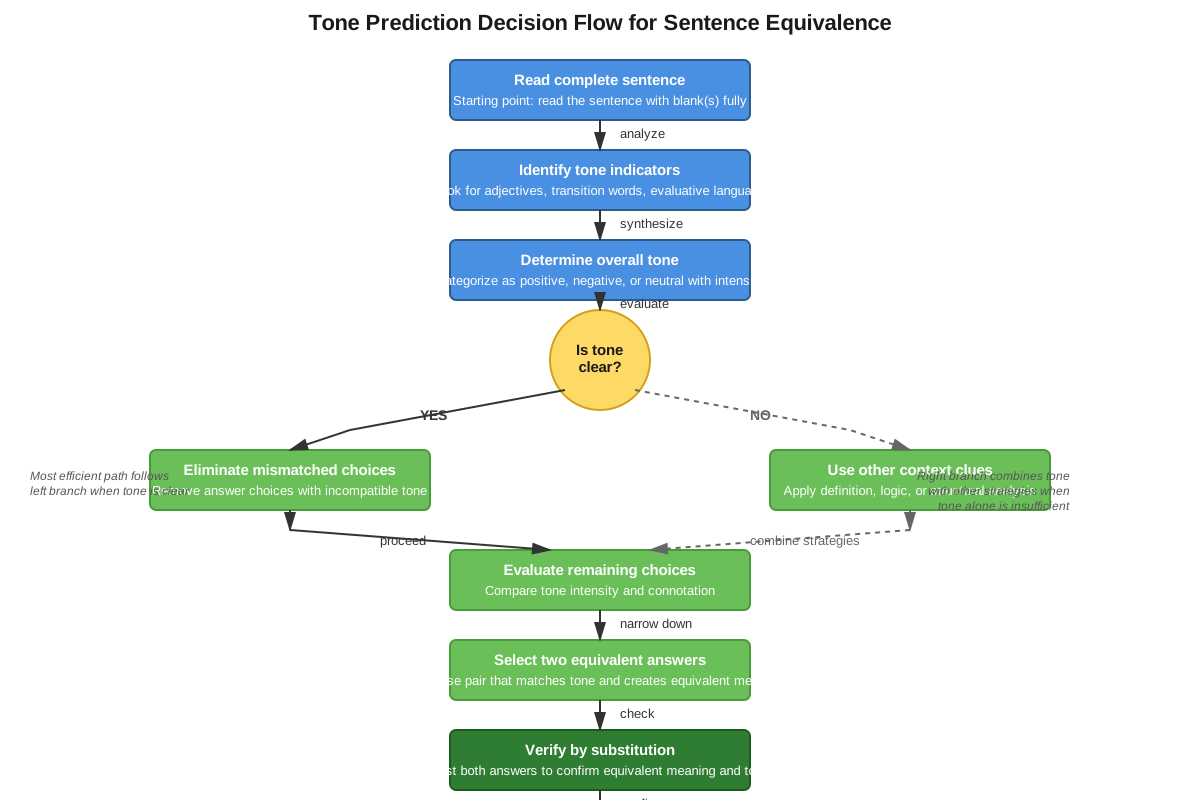
Effective tone prediction follows a systematic four-step process:
- Scan for explicit evaluative language: Identify adjectives, adverbs, and verbs that carry clear positive or negative connotations before the blank
- Analyze structural signals: Note transition words (however, although, despite) that indicate tonal shifts or continuations
- Determine tone direction and intensity: Classify the required tone as positive/negative and strong/moderate
- Eliminate mismatched choices: Remove options that contradict the established tone before considering precise meanings
This process proves particularly powerful when combined with the synonym pair strategy required for Sentence Equivalence questions. Students should first eliminate all options with incorrect tone, then identify which remaining words form a synonym pair that maintains tonal consistency.
Context Clues Supporting Tone
Beyond explicit evaluative words, several contextual elements reinforce tone prediction:
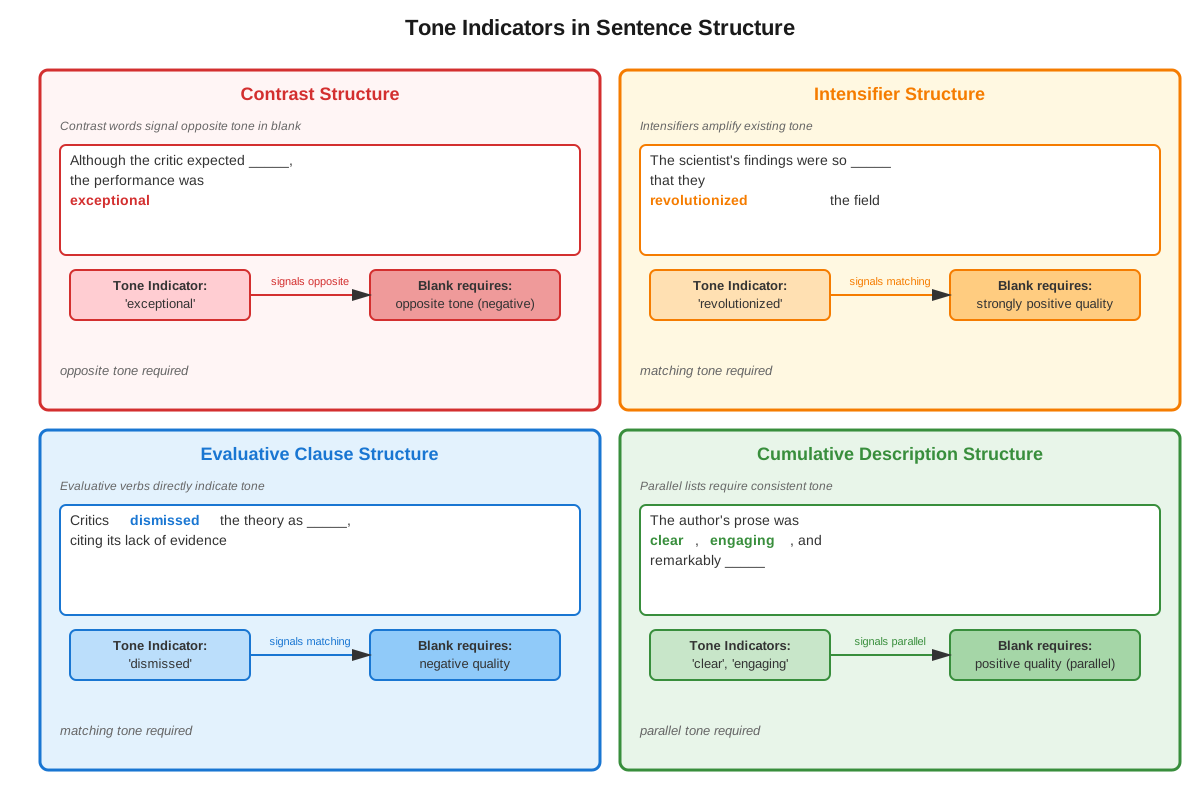
Cause-and-effect relationships often establish tone through their outcomes. If a sentence describes negative consequences, the blank likely requires a negative descriptor for the cause. Conversely, positive results suggest positive characterization.
Comparison and contrast structures signal whether the blank should match or oppose the tone of the compared element. Phrases like "unlike," "in contrast to," and "whereas" indicate tonal opposition, while "similarly," "likewise," and "equally" suggest tonal alignment.
Descriptive details accumulate to create overall tone. A sentence listing multiple negative features establishes negative tone even without explicit evaluative terms, guiding blank completion toward tonally consistent vocabulary.
Tone Consistency Across Sentence Elements
The GRE tests whether students recognize that tone consistency must extend throughout the entire sentence. A sentence cannot logically describe something with positive adjectives while using a negative verb, or vice versa, unless a contrast structure explicitly signals the shift. This principle helps eliminate answer choices that create tonal discord.
For example, if a sentence describes an artist's work as "innovative and groundbreaking," the blank describing critical reception cannot logically be filled with "dismissed" or "derided" unless a contrast word like "nevertheless" appears. The positive descriptors establish a tone that must continue unless explicitly redirected.
Concept Relationships
Tone prediction functions as the foundational layer upon which other Sentence Equivalence strategies build. The relationship flows as follows:
Tone Prediction → Eliminates Incorrect Categories → Narrows to Synonym Pairs → Enables Precise Selection
Within the topic itself, understanding tone categories enables recognition of tone indicators, which facilitates the tone prediction process, which ultimately ensures tone consistency across sentence elements. These concepts form a hierarchical relationship where each builds upon the previous.
Tone prediction connects to prerequisite knowledge of context clues by adding an evaluative dimension to semantic analysis. While basic context clues help determine what type of word fits (noun, verb, positive, negative), tone prediction refines this to determine the specific emotional register required. It also relates to vocabulary knowledge through connotation awareness—understanding that "frugal" and "miserly" both mean thrifty but carry different tones.
Looking forward, mastering tone prediction enables progression to more advanced strategies like recognizing authorial bias in Reading Comprehension passages and identifying rhetorical purpose in argumentative texts. The skill transfers directly to analyzing tone in longer passages where understanding the author's attitude proves essential for answering inference questions.
High-Yield Facts
⭐ Approximately 60-70% of GRE Sentence Equivalence questions can be approached effectively through tone analysis before considering precise definitions
⭐ Transition words like "however," "although," and "despite" signal tone shifts, while "furthermore," "moreover," and "indeed" indicate tone continuation
⭐ Intensifiers (extremely, profoundly, utterly) and qualifiers (somewhat, relatively, fairly) modulate tone strength and must match in answer choices
⭐ Positive and negative tones have multiple gradations—mildly positive differs from enthusiastically positive, just as critical differs from hostile
⭐ Tone must remain consistent throughout a sentence unless a contrast structure explicitly signals a shift
- Descriptive details that accumulate create overall tone even without explicit evaluative terms
- Cause-and-effect relationships establish tone through their outcomes—negative consequences suggest negative causes
- Comparison structures using "unlike" or "in contrast to" indicate the blank should oppose the compared element's tone
- Words can be semantically similar but tonally different (e.g., "confident" vs. "arrogant")
- Neutral/objective tone is less common in Sentence Equivalence questions than clearly positive or negative tone
- The GRE deliberately includes answer choices with correct semantic fields but incorrect tones as attractive distractors
- Recognizing tone allows educated guessing even with partially unfamiliar vocabulary
Quick check — test yourself on Tone prediction so far.
Try Flashcards →Common Misconceptions
Misconception: Tone prediction only works when explicit evaluative words appear in the sentence → Correction: Tone can be established through structural patterns, descriptive details, cause-and-effect relationships, and comparison structures even without obvious evaluative adjectives. The accumulation of contextual clues creates tone.
Misconception: All positive words are interchangeable, as are all negative words → Correction: Tone has gradations of intensity and specific flavors. "Adequate" and "exceptional" are both positive but differ dramatically in enthusiasm. "Problematic" and "catastrophic" are both negative but vary in severity. Answer choices must match both direction and intensity.
Misconception: Synonym pairs in Sentence Equivalence must have identical tones → Correction: While synonym pairs must create equivalent meaning, they should match in tone direction and approximate intensity. Slight tonal variations are acceptable if both choices produce logically equivalent sentences.
Misconception: Neutral tone means the sentence lacks any attitude → Correction: Neutral tone represents a deliberate choice to present information objectively without evaluation. It's an active stance, not an absence of stance, and requires answer choices that maintain descriptive rather than judgmental language.
Misconception: Tone prediction replaces the need for vocabulary knowledge → Correction: Tone prediction is a powerful elimination strategy that narrows choices, but precise vocabulary knowledge remains essential for final selection between tonally appropriate options. The strategies work synergistically, not independently.
Misconception: If a sentence contains one positive word, the entire sentence must be positive → Correction: Sentences can contain mixed elements, especially when contrast structures appear. A sentence might acknowledge positive aspects while ultimately expressing negative judgment, or vice versa. The overall tone depends on the sentence's logical structure and emphasis.
Worked Examples
Example 1: Identifying and Applying Tone
Question: The critic's review of the novel was surprisingly _____, given her typically harsh assessments of contemporary fiction.
Select two answer choices that produce sentences with equivalent meaning:
A) scathing
B) laudatory
C) ambivalent
D) complimentary
E) derivative
F) pedantic
Solution Process:
Step 1 - Identify tone indicators: The word "surprisingly" signals that the blank will contrast with "typically harsh assessments." The phrase "harsh assessments" establishes that the critic usually writes negative reviews.
Step 2 - Determine required tone: Since the sentence expresses surprise, the blank must contain the opposite of harsh/negative, meaning it requires a positive tone. The critic's review was unexpectedly positive.
Step 3 - Eliminate tonally incorrect choices:
- A) scathing - negative tone (means harshly critical) - ELIMINATE
- B) laudatory - positive tone (means expressing praise) - KEEP
- C) ambivalent - neutral/mixed tone - ELIMINATE
- D) complimentary - positive tone (means expressing approval) - KEEP
- E) derivative - negative/neutral tone (means unoriginal) - ELIMINATE
- F) pedantic - negative tone (means overly concerned with details) - ELIMINATE
Step 4 - Verify synonym relationship: "Laudatory" and "complimentary" both mean expressing praise or approval, and both create logically equivalent sentences with positive tone contrasting with the critic's usual harshness.
Answer: B and D
Connection to learning objectives: This example demonstrates identifying when tone prediction is tested (the contrast structure with "surprisingly"), explaining the strategy (eliminating choices that don't match the required positive tone), and applying it accurately to select the correct pair.
Example 2: Recognizing Tone Gradations
Question: While the committee acknowledged the proposal's innovative approach, they ultimately found its practical applications too _____ to warrant implementation.
Select two answer choices that produce sentences with equivalent meaning:
A) speculative
B) revolutionary
C) theoretical
D) conventional
E) pragmatic
F) beneficial
Solution Process:
Step 1 - Identify structural signals: "While" signals a contrast structure. The first clause is positive ("acknowledged the proposal's innovative approach"), so the second clause will be negative. The phrase "too ___ to warrant implementation" confirms negative evaluation—the proposal was rejected.
Step 2 - Analyze the specific criticism: The committee's concern is about "practical applications," suggesting the proposal lacked real-world applicability. The blank needs a word indicating insufficient practical grounding, with negative or limiting connotation in this context.
Step 3 - Determine tone and semantic field: Required tone is negative/limiting, and the semantic field relates to lack of practical application or excessive abstraction.
Step 4 - Eliminate mismatched choices:
- A) speculative - negative in this context (means based on conjecture rather than practical evidence) - KEEP
- B) revolutionary - positive tone (means dramatically innovative) - ELIMINATE
- C) theoretical - negative in this context (means abstract rather than practical) - KEEP
- D) conventional - neutral/negative but wrong semantic field (means traditional) - ELIMINATE
- E) pragmatic - positive tone (means practical) - opposite of what's needed - ELIMINATE
- F) beneficial - positive tone (means advantageous) - ELIMINATE
Step 5 - Verify equivalence: "Speculative" and "theoretical" both indicate lack of practical grounding, and both carry appropriate negative connotation in this context of rejected implementation. Both create equivalent sentences expressing that the proposal was too abstract/impractical.
Answer: A and C
Connection to learning objectives: This example shows how tone prediction works with contrast structures, demonstrates distinguishing between words that might be positive in isolation but negative in context, and illustrates combining tone analysis with semantic field consideration.
Exam Strategy
Approaching Tone-Based Questions
When encountering a Sentence Equivalence question, implement this strategic sequence:
- Read the entire sentence first without looking at answer choices to form an independent impression of tone
- Circle or mentally note tone indicators including evaluative adjectives, transition words, and structural patterns
- Classify the required tone as positive, negative, neutral, or mixed, and estimate intensity (mild, moderate, strong)
- Scan answer choices for tone before considering precise meanings, physically crossing out tonally incorrect options
- Identify synonym pairs among remaining tonally appropriate choices
- Verify by substitution that both selected words create logically equivalent, tonally consistent sentences
Trigger Words and Phrases
Watch for these high-frequency trigger words that signal tone-based questions:
Contrast triggers (indicate tone shift): however, although, despite, nevertheless, yet, while, whereas, in contrast to, unlike
Continuation triggers (indicate tone consistency): furthermore, moreover, indeed, similarly, likewise, equally, also, additionally
Surprise/expectation triggers (often indicate tone reversal): surprisingly, unexpectedly, remarkably, ironically, paradoxically
Evaluative intensifiers: extremely, profoundly, utterly, thoroughly, decidedly, particularly, especially, notably
Process of Elimination Tips
Tone-based elimination proves especially powerful because:
- Eliminating 3-4 options through tone analysis reduces cognitive load and increases accuracy on the remaining choices
- Tone mismatches are absolute disqualifiers—a word with wrong tone cannot be correct regardless of its precise meaning
- When vocabulary is partially unfamiliar, tone provides sufficient information for educated elimination even without knowing exact definitions
Exam Tip: If you can identify tone but don't know all vocabulary precisely, eliminate tonally incorrect choices first, then select the pair that "sounds most similar" among remaining options. This strategy significantly outperforms random guessing.
Time Allocation
For Sentence Equivalence questions using tone prediction:
- Spend 5-10 seconds on initial tone analysis before examining answer choices
- Invest this upfront time because it accelerates elimination and reduces time spent deliberating between options
- Aim for 60-90 seconds total per Sentence Equivalence question, with tone analysis consuming roughly 15-20% of that time
- If tone is ambiguous after 10 seconds, proceed to semantic analysis rather than over-analyzing tone
Memory Techniques
The TONE Acronym
Transition words signal shifts
Opposite or same direction?
Negative, positive, or neutral?
Eliminate mismatches first
Visualization Strategy
Picture tone as a spectrum with intensity levels:
NEGATIVE ←------------------------→ POSITIVE
hostile | critical | neutral | favorable | enthusiastic
When reading a sentence, mentally place the required tone on this spectrum, then eliminate answer choices that fall in the wrong region or at the wrong intensity level.
The "Feeling First" Technique
Before analyzing vocabulary, ask: "How does this sentence make me feel about the subject?" The emotional response often accurately captures tone even when analytical processing might overcomplicate. Trust initial impressions about whether something is being praised, criticized, or described neutrally.
Contrast Structure Mnemonic
"WHILE signals WILD differences" - Remember that "while," "although," "despite," and similar contrast words indicate the blank will have opposite tone from the other clause.
Synonym Pair Reminder
"Twins must match in mood" - Synonym pairs in Sentence Equivalence must share tone direction and approximate intensity, not just semantic similarity.
Summary
Tone prediction represents a foundational strategy for GRE Sentence Equivalence success, enabling test-takers to eliminate incorrect answer choices based on emotional register and evaluative stance before considering precise vocabulary meanings. By identifying whether a sentence expresses positive, negative, neutral, or mixed attitudes through structural signals, transition words, and evaluative language, students can narrow options efficiently and increase accuracy even with partially unfamiliar vocabulary. The technique requires recognizing that tone exists on a spectrum with gradations of intensity, that tone must remain consistent throughout a sentence unless contrast structures explicitly signal shifts, and that synonym pairs must match in both semantic meaning and tonal quality. Mastering tone prediction involves systematic analysis: scanning for tone indicators, classifying required tone direction and intensity, eliminating mismatched choices, and verifying that selected answers maintain tonal consistency. This skill proves particularly valuable because approximately 60-70% of Sentence Equivalence questions can be approached effectively through tone analysis, making it one of the highest-yield strategies for the Verbal Reasoning section. Success requires practice in distinguishing subtle tonal gradations and recognizing how structural elements like cause-and-effect relationships and comparison patterns establish tone even without explicit evaluative vocabulary.
Key Takeaways
- Tone prediction eliminates 50-70% of answer choices in typical Sentence Equivalence questions before considering precise definitions, making it the most efficient first-pass strategy
- Transition words are tone roadmaps: contrast words (however, although, despite) signal tone shifts, while continuation words (furthermore, moreover, indeed) indicate tone consistency
- Tone has direction AND intensity: both must match in correct answer pairs—"adequate" and "exceptional" are both positive but differ in enthusiasm level
- Structural patterns establish tone even without explicit evaluative words through cause-and-effect relationships, comparison structures, and accumulated descriptive details
- Tone consistency is mandatory throughout a sentence unless contrast structures explicitly signal shifts—positive descriptors cannot logically pair with negative verbs without transitional signals
- The four-step process (identify indicators → classify tone → eliminate mismatches → verify pairs) provides a systematic approach that works across diverse question types
- Tone prediction and vocabulary knowledge work synergistically—tone narrows choices while vocabulary enables precise final selection between tonally appropriate options
Related Topics
Connotation vs. Denotation: Understanding the difference between a word's literal meaning and its emotional associations deepens tone prediction accuracy. Mastering tone prediction provides the foundation for recognizing subtle connotative differences.
Context Clue Strategies: Tone prediction represents one category of context clues alongside definition clues, example clues, and contrast clues. Students who master tone prediction can integrate it with other context clue types for comprehensive Sentence Equivalence approaches.
Reading Comprehension - Author's Attitude: The tone prediction skills developed for Sentence Equivalence transfer directly to identifying authorial stance in longer passages, enabling success on questions asking about the author's tone, purpose, or perspective.
Text Completion - Logical Consistency: While Sentence Equivalence emphasizes synonym pairs, Text Completion questions also require tone awareness to maintain logical consistency across multiple blanks within complex sentences.
Vocabulary Building - Synonym Clusters: Organizing vocabulary study around tone categories (positive synonyms, negative synonyms, neutral descriptors) reinforces both vocabulary retention and tone prediction skills simultaneously.
Practice CTA
Now that you've mastered the fundamentals of tone prediction, it's time to cement your understanding through active practice. The concepts you've learned—identifying tone indicators, classifying emotional register, eliminating mismatched choices, and verifying tonal consistency—will become automatic only through repeated application to authentic GRE-style questions. Challenge yourself with the practice questions and flashcards designed specifically for this topic, paying particular attention to questions where tone provides the decisive clue for elimination. Remember that every practice question you complete strengthens your pattern recognition and builds the confidence you'll need on test day. Your investment in mastering tone prediction will pay dividends across the entire Verbal Reasoning section—start practicing now to transform this knowledge into test-taking skill!
Sign up free to keep reading
Create a free AnvayaPrep account to finish this GRE guide on Tone prediction — plus flashcards and practice questions.