Overview
Academic adjectives are sophisticated, precise descriptive words commonly found in scholarly writing, research papers, and formal discourse—exactly the type of language that permeates GRE passages and questions. These adjectives represent a specialized vocabulary tier that goes beyond everyday conversational English, encompassing words like "ephemeral," "pragmatic," "ubiquitous," and "contentious." Mastering these terms is not merely about expanding vocabulary; it's about developing the linguistic precision required to distinguish between subtle shades of meaning that the GRE consistently tests.
The GRE Verbal Reasoning section, particularly in Sentence Equivalence questions, relies heavily on testing whether students can identify synonymous or near-synonymous GRE academic adjectives that maintain the logical consistency of a sentence. These questions present a sentence with a blank and six answer choices, requiring test-takers to select two words that both complete the sentence coherently and produce sentences similar in meaning. Academic adjectives frequently populate these answer choices because their nuanced meanings create the perfect testing ground for vocabulary discrimination. A student who confuses "reticent" with "reluctant" or "ambiguous" with "ambivalent" will struggle to identify correct answer pairs.
Understanding academic adjectives connects directly to broader Verbal Reasoning competencies including Reading Comprehension, Text Completion, and critical analysis skills. These adjectives serve as the building blocks of complex arguments in passages, signal authorial tone and attitude, and establish precise relationships between ideas. When an author describes a theory as "untenable" versus "controversial," the distinction matters significantly for comprehension questions. Academic adjectives function as interpretive keys that unlock deeper meaning in sophisticated texts, making them indispensable for achieving competitive GRE scores.
Learning Objectives
- [ ] Identify when Academic adjectives is being tested in Sentence Equivalence and Text Completion questions
- [ ] Explain the core rule or strategy behind Academic adjectives usage and selection
- [ ] Apply Academic adjectives to GRE-style questions accurately by distinguishing between near-synonyms
- [ ] Categorize academic adjectives by semantic fields (positive/negative connotation, degree of intensity, contextual appropriateness)
- [ ] Recognize common academic adjective roots, prefixes, and suffixes to decode unfamiliar terms
- [ ] Evaluate answer choices by testing academic adjectives for both semantic accuracy and stylistic consistency
Prerequisites
- Basic vocabulary foundation: Understanding common English adjectives provides the baseline from which academic vocabulary extends; without this foundation, students cannot recognize the elevated register of academic terms.
- Parts of speech recognition: Identifying adjectives versus adverbs, nouns, or verbs ensures students can correctly parse sentence structure and determine what type of word belongs in a blank.
- Contextual reading skills: The ability to extract meaning from surrounding context enables students to infer the appropriate connotation and intensity level required for a given blank.
- Synonym and antonym relationships: Understanding how words relate through similarity and opposition forms the basis for selecting equivalent academic adjectives in Sentence Equivalence questions.
Why This Topic Matters
Academic adjectives represent approximately 30-40% of the vocabulary tested in GRE Verbal Reasoning questions, making them one of the highest-yield study areas for score improvement. Unlike specialized technical terminology from specific disciplines, academic adjectives appear across all subject areas—from humanities passages discussing literary criticism to science passages analyzing research methodologies. This universality means that mastering these terms provides consistent returns across every section of the exam.
In real-world applications, academic adjectives form the vocabulary of professional and scholarly communication. Graduate programs expect students to read, comprehend, and produce writing that employs these precise descriptive terms. Whether analyzing a "nascent" trend in economics, describing a "parsimonious" statistical model, or critiquing a "tendentious" argument in philosophy, these adjectives enable the nuanced expression required in advanced academic work.
On the GRE specifically, academic adjectives appear most frequently in:
- Sentence Equivalence questions (70-80% of questions include at least one academic adjective among answer choices)
- Text Completion questions (particularly in blanks requiring tone or evaluation words)
- Reading Comprehension passages (where they signal authorial attitude and establish argument structure)
- Vocabulary-in-context questions (testing whether students can determine precise meaning from surrounding text)
The ETS (Educational Testing Service) deliberately selects academic adjectives that create plausible distractors—words that seem potentially correct but differ in crucial ways from the actual answer. Understanding these subtle distinctions separates high scorers from average performers.
Core Concepts
Definition and Characteristics of Academic Adjectives
Academic adjectives constitute a register of descriptive vocabulary characterized by formal tone, precise meaning, and frequent appearance in scholarly discourse. Unlike basic adjectives ("good," "bad," "big," "small"), academic adjectives convey specific nuances that resist simple paraphrase. The word "meticulous," for instance, doesn't merely mean "careful"—it implies extreme attention to detail with connotations of thoroughness and precision that "careful" alone cannot capture.
These adjectives typically share several defining features:
- Latinate or Greek origins: Most derive from Latin or Greek roots (e.g., "ubiquitous" from Latin ubique meaning "everywhere")
- Morphological complexity: They often contain multiple morphemes including prefixes, roots, and suffixes (e.g., "in-con-tro-vert-ible")
- Semantic precision: Each occupies a specific semantic niche that distinguishes it from near-synonyms
- Register formality: They belong to formal written English rather than conversational speech
- Cross-disciplinary usage: They appear across academic fields rather than being discipline-specific jargon
Categories of Academic Adjectives by Function
Academic adjectives can be systematically organized by their functional roles in sentences and arguments:
Evaluative Adjectives
These adjectives express judgment, quality, or assessment:
| Positive Evaluation | Negative Evaluation | Neutral/Mixed Evaluation |
|---|---|---|
| exemplary, laudable, meritorious | egregious, deplorable, reprehensible | ambiguous, equivocal, problematic |
| commendable, praiseworthy, admirable | pernicious, deleterious, detrimental | contentious, controversial, debatable |
| salutary, beneficial, advantageous | specious, spurious, fallacious | provisional, tentative, qualified |
Descriptive Adjectives of Degree or Intensity
These adjectives specify the extent, magnitude, or intensity of a quality:
- Extreme degree: paramount, quintessential, consummate, preeminent, superlative
- Moderate degree: considerable, substantial, appreciable, notable, marked
- Minimal degree: negligible, marginal, nominal, trivial, inconsequential
- Complete/absolute: categorical, unequivocal, unmitigated, absolute, comprehensive
- Partial/incomplete: partial, fragmentary, rudimentary, inchoate, nascent
Temporal and Durational Adjectives
These adjectives describe time-related qualities:
- Brief duration: ephemeral, transient, fleeting, momentary, evanescent
- Long duration: enduring, perennial, perpetual, immutable, timeless
- Ancient/old: archaic, antiquated, obsolete, anachronistic
- New/recent: novel, nascent, incipient, emergent, contemporary
Behavioral and Dispositional Adjectives
These adjectives characterize personality traits, attitudes, or behavioral tendencies:
- Positive traits: diligent, assiduous, conscientious, scrupulous, judicious
- Negative traits: indolent, perfunctory, negligent, capricious, arbitrary
- Communication style: articulate, eloquent, verbose, laconic, reticent
- Thinking style: pragmatic, dogmatic, skeptical, credulous, circumspect
Connotation and Register Sensitivity
A critical aspect of academic adjectives involves understanding their connotative dimensions—the emotional associations and implied judgments beyond literal definitions. Consider these near-synonym sets:
Confident → Self-assured → Arrogant
- All describe belief in one's abilities, but connotations shift from neutral to positive to negative
Thrifty → Frugal → Parsimonious → Miserly
- All relate to careful spending, but intensity and negativity increase across the spectrum
Unusual → Distinctive → Eccentric → Aberrant
- All indicate deviation from norms, but evaluative judgment becomes increasingly negative
The GRE frequently tests whether students can distinguish between words in these connotative gradients. A sentence describing someone's "_______ attention to detail" might accept "meticulous" or "scrupulous" (both positive) but not "obsessive" (negative) or "adequate" (insufficient intensity).
Morphological Analysis for Meaning Derivation
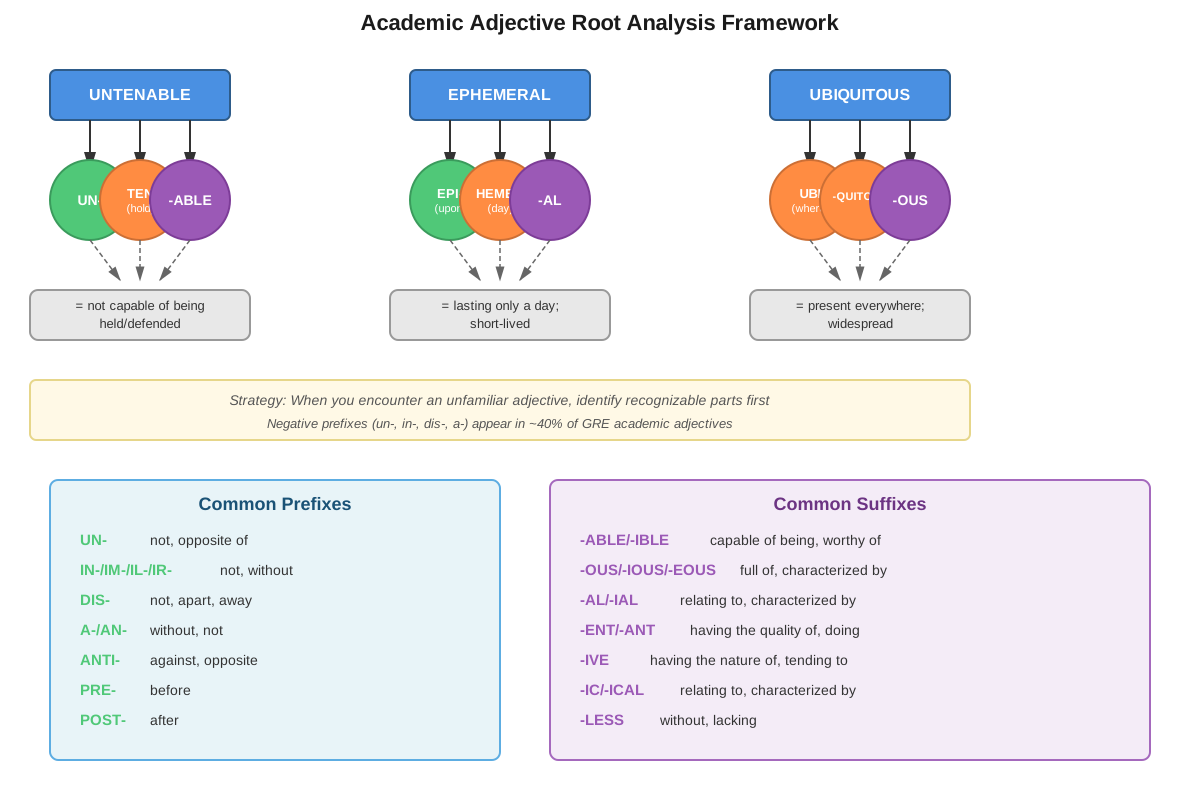
Understanding common prefixes, roots, and suffixes enables students to decode unfamiliar academic adjectives:
Common Prefixes:
- in-/im-/il-/ir- (not): ineffable, immutable, illicit, irrefutable
- un- (not): untenable, unprecedented, unequivocal
- dis- (not, opposite): disparate, dispassionate, discordant
- pre- (before): preeminent, precipitous, precocious
- post- (after): posthumous, posterior
- inter- (between): intermediate, interminable
- intra- (within): intractable, intrinsic
Common Roots:
- -cred- (believe): credulous, incredulous, credible
- -fid- (faith, trust): diffident, perfidious
- -vol- (wish, will): benevolent, malevolent, volition
- -path- (feeling): apathetic, empathetic, antipathetic
- -gen- (birth, kind): indigenous, ingenuous, congenital
Common Suffixes:
- -ous/-ious (full of): contentious, specious, gratuitous
- -able/-ible (capable of): tenable, feasible, plausible
- -ent/-ant (having quality of): reticent, vigilant, complacent
- -ic (relating to): pragmatic, dogmatic, systematic
Contextual Appropriateness and Collocation
Academic adjectives exhibit collocational preferences—they naturally pair with certain nouns more than others. Understanding these patterns helps identify correct answers:
- "Cursory" collocates with: examination, glance, review, analysis
- "Meticulous" collocates with: attention, care, planning, documentation
- "Tenuous" collocates with: connection, link, relationship, argument
- "Compelling" collocates with: evidence, argument, reason, case
The GRE exploits these patterns by including adjectives that are semantically plausible but collocationally awkward. A "meticulous glance" sounds odd because "meticulous" implies thoroughness incompatible with the brevity of a "glance."
Concept Relationships
The mastery of academic adjectives builds hierarchically upon foundational vocabulary knowledge. Basic adjective understanding → recognition of formal register → discrimination between near-synonyms → contextual application in complex sentences represents the developmental progression.
Within the topic itself, several interconnected concepts operate simultaneously:
Morphological analysis ↔ Meaning derivation: Understanding word parts enables educated guessing about unfamiliar terms, which in turn reinforces morphological pattern recognition.
Connotation awareness → Appropriate selection: Recognizing emotional valence and intensity determines which synonyms fit specific contexts.
Semantic categorization → Efficient elimination: Grouping adjectives by function (evaluative, temporal, behavioral) allows rapid elimination of inappropriate answer choices.
Collocation patterns ↔ Contextual appropriateness: Natural word pairings both reflect and determine which adjectives sound correct in given contexts.
These concepts connect to broader Verbal Reasoning skills: academic adjectives provide the vocabulary precision necessary for Reading Comprehension (understanding authorial tone), Text Completion (selecting contextually appropriate words), and Sentence Equivalence (identifying true synonyms). They also relate to critical reasoning by enabling students to recognize subtle distinctions in arguments—whether a claim is "dubious" versus "controversial" affects how one evaluates its validity.
High-Yield Facts
⭐ Academic adjectives appear in 70-80% of Sentence Equivalence questions, making them the most frequently tested vocabulary category.
⭐ Connotation (positive/negative/neutral) eliminates approximately 50% of answer choices in typical Sentence Equivalence questions.
⭐ The GRE tests near-synonyms more than antonyms; distinguishing "reticent" from "reluctant" is more common than distinguishing "verbose" from "laconic."
⭐ Morphological analysis (prefix + root + suffix) enables educated guessing for approximately 60% of unfamiliar academic adjectives.
⭐ Collocation violations signal incorrect answers; if an adjective-noun pairing sounds unnatural, it's likely wrong.
- Academic adjectives with Latin/Greek origins comprise approximately 75% of GRE vocabulary questions.
- Intensity/degree distinctions separate correct from incorrect answers in 40% of questions featuring academic adjectives.
- Temporal adjectives ("ephemeral," "perennial," "nascent") appear disproportionately in science and social science passages.
- Behavioral adjectives ("pragmatic," "dogmatic," "circumspect") frequently appear in humanities passages discussing authors or historical figures.
- The GRE rarely tests extremely obscure academic adjectives; most tested words appear in educated discourse and quality journalism.
- Understanding one academic adjective often provides access to an entire word family (e.g., knowing "credulous" helps with "credible," "incredible," "credulity").
Quick check — test yourself on Academic adjectives so far.
Try Flashcards →Common Misconceptions
Misconception: Academic adjectives are simply "fancy" synonyms for common words, so any sophisticated-sounding word will work.
Correction: Academic adjectives carry precise meanings and specific connotations. "Fastidious" doesn't simply mean "careful"—it specifically implies excessive attention to detail, often with negative connotations of being hard to please. Using academic adjectives requires understanding their exact semantic boundaries.
Misconception: In Sentence Equivalence, any two words with similar meanings will produce equivalent sentences.
Correction: The two correct answers must create sentences that are truly similar in meaning, not just vaguely related. "Ambiguous" and "unclear" might both suggest lack of clarity, but "ambiguous" specifically means having multiple possible interpretations, while "unclear" simply means difficult to understand. These produce different sentence meanings.
Misconception: Positive-sounding academic adjectives are always complimentary, and negative-sounding ones are always critical.
Correction: Context determines valence. "Discriminating" can be positive (showing good judgment) or negative (showing prejudice). "Aggressive" can be positive (assertive, proactive) or negative (hostile, violent). Always consider the sentence context before assigning positive or negative value.
Misconception: If you don't know an academic adjective's meaning, you should skip it and guess randomly.
Correction: Morphological analysis provides substantial clues. Even if you've never seen "intransigent," recognizing the prefix "in-" (not), the root "trans-" (across/change), and the suffix "-ent" (having quality of) suggests "not willing to change"—which is correct. Use word parts to make educated guesses.
Misconception: Academic adjectives only appear in answer choices, not in the question stems or passages.
Correction: Academic adjectives pervade GRE passages and question stems, where they signal authorial attitude, establish argument structure, and create the context for comprehension questions. Recognizing "the author's sanguine assessment" or "a contentious claim" is essential for answering questions correctly.
Misconception: Memorizing dictionary definitions of academic adjectives is sufficient for GRE success.
Correction: Understanding usage patterns, collocations, connotations, and contextual appropriateness matters as much as knowing definitions. "Pedestrian" means "ordinary/dull," but knowing it collocates with "prose," "analysis," or "approach" (not typically with concrete objects) helps identify correct usage.
Worked Examples
Example 1: Sentence Equivalence Question
Question: The scientist's methodology was so _______ that even minor deviations from protocol were immediately apparent to observers.
(A) meticulous
(B) rigorous
(C) haphazard
(D) systematic
(E) arbitrary
(F) cursory
Step 1: Analyze the sentence context
The sentence indicates that the methodology made "even minor deviations" immediately apparent. This suggests extreme attention to detail and careful organization. The word "so" indicates high intensity. We need an adjective with positive connotation regarding carefulness and organization.
Step 2: Eliminate based on connotation
- (C) haphazard = negative, suggests randomness ❌
- (E) arbitrary = negative, suggests lack of principle ❌
- (F) cursory = negative, suggests superficiality ❌
Step 3: Evaluate remaining positive options
- (A) meticulous = extremely careful with attention to detail ✓
- (B) rigorous = extremely thorough and accurate ✓
- (D) systematic = methodical and organized ✓
Step 4: Test for true equivalence
We need two words that create sentences similar in meaning:
- "meticulous methodology" → emphasizes attention to detail
- "rigorous methodology" → emphasizes thoroughness and precision
- "systematic methodology" → emphasizes organization and method
Both "meticulous" and "rigorous" suggest the extreme carefulness that would make minor deviations apparent. "Systematic" suggests organization but doesn't necessarily imply the intensity required to notice minor deviations.
Answer: (A) meticulous and (B) rigorous
Connection to Learning Objectives: This example demonstrates identifying when academic adjectives are tested (Objective 1), applying the core strategy of analyzing connotation and intensity (Objective 2), and accurately distinguishing between near-synonyms (Objective 3).
Example 2: Text Completion Question
Question: Despite the _______ nature of the evidence, the prosecutor proceeded with the case, confident that the jury would find the defendant guilty.
(A) compelling
(B) circumstantial
(C) incontrovertible
(D) tenuous
(E) substantial
Step 1: Identify the logical relationship
The word "Despite" signals contrast. The prosecutor proceeded confidently despite something about the evidence. This suggests the evidence had a quality that would normally discourage proceeding—it was weak or questionable.
Step 2: Determine required connotation
We need an adjective suggesting weakness or insufficiency to create the contrast with "confident" and "proceeded."
Step 3: Evaluate each option
- (A) compelling = strong, persuasive (no contrast) ❌
- (B) circumstantial = indirect, not conclusive (creates contrast) ✓
- (C) incontrovertible = impossible to dispute (no contrast) ❌
- (D) tenuous = weak, flimsy (creates contrast) ✓
- (E) substantial = considerable, significant (no contrast) ❌
Step 4: Choose the best fit
Both (B) and (D) create logical contrast, but we need only one answer for Text Completion. Consider collocation and typical usage:
- "circumstantial evidence" is a standard legal term
- "tenuous evidence" is also appropriate
In this context, "tenuous" more strongly emphasizes the weakness that makes the prosecutor's confidence notable. "Circumstantial" is more neutral—circumstantial evidence can sometimes be quite strong.
Answer: (D) tenuous
Connection to Learning Objectives: This example shows how to identify contrast signals that test academic adjectives (Objective 1), apply the strategy of analyzing logical relationships (Objective 2), and evaluate contextual appropriateness (Objective 4).
Exam Strategy
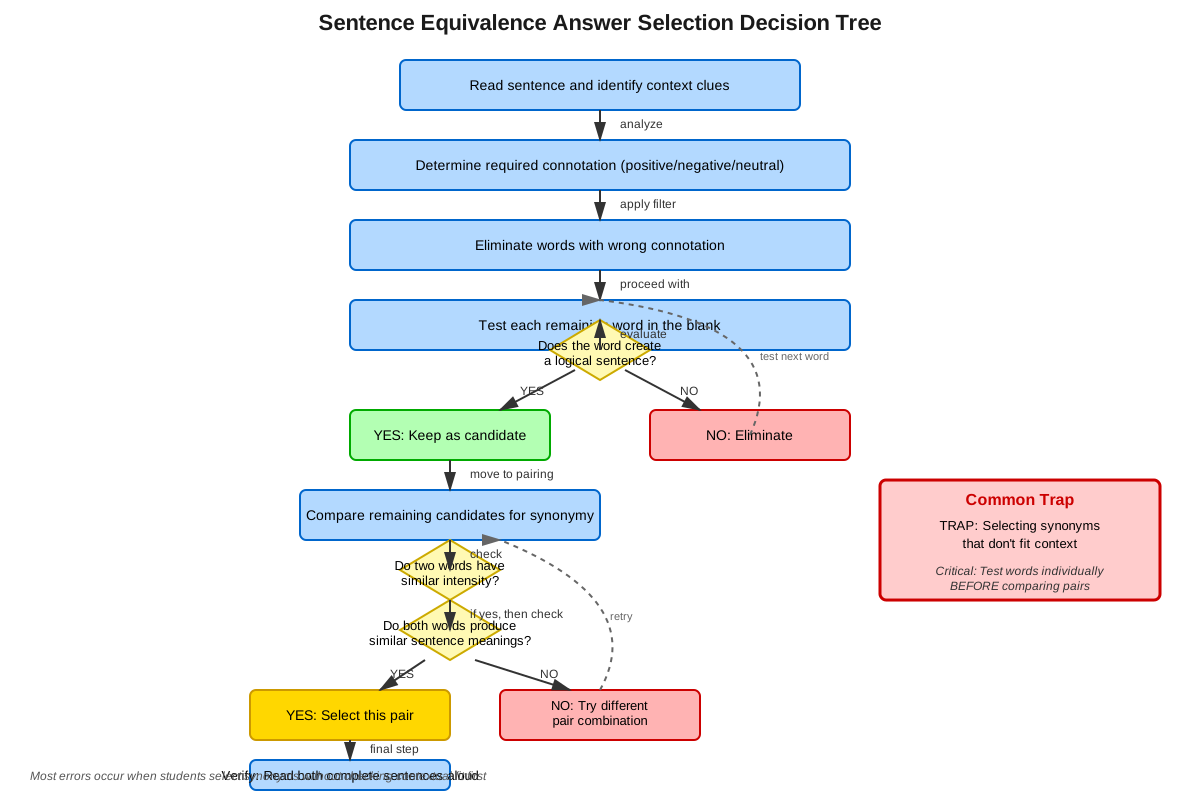
Systematic Approach to Academic Adjective Questions
Step 1: Read for context and tone (15-20 seconds)
Before looking at answer choices, understand what the sentence communicates. Identify:
- Positive, negative, or neutral tone
- Degree/intensity indicators ("very," "somewhat," "extremely")
- Logical relationship words ("although," "because," "despite")
- Subject matter and register
Step 2: Predict the blank (10 seconds)
Generate your own word or phrase for the blank. This prediction doesn't need to be sophisticated—"very careful" or "not lasting long" suffices. The prediction anchors your evaluation of answer choices.
Step 3: Eliminate based on connotation (20 seconds)
Remove all choices with wrong emotional valence (positive/negative/neutral). This typically eliminates 2-3 options immediately.
Step 4: Eliminate based on intensity (15 seconds)
If the sentence requires extreme intensity ("so _______ that"), eliminate moderate terms. If it requires moderation, eliminate extreme terms.
Step 5: Test remaining options for equivalence (30 seconds)
For Sentence Equivalence, plug in each remaining word and verify that two choices create truly similar sentences. Read the complete sentence with each word—don't just compare dictionary definitions.
Exam Tip: If you're stuck between two similar academic adjectives, test them with extreme examples. Would you describe a "meticulous" person or a "careful" person? The more specific, intense term is usually "meticulous," helping you distinguish intensity levels.
Trigger Words and Phrases
Watch for these signals that academic adjectives are being tested:
Contrast signals (require opposite connotations):
- despite, although, while, whereas, however, yet, nevertheless
Support signals (require consistent connotations):
- because, since, therefore, thus, consequently, indeed
Intensity indicators (require attention to degree):
- so...that, such...that, extremely, particularly, somewhat, rather
Evaluation contexts (require evaluative adjectives):
- "The theory was _______"
- "Her approach proved _______"
- "The argument remains _______"
Process of Elimination Strategies
The Connotation Test: If a sentence describes something positively in context, eliminate all negative-connotation adjectives immediately. Approximately 50% of wrong answers fail this basic test.
The Collocation Test: Say the adjective-noun combination aloud. If it sounds unnatural ("a meticulous glance," "an ephemeral building"), it's likely wrong. Trust your linguistic intuition about what sounds right.
The Substitution Test: Replace the academic adjective with a simpler synonym. If "the ephemeral nature of fame" becomes "the temporary nature of fame" and the sentence still makes sense, you've correctly understood "ephemeral."
The Intensity Matching Test: Ensure the adjective's intensity matches the sentence context. "Somewhat problematic" and "catastrophically problematic" require different intensity adjectives.
Time Allocation
For Sentence Equivalence questions with academic adjectives:
- Total time budget: 60-90 seconds per question
- Reading and prediction: 25 seconds
- Elimination: 35 seconds
- Final verification: 15 seconds
- If stuck: Mark for review and move on after 90 seconds maximum
Exam Tip: Academic adjectives questions reward systematic elimination more than prolonged deliberation. If you've eliminated four options and are stuck between two, make your best guess and move forward. The time saved helps on other questions.
Memory Techniques
Mnemonic for Connotation Categories
PENNE helps remember the five main connotation categories:
- Positive evaluation (laudable, exemplary, commendable)
- Extreme/intense (paramount, quintessential, negligible)
- Negative evaluation (egregious, pernicious, deplorable)
- Neutral/mixed (ambiguous, contentious, provisional)
- Emotional/behavioral (reticent, gregarious, circumspect)
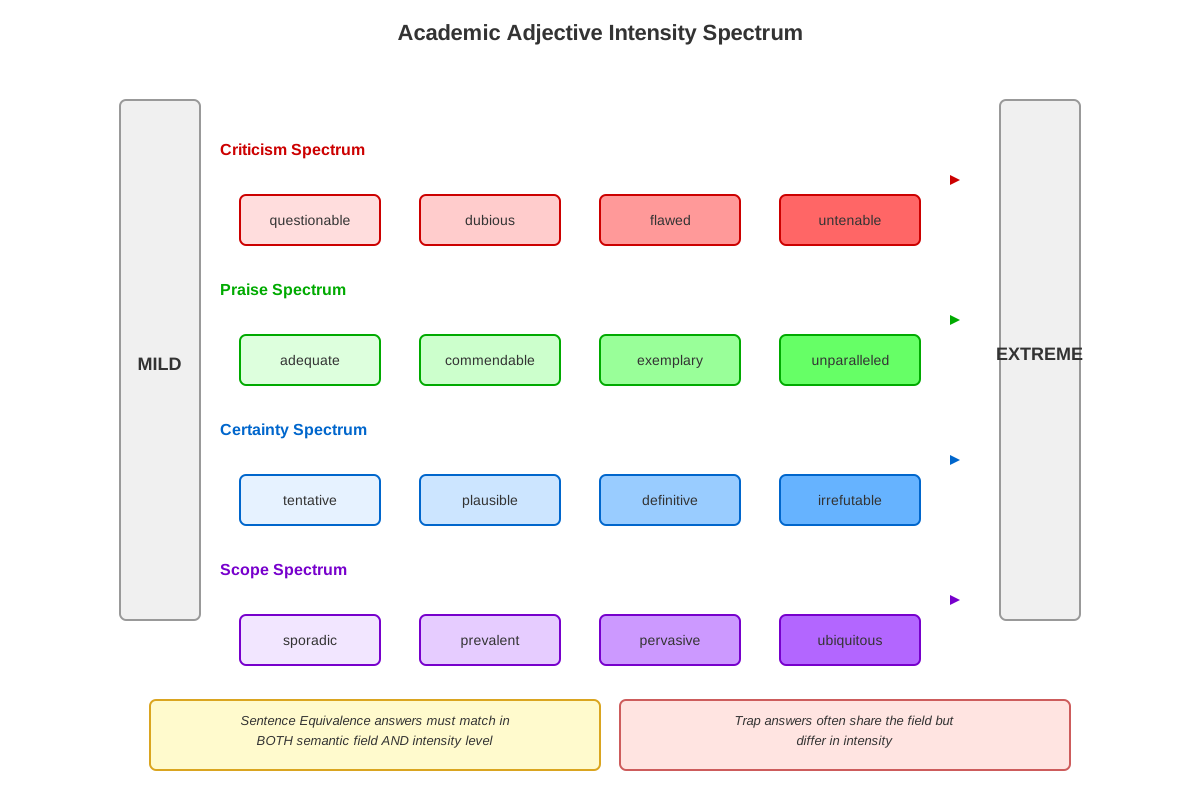
Visualization Strategy: The Intensity Spectrum
Visualize academic adjectives on a spectrum from weak to strong:
WEAK ←―――――――――――――――――――――――――――――――――→ STRONG
negligible → marginal → moderate → substantial → paramount
fleeting → brief → lasting → enduring → perpetual
flawed → problematic → dubious → untenable → absurd
When encountering an unfamiliar adjective, mentally place it on the relevant spectrum based on context clues.
Root-Based Memory Clusters
Group adjectives by shared roots to learn multiple words simultaneously:
CRED- (believe) family:
- credulous (too willing to believe)
- incredulous (unwilling to believe)
- credible (believable)
- incredible (unbelievable)
VOL- (wish/will) family:
- benevolent (wishing good)
- malevolent (wishing harm)
- voluntary (by one's own will)
PATH- (feeling) family:
- apathetic (without feeling)
- empathetic (feeling with others)
- antipathetic (feeling against)
- pathetic (evoking feeling)
The "Opposite Pairs" Technique
Memorize academic adjectives in antonym pairs—learning one gives you two:
- ephemeral ↔ enduring
- verbose ↔ laconic
- dogmatic ↔ open-minded
- sanguine ↔ pessimistic
- meticulous ↔ careless
- ubiquitous ↔ rare
- orthodox ↔ heterodox
- indigenous ↔ foreign
Acronym for Elimination Strategy
CITE guides systematic elimination:
- Connotation check (positive/negative/neutral)
- Intensity match (degree appropriate to context)
- Tone consistency (formal register maintained)
- Equivalence test (for Sentence Equivalence, do both create similar meaning?)
Summary
Academic adjectives constitute the sophisticated descriptive vocabulary that appears throughout GRE Verbal Reasoning, particularly in Sentence Equivalence and Text Completion questions. These formal-register adjectives—characterized by Latinate origins, morphological complexity, and semantic precision—require students to discriminate between subtle shades of meaning rather than simply recognizing basic definitions. Mastery involves understanding five key dimensions: connotation (positive/negative/neutral valence), intensity (degree of the quality described), contextual appropriateness (what fits the sentence logically), collocation (natural word pairings), and morphological structure (prefixes, roots, suffixes that enable meaning derivation). Success on GRE questions testing academic adjectives depends on systematic elimination strategies that leverage these dimensions, particularly eliminating based on connotation first, then intensity, then testing remaining options for true equivalence. The high frequency of academic adjectives across all Verbal Reasoning question types—appearing in 70-80% of Sentence Equivalence questions and pervading Reading Comprehension passages—makes this topic one of the highest-yield areas for focused study and score improvement.
Key Takeaways
- Academic adjectives appear in 70-80% of Sentence Equivalence questions, making them the most frequently tested vocabulary category and highest-yield study focus.
- Connotation analysis (positive/negative/neutral) eliminates approximately half of wrong answers immediately and should be the first elimination step.
- Morphological analysis (prefix + root + suffix) enables educated guessing for unfamiliar terms; understanding common word parts unlocks meaning for 60% of unknown adjectives.
- True synonyms for Sentence Equivalence must create equivalent sentences, not just share similar definitions; test by reading complete sentences with each option.
- Intensity and degree distinctions separate correct from incorrect answers; match the adjective's strength to context clues like "so...that" or "somewhat."
- Collocation patterns (natural word pairings) signal correctness; if an adjective-noun combination sounds unnatural, it's likely wrong.
- Systematic elimination using CITE (Connotation, Intensity, Tone, Equivalence) maximizes accuracy while maintaining efficient time management of 60-90 seconds per question.
Related Topics
Text Completion Strategies: Mastering academic adjectives directly enhances Text Completion performance, where selecting contextually appropriate vocabulary is essential. The logical relationship analysis skills developed here transfer directly to multi-blank Text Completion questions.
Reading Comprehension - Author's Tone: Academic adjectives signal authorial attitude in passages. Understanding whether an author describes a theory as "dubious," "controversial," or "untenable" affects comprehension questions about the author's perspective.
Vocabulary Building - Academic Nouns and Verbs: Academic adjectives form one component of formal academic vocabulary. Expanding to academic nouns (paradigm, dichotomy, anomaly) and verbs (corroborate, refute, extrapolate) creates comprehensive vocabulary mastery.
Context Clues and Inference: The skills for determining appropriate academic adjectives from context transfer to vocabulary-in-context questions and inference questions in Reading Comprehension.
Argument Analysis: Recognizing the precise meaning of academic adjectives in arguments (whether evidence is "compelling" versus "suggestive" versus "inconclusive") strengthens critical reasoning skills tested throughout Verbal Reasoning.
Practice CTA
Now that you've mastered the core concepts of academic adjectives, it's time to cement your understanding through active practice. Attempt the practice questions to apply your knowledge of connotation analysis, intensity matching, and systematic elimination strategies. Use the flashcards to build automatic recognition of high-frequency academic adjectives and their precise meanings. Remember: vocabulary mastery comes through repeated exposure and active retrieval practice. Each question you work through strengthens your ability to discriminate between subtle meaning differences—exactly the skill that separates good GRE scores from great ones. Your investment in mastering academic adjectives will pay dividends across every section of Verbal Reasoning. Start practicing now to transform this knowledge into test-day performance!
Sign up free to keep reading
Create a free AnvayaPrep account to finish this GRE guide on Academic adjectives — plus flashcards and practice questions.