Overview
Blank prediction in sentence equivalence is a foundational strategy for tackling one of the two major question types in the GRE Verbal Reasoning section. Sentence Equivalence questions present a single sentence with one blank and six answer choices, requiring test-takers to select two answers that both complete the sentence coherently and produce sentences with similar meanings. Rather than immediately scanning the answer choices—a common trap that leads to confusion and time waste—skilled test-takers employ blank prediction to formulate their own word or phrase for the blank before examining the options. This proactive approach anchors reasoning in the sentence's context and logic, dramatically reducing susceptibility to distractor answers.
The power of gre blank prediction in sentence equivalence lies in its ability to transform a potentially overwhelming task into a systematic process. By predicting what type of word belongs in the blank based on contextual clues, transition words, and logical relationships within the sentence, students can approach the answer choices with a clear target in mind. This strategy prevents the common pitfall of selecting two synonyms that don't actually fit the sentence's meaning or choosing words that fit individually but create sentences with different meanings. The prediction doesn't need to be perfect or use sophisticated vocabulary—a simple word, phrase, or even a directional indicator (positive/negative) provides sufficient guidance for effective answer evaluation.
Within the broader landscape of GRE Verbal Reasoning, blank prediction serves as the critical first step in a comprehensive sentence completion methodology. It connects directly to skills in contextual analysis, vocabulary recognition, and logical reasoning. While Text Completion questions also benefit from prediction strategies, Sentence Equivalence questions make this approach particularly essential because the dual-answer requirement demands precision in understanding the sentence's core meaning. Mastering blank prediction establishes the foundation for efficiently navigating all sentence-level vocabulary questions on the exam.
Learning Objectives
- [ ] Identify when Blank prediction in sentence equivalence is being tested
- [ ] Explain the core rule or strategy behind Blank prediction in sentence equivalence
- [ ] Apply Blank prediction in sentence equivalence to GRE-style questions accurately
- [ ] Analyze sentence structure to identify contextual clues that inform blank prediction
- [ ] Distinguish between effective predictions (directional/conceptual) and ineffective predictions (overly specific)
- [ ] Evaluate answer choices systematically using a prediction as an anchor point
- [ ] Recognize and avoid common traps that occur when skipping the prediction step
Prerequisites
- Basic vocabulary knowledge: Understanding common GRE-level words enables recognition of answer choices that match predictions
- Sentence structure comprehension: Identifying subjects, verbs, and modifiers helps locate contextual clues within complex sentences
- Logical reasoning skills: Recognizing cause-effect, contrast, and support relationships allows accurate prediction of blank meaning
- Familiarity with transition words: Understanding signals like "however," "moreover," and "although" guides prediction direction
Why This Topic Matters
Blank prediction represents one of the highest-yield strategies for GRE Verbal Reasoning success. Sentence Equivalence questions constitute approximately one-third of the Verbal section's scored questions, appearing 4-5 times per 20-question section. Unlike Reading Comprehension, which tests passage analysis skills, Sentence Equivalence directly assesses vocabulary knowledge and contextual reasoning—skills that improve dramatically with systematic strategy application. Students who master blank prediction typically see immediate score improvements because this technique provides a replicable process that works across all difficulty levels.
In real-world applications, the cognitive skills developed through blank prediction extend far beyond standardized testing. The ability to infer meaning from context, recognize logical relationships, and resist premature conclusions proves invaluable in academic reading, professional communication, and critical analysis. Graduate-level coursework frequently requires students to comprehend complex texts where unfamiliar terminology must be understood through contextual clues—precisely the skill that blank prediction develops.
On the GRE specifically, Sentence Equivalence questions appear in predictable formats but with varying difficulty levels. Easy questions feature straightforward contextual clues and common vocabulary, while difficult questions employ complex sentence structures, subtle logical relationships, and advanced vocabulary. Regardless of difficulty, every Sentence Equivalence question rewards the same systematic approach: analyze context, predict the blank, evaluate choices against the prediction, and verify that both selected answers create equivalent meanings. Questions commonly test the ability to recognize contrast relationships (signaled by words like "despite," "although," "while"), support relationships (signaled by "because," "since," "given"), and continuation relationships (signaled by "moreover," "furthermore," "additionally").
Core Concepts
The Blank Prediction Strategy
Blank prediction in sentence equivalence is the systematic process of formulating a word, phrase, or directional concept to fill a blank before examining answer choices. This strategy operates on the principle that the sentence itself contains sufficient contextual information to determine what type of word belongs in the blank. Rather than allowing answer choices to influence thinking, test-takers use the sentence's internal logic to generate an independent prediction that serves as an evaluation criterion.
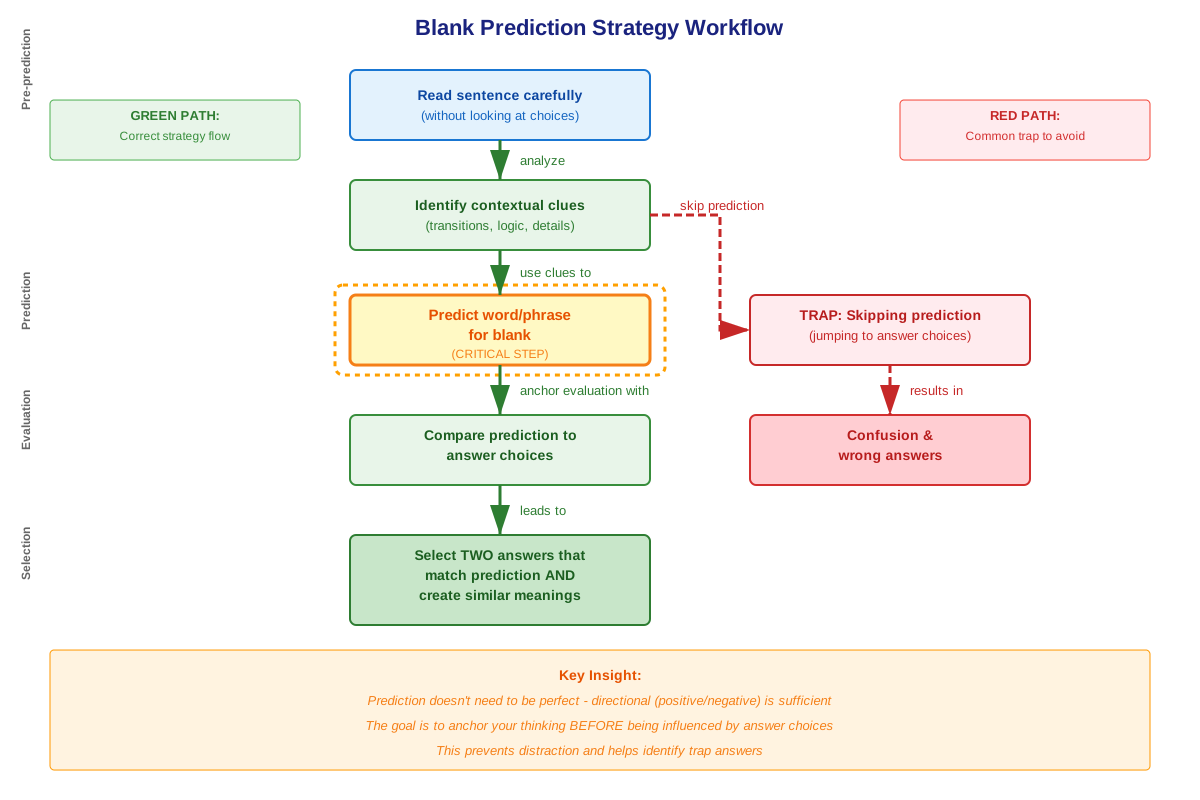
The prediction process follows a structured sequence:
- Read the entire sentence carefully, noting its overall meaning and structure
- Identify contextual clues such as descriptive phrases, examples, or explanatory clauses
- Recognize logical relationship indicators including transition words and punctuation
- Formulate a prediction using simple language or a positive/negative directional indicator
- Evaluate answer choices by comparing each to the prediction
- Select two answers that match the prediction and create equivalent sentence meanings
The prediction itself need not be sophisticated or use advanced vocabulary. A simple word like "bad," "good," "increase," or "decrease" often suffices. Even a directional indicator such as "positive word" or "negative word" provides adequate guidance. The goal is not to guess the exact answer but to establish a conceptual target that prevents distraction by plausible-sounding but contextually inappropriate choices.
Contextual Clues and Signal Words
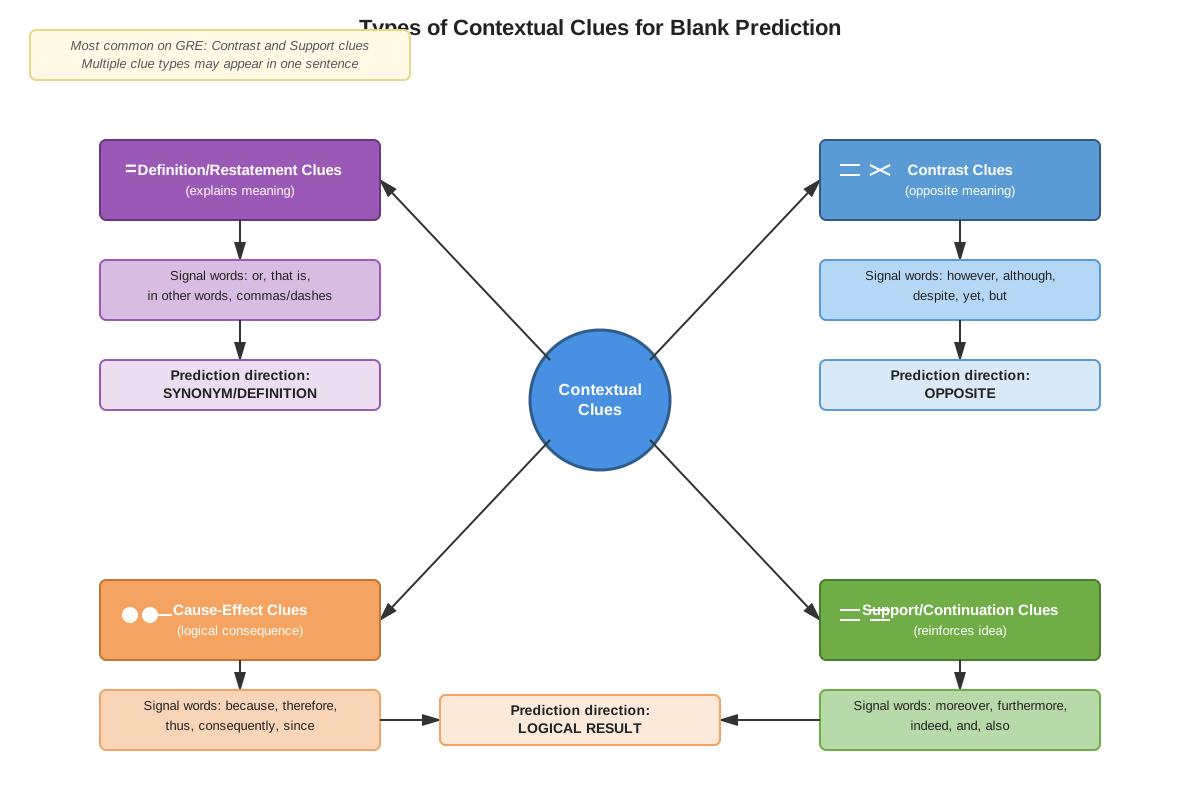
Effective blank prediction depends on identifying contextual clues—words, phrases, or structural elements that reveal the blank's meaning. These clues typically appear in several forms:
Definitional clues provide direct explanations or restatements. For example: "The scientist's approach was _____, relying entirely on empirical observation rather than theoretical speculation." The phrase "relying entirely on empirical observation" defines the blank's meaning, suggesting words like "practical" or "experimental."
Contrast clues signal that the blank opposes or differs from another element in the sentence. Words like "however," "despite," "although," "while," "but," and "yet" indicate contrast relationships. Example: "Despite her reputation for being _____, the professor proved remarkably patient with struggling students." The contrast between reputation and reality suggests the blank should mean "impatient" or "harsh."
Support clues indicate that the blank reinforces or continues the sentence's established direction. Words like "because," "since," "given," "therefore," "thus," and "consequently" signal support relationships. Example: "Because the evidence was _____, the jury reached a verdict quickly." The causal relationship suggests the blank means "clear" or "convincing."
Example clues provide specific instances that illustrate the blank's meaning. Phrases like "such as," "for example," "including," and "like" introduce examples. Example: "The garden contained _____ plants, including several rare orchids and exotic ferns." The examples suggest the blank means "unusual" or "diverse."
Logical Relationship Patterns
Understanding common logical relationship patterns enables rapid, accurate prediction. The GRE repeatedly employs several standard patterns:
| Pattern Type | Signal Words | Prediction Strategy | Example |
|---|---|---|---|
| Contrast | despite, although, while, however, but, yet | Predict opposite of stated element | "Although typically _____, he acted boldly" → predict opposite of bold |
| Cause-Effect | because, since, therefore, thus, consequently | Predict logical result or reason | "Because it was _____, we stayed inside" → predict weather condition |
| Continuation | moreover, furthermore, additionally, also | Predict similar concept | "She was talented; moreover, she was _____" → predict another positive trait |
| Definition | that is, in other words, specifically | Predict restatement | "He was laconic, _____ few words" → predict "using" or "speaking" |
| Example | such as, including, for example | Predict category that includes examples | "_____ animals, such as lions and tigers" → predict "large" or "predatory" |
Prediction Precision Levels
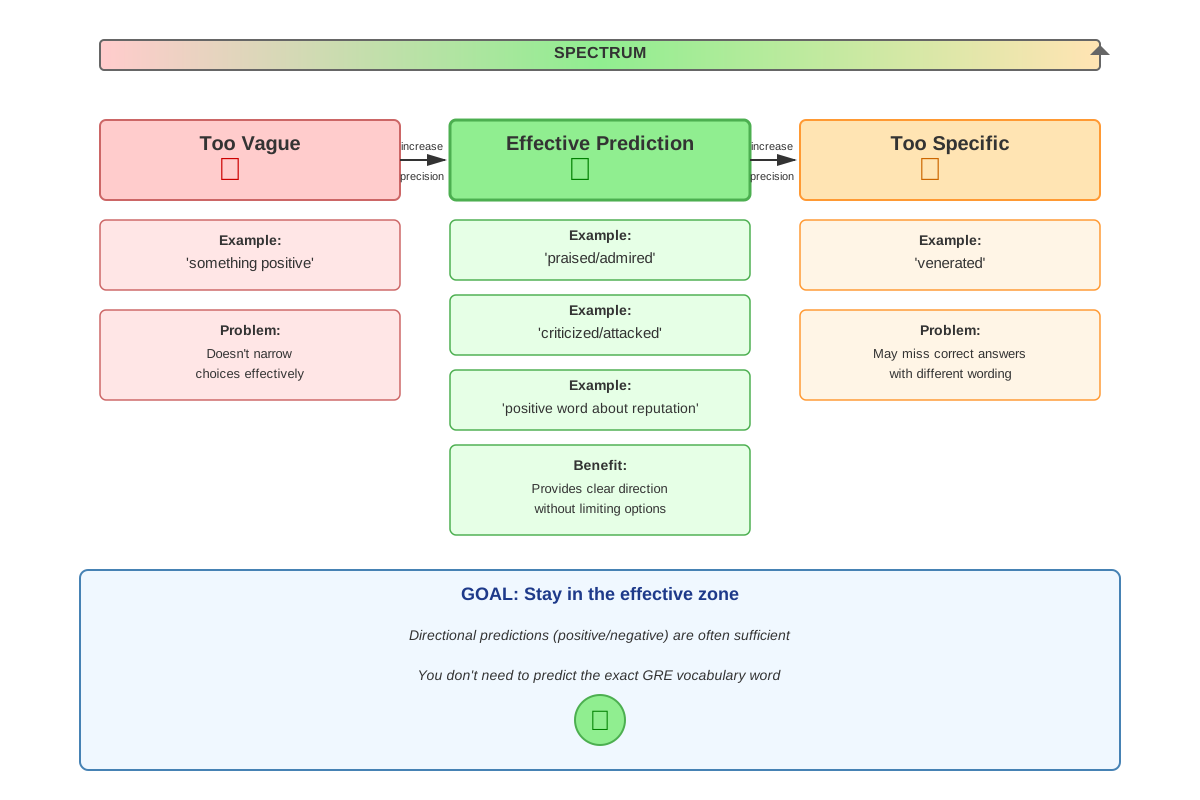
Predictions vary in specificity, and understanding appropriate precision levels prevents both over-specification and under-specification. Three precision levels prove effective:
Specific word predictions work when contextual clues strongly indicate a particular concept. Example: "The desert landscape was _____, with no vegetation visible for miles." Context strongly suggests "barren," "desolate," or similar specific concepts.
Conceptual predictions capture the general idea without committing to specific vocabulary. Example: "Her argument was _____, convincing even skeptical audience members." A conceptual prediction might be "persuasive" or "effective," providing direction without excessive specificity.
Directional predictions simply indicate positive or negative valence. Example: "The critic's review was _____, praising every aspect of the performance." A directional prediction of "positive" suffices to eliminate negative answer choices and focus evaluation.
The optimal precision level depends on contextual clarity. Strong, unambiguous clues support specific predictions, while subtle or complex contexts benefit from conceptual or directional approaches. Over-specification risks missing correct answers that use unexpected vocabulary, while under-specification may not sufficiently narrow the field of plausible choices.
Answer Choice Evaluation
After formulating a prediction, systematic answer choice evaluation ensures accurate selection. This process involves:
Individual assessment: Evaluate each answer choice independently against the prediction before comparing choices to each other. Ask: "Does this word match my prediction? Does it fit the sentence's context and logic?"
Meaning verification: Insert each potential answer into the sentence and verify that it creates a coherent, logical statement. Some words may seem related to the prediction but produce awkward or illogical sentences.
Equivalence checking: After identifying candidates that match the prediction, verify that they create sentences with truly equivalent meanings. The GRE often includes synonym pairs that both fit the blank but produce subtly different sentence meanings—these are incorrect.
Elimination of distractors: Common distractor types include: (1) words related to the sentence topic but contextually inappropriate, (2) synonyms that don't fit the blank, (3) words that fit individually but don't create equivalent meanings, and (4) words with similar sounds or appearances to correct answers.
Concept Relationships
The concepts within blank prediction form an interconnected system where each element supports and reinforces the others. The process begins with sentence analysis, which identifies contextual clues and logical relationships. These clues inform prediction formulation, which establishes an evaluation criterion. The prediction then guides answer choice evaluation, which applies the criterion systematically to identify correct answers. Finally, equivalence verification ensures that selected answers create truly similar sentence meanings, completing the cycle.
This topic connects directly to prerequisite knowledge of sentence structure and vocabulary. Understanding grammatical relationships enables identification of contextual clues, while vocabulary knowledge facilitates recognition of answer choices that match predictions. The strategy also relates to broader Verbal Reasoning skills: contextual analysis (used in Reading Comprehension), logical reasoning (applied across all question types), and vocabulary application (essential for Text Completion).
The relationship map flows as follows:
Sentence Structure Knowledge → enables → Contextual Clue Identification → informs → Logical Relationship Recognition → guides → Prediction Formulation → anchors → Answer Choice Evaluation → leads to → Correct Answer Selection → verified by → Equivalence Checking
Additionally, Vocabulary Knowledge supports both Prediction Formulation (by providing conceptual frameworks) and Answer Choice Evaluation (by enabling meaning recognition). Logical Reasoning Skills underpin the entire process, particularly in recognizing relationships and avoiding logical inconsistencies.
Quick check — test yourself on Blank prediction in sentence equivalence so far.
Try Flashcards →High-Yield Facts
⭐ Blank prediction should always precede answer choice examination to prevent premature anchoring on incorrect options
⭐ Transition words are the most reliable indicators of logical relationships that inform predictions
⭐ The prediction need not use sophisticated vocabulary—simple words or directional indicators (positive/negative) suffice
⭐ Both selected answers must create sentences with equivalent meanings, not merely fit the blank individually
⭐ Contextual clues typically appear immediately before or after the blank, though they may appear elsewhere in the sentence
- Contrast relationships (despite, although, however) are the most frequently tested logical pattern on the GRE
- Definitional clues often appear after semicolons or colons, providing explicit explanations
- Synonym pairs in answer choices are often distractors—they may not fit the context despite being synonyms
- Predictions should be flexible; if no answer choices match, reconsider the prediction rather than forcing a match
- Time spent on prediction (10-15 seconds) is recovered through faster, more accurate answer evaluation
Common Misconceptions
Misconception: The prediction must use advanced GRE-level vocabulary to be effective.
Correction: Simple, everyday words or even directional indicators (positive/negative) provide sufficient guidance. A prediction of "bad" works as well as "deleterious" if it accurately captures the contextual meaning.
Misconception: If two answer choices are synonyms, they must be the correct pair.
Correction: Synonyms are correct only if they both fit the sentence's context and create equivalent meanings. The GRE frequently includes synonym pairs as distractors that don't match the contextual requirements.
Misconception: The prediction should match the exact word in the answer choices.
Correction: Predictions establish conceptual targets, not exact vocabulary matches. A prediction of "unclear" might correspond to answer choices like "ambiguous," "cryptic," or "opaque."
Misconception: Contextual clues always appear immediately adjacent to the blank.
Correction: While clues often appear near the blank, they may appear anywhere in the sentence. The entire sentence provides context, requiring comprehensive analysis rather than localized focus.
Misconception: If the prediction doesn't match any answer choices, the strategy has failed.
Correction: Mismatches indicate the need to reconsider the prediction, not abandon the strategy. Re-examine the sentence for overlooked clues or alternative logical relationships.
Misconception: Blank prediction takes too much time and slows down test completion.
Correction: The 10-15 seconds spent on prediction dramatically accelerates answer evaluation by providing clear selection criteria, resulting in net time savings and improved accuracy.
Misconception: Difficult vocabulary in answer choices means the prediction approach won't work.
Correction: Prediction helps even with unfamiliar vocabulary by enabling elimination of clearly inappropriate choices and identification of words that might match the predicted concept based on roots, prefixes, or context.
Worked Examples
Example 1: Contrast Relationship
Question: "Although the committee's decision appeared _____, it was actually based on months of careful deliberation and analysis."
Step 1 - Read and Analyze: The sentence contains "although," a strong contrast signal. The contrast is between appearance and reality.
Step 2 - Identify Contextual Clues: The phrase "actually based on months of careful deliberation and analysis" describes the reality as thoughtful and considered. The blank describes the appearance, which contrasts with this reality.
Step 3 - Recognize Logical Relationship: The contrast pattern indicates the blank should mean the opposite of "careful" or "deliberate."
Step 4 - Formulate Prediction: Predict "hasty," "quick," or "impulsive"—words suggesting lack of careful thought.
Step 5 - Evaluate Answer Choices:
- (A) meticulous - means careful; opposite of prediction; eliminate
- (B) precipitate - means hasty; matches prediction; keep
- (C) judicious - means wise/careful; opposite of prediction; eliminate
- (D) impetuous - means impulsive; matches prediction; keep
- (E) systematic - means methodical; opposite of prediction; eliminate
- (F) deliberate - means careful; opposite of prediction; eliminate
Step 6 - Verify Equivalence: "Precipitate" and "impetuous" both mean hasty/impulsive and create sentences with equivalent meanings about the decision appearing rushed despite actually being carefully considered.
Answer: (B) precipitate and (D) impetuous
Connection to Learning Objectives: This example demonstrates identifying when blank prediction is tested (contrast relationship), explaining the strategy (predict opposite of stated element), and applying it accurately to reach correct answers.
Example 2: Support Relationship with Definitional Clue
Question: "The scientist's methodology was _____, relying exclusively on direct observation rather than theoretical models or abstract reasoning."
Step 1 - Read and Analyze: The sentence contains a definitional clue after the comma that explains the blank's meaning.
Step 2 - Identify Contextual Clues: "Relying exclusively on direct observation rather than theoretical models or abstract reasoning" defines the methodology. The phrase "rather than" indicates what the methodology is NOT (theoretical, abstract), while "direct observation" indicates what it IS.
Step 3 - Recognize Logical Relationship: This is a support/definition pattern where the second clause explains the first.
Step 4 - Formulate Prediction: Predict "practical," "observational," or "experimental"—words describing approaches based on direct observation rather than theory.
Step 5 - Evaluate Answer Choices:
- (A) empirical - means based on observation; matches prediction; keep
- (B) theoretical - means based on theory; opposite of prediction; eliminate
- (C) speculative - means based on conjecture; opposite of prediction; eliminate
- (D) pragmatic - means practical; matches prediction; keep
- (E) abstract - means theoretical; opposite of prediction; eliminate
- (F) dogmatic - means rigidly adhering to principles; doesn't match prediction; eliminate
Step 6 - Verify Equivalence: "Empirical" and "pragmatic" both describe observation-based, practical approaches and create sentences with equivalent meanings about methodology based on direct observation.
Answer: (A) empirical and (D) pragmatic
Connection to Learning Objectives: This example shows analyzing sentence structure to identify contextual clues (the definitional phrase), distinguishing effective predictions (conceptual rather than overly specific), and evaluating choices systematically using the prediction.
Exam Strategy
When approaching Sentence Equivalence questions on the GRE, implement this systematic process:
Time allocation: Spend 10-15 seconds reading and predicting, then 20-30 seconds evaluating choices. Total time per question should average 45-60 seconds, allowing completion of all questions with time for review.
Trigger word recognition: Immediately identify transition words and logical relationship indicators. Words like "although," "despite," "however," "because," "therefore," and "moreover" provide instant insight into the sentence's logical structure. Punctuation also signals relationships—semicolons often introduce explanations or contrasts, while colons typically introduce definitions or examples.
Process of elimination: Use the prediction to eliminate clearly inappropriate choices first. If the prediction is "negative," immediately eliminate all positive words. This typically reduces six choices to 3-4 candidates, making equivalence checking more manageable.
Equivalence verification technique: After identifying two candidates that match the prediction, insert each into the sentence separately and compare the resulting meanings. Ask: "Do these sentences say essentially the same thing?" If the meanings differ even subtly, reconsider the choices.
Handling difficult vocabulary: When encountering unfamiliar words, use the prediction as an anchor. If a word's roots, prefixes, or suffixes suggest it might match the prediction, keep it as a possibility. Eliminate words you know don't match, then make an educated guess between remaining options.
Exam Tip: If stuck between two pairs of answers that both seem plausible, return to the sentence's core meaning. The correct pair will align with the sentence's primary logical relationship, while distractors often match secondary or superficial elements.
Common trap avoidance: The GRE frequently includes these distractor types:
- Topic-related words that relate to the sentence's subject but don't fit the blank's specific context
- Synonym pairs that don't match the contextual requirements
- Near-synonyms that fit individually but create subtly different sentence meanings
- Extreme words that go too far in the predicted direction
Recognize these patterns and verify that selected answers truly match both the prediction and each other.
Memory Techniques
PREDICT Acronym for the blank prediction process:
- Pause before looking at answer choices
- Read the entire sentence carefully
- Examine contextual clues and transition words
- Determine the logical relationship
- Imagine a simple word for the blank
- Compare answer choices to your prediction
- Test equivalence of your two selections
Transition Word Categories Mnemonic: Remember "CCSE" for the four main logical relationship types:
- Contrast (although, despite, however)
- Cause-effect (because, therefore, since)
- Support/continuation (moreover, furthermore, also)
- Example/definition (such as, that is, specifically)
Visualization Strategy: Picture the sentence as a bridge with the blank as a missing plank. The contextual clues are the surrounding planks that show the missing plank's size, shape, and material. The prediction identifies what type of plank fits, and answer choices are candidate planks to test.
The "Simple Word" Reminder: When formulating predictions, imagine explaining the sentence to a middle-school student. What simple, everyday word would you use? This prevents over-complication and keeps predictions practical and effective.
Summary
Blank prediction in sentence equivalence is the foundational strategy for systematically approaching one of the GRE's most common Verbal Reasoning question types. By formulating a prediction before examining answer choices, test-takers anchor their reasoning in the sentence's contextual clues and logical relationships rather than being swayed by plausible-sounding distractors. The strategy requires identifying transition words and logical patterns (contrast, cause-effect, support, definition), using these to predict what type of word belongs in the blank, and then evaluating answer choices against this prediction. The prediction itself need not be sophisticated—simple words or directional indicators (positive/negative) provide sufficient guidance. Success depends on systematic application: read carefully, identify clues, recognize relationships, predict, evaluate, and verify equivalence. This approach transforms potentially overwhelming questions into manageable, step-by-step processes that consistently yield correct answers while saving time and reducing anxiety.
Key Takeaways
- Always formulate a prediction before examining answer choices to avoid distraction by plausible but incorrect options
- Transition words (although, because, moreover, however) are the most reliable indicators of logical relationships that inform predictions
- Predictions should be simple and flexible—everyday words or positive/negative indicators work better than overly specific vocabulary
- Both selected answers must create sentences with truly equivalent meanings, not merely fit the blank individually
- Contextual clues appear throughout the sentence; analyze the entire sentence rather than focusing only on words adjacent to the blank
- The prediction strategy saves time overall by accelerating answer evaluation and improving accuracy
- Systematic application of the PREDICT process (Pause, Read, Examine, Determine, Imagine, Compare, Test) ensures consistent performance across all difficulty levels
Related Topics
Text Completion Strategy: While Sentence Equivalence requires selecting two equivalent answers, Text Completion questions involve one to three blanks with different answer choice structures. Mastering blank prediction in Sentence Equivalence provides the foundation for the similar but more complex prediction strategies used in Text Completion.
Vocabulary in Context: Understanding how words function within specific contexts—rather than memorizing isolated definitions—builds directly on the contextual analysis skills developed through blank prediction. This topic explores how word meaning shifts based on usage.
Logical Reasoning Patterns: Deeper study of argument structure, assumption identification, and logical relationships enhances the ability to recognize the patterns that inform blank prediction, particularly in complex sentences with multiple clauses.
Advanced Transition Word Usage: Expanding knowledge of subtle transition words and phrases (notwithstanding, albeit, insofar as) enables more sophisticated analysis of complex sentence structures that appear in difficult Sentence Equivalence questions.
Practice CTA
Now that you understand the systematic approach to blank prediction in sentence equivalence, it's time to reinforce these concepts through active practice. Attempt the practice questions designed for this topic, applying the PREDICT process to each question. Use the flashcards to internalize common transition words and their associated logical relationships. Remember: blank prediction is a skill that improves dramatically with deliberate practice. Each question you work through strengthens your ability to identify contextual clues, recognize logical patterns, and formulate effective predictions. Approach practice with the same systematic methodology you'll use on test day, and you'll build the confidence and competence needed to excel on this high-yield question type. Your investment in mastering this strategy will pay dividends across the entire Verbal Reasoning section!
Sign up free to keep reading
Create a free AnvayaPrep account to finish this GRE guide on Blank prediction in sentence equivalence — plus flashcards and practice questions.