Overview
Synonym pairs represent one of the most critical and frequently tested concepts in the GRE Sentence Equivalence section. In these questions, test-takers must select two answer choices that, when inserted into a single sentence, produce completed sentences that are alike in meaning. The fundamental challenge lies not merely in understanding vocabulary, but in recognizing that the correct answers must function as near-synonyms within the specific context of the sentence. This concept tests both vocabulary depth and the ability to discern subtle meaning differences between words that may appear similar but function differently in context.
Understanding GRE synonym pairs is essential because Sentence Equivalence questions constitute approximately half of the text completion items on the Verbal Reasoning section, and each question requires selecting exactly two correct answers—no partial credit is awarded. Students who master synonym pair identification significantly improve their Verbal Reasoning scores because they can efficiently eliminate answer choices that don't have synonym partners, even when those individual words might seem to fit the sentence. This strategic approach transforms what appears to be a vocabulary test into a logical reasoning exercise.
The concept of synonym pairs connects intimately to broader Verbal Reasoning skills including contextual vocabulary usage, semantic precision, and logical sentence completion. Unlike traditional synonym recognition, GRE synonym pairs must produce sentences with equivalent meanings while maintaining grammatical correctness and stylistic consistency. This requirement elevates the task beyond simple vocabulary matching to sophisticated language analysis, making it a cornerstone skill for achieving competitive GRE scores.
Learning Objectives
By the end of this study guide, students will be able to:
- [ ] Identify when Synonym pairs is being tested
- [ ] Explain the core rule or strategy behind Synonym pairs
- [ ] Apply Synonym pairs to GRE-style questions accurately
- [ ] Distinguish between words that are general synonyms versus contextual synonyms
- [ ] Eliminate answer choices systematically by identifying words without synonym partners
- [ ] Recognize common synonym pair patterns that frequently appear on the GRE
- [ ] Evaluate whether two words create sentences with truly equivalent meanings
Prerequisites
Students should have foundational knowledge in the following areas:
- Advanced vocabulary recognition: Understanding nuanced differences between similar words is essential because synonym pairs require precise semantic matching rather than approximate similarity
- Sentence structure and grammar: Recognizing how words function within sentences helps determine whether two synonyms maintain equivalent meaning in context
- Context clue identification: The ability to extract meaning from surrounding text enables students to determine which synonym pair best fits the sentence's logical flow
- Basic GRE Sentence Equivalence format: Familiarity with the question structure (one sentence, six answer choices, select exactly two) allows students to focus on strategy rather than format
Why This Topic Matters
Synonym pairs appear in every GRE Verbal Reasoning section, typically comprising 4 out of the 10 text completion questions per section. This consistent presence means that mastering synonym pairs directly impacts approximately 20% of the Verbal Reasoning score. Students who develop systematic approaches to identifying synonym pairs often see score improvements of 3-5 points on the 130-170 Verbal scale, making this one of the highest-yield topics for focused study.
Beyond test performance, the skill of identifying contextual synonyms has practical applications in academic writing, professional communication, and critical reading. The ability to recognize when two different words convey equivalent meanings in specific contexts enhances precision in both comprehension and expression. Graduate-level coursework frequently requires students to synthesize information from multiple sources that use different terminology for the same concepts—a skill directly developed through synonym pair practice.
On the GRE, synonym pairs appear exclusively in Sentence Equivalence questions, which present a single sentence with one blank and six answer choices. The instructions explicitly state that test-takers must "select the two answer choices that, when used to complete the sentence, fit the meaning of the sentence as a whole and produce completed sentences that are alike in meaning." This phrasing reveals the dual requirement: each word must fit independently, AND the two words must create equivalent sentences. Common trap answers include words that fit the sentence perfectly but lack a synonym partner among the remaining choices.
Core Concepts
The Fundamental Principle of Synonym Pairs
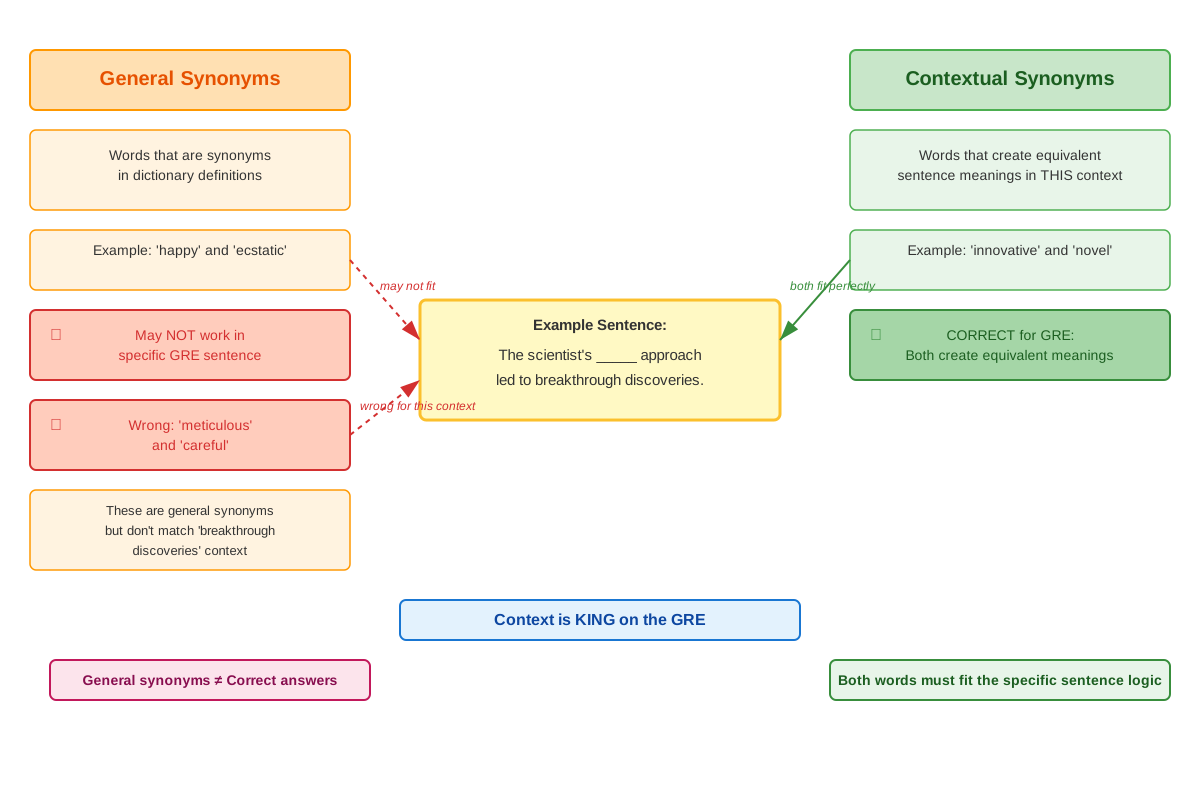
The core principle underlying synonym pairs is that two words must produce sentences with equivalent meanings when substituted into the same blank. This requirement differs fundamentally from traditional synonym identification in two critical ways. First, the words need not be synonyms in all contexts—they must function as synonyms specifically within the given sentence. Second, both words must independently satisfy the sentence's logical, grammatical, and stylistic requirements before their synonym relationship becomes relevant.
Consider this distinction: "happy" and "content" are general synonyms, but in the sentence "The child was _____ to receive any gift at all," only "happy" works idiomatically, making them non-equivalent in this context. The GRE exploits these contextual limitations to create challenging questions where superficial synonym knowledge proves insufficient.
Contextual Synonymy vs. Dictionary Synonymy
Contextual synonymy represents the relationship between words that convey equivalent meanings within a specific sentence, regardless of whether they function as synonyms in other contexts. This concept is crucial because the GRE frequently includes answer choices that are dictionary synonyms but fail to create equivalent sentences in the given context.
For example, "brief" and "short" are dictionary synonyms, but in the sentence "The professor's _____ explanation left students confused," these words might not be contextual synonyms if the sentence's logic suggests incompleteness rather than duration. Understanding this distinction prevents students from selecting answer pairs based solely on memorized synonym lists rather than careful contextual analysis.
| Dictionary Synonyms | Contextual Synonyms |
|---|---|
| Related in general usage | Related in specific sentence context |
| Found in thesaurus entries | Determined by sentence logic and tone |
| May have different connotations | Must produce equivalent sentence meanings |
| Can differ in register or formality | Must maintain consistent register |
The Synonym Partner Elimination Strategy
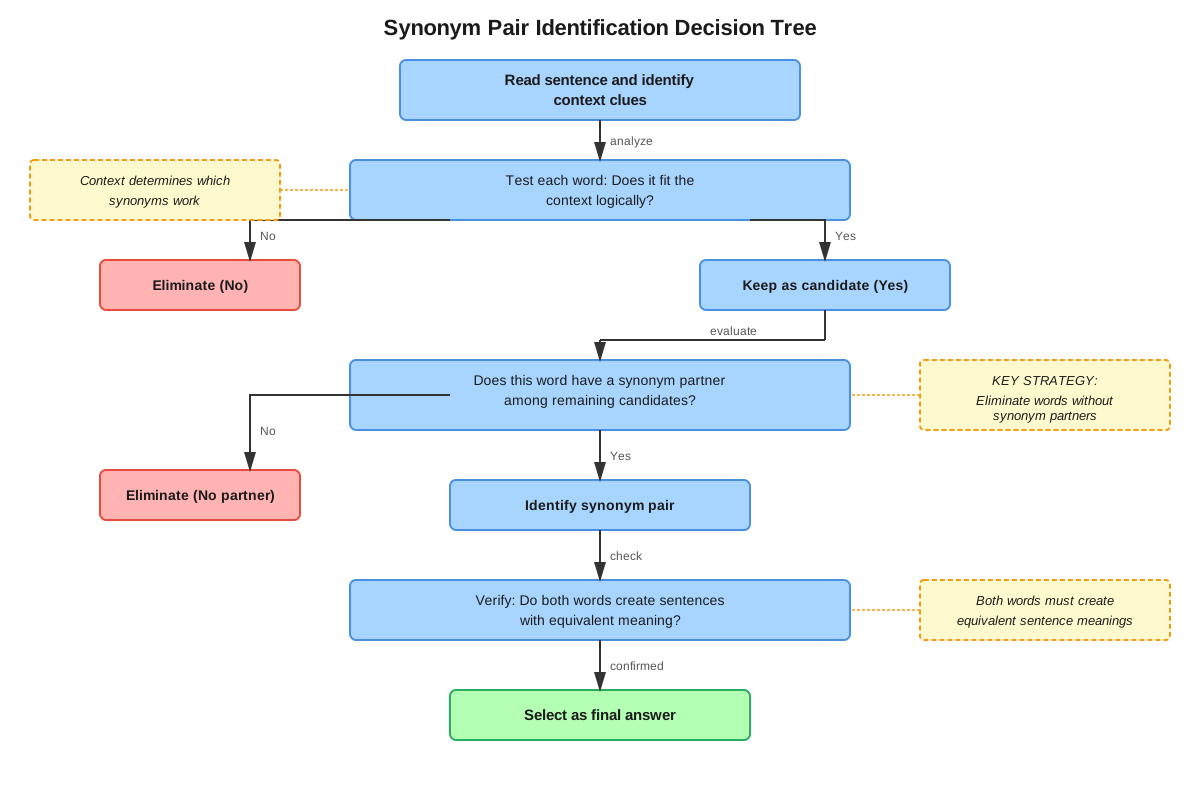
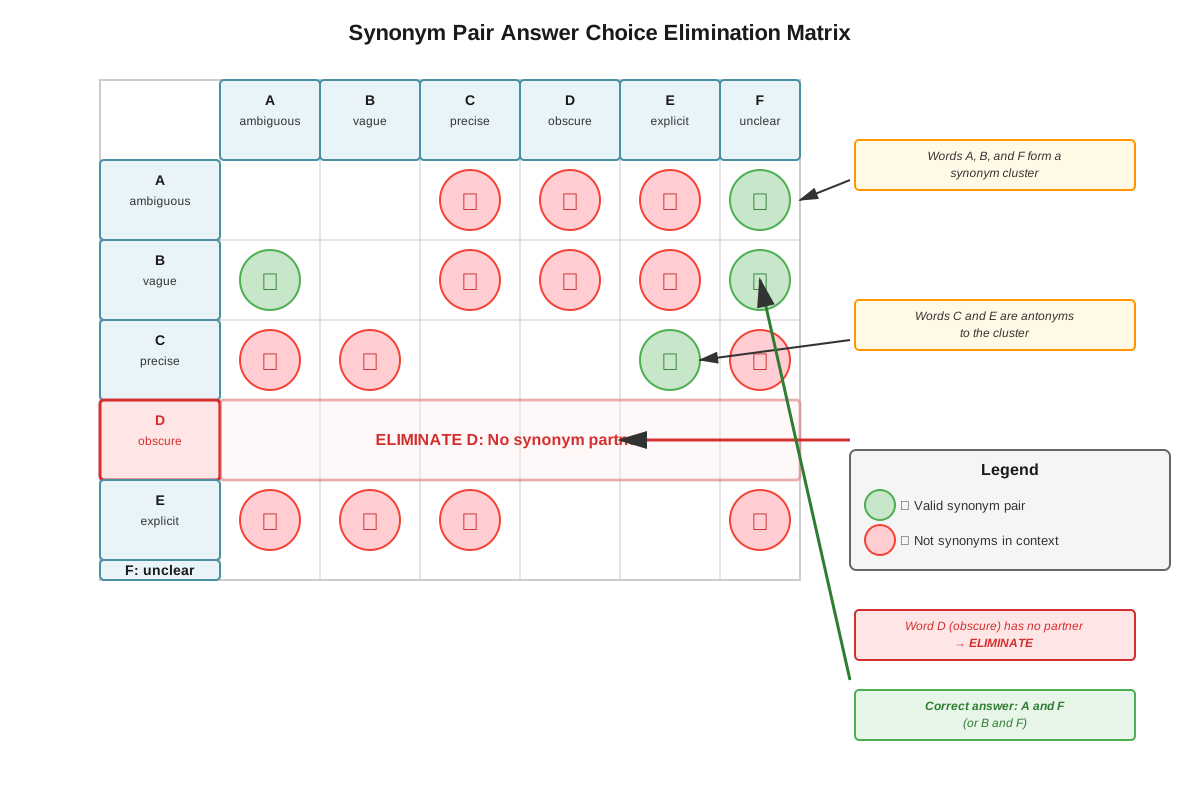
The most powerful approach to Sentence Equivalence questions involves systematically identifying which answer choices have potential synonym partners. This strategy works because if a word lacks any synonym among the remaining five choices, it cannot be correct—regardless of how well it fits the sentence independently.
The elimination process follows these steps:
- Read the sentence carefully and predict the general meaning needed for the blank
- Scan all six answer choices to identify obvious synonym pairs
- Eliminate any word that has no potential synonym partner among the other five choices
- Test remaining pairs by substituting each word into the sentence to verify both fit logically
- Compare the resulting sentences to ensure they convey equivalent meanings
This systematic approach often reduces six choices to two or three viable candidates before detailed analysis begins, significantly improving accuracy and speed.
Degree and Intensity Matching
Many GRE synonym pair questions test whether students recognize that true synonym pairs must match not only in basic meaning but also in degree and intensity. Words like "annoyed" and "furious" both relate to anger, but they differ dramatically in intensity and therefore cannot form a valid synonym pair in most contexts.
The GRE exploits this principle by including answer choices that share semantic fields (both relate to the same general concept) but differ in intensity. For example, a sentence might logically require a moderate descriptor, with answer choices including both "concerned" and "alarmed." While both relate to worry, only "concerned" would pair with another moderate-intensity synonym like "troubled," while "alarmed" would require a high-intensity partner like "distressed."
Connotation Consistency
Beyond denotative meaning, connotation—the emotional or evaluative associations of words—must remain consistent between synonym pairs. The GRE frequently includes answer choices that denote similar concepts but carry different connotations (positive vs. negative, formal vs. informal, technical vs. colloquial).
For instance, "frugal" and "cheap" both denote spending little money, but "frugal" carries positive connotations of wise financial management while "cheap" suggests negative qualities like poor quality or excessive stinginess. In a sentence praising someone's financial habits, "frugal" might pair with "economical," but "cheap" would be eliminated due to connotation mismatch.
Grammatical Function and Collocational Fit
Valid synonym pairs must share identical grammatical functions and maintain natural collocational patterns—the tendency of certain words to appear together in natural language. Even when two words are perfect synonyms in meaning, they may differ in the grammatical structures or companion words they typically accompany.
For example, "interested in" and "fascinated by" are near-synonyms, but they require different prepositions. If a sentence includes a specific preposition after the blank, only words that naturally collocate with that preposition can be correct. Similarly, some adjectives naturally precede certain nouns ("utter chaos" sounds natural, while "complete chaos" is more common than "utter organization"), making collocational awareness essential for identifying valid synonym pairs.
Concept Relationships
The concepts within synonym pair identification form an interconnected system where each element reinforces the others. Contextual synonymy serves as the foundation, establishing that words must function equivalently in the specific sentence rather than in general usage. This principle directly enables the synonym partner elimination strategy, which leverages the fact that correct answers must exist in pairs—any word without a contextual synonym among the remaining choices can be eliminated immediately.
Degree and intensity matching and connotation consistency function as refinement filters that distinguish between words in the same semantic field. Once students identify potential synonym pairs through basic meaning, these concepts help eliminate pairs that differ in emotional tone or strength of expression. Finally, grammatical function and collocational fit serve as the final verification step, ensuring that both words in a pair not only mean the same thing but also integrate naturally into the sentence structure.
The relationship flows as follows:
Contextual Synonymy (foundation) → Synonym Partner Elimination (initial filtering) → Degree/Intensity Matching + Connotation Consistency (semantic refinement) → Grammatical/Collocational Fit (final verification) → Correct Answer Pair
These concepts also connect to prerequisite knowledge: advanced vocabulary recognition enables contextual synonymy identification, sentence structure knowledge supports grammatical function analysis, and context clue skills facilitate degree and connotation assessment.
High-Yield Facts
⭐ Synonym pairs must produce sentences with equivalent meanings, not just contain words that are general synonyms
⭐ If a word has no potential synonym partner among the other five choices, it cannot be correct regardless of how well it fits the sentence
⭐ Correct synonym pairs must match in intensity/degree—"annoyed" and "furious" cannot pair despite both relating to anger
⭐ Connotation (positive/negative associations) must remain consistent between synonym pairs
⭐ Both words in a correct pair must independently satisfy the sentence's logical requirements before their synonym relationship matters
- Grammatical function must be identical between synonym pairs (both adjectives, both verbs in the same form, etc.)
- Collocational patterns (natural word combinations) can eliminate otherwise valid synonyms that don't fit the sentence structure
- The GRE frequently includes "trap pairs" where two words are synonyms but neither fits the sentence's logic
- Register and formality level must match between synonym pairs (both formal or both informal)
- Sentence Equivalence questions award no partial credit—both answers must be correct to receive points
⭐ Testing each word individually before considering pairs wastes time; scan for synonym relationships first
- Approximately 40% of Verbal Reasoning text completion questions use the Sentence Equivalence format
- The most common wrong answer pattern involves selecting one correct word and one word that fits the sentence but lacks a synonym partner
- Synonym pairs often share Greek or Latin roots, providing morphological clues to their relationship
- Time pressure makes synonym pair questions particularly challenging; systematic elimination strategies improve both speed and accuracy
Quick check — test yourself on Synonym pairs so far.
Try Flashcards →Common Misconceptions
Misconception: Any two words that are synonyms in the dictionary will work as a synonym pair on the GRE.
Correction: Dictionary synonyms may not function as contextual synonyms in a specific sentence. The GRE tests whether words create equivalent meanings in the given context, not whether they appear together in a thesaurus. Always verify that both words fit the sentence's logic and produce equivalent overall meanings.
Misconception: If a word fits perfectly in the sentence, it must be one of the correct answers.
Correction: A word can fit the sentence flawlessly but still be incorrect if it lacks a synonym partner among the remaining five choices. The Sentence Equivalence format requires two words that both fit AND create equivalent sentences. Always identify the synonym partner before committing to an answer.
Misconception: Synonym pairs must be exactly the same part of speech with identical grammatical forms.
Correction: While synonym pairs must function grammatically in identical ways within the sentence, they need not be the exact same part of speech in all contexts. For example, "alleviate" (verb) and "mitigate" (verb) can pair, but so can "lessening" (gerund/noun) and "reduction" (noun) if the sentence structure accommodates both. The key is functional equivalence in the specific sentence.
Misconception: Words with similar meanings but different intensities can form valid synonym pairs if they're close enough.
Correction: Intensity differences, even subtle ones, prevent words from forming valid synonym pairs because they produce sentences with non-equivalent meanings. "Concerned" and "alarmed" both relate to worry, but they convey different levels of anxiety and therefore cannot pair. The resulting sentences would have meaningfully different implications.
Misconception: Selecting synonym pairs is primarily a vocabulary test, so students with limited vocabulary cannot improve their performance.
Correction: While vocabulary knowledge helps, synonym pair questions primarily test logical reasoning and systematic elimination skills. Students can significantly improve performance by learning to identify words without synonym partners, recognize intensity mismatches, and verify contextual fit—all strategies that work even with moderate vocabulary knowledge.
Misconception: The two correct answers will always be adjacent or near each other in the answer choice list.
Correction: The GRE randomizes answer choice positions, and correct synonym pairs appear in any positions (A and F, B and D, etc.). Students who assume proximity waste time searching for patterns that don't exist. Focus on meaning relationships rather than positional patterns.
Misconception: If two words share the same root or prefix, they're likely to be the correct synonym pair.
Correction: While shared roots can indicate related meanings, they don't guarantee synonym pairs. "Respectful" and "respectable" share a root but have different meanings (showing respect vs. worthy of respect). Similarly, "incredible" and "incredulous" are not synonyms despite their shared root. Always verify meaning equivalence rather than relying on morphological similarity.
Worked Examples
Example 1: Identifying Contextual Synonyms
Question: The scientist's _____ approach to the experiment, though time-consuming, ultimately yielded more reliable results than rushed methodologies.
(A) meticulous
(B) sluggish
(C) painstaking
(D) leisurely
(E) deliberate
(F) cautious
Solution Process:
Step 1: Analyze the sentence context
The sentence contrasts the scientist's approach (described as "time-consuming") with "rushed methodologies," and notes that this approach "yielded more reliable results." The blank requires a word with positive connotations suggesting careful, thorough work that takes time but produces quality outcomes.
Step 2: Scan for potential synonym pairs
- (A) meticulous and (C) painstaking are near-synonyms meaning extremely careful and thorough
- (B) sluggish and (D) leisurely both relate to slowness but have different connotations
- (E) deliberate and (F) cautious both suggest carefulness
Step 3: Test each potential pair in context
Testing (A) and (C): "The scientist's meticulous approach..." and "The scientist's painstaking approach..." both convey careful, thorough work that takes time. Both fit the positive tone (yielding "more reliable results") and the contrast with "rushed methodologies." These create equivalent sentences. ✓
Testing (B) and (D): "Sluggish" has negative connotations (implying inefficiency or laziness), while "leisurely" suggests comfortable slowness. Neither fits the positive outcome described. ✗
Testing (E) and (F): "Deliberate" emphasizes intentional, thoughtful action, while "cautious" emphasizes avoiding risk. While both could fit, "deliberate" doesn't have a clear synonym partner among the remaining choices after eliminating (B) and (D). ✗
Step 4: Verify intensity and connotation match
"Meticulous" and "painstaking" both convey high-intensity carefulness with positive connotations regarding quality work. They match in degree (both suggest extreme thoroughness) and tone (both positive in context of producing reliable results).
Answer: (A) meticulous and (C) painstaking
Connection to Learning Objectives: This example demonstrates identifying when synonym pairs are tested (Sentence Equivalence format), applying the core strategy (scanning for synonym relationships before detailed analysis), and distinguishing contextual synonyms (meticulous/painstaking work in context) from words that might seem related but don't create equivalent meanings (sluggish/leisurely).
Example 2: Eliminating Words Without Synonym Partners
Question: Despite the committee's _____ attempts to resolve the dispute, the two parties remained entrenched in their opposing positions.
(A) valiant
(B) futile
(C) persistent
(D) unavailing
(E) sporadic
(F) earnest
Solution Process:
Step 1: Analyze sentence logic
The word "Despite" signals contrast: the committee attempted something, BUT the parties remained entrenched (unchanged). This suggests the attempts were unsuccessful or ineffective. The blank needs a word that either emphasizes the effort made or the lack of success.
Step 2: Identify words without synonym partners
- (A) valiant (brave, courageous) - no clear synonym among other choices
- (B) futile (unsuccessful, pointless) - potential synonym: (D) unavailing
- (C) persistent (continuing despite difficulty) - potential synonym: (F) earnest? Not quite—earnest means sincere, not continuing
- (D) unavailing (ineffective, useless) - potential synonym: (B) futile
- (E) sporadic (irregular, occasional) - no synonym among other choices
- (F) earnest (sincere, serious) - potential synonym: (A) valiant? Not quite—valiant emphasizes bravery, not sincerity
Step 3: Eliminate isolated words
(A) valiant, (C) persistent, (E) sporadic, and (F) earnest all lack clear synonym partners. This leaves only (B) futile and (D) unavailing as a potential pair.
Step 4: Verify the remaining pair
"Despite the committee's futile attempts..." and "Despite the committee's unavailing attempts..." both mean the attempts were unsuccessful/ineffective. Both create sentences with equivalent meanings: the committee tried but failed to resolve the dispute. The "Despite" structure works because it contrasts the effort (attempts) with the outcome (parties remained entrenched), and both "futile" and "unavailing" emphasize the lack of success. ✓
Answer: (B) futile and (D) unavailing
Connection to Learning Objectives: This example illustrates the synonym partner elimination strategy—the most efficient approach to Sentence Equivalence questions. By identifying that four words lack synonym partners, we reduce six choices to two without detailed contextual analysis. This demonstrates applying the core strategy accurately and efficiently, even when several answer choices might seem plausible individually.
Exam Strategy
Systematic Approach to Sentence Equivalence Questions
When encountering a Sentence Equivalence question, follow this time-efficient process:
- Read the sentence once for overall meaning (15-20 seconds): Understand the logical flow and identify any contrast words (however, despite, although), continuation words (furthermore, moreover), or cause-effect relationships (because, therefore).
- Predict the general type of word needed (5-10 seconds): Don't try to predict the exact word, but determine whether the blank needs something positive/negative, strong/weak, concrete/abstract.
- Scan all six choices for obvious synonym pairs (10-15 seconds): Look for words you immediately recognize as related in meaning. Mark potential pairs mentally or on scratch paper.
- Eliminate words without synonym partners (10-15 seconds): Any word that has no potential synonym among the other five choices cannot be correct. Cross these out immediately.
- Test remaining pairs in context (20-30 seconds): Substitute each word of potential pairs into the sentence. Verify that both words fit logically and grammatically.
- Verify equivalent sentence meanings (10-15 seconds): Read both completed sentences to ensure they convey the same overall message.
Total time allocation: 70-105 seconds per question (approximately 1-1.5 minutes)
Trigger Words and Phrases
Certain sentence structures signal specific synonym pair patterns:
- Contrast words (despite, although, however, yet, while): The blank often requires words describing unsuccessful efforts, unexpected outcomes, or contradictory qualities
- Intensifiers (extremely, particularly, especially, remarkably): The blank typically needs high-intensity words; moderate synonyms won't pair correctly
- Hedging language (somewhat, relatively, fairly, rather): The blank requires moderate-intensity words; extreme synonyms are likely incorrect
- Evaluative phrases (unfortunately, fortunately, surprisingly): These signal the connotation (positive/negative) required for the blank
Process-of-Elimination Tips
Eliminate based on connotation mismatch: If the sentence clearly requires a positive word (e.g., "The teacher's _____ feedback helped students improve"), immediately eliminate all negative-connotation words, even if they're synonyms of each other. "Critical" and "harsh" might be synonyms, but neither fits a positive context.
Eliminate based on intensity mismatch: If you identify one correct answer with moderate intensity, eliminate all high-intensity words as potential partners. "Concerned" cannot pair with "alarmed" or "panicked," only with other moderate words like "worried" or "troubled."
Eliminate based on collocational awkwardness: If a word creates an unnatural phrase (e.g., "utter success" sounds less natural than "complete success"), it's likely incorrect even if it's a synonym of another choice.
Use the "swap test": After identifying a potential synonym pair, swap them in the sentence. If the sentences aren't truly equivalent in meaning (not just similar, but equivalent), the pair is incorrect.
Time Management
Sentence Equivalence questions should take slightly less time than three-blank Text Completion questions but slightly more time than single-blank completions. Allocate approximately 1-1.5 minutes per question. If you've spent 90 seconds without identifying a clear synonym pair, make your best guess and move on—spending 3 minutes on one question jeopardizes your ability to complete the section.
Time-saving tip: If you can eliminate four answer choices (leaving only two), select those two immediately without extensive verification. The probability that the remaining two are correct is extremely high, and the time saved can be applied to more challenging questions.
Memory Techniques
The SCREAM Mnemonic for Synonym Pair Verification
Use SCREAM to remember the six criteria that valid synonym pairs must satisfy:
- Synonymy: Do the words have similar meanings in general?
- Context: Do both words fit the sentence's logical flow?
- Register: Do both words match in formality level?
- Equivalence: Do the completed sentences mean the same thing?
- Amount/Intensity: Do both words match in degree or strength?
- Morphology: Do both words function grammatically in the same way?
Visualization Strategy: The Twin Test
Imagine the two words as twins who must dress identically for a formal event (the sentence). They can have different names (the words themselves) and different personalities in other contexts (dictionary meanings), but in this specific event (sentence context), they must:
- Wear the same outfit (grammatical function)
- Project the same mood (connotation)
- Have the same energy level (intensity)
- Create the same impression on observers (equivalent sentence meaning)
If the "twins" fail any of these requirements, they're not a valid pair for this event.
The "No Partner, No Points" Reminder
Create a mental image of a dance competition where contestants must have partners. A brilliant dancer (a word that fits perfectly) receives zero points if they have no partner (no synonym among the other choices). This reinforces that individual fit is insufficient—synonym pairing is mandatory.
Root Recognition Acronym: GRECO
Many GRE synonym pairs share GRECO origins (Greek and Roman Classical Origins). When you spot shared roots, consider whether the words might be synonyms:
- Greek roots: -path- (feeling), -phil- (love), -phob- (fear)
- Roman/Latin roots: -bene- (good), -mal- (bad), -dict- (speak)
- Equivalent prefixes: in-/un- (not), pre-/ante- (before), post- (after)
- Common suffixes: -ous/-ious (adjectives), -tion/-sion (nouns), -ify/-ize (verbs)
- Opposite prefixes signal non-synonyms: pro-/anti-, pre-/post-
However, remember the misconception correction: shared roots suggest investigation, not confirmation. Always verify contextual meaning.
Summary
Synonym pairs represent the cornerstone of success on GRE Sentence Equivalence questions, requiring students to identify two words that create sentences with equivalent meanings when substituted into a single blank. Mastery demands understanding that contextual synonymy differs from dictionary synonymy—words must function equivalently in the specific sentence, matching in intensity, connotation, grammatical function, and collocational fit. The most efficient strategy involves scanning for synonym relationships before detailed analysis, eliminating words without partners, and verifying that both words independently satisfy the sentence's logical requirements while producing equivalent overall meanings. Common pitfalls include selecting dictionary synonyms that don't fit the context, choosing words that fit individually but lack synonym partners, and failing to recognize intensity or connotation mismatches. Success requires systematic application of elimination strategies, attention to trigger words signaling required connotations or intensities, and verification that completed sentences convey truly equivalent meanings rather than merely similar ideas.
Key Takeaways
- Synonym pairs must create equivalent sentence meanings in context, not just be dictionary synonyms—always verify contextual fit before selecting answers
- The synonym partner elimination strategy is the most efficient approach—any word without a potential synonym among the other five choices cannot be correct
- Intensity, connotation, and grammatical function must match exactly—even subtle differences in degree or tone prevent words from forming valid pairs
- Both words must independently fit the sentence's logic before their synonym relationship matters—don't select a synonym pair if neither word makes sense in context
- Systematic elimination and verification processes improve both speed and accuracy—following the SCREAM criteria (Synonymy, Context, Register, Equivalence, Amount/Intensity, Morphology) ensures comprehensive evaluation
- Time management requires allocating 1-1.5 minutes per question—spending excessive time on one question jeopardizes section completion
- Trigger words in sentences signal required connotations and intensities—contrast words, intensifiers, and hedging language guide answer selection
Related Topics
Text Completion (Single and Multiple Blanks): While Sentence Equivalence requires identifying synonym pairs, standard Text Completion questions test similar skills in contextual vocabulary usage and logical sentence completion. Mastering synonym pairs strengthens the ability to evaluate whether individual words fit complex sentence structures.
Reading Comprehension Vocabulary in Context: The skill of determining word meanings from context, essential for synonym pair identification, directly transfers to Reading Comprehension questions that ask about word meanings or require understanding nuanced vocabulary in passages.
Vocabulary Building and Word Roots: Expanding vocabulary knowledge and understanding Greek and Latin roots enhances the ability to recognize potential synonym pairs quickly, even when encountering unfamiliar words. This foundational skill supports all Verbal Reasoning question types.
Logical Reasoning and Argument Structure: The analytical thinking required to evaluate whether two words create equivalent sentence meanings connects to broader logical reasoning skills tested throughout the GRE, including identifying assumptions, evaluating evidence, and recognizing logical relationships.
Practice CTA
Now that you've mastered the core concepts and strategies for identifying synonym pairs, it's time to apply this knowledge to authentic GRE-style questions. Complete the practice questions associated with this topic to reinforce your understanding and build the speed necessary for test-day success. Pay special attention to questions where you initially select incorrect answers—these reveal specific areas for improvement, whether in vocabulary knowledge, elimination strategy, or contextual analysis. Remember that synonym pair mastery is a skill that improves dramatically with deliberate practice. Each question you analyze strengthens your pattern recognition and strategic thinking. Review the flashcards to internalize high-frequency synonym pairs and continue building the vocabulary foundation that supports all Verbal Reasoning success. Your systematic approach to these practice materials will translate directly into higher scores and greater confidence on test day.
Sign up free to keep reading
Create a free AnvayaPrep account to finish this GRE guide on Synonym pairs — plus flashcards and practice questions.