Overview
Contrast logic is one of the most frequently tested logical structures in GRE Verbal Reasoning, particularly within Sentence Equivalence and Text Completion questions. This fundamental concept requires test-takers to recognize when a sentence establishes an opposition, reversal, or unexpected relationship between two ideas. Mastering GRE contrast logic enables students to predict the semantic direction of missing words with remarkable accuracy, transforming challenging vocabulary questions into logical puzzles that can be solved systematically.
Understanding contrast logic is essential because approximately 30-40% of Sentence Equivalence questions and a significant portion of Text Completion questions rely on recognizing contrast relationships. When a sentence contains contrast indicators, the correct answer will typically express an idea that opposes, contradicts, or reverses the meaning established elsewhere in the sentence. Students who can identify these structural signals gain a decisive advantage, often selecting correct answers even when unfamiliar with specific vocabulary choices.
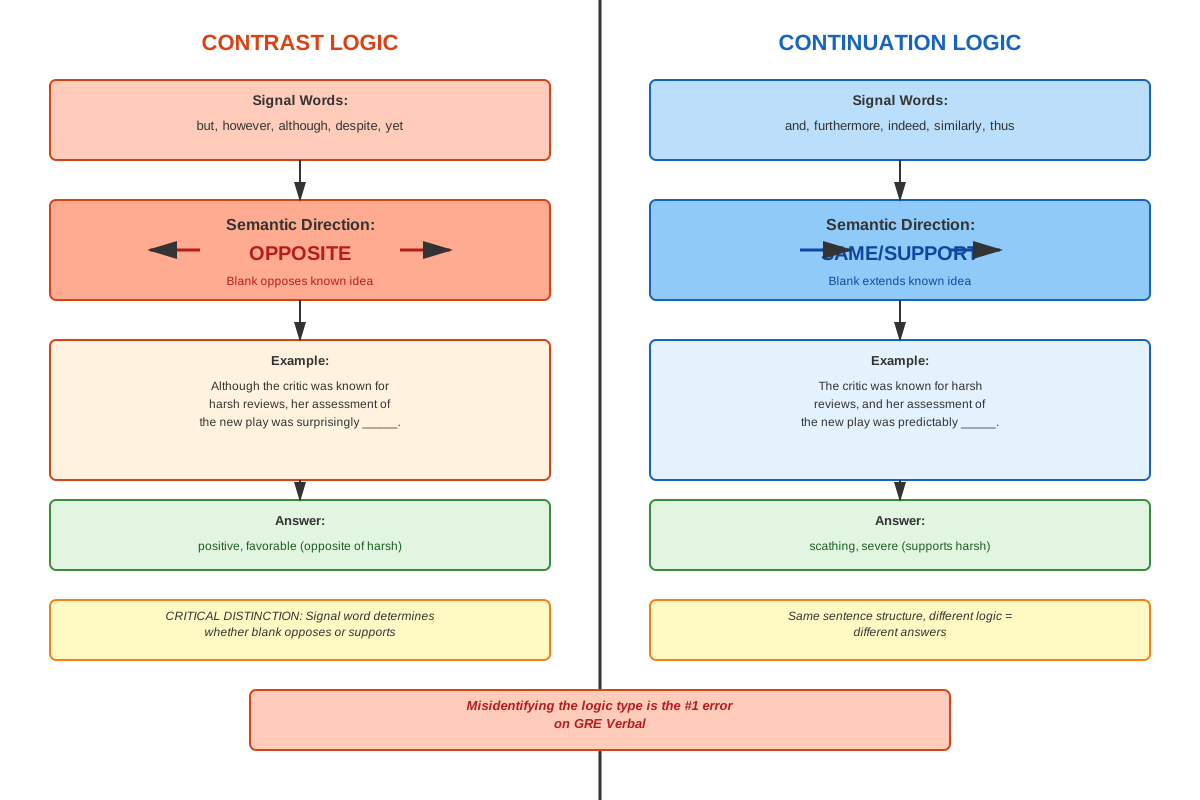
Contrast logic serves as a foundational pillar within the broader framework of sentence structure analysis on the GRE. It works in tandem with continuation logic (where ideas support or extend each other) and cause-and-effect relationships to form the three primary logical structures tested in Verbal Reasoning. By mastering contrast logic first, students develop the analytical framework necessary to tackle more complex multi-blank questions and reading comprehension passages that employ sophisticated rhetorical reversals.
Learning Objectives
- [ ] Identify when Contrast logic is being tested
- [ ] Explain the core rule or strategy behind Contrast logic
- [ ] Apply Contrast logic to GRE-style questions accurately
- [ ] Recognize and categorize all major contrast signal words and phrases
- [ ] Distinguish between explicit contrast markers and implicit contrast structures
- [ ] Predict the semantic direction of missing words based on contrast relationships
- [ ] Evaluate answer choices by testing whether they maintain the required contrast relationship
Prerequisites
- Basic sentence structure understanding: Recognizing subjects, predicates, and clauses is necessary to identify which parts of a sentence are being contrasted.
- Fundamental vocabulary knowledge: A working vocabulary enables students to understand the non-blank portions of sentences that establish the contrast relationship.
- Logical reasoning skills: The ability to recognize opposition and reversal in meaning forms the cognitive foundation for contrast logic.
- Familiarity with GRE question formats: Understanding how Sentence Equivalence and Text Completion questions are structured allows students to apply contrast logic strategically.
Why This Topic Matters
Contrast logic appears with exceptional frequency on the GRE Verbal Reasoning section, making it one of the highest-yield topics for score improvement. Research on released GRE questions indicates that contrast structures appear in approximately 35% of Sentence Equivalence questions and 25% of Text Completion questions. This prevalence means that a single test administration will likely feature 8-12 questions where recognizing contrast logic is the primary pathway to the correct answer.
Beyond exam performance, contrast logic reflects sophisticated reasoning patterns essential for graduate-level academic work. Academic writing frequently employs contrast to acknowledge counterarguments, present nuanced positions, and demonstrate critical thinking. Students who master contrast logic develop sharper analytical reading skills that transfer directly to comprehending complex scholarly articles, research papers, and theoretical texts encountered in graduate programs.
On the GRE specifically, contrast logic manifests in several distinct ways: sentences may contrast a person's expected behavior with their actual behavior, juxtapose historical periods or scientific theories, present surprising research findings that contradict conventional wisdom, or describe individuals whose characteristics seem paradoxical. The test-makers deliberately construct these sentences to reward students who analyze logical structure rather than simply matching vocabulary words based on superficial associations.
Core Concepts
Definition of Contrast Logic
Contrast logic refers to the logical relationship within a sentence where two ideas, characteristics, or situations are presented in opposition to each other. This opposition creates a semantic reversal—if one part of the sentence expresses a positive quality, the contrasting part will express a negative quality, or if one part describes an expected outcome, the contrasting part will describe an unexpected or opposite outcome. The fundamental principle is that the blank must be filled with a word that creates or maintains this oppositional relationship.
The power of contrast logic lies in its predictability. Once a contrast structure is identified, the semantic direction of the answer becomes constrained. If the sentence states "Although the scientist was known for her _____ approach, her latest paper was surprisingly dogmatic," the contrast signal "although" combined with "surprisingly" and "dogmatic" dictates that the blank must contain a word meaning flexible, open-minded, or non-dogmatic.
Explicit Contrast Signals
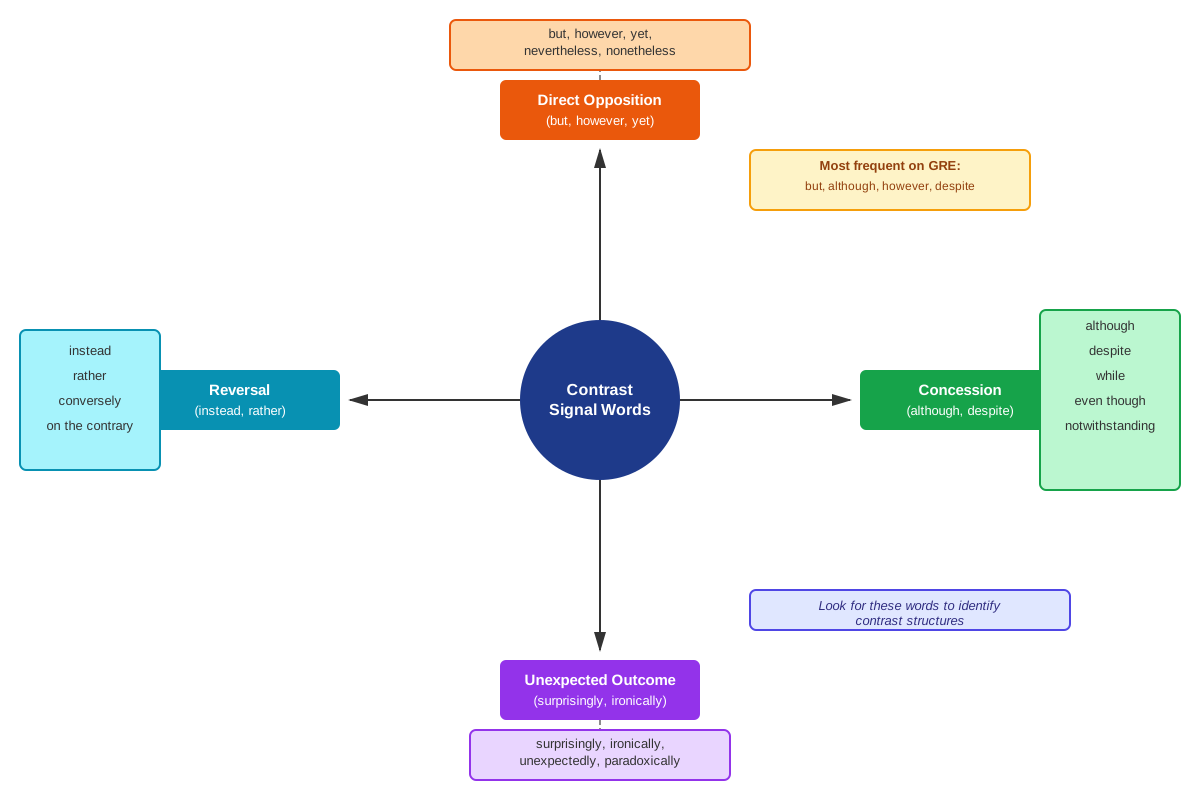
Explicit contrast signals are words and phrases that directly announce an oppositional relationship. These function as structural markers that alert careful readers to expect a reversal or contradiction. The most common explicit contrast signals include:
| Signal Type | Examples | Usage Pattern |
|---|---|---|
| Subordinating conjunctions | although, though, even though, while, whereas | Introduce dependent clauses that contrast with main clauses |
| Coordinating conjunctions | but, yet | Connect independent clauses in opposition |
| Transitional phrases | however, nevertheless, nonetheless, on the other hand, in contrast, conversely | Link sentences or independent clauses with contrasting ideas |
| Prepositions | despite, in spite of, notwithstanding | Indicate contrast between a noun phrase and the main clause |
| Adverbs | surprisingly, unexpectedly, paradoxically, ironically | Signal that what follows contradicts expectations |
When these signals appear in a GRE sentence, they serve as explicit instructions to find an answer that creates opposition. For example: "Despite her _____ demeanor, she was actually quite approachable" requires a word meaning unfriendly or intimidating because "despite" signals that her demeanor contrasts with being approachable.
Implicit Contrast Structures
Not all contrast relationships are marked by explicit signal words. Implicit contrast structures rely on semantic opposition built into the sentence's content rather than grammatical markers. These are more challenging to identify but equally important for GRE success.
Common implicit contrast patterns include:
Expectation vs. Reality: Sentences describe what would normally be expected, then present what actually occurred. Example: "One would expect a novice to struggle with such complex material, but she _____ it effortlessly." The contrast between "novice" and "effortlessly" implies the blank should mean "mastered" or "comprehended."
Temporal Contrasts: Sentences compare past and present states or before-and-after situations. Example: "Once _____ in his opinions, the professor became increasingly flexible after years of teaching." The temporal marker "once" combined with "became increasingly flexible" indicates the blank should mean rigid or inflexible.
Comparative Structures: Using words like "more," "less," "unlike," or "rather than" to establish opposition. Example: "Unlike her _____ colleagues, she approached problems with systematic precision." The word "unlike" signals that the blank should describe the opposite of systematic precision.
The Contrast Logic Decision Tree
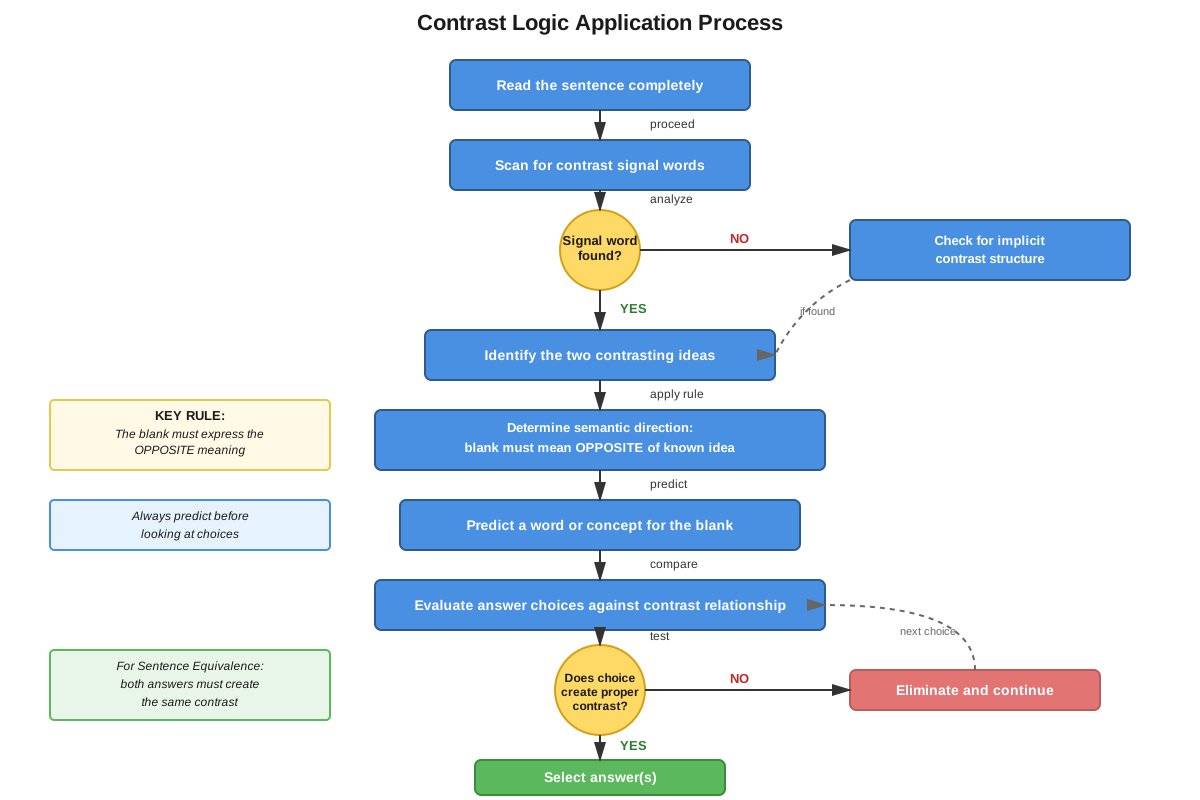
When approaching a sentence that may contain contrast logic, follow this systematic process:
- Scan for explicit contrast signals: Look for the signal words listed above
- Identify the two elements being contrasted: Determine which parts of the sentence are in opposition
- Analyze the known element: Understand the meaning and connotation of the non-blank portion
- Predict the semantic direction: Determine whether the blank needs a positive/negative word, strong/weak descriptor, or specific opposite
- Evaluate answer choices: Test each option to verify it maintains the contrast relationship
- Confirm with both blanks: For Sentence Equivalence, ensure both selected answers create the same contrast and produce equivalent meanings
Degree and Intensity in Contrast
Contrast logic doesn't always involve simple opposites like "hot" versus "cold." Often, the GRE tests understanding of degree and intensity within contrast relationships. A sentence might contrast "somewhat concerned" with "deeply alarmed" or "mildly interesting" with "utterly captivating." These contrasts involve escalation or de-escalation rather than pure opposition.
Recognizing intensity contrasts requires attention to modifying words and understanding connotative strength. Words like "utterly," "profoundly," "slightly," "somewhat," "exceedingly," and "moderately" signal that degree matters. When these appear in the non-blank portion, the answer must match the appropriate intensity level to maintain the contrast.
Multiple Contrast Structures
Advanced GRE questions sometimes contain multiple contrast relationships within a single sentence. These complex structures might contrast two different aspects of a subject or create nested contrasts. Example: "Although generally _____ in public settings, she was paradoxically _____ during private conversations." This sentence contains two blanks with a contrast relationship between them, requiring answers that oppose each other (such as "reserved" and "garrulous").
Concept Relationships
Contrast logic forms the foundation for understanding more complex logical relationships in GRE Verbal Reasoning. The primary conceptual flow operates as follows:
Contrast Logic → Continuation Logic: These represent opposite logical structures. While contrast logic requires opposition, continuation logic (also called support logic) requires consistency and reinforcement. Mastering contrast logic first makes continuation logic easier to recognize by comparison—any sentence without contrast signals likely employs continuation logic.
Contrast Logic → Cause-and-Effect Reasoning: Many contrast structures involve unexpected causes or surprising effects. Understanding contrast enables students to recognize when causal relationships violate expectations, a common GRE pattern.
Explicit Signals → Implicit Structures: Students should master explicit contrast signals first, as these provide clear structural guidance. Once comfortable with explicit markers, implicit contrast structures become recognizable through semantic analysis and contextual clues.
Single Contrasts → Multiple Contrasts: Simple sentences with one clear contrast relationship serve as building blocks for understanding complex sentences with multiple or nested contrasts. The analytical process remains the same but requires more careful tracking of which elements oppose which others.
Sentence-Level Logic → Passage-Level Logic: Contrast logic in individual sentences prepares students for recognizing rhetorical contrasts in Reading Comprehension passages, where authors present opposing viewpoints, acknowledge counterarguments, or describe paradigm shifts in scientific understanding.
High-Yield Facts
⭐ Approximately 35% of Sentence Equivalence questions test contrast logic as the primary logical structure
⭐ The presence of "although," "despite," "but," or "however" in a sentence indicates contrast logic with over 90% reliability
⭐ When contrast logic is present, the correct answer will have the opposite connotation (positive vs. negative) of the key word or phrase in the non-blank portion
⭐ Words like "surprisingly," "paradoxically," and "unexpectedly" signal that what follows contradicts normal expectations, creating an implicit contrast
⭐ In Sentence Equivalence questions with contrast logic, both correct answers must create the same contrast relationship and be synonyms of each other
- Contrast signals can appear at the beginning, middle, or end of a sentence, requiring careful reading of the entire sentence before selecting answers
- Temporal markers like "once," "formerly," "previously," and "now" often indicate implicit contrast between past and present states
- The phrase "far from" is a high-frequency implicit contrast signal meaning "not at all" or "the opposite of"
- Contrast logic questions often feature vocabulary that represents opposite ends of a spectrum (e.g., "dogmatic" vs. "flexible," "verbose" vs. "concise")
- When multiple contrast signals appear in one sentence, they may reinforce each other or create complex nested contrasts requiring careful analysis
- Semicolons followed by contrast words like "however" or "nevertheless" create strong contrast structures between independent clauses
- The construction "not X but Y" is an explicit contrast formula where Y represents the opposite or correction of X
Quick check — test yourself on Contrast logic so far.
Try Flashcards →Common Misconceptions
Misconception: Contrast logic only involves simple opposites like "good" vs. "bad" or "large" vs. "small."
Correction: Contrast logic encompasses a wide range of oppositional relationships including degree differences (mild vs. intense), expectation violations (predicted vs. actual), temporal changes (former vs. current), and nuanced semantic oppositions that require understanding connotation and context.
Misconception: If a sentence contains "and," it cannot have contrast logic.
Correction: While "and" typically signals continuation logic, sentences can contain both "and" and contrast structures. The contrast signal determines the logical relationship for the blank, even if "and" appears elsewhere in the sentence connecting non-contrasting elements.
Misconception: Both answers in Sentence Equivalence questions must be perfect synonyms in all contexts.
Correction: The two correct answers must be synonymous within the specific context of the sentence and must both create the same logical relationship (contrast or continuation). They need not be interchangeable in all possible contexts, only in the given sentence.
Misconception: Implicit contrast structures are rare and can be ignored when studying.
Correction: Implicit contrasts appear in approximately 40% of contrast logic questions on the GRE. Questions without explicit signal words often test deeper comprehension and are considered more difficult, making them essential to master for achieving top scores.
Misconception: Once a contrast signal is identified, any opposite word will work as the answer.
Correction: The answer must create the specific type of opposition required by the sentence's meaning. A sentence contrasting "methodical" might require "haphazard" rather than simply "bad" or "slow." The opposition must be semantically precise and contextually appropriate.
Misconception: Longer, more complex vocabulary words are more likely to be correct in contrast logic questions.
Correction: The GRE tests logical reasoning, not vocabulary showmanship. Correct answers may be relatively simple words that precisely create the required contrast. Students should select answers based on logical fit, not word complexity or impressiveness.
Worked Examples
Example 1: Explicit Contrast with "Although"
Question: Although the restaurant's décor was _____, the quality of the food was exceptional.
Answer Choices: (A) mediocre (B) unremarkable (C) elegant (D) distinctive (E) impressive (F) lavish
Step 1 - Identify the contrast signal: The word "although" at the beginning of the sentence is an explicit subordinating conjunction that signals contrast logic.
Step 2 - Identify the contrasting elements: The sentence contrasts the restaurant's décor (the blank) with "the quality of the food was exceptional."
Step 3 - Analyze the known element: "Exceptional" is strongly positive, indicating very high quality.
Step 4 - Predict the semantic direction: Because "although" signals contrast, and the food quality is exceptional (positive), the décor must be described with a negative or less positive term. The contrast suggests the décor was disappointing or unremarkable despite the excellent food.
Step 5 - Evaluate answer choices:
- (A) mediocre - negative, creates appropriate contrast ✓
- (B) unremarkable - negative/neutral, creates appropriate contrast ✓
- (C) elegant - positive, would not create contrast ✗
- (D) distinctive - positive, would not create contrast ✗
- (E) impressive - positive, would not create contrast ✗
- (F) lavish - positive, would not create contrast ✗
Step 6 - Confirm equivalence: Both "mediocre" and "unremarkable" are near-synonyms meaning ordinary or below expectations, and both create the same contrast with "exceptional."
Correct Answers: (A) and (B)
Learning Objective Connection: This example demonstrates identifying explicit contrast signals (although) and applying the core rule that contrast requires opposite semantic directions.
Example 2: Implicit Contrast with Temporal Structure
Question: The politician's early speeches were characterized by _____ rhetoric, but his recent addresses have been models of measured, thoughtful discourse.
Answer Choices: (A) inflammatory (B) incendiary (C) cautious (D) deliberate (E) temperate (F) provocative
Step 1 - Identify contrast structure: No explicit contrast signal word appears at the beginning, but "but" in the middle of the sentence signals contrast. Additionally, the temporal contrast between "early speeches" and "recent addresses" creates an implicit before-and-after structure.
Step 2 - Identify the contrasting elements: The sentence contrasts the politician's early rhetoric (the blank) with recent rhetoric described as "measured, thoughtful discourse."
Step 3 - Analyze the known element: "Measured" and "thoughtful" are positive descriptors suggesting careful, moderate, well-considered speech. This represents a calm, rational approach.
Step 4 - Predict the semantic direction: The blank must describe the opposite of measured and thoughtful. The contrast suggests the early speeches were extreme, rash, or emotionally charged rather than carefully considered.
Step 5 - Evaluate answer choices:
- (A) inflammatory - negative, meaning provocative and arousing strong emotion, creates contrast ✓
- (B) incendiary - negative, meaning inflammatory and provocative, creates contrast ✓
- (C) cautious - positive, similar to measured, would not create contrast ✗
- (D) deliberate - positive, similar to thoughtful, would not create contrast ✗
- (E) temperate - positive, meaning moderate and restrained, would not create contrast ✗
- (F) provocative - could work for contrast, but not a synonym of inflammatory in this context ✗
Step 6 - Confirm equivalence: "Inflammatory" and "incendiary" are close synonyms both meaning provocative and arousing strong reactions, and both create the same temporal contrast with the measured recent speeches.
Correct Answers: (A) and (B)
Learning Objective Connection: This example demonstrates recognizing implicit contrast structures (temporal comparison) and applying contrast logic when the signal appears mid-sentence rather than at the beginning.
Exam Strategy
Systematic Approach to Contrast Logic Questions
When approaching any Sentence Equivalence or Text Completion question, implement this strategic process:
First 10 seconds: Read the entire sentence carefully, scanning specifically for contrast signal words. Circle or mentally note any explicit markers like "although," "despite," "but," "however," or "surprisingly." If no explicit signals appear, look for implicit structures like temporal comparisons or expectation-setting language.
Next 15 seconds: Identify the two elements being contrasted and determine which element is known (non-blank) and which is unknown (blank). Analyze the connotation and meaning of the known element—is it positive or negative? Strong or weak? Expected or unexpected?
Next 10 seconds: Before looking at answer choices, predict the semantic direction and, if possible, a specific word or concept that would fit. This prediction prevents answer choices from biasing your logical analysis.
Next 20 seconds: Evaluate each answer choice by testing whether it creates the required contrast. Eliminate choices that fail to oppose the known element or that would create continuation rather than contrast.
Final 15 seconds: For Sentence Equivalence, confirm that your two selected answers are synonyms of each other and that both create equivalent sentences with the same meaning and the same contrast relationship.
High-Frequency Trigger Words
Memorize these trigger words and their strategic implications:
Immediate contrast indicators (nearly 100% reliability): although, though, even though, despite, in spite of, notwithstanding, but, yet, however, nevertheless, nonetheless
Surprise/expectation violation indicators: surprisingly, unexpectedly, paradoxically, ironically, curiously, strangely
Comparison indicators: unlike, in contrast to, rather than, instead of, whereas, while
Temporal contrast indicators: once, formerly, previously, initially, originally (when followed by "now," "currently," or "today")
Negation-based contrasts: far from, anything but, hardly, scarcely, not X but Y
Process of Elimination Techniques
When contrast logic is identified, use these elimination strategies:
- Eliminate same-direction words: If the known element is positive, immediately eliminate all positive answer choices (and vice versa for negative known elements)
- Eliminate intensity mismatches: If the known element uses strong language ("utterly," "profoundly"), eliminate mild opposites; if the known element is moderate, eliminate extreme opposites
- Eliminate non-synonymous pairs: In Sentence Equivalence, if two words cannot be synonyms, at least one must be wrong—eliminate both if neither has a synonym partner among the remaining choices
- Test the contrast explicitly: For remaining choices, mentally insert each word and ask "Does this create a clear opposition to [known element]?" If the answer is uncertain, the choice is likely incorrect
Time Allocation
For Sentence Equivalence questions with contrast logic, allocate approximately 70 seconds total:
- 10 seconds: Initial read and signal identification
- 15 seconds: Analysis of contrast structure
- 10 seconds: Prediction before viewing choices
- 25 seconds: Answer evaluation and elimination
- 10 seconds: Final confirmation of synonym pair
This timing allows for thorough analysis while maintaining the pace necessary to complete all Verbal Reasoning questions. Contrast logic questions should actually be completed faster than average because the logical structure provides clear guidance for elimination.
Memory Techniques
The ABCD Mnemonic for Contrast Signals
Although, But, Contrast, Despite
This simple acronym captures four of the most common explicit contrast signals. When reading a GRE sentence, mentally run through ABCD to check for these high-frequency markers.
The "Opposite Day" Visualization
When contrast logic is identified, visualize the sentence as describing "Opposite Day"—whatever quality or characteristic is mentioned in the non-blank portion, the blank must express the reverse. This childlike mental model helps prevent errors where students select answers that continue rather than contrast the established meaning.
The Pendulum Technique
Visualize a pendulum swinging from one extreme to the opposite. The known element represents one end of the pendulum's swing, and the blank must represent the other end. This physical visualization helps with understanding that contrast involves movement across a spectrum, not just random opposition.
The "But Test" Shortcut
For any sentence suspected of containing contrast logic, mentally insert the word "but" between the blank and the rest of the sentence. If "but" makes logical sense, contrast logic is present. Example: "The professor's lectures were _____ [but] students found them engaging" suggests the blank should be something negative like "tedious" or "dry."
The STOP Acronym for Implicit Contrasts
Surprising outcomes
Temporal changes (past vs. present)
Opposite expectations
Paradoxical characteristics
When no explicit contrast signal appears, check whether the sentence contains any STOP elements, which indicate implicit contrast structures.
Summary
Contrast logic represents one of the most testable and high-yield concepts in GRE Verbal Reasoning, appearing in approximately one-third of Sentence Equivalence questions and a significant portion of Text Completion items. The fundamental principle is straightforward: when a sentence establishes an oppositional relationship between two elements, the blank must be filled with a word that creates or maintains that opposition. Explicit contrast signals like "although," "despite," "but," and "however" directly announce these relationships, while implicit contrasts emerge through temporal comparisons, expectation violations, and semantic oppositions built into the sentence's content. Mastering contrast logic transforms vocabulary-dependent questions into logical puzzles that can be solved systematically through structural analysis. Students who can identify contrast signals, analyze the known element's connotation, predict the required semantic direction, and eliminate answer choices that fail to create opposition gain a decisive advantage on test day. The key to success lies in systematic application of the contrast logic decision tree: identify signals, determine contrasting elements, analyze the known portion, predict the direction, evaluate choices, and confirm synonym pairs for Sentence Equivalence questions.
Key Takeaways
- Contrast logic appears in approximately 35% of Sentence Equivalence questions, making it one of the highest-yield topics for score improvement on the GRE Verbal Reasoning section
- Explicit contrast signals (although, despite, but, however) provide immediate structural guidance, while implicit contrasts require semantic analysis of temporal changes, expectation violations, and comparative structures
- The fundamental rule: when contrast logic is present, the blank must contain a word with the opposite connotation or semantic direction from the key word or phrase in the non-blank portion of the sentence
- Both answers in Sentence Equivalence must be synonyms AND must create the same contrast relationship—meeting only one criterion results in an incorrect response
- Systematic analysis beats vocabulary memorization: identifying the logical structure and predicting semantic direction before viewing answer choices leads to more accurate and efficient question solving
- Degree and intensity matter: contrast logic involves not just simple opposites but also escalation/de-escalation relationships requiring attention to modifying words and connotative strength
- Time investment in mastering contrast logic yields disproportionate returns because the same analytical framework applies across hundreds of potential questions with different vocabulary
Related Topics
Continuation Logic (Support Logic): The complementary logical structure where sentence elements reinforce rather than oppose each other. Mastering contrast logic makes continuation logic easier to recognize by comparison, as sentences without contrast signals typically employ continuation structures.
Cause-and-Effect Reasoning: Many GRE sentences combine contrast logic with causal relationships, presenting unexpected causes or surprising effects. Understanding contrast enables recognition of when causal relationships violate expectations.
Two-Blank Text Completion: Advanced questions where contrast logic may operate between the two blanks themselves or where each blank participates in a different logical relationship. Mastering single-blank contrast logic is prerequisite to handling these complex items.
Reading Comprehension Rhetorical Analysis: Authors use contrast structures to present opposing viewpoints, acknowledge counterarguments, and describe paradigm shifts. Sentence-level contrast logic skills transfer directly to passage-level rhetorical analysis.
Vocabulary in Context: Understanding how contrast logic constrains word meaning helps with determining precise definitions of unfamiliar vocabulary based on structural clues rather than memorization alone.
Practice CTA
Now that you've mastered the core concepts of contrast logic, it's time to cement your understanding through active practice. Attempt the practice questions designed specifically for this topic, focusing on applying the systematic decision tree and identification strategies covered in this guide. Use the flashcards to reinforce recognition of contrast signal words and common contrast patterns. Remember that contrast logic is a skill that improves dramatically with deliberate practice—each question you analyze strengthens your ability to recognize these structures instantly on test day. Your investment in mastering this high-yield topic will pay dividends across dozens of questions on your actual GRE. Approach each practice item as an opportunity to refine your analytical process, and you'll find that contrast logic questions transform from challenging obstacles into reliable score-boosting opportunities.
Sign up free to keep reading
Create a free AnvayaPrep account to finish this GRE guide on Contrast logic — plus flashcards and practice questions.