Overview
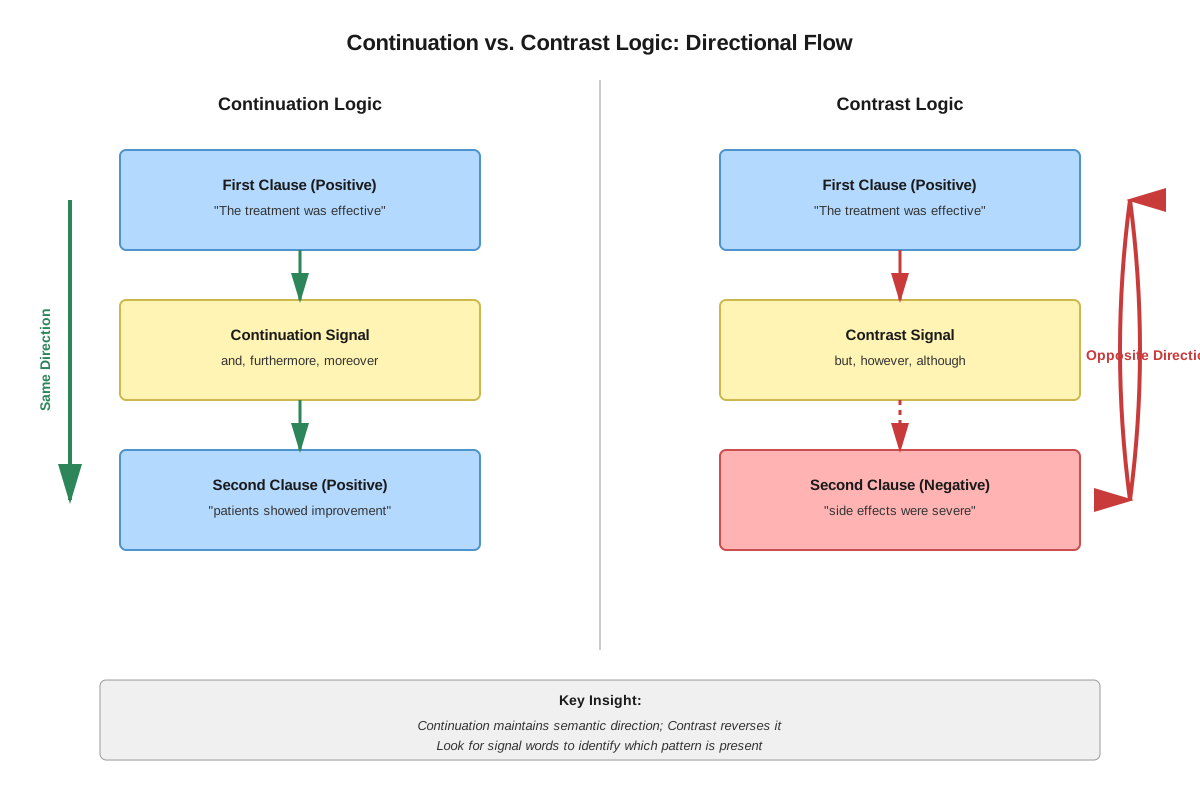
Continuation logic is one of the most frequently tested reasoning patterns in GRE Sentence Equivalence and Text Completion questions. This logical structure occurs when a sentence contains ideas that flow in the same direction—where the second part of the sentence reinforces, elaborates, or extends the meaning established in the first part. Unlike contrast logic, where ideas oppose each other, continuation logic maintains thematic consistency throughout the sentence.
Understanding GRE continuation logic is essential because approximately 40-50% of Sentence Equivalence questions rely on recognizing when ideas continue rather than contrast. Students who master this concept can quickly identify the relationship between sentence parts, predict the type of word needed, and eliminate incorrect answer choices with confidence. The ability to spot continuation signals transforms what might seem like vocabulary tests into logical reasoning exercises, significantly improving accuracy even when encountering unfamiliar words.
Within the broader Verbal Reasoning framework, continuation logic serves as a foundational skill that supports success across multiple question types. It connects directly to reading comprehension strategies, as recognizing continuation patterns helps students follow an author's argument development. This topic also relates closely to contrast logic (its logical opposite), parallelism in sentence structure, and the broader skill of identifying logical relationships between clauses. Mastering continuation logic provides students with a systematic approach to decoding sentence structure, making it one of the highest-yield topics in GRE preparation.
Learning Objectives
- [ ] Identify when Continuation logic is being tested in GRE Sentence Equivalence and Text Completion questions
- [ ] Explain the core rule or strategy behind Continuation logic and how it differs from other logical patterns
- [ ] Apply Continuation logic to GRE-style questions accurately and efficiently
- [ ] Recognize and categorize the various continuation signal words and phrases that appear in GRE questions
- [ ] Predict the semantic direction of missing words based on continuation clues in the sentence
- [ ] Distinguish between genuine continuation logic and superficially similar sentence structures that actually employ contrast
- [ ] Combine continuation logic recognition with vocabulary knowledge to select synonymous answer pairs
Prerequisites
- Basic sentence structure understanding: Recognizing subjects, predicates, and clauses is necessary to identify where logical relationships occur within sentences
- Fundamental vocabulary knowledge: A working vocabulary enables students to understand the context that continuation logic operates within
- Familiarity with GRE question formats: Understanding how Sentence Equivalence questions work (selecting two answers that create equivalent meanings) provides the framework for applying continuation logic
- Awareness of logical relationships: A general sense that sentences contain relationships between ideas helps students approach continuation logic systematically
Why This Topic Matters
Continuation logic appears in real-world communication constantly. Academic writing, professional correspondence, and persuasive arguments all rely on building ideas that flow logically from one point to the next. Writers use continuation to develop arguments, provide supporting evidence, elaborate on concepts, and reinforce themes. Recognizing these patterns enables readers to follow complex reasoning and anticipate where an argument leads.
On the GRE specifically, continuation logic appears in approximately 45-50% of Sentence Equivalence questions and 35-40% of Text Completion questions. This makes it one of the most frequently tested logical patterns on the exam. The Educational Testing Service (ETS) deliberately constructs sentences where recognizing continuation versus contrast determines success, making this skill more valuable than memorizing thousands of vocabulary words.
Common manifestations in GRE passages include: sentences where an initial description is followed by an elaboration using similar language; situations where cause-and-effect relationships maintain directional consistency; contexts where examples support a general statement; and structures where semicolons connect two parallel ideas. The test makers often include answer choices that would fit contrast logic to trap students who misidentify the sentence's logical structure. Students who confidently recognize continuation patterns can eliminate half the answer choices immediately, dramatically improving their odds even when vocabulary is challenging.
Core Concepts
Definition of Continuation Logic
Continuation logic refers to the logical relationship within a sentence where ideas maintain the same semantic direction, with later parts reinforcing, supporting, elaborating, or extending earlier parts. When continuation logic operates, the blank should be filled with a word that keeps the sentence moving in the same thematic direction rather than reversing or contradicting it.
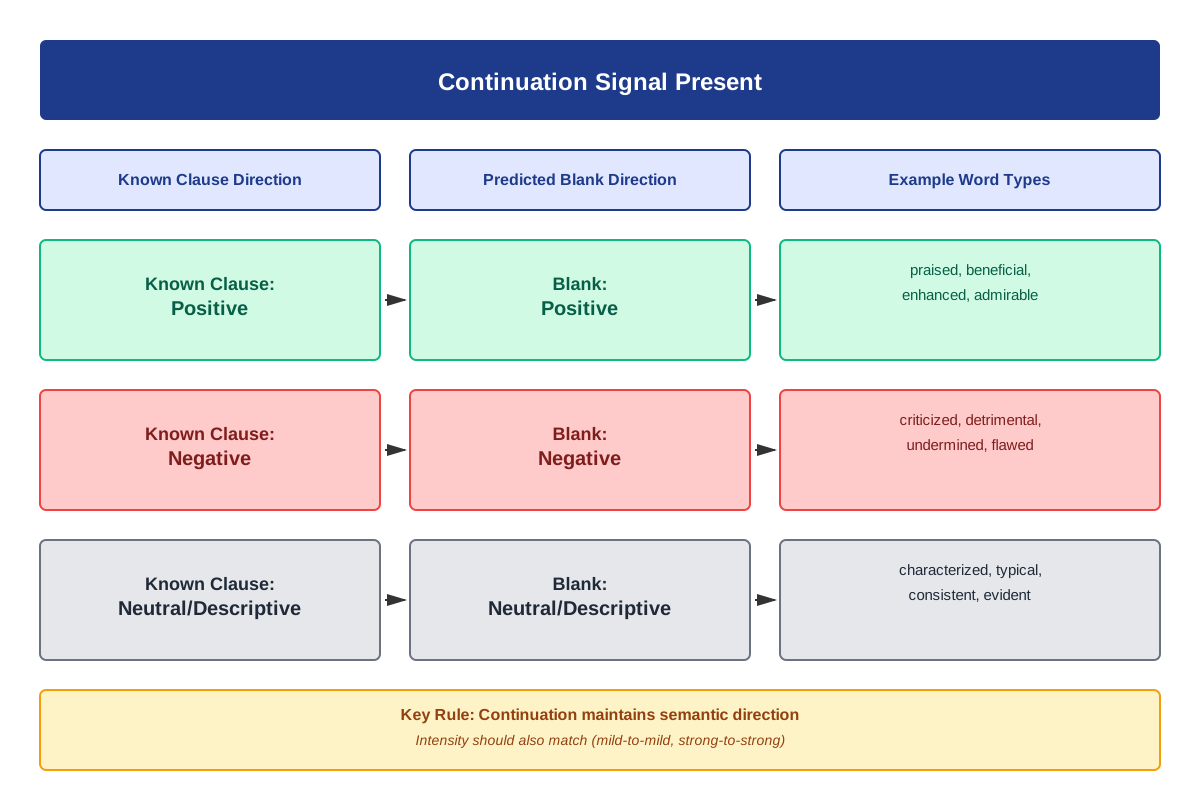
The fundamental principle is straightforward: if the first part of a sentence establishes a positive quality, the continuation will maintain that positive direction; if the first part establishes a negative quality, the continuation will maintain that negative direction. The sentence maintains thematic consistency throughout its structure.
Continuation Signal Words and Phrases
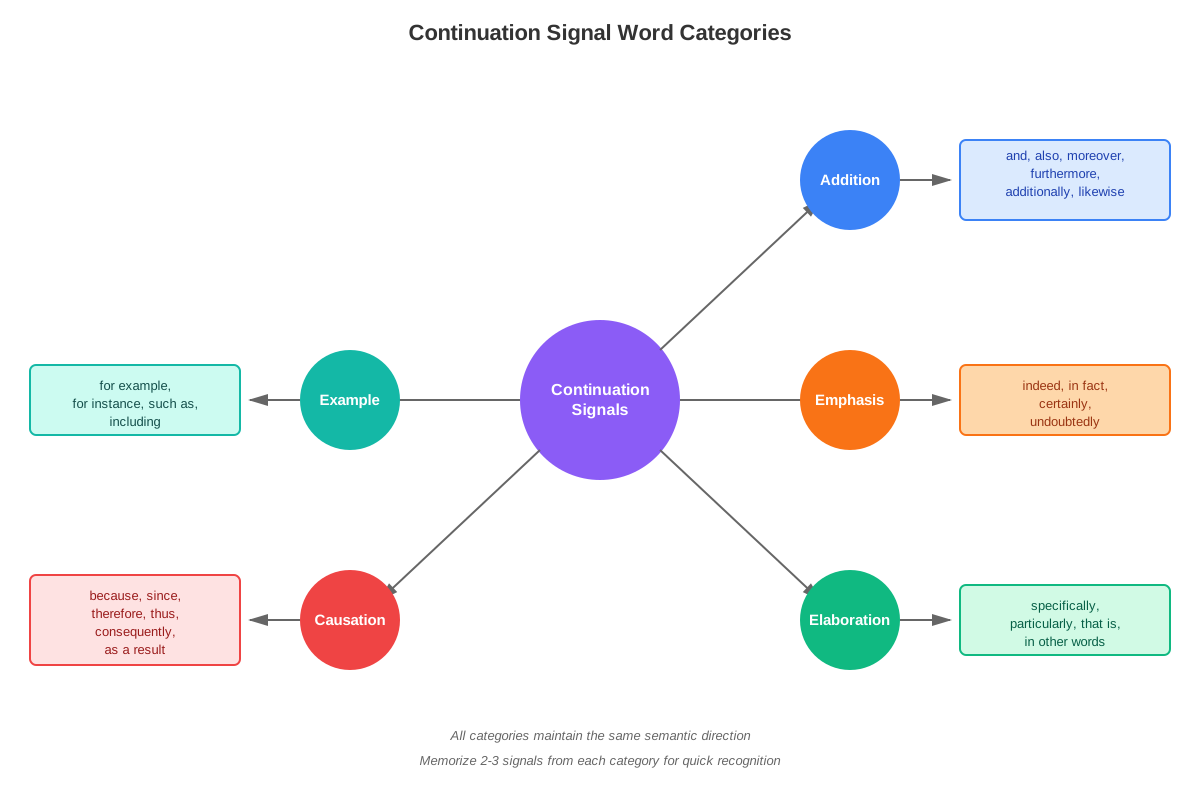
Certain words and phrases reliably indicate that continuation logic is operating. These continuation signals function as road signs, alerting careful readers that ideas will flow in the same direction:
Common Continuation Signals:
| Category | Signal Words/Phrases | Function |
|---|---|---|
| Addition | and, moreover, furthermore, additionally, also, as well as | Adds similar information |
| Emphasis | indeed, in fact, especially, particularly | Strengthens the existing idea |
| Causation | because, since, as, therefore, thus, consequently | Shows logical flow in same direction |
| Elaboration | specifically, for example, for instance, such as | Provides supporting detail |
| Similarity | similarly, likewise, in the same way, equally | Draws parallel connections |
| Sequence | first...second, not only...but also | Links parallel ideas |
The presence of these signals indicates that the blank should contain a word with similar connotation and meaning to the context already established. For example, if a sentence begins "The scientist was meticulous in her research; indeed, her attention to detail was _____," the word "indeed" signals continuation, meaning the blank requires another positive word about carefulness.
Semicolon as Continuation Indicator
The semicolon plays a special role in GRE continuation logic. When a semicolon appears without a contrast word (like "however" or "yet"), it almost always signals continuation. The semicolon connects two independent clauses that express parallel or reinforcing ideas.
Structure: [Independent clause establishing idea]; [Independent clause reinforcing same idea]
Example: "The politician's speech was bombastic; his rhetoric was filled with grandiose claims and exaggerated promises."
Here, "bombastic" and the description after the semicolon move in the same direction—both describe excessive, inflated language. Students should train themselves to see semicolons as strong continuation signals unless explicitly contradicted by contrast words.
Parallel Structure and Continuation
Parallel structure often accompanies continuation logic. When sentence elements are grammatically parallel (similar phrases, clauses, or lists), they typically express ideas moving in the same direction.
Example: "The professor was known for her _____ lectures and her engaging discussions."
The parallel structure "her _____ lectures and her engaging discussions" signals that the blank should contain a positive quality similar to "engaging." The parallelism reinforces the continuation relationship.
Cause-and-Effect Continuation
Continuation logic frequently appears in cause-and-effect relationships where the effect logically extends from the cause in a consistent direction:
- Positive cause → Positive effect: "Because the medication was effective, patients experienced _____ outcomes."
- Negative cause → Negative effect: "Due to the drought, crop yields were _____."
The causal relationship maintains directional consistency. If the cause is negative (drought), the effect continues in a negative direction (reduced/poor yields).
Elaboration and Specification
Another common continuation pattern involves moving from general to specific, where the second part of the sentence provides detailed examples or elaboration of the initial concept:
Pattern: [General statement]; [Specific elaboration]
Example: "The artist's work was derivative; she borrowed heavily from Renaissance masters and incorporated their techniques without innovation."
The second clause elaborates on what "derivative" means, maintaining the same critical direction established initially.
Concept Relationships
Continuation logic connects to several other verbal reasoning concepts in a hierarchical and complementary manner:
Internal Relationships: Within continuation logic itself, the various signal types (addition, emphasis, causation, elaboration) all serve the same fundamental purpose—maintaining semantic direction. These signals → indicate continuation → which guides word choice → leading to correct answer selection.
Contrast Logic Connection: Continuation logic exists in direct opposition to contrast logic. Understanding one deepens understanding of the other. The decision tree begins with: "Are ideas continuing or contrasting?" This binary choice → determines semantic direction → which narrows answer choices dramatically.
Sentence Structure Connection: Continuation logic relies on understanding how clauses relate within complex sentences. Recognizing independent versus dependent clauses → enables identification of where logical relationships occur → which reveals continuation patterns.
Vocabulary Application: Once continuation logic identifies semantic direction, vocabulary knowledge becomes more targeted. Logical analysis → determines whether positive or negative connotation is needed → vocabulary knowledge → selects the specific word → with consideration for synonymy in Sentence Equivalence.
Reading Comprehension Extension: The same continuation patterns that appear in individual sentences operate across paragraphs in reading passages. Sentence-level continuation skills → transfer to paragraph-level argument tracking → improving overall reading comprehension.
High-Yield Facts
⭐ Continuation logic appears in approximately 45-50% of GRE Sentence Equivalence questions, making it the most frequently tested logical pattern.
⭐ Semicolons without contrast words (however, yet, nevertheless) indicate continuation logic over 90% of the time on the GRE.
⭐ Words like "indeed," "in fact," and "moreover" are high-frequency continuation signals that should trigger immediate recognition of same-direction logic.
⭐ When continuation logic operates, both answer choices in Sentence Equivalence must have the same connotation (both positive or both negative) as the context.
⭐ Parallel grammatical structures (lists, paired phrases) almost always indicate continuation rather than contrast.
- Cause-and-effect relationships maintain directional consistency: negative causes lead to negative effects in continuation logic.
- The phrase "not only...but also" is a strong continuation signal indicating that the second element intensifies or adds to the first.
- Continuation logic can operate even without explicit signal words when semicolons or colons connect clauses.
- Examples and elaborations following general statements represent continuation logic, with specifics reinforcing the initial claim.
- Continuation signals can appear at the beginning, middle, or end of sentences, requiring flexible pattern recognition.
- When a sentence contains multiple blanks, continuation logic may operate between the blanks themselves, requiring consistent semantic direction across both.
Quick check — test yourself on Continuation logic so far.
Try Flashcards →Common Misconceptions
Misconception: All coordinating conjunctions (and, but, or) signal continuation logic. → Correction: While "and" typically signals continuation, "but" signals contrast, and "or" signals alternatives. Only "and" reliably indicates continuation, and even then, context matters. The phrase "and yet" actually signals contrast despite containing "and."
Misconception: Continuation logic means the blank must be a synonym of a word already in the sentence. → Correction: Continuation logic means the blank maintains the same semantic direction and connotation, but it may elaborate, intensify, or provide examples rather than directly synonymize. The blank might be more specific, more extreme, or provide a different aspect of the same general quality.
Misconception: Long sentences with multiple clauses are more likely to use contrast logic than continuation logic. → Correction: Sentence length doesn't determine logical structure. Complex sentences frequently use continuation logic to build elaborate arguments through multiple supporting clauses. Students should analyze logical signals rather than making assumptions based on sentence complexity.
Misconception: If a sentence contains both positive and negative elements, continuation logic cannot be operating. → Correction: Continuation logic can operate within either the positive or negative portion of a sentence. A sentence might contrast two subjects but use continuation logic within the description of each subject. For example: "While the first candidate was eloquent and persuasive, the second was inarticulate and _____." Continuation logic operates within the second clause (negative direction), even though the sentence overall contrasts two candidates.
Misconception: Continuation signals always appear before the blank. → Correction: Continuation signals can appear anywhere in the sentence. Sometimes the signal follows the blank, requiring students to read the entire sentence before determining logical structure. Example: "The chef's _____ approach to cuisine, incorporating unexpected ingredients and novel techniques, revolutionized the restaurant." The elaboration after the blank signals what type of word fits.
Misconception: Causal words like "because" and "therefore" always indicate continuation logic. → Correction: While causal relationships often maintain directional consistency, some sentences use causation to explain why something unexpected (contrasting) occurred. Context determines whether the cause-effect relationship continues or contrasts with expectations. However, on the GRE, causal words do indicate continuation in the vast majority of cases.
Worked Examples
Example 1: Classic Semicolon Continuation
Question: The executive's presentation was _____ and _____; she used clear language, provided concrete examples, and addressed audience questions thoroughly.
Answer Choices:
(A) lucid
(B) obscure
(C) comprehensive
(D) ambiguous
(E) articulate
(F) vague
Solution Process:
Step 1 - Identify the logical structure: The semicolon without a contrast word signals continuation logic. The second clause will reinforce the first.
Step 2 - Analyze the context after the semicolon: "Clear language," "concrete examples," and "addressed questions thoroughly" are all positive qualities indicating effective communication and completeness.
Step 3 - Determine semantic direction: The blanks must contain positive words about communication quality and thoroughness.
Step 4 - Evaluate answer choices:
- (A) lucid - positive, means clear ✓
- (B) obscure - negative, means unclear ✗
- (C) comprehensive - positive, means thorough/complete ✓
- (D) ambiguous - negative, means unclear ✗
- (E) articulate - positive, means clear ✓
- (F) vague - negative, means unclear ✗
Step 5 - Select synonymous pair: We need two words that create equivalent meanings. Looking at positive choices: "lucid" and "articulate" both mean clear/well-expressed, while "comprehensive" means thorough/complete. The sentence describes both clarity AND thoroughness, but for Sentence Equivalence, we need synonyms.
Correct Answer: (A) lucid and (E) articulate
Connection to Learning Objectives: This example demonstrates identifying continuation logic (semicolon signal), explaining the strategy (same-direction reinforcement), and applying it accurately to eliminate wrong answers and select synonymous pairs.
Example 2: Continuation with "Indeed"
Question: The scientist's methodology was rigorous and systematic; indeed, her _____ approach to data collection ensured reliable results.
Answer Choices:
(A) haphazard
(B) meticulous
(C) careless
(D) scrupulous
(E) arbitrary
(F) inconsistent
Solution Process:
Step 1 - Identify continuation signals: Both the semicolon AND "indeed" signal continuation. "Indeed" is an emphasis word that strengthens the existing idea.
Step 2 - Analyze established context: "Rigorous and systematic" are positive qualities indicating careful, thorough, organized work.
Step 3 - Determine what "indeed" emphasizes: The word "indeed" tells us the blank will reinforce and possibly intensify the qualities already mentioned.
Step 4 - Predict blank characteristics: Need a positive word meaning careful, thorough, or precise—something that would lead to "reliable results."
Step 5 - Evaluate choices:
- (A) haphazard - negative, means random/disorganized ✗
- (B) meticulous - positive, means extremely careful ✓
- (C) careless - negative, opposite of rigorous ✗
- (D) scrupulous - positive, means extremely thorough/careful ✓
- (E) arbitrary - negative, means random/without reason ✗
- (F) inconsistent - negative, opposite of systematic ✗
Step 6 - Verify synonymy: "Meticulous" and "scrupulous" are near-synonyms, both indicating extreme attention to detail and thoroughness.
Correct Answer: (B) meticulous and (D) scrupulous
Connection to Learning Objectives: This example shows recognizing multiple continuation signals working together, understanding how "indeed" functions to emphasize, and applying continuation logic to predict semantic requirements before evaluating vocabulary.
Exam Strategy
Initial Approach to Any Sentence
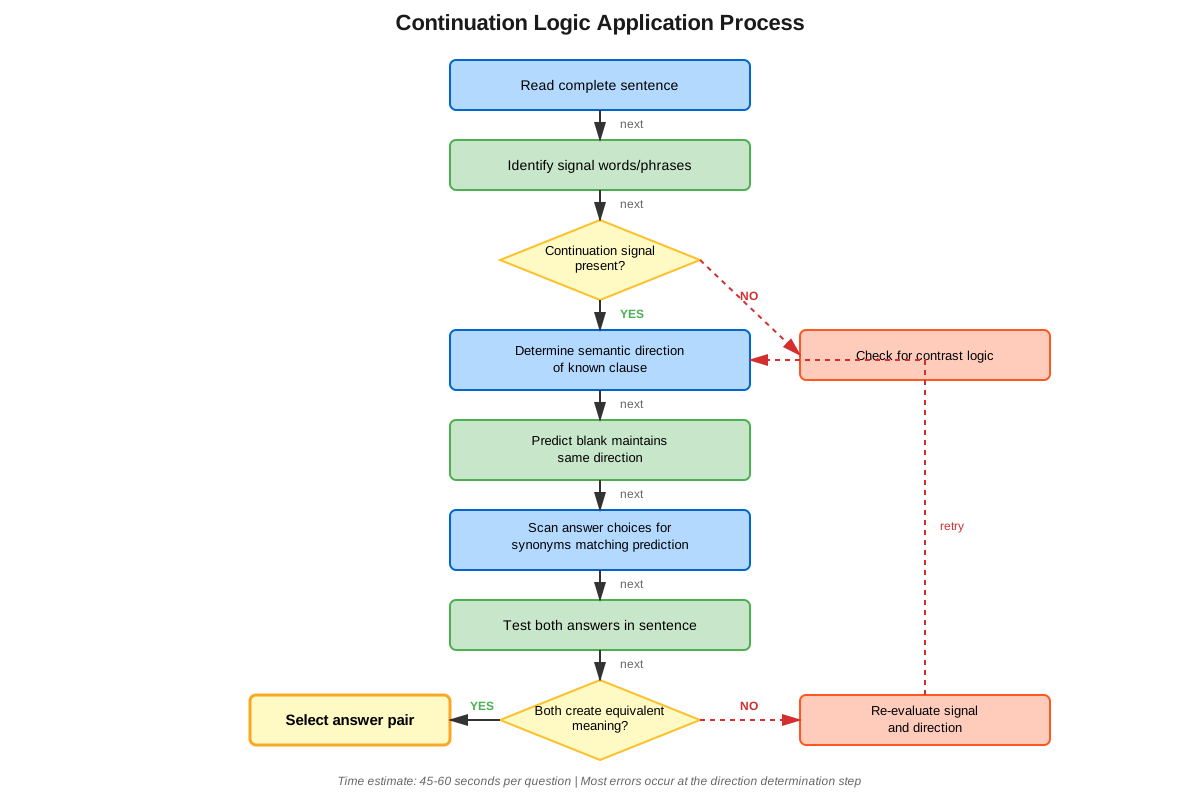
When encountering a GRE Sentence Equivalence or Text Completion question, follow this systematic process:
- Read the entire sentence first without looking at answer choices
- Identify logical structure signals (semicolons, signal words, parallel structures)
- Determine whether continuation or contrast logic operates
- Predict the semantic direction (positive or negative connotation needed)
- Only then evaluate answer choices against your prediction
Trigger Words to Watch For
Develop automatic recognition of high-frequency continuation signals:
Immediate continuation indicators: indeed, in fact, moreover, furthermore, additionally, similarly, likewise, and (in most contexts)
Structural continuation indicators: semicolons without contrast words, colons introducing elaboration, parallel grammatical structures
Causal continuation indicators: because, since, as, therefore, thus, consequently, as a result
When you spot these triggers, immediately think: "Same direction—the blank reinforces what's already established."
Process of Elimination Strategy
For continuation logic questions, eliminate aggressively:
- Eliminate opposite connotation first: If context is positive, eliminate all negative words immediately (and vice versa)
- Eliminate words that would create contrast: Remove any words that would reverse or contradict the established direction
- Among remaining choices, identify the synonymous pair: In Sentence Equivalence, the two correct answers must create equivalent sentence meanings
Exam Tip: In Sentence Equivalence with continuation logic, if you've correctly identified the semantic direction, you can often eliminate 3-4 answer choices immediately based on connotation alone, even if you don't know every word's precise definition.
Time Allocation
- Spend 15-20 seconds identifying logical structure before evaluating answers
- Spend 30-40 seconds on answer evaluation and selection
- Total time per question: 60-75 seconds for Sentence Equivalence
This upfront investment in logical analysis saves time by enabling confident elimination and reducing second-guessing.
Common Trap Patterns
The GRE deliberately includes wrong answers that would be correct if the logical structure were different:
- Contrast trap: Answer choices that would fit if the sentence used contrast logic instead of continuation
- Partial match trap: Words that relate to the topic but don't maintain semantic direction
- Synonym trap: In Sentence Equivalence, two words that are synonyms but both wrong for the context
Always verify that your selected pair both fits the continuation logic AND creates equivalent meanings.
Memory Techniques
The SAME Acronym for Continuation
Semantic direction stays the SAME
And, moreover, indeed are signals
Maintain the established tone
Elaboration extends the idea
When you see potential continuation, think "SAME" to remember that ideas flow in the same direction.
Semicolon Rule Visualization
Visualize a semicolon as an equals sign (=) when no contrast word follows it:
[Positive idea] ; [= Positive idea]
[Negative idea] ; [= Negative idea]
This mental image reinforces that semicolons typically signal equivalence and continuation.
The "Indeed Test"
When uncertain whether continuation operates, mentally insert "indeed" between clauses:
"The artist was talented [indeed] her work showed remarkable skill."
If "indeed" fits naturally, continuation logic is operating. If it sounds wrong, consider whether contrast logic might be present instead.
Signal Word Categories Mnemonic
ACE signals continuation:
- Addition (and, moreover, furthermore)
- Causation (because, therefore, thus)
- Emphasis (indeed, in fact, especially)
Parallel Structure Reminder
"Parallel grammar = Parallel meaning"
When you see parallel grammatical structures (lists, paired phrases), expect continuation logic with ideas moving in the same direction.
Summary
Continuation logic represents one of the most critical skills for GRE Verbal Reasoning success, appearing in nearly half of all Sentence Equivalence questions. This logical pattern occurs when sentence elements maintain the same semantic direction, with later parts reinforcing, elaborating, or extending earlier established ideas. Recognition of continuation signals—including words like "indeed," "moreover," and "furthermore," as well as structural indicators like semicolons and parallel constructions—enables students to predict the semantic requirements of blanks before evaluating vocabulary. The fundamental strategy involves identifying whether ideas continue or contrast, determining the established semantic direction (positive or negative), and selecting words that maintain that direction while creating equivalent meanings in Sentence Equivalence questions. Mastery of continuation logic transforms vocabulary-dependent questions into logic-based exercises, dramatically improving accuracy even with challenging words. Students who systematically analyze logical structure before evaluating answer choices can eliminate incorrect options efficiently and select correct answers confidently, making this skill one of the highest-yield investments in GRE preparation.
Key Takeaways
- Continuation logic maintains semantic direction: ideas flow in the same direction rather than contrasting, with later elements reinforcing earlier ones
- Semicolons without contrast words signal continuation over 90% of the time on the GRE, making them the most reliable structural indicator
- High-frequency signal words like "indeed," "moreover," "furthermore," and "because" should trigger immediate recognition of continuation patterns
- Eliminate based on connotation first: if context is positive, eliminate all negative answer choices immediately (and vice versa) before considering precise meanings
- Parallel grammatical structures almost always indicate continuation logic, with similar phrases expressing ideas moving in the same direction
- Continuation logic appears in approximately 45-50% of Sentence Equivalence questions, making it the single most frequently tested logical pattern
- Systematic logical analysis before vocabulary evaluation is the key strategy: identify structure, determine direction, predict requirements, then evaluate choices
Related Topics
Contrast Logic: The complementary opposite of continuation logic, where sentence elements oppose or reverse direction. Mastering continuation logic provides the foundation for understanding contrast patterns, as the two represent the primary logical structures tested on the GRE.
Text Completion Strategies: Continuation logic operates across all Text Completion question types (one-blank, two-blank, and three-blank). The principles learned here extend directly to more complex completion questions.
Sentence Structure Analysis: Understanding how independent and dependent clauses relate enables more sophisticated recognition of logical patterns. Deeper grammatical knowledge enhances continuation logic identification.
Connotation and Tone: Continuation logic relies heavily on recognizing whether words carry positive, negative, or neutral connotations. Developing stronger connotation awareness improves continuation logic application.
Reading Comprehension Argument Structure: The same continuation patterns that operate within sentences extend to paragraph-level argument development in reading passages. Mastering sentence-level continuation enables better tracking of multi-paragraph arguments.
Practice CTA
Now that you understand continuation logic deeply, it's time to apply these concepts to actual GRE-style questions. The practice questions and flashcards have been specifically designed to reinforce the patterns, signals, and strategies covered in this guide. As you practice, focus on identifying logical structure before evaluating vocabulary—this systematic approach will build the automatic recognition skills that lead to consistent high performance. Remember that continuation logic mastery is one of the highest-yield skills for GRE Verbal Reasoning success. Each practice question you complete strengthens your pattern recognition and builds the confidence needed for test day. You've invested the time to understand the concepts; now invest the time to apply them. Your improved accuracy and efficiency will demonstrate the power of strategic, logic-based approaches to GRE preparation.
Sign up free to keep reading
Create a free AnvayaPrep account to finish this GRE guide on Continuation logic — plus flashcards and practice questions.