Overview
Cause-effect logic is a fundamental reasoning pattern that appears throughout the GRE Verbal Reasoning section, particularly in Sentence Equivalence and Text Completion questions. This logical structure involves understanding the relationship between events, actions, or conditions where one element (the cause) produces or influences another element (the effect). On the GRE, recognizing cause-effect relationships enables test-takers to predict missing words, understand sentence structure, and select semantically equivalent answer choices. The ability to identify signal words, understand directional relationships, and distinguish between causes and their consequences is essential for achieving high scores on verbal questions.
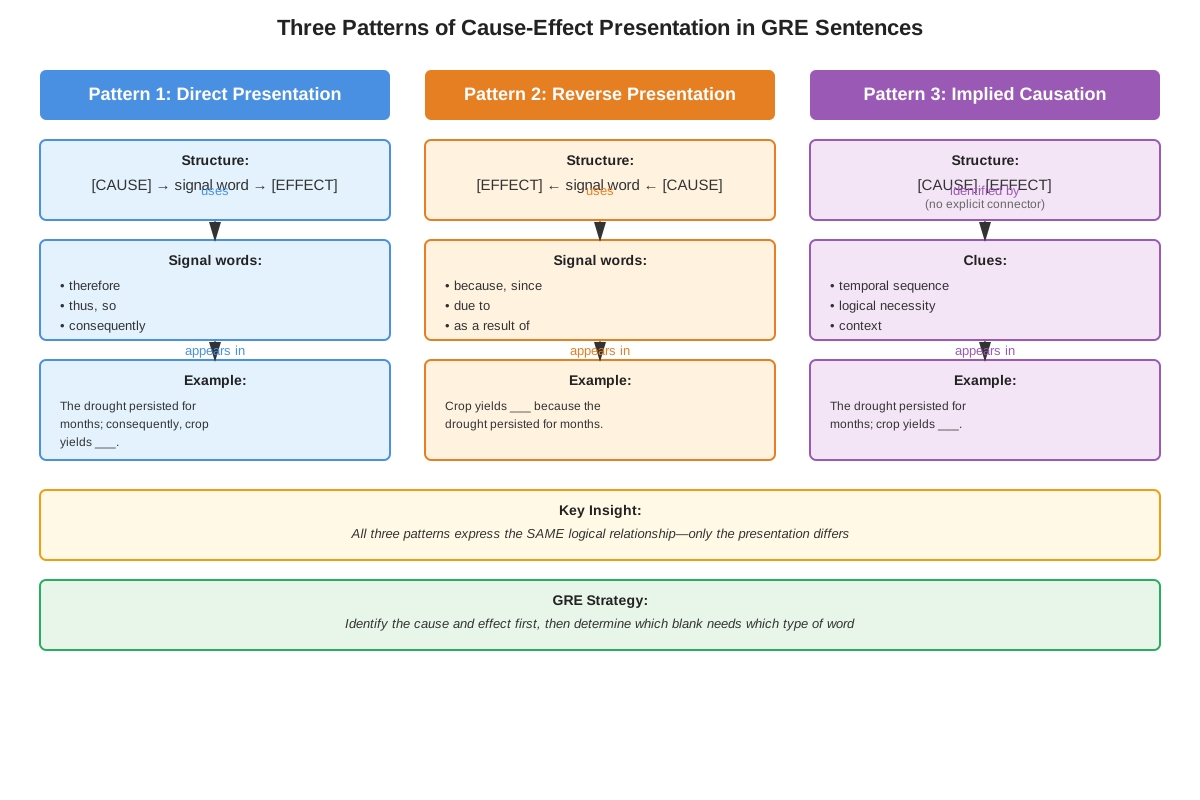
GRE cause-effect logic questions test more than simple vocabulary knowledge—they assess a student's ability to comprehend logical relationships within complex sentence structures. These questions often feature sophisticated academic language where the cause-effect relationship may be stated directly, implied through context, or reversed in presentation (effect stated before cause). Understanding these patterns allows students to eliminate incorrect answer choices systematically and identify the precise words that maintain logical coherence within a sentence.
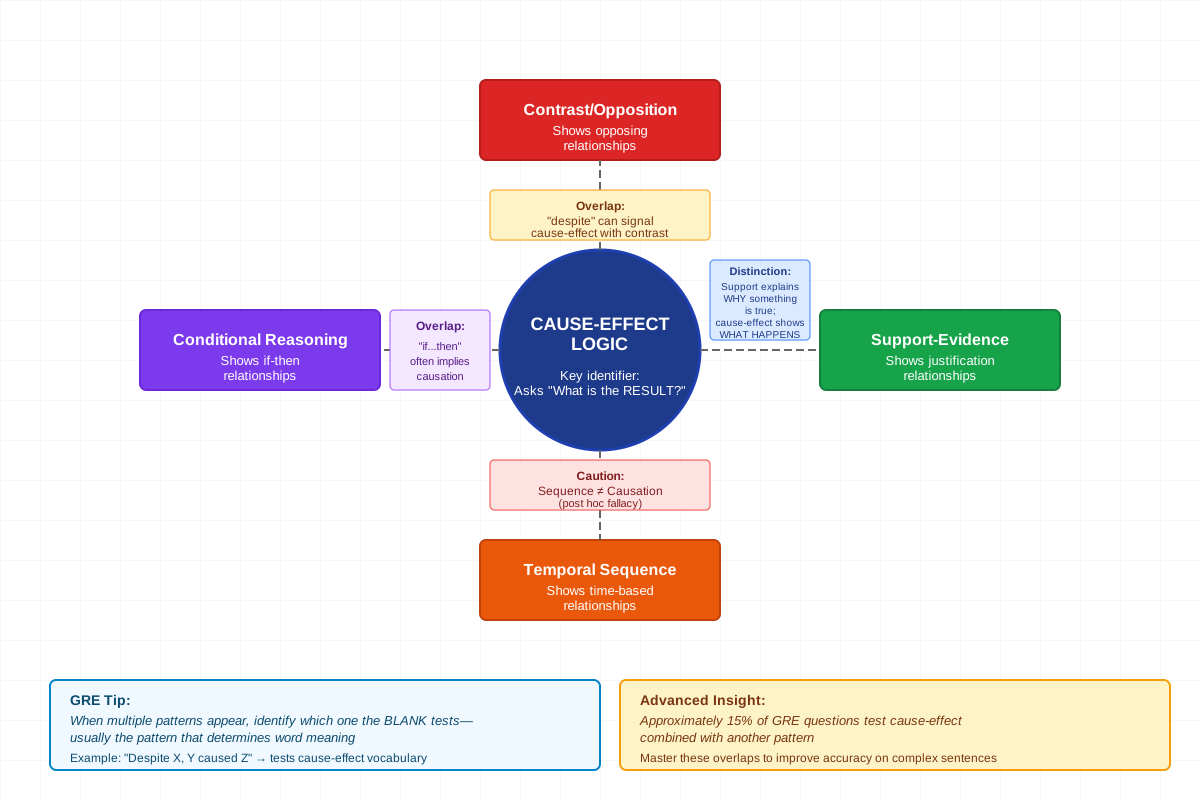
Mastering cause-effect logic connects directly to broader Verbal Reasoning skills including contextual analysis, logical inference, and semantic precision. This topic intersects with other critical GRE concepts such as contrast relationships, support-evidence patterns, and temporal sequences. Students who develop strong cause-effect reasoning skills will find themselves better equipped to tackle Reading Comprehension passages that present arguments, Text Completion questions that require logical prediction, and Sentence Equivalence questions where two words must create identical causal meanings.
Learning Objectives
- [ ] Identify when Cause-effect logic is being tested in GRE questions
- [ ] Explain the core rule or strategy behind Cause-effect logic
- [ ] Apply Cause-effect logic to GRE-style questions accurately
- [ ] Recognize and categorize cause-effect signal words and transitional phrases
- [ ] Distinguish between direct causation, correlation, and reverse cause-effect presentations
- [ ] Evaluate answer choices based on their logical consistency with established cause-effect relationships
- [ ] Predict missing words in sentences by analyzing the direction and strength of causal relationships
Prerequisites
- Basic sentence structure understanding: Recognizing subjects, verbs, and objects helps identify which element functions as cause versus effect
- Contextual vocabulary skills: Understanding word meanings in context enables accurate interpretation of causal relationships
- Logical reasoning fundamentals: Basic understanding of "if-then" relationships and logical connectors provides the foundation for more complex causal analysis
- Sentence completion strategies: Familiarity with predicting words based on context clues supports cause-effect reasoning
Why This Topic Matters
Cause-effect logic appears in approximately 30-40% of Sentence Equivalence questions and 25-35% of Text Completion questions on the GRE Verbal Reasoning section. This high frequency makes it one of the most testable logical patterns on the exam. Questions testing this concept often appear at medium to high difficulty levels, making them critical for students aiming for scores above the 160 threshold.
In real-world applications, cause-effect reasoning underlies scientific thinking, historical analysis, economic forecasting, and policy evaluation—all domains that graduate programs value. The GRE tests this skill because graduate-level work requires students to analyze research findings, understand experimental results, evaluate arguments, and construct logical explanations for phenomena.
On the exam, cause-effect logic commonly appears in several formats: sentences describing scientific processes (where one phenomenon triggers another), historical narratives (where events lead to consequences), behavioral explanations (where motivations produce actions), and economic or social analyses (where policies create outcomes). The test writers deliberately use sophisticated vocabulary and complex sentence structures to challenge students' ability to maintain logical coherence while processing unfamiliar words.
Core Concepts
Understanding Cause-Effect Relationships
A cause-effect relationship exists when one event, action, or condition (the cause) brings about, produces, or influences another event, action, or condition (the effect). In GRE questions, this relationship forms the logical backbone of the sentence, and the missing word(s) must maintain this causal connection. The cause represents the reason something happens, while the effect represents the result or consequence.
On the GRE, cause-effect relationships can be expressed in multiple ways:
- Direct causation: "Because of X, Y occurred"
- Indirect causation: "X contributed to Y"
- Necessary conditions: "Without X, Y would not happen"
- Sufficient conditions: "X alone is enough to produce Y"
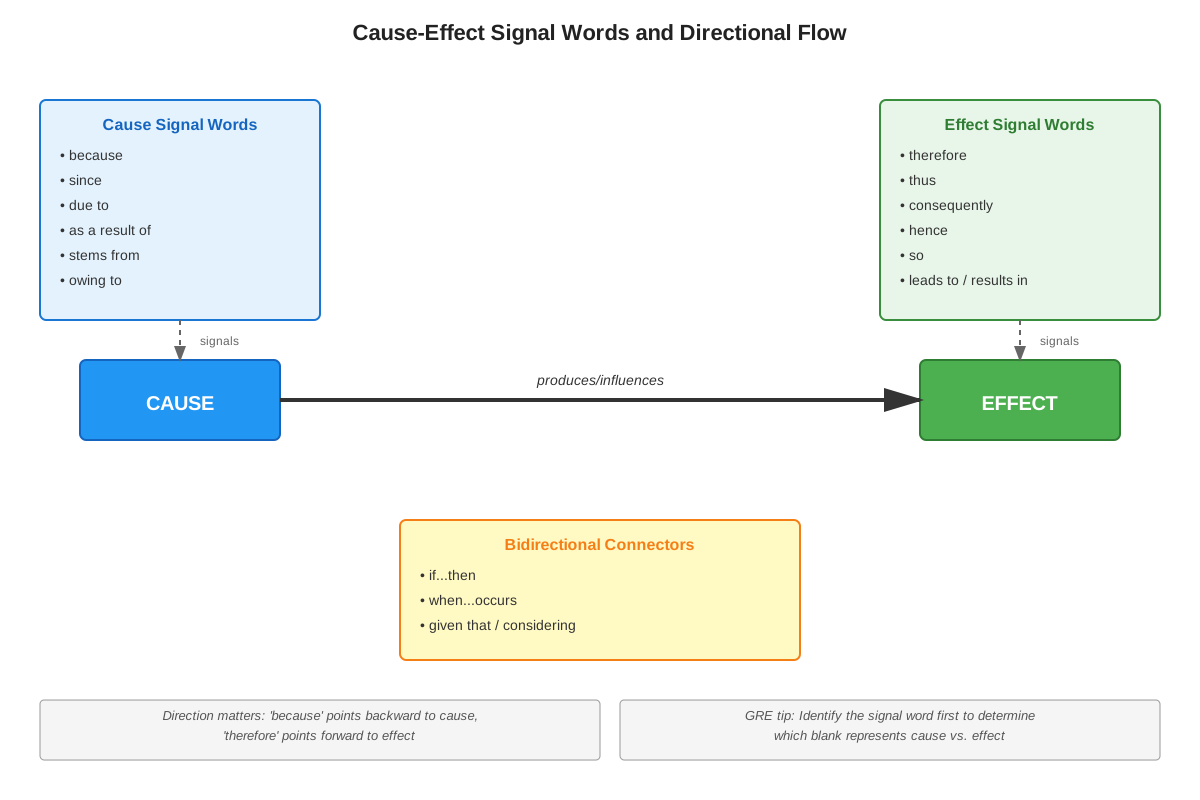
Signal Words and Transitional Phrases
Recognizing signal words is crucial for identifying when cause-effect logic is being tested. These linguistic markers explicitly indicate causal relationships:
| Cause Indicators | Effect Indicators | Bidirectional Markers |
|---|---|---|
| because, since, as | therefore, thus, hence | consequently, accordingly |
| due to, owing to | so, so that | as a result, as a consequence |
| on account of | for this reason | thereby, whereupon |
| given that, in light of | resulting in, leading to | this is why, that is why |
Understanding these markers helps students quickly identify the logical structure of a sentence and predict whether the blank requires a cause word or an effect word.
Direction of Causation
The direction of causation refers to which element comes first logically (not necessarily chronologically in the sentence). GRE questions frequently reverse the presentation order, stating the effect before the cause to increase difficulty. Consider these variations:
- Standard order: "The drought caused crop failure"
- Reversed order: "The crop failure resulted from the drought"
- Effect-first presentation: "The crop failure was caused by the drought"
Students must identify the logical direction regardless of presentation order. The key question is: "What made what happen?" The answer to "what made it happen" is the cause; "what happened" is the effect.
Strength of Causal Relationships
Causal relationships vary in strength and certainty, which affects word choice in GRE questions:
- Strong/Direct causation: Words like "caused," "produced," "generated," "created"
- Moderate causation: Words like "contributed to," "influenced," "affected," "facilitated"
- Weak/Possible causation: Words like "may have led to," "could have influenced," "potentially affected"
- Correlation without causation: Words like "associated with," "correlated with," "accompanied"
The GRE tests whether students can distinguish between these levels and select words that match the intended strength of the relationship.
Multiple Causes and Effects
Complex GRE sentences often present multiple causes leading to a single effect, or a single cause producing multiple effects. Students must track these relationships carefully:
- Multiple causes → Single effect: "Both the economic recession and the political instability contributed to the government's collapse"
- Single cause → Multiple effects: "The invention of the printing press revolutionized education and democratized knowledge"
- Causal chains: "Event A caused Event B, which in turn caused Event C"
Negative Causation
Negative causation occurs when the absence or prevention of something causes an effect, or when something causes the absence of an effect. GRE questions frequently test this more sophisticated understanding:
- "The lack of rainfall prevented crop growth"
- "The medication inhibited the disease's progression"
- "Without the intervention, the crisis would have worsened"
Students must recognize that words like "prevent," "inhibit," "preclude," "forestall," and "avert" indicate negative causal relationships.
Concept Relationships
The concepts within cause-effect logic build upon each other hierarchically. Understanding signal words enables students to identify when cause-effect logic is being tested → Recognizing the direction of causation allows proper interpretation of the relationship → Assessing the strength of causal relationships guides appropriate word selection → Identifying multiple causes/effects and negative causation enables handling of complex sentences.
Cause-effect logic connects to prerequisite knowledge of sentence structure because identifying subjects and verbs helps determine which elements function as causes versus effects. It relates to contextual vocabulary skills because the precise meaning of causal words determines whether they fit the logical relationship.
This topic also connects forward to more advanced Verbal Reasoning skills. In Reading Comprehension, cause-effect logic underlies argument analysis and inference questions. In Text Completion, it combines with other logical patterns (contrast, support, temporal sequence) to create multi-blank questions requiring integrated reasoning.
Relationship Map: Signal Word Recognition → Causal Direction Identification → Strength Assessment → Word Prediction → Answer Selection → Verification of Logical Consistency
High-Yield Facts
⭐ Cause-effect signal words appear in approximately 35% of Sentence Equivalence questions, making them the most frequent logical pattern tested.
⭐ The cause and effect can appear in any order in the sentence; the logical relationship remains constant regardless of presentation sequence.
⭐ Both answer choices in Sentence Equivalence must create the same cause-effect relationship, not just have similar meanings in isolation.
⭐ "Because" and "since" always introduce causes, while "therefore" and "thus" always introduce effects.
⭐ Negative causation words (prevent, inhibit, preclude) reverse the expected effect, requiring careful attention to logical direction.
- Words indicating correlation (associated with, correlated with) do not necessarily indicate causation on the GRE.
- Causal chains require tracking multiple relationships: A causes B, B causes C, therefore A indirectly causes C.
- The strength of causation must match throughout the sentence; mixing strong and weak causal language creates logical inconsistency.
- Temporal sequence (happening before) does not automatically indicate causation; the GRE tests this distinction.
- Passive voice constructions often reverse the presentation order of cause and effect: "The effect was produced by the cause."
Quick check — test yourself on Cause-effect logic so far.
Try Flashcards →Common Misconceptions
Misconception: Any word indicating a result or outcome will work in a cause-effect sentence. → Correction: The word must match the specific strength and direction of the causal relationship established by the sentence context. A strong direct cause requires words like "produced" or "generated," not weaker words like "influenced."
Misconception: In Sentence Equivalence, two synonyms will always create equivalent cause-effect relationships. → Correction: The words must create identical logical relationships within the specific sentence structure. "Caused" and "contributed to" are related but create different strengths of causation, making them non-equivalent in most contexts.
Misconception: The cause always appears before the effect in the sentence. → Correction: GRE sentences frequently present the effect first, then explain the cause. Signal words indicate the logical direction regardless of presentation order.
Misconception: If two events happen in sequence, the first causes the second. → Correction: Temporal sequence does not prove causation. The GRE tests the distinction between "happened before" and "caused." Additional context must establish the causal link.
Misconception: Negative causation words simply mean the opposite of positive causation words. → Correction: Negative causation involves preventing, inhibiting, or blocking an effect that would otherwise occur. This requires understanding both what would have happened and what actually happened.
Misconception: Multiple causes in a sentence all have equal weight. → Correction: Sentences often indicate that some causes are primary while others are contributing factors. Words like "primarily," "mainly," or "partly" signal these distinctions.
Worked Examples
Example 1: Standard Cause-Effect Sentence Equivalence
Question: The prolonged drought __________ the region's agricultural output, forcing farmers to seek alternative livelihoods.
Answer choices:
(A) enhanced
(B) decimated
(C) stabilized
(D) devastated
(E) diversified
(F) improved
Solution Process:
Step 1: Identify the logical structure. The sentence presents a cause (prolonged drought) and its effect (something happened to agricultural output). The second clause provides additional context: farmers had to seek alternative livelihoods, suggesting the effect was negative and severe.
Step 2: Recognize signal words. The sentence structure "X [verb] Y, forcing Z" indicates direct causation. The drought directly caused something to happen to agricultural output.
Step 3: Determine the direction and strength. The cause (drought) is negative. The effect must also be negative and strong enough to force farmers to abandon farming. This requires words indicating severe negative impact.
Step 4: Evaluate answer choices:
- (A) enhanced - positive effect, contradicts context
- (B) decimated - severe negative effect, matches context
- (C) stabilized - neutral effect, doesn't explain why farmers left
- (D) devastated - severe negative effect, matches context
- (E) diversified - neutral/positive, doesn't match context
- (F) improved - positive effect, contradicts context
Step 5: Verify equivalence. Both "decimated" and "devastated" indicate severe destruction or reduction, creating identical cause-effect relationships. They both logically explain why farmers would need to seek alternative livelihoods.
Answer: (B) and (D)
Connection to Learning Objectives: This example demonstrates identifying when cause-effect logic is tested (objective 1), applying the core strategy of matching effect strength to cause (objective 2), and accurately selecting answers that maintain logical consistency (objective 3).
Example 2: Reversed Presentation with Negative Causation
Question: The committee's intervention __________ the crisis that many analysts had predicted would destabilize the entire financial system.
Answer choices:
(A) precipitated
(B) averted
(C) anticipated
(D) forestalled
(E) triggered
(F) exacerbated
Solution Process:
Step 1: Identify the logical structure. This sentence presents the effect first (something happened to the crisis) then provides context about what would have occurred without the intervention. The phrase "had predicted would destabilize" indicates the crisis was expected but something changed that outcome.
Step 2: Recognize the negative causation. The intervention (cause) prevented something bad (the crisis) from happening. This requires a word indicating prevention or blocking.
Step 3: Analyze the context clues. "Would destabilize the entire financial system" tells us the crisis was serious and expected. The intervention changed this expected outcome, suggesting it prevented or stopped the crisis.
Step 4: Evaluate answer choices:
- (A) precipitated - caused to happen suddenly, opposite of prevention
- (B) averted - prevented from happening, matches negative causation
- (C) anticipated - predicted, doesn't indicate prevention
- (D) forestalled - prevented or delayed, matches negative causation
- (E) triggered - caused to begin, opposite of prevention
- (F) exacerbated - made worse, implies crisis happened
Step 5: Verify equivalence. Both "averted" and "forestalled" indicate preventing something from occurring, creating identical negative cause-effect relationships. Both logically explain why the predicted destabilization didn't happen.
Answer: (B) and (D)
Connection to Learning Objectives: This example demonstrates recognizing reversed presentation order (objective 4), distinguishing negative causation (objective 5), and evaluating logical consistency (objective 6).
Exam Strategy
Approaching Cause-Effect Questions
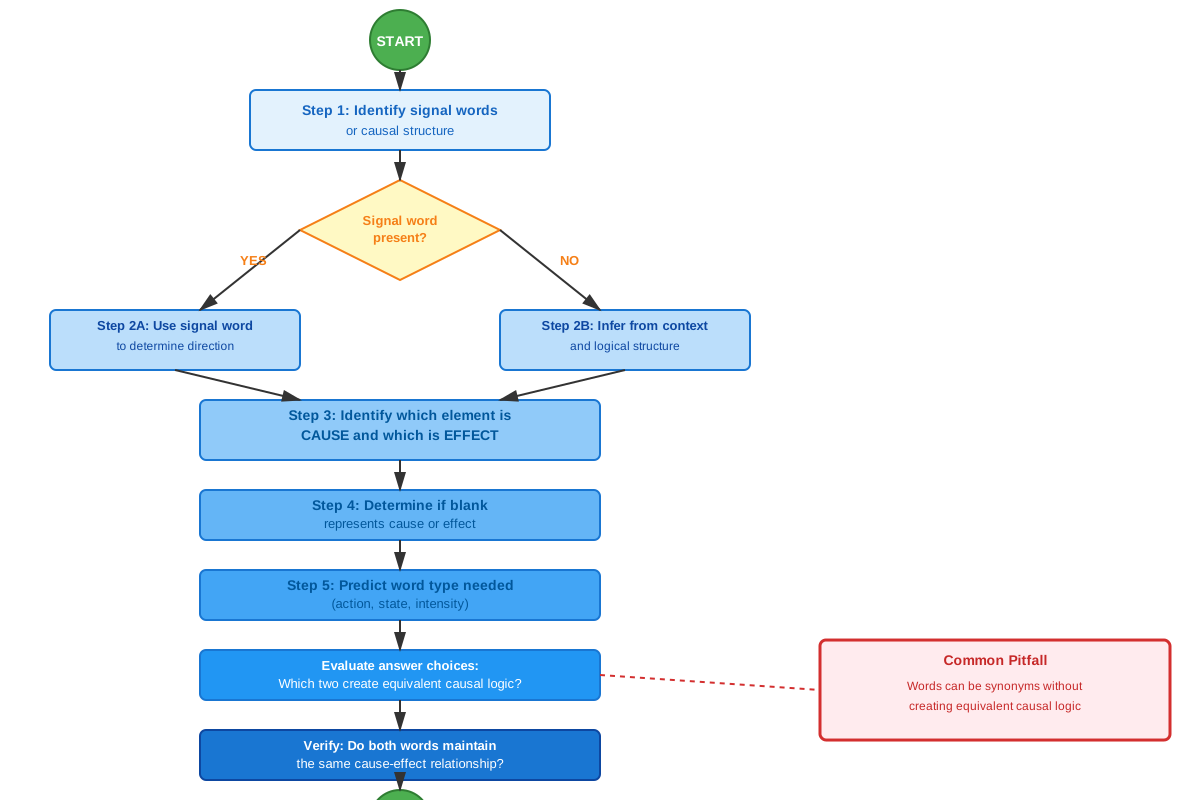
When encountering a potential cause-effect question, follow this systematic approach:
- Scan for signal words (because, therefore, since, thus, resulting in) to confirm cause-effect logic is being tested
- Identify which element is the cause and which is the effect, regardless of presentation order
- Determine whether the causation is positive or negative (does something happen or get prevented?)
- Assess the strength of the relationship (direct causation, contribution, correlation)
- Predict the type of word needed before looking at answer choices
- Eliminate choices that create wrong logical relationships (opposite direction, wrong strength, wrong valence)
Trigger Words and Phrases
High-Yield Exam Tip: When you see "because," "since," or "given that," the clause they introduce is ALWAYS the cause, never the effect. When you see "therefore," "thus," or "hence," what follows is ALWAYS the effect.
Watch for these additional triggers that indicate cause-effect testing:
- "Led to," "resulted in," "brought about" → effect follows
- "Due to," "owing to," "on account of" → cause follows
- "Consequently," "accordingly," "as a result" → effect follows
- "Stems from," "arises from," "derives from" → cause follows
Process of Elimination Tips
Eliminate immediately:
- Words that reverse the logical direction (if context shows X caused Y, eliminate words suggesting Y caused X)
- Words with wrong valence (positive words when negative effect is needed, or vice versa)
- Words indicating correlation when causation is clearly stated
- Words that are too weak or too strong for the established relationship
Keep for consideration:
- Words that match the direction, valence, and strength of the relationship
- Words that create parallel logical structures in Sentence Equivalence
- Words that maintain consistency with all context clues, not just the immediate clause
Time Allocation
For cause-effect Sentence Equivalence questions, allocate approximately 60-75 seconds:
- 15-20 seconds: Read and identify the logical structure
- 20-25 seconds: Predict the needed word type and evaluate choices
- 15-20 seconds: Verify both selected answers create equivalent relationships
- 5-10 seconds: Final check for logical consistency
Don't rush the verification step—many students select one correct answer and one incorrect answer because they fail to confirm both create identical cause-effect relationships.
Memory Techniques
The CAUSE Acronym
Check for signal words
Analyze the direction (which causes which?)
Understand the strength (direct, contributing, or correlation?)
Select words matching the relationship
Ensure both answers create equivalent logic
Visualization Strategy
Picture cause-effect relationships as arrows: Cause → Effect. When reading a sentence, mentally draw the arrow from cause to effect, regardless of which appears first in the sentence. For negative causation, picture a blocked arrow: Cause →X Effect (the X represents prevention).
Signal Word Categories Mnemonic
"BEST" for causes: Because, Explaining, Since, Thanks to
"THERE" for effects: Therefore, Hence, Ergo, Resulting, Effect
Strength Spectrum Memory Aid
Remember causal strength as a spectrum from weak to strong:
"Might Maybe Contribute Cause Create"
- Might have influenced (weakest)
- May have affected
- Contributed to (moderate)
- Caused (strong)
- Created/Generated (strongest)
Summary
Cause-effect logic represents one of the most frequently tested reasoning patterns on the GRE Verbal Reasoning section, appearing in approximately one-third of Sentence Equivalence and Text Completion questions. Mastering this topic requires understanding that causal relationships involve one element (the cause) producing, influencing, or preventing another element (the effect). Success depends on recognizing signal words that indicate causation, determining the direction of the relationship regardless of presentation order, assessing the strength of causation, and selecting words that maintain logical consistency. The GRE tests sophisticated variations including reversed presentation, negative causation, multiple causes or effects, and causal chains. Students must distinguish between correlation and causation, match word choice to relationship strength, and ensure that both Sentence Equivalence answers create identical logical relationships. By systematically identifying the logical structure, predicting needed word types, and eliminating choices that create inconsistent relationships, students can consistently answer cause-effect questions correctly and efficiently.
Key Takeaways
- Cause-effect logic appears in 30-40% of Sentence Equivalence questions, making it the highest-yield logical pattern to master
- Signal words reliably indicate whether a clause contains the cause or the effect, regardless of sentence order
- The logical direction (which causes which) remains constant even when presentation order is reversed
- Strength matters: words indicating direct causation, contribution, and correlation are not interchangeable
- Negative causation (prevention, inhibition) requires recognizing both what would have happened and what actually happened
- Both Sentence Equivalence answers must create identical cause-effect relationships, not just have similar meanings
- Systematic analysis (identify structure → determine direction → assess strength → predict word → verify logic) produces consistent accuracy
Related Topics
Contrast and Concession Logic: Understanding how sentences present opposing ideas or unexpected outcomes builds on cause-effect reasoning by introducing complications to expected causal relationships. Mastering cause-effect logic provides the foundation for recognizing when outcomes contradict expectations.
Support and Evidence Patterns: These patterns involve one element providing justification or proof for another, which shares structural similarities with causation but tests different logical relationships. Students who understand cause-effect logic can more easily distinguish between "X proves Y" and "X causes Y."
Temporal Sequence and Chronology: While related to cause-effect logic, temporal patterns test whether students can distinguish "happened before" from "caused." Mastering causation enables this critical distinction.
Argument Structure in Reading Comprehension: Cause-effect reasoning underlies many argument-based passages where authors claim certain factors produce specific outcomes. The analytical skills developed through cause-effect logic transfer directly to evaluating arguments.
Practice CTA
Now that you've mastered the core concepts of cause-effect logic, it's time to reinforce your understanding through active practice. Attempt the practice questions designed specifically for this topic, focusing on applying the systematic approach outlined in the Exam Strategy section. Use the flashcards to drill signal words and strengthen your instant recognition of causal patterns. Remember: understanding the concepts is the first step, but consistent practice transforms that understanding into the automatic pattern recognition that produces high scores on test day. Each practice question you complete strengthens your ability to identify, analyze, and apply cause-effect logic under timed conditions. You've built the foundation—now build the speed and confidence that will serve you on exam day!
Sign up free to keep reading
Create a free AnvayaPrep account to finish this GRE guide on Cause-effect logic — plus flashcards and practice questions.