Overview
Connotation in sentence equivalence represents one of the most nuanced and frequently tested aspects of GRE Verbal Reasoning. While many test-takers focus primarily on dictionary definitions (denotations) when selecting answer pairs, the GRE consistently rewards those who can distinguish between words with similar meanings but different emotional tones, cultural associations, or implied judgments. A sentence equivalence question requires selecting two answer choices that complete a sentence with equivalent meanings, and understanding connotation is essential because words that appear synonymous at first glance often carry subtle differences in tone that make them incompatible as correct answer pairs.
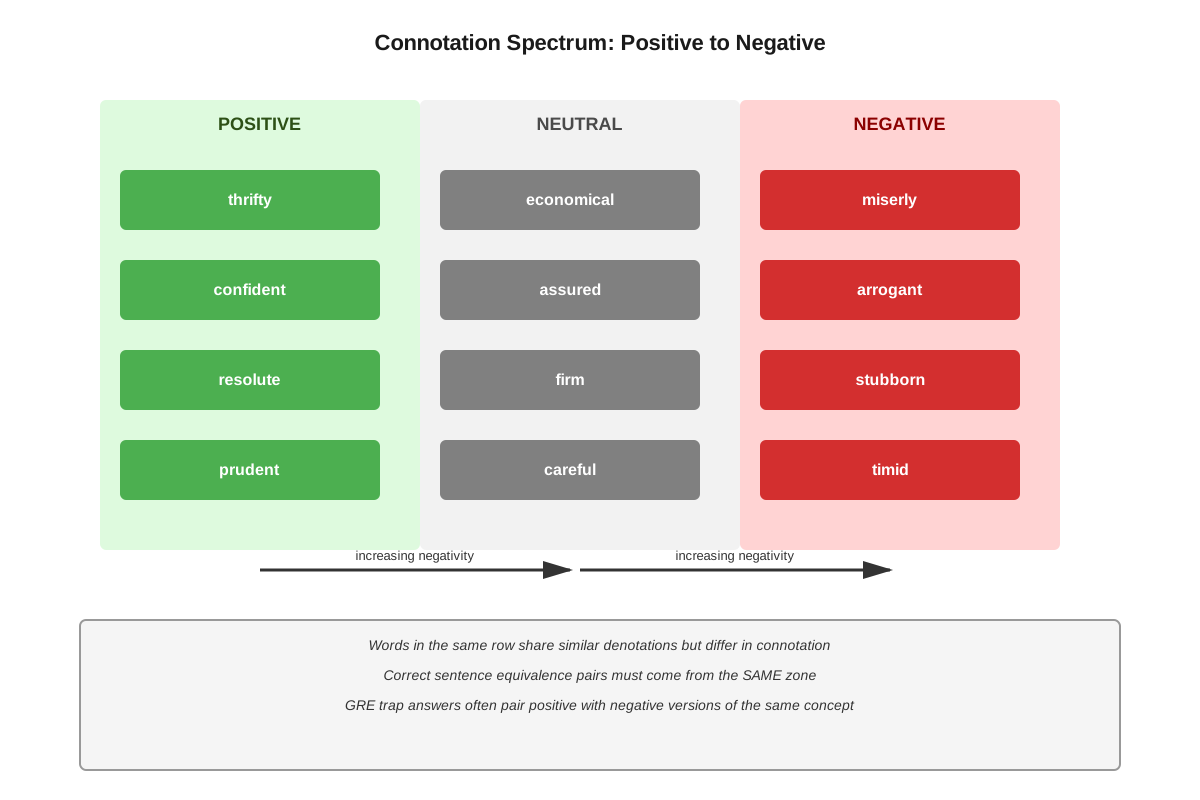
The challenge of GRE connotation in sentence equivalence lies in recognizing that the test designers deliberately include trap answers—words that share the same basic meaning but differ in their positive, negative, or neutral associations. For example, "thrifty" and "miserly" both relate to careful spending, but "thrifty" carries positive connotations of wise financial management while "miserly" suggests excessive stinginess. Selecting both would create sentences with fundamentally different tones, violating the equivalence requirement. This subtle distinction separates high scorers from average performers.
Understanding connotation connects directly to broader Verbal Reasoning skills including vocabulary depth, contextual analysis, and tone recognition. Mastering this topic enhances performance not only on sentence equivalence questions but also on text completion and reading comprehension passages where recognizing an author's attitude or evaluative stance proves critical. The ability to detect connotative differences represents sophisticated language awareness that the GRE values highly, as it reflects the analytical reading skills essential for graduate-level academic work.
Learning Objectives
- [ ] Identify when connotation in sentence equivalence is being tested
- [ ] Explain the core rule or strategy behind connotation in sentence equivalence
- [ ] Apply connotation in sentence equivalence to GRE-style questions accurately
- [ ] Distinguish between positive, negative, and neutral connotations in answer choice pairs
- [ ] Recognize common connotation traps that test designers use to create plausible distractors
- [ ] Evaluate whether two synonyms maintain equivalent tone when substituted into a sentence
- [ ] Analyze sentence context clues that signal the required connotation for correct answers
Prerequisites
- Basic vocabulary knowledge: Understanding word definitions (denotations) provides the foundation for recognizing connotative differences between near-synonyms
- Sentence structure comprehension: Identifying how words function grammatically within sentences helps determine which answer choices fit logically
- Context clue recognition: The ability to extract meaning from surrounding words enables students to determine the appropriate tone required by the sentence
- Synonym and antonym relationships: Familiarity with word relationships helps identify which pairs are truly equivalent versus merely similar
Why This Topic Matters
Connotation questions appear in approximately 40-50% of sentence equivalence problems on the GRE Verbal Reasoning section, making this one of the highest-yield topics for score improvement. Test designers specifically craft answer choices to include pairs of words with similar denotations but divergent connotations, creating sophisticated traps for students who rely solely on basic vocabulary knowledge. The ability to distinguish connotative nuances directly correlates with performance in the 160+ score range, where precision in language understanding becomes the primary differentiator.
Beyond the exam context, connotation awareness represents a fundamental component of advanced literacy and critical thinking. Graduate programs require students to analyze scholarly arguments, detect authorial bias, and craft precisely worded communications—all skills that depend on recognizing how word choice shapes meaning and perception. Professionals in law, business, medicine, and academia must regularly interpret subtle language differences where connotation carries significant implications for interpretation and decision-making.
On the GRE, connotation testing appears most frequently in sentence equivalence questions featuring evaluative or descriptive contexts. Common scenarios include descriptions of people's character traits, assessments of actions or policies, characterizations of artistic or intellectual work, and evaluations of historical events or social phenomena. The test consistently presents answer choices where three or four options share similar core meanings but only two maintain equivalent connotative tone, requiring test-takers to exercise sophisticated discrimination.
Core Concepts
Understanding Denotation versus Connotation
Denotation refers to the literal, dictionary definition of a word—its explicit, objective meaning without emotional coloring or cultural associations. Connotation, by contrast, encompasses the emotional, cultural, and associative meanings that words carry beyond their basic definitions. For GRE sentence equivalence questions, recognizing this distinction proves essential because correct answer pairs must match in both denotation and connotation.
Consider the word group: "slender," "thin," "skinny," and "emaciated." All four words denote a body type with relatively little fat or bulk. However, their connotations differ dramatically:
- Slender: positive connotation suggesting attractiveness and grace
- Thin: neutral connotation, purely descriptive
- Skinny: mildly negative connotation suggesting excessive thinness
- Emaciated: strongly negative connotation indicating unhealthy, extreme thinness
In a sentence equivalence question, only words with matching connotations can serve as correct answer pairs, regardless of their shared denotation.
The Three Categories of Connotation
Connotations generally fall into three categories that test-takers must quickly identify:
| Connotation Type | Characteristics | Example Words |
|---|---|---|
| Positive | Favorable associations, approval, admiration | Confident, determined, assertive, steadfast |
| Negative | Unfavorable associations, disapproval, criticism | Arrogant, stubborn, aggressive, obstinate |
| Neutral | Objective, factual, without emotional coloring | Self-assured, persistent, forceful, unwavering |
The GRE frequently tests whether students can distinguish between these categories by presenting answer choices that span all three types while sharing similar denotations. For instance, words describing someone who doesn't give up easily might include "persistent" (neutral/positive), "tenacious" (positive), "stubborn" (negative), and "dogged" (neutral/slightly negative). Only pairs with matching connotative categories create equivalent sentences.
Contextual Signals for Required Connotation
Sentence equivalence questions always provide contextual clues indicating whether the blank requires a positive, negative, or neutral word. Recognizing these connotation signals enables efficient elimination of incompatible answer choices:
Positive context signals:
- Words like "fortunately," "admirably," "commendably," "praised"
- Descriptions of success, achievement, or beneficial outcomes
- Favorable comparisons or approving tone
Negative context signals:
- Words like "unfortunately," "regrettably," "criticized," "condemned"
- Descriptions of failure, harm, or detrimental outcomes
- Unfavorable comparisons or disapproving tone
Neutral context signals:
- Objective, factual descriptions without evaluative language
- Academic or scientific contexts emphasizing precision over judgment
- Balanced presentations showing multiple perspectives
Intensity and Degree in Connotation
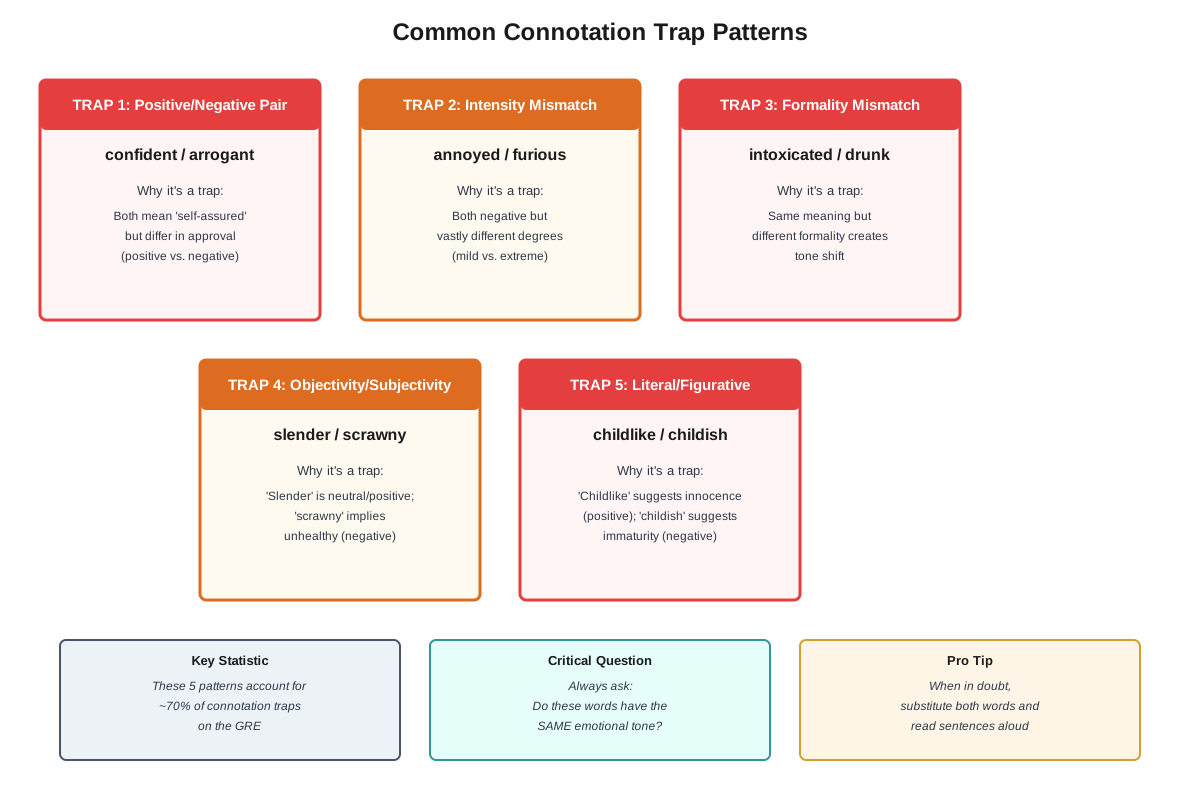
Beyond positive/negative/neutral distinctions, connotation involves intensity—the strength of the emotional association. Words may share the same connotative direction but differ in degree, creating incompatible pairs. For example:
- Mild positive: pleased, satisfied, content
- Moderate positive: happy, delighted, glad
- Strong positive: ecstatic, jubilant, euphoric
A sentence describing someone's reaction to good news might accommodate "delighted" and "pleased" if the context suggests moderate positive emotion, but "ecstatic" would be too intense unless the context indicates extreme reaction. The GRE tests whether students can match not only connotative direction but also appropriate intensity level.
Common Connotation Patterns on the GRE
Certain word categories appear repeatedly in connotation-based sentence equivalence questions:
- Character trait descriptors: Words describing personality features where the same behavior can be framed positively or negatively (confident vs. arrogant, frugal vs. cheap)
- Intellectual descriptors: Terms characterizing thinking or communication (articulate vs. verbose, thoughtful vs. plodding)
- Action descriptors: Verbs describing how someone does something (assert vs. claim, suggest vs. insinuate)
- Aesthetic judgments: Words evaluating artistic or creative work (simple vs. simplistic, ornate vs. gaudy)
- Behavioral descriptors: Terms characterizing conduct or demeanor (careful vs. timid, bold vs. reckless)
Understanding these patterns helps test-takers anticipate connotation traps and quickly categorize answer choices during the exam.
Concept Relationships
The concepts within connotation analysis form an interconnected system where each element informs the others. Denotation versus connotation serves as the foundational distinction, establishing that words require analysis beyond dictionary definitions. This foundation leads directly to categorizing connotations (positive/negative/neutral), which enables systematic evaluation of answer choices.
Contextual signal recognition connects back to both denotation and categorization: the sentence context determines which connotative category fits logically, while the denotative meaning must still satisfy the sentence's literal requirements. Intensity matching represents a refinement of connotation categorization, adding a second dimension to the analysis—not just direction but degree.
These concepts collectively support the pattern recognition skill, where familiarity with common GRE connotation scenarios accelerates question analysis. The relationship flows: Denotation/Connotation Distinction → Connotation Categorization → Context Analysis → Intensity Matching → Pattern Recognition → Efficient Answer Selection.
This topic connects to prerequisite knowledge of vocabulary and context clues by adding a layer of sophistication. Where basic vocabulary knowledge provides denotations and context clues indicate general meaning, connotation analysis requires synthesizing both to determine precise tone. The skill also relates to reading comprehension, where recognizing an author's connotative word choices reveals attitude and purpose—critical for inference questions.
High-Yield Facts
⭐ Correct sentence equivalence answer pairs must match in both denotation (basic meaning) and connotation (emotional tone)
⭐ The GRE deliberately includes trap answers with correct denotations but mismatched connotations
⭐ Approximately 40-50% of sentence equivalence questions test connotation awareness as the primary discriminator
⭐ Context clues in the sentence always signal whether positive, negative, or neutral connotation is required
⭐ Words describing character traits represent the most common category for connotation testing
- Connotation intensity (mild, moderate, strong) must also match between correct answer pairs
- Neutral words can sometimes pair with mildly positive or mildly negative words if context is ambiguous, but strongly charged words require matching intensity
- The same word can carry different connotations in different contexts (e.g., "aggressive" is negative for social behavior but potentially positive for business strategy)
- Recognizing connotation requires cultural and contextual awareness beyond simple vocabulary memorization
- Test designers often include three words with similar denotations but different connotations to create sophisticated distractors
Quick check — test yourself on Connotation in sentence equivalence so far.
Try Flashcards →Common Misconceptions
Misconception: If two words are listed as synonyms in a thesaurus, they can serve as correct answer pairs in sentence equivalence questions.
Correction: Thesaurus synonyms often share denotations but differ significantly in connotation. The GRE specifically tests the ability to distinguish between near-synonyms based on their emotional tone and associations. Words must be equivalent in both meaning and connotation to create interchangeable sentences.
Misconception: Neutral words can pair with either positive or negative words as long as the basic meaning matches.
Correction: Neutral words typically pair only with other neutral words or with very mildly charged words. A strongly positive or negative word creates a distinct tone that a neutral word cannot replicate, violating the equivalence requirement.
Misconception: Connotation is subjective and varies by individual, so there's no definitive right answer.
Correction: While connotation can vary somewhat by cultural context, the GRE uses words with widely recognized, conventional connotations in American English. The test relies on standard connotative associations that educated English speakers consistently recognize.
Misconception: If the sentence context is neutral or factual, connotation doesn't matter for answer selection.
Correction: Even in neutral contexts, answer choices with charged connotations introduce inappropriate tone. A neutral context requires neutral words; selecting a negatively or positively connotated word would impose an evaluative stance not supported by the sentence.
Misconception: Focusing on connotation is only necessary when vocabulary is difficult or unfamiliar.
Correction: The GRE often tests connotation using relatively common words precisely because test-takers may overlook subtle distinctions in familiar vocabulary. Some of the most challenging connotation questions use everyday words with nuanced differences.
Misconception: The more sophisticated or advanced vocabulary word is more likely to be correct.
Correction: Answer correctness depends entirely on meaning and tone match, not vocabulary difficulty. The GRE includes both simple and complex words in correct and incorrect answers, testing precision rather than vocabulary breadth alone.
Worked Examples
Example 1: Character Trait Description
Question: The committee members praised the director's __________ approach to budget management, noting how carefully she allocated resources without being excessive.
(A) economical
(B) miserly
(C) thrifty
(D) stingy
(E) prudent
(F) parsimonious
Step 1: Analyze the context for connotation signals
The sentence contains clear positive signals: "praised" and "carefully...without being excessive." The context indicates approval of the director's behavior, requiring positively or neutrally connotated words. The phrase "without being excessive" suggests the behavior is balanced and appropriate, not extreme.
Step 2: Evaluate each answer choice's denotation and connotation
- (A) economical: Denotation = using resources efficiently; Connotation = positive/neutral, suggests wise resource use
- (B) miserly: Denotation = unwilling to spend money; Connotation = strongly negative, suggests excessive stinginess and selfishness
- (C) thrifty: Denotation = careful with money; Connotation = positive, suggests wise frugality
- (D) stingy: Denotation = unwilling to give or spend; Connotation = negative, suggests inappropriate unwillingness to share
- (E) prudent: Denotation = showing careful judgment; Connotation = positive, suggests wisdom and foresight
- (F) parsimonious: Denotation = very unwilling to spend; Connotation = negative/neutral, suggests excessive frugality
Step 3: Eliminate choices with mismatched connotations
The positive context eliminates (B) miserly, (D) stingy, and (F) parsimonious, all of which carry negative connotations suggesting excessive or inappropriate behavior. This leaves (A), (C), and (E) as possibilities.
Step 4: Find the equivalent pair
Among the remaining choices, we need two words that create equivalent sentences:
- "Economical approach" emphasizes efficiency and cost-effectiveness
- "Thrifty approach" emphasizes careful, wise spending
- "Prudent approach" emphasizes careful judgment and wisdom
Both (A) economical and (C) thrifty specifically relate to financial management with positive connotations and similar intensity. While (E) prudent is also positive, it's more general (applying to any careful judgment, not specifically financial) and slightly more formal in tone.
Answer: (A) and (C)
These words share both denotation (careful with resources) and connotation (positive, approving, moderate intensity), creating truly equivalent sentences.
Example 2: Intellectual Description
Question: Critics argued that the author's prose style, while technically correct, was so __________ that readers struggled to maintain interest through lengthy passages.
(A) verbose
(B) elaborate
(C) prolix
(D) detailed
(E) comprehensive
(F) thorough
Step 1: Analyze context for connotation signals
The context contains negative signals: "Critics argued" and "readers struggled to maintain interest." The phrase "while technically correct" suggests the problem isn't accuracy but rather an excess of something that makes reading difficult. This requires negatively connotated words suggesting excessive wordiness or length.
Step 2: Evaluate each answer choice
- (A) verbose: Denotation = using more words than necessary; Connotation = negative, suggests tedious wordiness
- (B) elaborate: Denotation = detailed and complicated; Connotation = neutral/positive, suggests thoroughness and care
- (C) prolix: Denotation = using too many words; Connotation = negative, suggests tedious, excessive length
- (D) detailed: Denotation = including many details; Connotation = neutral/positive, suggests thoroughness
- (E) comprehensive: Denotation = including everything; Connotation = positive, suggests admirable completeness
- (F) thorough: Denotation = complete and careful; Connotation = positive, suggests admirable attention to detail
Step 3: Eliminate mismatched connotations
The negative context (critics complaining, readers struggling) eliminates (B), (D), (E), and (F), which all carry neutral-to-positive connotations suggesting admirable qualities. Only (A) verbose and (C) prolix carry the negative connotation of excessive, tedious wordiness that matches the critical tone.
Step 4: Verify equivalence
Both "verbose" and "prolix" denote using more words than necessary and connote criticism of tedious, excessive writing. They create equivalent sentences with matching tone and meaning.
Answer: (A) and (C)
This example demonstrates how connotation testing often involves distinguishing between words that describe similar qualities but frame them as positive (thorough, detailed) versus negative (verbose, prolix).
Exam Strategy
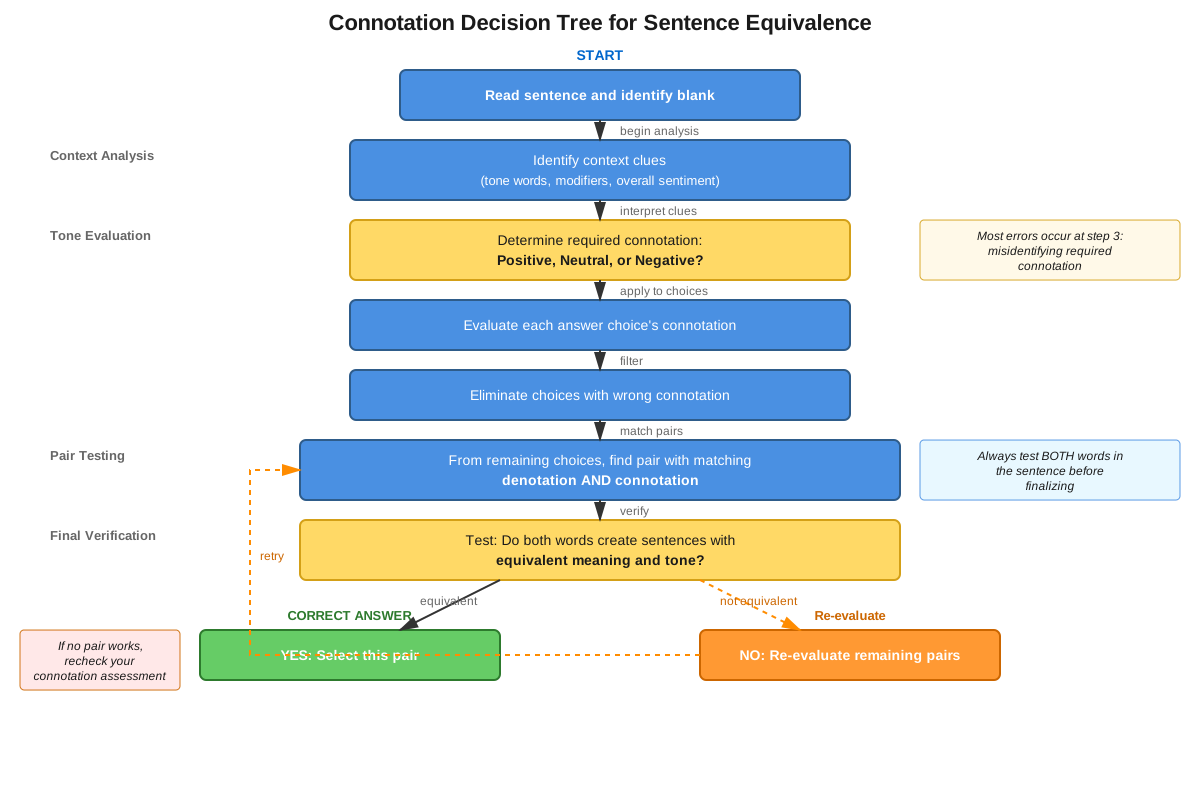
When approaching sentence equivalence questions where connotation is being tested, implement this systematic process:
1. Read the sentence completely before looking at answer choices to understand the overall context and tone. Identify any evaluative language, emotional signals, or judgmental phrases that indicate whether positive, negative, or neutral words are required.
2. Look for explicit connotation triggers: words like "praised," "criticized," "unfortunately," "admirably," "regrettably," or "commendably" that directly signal the required tone. Also note implicit signals like descriptions of positive or negative outcomes.
3. Quickly categorize all six answer choices as positive (+), negative (-), or neutral (0) before attempting to find the correct pair. This visual organization helps identify which choices are even candidates for pairing.
4. Eliminate all choices whose connotation contradicts the sentence context. This typically eliminates 3-4 options immediately, dramatically simplifying the question.
5. Among remaining choices, verify both denotation match and connotation intensity match. Two words might both be positive but differ in intensity (pleased vs. ecstatic), making them incompatible.
6. Test your selected pair by mentally substituting each word into the sentence and confirming that both versions convey equivalent meaning and tone. If the sentences feel different in any way, reconsider your selection.
Exam Tip: When stuck between two possible pairs, pay special attention to intensity. The GRE frequently includes one pair that matches in direction (both positive or both negative) but differs in intensity, creating subtly non-equivalent sentences.
Time allocation: Spend 15-20 seconds on initial reading and context analysis, 20-30 seconds on categorizing and eliminating choices, and 10-15 seconds on final verification. Connotation questions should not require more than 60 seconds once you've mastered the systematic approach.
Red flag phrases that signal connotation testing:
- "While technically..." (suggests a negative quality despite surface correctness)
- "Praised for being..." (requires positive connotation)
- "Criticized as..." (requires negative connotation)
- "Neither...nor..." (often requires neutral or balanced terms)
- Descriptions of personality traits, especially with evaluative context
Memory Techniques
The TONE Acronym for systematic connotation analysis:
- Type: Identify whether context requires positive, negative, or neutral
- Observe: Look for explicit signals (praised, criticized, etc.)
- Narrow: Eliminate all choices with mismatched connotation type
- Equivalence: Verify remaining pair matches in both meaning and intensity
Visualization Strategy: Create a mental "connotation spectrum" for common word groups:
NEGATIVE ←---------------→ NEUTRAL ←---------------→ POSITIVE
stubborn     persistent     determined     resolute     steadfast
cheap        economical     thrifty        prudent      wise
When encountering a question, mentally place answer choices on this spectrum and select the pair that occupies the same position.
The "Synonym Trap" Reminder: Create a mental warning label: "Thesaurus ≠ GRE Equivalence." Whenever you recognize two words as synonyms, immediately check whether they share connotation, not just denotation.
Character Trait Mnemonic for common positive/negative pairs:
CONFIDENT (positive) vs. ARROGANT (negative)
CAREFUL (positive) vs. TIMID (negative)
DETERMINED (positive) vs. STUBBORN (negative)
FRUGAL (positive) vs. CHEAP (negative)
Remember: "The same behavior, different judgment" – many GRE connotation questions test whether you recognize that identical behaviors can be described with opposite evaluative tones.
Summary
Connotation in sentence equivalence represents a sophisticated language skill that distinguishes high-scoring GRE test-takers from average performers. Success requires moving beyond basic vocabulary knowledge to recognize that words sharing similar denotations often carry dramatically different emotional tones, cultural associations, and implied judgments. The GRE consistently tests this awareness by presenting answer choices where only one pair maintains equivalent connotation—positive, negative, or neutral—while other options share the basic meaning but differ in tone. Mastering this topic requires systematic analysis: identifying contextual signals that indicate required connotation, categorizing answer choices by their emotional associations, eliminating mismatched options, and verifying that the selected pair matches in both meaning and intensity. The most common testing scenarios involve character trait descriptions, intellectual assessments, and behavioral evaluations where the same quality can be framed positively or negatively. Students who develop sensitivity to these nuances and apply a structured approach to connotation analysis gain a significant advantage on sentence equivalence questions, which constitute a substantial portion of the Verbal Reasoning score.
Key Takeaways
- Correct sentence equivalence pairs must match in both denotation (literal meaning) and connotation (emotional tone)—sharing basic meaning is necessary but insufficient
- Context clues always signal whether positive, negative, or neutral connotation is required—look for evaluative language, outcome descriptions, and explicit judgment words
- The GRE deliberately creates traps using near-synonyms with mismatched connotations—approximately 40-50% of sentence equivalence questions test this skill as the primary discriminator
- Systematic categorization of answer choices by connotation type enables efficient elimination—quickly labeling options as positive, negative, or neutral simplifies complex questions
- Intensity matching matters as much as directional matching—two positive words of different intensity (pleased vs. ecstatic) create non-equivalent sentences
- Character trait descriptors represent the highest-yield category for connotation testing—the same behavior described with different evaluative frames (confident vs. arrogant) appears frequently
- Connotation awareness extends beyond sentence equivalence to enhance reading comprehension and text completion performance—recognizing authorial tone and attitude depends on connotative sensitivity
Related Topics
Tone and Attitude in Reading Comprehension: Understanding connotation directly supports identifying an author's perspective, bias, or evaluative stance in passages. Mastering connotation in sentence equivalence builds the sensitivity to word choice nuances essential for tone-based inference questions.
Context Clues in Text Completion: Single-blank and multi-blank text completion questions often require selecting words with appropriate connotations based on surrounding context. The analytical skills developed through sentence equivalence connotation work transfer directly to these question types.
Vocabulary in Context: Advanced vocabulary study moves beyond memorizing definitions to understanding the connotative ranges and appropriate usage contexts for sophisticated words. Connotation mastery enables more nuanced vocabulary application across all Verbal Reasoning question types.
Rhetorical Analysis: Graduate-level reading requires analyzing how authors use connotatively charged language to persuade, criticize, or advocate. The connotation awareness developed for the GRE provides foundational skills for academic discourse analysis.
Practice CTA
Now that you understand the principles of connotation in sentence equivalence, it's time to apply these strategies to actual GRE-style questions. The practice questions and flashcards will reinforce your ability to quickly identify connotation signals, categorize answer choices, and select truly equivalent pairs. Remember that connotation awareness is a skill that improves with deliberate practice—each question you analyze strengthens your sensitivity to the subtle distinctions that separate correct answers from sophisticated traps. Approach the practice materials systematically, using the TONE framework and elimination strategies you've learned. Your investment in mastering this high-yield topic will pay dividends across multiple question types and significantly boost your Verbal Reasoning score. You've built the foundation—now cement it through focused practice!
Sign up free to keep reading
Create a free AnvayaPrep account to finish this GRE guide on Connotation in sentence equivalence — plus flashcards and practice questions.