Overview
Sentence equivalence pacing is a critical time-management and strategic skill that determines success on the GRE Verbal Reasoning section. Unlike traditional vocabulary or reading comprehension questions, sentence equivalence questions require test-takers to select two answer choices that both complete a sentence with equivalent meanings while maintaining logical coherence. The pacing component refers to the optimal allocation of time per question, the strategic decision-making process about when to invest more time versus when to make an educated guess, and the systematic approach that prevents both rushing through questions carelessly and spending excessive time on any single item.
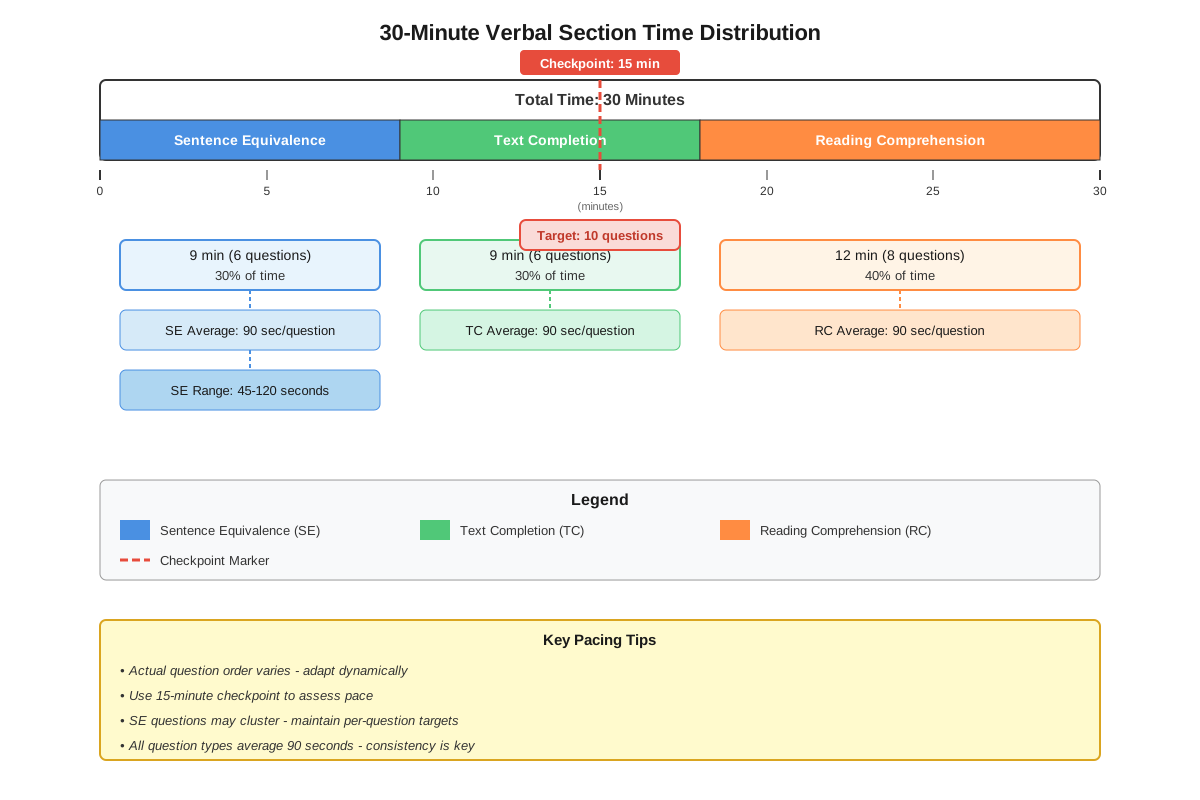
Mastering GRE sentence equivalence pacing directly impacts overall Verbal Reasoning scores because these questions constitute approximately one-third of the verbal section. Each GRE Verbal section contains roughly 6 sentence equivalence questions out of 20 total questions, and test-takers have only 30 minutes per section. This translates to an average of 90 seconds per question, but effective pacing strategies recognize that not all questions deserve equal time investment. Understanding when to spend 45 seconds on a straightforward question versus when to allocate 2 minutes to a complex item with challenging vocabulary can mean the difference between completing the section with confidence and leaving questions unanswered.
The relationship between sentence equivalence pacing and other Verbal Reasoning concepts is foundational. Efficient pacing enables better performance on text completion and reading comprehension questions by preserving cognitive resources and time. Additionally, pacing strategies integrate vocabulary knowledge, contextual analysis skills, and answer elimination techniques into a cohesive approach. Students who master pacing develop a metacognitive awareness that allows them to recognize question difficulty patterns, adjust their speed dynamically, and maintain composure under timed conditions—skills that transfer across all GRE question types.
Learning Objectives
- [ ] Identify when sentence equivalence pacing is being tested
- [ ] Explain the core rule or strategy behind sentence equivalence pacing
- [ ] Apply sentence equivalence pacing to GRE-style questions accurately
- [ ] Determine optimal time allocation for sentence equivalence questions based on difficulty indicators
- [ ] Execute a systematic triage process to categorize questions as quick-solve, standard, or time-intensive
- [ ] Implement recovery strategies when falling behind the target pace during the exam
- [ ] Evaluate personal pacing patterns through timed practice to identify improvement areas
Prerequisites
- Basic GRE test structure knowledge: Understanding the overall format, timing, and scoring of the Verbal Reasoning section provides the framework for pacing decisions
- Sentence equivalence question format familiarity: Recognizing that these questions require selecting two answers that create equivalent meanings is essential before optimizing speed
- Fundamental vocabulary skills: A baseline vocabulary enables quicker comprehension of answer choices, reducing time spent decoding unfamiliar words
- Contextual clue identification: The ability to identify logical relationships and transition words within sentences supports faster answer selection
- Basic time management principles: General awareness of time tracking and self-monitoring forms the foundation for exam-specific pacing strategies
Why This Topic Matters
Sentence equivalence pacing represents one of the most controllable variables affecting GRE Verbal scores. While vocabulary knowledge and reading comprehension skills develop over months of study, pacing strategies can be learned and implemented within weeks, yielding immediate score improvements. Test-takers who master pacing report reduced anxiety, increased confidence, and higher completion rates—all factors that directly correlate with score gains of 2-4 points on the 130-170 Verbal scale.
From an exam statistics perspective, sentence equivalence questions appear with high frequency and predictability. Each 30-minute Verbal section contains approximately 6 sentence equivalence items, representing 30% of the section's questions. These questions are distributed throughout the section rather than grouped together, meaning pacing decisions must be made continuously. Research on GRE performance indicates that students who leave questions blank or rush through the final questions score significantly lower than those who maintain consistent pacing, even when both groups have similar vocabulary knowledge.
Common manifestations of pacing challenges include spending 3-4 minutes on difficult vocabulary-heavy questions early in the section, leaving insufficient time for later questions; failing to recognize when a question requires educated guessing rather than extended analysis; and experiencing decision paralysis when multiple answer pairs seem plausible. The GRE's computer-adaptive format means that question difficulty adjusts based on performance, making efficient pacing even more critical—spending too long on medium-difficulty questions may prevent the test-taker from demonstrating their ability on harder questions that could elevate their score to the next performance band.
Core Concepts
The 90-Second Baseline Rule
The fundamental principle of sentence equivalence pacing begins with understanding the mathematical reality of the GRE Verbal section. With 30 minutes allocated for approximately 20 questions, test-takers have an average of 90 seconds per question. However, this average conceals important strategic nuances. Reading comprehension passages with multiple questions require bulk time investment upfront, meaning sentence equivalence and text completion questions must often be completed in less than 90 seconds to create time reserves.
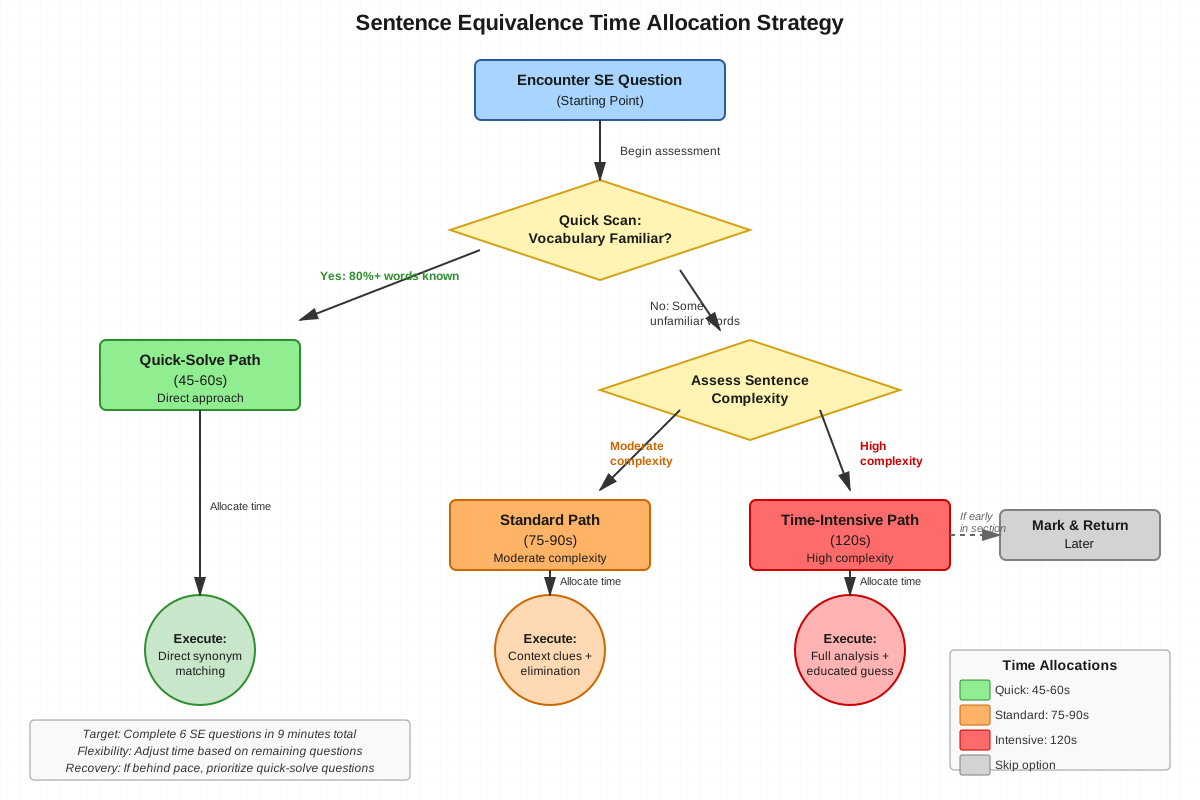
The 90-second baseline serves as a reference point rather than a rigid rule. Effective pacing strategies categorize sentence equivalence questions into three tiers:
| Question Tier | Time Allocation | Characteristics | Strategy |
|---|---|---|---|
| Quick-Solve | 30-60 seconds | Familiar vocabulary, clear context clues, obvious answer pair | Solve immediately, move forward |
| Standard | 60-90 seconds | Moderate vocabulary, requires careful reading, 2-3 plausible pairs | Apply systematic elimination |
| Time-Intensive | 90-120 seconds | Difficult vocabulary, subtle meaning distinctions, multiple viable pairs | Invest extra time or strategic guess |
The Triage Decision Framework
Effective GRE sentence equivalence pacing requires making rapid triage decisions within the first 15-20 seconds of encountering a question. This initial assessment determines the time budget and approach strategy. The triage process follows a systematic evaluation:
- Vocabulary scan: Quickly assess whether all six answer choices contain familiar words. If 4+ words are unfamiliar, this signals a time-intensive question.
- Sentence complexity analysis: Evaluate the sentence structure. Simple sentences with clear logical indicators (contrast, cause-effect, example) suggest quick-solve potential. Complex sentences with multiple clauses or abstract concepts indicate standard or time-intensive questions.
- Answer choice clustering: Observe whether answer choices fall into obvious synonym groups. When 2-3 clear pairs emerge immediately, the question is likely quick-solve. When all six words seem potentially correct or no clear pairs exist, expect a time-intensive question.
- Gut confidence check: Assess initial confidence level. High confidence with an immediate answer pair in mind suggests quick-solve. Uncertainty or confusion signals the need for more time or strategic guessing.
The Progressive Elimination Method
Rather than attempting to identify the correct answer pair immediately, efficient pacing employs a progressive elimination approach that conserves cognitive energy and time. This method proceeds through three stages:
Stage 1: Rapid Elimination (10-15 seconds) - Remove obviously incorrect answers that contradict the sentence's meaning or logic. This typically eliminates 2-3 choices, reducing the problem space.
Stage 2: Pair Testing (20-40 seconds) - Test remaining words in potential pairs by substituting them into the sentence. Focus on whether each word maintains logical consistency and whether the two words create equivalent meanings.
Stage 3: Meaning Verification (10-20 seconds) - Verify that the selected pair produces two sentences with truly equivalent meanings, not merely similar ones. This final check prevents the common error of selecting synonyms that don't both fit the context.
The Time-Check Protocol
Maintaining awareness of elapsed time without becoming obsessed with the clock requires a structured time-check protocol. Effective test-takers implement checkpoints at strategic intervals:
- After Question 5: Should have approximately 22-23 minutes remaining (7-8 minutes elapsed)
- After Question 10: Should have approximately 15 minutes remaining (15 minutes elapsed)
- After Question 15: Should have approximately 7-8 minutes remaining (22-23 minutes elapsed)
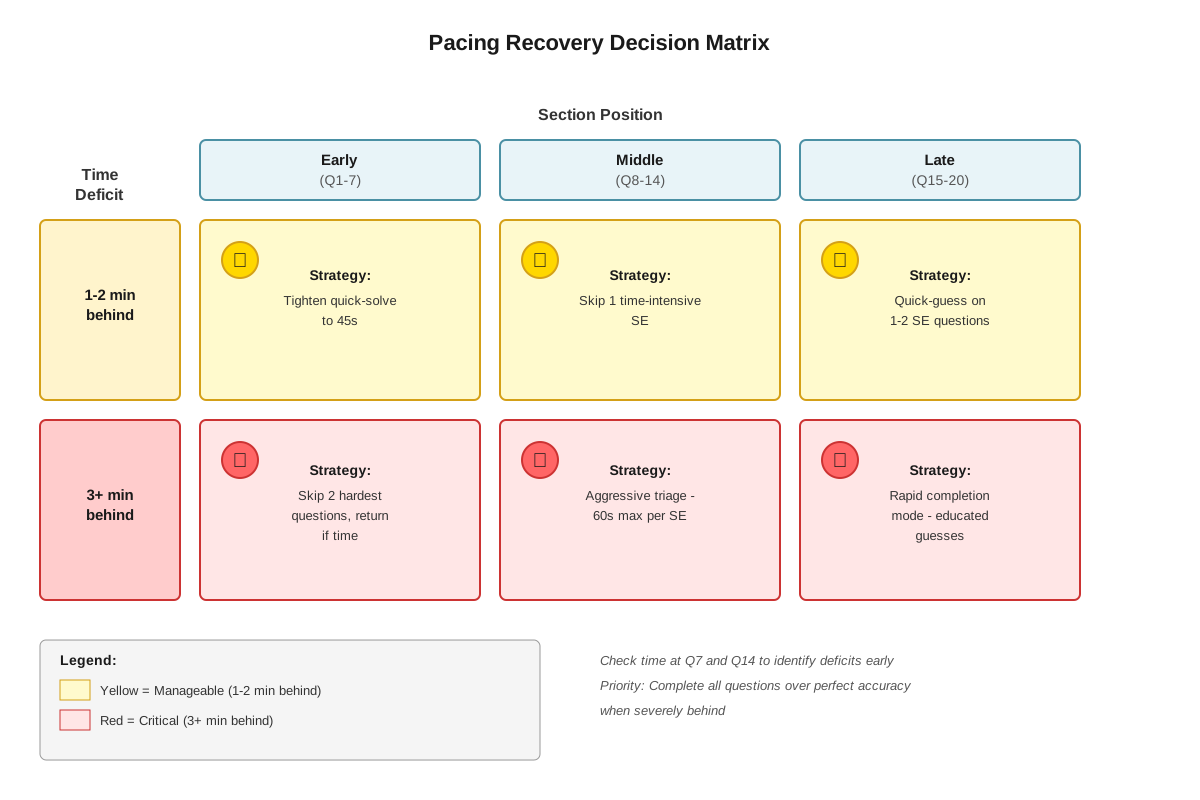
These checkpoints serve as calibration moments. Being 1-2 minutes behind schedule is manageable and requires minor pace acceleration. Being 3+ minutes behind necessitates strategic adjustments, such as reducing time on remaining sentence equivalence questions or making educated guesses on the most difficult items.
The Strategic Guessing Decision
A critical component of sentence equivalence pacing involves recognizing when strategic guessing yields better expected value than continued analysis. This decision point typically occurs when:
- 90+ seconds have elapsed without identifying a confident answer pair
- Vocabulary gaps prevent meaningful discrimination between answer choices
- Time reserves are depleted and remaining questions require attention
- Cognitive fatigue reduces analytical effectiveness
Strategic guessing differs from random guessing. Even with incomplete information, test-takers can eliminate 1-2 obviously wrong answers and select from remaining choices based on partial knowledge, word roots, or contextual fit. This approach maintains forward momentum while preserving time for questions where knowledge and skills can be fully applied.
The Recovery Protocol
When pacing falls significantly behind schedule, implementing a recovery protocol prevents cascading time pressure. The protocol includes:
- Immediate acknowledgment: Recognize the time deficit without emotional reaction
- Question skip strategy: Identify the current question's difficulty tier; if time-intensive, mark for review and move forward
- Accelerated processing: Reduce time on next 2-3 questions to standard tier (60-75 seconds) regardless of difficulty
- Selective depth: Accept slightly lower confidence thresholds for answer selection to regain time
- Return strategy: If time permits after completing all questions, return to skipped items with fresh perspective
Concept Relationships
The concepts within sentence equivalence pacing form an interconnected system where each element supports and reinforces others. The 90-second baseline rule establishes the quantitative foundation that informs the triage decision framework. Without understanding the time budget, triage decisions lack meaningful criteria. The triage framework then determines which questions receive the progressive elimination method versus which require strategic guessing decisions.
The time-check protocol serves as the monitoring system that detects when the recovery protocol must be activated. These two concepts function as paired mechanisms—monitoring and intervention—that maintain pacing equilibrium throughout the exam. All five core concepts ultimately serve the overarching goal of maximizing correct answers within the time constraint.
Connections to prerequisite topics are equally important. Vocabulary skills directly impact triage decisions—stronger vocabulary enables faster categorization of questions as quick-solve versus time-intensive. Contextual clue identification accelerates the progressive elimination method by providing logical anchors for answer evaluation. The relationship flows bidirectionally: improved pacing creates more time for careful contextual analysis, which in turn improves accuracy and confidence, further enhancing pacing efficiency.
The relationship map can be visualized as:
Time Constraint (30 min/20 questions) → 90-Second Baseline → Triage Framework → Question Categorization → Method Selection (Progressive Elimination OR Strategic Guessing) → Time-Check Protocol → Recovery Protocol (if needed) → Optimized Performance
High-Yield Facts
⭐ The average time per sentence equivalence question should be 60-90 seconds, not the section average of 90 seconds, because reading comprehension passages require bulk time allocation
⭐ The first 15-20 seconds of encountering a sentence equivalence question should be devoted to triage assessment, not answer selection
⭐ Spending more than 120 seconds on any single sentence equivalence question produces diminishing returns and jeopardizes overall section completion
⭐ Strategic guessing after 90 seconds of analysis typically yields better expected value than continuing to analyze when no clear answer emerges
⭐ Time-check protocols should occur after questions 5, 10, and 15 to enable mid-section pacing adjustments
- Questions with 4+ unfamiliar vocabulary words should be categorized as time-intensive or skip candidates during triage
- The progressive elimination method should remove 2-3 obviously incorrect answers within the first 15 seconds
- Recovery protocols should be activated when time deficit exceeds 3 minutes at any checkpoint
- Sentence equivalence questions appearing early in the section should not receive disproportionate time investment despite being encountered first
- Maintaining forward momentum by completing all questions, even with educated guesses, produces higher scores than leaving questions blank
- The computer-adaptive format means that efficient pacing on early questions enables access to higher-difficulty questions that can elevate score bands
- Cognitive fatigue increases after question 15, making earlier time investment in difficult questions more efficient than later investment
- Answer pairs that are synonyms but don't both fit the sentence context represent the most common time-wasting trap
Quick check — test yourself on Sentence equivalence pacing so far.
Try Flashcards →Common Misconceptions
Misconception: All sentence equivalence questions deserve equal time investment because they carry equal point value → Correction: While questions have equal scoring weight, they have vastly different time-to-accuracy ratios. Quick-solve questions may achieve 95% accuracy in 45 seconds, while time-intensive questions might reach only 60% accuracy even after 2 minutes. Efficient pacing prioritizes high-accuracy questions and manages time-intensive ones strategically.
Misconception: Spending extra time on difficult questions demonstrates thoroughness and increases accuracy → Correction: Research on GRE performance shows that accuracy plateaus or even declines after 90-120 seconds on sentence equivalence questions. Extended analysis often leads to overthinking, second-guessing correct initial instincts, and time depletion that forces rushing on subsequent questions.
Misconception: The 90-second average means every question should take approximately that long → Correction: The 90-second figure is a section-wide average that includes reading comprehension passages. Effective pacing creates a bimodal distribution with quick-solve questions taking 30-60 seconds and time-intensive questions taking 90-120 seconds, while maintaining the overall average.
Misconception: Checking the clock frequently improves time management → Correction: Excessive clock-checking (more than 3-4 times per section) increases anxiety and disrupts cognitive flow. The time-check protocol at questions 5, 10, and 15 provides sufficient monitoring without creating counterproductive stress.
Misconception: Skipping difficult questions and returning later wastes time → Correction: The skip-and-return strategy is highly effective when time reserves exist. A fresh perspective after completing other questions often yields immediate clarity on previously confusing items. The key is implementing this strategy early enough to preserve return time.
Misconception: Strategic guessing is only for students with weak vocabulary → Correction: Even test-takers with strong vocabulary encounter questions where strategic guessing is optimal. The GRE includes experimental questions and items designed to challenge even high-performing students. Recognizing when to guess is a sophisticated skill that maximizes expected score.
Misconception: Pacing strategies are only necessary for students who work slowly → Correction: Pacing strategies benefit all test-takers by optimizing time allocation across questions of varying difficulty. Fast workers who lack pacing strategies often rush through questions they could answer correctly with slightly more time, while slow workers without strategies fail to complete sections.
Worked Examples
Example 1: Triage and Quick-Solve Execution
Question: The scientist's presentation was remarkably _______, conveying complex research findings in language accessible to the general public.
(A) abstruse
(B) lucid
(C) pedantic
(D) perspicuous
(E) esoteric
(F) convoluted
Triage Assessment (0-15 seconds):
- Vocabulary scan: All words are moderately familiar except possibly "perspicuous"
- Sentence complexity: Simple structure with clear contrast ("complex findings" vs. "accessible language")
- Answer choice clustering: "Lucid" and "perspicuous" are likely synonyms; "abstruse," "esoteric," and "convoluted" form an opposite cluster
- Gut confidence: High—the sentence clearly indicates clarity/accessibility
- Triage decision: Quick-solve question, allocate 45-60 seconds
Progressive Elimination (15-35 seconds):
- Stage 1 Rapid Elimination: The sentence indicates the presentation made complex ideas accessible, so eliminate words meaning "difficult to understand": (A) abstruse, (E) esoteric, (F) convoluted are OUT
- Stage 2 Pair Testing: Remaining choices are (B) lucid, (C) pedantic, (D) perspicuous
- "Pedantic" means overly concerned with minor details—doesn't fit "accessible to general public"
- "Lucid" means clear and easy to understand—FITS
- "Perspicuous" means clearly expressed—FITS
- Stage 3 Meaning Verification: Both "lucid" and "perspicuous" create equivalent meanings: "The presentation was clear/understandable"
Answer: (B) and (D)
Total time: 50 seconds
Learning objective connection: This example demonstrates identifying a quick-solve question through triage and applying efficient elimination to complete the question well under the 90-second baseline.
Example 2: Time-Intensive Question with Strategic Decision
Question: Despite the committee's efforts to maintain _______ in their deliberations, partisan disagreements repeatedly surfaced during the proceedings.
(A) impartiality
(B) decorum
(C) objectivity
(D) brevity
(E) unanimity
(F) civility
Triage Assessment (0-20 seconds):
- Vocabulary scan: All words are familiar
- Sentence complexity: Moderate—requires understanding the contrast between "efforts to maintain" and "partisan disagreements"
- Answer choice clustering: Multiple plausible pairs exist: (A)/(C), (B)/(F), possibly (D)/(E)
- Gut confidence: Medium—several answers seem potentially correct
- Triage decision: Standard to time-intensive question, allocate 75-100 seconds
Progressive Elimination (20-70 seconds):
- Stage 1 Rapid Elimination: "Brevity" (shortness) doesn't logically contrast with "partisan disagreements"—eliminate (D)
- Stage 2 Pair Testing: Test remaining pairs
- (A) impartiality + (C) objectivity: Both mean "lack of bias"—this contrasts well with "partisan disagreements" ✓
- (B) decorum + (F) civility: Both mean "politeness/proper behavior"—but "partisan disagreements" doesn't necessarily mean impoliteness; disagreements can be civil yet partisan
- (E) unanimity: Means "complete agreement"—contrasts with disagreements, but no clear pair remains
- Stage 3 Meaning Verification: Testing (A) and (C): "Despite efforts to maintain impartiality/objectivity, partisan disagreements surfaced"—both create equivalent, logical meanings
Time check at 85 seconds: Confident in (A) and (C), proceed with answer
Answer: (A) and (C)
Total time: 85 seconds
Learning objective connection: This example shows proper time allocation for a standard-difficulty question, systematic elimination of less-fitting pairs, and verification before selection. The question required more time than a quick-solve but stayed within optimal range.
Exam Strategy
Approaching sentence equivalence questions with optimal pacing requires a pre-exam strategy and in-exam execution plan. Before test day, establish personal benchmarks through timed practice. Complete sets of 10 sentence equivalence questions in 12-15 minutes to build the muscle memory for appropriate pacing. Track which question types consistently consume excess time—vocabulary-heavy questions, abstract concept questions, or subtle distinction questions—and develop targeted strategies for each.
Trigger words and phrases that signal time-intensive questions include:
- Abstract nouns (e.g., "verisimilitude," "parsimony," "equanimity") that require precise understanding
- Sentences with multiple subordinate clauses that obscure the main logical relationship
- Answer choices where 4+ words are advanced vocabulary (GRE 320+ level)
- Sentences describing nuanced emotional states or complex interpersonal dynamics
- Questions where the blank appears early in the sentence, requiring understanding of the entire sentence before solving
Process-of-elimination tips specific to sentence equivalence pacing:
- The 2-3-1 elimination pattern: Aim to eliminate 2 obviously wrong answers in 10 seconds, narrow to 3 plausible answers in the next 20 seconds, then identify the correct pair from those 3 in the final 30 seconds
- Synonym clustering: Quickly group answer choices into synonym pairs; the correct answer will be one of these pairs, immediately reducing the problem space
- Extreme word elimination: Words with extreme or absolute meanings (e.g., "unprecedented," "ubiquitous," "immutable") are often incorrect unless the sentence contains equally strong language
- Tone matching: Eliminate words whose connotation (positive/negative/neutral) doesn't match the sentence's overall tone
Time allocation advice for different scenarios:
- When ahead of pace: Invest extra time in time-intensive questions that appear later in the section when cognitive fatigue typically increases
- When behind pace: Implement the recovery protocol immediately; reduce next 2-3 questions to 60-second maximum regardless of difficulty
- When uncertain: If 60 seconds have elapsed without clear direction, make your best educated guess and move forward; return only if time permits after completing all questions
- Final 5 minutes: If questions remain, allocate 60-75 seconds maximum per question; prioritize completion over perfection
Exam Tip: The GRE's computer interface doesn't show a running timer for individual questions, only section time remaining. Develop the habit of noting the section time when starting each question to maintain awareness without constant clock-checking.
Memory Techniques
Mnemonic for the Triage Framework - "VSAC":
- Vocabulary scan
- Sentence complexity
- Answer clustering
- Confidence check
Visualize a "VSAC" badge that you flash at each question like a security checkpoint—only questions that pass inspection get full time investment.
Mnemonic for Time Checkpoints - "5-10-15 at 23-15-8":
Check time after questions 5, 10, and 15 and should see approximately 23, 15, and 8 minutes remaining. The pattern creates a memorable rhythm: "Five at twenty-three, ten at fifteen, fifteen at eight."
Visualization for the 90-Second Baseline:
Picture a 90-second hourglass next to each question. Quick-solve questions flip the hourglass only halfway. Time-intensive questions get one full flip plus a small additional pour. This visual reinforces that 90 seconds is a flexible guideline, not a rigid rule.
Acronym for Recovery Protocol - "RASSR":
- Recognize the deficit
- Acknowledge without emotion
- Skip current difficult question
- Speed up next 2-3 questions
- Return if time permits
Think of "RASSR" as a "razor" that cuts through time pressure, trimming excess time from subsequent questions.
Memory Palace Technique:
Associate each core concept with a room in a familiar building:
- Entrance hall: 90-second baseline (check your watch as you enter)
- First room: Triage framework (sorting area where items are categorized)
- Second room: Progressive elimination (items being removed from shelves)
- Third room: Time-check protocol (wall of clocks showing checkpoints)
- Fourth room: Recovery protocol (emergency supplies and first aid)
Walking through this mental space before the exam reinforces the sequential flow of pacing strategies.
Summary
Sentence equivalence pacing represents the strategic time management system that optimizes performance on approximately 30% of GRE Verbal Reasoning questions. The foundation rests on the 90-second baseline rule, which serves as a flexible reference point rather than a rigid constraint. Effective pacing requires rapid triage assessment within 15-20 seconds of encountering each question, categorizing items as quick-solve (30-60 seconds), standard (60-90 seconds), or time-intensive (90-120 seconds) based on vocabulary familiarity, sentence complexity, answer choice clustering, and initial confidence. The progressive elimination method provides a systematic three-stage approach that conserves cognitive energy while maintaining accuracy. Time-check protocols at questions 5, 10, and 15 enable mid-section adjustments before time deficits become unrecoverable. When pacing falls behind, recovery protocols involving strategic question skipping and accelerated processing prevent cascading time pressure. Strategic guessing after 90 seconds of analysis often yields better expected value than continued analysis, particularly when vocabulary gaps or subtle distinctions prevent confident discrimination. Mastering these interconnected strategies transforms sentence equivalence questions from time-consuming challenges into efficiently managed opportunities for score gains.
Key Takeaways
- The 90-second baseline is a flexible reference point; effective pacing creates a bimodal distribution with quick-solve questions (30-60 seconds) and time-intensive questions (90-120 seconds)
- Triage assessment in the first 15-20 seconds determines time allocation and approach strategy, preventing both under-investment in manageable questions and over-investment in time-intensive ones
- Time-check protocols at questions 5, 10, and 15 (targeting 23, 15, and 8 minutes remaining) enable proactive pacing adjustments before deficits become critical
- Strategic guessing after 90 seconds of analysis maximizes expected value by preserving time for questions where knowledge and skills can be fully applied
- The progressive elimination method (rapid elimination → pair testing → meaning verification) provides a systematic approach that balances speed and accuracy
- Recovery protocols must be activated immediately when time deficits exceed 3 minutes, involving question skipping and accelerated processing on subsequent items
- Forward momentum through section completion, even with educated guesses, produces higher scores than leaving questions blank or spending excessive time on individual items
Related Topics
Text Completion Pacing: Similar time management principles apply to text completion questions, but the strategies adapt to handle 1-3 blanks and different answer selection mechanics. Mastering sentence equivalence pacing provides transferable skills for optimizing text completion performance.
Reading Comprehension Time Allocation: Understanding how to budget time for passage reading versus question answering complements sentence equivalence pacing by creating a comprehensive verbal section time management system.
Vocabulary Building Strategies: Enhanced vocabulary knowledge directly improves sentence equivalence pacing by reducing triage time and enabling faster answer discrimination, creating a virtuous cycle of efficiency and accuracy.
Adaptive Test Strategy: The GRE's computer-adaptive format means that efficient pacing on early questions enables access to higher-difficulty items that can elevate score bands, making pacing skills essential for maximizing adaptive scoring benefits.
Test Anxiety Management: Pacing strategies reduce anxiety by providing concrete action steps and decision frameworks, transforming vague time pressure into manageable protocols. This psychological benefit enhances overall test performance.
Practice CTA
Now that you've mastered the strategies behind sentence equivalence pacing, it's time to put these concepts into action. Attempt the practice questions with deliberate focus on implementing the triage framework, progressive elimination method, and time-check protocols. Use a timer to track your pace on each question, noting which types consistently consume more or less time than your target. Review the flashcards to reinforce the VSAC triage framework and time checkpoint targets until they become automatic. Remember: pacing is a skill that improves rapidly with deliberate practice. Each timed practice set builds the muscle memory and confidence that will serve you on test day. Your investment in mastering these strategies will yield immediate, measurable improvements in both completion rates and accuracy. Start practicing now—your target score awaits!
Sign up free to keep reading
Create a free AnvayaPrep account to finish this GRE guide on Sentence equivalence pacing — plus flashcards and practice questions.