Overview
Root-based vocabulary inference is a critical skill for GRE Verbal Reasoning success, enabling test-takers to decode unfamiliar words by analyzing their component parts—prefixes, roots, and suffixes. Rather than memorizing thousands of vocabulary words in isolation, this strategic approach empowers students to make educated guesses about word meanings even when encountering terms they've never seen before. The GRE frequently tests vocabulary that appears obscure or archaic, making root-based inference not just helpful but essential for achieving competitive scores.
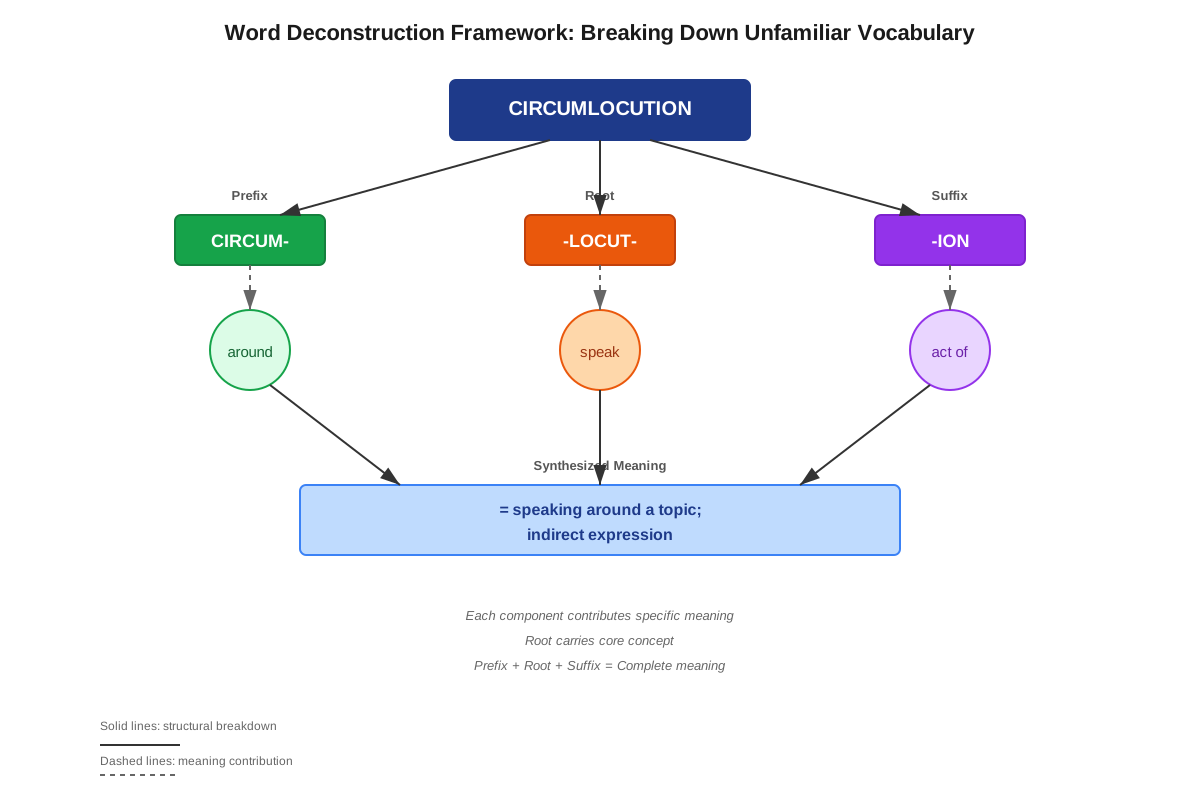
This technique bridges the gap between passive vocabulary recognition and active meaning construction. When facing a challenging Sentence Equivalence or Text Completion question, students who can break down words like "circumlocution" (circum = around, locut = speak) or "intransigent" (in = not, trans = across/change) gain immediate contextual advantages. The GRE deliberately includes vocabulary that rewards analytical thinking over rote memorization, and gre root-based vocabulary inference serves as the primary tool for this analytical approach.
Within the broader Verbal Reasoning framework, root-based vocabulary inference connects directly to reading comprehension, contextual analysis, and logical reasoning. It complements other vocabulary strategies while providing a systematic method for expanding word knowledge exponentially. Mastering approximately 50-100 common roots, prefixes, and suffixes can unlock understanding of thousands of English words, making this one of the highest-yield study investments for GRE preparation.
Learning Objectives
- [ ] Identify when Root-based vocabulary inference is being tested
- [ ] Explain the core rule or strategy behind Root-based vocabulary inference
- [ ] Apply Root-based vocabulary inference to GRE-style questions accurately
- [ ] Deconstruct unfamiliar words into their constituent morphological components (prefix, root, suffix)
- [ ] Combine knowledge of multiple word parts to synthesize accurate meaning predictions
- [ ] Distinguish between words with similar roots but different meanings through contextual analysis
- [ ] Evaluate the reliability of root-based inferences by checking against sentence context
Prerequisites
- Basic understanding of word structure: Recognition that English words consist of meaningful parts helps students approach vocabulary analytically rather than as arbitrary letter combinations
- Familiarity with common prefixes and suffixes: Knowledge of basic word parts like "un-," "re-," "-tion," and "-able" provides the foundation for more advanced root analysis
- Contextual reading skills: The ability to use sentence context to verify or refine word meaning predictions ensures that root-based inferences remain accurate
- Sentence Equivalence question format: Understanding how GRE Sentence Equivalence questions work allows students to apply root-based inference strategically within time constraints
Why This Topic Matters
Root-based vocabulary inference represents one of the most practical and transferable skills for standardized testing and professional communication. In real-world contexts, professionals regularly encounter specialized terminology in fields outside their expertise—medical reports, legal documents, technical specifications—and the ability to decode unfamiliar words through morphological analysis proves invaluable. This skill extends beyond test preparation into lifelong learning and professional development.
On the GRE specifically, vocabulary-focused questions appear throughout both Sentence Equivalence and Text Completion sections, comprising approximately 40-50% of the Verbal Reasoning score. The Educational Testing Service (ETS) deliberately selects words that are uncommon in everyday speech but analyzable through root knowledge. Research on GRE vocabulary patterns reveals that approximately 65-70% of challenging GRE words contain Latin or Greek roots that can be systematically decoded. Questions testing vocabulary inference appear in multiple formats: direct synonym selection in Sentence Equivalence, contextual word choice in Text Completion, and comprehension of technical terms in Reading Comprehension passages.
The exam frequently presents scenarios where two answer choices appear equally plausible based on superficial reading, but root analysis reveals subtle meaning distinctions. For example, distinguishing between "ameliorate" (ad + melior = toward better) and "exacerbate" (ex + acerb = out of harsh) becomes straightforward when roots are understood. This topic appears consistently across all GRE administrations, making it one of the most reliable areas for score improvement through focused study.
Core Concepts
Understanding Word Morphology
Morphology refers to the study of word structure and formation. English words, particularly academic and technical vocabulary, are constructed from discrete meaningful units called morphemes. These morphemes fall into three primary categories: prefixes (word beginnings that modify meaning), roots (core meaning-bearing elements), and suffixes (word endings that often indicate part of speech or grammatical function).
The majority of challenging GRE vocabulary derives from Latin and Greek origins, languages that contribute systematic, predictable word parts to English. A single root can appear in dozens of related words, creating semantic families. For example, the Latin root "spec/spect" (meaning "to look" or "see") appears in: inspect, spectator, retrospect, introspection, circumspect, perspective, and conspicuous. Recognizing this root immediately provides insight into any unfamiliar word containing it.
The Three-Part Analysis Framework
Effective root-based vocabulary inference follows a systematic three-step process:
- Identify the prefix (if present): Prefixes typically modify or specify the root's meaning. Common prefixes include: anti- (against), pre- (before), post- (after), sub- (under), super- (above), inter- (between), intra- (within), circum- (around), trans- (across), and retro- (backward).
- Locate the root: The root carries the word's core meaning. High-yield roots include: -dict- (say/speak), -port- (carry), -scrib/script- (write), -ject- (throw), -duc/duct- (lead), -mit/miss- (send), -ven/vent- (come), -cred- (believe), -path- (feeling), and -log/logy- (study/word).
- Analyze the suffix (if present): Suffixes often indicate part of speech and provide grammatical information. Common suffixes include: -tion/-sion (noun), -ous/-ious (adjective), -ly (adverb), -ize (verb), -able/-ible (capable of), -ful (full of), and -less (without).
High-Frequency Root Categories
| Root Category | Meaning | Example Roots | Sample Words |
|---|---|---|---|
| Motion/Direction | Movement or position | -ced/cess- (go), -gress- (step), -vert/vers- (turn) | proceed, digress, revert |
| Communication | Speaking or writing | -dict- (say), -loqu/locut- (speak), -voc/vok- (call) | predict, loquacious, revoke |
| Cognition | Thinking or knowing | -cogn- (know), -sci- (know), -soph- (wise) | recognize, prescient, philosophy |
| Emotion/Feeling | Psychological states | -path- (feeling), -phil- (love), -phob- (fear) | empathy, philanthropy, claustrophobia |
| Physical Action | Doing or making | -fac/fact- (make), -pon/pos- (place), -struct- (build) | manufacture, impose, construct |
Contextual Verification Strategy
Root-based inference provides a hypothesis about word meaning, but contextual verification ensures accuracy. After deconstructing a word, students must check whether the predicted meaning fits logically within the sentence. This two-stage process—morphological analysis followed by contextual confirmation—prevents errors from false cognates or multiple-meaning roots.
For example, the word "egregious" contains the prefix "e-/ex-" (out of) and the root "greg" (flock/group). The literal meaning "out of the flock" might suggest "unusual" or "exceptional," which could be positive or negative. Context determines that "egregious" specifically means "outstandingly bad" or "shocking." The root provides the foundation, but context refines the precise connotation.
Prefix Patterns and Negation
Negative prefixes represent one of the highest-yield categories for GRE preparation. Multiple prefixes convey negation or opposition, each with subtle distinctions:
- in-/im-/il-/ir-: not, opposite of (inactive, impossible, illegal, irregular)
- un-: not, reverse action (unclear, undo)
- dis-: not, opposite, apart (disagree, disassemble)
- a-/an-: without, not (amoral, anarchy)
- anti-: against, opposite (antibiotic, antipathy)
- contra-/counter-: against, opposite (contradict, counteract)
Understanding these distinctions helps differentiate between similar-appearing answer choices. "Amoral" (without morals) differs from "immoral" (against morals), a distinction that frequently appears in GRE questions.
Suffix Functions and Part of Speech
Suffixes primarily indicate grammatical function and part of speech, helping students understand how words function within sentences:
Noun suffixes: -tion/-sion (action/state), -ment (result), -ness (quality), -ity (state), -ance/-ence (state/quality), -er/-or (one who), -ism (doctrine/practice)
Adjective suffixes: -ous/-ious (characterized by), -ive (having nature of), -al (relating to), -ful (full of), -less (without), -able/-ible (capable of)
Verb suffixes: -ize/-ise (make/become), -ate (make/cause), -ify (make/cause), -en (make/become)
Adverb suffixes: -ly (in the manner of)
Recognizing these patterns helps students predict not only meaning but also grammatical function, which aids in eliminating answer choices that don't fit the sentence structure.
Concept Relationships
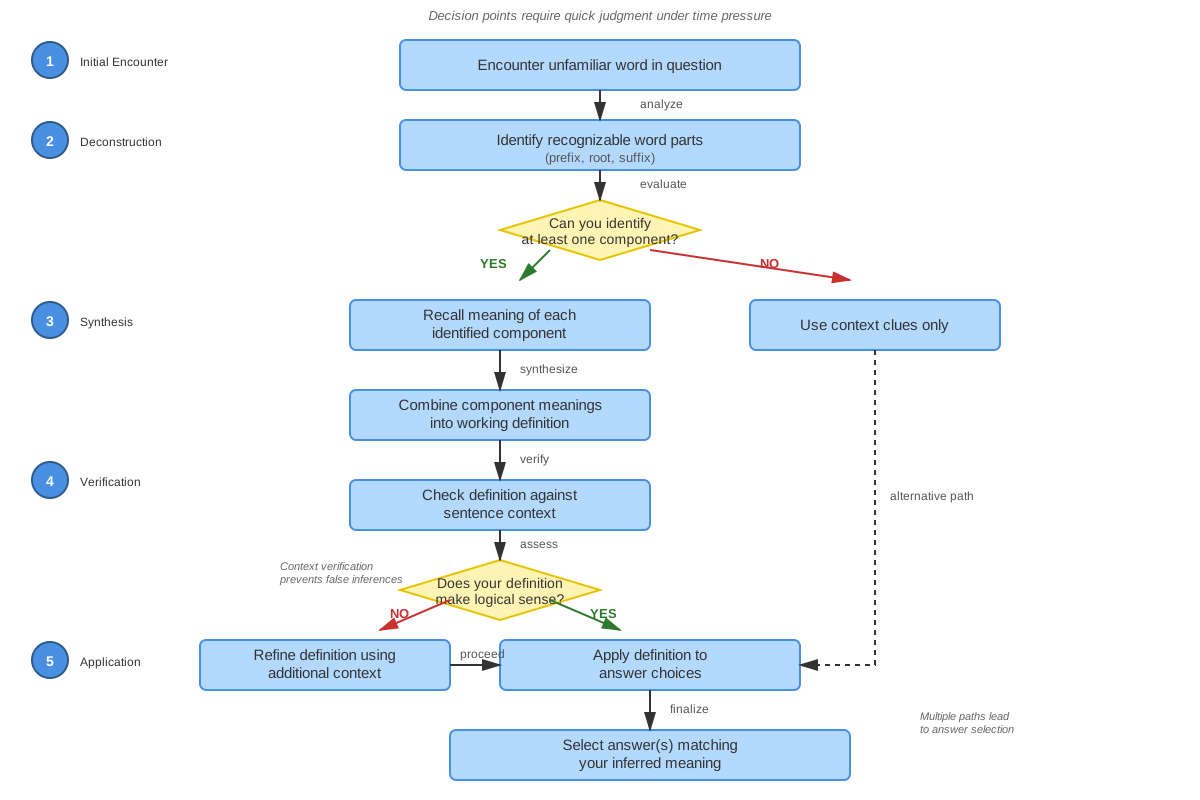
Root-based vocabulary inference operates within an interconnected system of linguistic analysis skills. The morphological analysis (breaking words into parts) → semantic synthesis (combining part meanings) → contextual verification (checking against sentence meaning) sequence forms the core workflow. Each stage depends on the previous one while informing subsequent analysis.
This topic connects directly to contextual vocabulary strategies, where sentence-level clues complement word-level analysis. When root-based inference suggests multiple possible meanings, context narrows the options. Conversely, when context alone proves insufficient, morphological analysis provides additional information. These strategies work synergistically rather than in isolation.
The relationship to Sentence Equivalence strategy is particularly strong. Sentence Equivalence questions require selecting two words that create equivalent meanings, making precise vocabulary understanding essential. Root-based inference helps identify subtle meaning distinctions between near-synonyms, enabling accurate pair selection. For example, distinguishing "mitigate" (mit = send, make less severe) from "exacerbate" (ex + acerb = make more harsh) becomes straightforward through root analysis.
Additionally, root-based vocabulary inference supports Reading Comprehension by enabling students to understand technical or specialized terminology without disrupting reading flow. Rather than becoming stuck on unfamiliar words, students can quickly decode meanings and maintain comprehension momentum.
High-Yield Facts
⭐ Approximately 60-70% of challenging GRE vocabulary words contain analyzable Latin or Greek roots
⭐ The prefix "in-/im-/il-/ir-" can mean either "not" (inactive) or "in/into" (influx), requiring contextual determination
⭐ Mastering 50-100 common roots enables understanding of thousands of English words through systematic combination
⭐ Root-based inference should always be verified against sentence context to avoid false cognate errors
⭐ Negative prefixes (in-, un-, dis-, a-, anti-) appear in approximately 30% of GRE vocabulary questions
- The roots "bene-" (good) and "mal-" (bad) create semantic opposites: benefactor vs. malefactor, benign vs. malignant
- Greek roots often relate to academic and scientific terminology, while Latin roots appear more frequently in legal and administrative vocabulary
- Compound words containing multiple roots (circumlocution = circum + locut + ion) require analyzing each component separately
- The suffix "-ous" typically converts nouns to adjectives (danger → dangerous, glory → glorious)
- Words with the same root but different prefixes often appear as trap answers in Sentence Equivalence questions
- The root "path" (feeling/suffering) appears in both empathy (feeling with) and apathy (without feeling), demonstrating how prefixes reverse meaning
- Recognizing the root "chron" (time) immediately clarifies words like anachronism, synchronize, and chronic
- The prefix "circum-" (around) appears less frequently than other prefixes but signals specific spatial or conceptual relationships
- Latin roots ending in consonants often add connecting vowels (-i-, -u-) before suffixes: fact + i + ous = factious
- Understanding that "-logy" means "study of" unlocks dozens of academic field names: biology, psychology, geology, anthropology
Quick check — test yourself on Root-based vocabulary inference so far.
Try Flashcards →Common Misconceptions
Misconception: All words with similar roots have related meanings → Correction: While roots provide semantic foundations, context and additional word parts significantly modify meaning. "Manufacture" (make by hand) and "manure" (work by hand) share the root "manu" (hand) but have vastly different modern meanings. Always verify root-based predictions against context.
Misconception: Root-based inference works for all English words → Correction: Root-based analysis applies primarily to Latinate and Greek-derived vocabulary. Germanic-origin words (common everyday vocabulary like "get," "make," "good") don't follow the same morphological patterns. The GRE specifically tests Latinate vocabulary where root analysis proves most effective.
Misconception: Knowing the root automatically reveals the exact dictionary definition → Correction: Root analysis provides semantic approximations and meaning categories, not precise definitions. The word "egregious" (e + greg = out of the flock) suggests "standing out" but doesn't specify the negative connotation without contextual knowledge. Root-based inference narrows possibilities rather than providing exact meanings.
Misconception: Prefixes always carry the same meaning across all words → Correction: Some prefixes have multiple meanings depending on context. The prefix "in-" can mean "not" (inactive, insufficient) or "in/into" (influx, infiltrate). Students must consider both possibilities and use context to determine which applies.
Misconception: Longer words with more parts are always more difficult to decode → Correction: Words with multiple clear morphemes are often easier to analyze than shorter words with obscured roots. "Circumlocution" (circum + locut + ion = talking around) is more transparent than "terse" (no clear morphological components). More parts can mean more analytical clues.
Misconception: Root-based inference is too slow for timed GRE conditions → Correction: With practice, morphological analysis becomes automatic and rapid, often faster than searching memory for memorized definitions. The initial investment in learning roots pays dividends in processing speed and accuracy across hundreds of vocabulary questions.
Misconception: If you recognize one part of a word, you understand the whole word → Correction: Partial recognition can mislead without complete analysis. Recognizing "bene-" (good) in "beneficiary" helps, but understanding "-fic-" (make/do) and "-ary" (one who) provides the complete picture: "one who receives good/benefits." Incomplete analysis leads to imprecise understanding.
Worked Examples
Example 1: Sentence Equivalence Question
Question: The professor's lecture style was notably __________, as he would often stray from the main topic to discuss tangential historical anecdotes.
(A) discursive
(B) laconic
(C) digressive
(D) terse
(E) concise
(F) focused
Step 1 - Analyze Context: The sentence indicates the professor strays from the main topic, suggesting the blank requires a word meaning "wandering" or "off-topic."
Step 2 - Apply Root-Based Inference to Challenging Options:
Discursive:
- Prefix: "dis-" (apart, away)
- Root: "curs" (run, course)
- Suffix: "-ive" (having the nature of)
- Synthesis: "running apart/away" → wandering in discussion
- Contextual fit: ✓ Matches the "straying from topic" description
Laconic:
- Root: "lacon" (from Laconia/Sparta, known for brief speech)
- Suffix: "-ic" (characterized by)
- Synthesis: brief, using few words
- Contextual fit: ✗ Opposite of the described behavior
Digressive:
- Prefix: "di-" (apart, away)
- Root: "gress" (step, walk)
- Suffix: "-ive" (having the nature of)
- Synthesis: "stepping away" → departing from main subject
- Contextual fit: ✓ Matches the "straying from topic" description
Terse:
- Root: unclear morphology (from Latin "tersus" = wiped clean/polished)
- Meaning: brief, concise
- Contextual fit: ✗ Opposite of the described behavior
Step 3 - Identify the Pair: Both "discursive" and "digressive" contain roots indicating movement away (dis-/di- + curs/gress) and fit the context of wandering from the main topic.
Answer: (A) discursive and (C) digressive
Learning Objective Connection: This example demonstrates applying root-based vocabulary inference to GRE-style questions accurately by systematically analyzing word parts and verifying against context.
Example 2: Text Completion with Unfamiliar Vocabulary
Question: Despite the medication's proven efficacy in clinical trials, some patients remained __________ about its benefits, refusing to believe it could alleviate their chronic symptoms.
(A) credulous
(B) incredulous
(C) credible
(D) incredible
Step 1 - Identify the Core Root: All options contain "cred" (believe/trust)
Step 2 - Analyze Prefixes and Suffixes:
Credulous:
- Root: "cred" (believe)
- Suffix: "-ulous" (tending to, full of)
- Synthesis: tending to believe, gullible
- Contextual fit: ✗ The sentence indicates refusal to believe, opposite of gullible
Incredulous:
- Prefix: "in-" (not)
- Root: "cred" (believe)
- Suffix: "-ulous" (tending to)
- Synthesis: not believing, skeptical
- Contextual fit: ✓ Matches "refusing to believe"
Credible:
- Root: "cred" (believe)
- Suffix: "-ible" (capable of being)
- Synthesis: capable of being believed, believable
- Contextual fit: ✗ Describes the object of belief, not the believer's attitude
Incredible:
- Prefix: "in-" (not)
- Root: "cred" (believe)
- Suffix: "-ible" (capable of being)
- Synthesis: not believable, unbelievable
- Contextual fit: ✗ Describes the medication, not the patients' attitude
Step 3 - Distinguish Between Similar Words: The key distinction lies in the suffixes: "-ulous" creates adjectives describing people's tendencies (credulous/incredulous), while "-ible" creates adjectives describing things' qualities (credible/incredible). The sentence requires a word describing the patients' attitude, not the medication's quality.
Answer: (B) incredulous
Learning Objective Connection: This example demonstrates explaining the core strategy behind root-based vocabulary inference by showing how systematic morphological analysis distinguishes between similar-appearing words through suffix function recognition.
Exam Strategy
Recognition Triggers
Identify when root-based vocabulary inference is being tested by watching for these signals:
- Unfamiliar but analyzable words: If you don't immediately recognize a word but can identify familiar prefixes, roots, or suffixes, root-based inference applies
- Multiple answer choices with shared roots: When several options contain the same root with different prefixes (e.g., credulous, incredulous, credible), the question tests morphological analysis
- Academic or technical vocabulary: Latinate and Greek-derived words appearing in formal contexts typically reward root-based analysis
- Words that "look like" familiar words: If a word resembles one you know (e.g., "circumlocution" resembles "circumference"), root analysis clarifies the connection
Systematic Approach Process
- Read the sentence completely first: Understand the overall meaning and logical flow before analyzing individual words
- Identify the target word's function: Determine whether you need a noun, verb, adjective, or adverb based on sentence structure
- Deconstruct systematically: Separate prefix, root, and suffix, analyzing each component's contribution
- Synthesize a working definition: Combine component meanings into a coherent hypothesis
- Verify against context: Check whether your predicted meaning fits logically within the sentence
- Compare with other options: Use root analysis to distinguish between similar answer choices
Time Management Guidelines
Root-based inference should enhance speed, not slow it down. Allocate approximately:
- 5-10 seconds for initial word deconstruction
- 3-5 seconds for contextual verification
- 5-10 seconds for comparing answer choices
If morphological analysis doesn't yield clarity within 15-20 seconds, pivot to contextual elimination strategies. Root-based inference works best when roots are immediately recognizable; struggling to recall obscure roots wastes valuable time.
Process of Elimination Tactics
- Eliminate based on prefix meaning: If the sentence requires a negative concept, immediately eliminate options with positive prefixes (bene-, eu-, pro-)
- Check suffix compatibility: Eliminate options that don't match the required part of speech (e.g., eliminate nouns when the sentence needs an adjective)
- Identify semantic opposites: Root analysis often reveals that answer choices fall into opposite pairs; context determines which pair member fits
- Watch for trap answers with partial similarity: The GRE frequently includes words that share roots with the correct answer but have different prefixes or suffixes that reverse meaning
Common Trap Patterns
Be alert for these recurring GRE tactics:
- False friends: Words that look similar to familiar words but have different meanings (e.g., "noisome" doesn't relate to "noise"; it means "foul-smelling" from "annoy")
- Prefix ambiguity: Questions exploiting prefixes with multiple meanings (in- as "not" vs. "in/into")
- Connotation traps: Words with correct denotative meaning but wrong connotation (positive vs. negative)
- Register mismatches: Informal words in formal contexts or vice versa
Memory Techniques
High-Frequency Root Mnemonics
SPEC-tacular Memory: "SPEC" (look/see) - Picture a spectacular view you're looking at
- Inspector = in + spec + tor (one who looks into)
- Spectator = spec + tat + or (one who looks)
- Retrospect = retro + spec (looking backward)
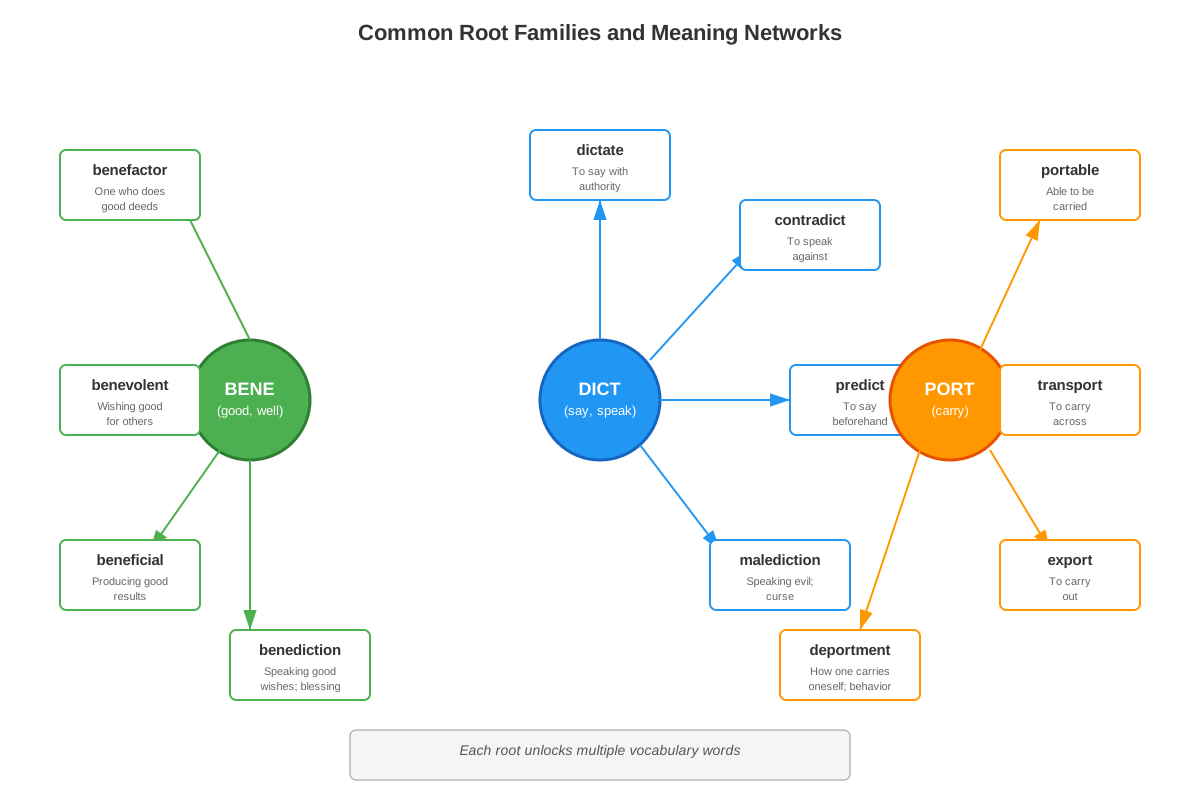
PORT-able Carrying: "PORT" (carry) - Imagine carrying a portable device through a port
- Transport = trans + port (carry across)
- Import = im + port (carry in)
- Export = ex + port (carry out)
DICT-ation Device: "DICT" (say/speak) - Picture a dictator dictating orders
- Predict = pre + dict (say before)
- Contradict = contra + dict (speak against)
- Verdict = ver + dict (true saying)
Prefix Visualization Strategy
Create mental images linking prefixes to their meanings:
- CIRCUM- (around): Visualize walking the circumference of a circle
- TRANS- (across): Picture a transcontinental train crossing a continent
- RETRO- (backward): Imagine retro fashion looking backward to past decades
- INTER- (between): See an intersection where roads meet between destinations
- INTRA- (within): Visualize intravenous medication going within veins
Suffix Function Acronym: "NAVA"
Remember suffix categories with NAVA:
- Noun suffixes: -tion, -ment, -ness, -ity
- Adjective suffixes: -ous, -ive, -al, -ful
- Verb suffixes: -ize, -ate, -ify, -en
- Adverb suffixes: -ly
Root Family Clustering
Group related roots by semantic field for efficient memorization:
Communication Cluster: dict (say), loqu/locut (speak), voc/vok (call), scrib/script (write)
Motion Cluster: port (carry), ject (throw), duc/duct (lead), mit/miss (send), ven/vent (come)
Cognition Cluster: cogn (know), sci (know), soph (wise), mem (remember), ment (mind)
Emotion Cluster: path (feeling), phil (love), phob (fear), bene (good), mal (bad)
The "Three-Part Story" Method
For complex words, create mini-stories combining all parts:
Circumlocution = circum (around) + locut (speak) + ion (noun)
Story: "The politician walked around the stage while speaking in circles—his circumlocution avoided the question."
Intransigent = in (not) + trans (across/change) + ig (drive) + ent (adjective)
Story: "The stubborn mule would not be driven to change positions—completely intransigent."
Summary
Root-based vocabulary inference represents the most efficient and reliable strategy for decoding unfamiliar GRE vocabulary by systematically analyzing word components—prefixes, roots, and suffixes. This morphological approach enables students to make educated predictions about word meanings even when encountering terms never previously studied. The strategy operates through a three-stage process: deconstructing words into constituent parts, synthesizing component meanings into coherent definitions, and verifying predictions against sentence context. Mastery of approximately 50-100 high-frequency roots, combined with knowledge of common prefixes and suffixes, unlocks understanding of thousands of English words, making this technique exceptionally high-yield for GRE preparation. The method proves particularly valuable for Sentence Equivalence questions, where precise vocabulary distinctions determine correct answer pairs, and for Text Completion questions requiring contextually appropriate word selection. Success requires both systematic morphological knowledge and the discipline to verify root-based predictions against contextual clues, ensuring accuracy while maintaining the speed necessary for timed test conditions.
Key Takeaways
- Root-based vocabulary inference decodes unfamiliar words by analyzing prefixes, roots, and suffixes systematically, enabling educated meaning predictions without prior memorization
- Approximately 60-70% of challenging GRE vocabulary contains analyzable Latin or Greek roots, making morphological analysis highly applicable across test questions
- The three-stage process—deconstruction, synthesis, and contextual verification—ensures both speed and accuracy in vocabulary inference
- Mastering 50-100 common roots provides exponential returns, unlocking understanding of thousands of related words through systematic combination
- Negative prefixes (in-, un-, dis-, a-, anti-) appear frequently on the GRE and require careful distinction, as some prefixes carry multiple meanings depending on context
- Root-based inference must always be verified against sentence context to avoid false cognate errors and ensure precise meaning selection
- Suffix recognition clarifies part of speech and grammatical function, enabling elimination of structurally incompatible answer choices even when root meanings remain ambiguous
Related Topics
Latin and Greek Root Mastery: Deep dive into the 100 most common roots appearing on standardized tests, with extensive word family examples and practice exercises. Mastering root-based vocabulary inference provides the foundation for this more comprehensive root study.
Contextual Vocabulary Strategies: Techniques for using sentence-level clues, logical relationships, and rhetorical patterns to infer word meanings when morphological analysis proves insufficient. This complements root-based inference by providing alternative analytical pathways.
Sentence Equivalence Advanced Strategies: Specialized approaches for selecting synonym pairs in GRE Sentence Equivalence questions, building on vocabulary inference skills to distinguish subtle meaning differences between near-synonyms.
Etymology and Word History: Understanding how English vocabulary evolved from Latin, Greek, French, and Germanic sources, providing deeper insight into morphological patterns and semantic relationships. Root-based inference becomes more intuitive with etymological knowledge.
Academic Vocabulary by Discipline: Field-specific terminology patterns in sciences, humanities, and social sciences, showing how root-based inference applies to specialized academic contexts frequently appearing in GRE Reading Comprehension passages.
Practice CTA
Now that you've mastered the systematic approach to root-based vocabulary inference, it's time to put these strategies into action. The practice questions and flashcards have been specifically designed to reinforce the morphological analysis techniques covered in this guide, progressing from straightforward root identification to complex multi-part word deconstruction. Each practice item provides an opportunity to strengthen your analytical speed and accuracy, building the automaticity necessary for test-day success. Remember: vocabulary mastery isn't about memorizing thousands of isolated definitions—it's about developing the analytical tools to decode any unfamiliar word you encounter. Your investment in root-based inference will pay dividends across every section of the GRE Verbal Reasoning test. Start practicing now, and watch your vocabulary confidence soar!
Sign up free to keep reading
Create a free AnvayaPrep account to finish this GRE guide on Root-based vocabulary inference — plus flashcards and practice questions.