Overview
Double-negative traps represent one of the most sophisticated and frequently tested linguistic challenges on the GRE Verbal Reasoning section. These questions deliberately employ two negating elements within a single sentence or clause, creating a logical structure that can confuse even advanced test-takers. The GRE test designers intentionally craft these sentences to test whether students can accurately track the logical meaning through multiple layers of negation. Understanding how to navigate these constructions is not merely about grammar—it requires precise logical reasoning and the ability to mentally simplify complex sentence structures under time pressure.
The significance of mastering GRE double-negative traps extends beyond isolated trick questions. These constructions appear across multiple question types in the Verbal Reasoning section, including Sentence Equivalence, Text Completion, and Reading Comprehension passages. The GRE favors sophisticated academic prose that often employs negation through prefixes (un-, in-, dis-), negative adverbs (hardly, scarcely, barely), and subtle negative constructions (fail to, reluctant to, absence of). When two such elements combine in a single sentence, the resulting meaning can flip entirely from what an initial reading might suggest. Students who fail to recognize these patterns consistently misinterpret sentence meaning and select answer choices that are precisely opposite to what the sentence requires.
Within the broader context of Verbal Reasoning, double-negative traps connect directly to critical reading skills, logical reasoning, and vocabulary precision. They test the same analytical abilities required for argument analysis and inference questions, making them a high-yield topic for overall score improvement. Mastering this concept strengthens the foundational skill of extracting accurate meaning from complex academic text—the core competency the GRE Verbal section measures.
Learning Objectives
- [ ] Identify when Double-negative traps is being tested in GRE questions
- [ ] Explain the core rule or strategy behind Double-negative traps
- [ ] Apply Double-negative traps to GRE-style questions accurately
- [ ] Recognize all forms of negation including prefixes, negative adverbs, and implicit negation
- [ ] Systematically convert double-negative constructions into positive equivalents
- [ ] Distinguish between true double negatives and single negatives with negative-sounding words
- [ ] Predict common wrong answer choices that exploit double-negative confusion
Prerequisites
- Basic sentence structure and grammar: Understanding subjects, verbs, and modifiers is essential for parsing complex sentences with multiple negating elements
- Vocabulary fundamentals: Familiarity with common prefixes and word roots helps identify hidden negation within sophisticated vocabulary
- Logical reasoning basics: The ability to track logical relationships (if-then, cause-effect) provides the foundation for understanding how negation affects meaning
- Sentence Equivalence question format: Knowledge of how to approach these questions ensures students can apply double-negative recognition strategically
Why This Topic Matters
Double-negative traps appear with remarkable frequency on the GRE, showing up in approximately 15-25% of Sentence Equivalence questions and 10-15% of Text Completion items. The GRE deliberately uses these constructions because they efficiently separate students who read carefully and think logically from those who rely on superficial pattern recognition. In Reading Comprehension passages, double negatives often appear in the most challenging inference and detail questions, where a single misread negation leads to selecting the exact opposite of the correct answer.
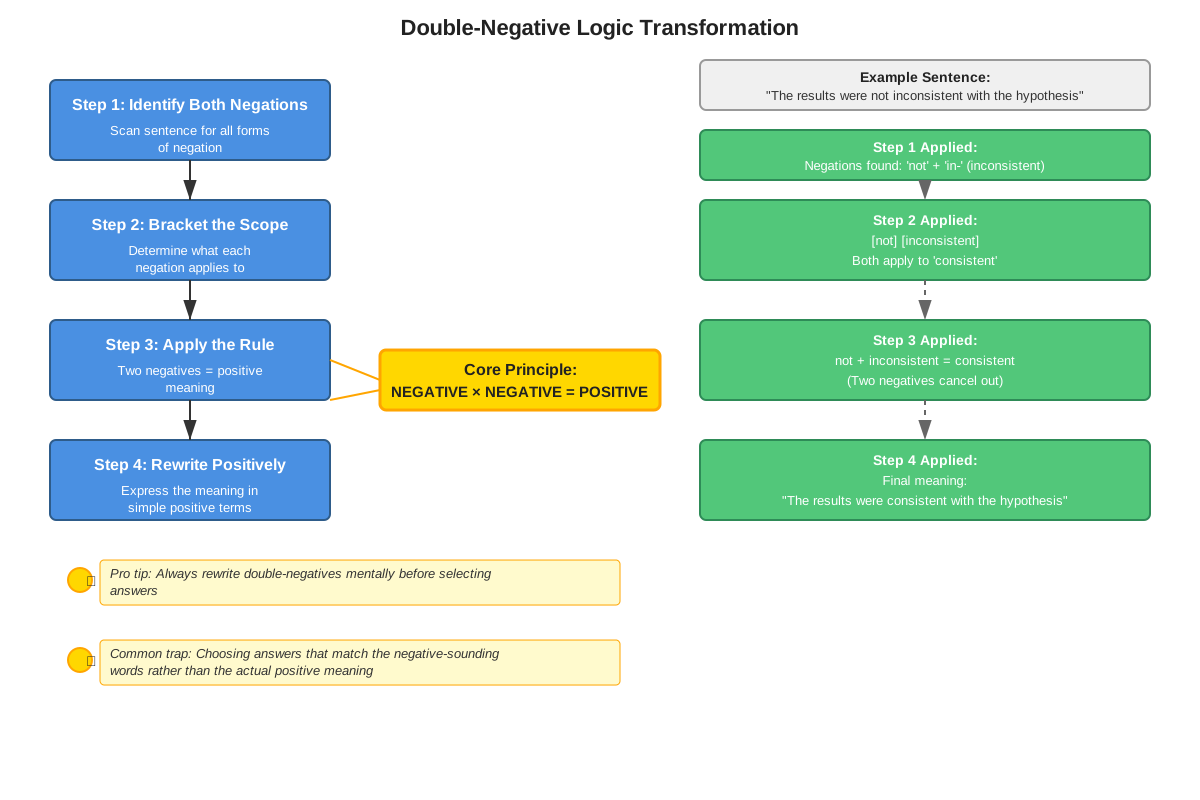
Beyond test performance, the ability to parse double negatives reflects genuine academic reading competence. Graduate-level texts across disciplines—from philosophy to scientific research papers—regularly employ complex negation to express nuanced positions. A statement like "The results were not inconsistent with the hypothesis" carries a meaningfully different implication than "The results confirmed the hypothesis," and academic readers must distinguish these shades of meaning accurately.
On the GRE specifically, double-negative traps most commonly appear in sentences discussing contradictions, unexpected outcomes, or subtle distinctions. Test designers favor contexts where the double negative creates irony or emphasizes a point through understatement. For example, sentences about historical figures who "were not without influence" or scientific theories that "cannot be discounted" exploit double negation to test precise comprehension. Students who recognize these patterns gain a significant strategic advantage, as they can immediately flag sentences for careful analysis rather than falling into the trap of hasty misreading.
Core Concepts
What Constitutes a Double Negative
A double-negative trap occurs when two negating elements appear in the same clause or closely related clauses, creating a logical structure where the negations cancel each other out to produce an affirmative meaning. The fundamental mathematical principle applies: negative × negative = positive. However, unlike simple arithmetic, linguistic negation operates through diverse mechanisms that can obscure this basic rule.
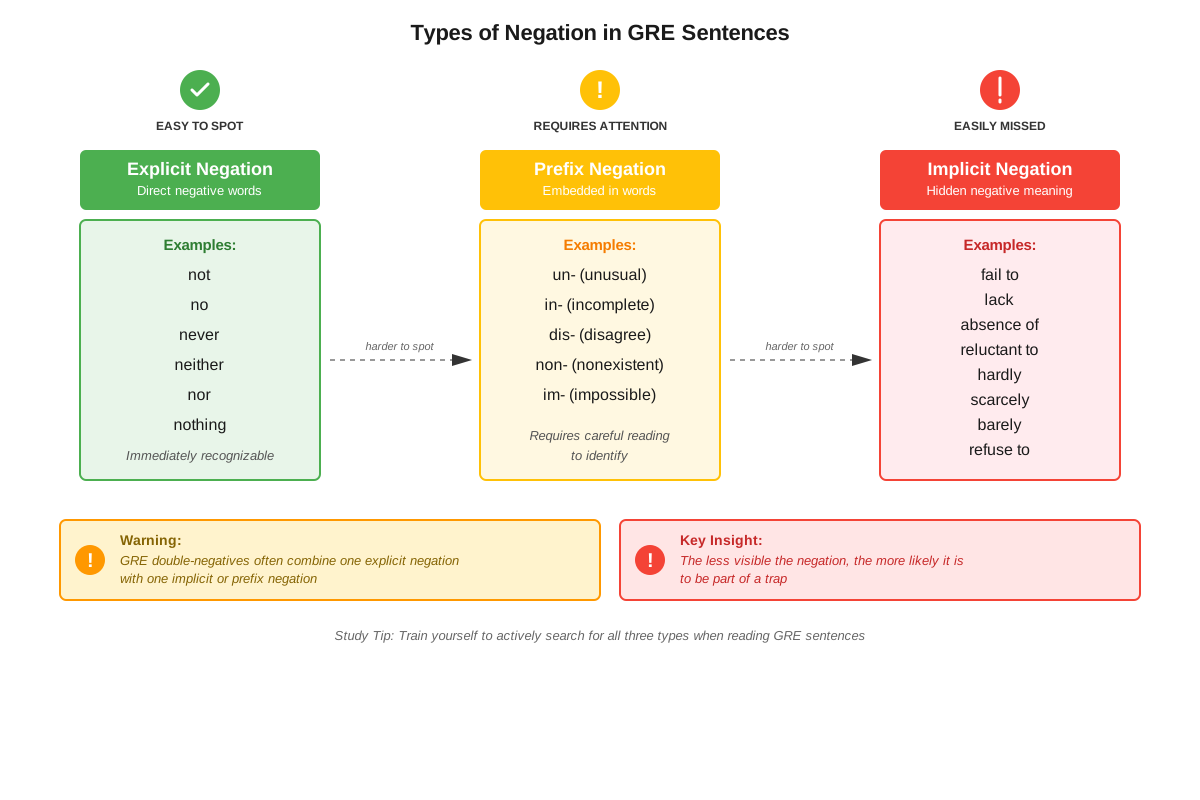
Negation in English manifests through multiple forms:
| Negation Type | Examples | Notes |
|---|---|---|
| Explicit negative words | not, no, never, neither, nor | Most obvious form; easily recognized |
| Negative prefixes | un-, in-, im-, il-, ir-, dis-, non- | Often overlooked in complex vocabulary |
| Negative suffixes | -less (meaningless, worthless) | Creates adjectives with negative meaning |
| Negative adverbs | hardly, scarcely, barely, rarely, seldom | Subtle negation; often missed |
| Implicit negation | fail to, refuse to, lack, absence, without | Requires semantic understanding |
| Negative verbs | deny, reject, oppose, contradict, preclude | Meaning inherently contains negation |
When any two of these elements combine within a single grammatical unit, they create a double negative. The critical insight is that the resulting meaning is affirmative, though often with a nuanced or understated quality compared to a straightforward positive statement.
The Core Logical Rule
The fundamental principle governing double negatives is negation cancellation: two negatives in the same logical scope produce a positive meaning. Consider these transformations:
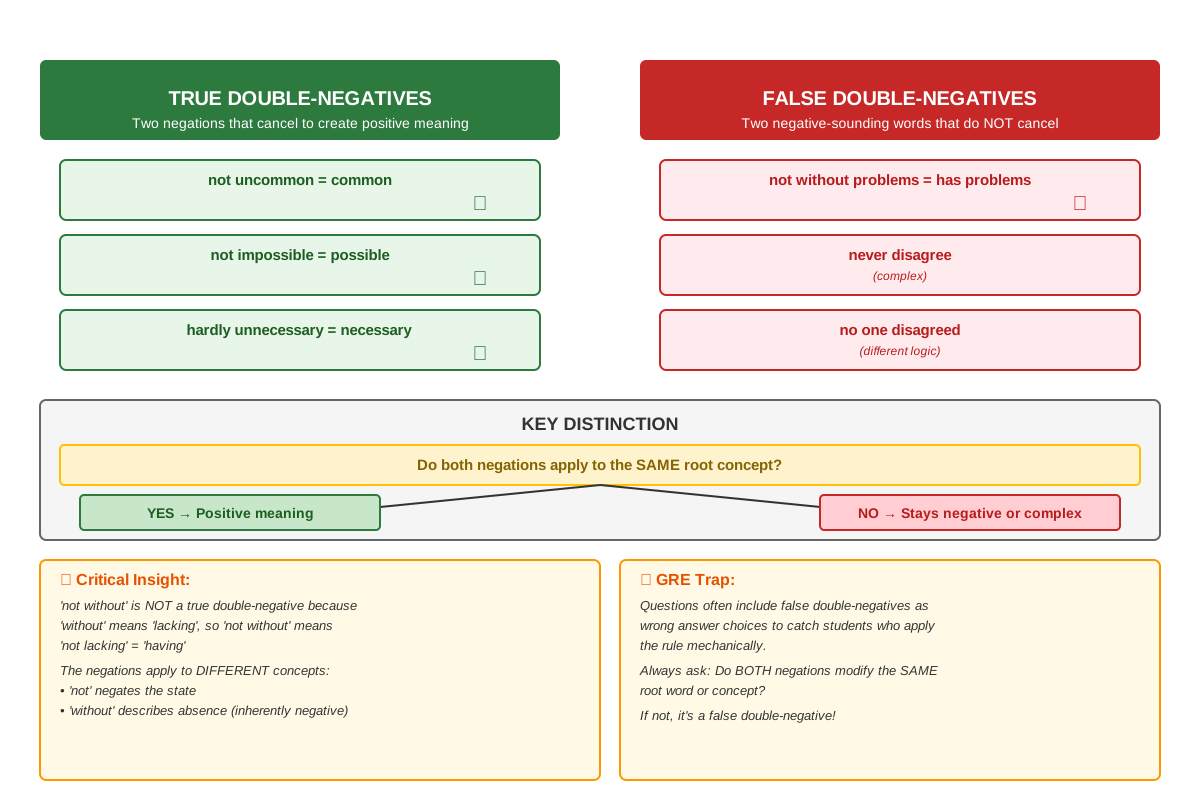
- "not uncommon" = common (or fairly common)
- "not without merit" = has merit (or has some merit)
- "hardly insignificant" = significant (or quite significant)
- "cannot be discounted" = must be considered (or is important)
However, the resulting positive often carries a more moderate or qualified tone than a direct positive statement. "Not unhappy" suggests a state somewhere between neutral and happy, rather than enthusiastically happy. This nuance is precisely what the GRE tests—whether students can recognize both the affirmative direction and the subtle qualification.
Recognition Patterns on the GRE
The GRE employs several characteristic patterns for double-negative traps:
Pattern 1: Negative prefix + explicit negative
"The evidence was not inconsistent with the theory" → The evidence was consistent with (or supported) the theory
Pattern 2: Negative adverb + negative adjective
"The contribution was hardly negligible" → The contribution was significant (or substantial)
Pattern 3: Negative verb + negative object
"The committee could not dismiss the objections" → The committee had to consider the objections
Pattern 4: Without + negative noun/adjective
"The argument was not without flaws" → The argument had flaws
Pattern 5: Fail/refuse + negative infinitive
"The author does not fail to acknowledge the limitations" → The author acknowledges the limitations
Strategic Simplification Method
To avoid falling into double-negative traps, employ this systematic approach:
- Scan for all negating elements in the sentence, including prefixes, negative adverbs, and implicit negation
- Count the negations in each clause (focus on the blank's immediate context)
- Apply the cancellation rule: even number of negations = positive meaning; odd number = negative meaning
- Translate to simple positive or negative before looking at answer choices
- Verify your translation by substituting it back into the original sentence
For example, with the sentence: "The scientist's findings were not _____, despite initial skepticism."
If the blank contains "unsubstantiated" (negative prefix), the complete phrase becomes "not unsubstantiated" = substantiated/supported. This creates a logical sentence: the findings were supported, which makes sense despite initial skepticism.
Common Disguises and Complications
The GRE makes double negatives challenging through several sophisticated techniques:
Vocabulary obscurity: Using advanced words with negative prefixes that students might not immediately recognize as negative (e.g., "untenable," "incontrovertible," "irrefutable")
Distance between negations: Placing the two negating elements far apart in the sentence, separated by multiple clauses or modifying phrases
Triple negatives: Occasionally employing three negating elements, which resolves to a negative meaning (negative × negative × negative = negative)
False negatives: Including words that sound negative but aren't (e.g., "notorious" is not a true negative; "infamous" means famous, not un-famous)
Contextual negation: Using phrases where negation emerges from context rather than explicit negative words (e.g., "far from simple" = complex)
Concept Relationships
The mastery of double-negative traps builds directly upon fundamental grammar and vocabulary knowledge. Understanding sentence structure enables students to identify the scope of each negation—determining whether two negative elements operate within the same logical unit or in separate clauses. Strong vocabulary knowledge, particularly of prefixes and roots, allows immediate recognition of hidden negation in sophisticated academic words.
Within the topic itself, the concepts connect in a clear progression: Recognition of negating elements → Identification of double-negative structure → Application of cancellation rule → Translation to simplified meaning → Selection of appropriate answer choices. Each step depends on the previous one, making the recognition phase absolutely critical.
Double-negative traps also connect forward to more advanced Verbal Reasoning skills. The logical reasoning required to track negation through complex sentences directly supports argument analysis in Reading Comprehension. The ability to recognize subtle meaning distinctions (the difference between "not unhappy" and "happy") enhances performance on inference questions and author's tone questions. Additionally, mastering double negatives improves overall reading efficiency, as students develop the habit of actively tracking logical relationships rather than passively absorbing words.
The relationship to Sentence Equivalence specifically is crucial: double negatives often appear in sentences where students must select two words that produce equivalent meanings. If the sentence contains a double negative, both answer choices must account for the resulting positive meaning, or both must work with a negative meaning if only one negation is present. This creates a powerful elimination strategy—if you misread the negation, you'll likely select two words that are synonyms but produce the wrong overall meaning.
High-Yield Facts
⭐ Two negatives in the same logical scope always produce an affirmative meaning, though often with a more moderate or qualified tone than a direct positive statement.
⭐ Negative prefixes (un-, in-, im-, il-, ir-, dis-, non-) are the most commonly overlooked form of negation in GRE double-negative traps.
⭐ Words like "hardly," "scarcely," and "barely" function as negatives, not as modifiers of degree—they reverse the meaning of what follows.
⭐ The phrase "not without" always signals a double negative and translates to "has" or "with" (e.g., "not without merit" = "has merit").
⭐ Triple negatives resolve to negative meaning (negative × negative × negative = negative), though they appear less frequently than double negatives.
- "Fail to" and "refuse to" are implicit negatives that create double negatives when combined with negative objects or complements.
- Distance between negating elements is a deliberate trap—the GRE often separates the two negations with multiple phrases to obscure the relationship.
- In Sentence Equivalence, if you misidentify a double negative as a single negative, you'll select answer choices that are synonyms but produce the opposite meaning from what's required.
- Not all negative-sounding words are true negatives—words like "notorious," "formidable," or "daunting" don't contain logical negation despite their connotations.
- The resulting positive from a double negative typically carries nuance—"not uncommon" suggests "fairly common" rather than "very common," and this subtlety can affect answer choice selection.
- Verbs like "deny," "reject," "oppose," and "preclude" contain inherent negation and can form double negatives when combined with negative objects.
- Context determines whether "without" functions as a negative—"without hesitation" is simply descriptive, but "not without hesitation" creates a double negative meaning "with hesitation."
Quick check — test yourself on Double-negative traps so far.
Try Flashcards →Common Misconceptions
Misconception: All sentences with two negative words are double negatives that cancel out.
Correction: The negations must operate within the same logical scope. "He did not go, nor did she stay" contains two negatives in separate independent clauses, so they don't cancel—both clauses remain negative.
Misconception: Double negatives always mean exactly the same as the corresponding positive.
Correction: Double negatives typically produce a more qualified or understated meaning than direct positives. "Not unhappy" suggests a moderate positive state, not enthusiastic happiness. This nuance matters for selecting the most precise answer choice.
Misconception: Words with negative prefixes always function as negatives in double-negative constructions.
Correction: Some words with negative prefixes have become independent words without truly negative meaning. "Invaluable" means extremely valuable, not "not valuable." Always verify the actual meaning of the word, not just its prefix.
Misconception: "Hardly," "barely," and "scarcely" are just weak modifiers that reduce intensity.
Correction: These words function as full negatives. "Hardly significant" means "not significant," not "somewhat significant." They reverse meaning rather than merely weakening it.
Misconception: If a sentence sounds confusing or awkward, it must contain a double negative.
Correction: Sentences can be complex for many reasons. Only sentences with two actual negating elements in the same logical scope contain double negatives. Complexity alone doesn't indicate this specific pattern.
Misconception: The GRE uses double negatives as errors to identify.
Correction: Unlike some grammar tests, the GRE uses double negatives as legitimate, sophisticated constructions that test reading comprehension. They're not errors—they're intentional structures designed to assess whether you can extract accurate meaning from complex academic prose.
Worked Examples
Example 1: Sentence Equivalence with Negative Prefix
Question: The historian's interpretation of the evidence was not _____, as several colleagues found merit in her unconventional approach.
Answer choices:
(A) untenable
(B) persuasive
(C) indefensible
(D) conventional
(E) thorough
(F) systematic
Solution Process:
Step 1: Identify negating elements. The sentence contains "not" before the blank. We need to determine if any answer choices contain additional negation.
Step 2: Analyze the logic. The sentence states that colleagues "found merit" in the interpretation, which is positive support. The structure "was not _____" suggests that whatever fills the blank should be negative, and the "not" will reverse it to positive, aligning with colleagues finding merit.
Step 3: Examine answer choices for negative meaning:
- (A) "untenable" = not defensible (negative prefix "un-")
- (B) "persuasive" = convincing (positive)
- (C) "indefensible" = cannot be defended (negative prefix "in-")
- (D) "conventional" = traditional (neutral/positive)
- (E) "thorough" = complete (positive)
- (F) "systematic" = methodical (positive)
Step 4: Apply double-negative logic. If we choose (A) "untenable," we get "not untenable" = tenable/defensible. If we choose (C) "indefensible," we get "not indefensible" = defensible. Both create double negatives that resolve to positive meanings, which aligns with colleagues finding merit.
Step 5: Verify equivalence. "Not untenable" and "not indefensible" both mean the interpretation could be defended or had validity. These produce equivalent meanings.
Step 6: Eliminate other choices. Choices (B), (E), and (F) are positive words that would create "not persuasive," "not thorough," and "not systematic"—all negative meanings that contradict colleagues finding merit. Choice (D) doesn't fit the logical relationship.
Answer: (A) and (C)
Key takeaway: This question demonstrates Pattern 1 (negative prefix + explicit negative). The double negative creates an affirmative meaning that must align with the positive context clue "found merit."
Example 2: Text Completion with Negative Adverb
Question: The committee's decision to proceed with the controversial policy was _____ surprising, given the intense public opposition that had characterized the preceding months.
Answer choices:
(A) hardly
(B) completely
(C) somewhat
(D) predictably
(E) unfortunately
Solution Process:
Step 1: Identify the logical relationship. The sentence sets up a contrast: intense public opposition existed, yet the committee proceeded anyway. The blank describes how surprising this decision was.
Step 2: Determine expected meaning. Given strong opposition, proceeding with the policy would be very surprising. However, the sentence structure with "given" suggests we're explaining why something makes sense, which often signals an unexpected twist.
Step 3: Analyze choice (A) "hardly." This is a negative adverb meaning "not" or "barely." If we choose "hardly surprising," this creates a negative meaning: the decision was NOT surprising. But wait—does this make logical sense?
Step 4: Re-examine the logic. Actually, if the committee had been determined or had other motivations, proceeding despite opposition might NOT be surprising. The sentence could be saying: "Given the opposition, you might expect us to be surprised they proceeded, but actually it wasn't surprising [for some unstated reason]."
Step 5: Check other choices. "Completely surprising" (B) would mean very surprising, which seems to fit the opposition context. "Somewhat surprising" (C) is moderate. "Predictably" (D) doesn't fit grammatically with "surprising." "Unfortunately" (E) adds judgment but doesn't address the degree of surprise.
Step 6: Consider context more carefully. The phrase "given the intense public opposition" typically introduces an explanation for why something makes sense. If the decision was "completely surprising given the opposition," the "given" doesn't explain anything—it just restates that opposition makes the decision surprising. However, "hardly surprising given the opposition" could mean "not surprising given the opposition" if we understand that the committee was known to be stubborn or had other priorities.
Most likely answer: (A) "hardly"—though this question demonstrates how context and double-negative logic interact. The negative adverb "hardly" means the decision was NOT surprising, which makes sense if the sentence is explaining that despite what you might think, the opposition actually made the committee's stubbornness predictable.
Alternative interpretation: Without additional context, (B) "completely" could work if the sentence is simply emphasizing how surprising the decision was. This ambiguity shows why careful reading of the entire sentence is crucial.
Key takeaway: This example shows how negative adverbs function as full negatives and how sentence logic must guide interpretation. The word "hardly" doesn't mean "a little bit"—it means "not."
Exam Strategy
Systematic Approach for Double-Negative Questions
When approaching any GRE Verbal question, implement this rapid screening process:
- Scan for explicit negatives (not, no, never, neither, nor) in the first read-through
- Flag negative prefixes in answer choices and surrounding text
- Watch for negative adverbs (hardly, scarcely, barely, rarely, seldom)
- Identify implicit negation (fail to, lack, without, absence)
- Count total negations in the relevant clause
Exam Tip: If you identify two negations in the same clause, immediately translate the construction to a simple positive before looking at answer choices. This prevents the confusion that leads to selecting opposite meanings.
Trigger Words and Phrases
Certain phrases almost always signal double-negative traps on the GRE:
High-probability triggers:
- "not un-" (not uncommon, not unusual, not unprecedented)
- "not in-/im-/il-/ir-" (not insignificant, not impossible, not illogical)
- "not without" (not without merit, not without reason)
- "hardly/scarcely/barely" + negative adjective
- "cannot be" + negative past participle (cannot be discounted, cannot be dismissed)
- "fail to" + negative verb (fail to deny, fail to reject)
When you encounter these phrases, immediately pause and apply the cancellation rule before proceeding.
Process of Elimination Strategy
For Sentence Equivalence questions with double negatives:
- Determine the final meaning (positive or negative) after applying cancellation
- Eliminate all answer choices that don't match this polarity
- Among remaining choices, look for true synonyms that both create the correct meaning
- Verify by substitution: plug both choices back into the sentence to confirm equivalent meanings
For Text Completion with double negatives:
- Simplify the sentence by converting the double negative to a positive
- Predict the meaning you need before looking at choices
- Eliminate choices that don't match your prediction
- Verify the logic of your selection by reading the complete sentence
Time Management
Double-negative questions often consume extra time because they require careful analysis. Budget your time strategically:
- Initial recognition: 5-10 seconds to identify the double negative
- Simplification: 10-15 seconds to translate to simple positive/negative
- Answer selection: 15-20 seconds to evaluate choices
- Verification: 5-10 seconds to confirm
Total: approximately 35-55 seconds for a double-negative question, slightly more than average. This investment prevents the costly error of selecting the opposite meaning, which cannot be recovered.
If you're running short on time, double-negative questions are NOT good candidates for random guessing—the trap answers are specifically designed to catch hasty readers. If you must guess, eliminate any choices that seem too obvious or that match your first instinctive reading without careful analysis.
Memory Techniques
The Cancellation Mnemonic: "NEGATIVE TWINS TURN POSITIVE"
Remember that two negatives in the same space always cancel out, just like in mathematics. Visualize two negative signs meeting and transforming into a plus sign.
The PREFIX Alert: "UN-IN-DIS-NON = NEGATION"
Create a mental checklist of the most common negative prefixes. When you see any word beginning with these letters, pause to verify whether it contains true negation:
- UN-common, UN-tenable, UN-precedented
- IN-significant, IM-possible, IL-logical, IR-relevant
- DIS-agree, DIS-miss, DIS-count
- NON-essential, NON-existent
The HARDLY Reminder: "HARDLY = NOT"
Many students treat "hardly," "scarcely," and "barely" as weak modifiers. Instead, remember this equation:
- HARDLY = NOT
- SCARCELY = NOT
- BARELY = NOT
These words don't reduce intensity—they reverse meaning entirely.
The "NOT WITHOUT" Translation
Whenever you see "not without," immediately translate:
- "not without" → "with" or "has"
- "not without merit" → "has merit"
- "not without difficulty" → "with difficulty"
Visualization Strategy
Picture negation as a light switch. One flip (one negative) turns the light off (negative meaning). Two flips (two negatives) returns the light to on (positive meaning). Three flips (rare triple negative) turns it off again (negative meaning). This physical visualization helps track negation through complex sentences.
The Scope Circle Technique
When analyzing a complex sentence, mentally draw a circle around the clause containing the blank or the key phrase. Count only the negations within that circle. Negations outside the circle don't affect the double-negative calculation. This prevents confusion in sentences with multiple clauses.
Summary
Double-negative traps represent a high-yield, frequently tested concept on the GRE Verbal Reasoning section, appearing in 15-25% of Sentence Equivalence questions and regularly in Text Completion and Reading Comprehension. The fundamental principle is straightforward: two negating elements in the same logical scope cancel each other out to produce an affirmative meaning, following the mathematical rule that negative × negative = positive. However, the GRE makes this challenging by employing diverse forms of negation—explicit negative words, negative prefixes, negative adverbs, and implicit negation—and by separating the two negating elements within complex sentence structures. Success requires systematic recognition of all negation forms, careful counting of negating elements within the relevant clause, application of the cancellation rule, and translation to simplified positive or negative meaning before evaluating answer choices. The resulting positive from a double negative typically carries a more qualified or understated tone than a direct positive statement, adding nuance that affects precise answer selection. Mastering this concept prevents the costly error of selecting answer choices that mean the exact opposite of what the sentence requires.
Key Takeaways
- Two negatives in the same logical scope always cancel to create affirmative meaning, though often with qualified or understated tone
- Negative prefixes (un-, in-, dis-, non-) are the most commonly overlooked negation form—scan every word for these prefixes
- "Hardly," "scarcely," and "barely" function as complete negatives, not as weak modifiers—they reverse meaning entirely
- Systematic simplification prevents errors: identify all negations → count them → apply cancellation → translate to simple positive/negative → then evaluate choices
- The phrase "not without" always signals a double negative and translates to "has" or "with"
- Distance between negating elements is a deliberate trap—the GRE separates negations to obscure the relationship
- In Sentence Equivalence, misreading a double negative leads to selecting synonyms that produce the opposite required meaning—verify polarity before selecting answer pairs
Related Topics
Sentence Equivalence Strategy: Mastering double negatives enhances overall Sentence Equivalence performance, as these questions frequently combine multiple challenging elements including double negatives, complex vocabulary, and subtle meaning distinctions.
Text Completion Logic: The logical reasoning skills developed through double-negative analysis transfer directly to multi-blank Text Completion questions, where tracking relationships between clauses determines correct answer combinations.
Reading Comprehension Inference Questions: Double negatives appear regularly in passages, particularly in questions asking what can be inferred or what the author suggests. Misreading negation leads to selecting the opposite inference.
Vocabulary in Context: Understanding how prefixes affect word meaning connects to broader vocabulary strategies, helping students decode unfamiliar words by analyzing their component parts.
Argument Analysis: The logical precision required for double negatives supports argument evaluation skills, as both require tracking how modifiers and qualifiers affect claims.
Practice CTA
Now that you've mastered the core concepts of double-negative traps, it's time to cement your understanding through active practice. Attempt the practice questions designed specifically for this topic, focusing on applying the systematic recognition and simplification process you've learned. Use the flashcards to drill recognition of negative prefixes, negative adverbs, and common double-negative phrases until identification becomes automatic. Remember: the difference between a good score and a great score often comes down to mastering these high-frequency patterns that trap unprepared test-takers. Every double-negative question you correctly analyze builds the logical reasoning skills that elevate performance across the entire Verbal section. You've invested the time to understand the concept—now invest the practice time to make it instinctive.
Sign up free to keep reading
Create a free AnvayaPrep account to finish this GRE guide on Double-negative traps — plus flashcards and practice questions.