Overview
Double-positive traps represent one of the most deceptive question types in GRE Sentence Equivalence, designed specifically to catch test-takers who rely on superficial pattern recognition rather than deep comprehension. These questions present sentences where two words that appear similar in meaning—both carrying positive or neutral connotations—seem like obvious answer choices. However, selecting both would result in sentences with subtly different meanings, violating the fundamental requirement of Sentence Equivalence questions: that both answer choices must produce sentences with equivalent meanings.
The GRE test makers deliberately craft these traps because they exploit a common test-taking shortcut: scanning for synonyms without fully considering sentence context and logical coherence. When students encounter words like "beneficial" and "advantageous," or "innovative" and "creative," the temptation to select both is strong because they share semantic territory. Yet GRE double-positive traps succeed precisely because these near-synonyms create different nuances when inserted into the sentence blank. One might fit the logical flow perfectly while the other, though positive and related, shifts the meaning in ways that become apparent only through careful analysis.
Understanding double-positive traps is essential not just for Sentence Equivalence success, but for developing the critical reading skills that underpin all GRE Verbal Reasoning sections. This topic connects directly to vocabulary precision, contextual analysis, and the ability to distinguish between denotation and connotation—skills that also enhance performance on Text Completion and Reading Comprehension questions. Mastering this concept transforms students from passive synonym-hunters into active meaning-makers who can navigate the subtle distinctions that separate correct answers from attractive distractors.
Learning Objectives
- [ ] Identify when Double-positive traps is being tested
- [ ] Explain the core rule or strategy behind Double-positive traps
- [ ] Apply Double-positive traps to GRE-style questions accurately
- [ ] Distinguish between true synonyms and semantically related words with different contextual applications
- [ ] Evaluate answer choices by testing both words in the sentence to verify meaning equivalence
- [ ] Recognize common word pairs that frequently appear in double-positive trap scenarios
- [ ] Develop a systematic verification process to avoid falling for superficially similar answer choices
Prerequisites
- Basic understanding of Sentence Equivalence format: Students must know that Sentence Equivalence requires selecting two answer choices that produce sentences with equivalent meanings, as this is the foundational principle that double-positive traps exploit.
- Intermediate vocabulary knowledge: Familiarity with common GRE vocabulary words and their nuances is necessary to distinguish between subtle meaning differences in positive-connotation words.
- Contextual reading skills: The ability to understand how sentence structure, tone, and logical flow constrain word choice is essential for identifying when seemingly similar words actually create different meanings.
Why This Topic Matters
Double-positive traps appear with remarkable frequency on the GRE, representing approximately 30-40% of Sentence Equivalence questions according to test-prep analytics. The ETS (Educational Testing Service) deliberately includes these questions because they effectively measure vocabulary precision and contextual reasoning—two skills highly correlated with graduate-level academic success. Unlike straightforward synonym questions, double-positive traps assess whether students can move beyond surface-level word associations to evaluate semantic fit within specific contexts.
In real-world academic and professional settings, the ability to distinguish between similar positive concepts proves invaluable. The difference between describing research as "innovative" versus "unconventional," or a policy as "pragmatic" versus "practical," can significantly alter meaning and reception. Graduate programs require students to make these precise distinctions in their writing and analysis, making this skill directly transferable beyond test day.
On the GRE, double-positive traps most commonly appear in Sentence Equivalence questions featuring abstract concepts, evaluative statements, or descriptive passages about people, policies, or phenomena. They rarely appear in straightforward factual statements but thrive in sentences requiring nuanced judgment or characterization. Test-makers favor these traps in medium-to-hard difficulty questions, positioning them strategically to differentiate between good and excellent test-takers.
Core Concepts
The Anatomy of Double-Positive Traps
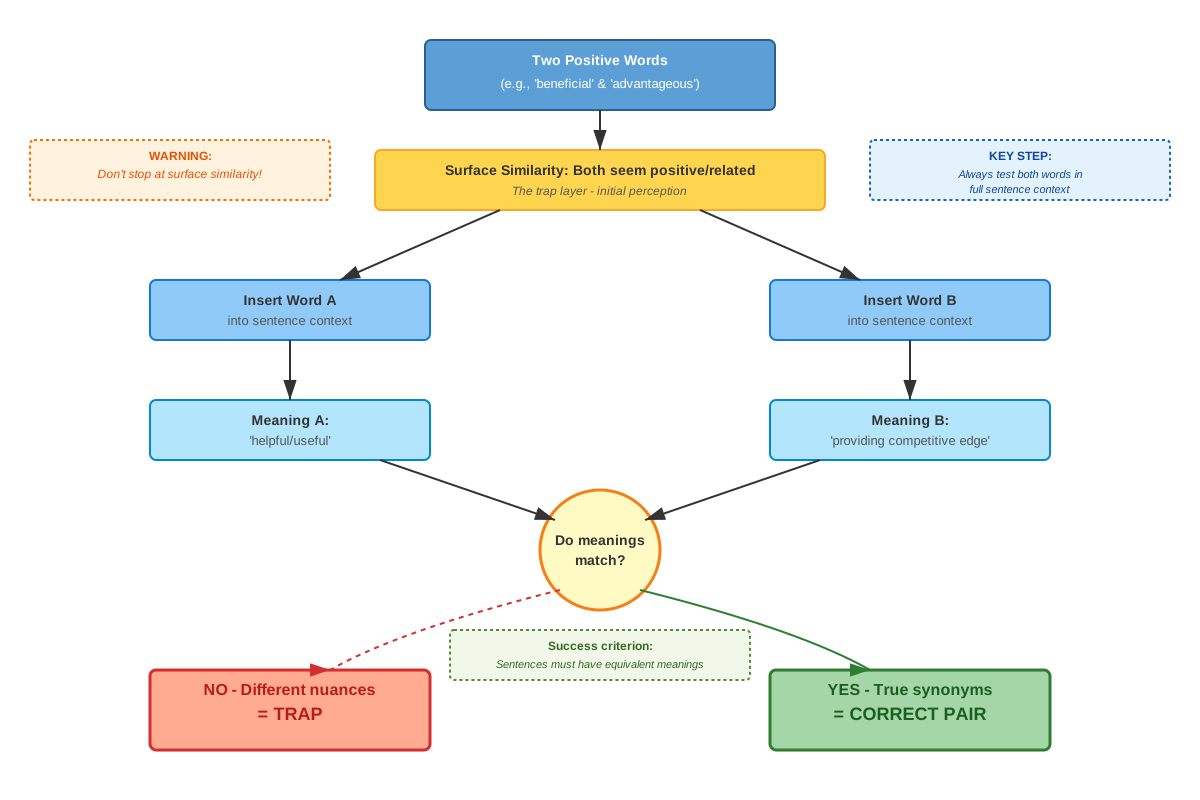
Double-positive traps are Sentence Equivalence questions where two answer choices share positive connotations and semantic similarity but fail to produce equivalent sentence meanings when substituted into the blank. The "trap" element lies in their superficial resemblance—both words seem appropriate at first glance, triggering the pattern-recognition response that "these words are similar, so they must be the answer pair."
The mechanism operates on three levels:
- Semantic overlap: The trap words share a common semantic field (e.g., both relate to intelligence, both suggest improvement, both indicate novelty)
- Connotation alignment: Both carry positive or neutral connotations, avoiding the obvious positive-negative distinction that would immediately disqualify one
- Contextual divergence: Despite their similarities, the words create different logical relationships or emphasize different aspects when placed in the sentence
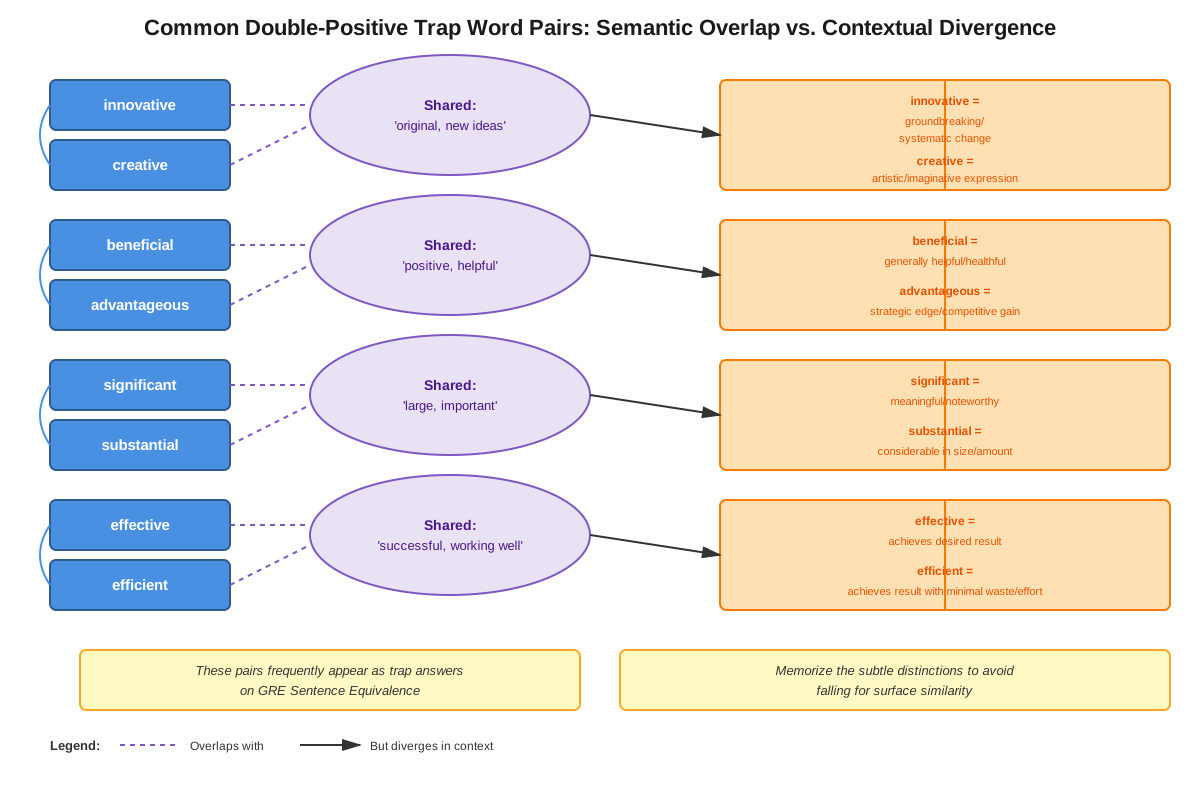
Consider the distinction between "beneficial" and "advantageous." Both are positive, both suggest something good or helpful. However, "beneficial" emphasizes inherent positive effects or contributions to well-being, while "advantageous" emphasizes strategic positioning or competitive edge. In a sentence about a medical treatment, "beneficial" fits naturally; in a sentence about a business decision, "advantageous" might be more precise. Using them interchangeably in a Sentence Equivalence question would create subtly different meanings.
The Synonym Versus Equivalence Distinction
A critical concept for avoiding double-positive traps is understanding that synonym status does not guarantee sentence equivalence. Two words can be synonyms in general usage while still producing non-equivalent sentences in specific contexts. This occurs because:
| Aspect | Synonyms | Sentence Equivalence |
|---|---|---|
| Relationship | Share core meaning across contexts | Must create identical meaning in THIS specific sentence |
| Flexibility | Can substitute in many situations | Must work in the exact grammatical and logical context provided |
| Nuance | May have different connotations or emphasis | Connotations and emphasis must align with sentence requirements |
| Evaluation | Dictionary-based relationship | Context-dependent functional relationship |
For example, "creative" and "innovative" are synonyms, but in the sentence "The scientist's _____ approach challenged fundamental assumptions in the field," "innovative" (suggesting new methods or ideas) fits better than "creative" (suggesting imagination or artistic originality). The sentence context demands a word emphasizing novelty in methodology, not artistic expression.
Contextual Constraint Analysis
Every Sentence Equivalence question contains contextual constraints—elements within the sentence that limit which words can appropriately fill the blank. These constraints include:
- Logical relationships: Cause-effect, contrast, support, or comparison structures that require specific semantic relationships
- Collocational patterns: Certain words naturally pair with others (e.g., "mitigate concerns" is more standard than "alleviate concerns" in formal contexts)
- Tone and register: Academic, formal, casual, or technical language levels that favor certain word choices
- Scope and intensity: The degree or extent of the quality being described
Double-positive traps exploit situations where two positive words meet some but not all contextual constraints. A student who checks only for positive connotation might miss that one word fits the logical relationship while the other doesn't.
The Verification Process
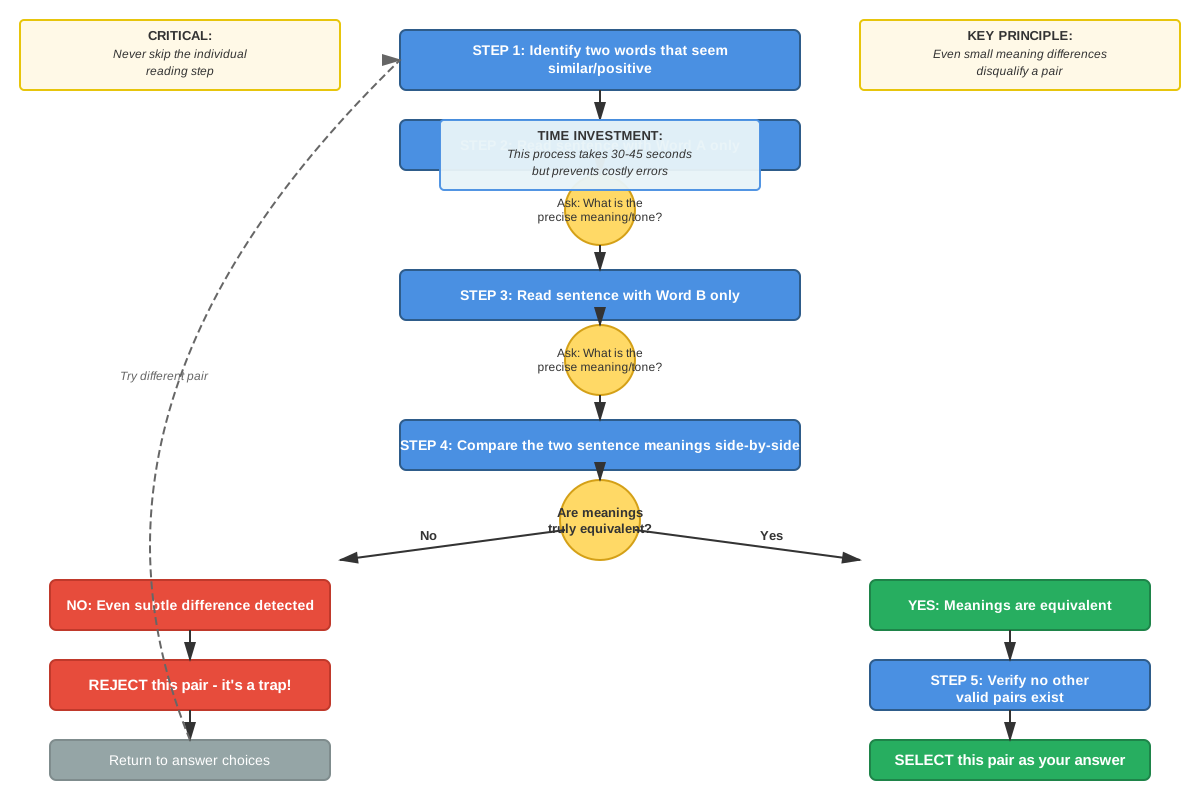
To avoid double-positive traps, students must implement a systematic verification process:
- Read the complete sentence and identify its main idea and logical structure
- Predict the blank based on context clues, noting the specific quality or relationship needed
- Evaluate each answer choice individually by substituting it into the sentence
- Select two candidates that seem to fit
- Test both candidates together by reading both complete sentences aloud or mentally
- Compare the meanings of the two resulting sentences—are they truly equivalent, or do subtle differences emerge?
- If differences exist, eliminate one candidate and test other combinations
This process prevents the premature commitment to answer choices based solely on their similarity to each other rather than their fit within the sentence.
Common Double-Positive Trap Categories
Certain word categories frequently appear in double-positive traps:
Intelligence/Ability Words: astute, clever, intelligent, shrewd, perceptive, discerning—all positive, but "shrewd" implies practical judgment, "astute" suggests keen perception, and "clever" can suggest ingenuity or even cunning.
Improvement/Change Words: enhance, improve, refine, augment, bolster—all suggest making something better, but "refine" emphasizes removing imperfections, "augment" emphasizes adding to, and "bolster" emphasizes strengthening support.
Novelty/Innovation Words: novel, innovative, original, unprecedented, unconventional—all suggest newness, but "unconventional" can carry implications of rule-breaking that "innovative" (suggesting positive new methods) doesn't share.
Practicality Words: pragmatic, practical, realistic, sensible, judicious—all suggest sound judgment, but "pragmatic" emphasizes results over principles, while "judicious" emphasizes careful wisdom.
Concept Relationships
The concept of double-positive traps connects directly to the fundamental principle of Sentence Equivalence: that answer choices must produce sentences with equivalent meanings, not merely similar words. This principle → requires → contextual analysis skills, which → depend on → vocabulary precision and understanding of connotation versus denotation.
Double-positive traps → exploit → the natural tendency toward pattern recognition, which → can override → careful contextual reading. Therefore, avoiding these traps → requires → developing verification habits that → ensure → both answer choices create truly equivalent sentences.
The relationship between synonyms and sentence equivalence forms the conceptual foundation: general synonyms → do not guarantee → contextual equivalence, which → means → students must → evaluate words within their specific sentence context rather than in isolation.
This topic also connects to broader Verbal Reasoning skills: the contextual constraint analysis used here → applies equally to → Text Completion questions, and the attention to nuance → enhances → Reading Comprehension performance, particularly on inference and tone questions.
High-Yield Facts
⭐ Double-positive traps feature two answer choices that share positive connotations and semantic similarity but create non-equivalent sentence meanings.
⭐ Synonym status in general usage does not guarantee that two words will produce equivalent sentences in a specific context.
⭐ The correct answer pair in Sentence Equivalence must create sentences with identical meanings, not just similar or related meanings.
⭐ Contextual constraints—logical relationships, tone, collocations, and scope—determine which words appropriately fill the blank.
⭐ Testing both candidate words by reading complete sentences is essential for verifying true equivalence.
- Double-positive traps most commonly appear in medium-to-hard Sentence Equivalence questions.
- Words describing intelligence, improvement, novelty, and practicality frequently appear in double-positive trap scenarios.
- The trap succeeds by triggering premature pattern recognition before complete contextual analysis.
- Subtle connotation differences between similar positive words often determine correctness.
- Reading both complete sentences aloud or mentally helps reveal meaning differences that aren't apparent when comparing words in isolation.
- Double-positive traps test vocabulary precision and contextual reasoning simultaneously.
- The verification process should take 30-45 seconds per Sentence Equivalence question to ensure accuracy.
Quick check — test yourself on Double-positive traps so far.
Try Flashcards →Common Misconceptions
Misconception: If two words are synonyms in the dictionary, they must be correct for Sentence Equivalence. → Correction: Dictionary synonyms share general meaning but may have different connotations, collocations, or contextual applications that make them non-equivalent in specific sentences. Sentence Equivalence requires contextual equivalence, not general synonym status.
Misconception: Both answer choices should be as similar as possible in meaning. → Correction: Both answer choices should create sentences with equivalent meanings, but the words themselves might be quite different. Sometimes the correct pair consists of words that seem less similar but produce truly equivalent sentences, while a more obviously similar pair creates subtle meaning differences.
Misconception: If both words are positive and fit grammatically, they're probably correct. → Correction: Grammatical fit and positive connotation are necessary but insufficient. The words must also match the sentence's logical relationships, tone, scope, and specific contextual requirements. Many double-positive traps feature grammatically correct, positive words that nonetheless create different meanings.
Misconception: The first two words that seem to work together are usually correct, so there's no need to check other combinations. → Correction: Double-positive traps are designed to make incorrect pairs seem obviously correct at first glance. Always test multiple combinations and verify that your chosen pair truly creates equivalent sentences before finalizing your answer.
Misconception: Subtle meaning differences don't matter as long as the general idea is similar. → Correction: The GRE specifically tests the ability to recognize subtle meaning differences. Even small distinctions in connotation, emphasis, or logical relationship make answer choices incorrect. "Close enough" is never correct on Sentence Equivalence questions.
Worked Examples
Example 1: The Innovation Trap
Question: The researcher's _____ methodology, which combined traditional techniques with cutting-edge technology, produced results that advanced the entire field.
Answer Choices:
(A) creative
(B) innovative
(C) unconventional
(D) groundbreaking
(E) artistic
(F) imaginative
Step 1: Analyze the context
The sentence describes a methodology that combines traditional and new approaches and produces field-advancing results. The blank requires a word that emphasizes the positive impact of introducing new methods while maintaining some connection to established practices.
Step 2: Identify potential candidates
"Creative" (A), "innovative" (B), "unconventional" (C), and "groundbreaking" (D) all seem positive and related to newness. This is a potential double-positive trap scenario.
Step 3: Evaluate contextual fit
- "Creative" emphasizes imagination and originality but doesn't specifically emphasize methodological advancement
- "Innovative" directly addresses new methods and approaches, fitting the "cutting-edge technology" reference
- "Unconventional" suggests breaking from norms, which could imply rejection of "traditional techniques" rather than combination
- "Groundbreaking" emphasizes revolutionary impact, fitting the "advanced the entire field" outcome
Step 4: Test combinations
Testing "innovative" and "groundbreaking": Both sentences emphasize that the methodology introduced significant positive change through new approaches. "Innovative" focuses on the newness of the method; "groundbreaking" focuses on the significance of the results. Both create equivalent meanings: the methodology was notably new/significant and produced important advances.
Testing "creative" and "innovative": "Creative methodology" emphasizes imaginative design, while "innovative methodology" emphasizes new approaches. These create subtly different emphases—one on imagination, one on novelty—making them non-equivalent.
Testing "innovative" and "unconventional": "Unconventional" could suggest the methodology was merely different or rule-breaking, without the positive advancement connotation that "innovative" carries. Non-equivalent.
Answer: (B) innovative and (D) groundbreaking
Learning Objective Connection: This example demonstrates identifying when double-positive traps are being tested (multiple positive words related to newness) and applying verification strategies to distinguish between similar words that create non-equivalent meanings.
Example 2: The Improvement Trap
Question: The editor's suggestions were _____ to the manuscript, transforming a competent draft into a compelling narrative that captured readers' attention.
Answer Choices:
(A) beneficial
(B) helpful
(C) instrumental
(D) advantageous
(E) crucial
(F) valuable
Step 1: Analyze the context
The sentence describes suggestions that caused a significant positive transformation from "competent" to "compelling." The blank needs a word that emphasizes the essential role these suggestions played in achieving this improvement.
Step 2: Identify the double-positive trap
All six words are positive and relate to being helpful or useful—a classic double-positive trap setup. The challenge is finding which two create equivalent meanings in this specific context.
Step 3: Evaluate intensity and causation
- "Beneficial" (A) means having positive effects but doesn't emphasize necessity or causation
- "Helpful" (B) suggests assistance but is relatively weak for a transformation this significant
- "Instrumental" (C) means serving as a crucial means to an end, emphasizing essential causation
- "Advantageous" (D) suggests providing an advantage or benefit but doesn't emphasize transformation
- "Crucial" (E) means extremely important or essential, emphasizing necessity
- "Valuable" (F) means having worth but doesn't emphasize causal role
Step 4: Test for equivalence
The sentence structure "were _____ to the manuscript, transforming..." suggests the suggestions didn't just help—they were essential to achieving the transformation.
Testing "instrumental" and "crucial": "The suggestions were instrumental to the manuscript, transforming..." and "The suggestions were crucial to the manuscript, transforming..." both convey that the suggestions were essential to achieving the transformation. These create equivalent meanings.
Testing "beneficial" and "helpful": Both suggest positive effects but don't capture the essential, transformative role emphasized by "transforming a competent draft into a compelling narrative." These are too weak for the context.
Testing "instrumental" and "beneficial": "Instrumental" emphasizes essential causation; "beneficial" merely indicates positive effects. Non-equivalent in this context.
Answer: (C) instrumental and (E) crucial
Learning Objective Connection: This example illustrates the core strategy of evaluating not just whether words are positive and related, but whether they match the specific intensity and logical relationship required by the sentence context.
Exam Strategy
Recognition Triggers
Watch for these signals that a double-positive trap may be present:
- Multiple positive answer choices in the same semantic field: When you see three or more words that all relate to intelligence, improvement, novelty, or other positive qualities, double-positive traps are likely.
- Sentences with strong logical relationships: Cause-effect, transformation, or comparison structures often host double-positive traps because they require precise logical fit, not just positive connotation.
- Abstract or evaluative content: Sentences describing people's qualities, policies' effects, or ideas' characteristics frequently feature double-positive traps.
Systematic Approach
Use this process for every Sentence Equivalence question:
- Read completely first (15 seconds): Never look at answer choices before understanding the sentence's complete meaning and logical structure.
- Predict the blank (5 seconds): Based on context, determine what quality, relationship, or concept the blank requires. This prediction serves as your evaluation standard.
- Eliminate obvious mismatches (10 seconds): Remove choices that clearly don't fit the context, wrong part of speech, or opposite meaning.
- Test remaining choices individually (10 seconds): Substitute each into the sentence and evaluate fit.
- Verify equivalence (10 seconds): Read both complete sentences with your chosen pair and confirm they mean the same thing.
Exam Tip: If two words seem "too obviously" similar, pause and verify carefully. The GRE rarely makes correct answers obvious, so apparent synonym pairs warrant extra scrutiny.
Process of Elimination Specific to Double-Positive Traps
- Eliminate words that match only surface features: If a word shares the positive connotation but doesn't fit the logical relationship, eliminate it even if it seems related to other choices.
- Beware of intensity mismatches: Words that are too strong or too weak for the context create non-equivalent meanings even if they're in the same semantic field.
- Check collocational naturalness: Some word combinations sound awkward or unnatural in formal academic English. Trust your ear—if a combination sounds off, it probably is.
- Test the "swap test": If you can't swap your two chosen words in other contexts and maintain similar meanings, they're probably not equivalent in this context either.
Time Allocation
Allocate 60-75 seconds per Sentence Equivalence question. Spending an extra 10-15 seconds on verification prevents the costly error of falling for double-positive traps. Missing a question due to a trap costs more time than you save by rushing.
Memory Techniques
The CONTEXT Acronym
Use CONTEXT to remember the verification process:
- Complete the sentence reading first
- Observe logical relationships and tone
- Note your prediction for the blank
- Test each candidate individually
- Evaluate pairs for true equivalence
- X-out (eliminate) choices that create different meanings
- Trust the verification process, not first impressions
The "Twin Test" Visualization
Imagine the two sentences created by your answer choices as identical twins. If you can spot any difference in their "appearance" (meaning), they're not truly identical, and your answer is wrong. This visualization reinforces that "similar" isn't sufficient—only "identical in meaning" counts.
The Synonym Trap Reminder
Remember: "Synonyms in the dictionary ≠ Equivalence in the sentence"
Visualize a dictionary and a specific sentence as two different contexts. Words that are interchangeable in the dictionary's general context may not be interchangeable in the sentence's specific context.
Common Trap Word Pairs to Memorize
Memorize these frequently-appearing double-positive trap pairs and their key distinctions:
- Innovative vs. Creative: Innovative = new methods; Creative = imaginative design
- Pragmatic vs. Practical: Pragmatic = results-focused; Practical = sensibly applicable
- Beneficial vs. Advantageous: Beneficial = inherently helpful; Advantageous = strategically favorable
- Astute vs. Shrewd: Astute = perceptively intelligent; Shrewd = practically clever
- Enhance vs. Augment: Enhance = improve quality; Augment = increase quantity/size
Summary
Double-positive traps represent a sophisticated GRE Sentence Equivalence question type that tests vocabulary precision and contextual reasoning by presenting answer choices that share positive connotations and semantic similarity but fail to produce equivalent sentence meanings. These traps succeed by exploiting test-takers' tendency toward pattern recognition and superficial synonym matching rather than deep contextual analysis. The key to avoiding these traps lies in understanding that synonym status in general usage does not guarantee contextual equivalence in specific sentences. Students must implement a systematic verification process: reading the complete sentence, identifying contextual constraints (logical relationships, tone, collocations, and scope), testing individual answer choices, and most critically, verifying that both chosen words create sentences with truly identical meanings. Common trap categories include words describing intelligence, improvement, novelty, and practicality, where subtle connotation differences determine correctness. Mastering double-positive traps requires moving beyond the question "Are these words similar?" to "Do these words create equivalent meanings in this specific context?"—a distinction that separates good test-takers from excellent ones.
Key Takeaways
- Double-positive traps feature semantically similar, positive-connotation words that create non-equivalent sentence meanings despite their surface similarity.
- Sentence Equivalence requires contextual equivalence, not general synonym status—dictionary synonyms may not work interchangeably in specific sentences.
- Always verify equivalence by reading both complete sentences and comparing their meanings, not just comparing the words in isolation.
- Contextual constraints—logical relationships, tone, collocations, intensity, and scope—determine which words appropriately fill the blank.
- Common trap categories include intelligence/ability words, improvement/change words, novelty/innovation words, and practicality words, each with subtle but important distinctions.
- The systematic verification process (read completely, predict, test individually, verify equivalence) prevents premature commitment to superficially similar answer pairs.
- Spending an extra 10-15 seconds on verification is worthwhile—falling for double-positive traps costs more than the time saved by rushing.
Related Topics
Text Completion Strategy: Mastering double-positive traps enhances Text Completion performance by developing the contextual analysis skills needed to select words that fit precise logical relationships rather than general semantic fields.
Vocabulary in Context: Understanding how connotation, register, and collocational patterns affect word choice builds on the contextual constraint analysis central to avoiding double-positive traps.
Reading Comprehension Inference Questions: The attention to subtle meaning distinctions required for double-positive traps directly transfers to inference questions, where distinguishing between what's stated and what's implied requires similar precision.
Synonym and Antonym Recognition: While double-positive traps show that synonyms don't guarantee equivalence, understanding synonym relationships remains foundational for efficiently eliminating incorrect answer choices.
Practice CTA
Now that you understand the mechanics of double-positive traps and have learned systematic strategies for avoiding them, it's time to put this knowledge into practice. Attempt the practice questions designed specifically for this topic, paying special attention to implementing the verification process and testing for true equivalence rather than surface similarity. Use the flashcards to reinforce your understanding of common trap word pairs and their subtle distinctions. Remember: recognizing these traps is a learnable skill that improves with deliberate practice. Each question you work through strengthens your ability to distinguish between superficial similarity and true contextual equivalence—a skill that will serve you not just on test day, but throughout your graduate studies and professional career. You've got this!
Sign up free to keep reading
Create a free AnvayaPrep account to finish this GRE guide on Double-positive traps — plus flashcards and practice questions.