Overview
The non-equivalent synonym trap represents one of the most sophisticated and frequently encountered challenges in GRE Sentence Equivalence questions. This trap exploits test-takers' natural tendency to select answer choices based on superficial word similarity rather than contextual meaning. In Sentence Equivalence questions, students must choose two words that both complete the sentence with equivalent meanings, creating sentences that are alike in meaning. The non-equivalent synonym trap deliberately places two words that appear synonymous in isolation but produce different meanings when inserted into the specific sentence context. This design tests not merely vocabulary knowledge but the ability to discern subtle semantic distinctions and contextual appropriateness—skills essential for graduate-level reading comprehension.
Understanding and avoiding this trap is crucial for GRE success because Sentence Equivalence questions constitute approximately one-third of the Verbal Reasoning section's scored questions. The GRE non-equivalent synonym trap appears in roughly 40-50% of Sentence Equivalence questions, making it the single most common wrong-answer pattern test-makers employ. Students who fail to recognize this trap often select answer pairs that seem correct due to their dictionary definitions being similar, only to discover they've chosen words that create subtly different sentence meanings. This error pattern significantly impacts scores because it represents systematic rather than random mistakes.
The non-equivalent synonym trap connects directly to broader Verbal Reasoning competencies, particularly nuanced vocabulary understanding, contextual analysis, and semantic precision. Mastering this concept strengthens performance across Reading Comprehension passages where subtle meaning distinctions determine correct answers, and it reinforces the critical skill of evaluating words within their specific linguistic environments rather than in abstract isolation. This topic serves as a bridge between pure vocabulary knowledge and applied reading comprehension, embodying the GRE's emphasis on sophisticated language use rather than rote memorization.
Learning Objectives
- [ ] Identify when non-equivalent synonym trap is being tested in Sentence Equivalence questions
- [ ] Explain the core rule or strategy behind non-equivalent synonym trap recognition and avoidance
- [ ] Apply non-equivalent synonym trap awareness to GRE-style questions accurately
- [ ] Distinguish between true synonyms and context-dependent near-synonyms in sentence contexts
- [ ] Evaluate answer choice pairs for semantic equivalence after sentence insertion
- [ ] Recognize common word pairs that frequently appear in non-equivalent synonym traps
- [ ] Develop systematic verification procedures to confirm answer choice equivalence
Prerequisites
- Basic vocabulary knowledge: Understanding common GRE-level words is necessary to recognize when words appear similar but carry different connotations or denotations
- Sentence structure comprehension: Ability to parse sentence grammar helps identify how different word choices affect overall meaning
- Synonym and antonym relationships: Familiarity with word relationships provides the foundation for understanding why some synonyms work in specific contexts while others don't
- Sentence Equivalence question format: Knowledge of the two-answer requirement and scoring system (both must be correct for credit) establishes why trap answers are strategically placed
Why This Topic Matters
The non-equivalent synonym trap matters because it directly addresses the GRE's core assessment goal: measuring readiness for graduate-level academic work where precise language interpretation is essential. Graduate students must distinguish between subtly different arguments, recognize nuanced positions in scholarly debates, and communicate with exactitude. The ability to identify when two seemingly similar words create different meanings reflects this critical academic skill.
From an exam statistics perspective, Sentence Equivalence questions appear 6-8 times per Verbal Reasoning section, and the non-equivalent synonym trap features in approximately 3-4 of these questions per section. This frequency means that mastering this trap avoidance can directly improve scores by 3-4 raw points per section, translating to several points on the 130-170 scaled score. Given that many competitive graduate programs have Verbal score cutoffs, these points often make the difference between admission and rejection.
The trap appears most commonly in medium-to-hard difficulty questions where the sentence context requires careful analysis. Test-makers typically place the trap answers in positions that maximize their appeal: often as choices (B) and (D) or (C) and (E), positions where students' eyes naturally gravitate after eliminating obviously incorrect answers. The sentences themselves usually contain subtle contextual clues—such as tone indicators, logical connectors, or specific collocations—that distinguish which synonym pair truly maintains equivalent meaning. Questions featuring this trap often involve words with overlapping semantic fields but different connotations (formal vs. informal, positive vs. neutral, literal vs. figurative) or different intensities of meaning.
Core Concepts
The Fundamental Mechanism of the Trap
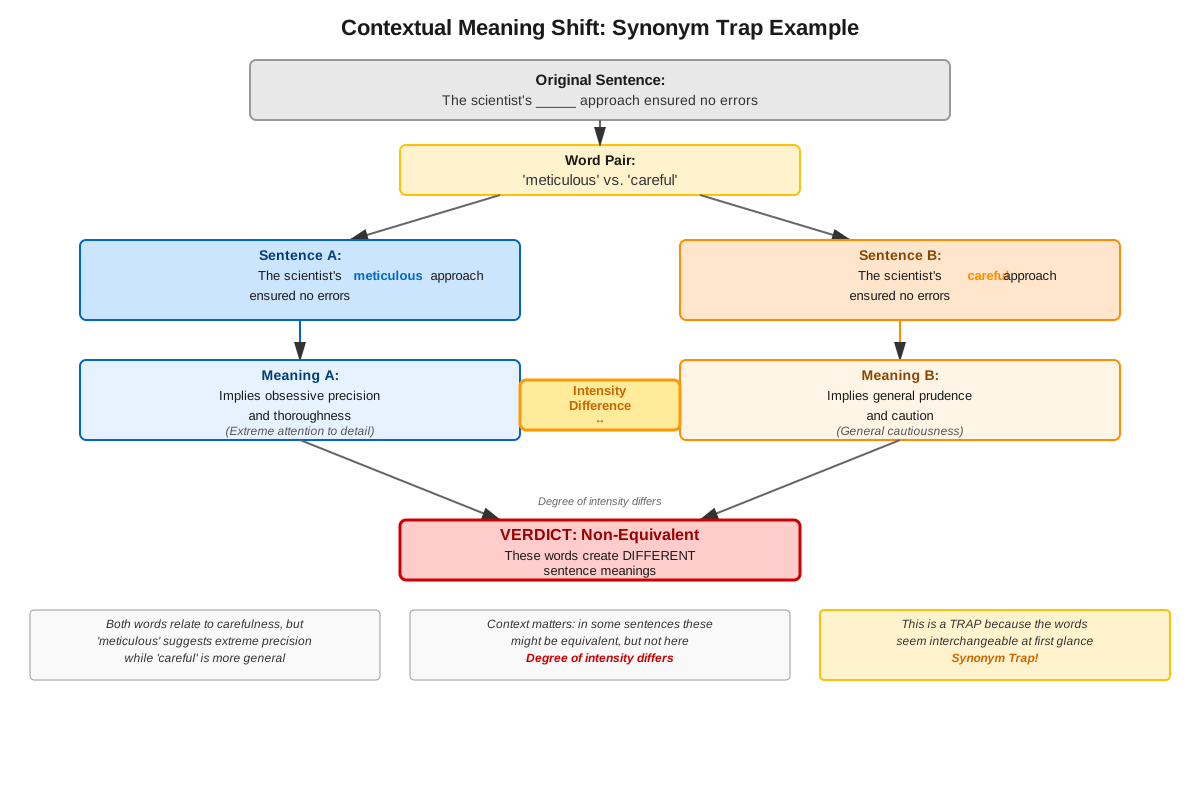
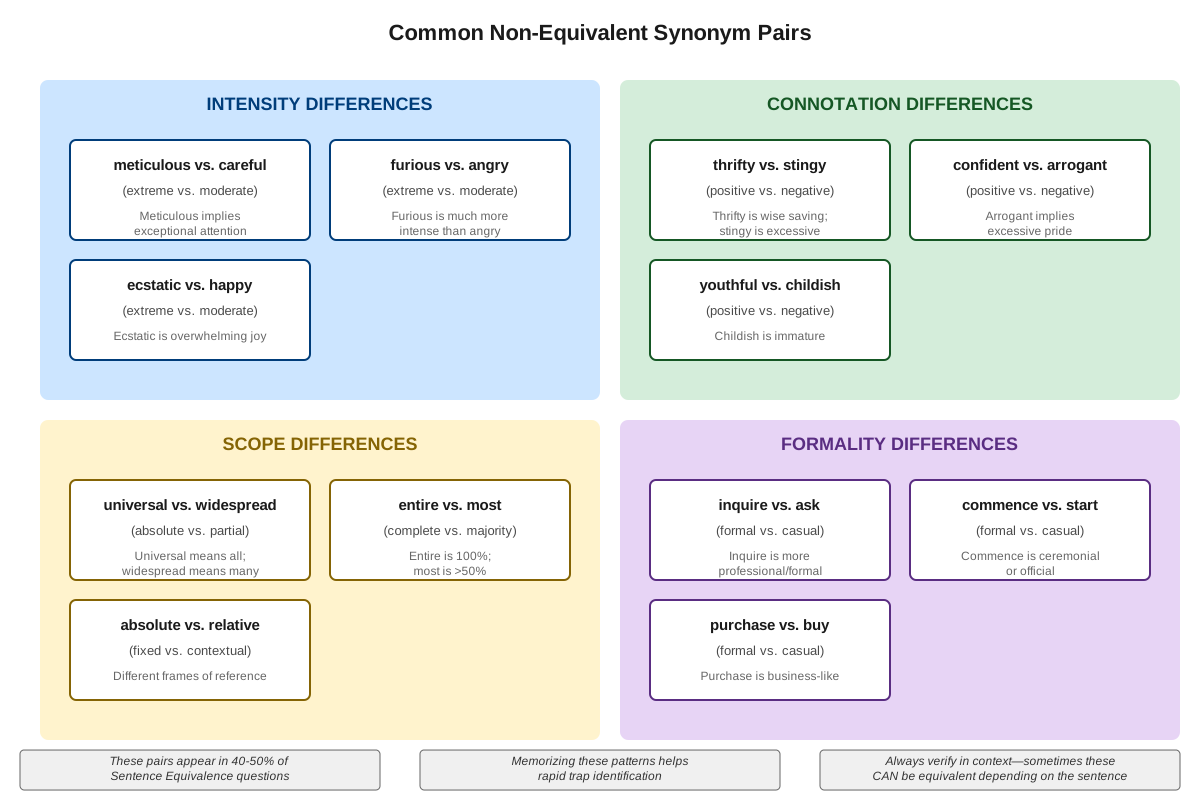
The non-equivalent synonym trap operates on a simple but powerful principle: two words can be synonyms in general usage while producing non-equivalent meanings in a specific sentence context. The trap exploits the gap between decontextualized similarity (how words relate in a dictionary or thesaurus) and contextualized equivalence (how words function within a particular sentence). Test-makers deliberately select word pairs that share semantic overlap but diverge in one or more critical dimensions: connotation, intensity, formality register, literal versus figurative usage, or collocational restrictions.
For example, "angry" and "furious" are synonyms denoting displeasure, but they differ in intensity. In a sentence describing someone's "mild reaction to a minor inconvenience," only "angry" would work; "furious" would create a different, more extreme meaning. Similarly, "old" and "ancient" both refer to age, but "ancient" carries connotations of historical significance or extreme age that "old" lacks. A sentence about "an _____ tradition dating back thirty years" would accept "old" but not "ancient," as thirty years doesn't qualify as ancient in most contexts.
Contextual Clues That Reveal True Equivalence
Successful trap avoidance requires identifying contextual determiners—sentence elements that constrain which synonyms produce equivalent meanings. These determiners include:
Intensity markers: Words like "slightly," "somewhat," "extremely," or "utterly" signal the required intensity level. A sentence with "slightly _____ by the comment" would accept "annoyed" or "bothered" but not "enraged" or "infuriated," even though all four words relate to negative reactions.
Tone indicators: Formal versus informal register matters. Academic or professional contexts require formal vocabulary, while casual contexts may require informal choices. "The scholar's _____ analysis" would pair "meticulous" with "thorough" but not with "picky" or "nitpicky," despite their semantic similarity.
Logical relationships: Conjunctions and transition words establish logical connections that constrain meaning. "Although the evidence was _____, the jury convicted" requires words suggesting weakness or insufficiency, but the specific type matters—"sparse" and "limited" work equivalently, while "sparse" and "questionable" create different logical relationships.
Collocational patterns: Certain words naturally combine with specific other words. "A _____ lie" accepts "blatant" and "flagrant" (both collocate with "lie"), but "obvious" and "clear," while synonymous with "blatant" in other contexts, don't create the same idiomatic force.
The Verification Process
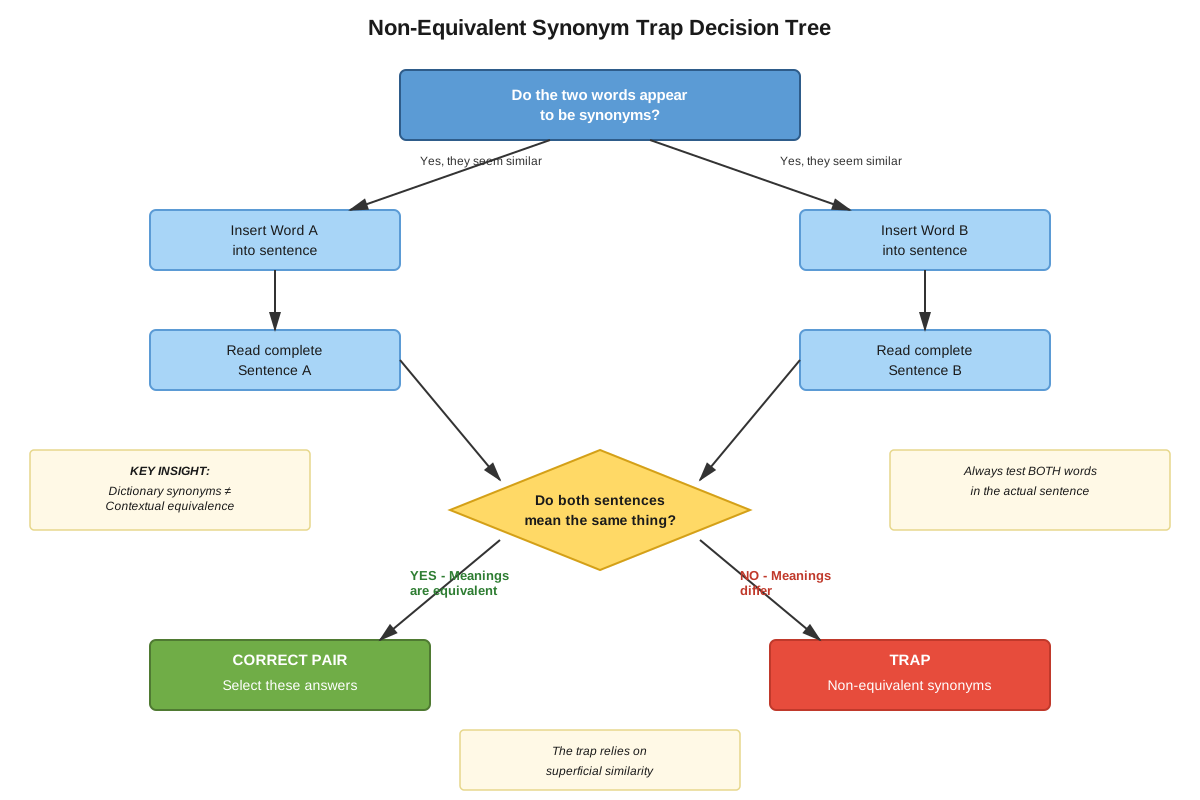
After selecting two answer choices, students must perform a semantic equivalence check by mentally inserting each word separately and comparing the resulting sentence meanings. This process involves three steps:
- Individual insertion: Read the complete sentence with the first word choice, noting the specific meaning, tone, and implications created
- Comparative insertion: Read the complete sentence with the second word choice, noting its meaning, tone, and implications
- Equivalence evaluation: Determine whether the two sentences convey the same essential meaning, not just similar meanings
The key distinction lies between "similar" and "equivalent." Similar meanings share semantic territory but may differ in nuance; equivalent meanings are interchangeable without changing the sentence's core message. For GRE purposes, equivalent means a reader would understand the same essential information from both sentences.
Common Trap Patterns
| Trap Pattern | Description | Example Word Pair | Why They're Non-Equivalent |
|---|---|---|---|
| Intensity mismatch | Words differ in degree or strength | "concerned" vs. "alarmed" | Different levels of worry |
| Connotation shift | Words carry different emotional associations | "thrifty" vs. "cheap" | Positive vs. negative connotation |
| Formality register | Words differ in formal/informal usage | "intoxicated" vs. "drunk" | Formal vs. colloquial |
| Literal vs. figurative | One word used literally, another figuratively | "bright" vs. "intelligent" | Physical vs. mental quality |
| Scope difference | Words cover different ranges of meaning | "old" vs. "ancient" | General age vs. extreme age |
| Precision level | Words differ in specificity | "said" vs. "whispered" | General vs. specific manner |
The Role of Distractors
Test-makers strategically position non-equivalent synonyms as paired distractors—two answer choices that appear to work together because of their surface similarity. These distractors serve multiple purposes: they appeal to students who rely on vocabulary knowledge alone without contextual analysis, they punish speed-reading without careful verification, and they distinguish between students who understand nuanced meaning versus those who recognize only basic definitions.
The most effective distractors are words that would be correct synonyms in many contexts but not in the specific sentence provided. This design ensures that students with strong vocabulary knowledge aren't automatically advantaged; they must also demonstrate contextual reasoning. For instance, "mitigate" and "alleviate" are near-perfect synonyms in most medical or problem-solving contexts, but in a sentence about "_____ the severity of the punishment," only "mitigate" works idiomatically, as "mitigate" specifically collocates with legal and punishment contexts in ways "alleviate" doesn't.
Concept Relationships
The non-equivalent synonym trap concept connects internally through a logical progression: understanding the trap mechanism → recognizing contextual clues → applying the verification process → identifying common trap patterns → avoiding paired distractors. Each element builds on the previous one, creating a comprehensive defense strategy.
This topic relates directly to prerequisite knowledge of synonym relationships by extending basic synonym understanding into contextual application. While prerequisite knowledge establishes that words can have similar meanings, this topic teaches that similarity doesn't guarantee equivalence in specific contexts. The relationship flows: basic synonyms (prerequisite) → contextual constraints (this topic) → verified equivalence (this topic's goal).
The concept also connects forward to broader Verbal Reasoning skills. Mastering the non-equivalent synonym trap strengthens Reading Comprehension performance by training students to notice subtle meaning distinctions in passages. It enhances Text Completion skills by reinforcing the importance of contextual fit over isolated word knowledge. The relationship map appears as:
Vocabulary Knowledge → Synonym Recognition → Contextual Analysis → Non-Equivalent Synonym Trap Awareness → Sentence Equivalence Mastery → Enhanced Reading Comprehension → Overall Verbal Reasoning Excellence
Additionally, the verification process taught in this topic parallels critical thinking skills required throughout the GRE: hypothesis formation (selecting potential answers) → testing (inserting words) → evaluation (checking equivalence) → conclusion (confirming or rejecting choices). This methodological approach transfers to Analytical Writing and even Quantitative Reasoning problem-solving.
High-Yield Facts
⭐ The non-equivalent synonym trap appears in approximately 40-50% of all Sentence Equivalence questions, making it the most common wrong-answer pattern.
⭐ Two words can be perfect synonyms in isolation but create non-equivalent meanings in specific sentence contexts due to connotation, intensity, formality, or collocational differences.
⭐ Always verify answer choices by mentally reading the complete sentence with each word separately and comparing the resulting meanings, not just the words themselves.
⭐ Intensity mismatches (e.g., "concerned" vs. "alarmed") represent the most frequent type of non-equivalent synonym trap on the GRE.
⭐ Contextual clues such as intensity markers, tone indicators, logical connectors, and collocational patterns reveal which synonyms produce equivalent meanings.
- Words with different connotations (positive, negative, or neutral) cannot create equivalent sentence meanings even if their denotations overlap.
- Formal versus informal register differences disqualify otherwise synonymous words from being correct answer pairs in context-specific sentences.
- The GRE never requires obscure vocabulary knowledge to distinguish non-equivalent synonyms; the distinctions are always based on standard usage patterns.
- Paired distractors are strategically placed to appeal to students who recognize vocabulary but don't verify contextual equivalence.
- The verification process should take 10-15 seconds per answer pair and is essential even when words seem obviously synonymous.
- Common trap word pairs include: "old/ancient," "angry/furious," "thrifty/cheap," "said/whispered," "bright/intelligent," and "mitigate/alleviate."
- Sentences containing subtle contextual clues (specific time frames, intensity markers, formal contexts) are most likely to feature non-equivalent synonym traps.
Quick check — test yourself on Non-equivalent synonym trap so far.
Try Flashcards →Common Misconceptions
Misconception: If two words are synonyms in the dictionary or thesaurus, they will always work as correct answer pairs in Sentence Equivalence questions.
Correction: Dictionary synonyms share general meaning but often differ in connotation, intensity, formality, or collocational patterns. Context determines whether synonyms are equivalent in a specific sentence. Always verify by reading the complete sentence with each word.
Misconception: The correct answer pair will always be the two words that are most similar to each other among the six choices.
Correction: The correct pair creates equivalent sentence meanings, which may involve words that seem less obviously related than trap answer pairs. Test-makers deliberately make trap pairs appear more similar to distract from the truly equivalent pair.
Misconception: If both words in a pair make grammatically correct sentences, they must be the right answer.
Correction: Grammatical correctness is necessary but insufficient. Both words must create sentences with equivalent meanings, not just grammatically acceptable sentences. Many trap answers produce grammatically perfect but semantically different sentences.
Misconception: Advanced vocabulary knowledge alone is sufficient to avoid the non-equivalent synonym trap.
Correction: While vocabulary knowledge helps, avoiding this trap requires contextual analysis skills. Students with extensive vocabulary often fall for this trap because they recognize the synonym relationship but fail to verify contextual equivalence. The trap specifically targets students who rely on vocabulary alone.
Misconception: The verification process takes too much time and should be skipped when words seem obviously correct.
Correction: The verification process takes only 10-15 seconds and prevents costly errors. Questions featuring non-equivalent synonym traps are designed to make trap answers seem obviously correct. The time invested in verification yields higher accuracy and better scores.
Misconception: If two words have the same emotional tone (both positive or both negative), they will create equivalent meanings.
Correction: Emotional tone is only one dimension of meaning. Words with the same general tone can differ in intensity, formality, specificity, or collocational patterns, creating non-equivalent meanings. For example, "pleased" and "ecstatic" are both positive but differ dramatically in intensity.
Worked Examples
Example 1: Intensity Mismatch Trap
Question: The critic's review was surprisingly _____, considering her typically harsh assessments of new restaurants.
(A) positive
(B) glowing
(C) favorable
(D) complimentary
(E) enthusiastic
(F) laudatory
Step 1 - Initial Analysis: The sentence establishes a contrast ("surprisingly") between this review and the critic's "typically harsh assessments." We need words meaning positive/praising that create equivalent sentences.
Step 2 - Identify Potential Pairs: Several words relate to positive assessment: (A) positive, (B) glowing, (C) favorable, (D) complimentary, (E) enthusiastic, (F) laudatory. The trap here involves intensity levels.
Step 3 - Contextual Clue Recognition: The word "surprisingly" signals a notable contrast with "typically harsh." This suggests we need words indicating clearly positive reviews, but the question is: how positive? The phrase "typically harsh" suggests the critic is known for negativity, so any positive review would be surprising. However, we must find two words that create the same degree of surprise.
Step 4 - Verification Process:
- "The review was surprisingly positive" - suggests a shift from negative to positive (moderate intensity)
- "The review was surprisingly glowing" - suggests an extremely positive review (high intensity)
- "The review was surprisingly favorable" - suggests a shift from negative to positive (moderate intensity)
- "The review was surprisingly complimentary" - suggests positive remarks (moderate intensity)
- "The review was surprisingly enthusiastic" - suggests strong positive emotion (high intensity)
- "The review was surprisingly laudatory" - suggests high praise (high intensity)
Step 5 - Trap Identification: The non-equivalent synonym trap appears with pairs like (B) glowing and (E) enthusiastic. While both are synonyms meaning "very positive," they create slightly different meanings: "glowing" emphasizes the quality of praise, while "enthusiastic" emphasizes emotional energy. More importantly, both are high-intensity words that might seem to pair together.
However, the truly equivalent pair is (A) positive and (C) favorable. Both create moderate-intensity positive meanings that contrast appropriately with "typically harsh" without overstating the case. They're interchangeable in this context: both indicate the review was good (surprising given her usual harshness) without specifying extreme praise.
Key Lesson: Don't automatically pair the most similar-seeming words. Verify that both create truly equivalent sentence meanings by considering intensity levels and contextual appropriateness.
Example 2: Connotation and Register Trap
Question: Despite the company's efforts to appear transparent, its financial disclosures remained _____, leaving investors uncertain about its true fiscal health.
(A) unclear
(B) vague
(C) murky
(D) opaque
(E) obscure
(F) ambiguous
Step 1 - Initial Analysis: The sentence contrasts "efforts to appear transparent" with the actual state of financial disclosures, which left investors "uncertain." We need words meaning "not clear" that create equivalent meanings.
Step 2 - Identify Potential Pairs: All six words relate to lack of clarity: (A) unclear, (B) vague, (C) murky, (D) opaque, (E) obscure, (F) ambiguous. This is a sophisticated trap because all words are genuine synonyms in many contexts.
Step 3 - Contextual Clue Recognition: The context is formal business/financial writing ("financial disclosures," "fiscal health"). The sentence also establishes a direct contrast with "transparent," suggesting we need a word that specifically opposes transparency. Additionally, "leaving investors uncertain" indicates the lack of clarity is problematic and possibly intentional.
Step 4 - Verification Process:
- "disclosures remained unclear" - general lack of clarity (neutral, somewhat informal)
- "disclosures remained vague" - lacking specificity or detail (neutral, suggests possible intentionality)
- "disclosures remained murky" - unclear with negative connotation, suggests something hidden (informal metaphor)
- "disclosures remained opaque" - impossible to see through, direct opposite of transparent (formal, technical)
- "disclosures remained obscure" - difficult to understand or hidden from view (formal, but suggests complexity rather than deliberate hiding)
- "disclosures remained ambiguous" - open to multiple interpretations (formal, neutral)
Step 5 - Trap Identification: The trap pairs might include (A) unclear and (B) vague, which seem like obvious synonyms. However, "unclear" is too informal for this business context, and "vague" emphasizes lack of detail rather than lack of transparency.
Another trap is (C) murky and (D) opaque, which both suggest inability to see through something. However, "murky" is metaphorical and informal (literally meaning "dark and dirty water"), while "opaque" is the technical, formal term directly opposing "transparent."
Correct Answer: (D) opaque and (F) ambiguous. Both are formal register words appropriate for business contexts. "Opaque" directly contrasts with "transparent" (both are technical terms about visibility/clarity), while "ambiguous" indicates the disclosures could be interpreted multiple ways, leaving investors uncertain. Both create equivalent meanings: the disclosures don't provide clear information, leaving investors unable to determine the company's true financial state.
Key Lesson: In formal contexts, register matters significantly. Words must match the formality level and use appropriate technical or domain-specific vocabulary. Additionally, consider which words create the most precise contrast with other terms in the sentence.
Exam Strategy
Systematic Approach to Sentence Equivalence Questions
When approaching any Sentence Equivalence question, implement this four-phase strategy to avoid the non-equivalent synonym trap:
Phase 1 - Context Analysis (15-20 seconds): Before looking at answer choices, read the sentence carefully and predict the general meaning needed. Identify contextual clues: intensity markers, tone indicators, logical connectors, time frames, and formal/informal register. Note any words that create specific collocational expectations.
Phase 2 - Initial Screening (10-15 seconds): Quickly eliminate answer choices that clearly don't fit the sentence meaning or create grammatically incorrect sentences. This typically eliminates 2-3 choices, leaving 3-4 viable options.
Phase 3 - Pair Testing (20-30 seconds): Identify potential pairs among remaining choices. Look for words that seem synonymous, but don't commit yet. This is where the trap appears most dangerous—resist the urge to select the first pair that seems synonymous.
Phase 4 - Verification (15-20 seconds): For each potential pair, mentally read the complete sentence twice—once with each word—and compare the resulting meanings. Ask: "Do these sentences convey the same essential information, or do they differ in intensity, connotation, specificity, or implication?" Only select the pair that creates truly equivalent meanings.
Trigger Words and Phrases
Watch for these contextual triggers that signal potential non-equivalent synonym traps:
- Intensity markers: "slightly," "somewhat," "extremely," "utterly," "barely," "profoundly" - these demand specific intensity levels
- Contrast indicators: "although," "despite," "however," "surprisingly," "yet" - these establish relationships that constrain word choice
- Formal contexts: "academic," "scholarly," "professional," "official," "technical" - these require formal register vocabulary
- Emotional contexts: "angry," "pleased," "disappointed," "excited" - these establish emotional tone that must be matched
- Temporal specificity: "ancient," "recent," "momentary," "enduring" - these establish time frames that constrain meaning
- Degree modifiers: "very," "quite," "rather," "fairly," "exceptionally" - these signal required intensity matching
Process-of-Elimination Tips
When using process of elimination, apply these trap-specific strategies:
- Eliminate intensity mismatches first: If the sentence contains intensity markers, immediately eliminate words that don't match the required intensity level, even if they're synonyms of words that do match.
- Check register consistency: In formal contexts, eliminate informal words; in casual contexts, eliminate overly formal words. This often eliminates one word from a trap pair.
- Test collocational fit: Say the phrase aloud (mentally) with each word. If it sounds unnatural or unidiomatic, eliminate that choice even if it's technically synonymous with other options.
- Beware of "obvious" pairs: If two words seem obviously synonymous and jump out as the clear answer, pause and verify carefully. Test-makers know which synonym pairs students recognize most readily and often use these as traps.
- Consider connotation carefully: Eliminate words whose positive/negative/neutral connotation doesn't match the sentence tone, even if their denotations fit.
Time Allocation
Allocate approximately 60-75 seconds per Sentence Equivalence question:
- Context analysis: 15-20 seconds
- Initial screening: 10-15 seconds
- Pair testing: 20-30 seconds
- Verification: 15-20 seconds
The verification phase is non-negotiable. Students who skip verification to save time actually lose time by missing questions and having to return to them later, or worse, by confidently selecting wrong answers. The 15-20 seconds spent on verification yields the highest return on time investment of any phase.
Exam Tip: If you're uncertain between two potential pairs, always choose the pair whose words are less obviously synonymous. Test-makers rarely make the correct answer the most obvious synonym pair; they save obvious pairs for traps.
Memory Techniques
The CIVIC Mnemonic
Remember CIVIC to check for non-equivalent synonym traps:
- Connotation: Do both words carry the same emotional association (positive/negative/neutral)?
- Intensity: Do both words express the same degree or strength of meaning?
- Verification: Have you read the complete sentence with each word separately?
- Idiom: Do both words form natural collocations with surrounding words?
- Context: Do both words match the formality register and tone of the sentence?
Visualization Strategy
Visualize a synonym spectrum for each set of related words. Place words along a line from weak to strong, informal to formal, or negative to positive. For example:
Intensity Spectrum for "angry":
annoyed — irritated — angry — furious — enraged — livid

Formality Spectrum for "drunk":
wasted — drunk — intoxicated — inebriated
When you encounter potential synonym pairs, visualize where each word falls on the relevant spectrum. If they occupy different positions, they're likely non-equivalent in context.
The "Swap Test" Acronym
Use SWAP to remember the verification process:
- Substitute the first word into the sentence
- Write (mentally) the complete meaning that results
- Alternate to the second word and substitute it
- Parallel check: Are the two meanings truly equivalent?
Pattern Recognition Memory Aid
Remember common trap patterns with this phrase: "Intensity Isn't Connotation, Formality Isn't Literalness" (IICFIL). This reminds you that:
- Intensity differences create non-equivalence
- Idiom/collocation matters
- Connotation differences create non-equivalence
- Formality register differences create non-equivalence
- Literal vs. figurative usage creates non-equivalence
Summary
The non-equivalent synonym trap represents the most prevalent and sophisticated wrong-answer pattern in GRE Sentence Equivalence questions, appearing in approximately 40-50% of these questions. This trap exploits the distinction between decontextualized synonym relationships and contextualized semantic equivalence by presenting word pairs that are synonymous in general usage but create different meanings in the specific sentence provided. Success requires moving beyond vocabulary recognition to contextual analysis, identifying how intensity, connotation, formality register, collocational patterns, and other contextual factors constrain which synonyms produce truly equivalent meanings. The systematic approach involves four phases: context analysis to identify constraining factors, initial screening to eliminate clearly wrong choices, pair testing to identify potential answers, and verification to confirm true equivalence by mentally reading complete sentences with each word and comparing meanings. Mastering this trap avoidance strategy directly improves Sentence Equivalence performance and strengthens broader Verbal Reasoning skills by training precise attention to semantic nuance and contextual meaning—exactly the sophisticated language skills the GRE aims to assess.
Key Takeaways
- The non-equivalent synonym trap appears in 40-50% of Sentence Equivalence questions, making it the most important trap pattern to master
- Two words can be perfect synonyms in isolation while creating non-equivalent meanings in specific sentence contexts due to differences in intensity, connotation, formality, or collocational patterns
- Always verify answer pairs by mentally reading the complete sentence with each word separately and comparing the resulting meanings, not just the words themselves
- Contextual clues—intensity markers, tone indicators, logical connectors, and collocational patterns—reveal which synonyms produce equivalent meanings in specific sentences
- The most common trap patterns involve intensity mismatches, connotation shifts, formality register differences, and literal versus figurative usage distinctions
- Allocate 15-20 seconds for verification even when answer pairs seem obviously correct; this time investment prevents costly errors and improves accuracy
- Use the CIVIC mnemonic (Connotation, Intensity, Verification, Idiom, Context) to systematically check for non-equivalent synonym traps before finalizing your answer
Related Topics
Sentence Equivalence Question Format and Strategy: Understanding the broader question type provides context for why the non-equivalent synonym trap is so effective and how it fits into overall Sentence Equivalence strategy. Mastering the trap is one component of comprehensive Sentence Equivalence excellence.
Contextual Vocabulary Usage: This advanced topic explores how word meanings shift based on context, domain, and usage patterns. The non-equivalent synonym trap serves as an introduction to these more sophisticated vocabulary concepts.
Connotation and Denotation in Verbal Reasoning: Deeper exploration of how words carry both literal meanings (denotation) and emotional/cultural associations (connotation) builds on the connotation-awareness developed through trap avoidance.
Collocations and Idiomatic Expressions: Understanding which words naturally combine helps predict which synonyms will work in specific contexts, directly supporting trap avoidance skills.
Text Completion Strategy: The contextual analysis skills developed for avoiding the non-equivalent synonym trap transfer directly to Text Completion questions, where contextual fit determines correct answers.
Reading Comprehension Inference Questions: The ability to distinguish subtle meaning differences—central to trap avoidance—is essential for inference questions where answer choices present similar but non-equivalent interpretations.
Practice CTA
Now that you understand the non-equivalent synonym trap, it's time to apply this knowledge through deliberate practice. Attempt the practice questions designed specifically for this topic, focusing on implementing the CIVIC verification process and the four-phase systematic approach. As you work through questions, pay special attention to moments when you're tempted to select "obvious" synonym pairs—these are exactly the situations where the trap appears. Use the flashcards to reinforce recognition of common trap word pairs and contextual clue patterns. Remember: mastery comes not from passive reading but from active application. Each practice question you analyze strengthens your trap-detection skills and builds the contextual reasoning abilities that distinguish top GRE performers. You've invested time in understanding the concept; now invest time in application to transform that understanding into points on test day.
Sign up free to keep reading
Create a free AnvayaPrep account to finish this GRE guide on Non-equivalent synonym trap — plus flashcards and practice questions.