Overview
Negative tone words represent a critical category of vocabulary that appears frequently throughout the GRE Verbal Reasoning section, particularly in Sentence Equivalence and Text Completion questions. These words convey criticism, disapproval, pessimism, or unfavorable judgments, and mastering them is essential for accurately interpreting passages and selecting correct answer choices. The ability to recognize and distinguish between various shades of negative meaning—from mild disapproval to harsh condemnation—directly impacts a test-taker's capacity to identify synonymous pairs in Sentence Equivalence questions and to maintain logical consistency in Text Completion items.
Understanding GRE negative tone words extends beyond simple memorization of definitions. Success requires developing sensitivity to connotation, intensity, and contextual appropriateness. The GRE frequently tests whether students can differentiate between words that share similar negative meanings but differ in degree (such as "critical" versus "scathing") or in specific application (such as "parsimonious" versus "frugal"). This nuanced understanding becomes particularly important when two answer choices must produce sentences with equivalent meaning, as required in Sentence Equivalence questions.
The mastery of negative tone words connects directly to broader Verbal Reasoning skills, including vocabulary development, contextual analysis, and logical reasoning. These words often appear in passages discussing criticism, failure, decline, or problematic situations, making them essential for Reading Comprehension as well. Furthermore, recognizing negative tone helps students eliminate answer choices that create inappropriate tonal shifts or logical inconsistencies within sentences, thereby improving accuracy across all question types in the Verbal section.
Learning Objectives
- [ ] Identify when negative tone words are being tested in GRE questions
- [ ] Explain the core rule or strategy behind selecting appropriate negative tone words
- [ ] Apply negative tone word knowledge to GRE-style questions accurately
- [ ] Distinguish between varying degrees of negative intensity in vocabulary choices
- [ ] Recognize subtle differences in connotation among synonymous negative terms
- [ ] Evaluate contextual clues that signal the need for negative tone vocabulary
- [ ] Construct mental categories organizing negative words by intensity and specific meaning
Prerequisites
- Basic vocabulary foundation: Understanding fundamental word meanings enables recognition of more sophisticated negative terms and their nuances
- Contextual reading skills: The ability to derive meaning from surrounding text is essential for determining appropriate tone and selecting words that maintain logical consistency
- Understanding of connotation versus denotation: Recognizing that words carry emotional associations beyond literal definitions is crucial for distinguishing between similar negative terms
- Familiarity with Sentence Equivalence format: Knowledge of how these questions require two answers that create equivalent meanings provides the framework for applying negative tone word strategies
Why This Topic Matters
Negative tone words appear in approximately 30-40% of all GRE Verbal Reasoning questions, making them one of the highest-yield vocabulary categories for test preparation. These words are particularly prevalent in Sentence Equivalence questions, where students must select two words that create sentences with similar meanings, and in Text Completion questions involving criticism, problems, or unfavorable situations. The GRE deliberately tests negative vocabulary because it reveals sophisticated language comprehension and the ability to make fine distinctions between closely related terms.
In real-world applications, the ability to recognize and use negative tone words appropriately is essential for academic reading, professional communication, and critical analysis. Graduate-level coursework requires students to understand scholarly criticism, evaluate arguments, and recognize bias or negative perspectives in research literature. Professional contexts demand precise language when discussing problems, providing constructive criticism, or analyzing failures, making this vocabulary category practically valuable beyond test performance.
Common manifestations of negative tone words on the GRE include passages discussing artistic criticism, scientific controversies, historical failures, economic downturns, or character flaws. Questions may present scenarios involving censure, deterioration, hostility, incompetence, or deception, requiring students to select vocabulary that accurately captures the specific type and intensity of negativity described. The exam also frequently tests whether students can identify when two negative words are truly synonymous versus when they represent different degrees or types of negativity.
Core Concepts
Understanding Tone and Connotation
Tone refers to the attitude or emotional quality conveyed by language, while connotation describes the associations and implications a word carries beyond its literal definition. Negative tone words specifically convey unfavorable, critical, or pessimistic attitudes. On the GRE, recognizing tone is fundamental because answer choices must match not only the logical meaning of a sentence but also its emotional quality. A sentence describing mild criticism requires moderately negative vocabulary, while one describing harsh condemnation demands intensely negative terms.
The distinction between denotation (literal meaning) and connotation becomes particularly important with negative vocabulary. For example, "thrifty," "frugal," and "miserly" all denote careful spending, but their connotations range from positive to neutral to negative. The GRE exploits these subtle differences, requiring students to select words that match both the factual content and the evaluative stance of a sentence.
Categories of Negative Tone Words
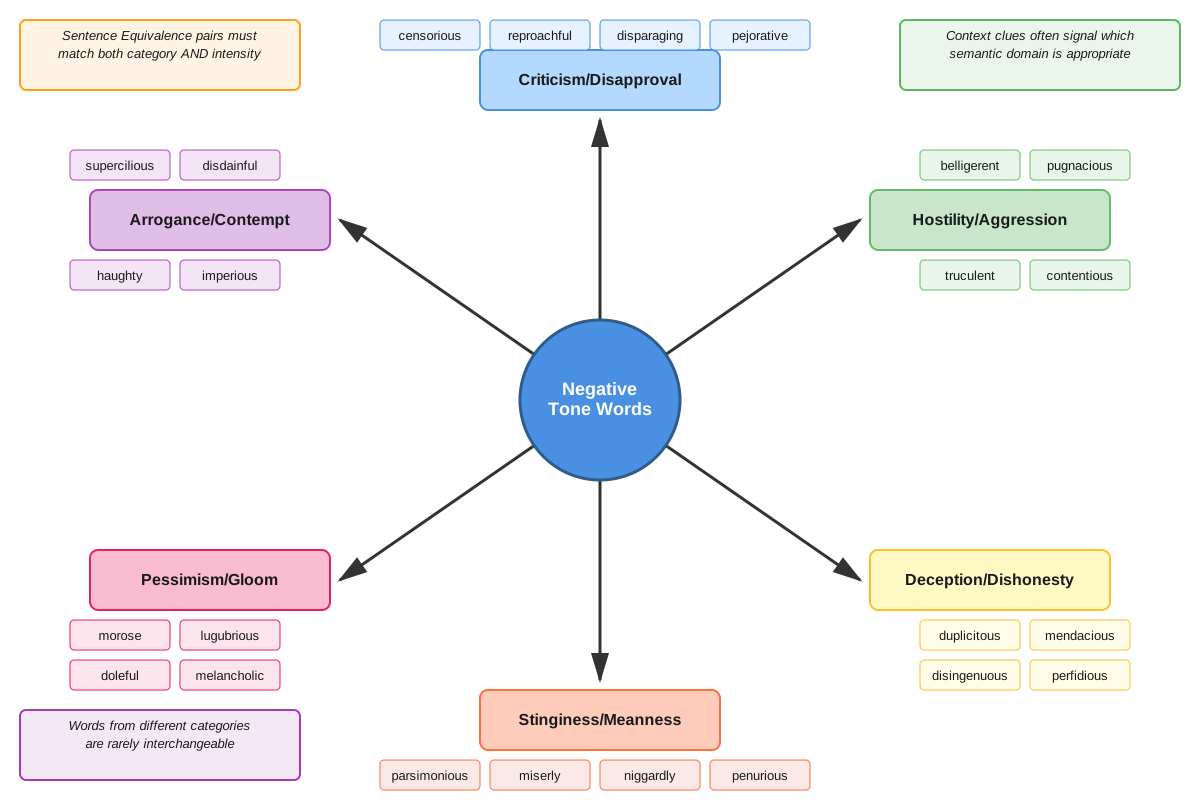
Negative vocabulary can be organized into several functional categories based on what aspect of negativity they express:
Criticism and Disapproval: Words like censure, denounce, disparage, deprecate, denigrate, and vilify express varying degrees of criticism. These terms differ in intensity, with "criticize" being relatively mild, "censure" indicating formal disapproval, and "vilify" suggesting harsh, abusive condemnation.
Hostility and Aggression: Terms such as acrimonious, bellicose, belligerent, contentious, pugnacious, and truculent describe antagonistic attitudes or behaviors. Understanding these words requires recognizing that they specifically relate to conflict and combativeness rather than general negativity.
Deception and Dishonesty: Words including duplicitous, mendacious, disingenuous, perfidious, chicanery, and subterfuge indicate various forms of dishonesty. The GRE frequently tests whether students can distinguish between general dishonesty and specific types like betrayal (perfidious) or clever trickery (chicanery).
Incompetence and Inadequacy: Vocabulary such as inept, maladroit, ineffectual, feckless, hapless, and bungling describes lack of skill or effectiveness. These words vary in whether they emphasize clumsiness, lack of impact, or general incompetence.
Stinginess and Greed: Terms like parsimonious, penurious, miserly, niggardly, avaricious, and rapacious relate to money and resources. Some emphasize excessive saving (parsimonious), while others emphasize excessive taking (rapacious).
Intensity Gradations
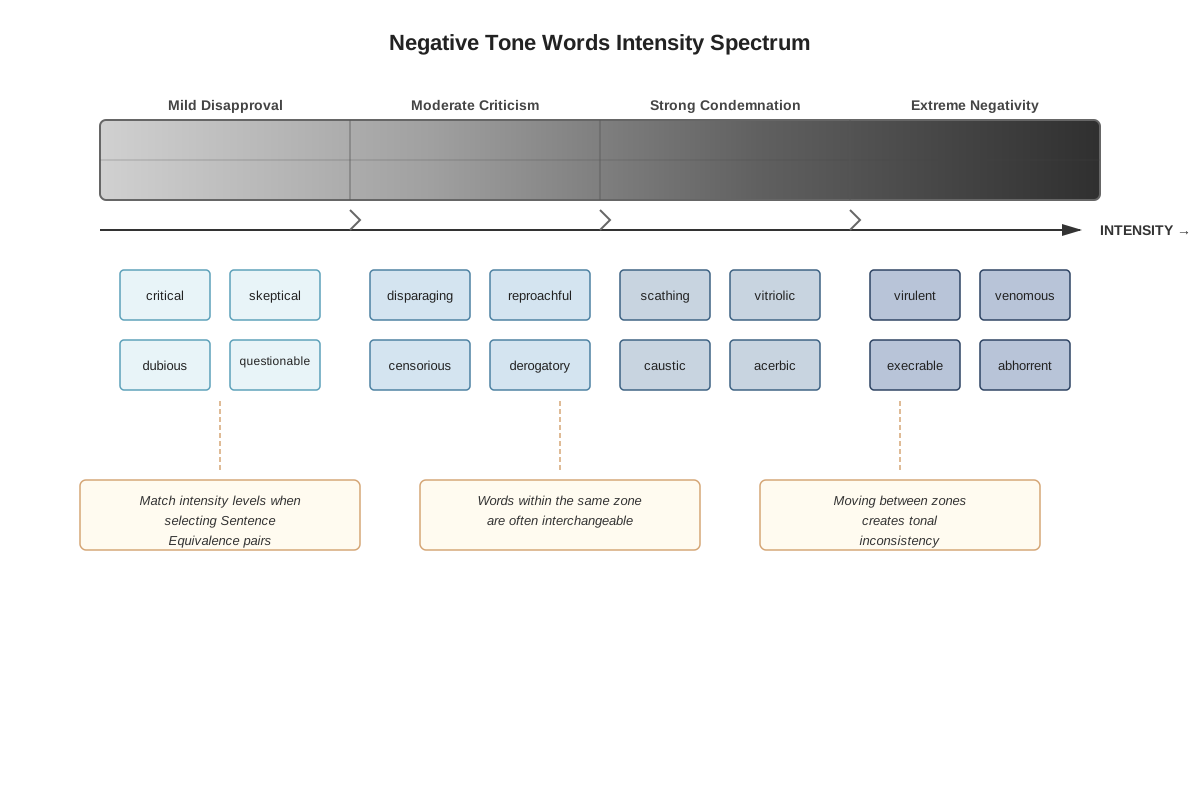
Understanding the intensity spectrum of negative words is crucial for GRE success. Consider these progressions:
| Mild Negative | Moderate Negative | Strong Negative |
|---|---|---|
| questionable | dubious | fraudulent |
| critical | censorious | vituperative |
| unfriendly | hostile | malevolent |
| careless | negligent | reckless |
| plain | austere | spartan |
The GRE frequently includes answer choices representing different intensity levels, testing whether students can match the degree of negativity required by context. A passage describing "harsh criticism" requires strongly negative vocabulary, while one mentioning "some concerns" calls for milder terms.
Context Clues for Negative Tone
Several textual signals indicate that negative tone words are appropriate:
Explicit negative markers: Words like "unfortunately," "regrettably," "problematically," or "disappointingly" directly signal negative tone.
Contrast structures: Phrases such as "rather than," "instead of," "unlike," or "however" often introduce negative qualities by contrasting them with positive ones.
Negative outcomes: Descriptions of failure, decline, deterioration, or harm indicate the need for negative vocabulary.
Critical language: Phrases like "critics argue," "opponents claim," or "skeptics suggest" signal that negative characterizations follow.
Synonymy in Negative Vocabulary
For Sentence Equivalence questions, identifying synonymous pairs among negative words is essential. True synonyms must match in both intensity and specific meaning type. Common synonymous pairs include:
- Parsimonious / Penurious (both mean excessively frugal)
- Vituperate / Excoriate (both mean to criticize harshly)
- Mendacious / Duplicitous (both mean dishonest)
- Truculent / Bellicose (both mean aggressively hostile)
- Inept / Maladroit (both mean lacking skill)
However, seemingly similar negative words often differ in crucial ways. "Frugal" and "miserly" both relate to spending, but only "miserly" is truly negative. "Critical" and "scathing" both involve criticism, but differ dramatically in intensity.
Concept Relationships
The concepts within negative tone words form an interconnected system where understanding one element enhances comprehension of others. Tone recognition serves as the foundation, enabling students to determine whether negative vocabulary is appropriate at all. This leads to category identification, where students determine what type of negativity (criticism, hostility, deception, etc.) fits the context. From there, intensity calibration allows selection of words with the appropriate degree of negativity. Finally, synonymy evaluation enables identification of answer pairs that create equivalent meanings.
These concepts connect to prerequisite knowledge of contextual reading skills, as students must analyze surrounding text to determine appropriate tone. The relationship to connotation versus denotation understanding is direct: recognizing that negative words carry emotional weight beyond literal meaning is essential for proper application. The connection to Sentence Equivalence format knowledge is also critical, as the requirement for equivalent meanings drives the need to distinguish between truly synonymous negative terms and those that differ in intensity or specific application.
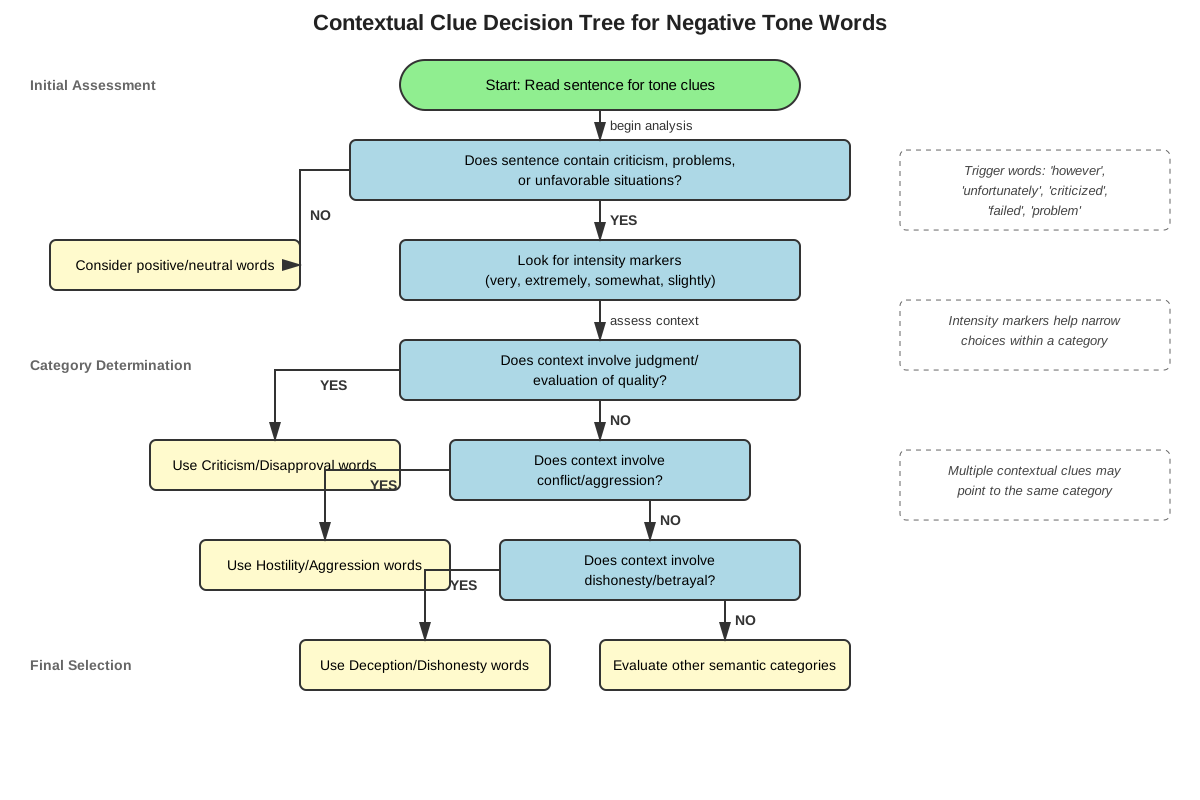
The relationship map flows as follows: Context Analysis → Tone Determination (positive/negative/neutral) → Category Selection (type of negativity) → Intensity Matching (degree of negativity) → Synonym Identification (for Sentence Equivalence) → Answer Selection. Each step depends on the previous one, creating a systematic approach to questions involving negative tone words.
High-Yield Facts
⭐ Negative tone words appear in 30-40% of GRE Verbal questions, making them one of the most frequently tested vocabulary categories.
⭐ Intensity matching is more important than general negativity: a word must match both the type and degree of negativity required by context.
⭐ Common negative word categories include criticism, hostility, deception, incompetence, and stinginess, each with distinct vocabulary sets.
⭐ Sentence Equivalence questions require true synonyms, not just words with similar negative meanings; intensity and specific application must match.
⭐ Context clues like "unfortunately," "critics argue," or "however" signal the need for negative vocabulary and help determine appropriate intensity.
- Words like "censure," "denounce," and "vilify" represent increasing degrees of criticism, from formal disapproval to harsh condemnation.
- "Parsimonious," "penurious," and "miserly" all mean excessively frugal and are frequently used as synonymous pairs on the GRE.
- "Acrimonious," "bellicose," and "truculent" specifically relate to hostility and conflict, not general negativity.
- "Mendacious" and "duplicitous" are high-frequency GRE words meaning dishonest or deceitful.
- Negative words with similar denotations often differ in connotation: "thrifty" is positive, "frugal" is neutral, and "miserly" is negative, despite all relating to careful spending.
- "Vituperate" and "excoriate" both mean to criticize harshly and commonly appear as correct answer pairs in Sentence Equivalence questions.
- The GRE frequently includes trap answers that are negative but wrong in intensity (too mild or too strong) or type (wrong category of negativity).
Quick check — test yourself on Negative tone words so far.
Try Flashcards →Common Misconceptions
Misconception: All negative words can be used interchangeably in contexts requiring negative tone.
Correction: Negative words differ significantly in intensity, specific meaning, and appropriate application. "Critical" and "scathing" are both negative, but "scathing" is far more intense and would be inappropriate in contexts requiring mild disapproval. Similarly, "hostile" and "deceptive" are both negative but describe entirely different qualities.
Misconception: If two words are both negative and somewhat related in meaning, they form a valid Sentence Equivalence pair.
Correction: Sentence Equivalence requires true synonyms that create sentences with equivalent meanings. "Stingy" and "greedy" are both negative words related to money, but they describe opposite behaviors (excessive saving versus excessive taking) and would not create equivalent sentences.
Misconception: More obscure or sophisticated negative words are always better choices than common ones.
Correction: The correct answer depends on context, not vocabulary sophistication. A sentence describing mild criticism might correctly use "critical" rather than the more advanced "vituperative," which would be too intense. Matching context is more important than demonstrating vocabulary knowledge.
Misconception: Negative tone words only appear in obviously negative contexts.
Correction: The GRE often presents subtle contexts where negativity is implied rather than explicit. A sentence might describe someone as "careful with money" in a context suggesting this is excessive, requiring negative vocabulary like "parsimonious" rather than neutral terms like "frugal."
Misconception: If a word has any negative connotation, it's appropriate for any negative context.
Correction: Negative words are highly specific. "Bellicose" specifically means warlike or aggressive, not generally bad. Using it to describe someone who is dishonest or incompetent would be incorrect, even though those are also negative qualities. Category matching is essential.
Misconception: Learning definitions alone is sufficient for mastering negative tone words.
Correction: Understanding connotation, intensity, and contextual appropriateness is equally important. "Criticize" and "censure" have similar definitions, but "censure" implies formal, official disapproval and would be inappropriate in casual contexts. Effective use requires understanding these nuances beyond basic definitions.
Worked Examples
Example 1: Sentence Equivalence Question
Question: The art critic's review was notably _________, attacking not only the exhibition's aesthetic choices but also questioning the artist's fundamental competence.
(A) laudatory
(B) scathing
(C) tepid
(D) vitriolic
(E) ambivalent
(F) measured
Solution:
Step 1: Analyze context for tone
The sentence describes a review that "attacks" choices and "questions competence." The word "attacking" is explicitly negative and aggressive. This signals that strongly negative vocabulary is required.
Step 2: Identify intensity level
The review doesn't just criticize; it "attacks" and questions "fundamental competence." This indicates harsh, intense criticism rather than mild disapproval. We need strongly negative words.
Step 3: Eliminate based on tone
- (A) "laudatory" means praising—opposite tone, eliminate
- (C) "tepid" means lukewarm or unenthusiastic—too mild, eliminate
- (E) "ambivalent" means having mixed feelings—doesn't match the clearly negative attack, eliminate
- (F) "measured" means careful and restrained—contradicts "attacking," eliminate
Step 4: Evaluate remaining choices
- (B) "scathing" means harshly critical, severely damaging
- (D) "vitriolic" means filled with bitter criticism and malice
Both words are intensely negative and specifically relate to harsh criticism. They match the context's intensity and type of negativity.
Step 5: Verify synonymy
"Scathing" and "vitriolic" are true synonyms in this context—both describe extremely harsh, damaging criticism. Either word creates a sentence with equivalent meaning.
Answer: (B) and (D)
Connection to learning objectives: This example demonstrates identifying when negative tone words are tested (the "attacking" language signals it), applying the core strategy of matching intensity and type (both words are intensely critical), and accurately selecting GRE-style answers (true synonyms that fit context).
Example 2: Text Completion Question
Question: Despite his reputation for generosity, the wealthy businessman proved surprisingly _________ when asked to contribute to the community center, offering only a token donation far below his means.
(A) magnanimous
(B) parsimonious
(C) prodigal
(D) philanthropic
(E) munificent
Solution:
Step 1: Identify contrast structure
The word "Despite" signals a contrast between the businessman's "reputation for generosity" and his actual behavior. This indicates the blank requires a word opposite to generosity.
Step 2: Analyze specific behavior described
He offered "only a token donation far below his means." This describes excessive frugality or stinginess, not general negativity. We need a word specifically about being unwilling to spend money.
Step 3: Determine appropriate intensity
The donation was "far below his means" and described as "only a token," suggesting significant stinginess rather than mere caution. A moderately to strongly negative term is appropriate.
Step 4: Evaluate each choice
- (A) "magnanimous" means generous and forgiving—matches his reputation but contradicts the contrast structure, eliminate
- (B) "parsimonious" means excessively frugal or stingy—matches the negative behavior with money, keep
- (C) "prodigal" means wastefully extravagant—opposite of the behavior described, eliminate
- (D) "philanthropic" means charitable and generous—contradicts the contrast, eliminate
- (E) "munificent" means very generous—contradicts the contrast, eliminate
Step 5: Verify logical consistency
"Despite his reputation for generosity, the wealthy businessman proved surprisingly parsimonious" creates a logical contrast and accurately describes someone who gives far less than expected.
Answer: (B) parsimonious
Connection to learning objectives: This example shows identifying when negative tone words are tested (the contrast structure signals it), explaining the core strategy (matching the specific type of negativity—stinginess—rather than general negativity), and applying knowledge accurately to select the contextually appropriate answer.
Exam Strategy
Approach Process for Negative Tone Questions:
- Read for tone markers first: Before focusing on the blank, identify words like "unfortunately," "however," "critics," "failed," or "attacking" that signal negative tone is required.
- Determine negativity type: Identify whether the context involves criticism, hostility, deception, incompetence, stinginess, or another specific category. This eliminates words that are negative but wrong in type.
- Calibrate intensity: Assess whether the context requires mild, moderate, or strong negativity. Words like "somewhat," "slightly," or "a bit" suggest mild negativity, while "extremely," "utterly," or "completely" indicate strong negativity.
- For Sentence Equivalence, find the synonym pair first: Identify which two words are true synonyms before evaluating whether they fit the context. This often eliminates four choices quickly.
- Eliminate positive and neutral options immediately: In clearly negative contexts, any positive or neutral words can be eliminated without detailed analysis, saving time.
Trigger Words and Phrases:
High-yield negative triggers: "unfortunately," "regrettably," "critics argue," "opponents claim," "failed to," "despite," "although," "however," "rather than," "instead of," "problematically," "disappointingly"
Intensity indicators: "extremely," "utterly," "somewhat," "slightly," "completely," "barely," "hardly," "severely," "mildly"
Category signals: "dishonest" → deception words; "aggressive" → hostility words; "incompetent" → inadequacy words; "stingy" → parsimony words
Process-of-Elimination Tips:
- In Sentence Equivalence, if you identify one word that clearly fits, look for its synonym among remaining choices rather than evaluating all six independently.
- Eliminate words that are negative but too mild or too strong for the context before considering subtle distinctions.
- Watch for trap answers that match in general negativity but differ in specific type (e.g., "deceptive" when "hostile" is needed).
- If two words seem synonymous but one is more common, don't assume the obscure word is correct—both should fit equally well.
Time Allocation:
Spend approximately 60-75 seconds on Sentence Equivalence questions involving negative tone words. Allocate 15 seconds to reading and identifying tone, 20 seconds to eliminating clearly wrong answers, 20 seconds to evaluating remaining choices for synonymy and fit, and 10-15 seconds to verify your selections. For Text Completion, allocate 45-60 seconds per blank, with similar proportions for analysis and elimination.
Memory Techniques
Mnemonic for Criticism Intensity Levels: "Can Cats Devour Enormous Vultures?"
- Critical (mild)
- Censure (moderate)
- Denounce (strong)
- Excoriate (very strong)
- Vilify (extreme)
Acronym for Hostility Words: "ABCPT"
- Acrimonious (bitter and angry)
- Bellicose (warlike, aggressive)
- Contentious (causing disagreement)
- Pugnacious (eager to fight)
- Truculent (aggressively defiant)
Visualization for Stinginess Words: Picture a PENNY being squeezed:
- Parsimonious
- Excessively frugal
- Niggardly
- Not generous
- Yielding nothing (miserly)
Mnemonic for Deception Words: "My Dog Deliberately Plays Charades Secretly"
- Mendacious (lying)
- Duplicitous (two-faced)
- Disingenuous (insincere)
- Perfidious (treacherous)
- Chicanery (trickery)
- Subterfuge (deception)
Intensity Matching Technique: Create a mental "thermometer" with three zones—cool (mild negative), warm (moderate negative), and hot (intense negative). When reading context, identify which zone the situation falls into, then select vocabulary from that same zone.
Category Association Method: Link each negative word category to a vivid scenario. For hostility words, imagine a boxing match. For deception words, picture a spy. For incompetence words, visualize someone repeatedly failing a simple task. When you encounter a word, recall which scenario it belongs to.
Summary
Mastering negative tone words is essential for GRE Verbal Reasoning success, as these terms appear in 30-40% of questions across Sentence Equivalence, Text Completion, and Reading Comprehension. Success requires more than memorizing definitions—students must develop sensitivity to connotation, intensity gradations, and contextual appropriateness. Negative vocabulary organizes into functional categories including criticism, hostility, deception, incompetence, and stinginess, each with distinct word sets. The key strategy involves identifying tone through context clues, determining the specific type and intensity of negativity required, and selecting words that match both dimensions. For Sentence Equivalence questions, identifying true synonyms that match in both intensity and specific meaning is crucial, as seemingly similar negative words often differ in critical ways. Common pitfalls include confusing general negativity with specific types, mismatching intensity levels, and assuming all negative words are interchangeable. Systematic application of tone analysis, category identification, intensity calibration, and synonym evaluation enables accurate answer selection and improved performance across all Verbal Reasoning question types.
Key Takeaways
- Negative tone words appear in 30-40% of GRE Verbal questions, making them a high-yield study focus with significant impact on overall scores.
- Intensity and category matching are more important than general negativity—words must match both the degree and specific type of negativity required by context.
- Common negative word categories (criticism, hostility, deception, incompetence, stinginess) each have distinct vocabulary sets that cannot be used interchangeably.
- Context clues like "unfortunately," "however," and "critics argue" signal negative tone and help determine appropriate intensity levels.
- Sentence Equivalence requires true synonyms that match in intensity and specific meaning, not just words with similar negative connotations.
- Systematic approach (tone identification → category selection → intensity matching → synonym evaluation) improves accuracy and efficiency.
- Connotation matters as much as denotation—words like "frugal" and "miserly" have similar literal meanings but vastly different emotional implications.
Related Topics
Positive Tone Words: Understanding positive vocabulary creates contrast with negative terms and enables recognition of tone shifts in passages. Mastering negative tone words provides the foundation for distinguishing between positive, negative, and neutral vocabulary across all contexts.
Neutral/Objective Tone Words: Many GRE passages require neutral, academic vocabulary rather than emotionally charged terms. Understanding when negative tone is inappropriate is as important as knowing when it's required.
Degree and Intensity Modifiers: Words like "somewhat," "extremely," "utterly," and "slightly" modify the intensity of tone words. Mastering these modifiers enhances the ability to calibrate negativity levels accurately.
Contrast and Transition Words: Terms like "however," "despite," and "although" often signal tone shifts, including movement from positive to negative contexts. Understanding these transitions improves recognition of when negative vocabulary is needed.
Text Completion Advanced Strategies: Building on negative tone word mastery enables more sophisticated approaches to multi-blank Text Completion questions where tone consistency across blanks is essential.
Practice CTA
Now that you've mastered the concepts, strategies, and vocabulary for negative tone words, it's time to apply this knowledge through practice. Attempt the practice questions and flashcards to reinforce your understanding and build the automaticity needed for test-day success. Remember, recognizing negative tone words quickly and accurately is a skill that improves with deliberate practice—each question you work through strengthens your ability to identify context clues, match intensity levels, and select appropriate vocabulary. Your investment in mastering this high-yield topic will pay dividends across all GRE Verbal Reasoning question types. Start practicing now to transform your understanding into top-tier performance!
Sign up free to keep reading
Create a free AnvayaPrep account to finish this GRE guide on Negative tone words — plus flashcards and practice questions.