Overview
Neutral tone words represent a critical category of vocabulary that appears frequently in GRE Sentence Equivalence questions. These words carry neither positive nor negative connotations, instead describing situations, actions, or characteristics in an objective, balanced manner. Understanding and recognizing neutral tone words is essential because the GRE often tests whether students can distinguish between words with similar meanings but different emotional registers. A word might be factually accurate in a sentence but incorrect because it introduces an inappropriate tone—either too positive, too negative, or too neutral when the context demands otherwise.
The ability to identify GRE neutral tone words becomes particularly important in Sentence Equivalence questions, where students must select two words that both complete the sentence logically and produce sentences with similar meanings. The GRE frequently includes answer choices that are semantically close but differ in their emotional coloring. For instance, "describe," "praise," and "criticize" all relate to discussing something, but only "describe" maintains neutrality. Students who cannot distinguish neutral words from their emotionally charged counterparts will struggle to identify the correct pair of synonyms, even when they understand the sentence's basic meaning.
Within the broader context of GRE Verbal Reasoning, mastery of neutral tone words connects directly to reading comprehension, vocabulary knowledge, and contextual analysis. This skill reinforces the importance of precision in language—a core competency the GRE assesses throughout its verbal sections. Recognizing neutral tone also supports critical reading skills, as students must evaluate author intent, distinguish fact from opinion, and identify objective versus subjective language in reading passages. The ability to work with neutral vocabulary therefore serves as a foundation for multiple question types across the verbal section.
Learning Objectives
- [ ] Identify when Neutral tone words is being tested
- [ ] Explain the core rule or strategy behind Neutral tone words
- [ ] Apply Neutral tone words to GRE-style questions accurately
- [ ] Distinguish neutral tone words from their positive and negative counterparts in answer choices
- [ ] Evaluate sentence context to determine whether neutral or emotionally charged vocabulary is appropriate
- [ ] Build a working vocabulary of high-frequency neutral tone words that appear on the GRE
Prerequisites
- Basic vocabulary knowledge: Understanding word definitions is necessary before analyzing their emotional connotations
- Sentence structure comprehension: Students must parse sentence meaning to determine what tone the context requires
- Synonym recognition: Identifying words with similar meanings forms the foundation for distinguishing tone differences
- Context clue interpretation: The ability to extract meaning from surrounding text helps determine appropriate word tone
Why This Topic Matters
In professional and academic writing, the distinction between neutral and emotionally charged language determines credibility, objectivity, and precision. Scientists, journalists, and scholars must describe phenomena without introducing bias, making neutral vocabulary essential for clear communication. The GRE tests this skill because graduate-level work demands the ability to present information objectively, distinguish between factual description and subjective interpretation, and recognize when authors introduce bias through word choice.
On the GRE, neutral tone words appear in approximately 30-40% of Sentence Equivalence questions and regularly feature in Text Completion questions as well. The test makers deliberately include answer choices that differ primarily in tone rather than core meaning, creating traps for students who focus solely on semantic similarity without considering connotation. Questions testing neutral tone typically present sentences describing research findings, historical events, or objective observations where emotional language would be inappropriate.
Common patterns include sentences about scientific studies ("The research _____ the relationship between variables"), neutral descriptions of actions ("The committee _____ the proposal"), or objective characterizations ("The author's style is _____ and straightforward"). In reading passages, recognizing neutral versus charged language helps students answer questions about author tone, purpose, and attitude. The ability to work with neutral vocabulary therefore impacts performance across multiple question types and contributes significantly to overall verbal scores.
Core Concepts
Defining Neutral Tone
Neutral tone words are vocabulary items that convey information without expressing approval, disapproval, enthusiasm, or criticism. These words function as objective descriptors, allowing speakers and writers to present facts, actions, or characteristics without revealing personal judgment. The neutrality exists on a spectrum—some words are completely neutral (like "walk" or "building"), while others lean slightly toward positive or negative but remain relatively balanced (like "unusual" or "different").
The key characteristic distinguishing neutral words from emotionally charged alternatives is their lack of evaluative content. Consider the word "thin": it neutrally describes a physical characteristic. Compare this to "slender" (positive connotation suggesting attractiveness) or "scrawny" (negative connotation suggesting unhealthy thinness). All three words describe similar physical states, but only "thin" maintains objectivity. On the GRE, this distinction becomes crucial when sentence context demands factual description rather than judgment.
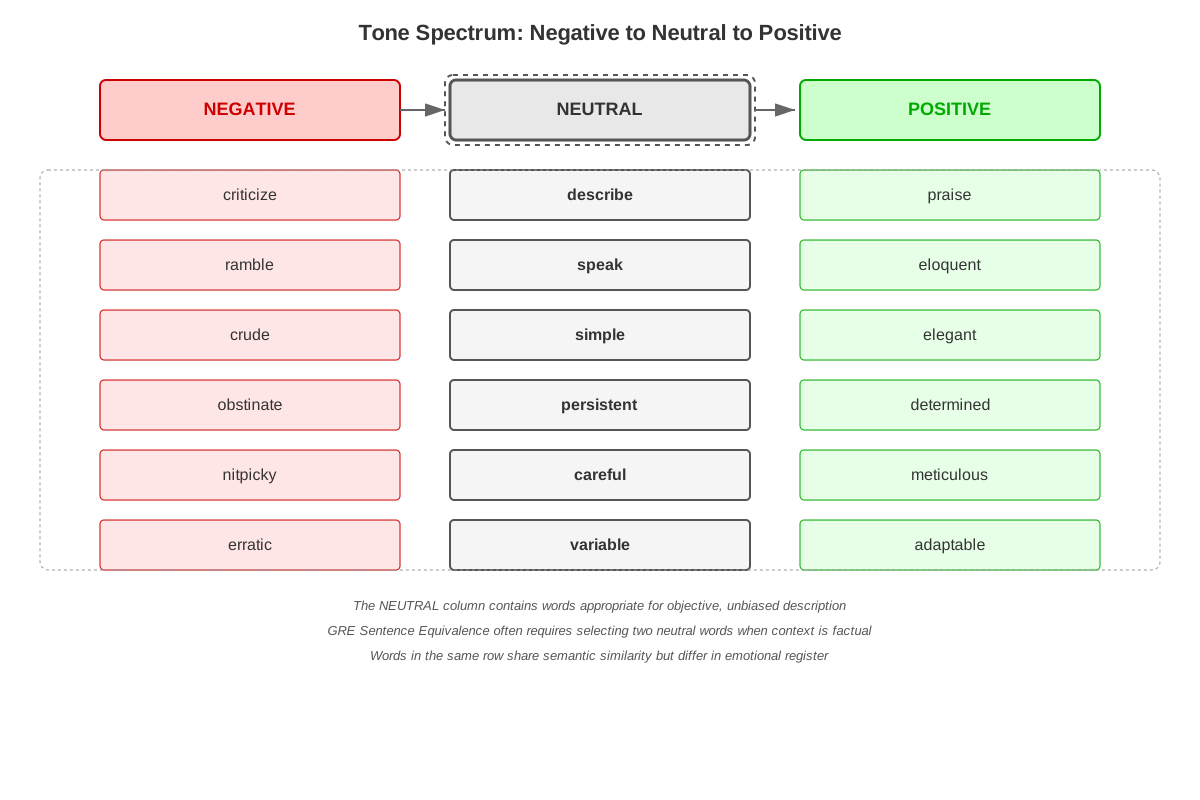
The Tone Spectrum
Understanding neutral tone requires recognizing where words fall on the emotional spectrum:
| Negative Tone | Neutral Tone | Positive Tone |
|---|---|---|
| stubborn | determined | resolute |
| cheap | inexpensive | economical |
| old | aged | vintage |
| childish | youthful | young-at-heart |
| nosy | curious | inquisitive |
Each row presents words describing similar concepts, but the middle column maintains objectivity while the outer columns introduce judgment. The GRE exploits this spectrum by offering answer choices from different columns, testing whether students recognize the appropriate tone for the context.
Context Clues for Neutral Tone
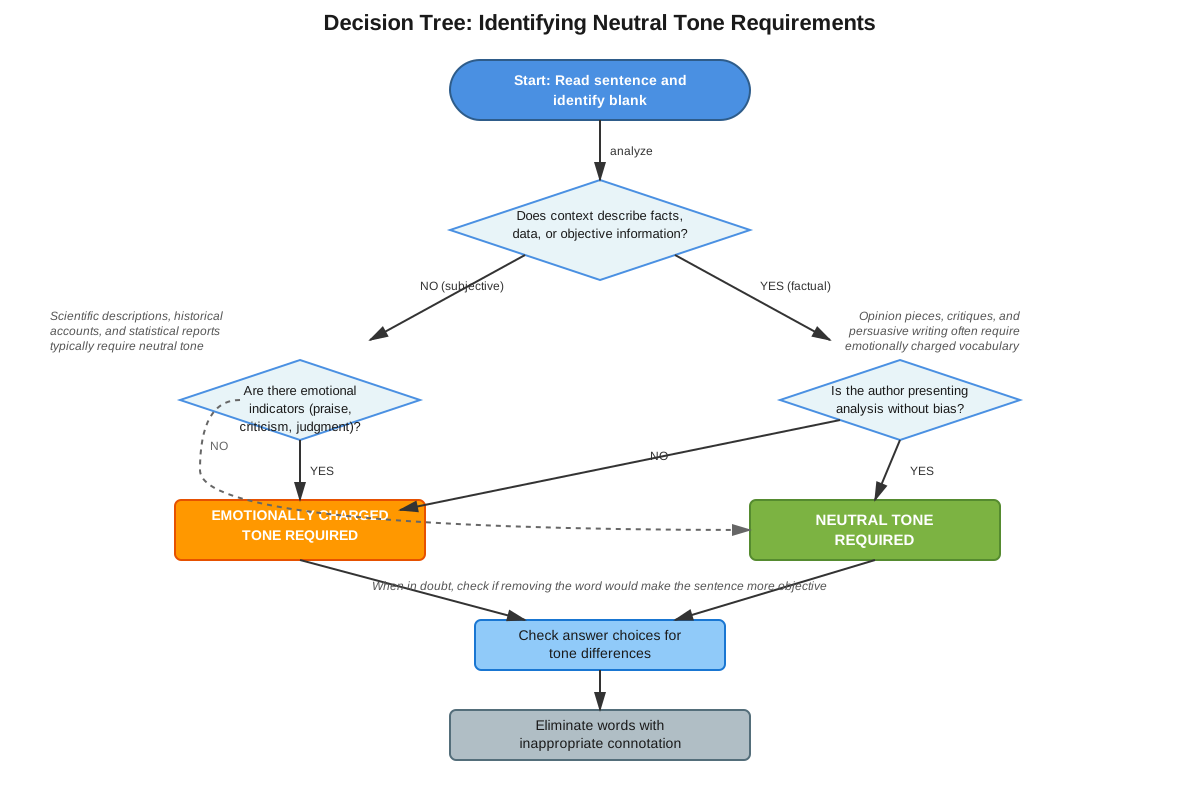
Certain sentence structures and contexts signal that neutral vocabulary is required:
- Scientific or academic descriptions: "The study _____ a correlation between the variables"
- Objective reporting: "The journalist _____ the events without commentary"
- Factual characterizations: "The building's architecture can be _____ as functional"
- Balanced presentations: "The author _____ both perspectives equally"
When sentences include words like "objective," "unbiased," "factual," "straightforward," or "neutral," they explicitly signal that emotionally charged vocabulary would be inappropriate. Similarly, contexts describing research, data, or formal documentation typically require neutral language.
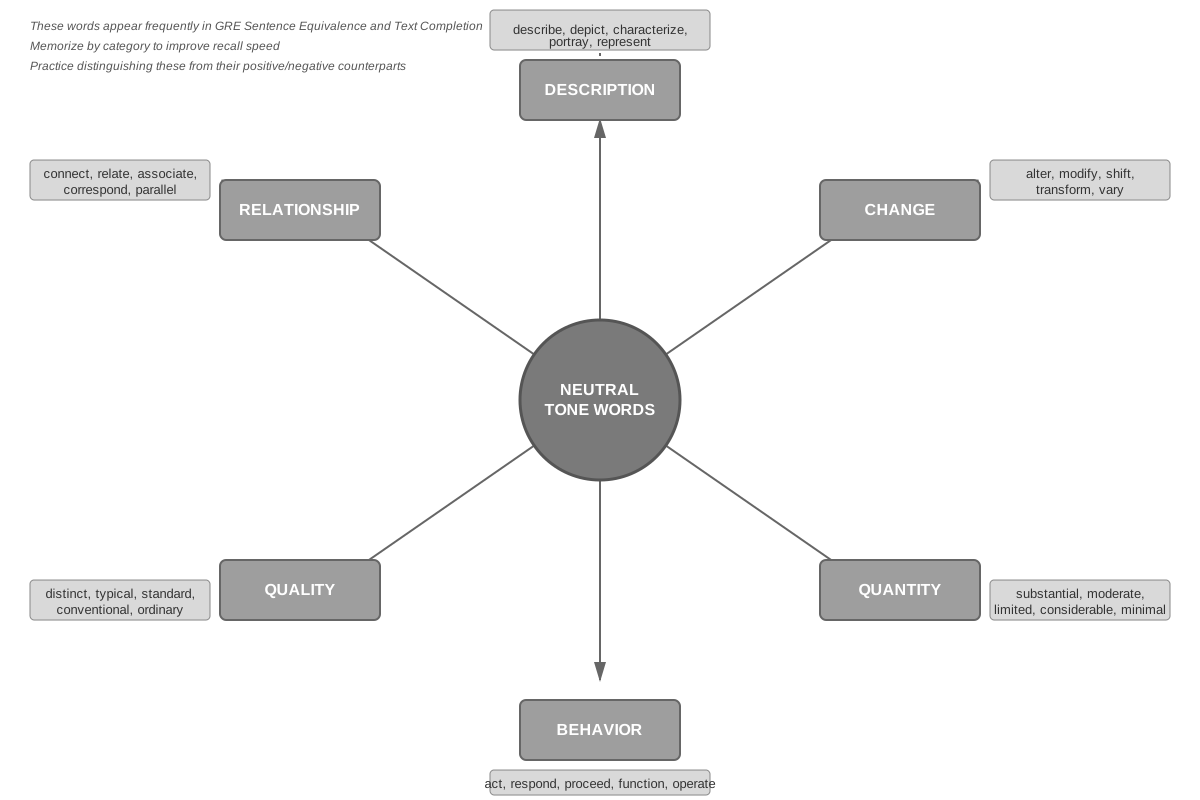
Common Neutral Word Categories
Descriptive Verbs: These verbs describe actions without implying judgment about whether those actions are good or bad. Examples include: describe, show, indicate, present, display, demonstrate, reveal, illustrate, depict, portray (in its neutral sense), state, report, note, observe, record, document.
Characterization Adjectives: These adjectives describe qualities without praising or criticizing. Examples include: different, unusual, distinct, particular, specific, certain, various, diverse, mixed, moderate, average, typical, standard, conventional, traditional, contemporary, modern.
Analytical Nouns: These nouns name concepts in objective terms. Examples include: difference, similarity, characteristic, feature, aspect, element, factor, component, pattern, trend, relationship, connection, association, correlation.
Distinguishing Neutral from Near-Synonyms
The GRE frequently pairs neutral words with emotionally charged near-synonyms to test precision. Consider these sets:
- Neutral: "The politician's speech was lengthy" vs. Negative: "The politician's speech was long-winded"
- Neutral: "The critic examined the film" vs. Positive: "The critic appreciated the film" vs. Negative: "The critic dismissed the film"
- Neutral: "The student was confident" vs. Positive: "The student was self-assured" vs. Negative: "The student was arrogant"
In each case, the neutral option allows for factual description without introducing the speaker's attitude. The GRE tests whether students can identify which tone the sentence context requires.
Tone Consistency in Sentence Equivalence
In Sentence Equivalence questions, both correct answers must match not only in meaning but also in tone. If the sentence requires neutral vocabulary, both answers must be neutral. A common trap involves pairing a neutral word with a positive or negative synonym—these might seem interchangeable but produce sentences with different implications.
For example, if a sentence reads: "The researcher's approach was _____ and produced reliable results," the blank requires a neutral or positive word. "Systematic" (neutral) and "methodical" (neutral) would work as a pair. However, "systematic" and "meticulous" (positive, suggesting exceptional care) would not be equivalent, despite both being potentially correct in isolation.
Concept Relationships
The concept of neutral tone words connects hierarchically to broader verbal reasoning skills. At the foundation lies vocabulary knowledge—students must know word definitions before analyzing connotations. Building on this, synonym recognition allows students to identify words with similar core meanings. The next level involves connotation analysis, where students distinguish between words' emotional colorings. Finally, contextual application requires determining which tone a specific sentence demands.
Within the topic itself, understanding the tone spectrum (negative-neutral-positive) enables students to categorize vocabulary into appropriate groups. This categorization then supports context analysis, where students identify signals indicating which tone is appropriate. These skills combine in answer evaluation, where students eliminate choices with incorrect tones and select pairs that match both in meaning and emotional register.
The relationship map flows as follows:
Vocabulary Knowledge → Synonym Recognition → Tone Spectrum Understanding → Context Signal Identification → Tone-Appropriate Word Selection → Answer Pair Verification
This topic also connects forward to reading comprehension skills, particularly author tone analysis and purpose identification. Students who can distinguish neutral from charged vocabulary in Sentence Equivalence questions develop sensitivity to these distinctions in reading passages, improving their ability to answer questions about author attitude and rhetorical strategy.
High-Yield Facts
⭐ Neutral tone words describe without evaluating or expressing judgment about whether something is good or bad
⭐ In Sentence Equivalence, both correct answers must match in tone as well as meaning
⭐ Scientific, academic, and journalistic contexts typically require neutral vocabulary
⭐ Common neutral verbs include: describe, show, indicate, present, demonstrate, reveal, illustrate
⭐ The GRE frequently traps students by offering near-synonyms that differ primarily in tone
- Neutral adjectives often include: different, unusual, distinct, particular, various, moderate, typical, standard
- Words like "objective," "unbiased," and "factual" in a sentence signal that neutral vocabulary is required
- Positive and negative words can both be incorrect when the context demands neutrality
- The same word can be neutral in one context and charged in another (e.g., "aggressive" is negative for personality but neutral for medical treatment)
- Eliminating emotionally charged answer choices often narrows options to the correct neutral pair
- Neutral words allow readers to form their own judgments rather than accepting the writer's evaluation
- Building awareness of tone requires actively categorizing new vocabulary as positive, negative, or neutral
Quick check — test yourself on Neutral tone words so far.
Try Flashcards →Common Misconceptions
Misconception: Neutral words are always simple or basic vocabulary → Correction: Many sophisticated, advanced vocabulary words are neutral in tone. "Elucidate," "delineate," and "enumerate" are all neutral despite being high-level academic vocabulary. Neutrality refers to emotional register, not complexity.
Misconception: If two words are synonyms, they're interchangeable in Sentence Equivalence → Correction: Synonyms must match in both meaning AND tone to be correct answers. "Thrifty" and "cheap" are synonyms describing careful spending, but "thrifty" is positive while "cheap" is negative, making them incorrect as a pair in most contexts.
Misconception: Neutral words are boring or weak → Correction: Neutral vocabulary is essential for precise, credible communication. Academic and professional writing relies heavily on neutral language to present information objectively. Using neutral words demonstrates sophistication and control.
Misconception: Context doesn't matter if a word is technically accurate → Correction: A word can be factually correct but wrong for the sentence if its tone doesn't match the context. In "The scientist _____ the groundbreaking discovery," "announced" (neutral) fits better than "boasted about" (negative), even though both could be factually true.
Misconception: All descriptive words are neutral → Correction: Many descriptive words carry strong connotations. "Slender," "thin," and "scrawny" all describe similar body types, but only "thin" is truly neutral. Students must evaluate each descriptive word for emotional coloring.
Misconception: Formal words are automatically neutral → Correction: Formality and neutrality are different dimensions. "Castigate" is formal but strongly negative. "Laud" is formal but strongly positive. Formal vocabulary can carry any tone.
Worked Examples
Example 1: Scientific Context
Question: The research team _____ the data without drawing premature conclusions about causation.
Answer Choices:
(A) analyzed
(B) celebrated
(C) examined
(D) questioned
(E) scrutinized
(F) praised
Step 1 - Analyze Context: The sentence describes researchers working with data in a careful, objective manner. The phrase "without drawing premature conclusions" emphasizes objectivity and caution. This context requires neutral vocabulary that describes the action of working with data without suggesting approval, disapproval, or skepticism.
Step 2 - Evaluate Tone of Each Choice:
- (A) "analyzed" - NEUTRAL: objectively examines data
- (B) "celebrated" - POSITIVE: expresses approval/joy
- (C) "examined" - NEUTRAL: objectively reviews
- (D) "questioned" - NEGATIVE: expresses doubt
- (E) "scrutinized" - SLIGHTLY NEGATIVE: suggests suspicion or intense critical examination
- (F) "praised" - POSITIVE: expresses approval
Step 3 - Eliminate Charged Words: Remove (B), (D), (E), and (F) because they introduce emotional content inappropriate for objective scientific work.
Step 4 - Verify Pair: Both (A) "analyzed" and (C) "examined" are neutral verbs describing objective data review. They produce equivalent sentences: "The research team analyzed the data..." and "The research team examined the data..." Both maintain the sentence's emphasis on objectivity.
Correct Answer: (A) and (C)
Connection to Learning Objectives: This example demonstrates identifying when neutral tone is tested (scientific context), applying the core strategy (eliminating emotionally charged options), and accurately selecting neutral vocabulary.
Example 2: Descriptive Context
Question: The author's writing style is _____ and accessible, making complex ideas understandable to general readers.
Answer Choices:
(A) straightforward
(B) simplistic
(C) clear
(D) elementary
(E) plain
(F) lucid
Step 1 - Analyze Context: The sentence describes an author's writing style positively—it makes complex ideas understandable, which is presented as a strength. The word "accessible" is neutral-to-positive. We need words that describe clarity without being condescending (too negative) or overly praising (too positive).
Step 2 - Evaluate Tone:
- (A) "straightforward" - NEUTRAL: describes direct, clear communication
- (B) "simplistic" - NEGATIVE: suggests oversimplification or lack of sophistication
- (C) "clear" - NEUTRAL: describes easy-to-understand communication
- (D) "elementary" - NEGATIVE: suggests basic to the point of being childish
- (E) "plain" - NEUTRAL-TO-NEGATIVE: can suggest lack of style or sophistication
- (F) "lucid" - NEUTRAL-TO-POSITIVE: describes clear, rational expression
Step 3 - Consider Context More Carefully: The sentence praises the author's ability to explain complex ideas, so we need neutral-to-positive words. "Simplistic" and "elementary" are too negative, suggesting the writing is overly basic. "Plain" might work but has slightly negative connotations about lacking style.
Step 4 - Verify Best Pair: (A) "straightforward" and (C) "clear" are both neutral descriptors of writing that communicates effectively. They match in tone and meaning, producing equivalent sentences that praise the author's clarity without excessive enthusiasm.
Correct Answer: (A) and (C)
Note: (F) "lucid" could potentially work with (C) "clear," but "lucid" leans slightly more positive/formal than "clear," making (A) and (C) the better match for tone equivalence.
Connection to Learning Objectives: This example shows how to distinguish neutral words from negative ones in the same semantic field, and how to evaluate whether context requires purely neutral or slightly positive vocabulary.
Exam Strategy
Recognition Triggers
Watch for these signals that a question tests neutral tone:
- Context words: "objective," "unbiased," "factual," "straightforward," "without judgment," "neutral," "balanced"
- Scientific/academic settings: research studies, data analysis, scholarly work
- Journalistic contexts: reporting, documenting, recording events
- Formal descriptions: official reports, academic characterizations
When these appear, immediately categorize answer choices by tone before evaluating meaning.
Systematic Approach
- Read the sentence completely to understand the overall context and tone
- Identify tone signals in the sentence that indicate whether neutral, positive, or negative vocabulary is required
- Categorize all answer choices by tone (positive/neutral/negative) before considering meaning
- Eliminate tone mismatches first, even if those words could work in isolation
- Evaluate remaining choices for meaning and synonym relationships
- Verify the pair produces sentences with equivalent meanings and matching tones
Process of Elimination
Exam Tip: In Sentence Equivalence, eliminating three or four choices based on tone alone often leaves you with the correct pair, even if you're not completely certain about the words' precise meanings.
Start by asking: "Does this sentence require neutral, positive, or negative vocabulary?" Then eliminate all choices that don't match. For example, if a sentence describes scientific research objectively, immediately eliminate any answer choices with positive connotations (praise, celebrate, laud) or negative connotations (criticize, question, dismiss).
Time Management
Tone analysis should take 10-15 seconds per question. Quickly scan for context clues, categorize choices by tone, and eliminate mismatches. Don't spend excessive time debating between two neutral words—if both are neutral and semantically similar, they're likely the correct pair. Save time by making tone your first filter rather than your last consideration.
Common Traps to Avoid
- The "technically correct" trap: A word might be factually accurate but wrong because its tone doesn't fit
- The "synonym" trap: Two words might be synonyms but differ in tone, making them incorrect as a pair
- The "formal = neutral" trap: Don't assume formal vocabulary is automatically neutral; evaluate each word's connotation
- The "overthinking" trap: If two neutral words are close in meaning, they're probably correct—don't talk yourself out of the obvious answer
Memory Techniques
The "Reporter Test" Mnemonic
When evaluating whether a word is neutral, imagine a news reporter using it in an objective news story. Would the word sound appropriately unbiased? If a reporter said "The politician announced the policy" versus "The politician boasted about the policy," the first maintains neutrality while the second introduces judgment. Apply this test to answer choices: "Would an objective reporter use this word?"
The Three-Column Visualization
Mentally organize vocabulary into three columns: NEGATIVE | NEUTRAL | POSITIVE. When learning new words, actively place them in the appropriate column. Visualize moving words from the outer columns toward the center when you need neutral vocabulary. This spatial organization helps during timed tests.
The "Tone Twins" Strategy
For high-frequency neutral words, memorize common pairs that often appear together as correct answers:
- analyze / examine
- describe / depict
- show / demonstrate
- indicate / suggest
- different / distinct
- unusual / atypical
- present / display
When you spot one of these words in answer choices, look for its "twin" as the likely second correct answer.
The NEUTRAL Acronym
No judgment expressed
Emotionally balanced
Unbiased description
Tone appropriate for reporting
Removes personal opinion
Allows reader to evaluate
Lacks praise or criticism
Use this acronym to quickly check whether a word qualifies as neutral.
Summary
Neutral tone words form a critical category of GRE vocabulary that describes situations, actions, and characteristics without expressing approval or disapproval. Success with these words requires understanding the tone spectrum (negative-neutral-positive), recognizing context clues that signal which tone is appropriate, and distinguishing neutral vocabulary from emotionally charged near-synonyms. The GRE frequently tests this skill in Sentence Equivalence questions by offering answer choices that differ primarily in tone rather than core meaning. Students must remember that both correct answers must match in tone as well as meaning—a neutral word cannot pair with a positive or negative synonym. Scientific, academic, and journalistic contexts typically require neutral vocabulary, while words like "objective," "unbiased," and "factual" explicitly signal this requirement. Mastering neutral tone words improves performance across multiple question types and develops the precision in language use that graduate-level work demands.
Key Takeaways
- Neutral tone words describe without evaluating—they present information objectively without revealing the speaker's judgment
- Tone matching is essential in Sentence Equivalence—both correct answers must share the same emotional register
- Context determines appropriate tone—scientific, academic, and journalistic settings typically require neutral vocabulary
- Eliminate by tone first—categorizing answer choices by emotional coloring quickly narrows options to the correct pair
- Common neutral verbs include analyze, examine, describe, show, indicate, present, and demonstrate
- Don't confuse formality with neutrality—sophisticated vocabulary can carry strong positive or negative connotations
- The "reporter test" helps identify neutral words—imagine whether an objective journalist would use the word in unbiased reporting
Related Topics
Positive and Negative Connotation Words: Understanding neutral tone provides the foundation for recognizing and working with emotionally charged vocabulary. Mastering the full tone spectrum enables students to handle any Sentence Equivalence question testing connotation.
Context Clues and Inference: The ability to identify signals indicating appropriate tone connects directly to broader context clue skills. Students who excel at tone recognition typically perform well on inference questions in reading passages.
Synonym Discrimination: Distinguishing between near-synonyms based on tone represents an advanced form of synonym recognition. This skill supports vocabulary building and precise word choice across all verbal question types.
Author Tone and Attitude Questions: Recognizing neutral versus charged language in answer choices prepares students for reading comprehension questions about author perspective, purpose, and rhetorical strategy.
Practice CTA
Now that you understand neutral tone words and their critical role in GRE Sentence Equivalence questions, reinforce your learning by attempting the practice questions. Focus on identifying context clues that signal neutral tone, categorizing answer choices by emotional register, and selecting pairs that match in both meaning and tone. The flashcards will help you build a working vocabulary of high-frequency neutral words that appear regularly on the test. Consistent practice with these concepts will develop the automatic tone recognition that leads to faster, more accurate performance on test day. You've built a strong foundation—now apply it!
Sign up free to keep reading
Create a free AnvayaPrep account to finish this GRE guide on Neutral tone words — plus flashcards and practice questions.