Overview
Positive tone words represent a critical category of vocabulary that appears frequently throughout the GRE Verbal Reasoning section, particularly in Sentence Equivalence and Text Completion questions. These words convey favorable, optimistic, or approving attitudes, emotions, or qualities. Mastering positive tone words enables test-takers to accurately assess the emotional valence of passages, identify appropriate synonyms, and eliminate incorrect answer choices that carry neutral or negative connotations.
The GRE consistently tests whether students can distinguish subtle gradations of meaning within positive vocabulary. A sentence might require a word that means "praising" rather than merely "mentioning," or "enthusiastic" rather than simply "interested." Understanding GRE positive tone words goes beyond recognizing that a word is favorable—it requires appreciating the intensity, formality, and specific context in which each word functions appropriately. This nuanced understanding separates high scorers from average performers.
Within the broader Verbal Reasoning framework, positive tone words connect intimately with reading comprehension, vocabulary in context, and author's attitude questions. They form one pillar of a three-part tonal vocabulary system (positive, negative, and neutral), and proficiency with all three categories enables students to decode complex passages, understand authorial intent, and select semantically equivalent answer pairs with confidence. The ability to recognize and deploy positive tone words accurately is foundational to achieving scores in the 160+ range on Verbal Reasoning.
Learning Objectives
- [ ] Identify when Positive tone words is being tested
- [ ] Explain the core rule or strategy behind Positive tone words
- [ ] Apply Positive tone words to GRE-style questions accurately
- [ ] Distinguish between varying intensities of positive tone (mild, moderate, strong)
- [ ] Recognize context clues that signal the need for positive vocabulary
- [ ] Differentiate between positive words with similar meanings but different connotations
Prerequisites
- Basic vocabulary knowledge: Understanding fundamental word meanings provides the foundation for learning more sophisticated positive tone vocabulary
- Sentence structure comprehension: Recognizing how clauses relate helps identify whether a positive or contrasting tone is required
- Context clue recognition: The ability to extract meaning from surrounding text is essential for determining appropriate tone
- Synonym and antonym relationships: Understanding word relationships enables quick elimination of incorrect answer choices
Why This Topic Matters
Positive tone words appear in approximately 40-50% of all GRE Verbal Reasoning questions, making them one of the highest-yield vocabulary categories for test preparation. In Sentence Equivalence questions, where students must select two words that create sentences with equivalent meanings, recognizing positive tone is often the first filtering mechanism for eliminating four of the six choices. Text Completion questions frequently hinge on identifying whether a blank requires positive, negative, or neutral vocabulary based on transition words and contextual clues.
Beyond standardized testing, the ability to recognize and employ positive tone vocabulary enhances professional communication, academic writing, and critical reading skills. In graduate-level coursework, students must interpret authors' attitudes toward their subjects, distinguish between enthusiastic endorsement and qualified approval, and articulate nuanced positions in their own writing. These real-world applications make positive tone vocabulary a transferable skill that extends far beyond test day.
The GRE specifically tests positive tone words in several recurring patterns: author attitude questions in Reading Comprehension, synonym selection in Sentence Equivalence, and contextually appropriate word choice in Text Completion. Questions may present a passage describing someone's reaction to an event (requiring words like "delighted," "pleased," or "satisfied"), an evaluation of a theory (needing terms like "compelling," "persuasive," or "convincing"), or a description of a quality (demanding adjectives like "exemplary," "commendable," or "laudable"). Recognizing these patterns accelerates question-solving and improves accuracy.
Core Concepts
Understanding Tone and Valence
Tone refers to the attitude or emotional quality conveyed by words, while valence describes whether that quality is positive, negative, or neutral. Positive tone words carry favorable connotations and express approval, admiration, satisfaction, optimism, or beneficial qualities. The GRE tests whether students can identify this positive valence and, more importantly, select words with the appropriate degree and type of positivity for a given context.
Not all positive words are interchangeable. Consider "good," "excellent," and "transcendent"—all positive, but varying dramatically in intensity. Similarly, "happy," "content," and "ecstatic" all convey positive emotions but differ in both intensity and the specific quality of that emotion. The GRE exploits these distinctions, requiring test-takers to match not just the general positive tone but the precise shade of meaning demanded by context.
Intensity Gradations in Positive Vocabulary
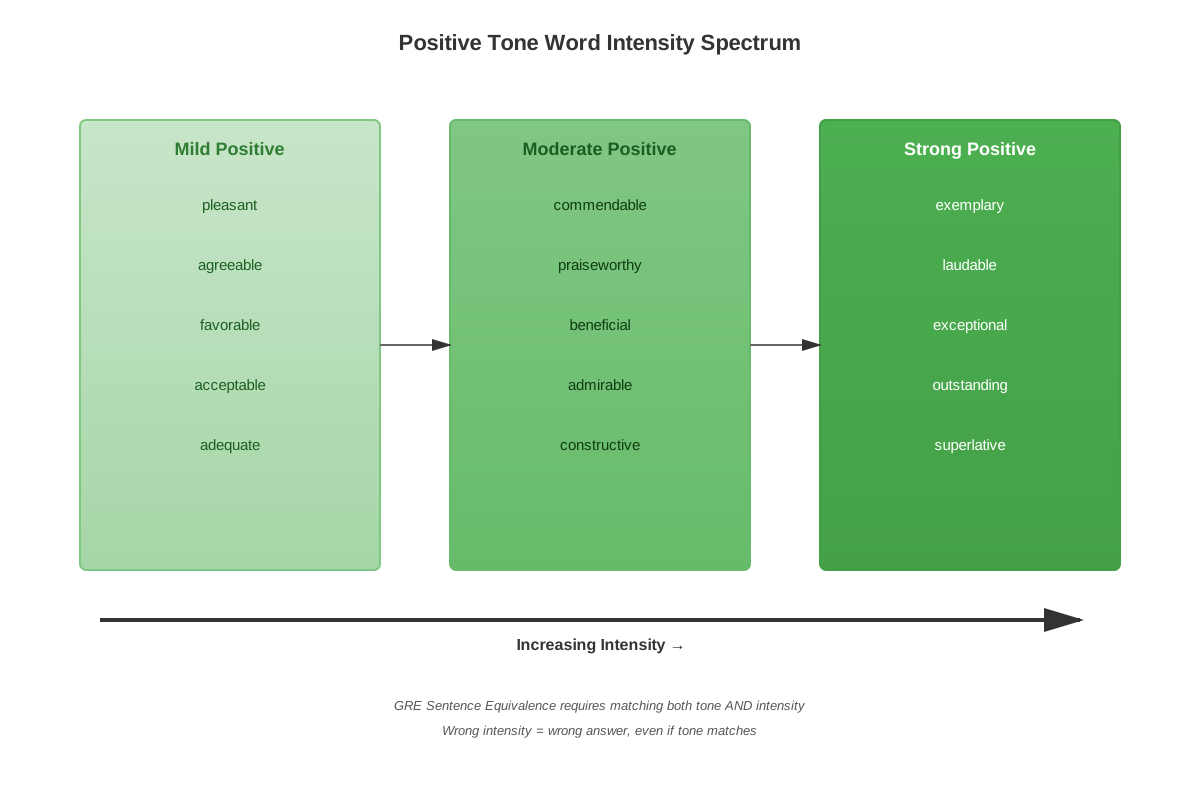
Positive tone words exist along a spectrum of intensity, and the GRE frequently tests whether students can distinguish between mild, moderate, and strong positive terms:
| Intensity Level | Characteristics | Example Words |
|---|---|---|
| Mild Positive | Subtle approval, slight favorability | adequate, acceptable, satisfactory, decent, fair |
| Moderate Positive | Clear approval, notable favorability | good, beneficial, favorable, commendable, praiseworthy |
| Strong Positive | Enthusiastic approval, exceptional quality | excellent, outstanding, exemplary, superlative, transcendent |
Understanding these gradations prevents common errors where students select a word that is positive but too weak or too strong for the context. A sentence describing a "groundbreaking discovery that revolutionized the field" requires strong positive vocabulary, not mild terms like "adequate" or "acceptable."
Categories of Positive Tone Words
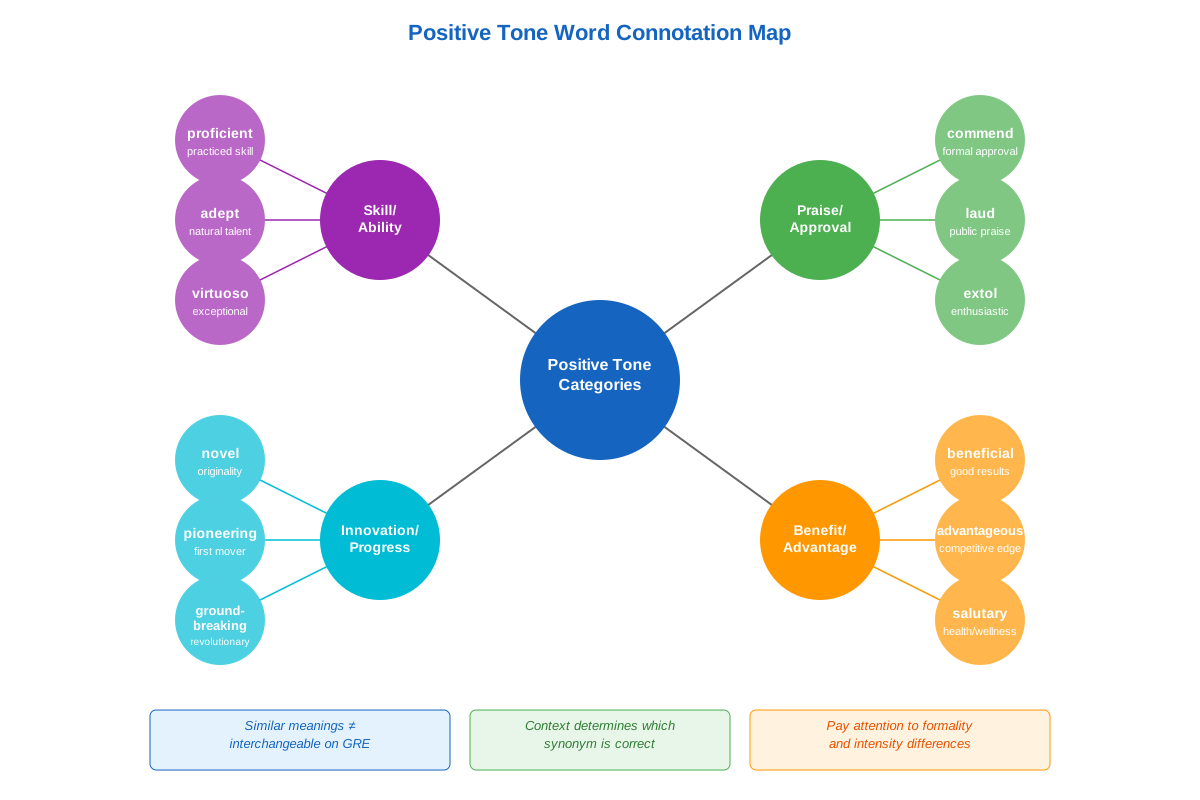
Positive vocabulary on the GRE falls into several functional categories, each serving different semantic purposes:
Praise and Approval Words: These terms express commendation or favorable judgment. Examples include laudatory, complimentary, flattering, approving, favorable, and adulatory. The GRE often uses these in contexts describing reviews, evaluations, or responses to work or ideas.
Quality and Excellence Words: These adjectives describe high standards or superior characteristics. Examples include exemplary, sterling, impeccable, flawless, pristine, and meritorious. These frequently appear in descriptions of performance, character, or craftsmanship.
Enthusiasm and Eagerness Words: These terms convey positive emotional energy or willingness. Examples include ardent, fervent, zealous, avid, keen, and enthusiastic. The GRE uses these to describe attitudes, supporters, or levels of interest.
Benefit and Advantage Words: These words indicate positive outcomes or helpful qualities. Examples include beneficial, advantageous, propitious, auspicious, salutary, and felicitous. These often appear in contexts discussing effects, circumstances, or timing.
Skill and Competence Words: These terms describe positive abilities or expertise. Examples include adept, proficient, accomplished, skilled, deft, and masterful. The GRE employs these when discussing someone's capabilities or performance.
Context Clues for Positive Tone
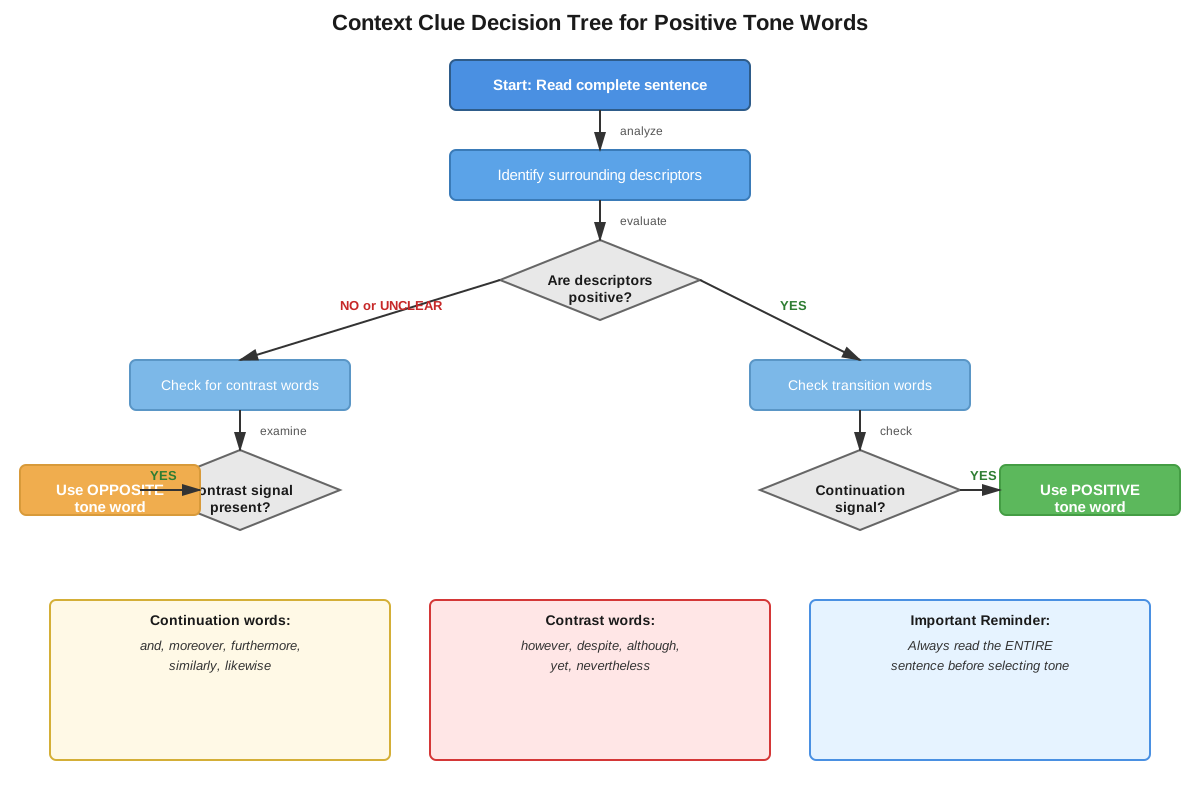
Identifying when positive tone words are required involves recognizing specific textual signals:
- Positive transition words: "furthermore," "moreover," "additionally" following positive statements
- Contrast markers with negative content: "unlike," "in contrast to," "rather than" preceding negative descriptions
- Positive descriptive phrases: "successful outcome," "welcomed development," "impressive achievement"
- Approval indicators: "praised for," "celebrated as," "recognized for"
- Beneficial result language: "led to improvements," "enhanced," "strengthened"
These context clues function as diagnostic tools, signaling that the blank or target word should carry positive valence. Missing these signals leads to tone mismatches, where students select semantically plausible words with incorrect emotional valence.
Connotation Versus Denotation in Positive Words
Denotation refers to a word's literal dictionary definition, while connotation encompasses the emotional associations and implied meanings. Two words may share similar denotations while carrying different connotations. For example, "confident" and "arrogant" both denote self-assurance, but "confident" carries positive connotations while "arrogant" is negative.
Within positive vocabulary, connotative differences create subtle distinctions the GRE exploits. "Thrifty" and "economical" both positively describe careful spending, but "thrifty" suggests personal virtue while "economical" emphasizes practical efficiency. "Childlike" and "youthful" both positively reference youth, but "childlike" emphasizes innocence and wonder while "youthful" suggests energy and vitality. Recognizing these connotative nuances enables precise word selection.
Concept Relationships
The concepts within positive tone words form an interconnected system where understanding one element enhances comprehension of others. Tone recognition serves as the foundation, enabling students to identify that positive vocabulary is required. This leads to intensity assessment, where students determine whether mild, moderate, or strong positive words fit the context. Category identification then narrows the field further by determining which type of positive word (praise, quality, enthusiasm, etc.) is semantically appropriate. Finally, connotation analysis allows selection between words with similar denotations but different implied meanings.
These concepts connect to prerequisite knowledge of context clues and sentence structure. Context clues → tone recognition → intensity assessment → category identification → connotation analysis → correct answer selection represents the decision-making pathway for positive tone word questions. Each step filters possibilities, making the process systematic rather than intuitive guesswork.
Positive tone words also relate inversely to negative tone words—understanding one category sharpens recognition of the other through contrast. Additionally, they connect to neutral vocabulary, as some questions require distinguishing between genuinely positive words and neutral terms that students might mistakenly perceive as positive (such as "notable" or "significant," which indicate importance without necessarily conveying approval).
High-Yield Facts
⭐ Positive tone words appear in 40-50% of GRE Verbal Reasoning questions, making them one of the most frequently tested vocabulary categories.
⭐ Intensity matching is more important than general positivity—a word can be positive but still incorrect if it's too strong or too weak for the context.
⭐ Sentence Equivalence questions require two words that create equivalent meanings, so both selected words must match in tone, intensity, and connotation, not just general positivity.
⭐ Contrast markers (however, although, despite) often signal tone shifts, meaning a positive word may be needed after a negative statement or vice versa.
⭐ Words ending in -ous, -able, -ful, and -ive frequently carry positive connotations (e.g., propitious, commendable, beneficial, productive), though exceptions exist.
- Positive tone words can describe people, ideas, events, qualities, or outcomes, requiring flexible application across contexts.
- The GRE includes "trap answers" that are positive but semantically inappropriate for the specific context (e.g., "generous" when "competent" is needed).
- Some words appear positive in isolation but function neutrally or negatively in context (e.g., "ambitious" can imply overreaching).
- Recognizing the subject being described (person, theory, event, quality) helps narrow which category of positive words is appropriate.
- Many GRE positive tone words are formal or academic in register, requiring familiarity with sophisticated vocabulary beyond everyday speech.
Quick check — test yourself on Positive tone words so far.
Try Flashcards →Common Misconceptions
Misconception: All words with positive denotations are interchangeable in positive contexts. → Correction: Positive words vary in intensity, formality, and specific connotation. "Good" and "superlative" are both positive but differ dramatically in intensity. Context determines which level of positivity is appropriate, and selecting a word with mismatched intensity creates an incorrect or awkward sentence.
Misconception: If a sentence describes something favorable, any positive word will work. → Correction: Semantic fit matters as much as tone. A sentence about someone's technical skills requires competence-related positive words (proficient, adept, skilled) rather than enthusiasm-related positive words (eager, keen, avid), even though both categories are positive.
Misconception: Positive tone words always appear in obviously positive contexts. → Correction: The GRE often embeds positive tone requirements in complex sentences with multiple clauses. A sentence might begin with negative content, then use a contrast marker ("however," "nevertheless") to introduce a clause requiring positive vocabulary. Missing the structural signal leads to tone errors.
Misconception: In Sentence Equivalence, selecting two positive words guarantees a correct answer. → Correction: Both words must be positive AND create sentences with equivalent meanings. Two positive words with different intensities or connotations (e.g., "adequate" and "exemplary") will not produce equivalent sentences, making the answer incorrect despite both being positive.
Misconception: Memorizing positive word lists is sufficient for GRE success. → Correction: While vocabulary knowledge is essential, application requires understanding context, recognizing intensity gradations, and distinguishing connotations. Students must practice applying positive vocabulary in GRE-style contexts, not just memorizing definitions in isolation.
Worked Examples
Example 1: Sentence Equivalence
Question: The critic's review of the novel was surprisingly _________, given her typically harsh assessments of contemporary fiction.
(A) scathing
(B) laudatory
(C) ambivalent
(D) complimentary
(E) verbose
(F) critical
Solution Process:
Step 1 - Identify context clues: The word "surprisingly" signals a contrast, and "typically harsh assessments" establishes that the critic is usually negative. The blank must contrast with "harsh," requiring a positive tone word.
Step 2 - Eliminate based on tone:
- (A) scathing = negative (eliminate)
- (C) ambivalent = neutral/mixed (eliminate)
- (E) verbose = neutral, describes length not tone (eliminate)
- (F) critical = negative (eliminate)
Step 3 - Evaluate remaining positive options:
- (B) laudatory = strongly positive, means expressing praise
- (D) complimentary = positive, means expressing approval or praise
Step 4 - Check for equivalent meanings: Both "laudatory" and "complimentary" are positive words describing praise or approval. They would create sentences with equivalent meanings: "The review was surprisingly full of praise" captures both words' meanings.
Step 5 - Verify intensity match: Both words are moderately-to-strongly positive, appropriate for describing a notable contrast with "typically harsh."
Answer: (B) and (D)
Connection to Learning Objectives: This example demonstrates identifying when positive tone is tested (contrast with "harsh"), explaining the strategy (eliminate non-positive options first, then check for equivalent meanings), and applying the concept accurately to select the correct pair.
Example 2: Text Completion
Question: Despite initial skepticism, the scientific community ultimately found the researcher's methodology to be _________, leading to widespread adoption of her techniques.
(A) questionable
(B) adequate
(C) exemplary
(D) conventional
(E) preliminary
Solution Process:
Step 1 - Identify structural signals: "Despite initial skepticism" sets up a contrast—the methodology was doubted at first. "Ultimately" signals a shift in opinion. "Leading to widespread adoption" indicates a strongly positive outcome.
Step 2 - Determine required tone and intensity: The blank needs a positive word. The phrase "widespread adoption" suggests the methodology wasn't just acceptable but notably good, requiring moderate-to-strong positive vocabulary.
Step 3 - Evaluate each option:
- (A) questionable = negative, contradicts "widespread adoption" (eliminate)
- (B) adequate = mildly positive, but too weak to motivate "widespread adoption" (eliminate)
- (C) exemplary = strongly positive, means serving as an excellent model
- (D) conventional = neutral, doesn't explain why adoption would be widespread (eliminate)
- (E) preliminary = neutral/slightly negative, suggests incompleteness (eliminate)
Step 4 - Verify semantic fit: "Exemplary" means serving as an outstanding example or model. This perfectly explains why the methodology would be widely adopted—it was so excellent that others wanted to emulate it.
Step 5 - Check intensity appropriateness: "Exemplary" is strongly positive, matching the intensity suggested by "widespread adoption" and providing sufficient contrast with "initial skepticism."
Answer: (C) exemplary
Connection to Learning Objectives: This example shows identifying the test of positive tone through contrast markers and outcome descriptions, explaining the strategy of matching intensity to context clues, and accurately applying positive vocabulary knowledge to select the semantically and tonally appropriate answer.
Exam Strategy
Initial Assessment Process: When approaching any GRE Verbal question, immediately scan for tone indicators before reading answer choices. Look for contrast markers (however, although, despite), outcome descriptions (led to success, resulted in failure), and evaluative language (praised, criticized, ignored). This 5-second assessment often reveals whether positive, negative, or neutral vocabulary is required, allowing you to eliminate 50-70% of answer choices immediately.
Trigger Words for Positive Tone Requirements:
- Contrast markers following negative content: "however," "nevertheless," "yet," "but"
- Success/benefit language: "improved," "enhanced," "successful," "beneficial"
- Approval indicators: "praised," "celebrated," "welcomed," "embraced"
- Quality descriptors: "high standard," "excellence," "superior"
- Positive outcome phrases: "fortunately," "happily," "to everyone's delight"
Process of Elimination Strategy: For Sentence Equivalence questions, use a three-pass approach:
- First pass - Eliminate wrong tone: Remove all words that don't match the required positive tone (typically eliminates 2-3 options)
- Second pass - Check intensity: Among remaining positive words, eliminate those too strong or too weak for context (typically eliminates 1-2 options)
- Third pass - Verify equivalence: Ensure the final two words create sentences with truly equivalent meanings, not just similar positivity
Time Allocation Advice: Spend 15-20 seconds identifying tone requirements before evaluating answer choices. This upfront investment saves time by preventing consideration of obviously incorrect options. For Sentence Equivalence, allocate 60-75 seconds total; for single-blank Text Completion, allocate 45-60 seconds. If you've correctly identified tone requirements, you should reach an answer within these timeframes.
Context Clue Prioritization: When multiple context clues seem to conflict, prioritize in this order:
- Structural signals (contrast markers, continuation words)
- Outcome descriptions (what resulted from the action/quality)
- Direct evaluative language (explicit praise or criticism)
- Surrounding vocabulary tone (general positive or negative language)
Common Trap Avoidance: The GRE includes "partial match" trap answers—words that are positive but semantically wrong. Always complete this two-part check: (1) Is the word positive? (2) Does it make logical sense in this specific context? A word can pass test #1 but fail test #2, making it an attractive but incorrect trap answer.
Memory Techniques
Intensity Spectrum Mnemonic - "MAD GOOD": Remember intensity levels as Mild, Average/Decent, Great, Outstanding, Optimal, Divine. This creates a memorable progression from weakest to strongest positive terms, helping you place unfamiliar words along the intensity spectrum.
Category Acronym - "PQEBS": Remember the five main categories of positive tone words as Praise, Quality, Enthusiasm, Benefit, Skill. When you identify that positive vocabulary is needed, mentally run through PQEBS to determine which category fits the context.
Visualization Strategy - The Approval Thermometer: Visualize positive tone words on a thermometer ranging from "cool" (mild positive) to "hot" (strong positive). When you encounter a positive word, mentally place it on this thermometer. This visual representation helps distinguish between "satisfied" (lukewarm), "pleased" (warm), and "ecstatic" (boiling hot).
Suffix Pattern Recognition: Remember that certain suffixes frequently signal positive words:
- -ous: propitious, auspicious, meritorious (favorable circumstances or qualities)
- -able/-ible: commendable, laudable, admirable (worthy of positive regard)
- -ful: beneficial, bountiful, masterful (full of positive qualities)
- -ive: productive, constructive, positive (creating favorable results)
Contrast Pair Memorization: Learn positive words alongside their negative counterparts to sharpen recognition:
- Laudatory ↔ Disparaging
- Exemplary ↔ Deficient
- Propitious ↔ Ominous
- Adept ↔ Inept
- Salutary ↔ Deleterious
This contrast method strengthens memory through opposition and helps prevent tone confusion under test pressure.
Summary
Positive tone words constitute a high-yield category of GRE vocabulary that appears in approximately half of all Verbal Reasoning questions. Mastery requires more than recognizing that a word is favorable—students must distinguish intensity gradations (mild, moderate, strong), identify functional categories (praise, quality, enthusiasm, benefit, skill), and recognize connotative differences between semantically similar terms. Success depends on systematic application of context clue analysis, particularly identifying contrast markers, outcome descriptions, and evaluative language that signal positive tone requirements. The most effective approach involves three-stage filtering: eliminating wrong-tone options, checking intensity appropriateness, and verifying semantic fit. Students who master positive tone vocabulary gain a decisive advantage on Sentence Equivalence and Text Completion questions, where tone recognition often enables immediate elimination of most answer choices. This topic connects fundamentally to reading comprehension, author's attitude analysis, and vocabulary in context, making it essential for achieving competitive Verbal Reasoning scores.
Key Takeaways
- Positive tone words appear in 40-50% of GRE Verbal questions, making them one of the highest-yield vocabulary categories for focused study
- Intensity matching is critical—a word must be not just positive but appropriately mild, moderate, or strong for the specific context
- Context clues, especially contrast markers and outcome descriptions, reliably signal when positive vocabulary is required
- Sentence Equivalence requires both words to be positive AND semantically equivalent, not just generally favorable
- Five main categories organize positive vocabulary: praise, quality, enthusiasm, benefit, and skill—identifying the required category narrows answer choices efficiently
- Systematic elimination based on tone, then intensity, then semantic fit provides a reliable process for approaching positive tone word questions
- Connotation distinguishes between similar positive words, requiring attention to implied meanings beyond dictionary definitions
Related Topics
Negative Tone Words: The complementary category to positive tone vocabulary, covering words that express criticism, disapproval, or unfavorable qualities. Mastering both positive and negative tone words enables comprehensive tone analysis and creates contrast-based elimination strategies.
Neutral Tone Words: Words that convey information without emotional valence, often tested alongside positive and negative options to assess whether students can distinguish objective description from evaluative language.
Transition Words and Logical Connectors: Understanding how words like "however," "moreover," and "consequently" signal relationships between clauses is essential for determining whether positive or negative tone is required in a given blank.
Connotation and Denotation: Deeper exploration of how words carry implied meanings beyond literal definitions, enabling more sophisticated vocabulary discrimination on challenging questions.
Author's Tone and Attitude: Reading Comprehension questions that require identifying whether an author is supportive, critical, or neutral toward a subject—directly applying positive tone word recognition to passage analysis.
Practice CTA
Now that you've mastered the core concepts of positive tone words, it's time to solidify your understanding through active practice. Attempt the practice questions associated with this topic, focusing on applying the systematic elimination strategy and intensity-matching techniques you've learned. Use the flashcards to reinforce your memory of high-yield positive vocabulary and their intensity levels. Remember, recognizing positive tone words quickly and accurately will give you a significant advantage on test day—this is one of the most efficient areas for score improvement. Your investment in mastering this topic will pay dividends across multiple question types throughout the Verbal Reasoning section!
Sign up free to keep reading
Create a free AnvayaPrep account to finish this GRE guide on Positive tone words — plus flashcards and practice questions.