Overview
Sentence equivalence elimination is a strategic approach to solving GRE Sentence Equivalence questions that focuses on systematically ruling out incorrect answer choices rather than immediately searching for the "right" answers. This technique leverages the unique structure of Sentence Equivalence questions, where test-takers must select two answer choices that both complete a sentence with equivalent meanings. By understanding which words can be eliminated based on meaning, tone, or logical incompatibility with the sentence context, students can dramatically improve their accuracy and efficiency on these challenging questions.
The elimination strategy is particularly powerful for GRE Sentence Equivalence because it transforms a seemingly complex task—finding two synonymous words that fit perfectly—into a more manageable process of identifying and removing words that clearly don't work. This approach is essential because the GRE deliberately includes trap answers: words that might fit the sentence individually but don't have a true synonym among the other choices, or words that seem plausible but create subtle meaning shifts that disqualify them. Mastering GRE sentence equivalence elimination allows students to navigate these traps systematically rather than relying on intuition alone.
Within the broader context of GRE Verbal Reasoning, sentence equivalence elimination connects directly to vocabulary knowledge, contextual reasoning, and synonym recognition. It builds upon fundamental reading comprehension skills while requiring precise attention to nuance and connotation. This topic represents a bridge between passive vocabulary recognition and active strategic test-taking, making it one of the highest-yield skills for improving Verbal Reasoning scores. Students who master elimination techniques typically see immediate score improvements because they make fewer careless errors and can confidently tackle questions even when they don't immediately recognize all six answer choices.
Learning Objectives
- [ ] Identify when Sentence equivalence elimination is being tested
- [ ] Explain the core rule or strategy behind Sentence equivalence elimination
- [ ] Apply Sentence equivalence elimination to GRE-style questions accurately
- [ ] Distinguish between words that are contextually inappropriate versus words that lack synonymous pairs
- [ ] Evaluate answer choices systematically using a multi-step elimination framework
- [ ] Recognize common trap patterns that the GRE uses in Sentence Equivalence questions
Prerequisites
- Vocabulary fundamentals: Understanding of basic synonyms, antonyms, and word relationships is essential because elimination relies on recognizing when words share or differ in meaning
- Sentence structure comprehension: Ability to identify the grammatical role of the blank (noun, verb, adjective, etc.) helps eliminate words that don't fit syntactically
- Contextual clue recognition: Familiarity with transition words, contrast indicators, and support clues enables identification of the sentence's logical direction
- Basic GRE Sentence Equivalence format: Knowledge that exactly two answers must be selected and must create sentences with equivalent meanings
Why This Topic Matters
In real-world communication, the ability to identify precise word choices and recognize subtle differences in meaning is crucial for effective writing, professional communication, and critical reading. The elimination strategy mirrors how skilled writers and editors evaluate word choices—by considering what doesn't work before committing to what does. This analytical approach to language strengthens overall verbal reasoning abilities that extend far beyond standardized testing.
On the GRE specifically, Sentence Equivalence questions constitute approximately 40% of the Verbal Reasoning section, appearing as 4 questions per verbal section (8 total in a standard GRE). Each question is worth the same as any other verbal question, making them high-value targets for score improvement. The elimination strategy is particularly valuable because it provides a systematic approach that works even under time pressure and test anxiety.
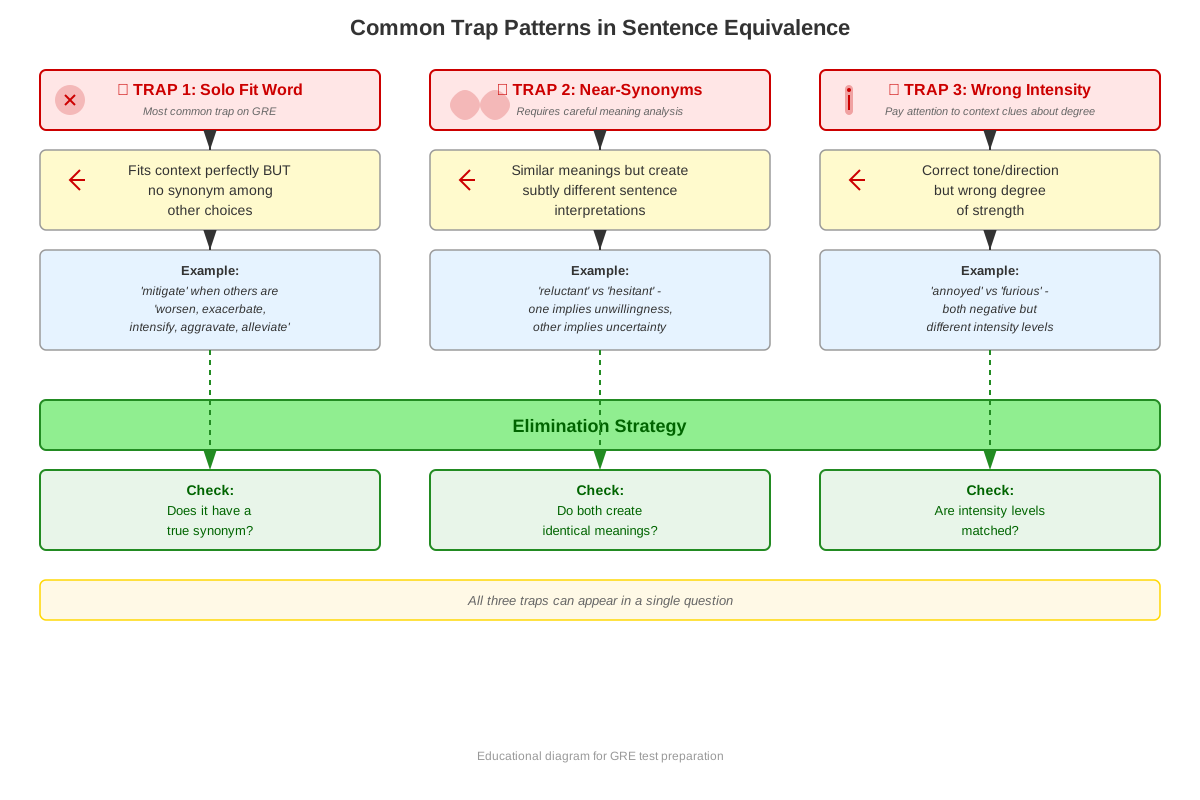
Sentence Equivalence questions appear in several predictable patterns on the exam. The GRE frequently tests elimination skills by including answer choices that: (1) fit the sentence perfectly but have no synonymous pair among the remaining options; (2) are close synonyms but create slightly different meanings when inserted into the sentence; (3) match the sentence's tone but not its logical meaning; or (4) seem sophisticated or impressive but are contextually inappropriate. Recognizing these patterns through elimination practice directly translates to points on test day.
Core Concepts
The Fundamental Principle of Elimination
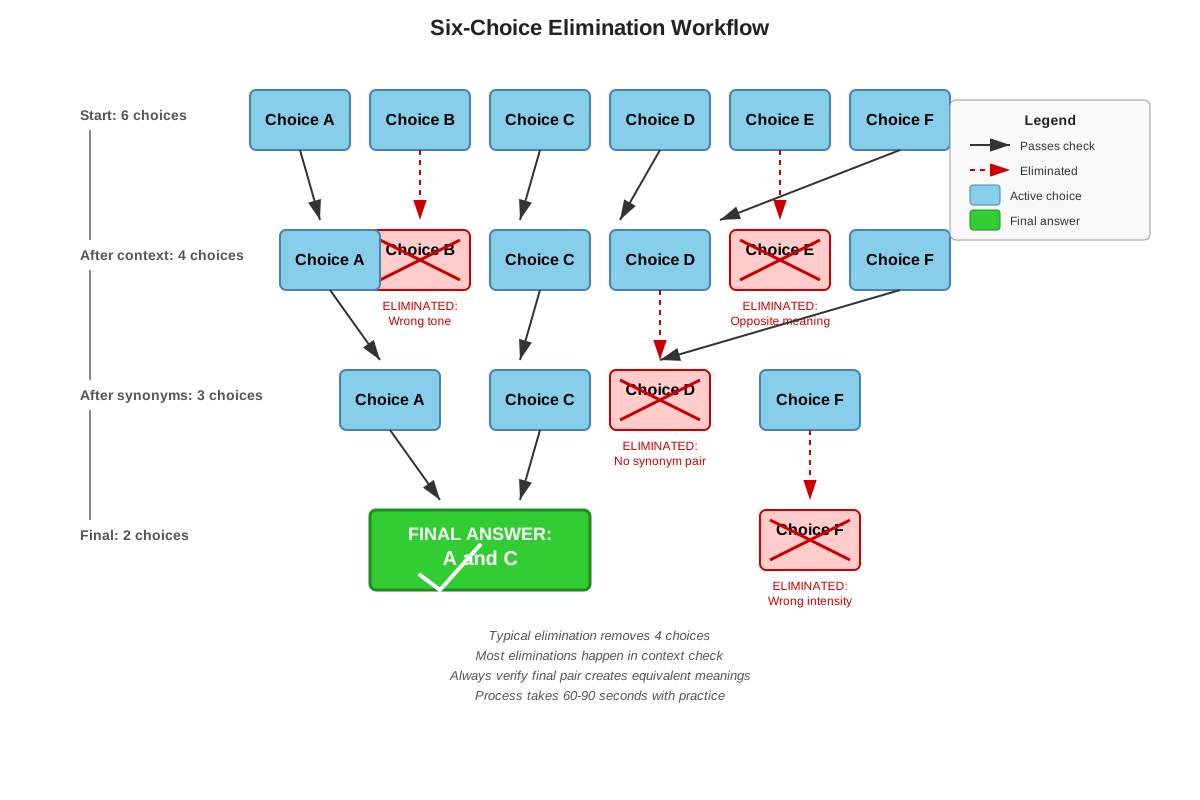
The core principle behind sentence equivalence elimination is that finding what's wrong is often easier than identifying what's right. In a typical Sentence Equivalence question with six answer choices, test-takers must select exactly two words that create sentences with equivalent meanings. This structure creates a mathematical reality: at least four answer choices must be eliminated. Rather than searching for the perfect pair immediately, effective test-takers systematically remove choices that fail specific criteria.
The elimination process works because the GRE's design creates multiple failure points for incorrect answers. A word might fail because: it doesn't fit the sentence's context, it has the wrong connotation (positive vs. negative), it lacks a true synonym among the other five choices, or it creates a logical contradiction with other parts of the sentence. By checking each answer against these criteria, students can often eliminate 3-4 choices quickly, leaving only 2-3 viable options to evaluate more carefully.
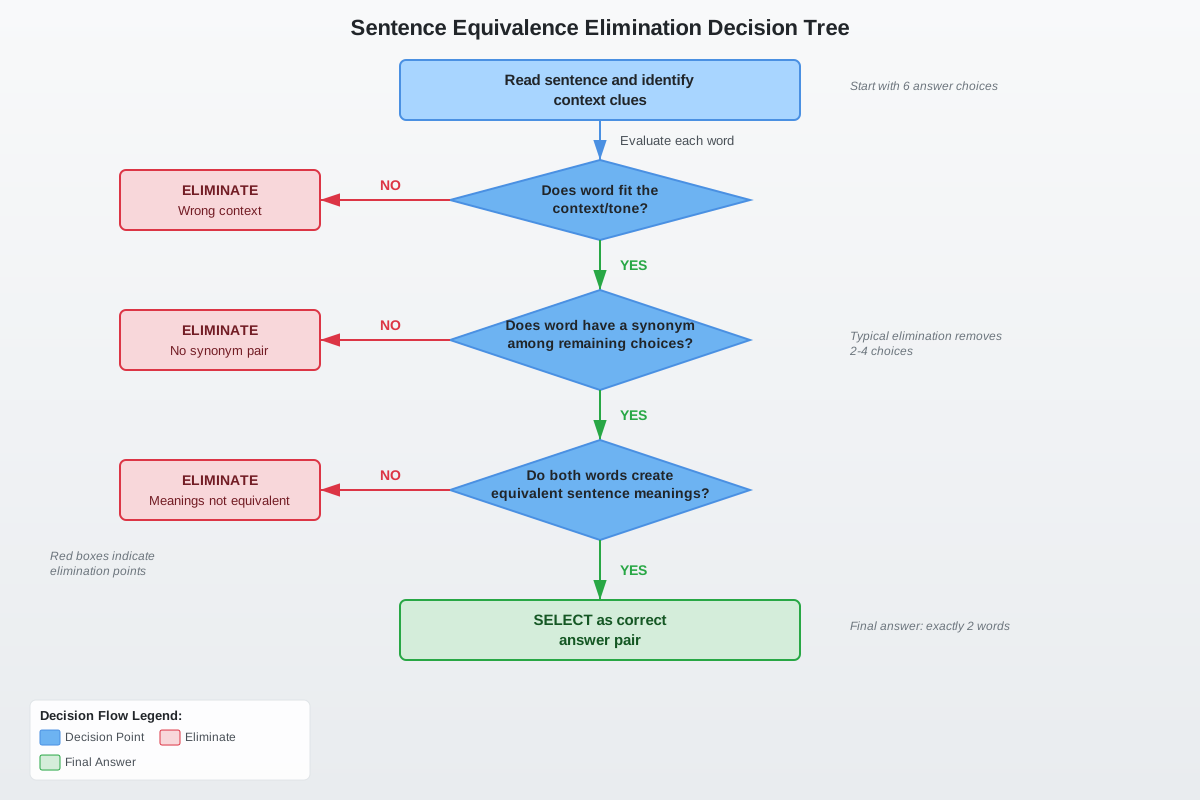
The Three-Stage Elimination Framework
Stage 1: Context-Based Elimination involves reading the sentence carefully to understand its overall meaning and logical direction. Before even looking at the answer choices, identify whether the blank requires a positive, negative, or neutral word. Look for context clues such as transition words (however, moreover, although), descriptive phrases, or logical relationships. Any answer choice that contradicts the sentence's established direction can be immediately eliminated.
Stage 2: Synonym Pair Identification requires scanning the remaining answer choices to identify which words could potentially be synonyms of each other. Remember that the two correct answers must create sentences with equivalent meanings, so they must be synonymous or near-synonymous. If a word has no plausible synonym among the other choices, it can be eliminated regardless of how well it fits the sentence individually. This is one of the most powerful elimination techniques because it often removes trap answers that "sound right" but are isolated.
Stage 3: Precision Testing involves inserting the remaining candidate pairs into the sentence and checking whether both words create logically equivalent sentences. Even words that are synonyms in general usage might create different meanings in a specific context. For example, "difficult" and "challenging" are synonyms, but in the sentence "The _____ student refused to follow instructions," "difficult" works while "challenging" doesn't. This final stage eliminates near-misses and confirms the correct pair.
Recognizing Trap Answer Patterns
The GRE employs several predictable trap patterns in Sentence Equivalence questions. The Isolated Perfect Fit is a word that fits the sentence beautifully but has no synonym among the other five choices. Test-takers who don't use elimination often select this word along with a "close enough" synonym, creating an incorrect answer. The elimination strategy defeats this trap by requiring synonym identification before final selection.
The False Synonym Pair consists of two words that are synonyms in general usage but create different meanings in the specific sentence context. For example, "reserved" and "reticent" both mean quiet or restrained, but "reserved" can also mean "set aside," creating different sentence meanings depending on context. Elimination catches this trap during the precision testing stage.
The Tone Mismatch involves words that fit the sentence's logical meaning but have the wrong connotation or register. A sentence might require a negative word, and an answer choice might be negative, but too extreme or too mild for the context. Elimination based on tone and intensity helps identify these mismatches.
The Role of Vocabulary Knowledge in Elimination
While elimination strategy is powerful, it operates most effectively when combined with strong vocabulary knowledge. Vocabulary depth (knowing multiple meanings and connotations of words) enables more accurate elimination during the context-based stage. Vocabulary breadth (knowing many words) increases the likelihood of recognizing synonym pairs during Stage 2.
However, elimination strategy provides a safety net when vocabulary knowledge is incomplete. If a test-taker doesn't know one or two of the answer choices, they can still eliminate the words they do know that clearly don't work, improving their odds significantly even if they must guess between remaining options.
Systematic vs. Intuitive Approaches
Many test-takers approach Sentence Equivalence questions intuitively, reading the sentence and selecting two words that "feel right." While intuition can work for easier questions, it fails on medium and hard questions where the GRE deliberately designs trap answers to feel correct. The systematic elimination approach provides a reliable framework that works consistently across difficulty levels.
The systematic approach involves: (1) reading the sentence without looking at answers, (2) predicting the type of word needed (positive/negative, noun/verb/adjective, general meaning), (3) eliminating choices that don't match the prediction, (4) identifying potential synonym pairs among remaining choices, (5) testing each pair for contextual equivalence, and (6) selecting the pair that creates truly equivalent sentences. This process takes practice to execute quickly but becomes faster with repetition.
Concept Relationships
The elimination strategy for Sentence Equivalence builds directly upon contextual clue recognition, as identifying the sentence's logical direction is the first elimination criterion. Without understanding context clues, test-takers cannot effectively eliminate choices in Stage 1. This relationship flows as: Context Clues → Logical Direction → Context-Based Elimination.
Vocabulary knowledge connects to elimination at multiple points. Broader vocabulary enables recognition of synonym pairs (Stage 2), while deeper vocabulary knowledge (understanding connotations and multiple meanings) improves precision testing (Stage 3). The relationship is bidirectional: Vocabulary Knowledge ↔ Elimination Effectiveness.
The elimination framework itself follows a sequential relationship: Context-Based Elimination → Synonym Pair Identification → Precision Testing. Each stage narrows the field of viable answers, with later stages only examining choices that survived earlier stages. This creates an efficiency relationship where effective early-stage elimination reduces the cognitive load of later stages.
Sentence equivalence elimination also connects to broader test-taking strategy concepts, particularly time management and confidence calibration. Systematic elimination provides a clear decision-making framework that reduces time spent on uncertainty and second-guessing. The relationship flows: Systematic Elimination → Faster Decision-Making → Better Time Management → Reduced Test Anxiety.
Finally, elimination strategy relates to error pattern analysis. By tracking which elimination stage typically fails (context, synonym identification, or precision), students can identify specific areas for improvement, creating a feedback loop: Elimination Practice → Error Analysis → Targeted Skill Development → Improved Elimination Accuracy.
High-Yield Facts
- ⭐ Sentence Equivalence questions always require exactly two answer choices that create sentences with equivalent meanings; selecting words that fit individually but don't create equivalent sentences is the most common error
- ⭐ If a word has no plausible synonym among the other five answer choices, it must be eliminated regardless of how well it fits the sentence
- ⭐ The GRE frequently includes one "perfect fit" word that has no synonym pair as a trap answer designed to catch test-takers who don't use systematic elimination
- ⭐ Context clues (transition words, descriptive phrases, logical relationships) should be identified before examining answer choices to enable effective Stage 1 elimination
- ⭐ Words that are synonyms in general usage may create different meanings in specific sentence contexts; always test both words in the actual sentence
- Approximately 40% of GRE Verbal Reasoning questions are Sentence Equivalence format, making elimination strategy high-yield for score improvement
- Eliminating even one or two clearly incorrect answers significantly improves guessing odds if vocabulary knowledge is incomplete
- Tone and connotation mismatches (words that are too extreme, too mild, or have wrong emotional valence) are common elimination criteria
- The systematic elimination approach is faster than intuitive selection once the framework becomes automatic through practice
- Sentence Equivalence questions are worth the same points as other verbal questions despite often being more time-consuming; efficient elimination improves time management
- Words with multiple meanings are frequent trap answers; the GRE exploits less common definitions to create plausible-seeming but incorrect choices
- Negative words (prefixes like un-, dis-, in-) should be carefully evaluated as the GRE often includes both positive and negative versions of similar concepts as trap answers
Quick check — test yourself on Sentence equivalence elimination so far.
Try Flashcards →Common Misconceptions
Misconception: The two correct answers must be perfect synonyms in all contexts. → Correction: The correct answers must create sentences with equivalent meanings in the specific sentence context, but they don't need to be interchangeable synonyms in all situations. Context-specific equivalence is what matters.
Misconception: If a word fits the sentence perfectly, it must be one of the correct answers. → Correction: A word can fit the sentence beautifully but still be incorrect if it lacks a synonymous pair among the other choices. Isolated perfect fits are common trap answers.
Misconception: Elimination should only be used when you don't know the answer. → Correction: Systematic elimination should be the primary approach for all Sentence Equivalence questions, regardless of confidence level, because it catches subtle traps that intuition misses.
Misconception: The two correct answers will always be obvious synonyms that you immediately recognize. → Correction: On medium and hard questions, the correct pair often consists of words that are not commonly thought of as synonyms, requiring careful contextual analysis to recognize their equivalence in the specific sentence.
Misconception: You should select your two answers and move on quickly to save time. → Correction: Spending an extra 15-20 seconds on systematic elimination actually saves time by preventing errors that would require returning to the question or losing points, and the framework becomes faster with practice.
Misconception: If two words are antonyms, they can be immediately eliminated. → Correction: While antonyms usually can be eliminated, occasionally the sentence context requires one or the other, so both should be evaluated against the context before elimination. Don't eliminate based solely on the relationship between answer choices without considering the sentence.
Misconception: Advanced vocabulary is more important than elimination strategy for Sentence Equivalence success. → Correction: While vocabulary is important, systematic elimination strategy is equally or more valuable because it provides a framework for handling questions even when vocabulary knowledge is incomplete and catches traps that vocabulary alone won't prevent.
Worked Examples
Example 1: The Isolated Perfect Fit Trap
Question: The professor's lecture was so _____ that even students who typically struggled with the subject found themselves understanding complex concepts with ease.
(A) lucid
(B) pedantic
(C) abstruse
(D) transparent
(E) convoluted
(F) verbose
Step 1 - Context Analysis: The sentence indicates that students understood easily, so the blank requires a positive word meaning "clear" or "easy to understand." The phrase "even students who typically struggled" emphasizes that the lecture made difficult material accessible.
Step 2 - Context-Based Elimination:
- (B) pedantic means overly concerned with minor details - doesn't match "easy to understand" → ELIMINATE
- (C) abstruse means difficult to understand - opposite of what's needed → ELIMINATE
- (E) convoluted means complicated - opposite of what's needed → ELIMINATE
- (F) verbose means wordy - doesn't necessarily mean clear → ELIMINATE
Step 3 - Synonym Pair Identification: Remaining choices are (A) lucid and (D) transparent. Both mean "clear" or "easy to understand." They form a potential synonym pair.
Step 4 - Precision Testing:
- "The lecture was so lucid that students understood easily" ✓
- "The lecture was so transparent that students understood easily" ✓
Both create equivalent meanings in this context.
Answer: (A) and (D)
Key Learning Point: Notice that if we had selected (A) lucid along with (F) verbose because "a clear, detailed lecture helps understanding," we would have fallen for the trap. Verbose fits somewhat but has no true synonym pair, and it doesn't create an equivalent meaning to lucid. The elimination framework prevents this error by requiring synonym pair identification.
Example 2: The False Synonym Pair
Question: Despite her _____ demeanor in public settings, she was known among close friends for her warmth and spontaneity.
(A) reserved
(B) reticent
(C) aloof
(D) distant
(E) formal
(F) austere
Step 1 - Context Analysis: The word "Despite" signals contrast. The blank describes public behavior that contrasts with "warmth and spontaneity" in private. We need a word suggesting coldness, distance, or restraint in public.
Step 2 - Context-Based Elimination: All six words could potentially describe someone who seems cold or restrained in public. No immediate eliminations based on context alone.
Step 3 - Synonym Pair Identification: Several potential pairs exist:
- (A) reserved and (B) reticent (both mean quiet/restrained)
- (C) aloof and (D) distant (both mean emotionally removed)
- (E) formal and (F) austere (both suggest lack of warmth)
Step 4 - Precision Testing: This is where careful analysis matters.
- Reserved/reticent: "Despite her reserved demeanor in public" suggests she's quiet but not necessarily cold. "Despite her reticent demeanor" is similar. Both work and create equivalent meanings. ✓
- Aloof/distant: "Despite her aloof demeanor" suggests emotional coldness. "Despite her distant demeanor" is nearly identical. Both work and create equivalent meanings. ✓
- Formal/austere: "Despite her formal demeanor" suggests adherence to social conventions. "Despite her austere demeanor" suggests severity or sternness, which is stronger than just formal. These create slightly different meanings. ✗
Step 5 - Final Decision: We have two viable pairs. Re-reading the sentence, the contrast is between public restraint and private warmth/spontaneity. Both reserved/reticent and aloof/distant could work, but aloof and distant more strongly convey the emotional distance that contrasts with "warmth," while reserved and reticent focus more on verbal restraint that contrasts with "spontaneity."
Answer: (C) and (D)
Key Learning Point: This example shows why precision testing is crucial. Multiple synonym pairs may seem viable, requiring careful evaluation of which pair creates the strongest logical contrast with the rest of the sentence. The elimination framework forces this careful analysis rather than accepting the first plausible pair.
Exam Strategy
When approaching GRE Sentence Equivalence questions, begin by reading the sentence completely without looking at the answer choices. This prevents premature anchoring on attractive but incorrect options. As you read, identify context clues and determine the logical direction: Does the blank need a positive, negative, or neutral word? What general meaning is required?
Trigger words to watch for include contrast indicators (despite, although, however, yet, while) and support indicators (moreover, furthermore, indeed, because). These words signal whether the blank should align with or oppose other parts of the sentence. Circle or mentally note these triggers as they guide Stage 1 elimination.
For process-of-elimination, follow this sequence: First, eliminate any words that contradict the sentence's logical direction (30 seconds). Second, scan remaining choices for potential synonym pairs (20 seconds). Third, test each viable pair by inserting both words into the sentence and confirming they create equivalent meanings (30 seconds). This structured approach typically takes 60-90 seconds per question once practiced, which is appropriate pacing for the GRE.
Time allocation should be approximately 1-1.5 minutes per Sentence Equivalence question. If you're spending more than 2 minutes, you're likely overthinking. Use elimination to narrow to 2-3 viable options, then make your best judgment and move forward. Mark the question for review if time permits at the end of the section.
A critical strategy: Never select two words just because they're synonyms. Always verify that both words fit the sentence context. The GRE includes synonym pairs that don't work in the specific sentence as trap answers. Conversely, don't reject a pair just because the words seem different at first glance; test them in context to see if they create equivalent meanings.
When you're unsure about vocabulary, use partial elimination to improve your odds. If you can eliminate even two choices with confidence, you've reduced six options to four, significantly improving guessing probability. If you can identify that the blank needs a positive or negative word, eliminate all words with the opposite valence before guessing.
Memory Techniques
The "STEP" Mnemonic for the elimination framework:
- Sentence analysis (read and identify context clues)
- Tone and direction (determine positive/negative/neutral)
- Eliminate mismatches (remove words that don't fit context)
- Pair and precision (identify synonym pairs and test for equivalence)
The "Two-Two-Two" Rule: Remember that Sentence Equivalence requires two answers that create two equivalent sentences, and you should test two things: (1) Does each word fit the sentence? (2) Do both words create the same meaning?
Visualization Strategy: Picture a funnel with three levels. Six answer choices enter at the top. The first filter (context) catches obvious mismatches. The second filter (synonym pairing) catches isolated words. The third filter (precision) catches false pairs. Only two choices emerge at the bottom.
The "Synonym Scan" Technique: After reading the sentence, quickly scan the six answer choices looking for words that jump out as potential synonyms before analyzing individual words. This activates your synonym recognition and often reveals the correct pair immediately, which you can then verify through elimination.
Acronym for Common Traps - "PITS":
- Perfect fit with no pair
- Isolated word that works alone
- Tone mismatch (too extreme or too mild)
- Synonyms in general but not in this specific context
Summary
Sentence equivalence elimination is a systematic strategy for solving GRE Sentence Equivalence questions by identifying and removing incorrect answer choices through a three-stage framework. The approach leverages the unique structure of these questions—requiring two answers that create equivalent meanings—to transform a complex task into a manageable process. The three stages (context-based elimination, synonym pair identification, and precision testing) work sequentially to narrow six choices to the correct pair. This strategy is essential because the GRE deliberately includes trap answers: isolated perfect fits, false synonym pairs, and tone mismatches designed to catch intuitive test-takers. By applying systematic elimination, students can avoid these traps, improve accuracy, and work more efficiently under time pressure. The framework works even when vocabulary knowledge is incomplete, providing a reliable approach across all difficulty levels. Mastery requires understanding that correct answers must create contextually equivalent sentences, not just be general synonyms, and that elimination should be the primary approach rather than a backup strategy.
Key Takeaways
- Systematic elimination through a three-stage framework (context, synonym pairing, precision) is more reliable than intuitive answer selection for Sentence Equivalence questions
- A word can fit the sentence perfectly but still be incorrect if it lacks a synonymous pair among the other five choices—this is the most common trap pattern
- The two correct answers must create sentences with equivalent meanings in the specific context, not necessarily be perfect synonyms in all situations
- Context clues (especially contrast and support indicators) should be identified before examining answer choices to enable effective elimination
- Elimination strategy provides a safety net when vocabulary knowledge is incomplete and catches subtle traps that vocabulary alone won't prevent
- Testing both words of a potential pair in the actual sentence is essential because words that are synonyms generally may create different meanings in specific contexts
- Approximately 60-90 seconds per question is appropriate pacing when using the systematic elimination framework
Related Topics
Text Completion Strategy builds on sentence equivalence elimination by applying similar context analysis and elimination techniques to questions with one, two, or three blanks. Mastering sentence equivalence elimination provides the foundation for more complex text completion approaches.
Vocabulary in Context deepens understanding of how word meanings shift based on sentence context, which is essential for the precision testing stage of elimination. This topic explores connotation, register, and contextual appropriateness in greater depth.
Reading Comprehension Inference Questions utilize similar logical reasoning skills as sentence equivalence elimination, particularly the ability to identify what must be true based on context clues and eliminate options that contradict given information.
Synonym and Antonym Recognition strengthens the vocabulary foundation necessary for effective Stage 2 elimination (synonym pair identification). Advanced study in this area improves speed and accuracy in recognizing potential pairs.
Time Management for Verbal Reasoning incorporates sentence equivalence elimination strategy into broader pacing frameworks for the entire verbal section, helping students allocate appropriate time across different question types.
Practice CTA
Now that you've mastered the systematic elimination framework for Sentence Equivalence questions, it's time to put these strategies into action. Work through the practice questions to reinforce the three-stage elimination process and develop the speed and confidence you need for test day. Pay special attention to identifying trap patterns—each practice question you analyze strengthens your ability to spot these traps instantly on the actual GRE. Review the flashcards to internalize key concepts and common trap patterns until the elimination framework becomes automatic. Remember, systematic elimination is a skill that improves dramatically with deliberate practice. Every question you work through builds the neural pathways that will help you execute this strategy quickly and accurately under test conditions. You've got this!
Sign up free to keep reading
Create a free AnvayaPrep account to finish this GRE guide on Sentence equivalence elimination — plus flashcards and practice questions.