Overview
The GRE Sentence Equivalence section presents a unique challenge that distinguishes it from traditional vocabulary tests. While many test-takers approach these questions by searching for simple dictionary synonyms, the GRE actually requires identifying words that produce equivalent meaning in the specific context of the sentence. This distinction represents one of the most critical—and frequently misunderstood—concepts in GRE Verbal Reasoning.
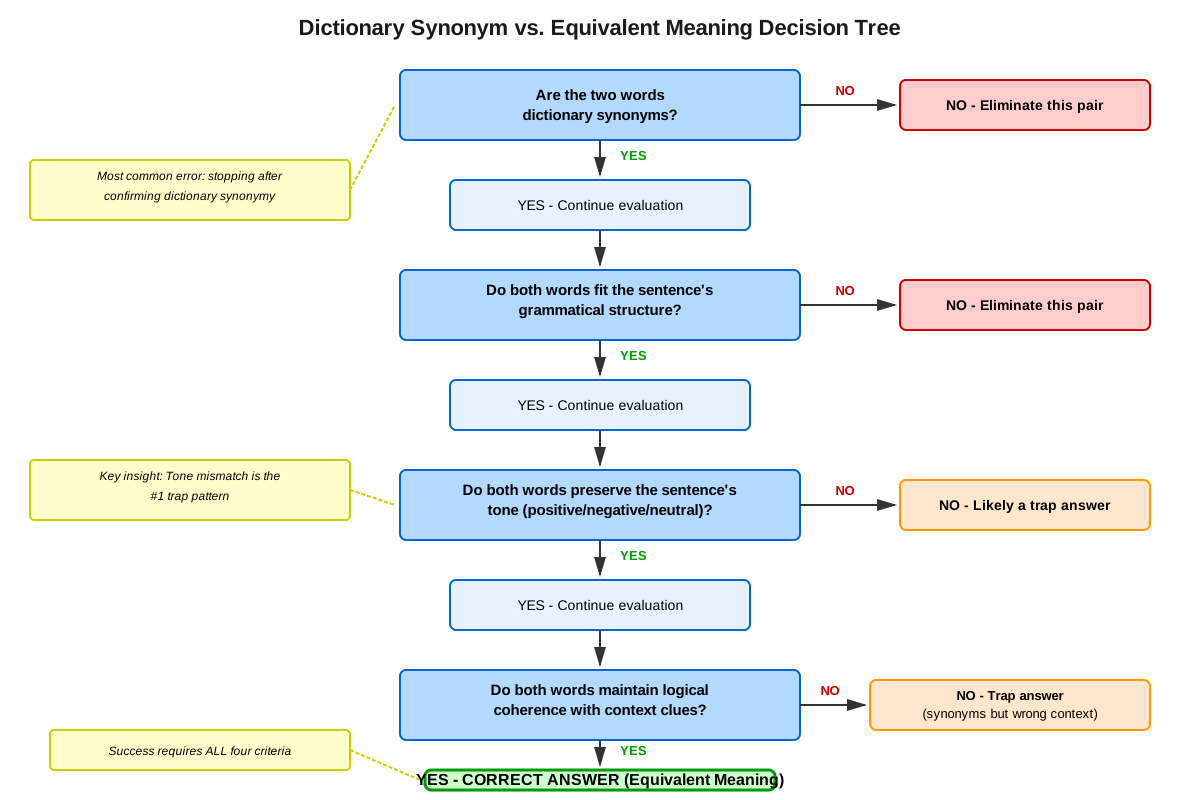
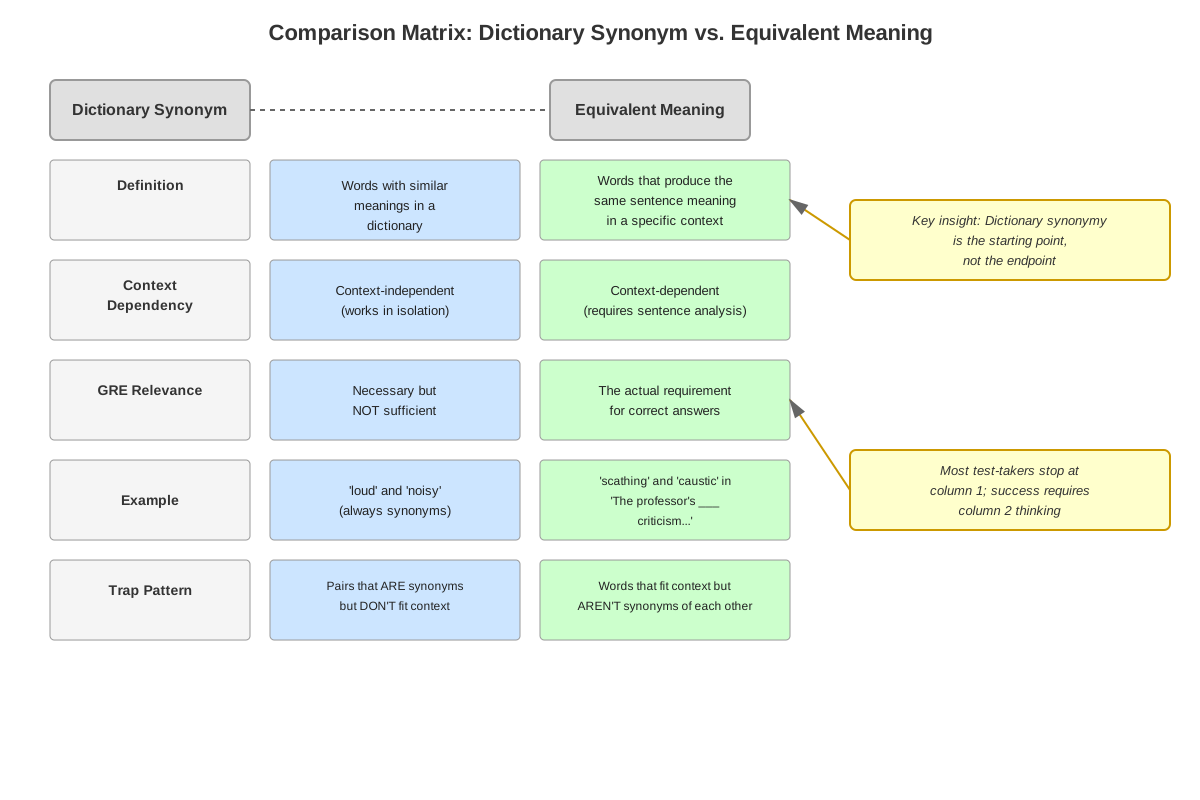
Understanding equivalent meaning versus dictionary synonym is essential because the GRE deliberately includes trap answers: words that are synonyms of each other in isolation but fail to maintain the sentence's intended meaning when substituted into the blank. For example, "loud" and "noisy" are dictionary synonyms, but in the sentence "The professor's _____ criticism silenced the room," only words conveying harshness (like "scathing" or "caustic") work—not words merely indicating volume. This topic tests reading comprehension, contextual reasoning, and vocabulary simultaneously, making it a high-value skill that impacts performance across multiple question types.
This concept connects directly to broader Verbal Reasoning skills including context clue identification, tone analysis, and logical coherence. Mastering the distinction between context-dependent equivalence and decontextualized synonymy enables test-takers to avoid the most common pitfalls in Sentence Equivalence questions while also improving performance on Text Completion and Reading Comprehension passages where precise word meaning matters.
Learning Objectives
- [ ] Identify when equivalent meaning versus dictionary synonym is being tested
- [ ] Explain the core rule or strategy behind equivalent meaning versus dictionary synonym
- [ ] Apply equivalent meaning versus dictionary synonym to GRE-style questions accurately
- [ ] Distinguish between words that are synonyms in isolation versus words that create equivalent sentence meaning
- [ ] Analyze sentence context to determine which semantic features must be preserved for meaning equivalence
- [ ] Evaluate answer pairs to identify trap answers that are synonyms of each other but contextually inappropriate
Prerequisites
- Basic vocabulary knowledge: Understanding word definitions is necessary before determining contextual appropriateness
- Sentence structure comprehension: Recognizing how words function grammatically helps identify what semantic role the blank must fill
- Context clue identification: The ability to extract meaning from surrounding words is foundational to determining equivalent meaning
- Logical reasoning skills: Understanding cause-effect relationships and logical flow enables prediction of appropriate word meanings
Why This Topic Matters
The GRE equivalent meaning versus dictionary synonym distinction appears in every Sentence Equivalence question on the exam, making it one of the highest-yield concepts for score improvement. Sentence Equivalence questions constitute approximately one-third of the Verbal Reasoning section, and research indicates that misunderstanding this concept accounts for the majority of errors even among high-scoring test-takers. Unlike vocabulary-only questions that reward memorization, these questions assess sophisticated reading comprehension—the very skill graduate programs value.
In real-world applications, this skill mirrors the precision required in academic writing and professional communication. Graduate students must select words that convey exact meanings within specific contexts, not merely choose from a list of synonyms. Legal documents, scientific papers, and policy analyses all demand this level of linguistic precision.
On the GRE, this topic appears in several predictable patterns: sentences with strong positive or negative tone where neutral synonyms serve as traps; sentences with technical or specialized meanings where common synonyms fail; and sentences with logical relationships where only certain semantic features preserve coherence. Approximately 60-70% of Sentence Equivalence questions include at least one trap answer pair that are dictionary synonyms but contextually incorrect, making this the single most important defensive skill for avoiding wrong answers.
Core Concepts
The Fundamental Distinction
Equivalent meaning refers to words that, when substituted into a specific sentence, produce two versions with the same essential meaning, tone, and logical relationships. Dictionary synonyms, by contrast, are words that share similar definitions when considered in isolation, without reference to any particular context. The GRE tests the former while deliberately including the latter as distractors.
Consider this critical principle: two words can be perfect synonyms in a dictionary yet completely inappropriate for creating equivalent sentence meaning. The word "happy" and "content" are synonyms, but in the sentence "The child's _____ laughter filled the room," only "happy" (or similar words like "joyful" or "gleeful") works—"content" suggests quiet satisfaction rather than exuberant expression.
Context-Dependent Semantic Features
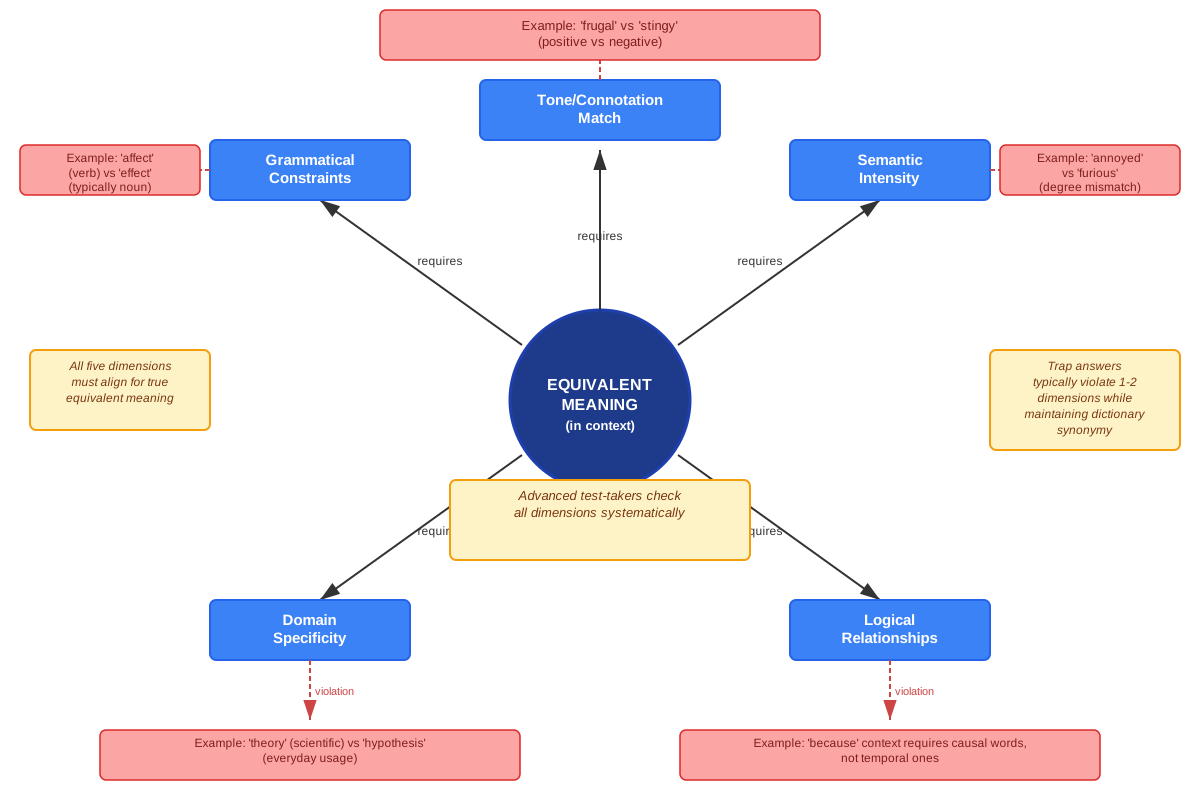
Every sentence context activates specific semantic features that the correct answer must possess. These features include:
| Semantic Feature | Definition | Example |
|---|---|---|
| Intensity | The degree or strength of the quality | "annoyed" vs. "furious" |
| Tone | Positive, negative, or neutral valence | "thrifty" vs. "cheap" |
| Formality | Register appropriate to context | "intoxicated" vs. "drunk" |
| Specificity | Level of precision or generality | "walked" vs. "sauntered" |
| Connotation | Associated implications beyond literal meaning | "childlike" vs. "childish" |
The correct answer pair must match ALL relevant semantic features activated by the sentence context. Dictionary synonyms often match only one or two features while differing in others.
The Sentence Coherence Test
To determine equivalent meaning, apply this three-step process:
- Read the complete sentence and predict the general meaning needed (positive/negative, strong/weak, literal/figurative)
- Substitute each answer choice individually and read the complete sentence aloud
- Compare the resulting sentences to verify they convey the same core meaning, tone, and logical relationships
A sentence maintains coherence when all parts work together logically. Words that create equivalent meaning preserve this coherence identically. For example, in "Despite his _____ appearance, the detective possessed a sharp mind," both "disheveled" and "unkempt" create equivalent meaning because both suggest the same contrast between external appearance and internal capability. However, "messy" (though a synonym) might suggest carelessness rather than mere appearance, subtly changing the sentence's implication.
Common Trap Patterns
The GRE employs several recurring trap patterns that exploit the synonym/equivalence distinction:
Pattern 1: Synonym Pairs with Different Intensities
The test includes two words that are synonyms but differ in intensity. Example: "concerned" and "worried" are synonyms, but in a sentence requiring strong emotion, only "worried" might work while "concerned" is too mild.
Pattern 2: Synonym Pairs with Different Connotations
Words like "unique" and "strange" both mean "unusual" but carry different connotations—one positive/neutral, one potentially negative.
Pattern 3: Synonym Pairs with Different Registers
Formal and informal synonyms appear together. In academic contexts, "intoxicated" works while "drunk" may be too informal, despite being synonyms.
Pattern 4: Synonym Pairs with Different Specificities
General and specific synonyms appear together. "Bad" and "toxic" are related, but "toxic" implies a specific type of harm that may not fit all contexts where "bad" would work.
The Role of Logical Indicators
Sentence Equivalence questions often include logical indicators—words that signal relationships between ideas. These indicators constrain which semantic features the answer must possess:
- Contrast indicators (although, despite, however): Signal that the blank must contrast with another element
- Support indicators (because, since, therefore): Signal that the blank must logically support or result from another element
- Continuation indicators (and, moreover, furthermore): Signal that the blank must align with the sentence's established direction
- Comparison indicators (like, similarly, as): Signal that the blank must parallel another element
When logical indicators are present, equivalent meaning requires preserving these logical relationships, not merely inserting synonyms.
Testing Your Answer Pair
After selecting two answers, verify they create equivalent meaning by asking:
- Do both sentences convey the same basic factual content?
- Do both sentences maintain the same tone (positive, negative, neutral)?
- Do both sentences preserve the same logical relationships between ideas?
- Could both sentences be true simultaneously in the same situation?
- Would a reader understand the same essential message from both versions?
If the answer to any question is "no," the words do not create equivalent meaning, regardless of whether they are dictionary synonyms.
Concept Relationships
The distinction between equivalent meaning and dictionary synonyms builds directly on context clue identification skills. Students must first extract contextual constraints from the sentence (prerequisite skill) before evaluating whether answer choices satisfy those constraints (this topic's focus).
This concept enables progression to more advanced skills: recognizing subtle tone shifts, identifying author intent in Reading Comprehension, and evaluating argument structure in Critical Reasoning. The relationship flows as follows:
Context Clue Identification → provides constraints → Equivalent Meaning Analysis → enables → Precise Answer Selection → supports → Reading Comprehension Mastery
Within this topic, the concepts connect hierarchically:
Fundamental Distinction (understanding what equivalence means) → Semantic Features (identifying which features matter) → Coherence Testing (applying the distinction) → Trap Pattern Recognition (defensive strategy) → Verification Process (confirming correct answers)
The concept also relates laterally to vocabulary study: while building vocabulary knowledge helps generate answer predictions, understanding equivalent meaning helps select between known words—making it a higher-order skill that multiplies the value of vocabulary knowledge.
High-Yield Facts
⭐ Sentence Equivalence requires words that create equivalent meaning in context, not words that are synonyms in a dictionary
⭐ Approximately 60-70% of Sentence Equivalence questions include trap answer pairs that are synonyms of each other but contextually wrong
⭐ The correct answer pair must match ALL relevant semantic features: intensity, tone, formality, specificity, and connotation
⭐ Logical indicators (although, because, despite) constrain which semantic features the answer must possess
⭐ Two sentences have equivalent meaning only if they convey the same factual content, tone, and logical relationships
- Words that are synonyms in isolation frequently differ in intensity, making them non-equivalent in context
- The GRE deliberately places dictionary synonym pairs among the answer choices to trap test-takers who don't consider context
- Reading the complete sentence with each answer choice substituted is more reliable than comparing answer choices to each other
- Formal and informal synonyms often appear together as traps in academic-context sentences
- The sentence coherence test (does everything work together logically?) is the ultimate verification method
- Connotation differences between synonyms often determine whether they create equivalent meaning
- Predicting the answer before looking at choices helps avoid being misled by attractive synonym pairs
- Words can be semantically similar yet create different implications when combined with specific sentence elements
Quick check — test yourself on Equivalent meaning versus dictionary synonym so far.
Try Flashcards →Common Misconceptions
Misconception: If two answer choices are synonyms of each other, they must be the correct pair.
Correction: Synonym pairs are often trap answers. The GRE includes dictionary synonyms that don't fit the sentence context to test whether students understand the difference between decontextualized synonymy and context-dependent equivalence.
Misconception: The correct answers must be perfect synonyms that could substitute for each other in any sentence.
Correction: The correct answers only need to create equivalent meaning in the specific sentence provided. They might not be interchangeable in other contexts. Context determines equivalence, not abstract similarity.
Misconception: If both answer choices "make sense" grammatically, they create equivalent meaning.
Correction: Grammatical correctness is necessary but insufficient. Both sentences must convey the same tone, intensity, and logical relationships—not merely be grammatically acceptable.
Misconception: More difficult or sophisticated vocabulary words are more likely to be correct.
Correction: The GRE tests contextual appropriateness, not vocabulary difficulty. Sometimes simpler words create equivalent meaning while sophisticated words do not fit the context.
Misconception: The correct answer pair will always be the same part of speech and have similar word structures.
Correction: While correct answers must be the same part of speech (to fit grammatically), they may differ significantly in structure, length, or etymology. Focus on meaning, not form.
Misconception: If one word in a potential pair is correct, its closest synonym among the remaining choices must be the other answer.
Correction: This strategy leads to trap answers. Each word must be evaluated independently for contextual fit before pairing them.
Misconception: Strong vocabulary knowledge alone is sufficient for Sentence Equivalence questions.
Correction: Vocabulary knowledge must be combined with contextual analysis. Knowing word definitions is necessary but not sufficient—students must also determine which semantic features the context requires.
Worked Examples
Example 1: Intensity Trap
Question: The scientist's _____ approach to research, characterized by meticulous attention to every detail, yielded groundbreaking results.
Answer Choices:
(A) careful
(B) rigorous
(C) systematic
(D) methodical
(E) thorough
(F) precise
Step 1: Analyze Context
The sentence describes an approach characterized by "meticulous attention to every detail" that produces "groundbreaking results." The context requires words suggesting extreme thoroughness and systematic precision—not merely carefulness.
Step 2: Evaluate Semantic Features Required
- Intensity: High (meticulous suggests extreme care)
- Tone: Positive (yielded groundbreaking results)
- Specificity: Suggests systematic, organized approach
- Connotation: Scientific, methodical precision
Step 3: Test Each Choice
- (A) "careful" - Too general and mild; doesn't capture the systematic nature
- (B) "rigorous" - Suggests strict, thorough, systematic approach ✓
- (C) "systematic" - Suggests organized, methodical approach ✓
- (D) "methodical" - Suggests organized, step-by-step approach ✓
- (E) "thorough" - Suggests completeness but lacks the systematic implication
- (F) "precise" - Suggests accuracy but doesn't capture the comprehensive approach
Step 4: Identify Trap
Notice that (C) "systematic" and (D) "methodical" are dictionary synonyms—they mean nearly the same thing in isolation. However, we need to verify they create equivalent meaning in THIS sentence.
Step 5: Test Sentence Equivalence
- "The scientist's rigorous approach... yielded groundbreaking results" - Emphasizes strict thoroughness
- "The scientist's systematic approach... yielded groundbreaking results" - Emphasizes organized methodology
Both preserve the meaning that extreme thoroughness led to success, matching the "meticulous attention to every detail" description.
Correct Answer: (B) and (C)
Key Lesson: While (C) and (D) are synonyms of each other, they don't both create equivalent meaning with the best answer. The trap here is assuming synonym pairs are automatically correct. "Rigorous" and "systematic" aren't perfect synonyms in isolation, but they create equivalent meaning in this specific context.
Example 2: Connotation Trap
Question: Although the politician's speech was _____, lacking any concrete policy proposals, it nonetheless energized the crowd with its emotional appeal.
Answer Choices:
(A) empty
(B) hollow
(C) vacant
(D) vapid
(E) void
(F) bare
Step 1: Analyze Context
The sentence uses "Although" (contrast indicator) and explicitly states the speech "lacking any concrete policy proposals" but still "energized the crowd." The blank must describe something negative (lack of substance) that contrasts with the positive effect.
Step 2: Evaluate Semantic Features Required
- Intensity: Moderate to strong (the contrast is significant)
- Tone: Negative (criticism of lack of substance)
- Connotation: Should suggest lack of meaningful content, not just physical emptiness
- Context: Intellectual/rhetorical emptiness, not literal emptiness
Step 3: Test Each Choice
- (A) "empty" - Could work but somewhat literal/physical
- (B) "hollow" - Suggests lack of genuine substance, often used for rhetoric ✓
- (C) "vacant" - Typically describes physical spaces or blank expressions
- (D) "vapid" - Suggests lack of substance, liveliness, or interest ✓
- (E) "void" - Too formal/technical; suggests complete absence
- (F) "bare" - Suggests minimal content but not necessarily lacking substance
Step 4: Identify Trap
Notice that (A) "empty," (B) "hollow," (C) "vacant," and (E) "void" are all dictionary synonyms meaning "containing nothing." This is a sophisticated trap—multiple synonyms appear, but only certain ones fit the rhetorical context.
Step 5: Test Sentence Equivalence
- "Although the politician's speech was hollow... it nonetheless energized the crowd" - Suggests rhetoric without substance
- "Although the politician's speech was vapid... it nonetheless energized the crowd" - Suggests dull, lacking substance
Both create equivalent meaning: the speech lacked meaningful content but still had emotional impact. Both preserve the contrast structure and the specific type of emptiness (intellectual/rhetorical rather than physical).
Correct Answer: (B) and (D)
Key Lesson: Multiple dictionary synonyms appeared (empty, hollow, vacant, void), but only two created equivalent meaning in context. The connotation of "rhetorical emptiness" versus "physical emptiness" was the distinguishing factor. This demonstrates why context-dependent semantic features matter more than decontextualized synonymy.
Exam Strategy
Approach Process
When encountering Sentence Equivalence questions, follow this systematic approach:
- Read the sentence completely before looking at answer choices (2-3 seconds)
- Identify logical indicators and context clues (5-10 seconds)
- Predict the general meaning needed—don't try to predict specific words (5 seconds)
- Eliminate clearly wrong answers based on tone, intensity, or logical fit (10-15 seconds)
- Test remaining choices by substituting each into the sentence (15-20 seconds)
- Verify your pair creates equivalent meaning using the coherence test (5-10 seconds)
Total time allocation: 45-60 seconds per question
Trigger Words and Phrases
Watch for these signals that equivalent meaning (not dictionary synonyms) is being tested:
- Contrast indicators: although, despite, however, yet, while, whereas
- Cause-effect indicators: because, since, therefore, thus, consequently
- Intensity modifiers: extremely, somewhat, barely, utterly, quite
- Tone markers: unfortunately, fortunately, surprisingly, predictably
- Specificity markers: particularly, generally, specifically, broadly
When these appear, they constrain which semantic features matter for equivalence.
Process of Elimination Tips
Eliminate based on tone mismatch: If the sentence is clearly negative (words like "unfortunately," "failed," "problem"), eliminate positive or neutral words immediately.
Eliminate based on intensity mismatch: If the sentence includes extreme language ("utterly," "completely," "devastating"), eliminate mild words.
Eliminate based on logical incoherence: If a word creates a logical contradiction with other sentence elements, eliminate it regardless of whether it's a synonym of other choices.
Beware of synonym clusters: If you see three or four words that are all synonyms of each other, recognize this as a trap pattern. The correct pair likely includes only one word from that cluster.
Test the contrast: For sentences with contrast indicators, verify that your answer pair maintains the same contrast relationship. If one choice weakens the contrast, it's wrong.
Time Management
- Spend more time analyzing the sentence context (15-20 seconds) than comparing answer choices
- If stuck between two pairs, substitute all four words and compare the resulting sentences
- Don't spend more than 90 seconds on any single question—guess strategically and move on
- Mark questions where you've narrowed to two possible pairs for review if time permits
Memory Techniques
The CONTEXT Acronym
Remember what to check for equivalent meaning:
- Coherence: Do both sentences work together logically?
- Overall meaning: Do both convey the same basic message?
- Nuance: Do both preserve subtle implications?
- Tone: Do both maintain the same positive/negative/neutral feeling?
- Emphasis: Do both stress the same elements?
- X-factors: Do both preserve logical relationships (contrast, cause, etc.)?
- Truth: Could both be true simultaneously?
The Synonym Trap Visualization
Visualize dictionary synonyms as "twins wearing different clothes"—they look similar but aren't dressed for the same occasion. Context is the "occasion," and only words "dressed appropriately" for that specific context create equivalent meaning.
The Three-Question Quick Check
Before finalizing your answer, ask:
- Same facts? (Do both sentences state the same information?)
- Same feeling? (Do both create the same emotional impression?)
- Same logic? (Do both preserve cause-effect, contrast, or other relationships?)
If yes to all three, you have equivalent meaning.
The Intensity Spectrum Mnemonic
Remember that synonyms often differ in intensity: "annoyed → irritated → angry → furious → enraged"
All are synonyms meaning "upset," but they're not interchangeable. Context determines which intensity level creates equivalent meaning.
Summary
The distinction between equivalent meaning and dictionary synonym represents the foundational concept for GRE Sentence Equivalence success. While dictionary synonyms share similar definitions in isolation, equivalent meaning requires words that produce identical sentence meaning, tone, and logical relationships when substituted into a specific context. The GRE deliberately includes synonym pairs as trap answers to test whether students understand this crucial difference. Mastery requires analyzing sentence context to identify which semantic features (intensity, tone, formality, specificity, connotation) the correct answers must possess, then verifying that the selected pair preserves all relevant features. Logical indicators like "although," "because," and "despite" constrain which features matter most. The most reliable strategy involves reading the complete sentence with each answer choice substituted, then comparing the resulting sentences to verify they convey identical meaning—not merely comparing answer choices to each other in isolation. This context-dependent approach, combined with awareness of common trap patterns, enables students to avoid the majority of errors on these high-value questions.
Key Takeaways
- Equivalent meaning requires identical sentence meaning in context; dictionary synonyms merely share similar definitions in isolation
- The GRE uses synonym pairs as trap answers in 60-70% of Sentence Equivalence questions
- All relevant semantic features (intensity, tone, formality, specificity, connotation) must match for true equivalence
- Logical indicators (although, because, despite) signal which semantic features are most important
- Substitute each answer into the sentence and compare resulting meanings rather than comparing answers to each other
- Context determines equivalence—words that are interchangeable in one sentence may not be in another
- The coherence test (do all sentence parts work together logically?) is the ultimate verification method
Related Topics
Text Completion Strategy: Understanding equivalent meaning enhances Text Completion performance by developing the skill of selecting words that fit precise contextual requirements rather than merely "sounding good."
Context Clue Mastery: This prerequisite skill becomes more sophisticated when combined with equivalent meaning analysis, enabling identification of subtle contextual constraints.
Vocabulary in Context: Reading Comprehension questions asking about word meaning in context directly apply the same principles—dictionary definitions must be adapted to specific usage.
Tone and Style Analysis: Recognizing how word choice affects tone builds on the semantic feature analysis developed through equivalent meaning study.
Argument Structure: Critical Reasoning questions benefit from understanding how word choice affects logical relationships, a skill developed through analyzing equivalent meaning.
Practice CTA
Now that you understand the critical distinction between equivalent meaning and dictionary synonyms, you're ready to apply this knowledge to practice questions. The concepts covered here—semantic features, context analysis, trap pattern recognition, and the coherence test—will transform your approach to Sentence Equivalence questions. Remember: the GRE rewards precise contextual thinking, not just vocabulary knowledge. Each practice question you attempt strengthens your ability to analyze context and select words that create true equivalence. Start with the practice questions to reinforce these concepts, then use the flashcards to internalize common trap patterns and high-yield vocabulary. Your investment in mastering this topic will yield significant score improvements across the entire Verbal Reasoning section. You've got this!
Sign up free to keep reading
Create a free AnvayaPrep account to finish this GRE guide on Equivalent meaning versus dictionary synonym — plus flashcards and practice questions.