Overview
Vocabulary grouping is a strategic approach to mastering GRE vocabulary by organizing words into meaningful clusters based on shared characteristics, meanings, or relationships. Rather than memorizing thousands of words in isolation, this technique leverages the brain's natural tendency to remember information through association and pattern recognition. On the GRE Verbal Reasoning section, particularly in Sentence Equivalence questions, understanding how words relate to one another becomes crucial for identifying synonymous pairs that produce sentences with equivalent meanings.
The GRE tests vocabulary not merely through rote memorization but through nuanced understanding of word relationships, connotations, and contextual usage. GRE vocabulary grouping enables test-takers to build robust mental networks where learning one word reinforces knowledge of related terms. This approach proves especially valuable when encountering unfamiliar words during the exam—students can often deduce meanings by recognizing root words, prefixes, or suffixes shared with known vocabulary groups.
This topic connects fundamentally to all aspects of Verbal Reasoning, including Text Completion, Reading Comprehension, and especially Sentence Equivalence. The ability to quickly identify semantic relationships between words directly impacts performance on questions requiring synonym selection. Moreover, vocabulary grouping enhances reading comprehension by enabling faster recognition of word meanings in context, ultimately improving both accuracy and time management across the entire Verbal section.
Learning Objectives
- [ ] Identify when Vocabulary grouping is being tested
- [ ] Explain the core rule or strategy behind Vocabulary grouping
- [ ] Apply Vocabulary grouping to GRE-style questions accurately
- [ ] Categorize GRE vocabulary words into at least five distinct semantic groups
- [ ] Recognize word relationships through etymology, connotation, and register
- [ ] Construct personal vocabulary networks that facilitate rapid recall during timed conditions
- [ ] Distinguish between true synonyms and near-synonyms within vocabulary groups
Prerequisites
- Basic understanding of parts of speech: Essential for recognizing how words function within sentences and which words can legitimately substitute for one another
- Familiarity with common Latin and Greek roots: Enables recognition of word families and facilitates grouping by etymological origin
- Exposure to intermediate-level academic vocabulary: Provides a foundation upon which to build more sophisticated vocabulary networks
- Understanding of connotation versus denotation: Critical for distinguishing subtle differences between words within the same semantic group
Why This Topic Matters
Vocabulary grouping represents one of the most efficient and effective strategies for GRE preparation, transforming what could be an overwhelming memorization task into a manageable, systematic learning process. Research in cognitive psychology demonstrates that information organized into meaningful categories is retained significantly better than isolated facts—a principle that directly applies to vocabulary acquisition.
On the GRE, approximately 50% of Verbal Reasoning questions directly test vocabulary knowledge, with Sentence Equivalence questions being particularly dependent on understanding word relationships. Each Sentence Equivalence question requires selecting two answer choices that create sentences with equivalent meanings, making the ability to identify true synonyms within vocabulary groups absolutely essential. Text Completion questions similarly benefit from vocabulary grouping, as recognizing semantic fields helps eliminate incorrect answer choices more efficiently.
The practical applications extend beyond test performance. Strong vocabulary grouping skills enhance academic reading comprehension, professional communication, and critical thinking abilities. In real-world contexts, understanding nuanced differences between related words—such as "mitigate," "alleviate," "assuage," and "mollify"—enables more precise expression and interpretation of complex ideas. For graduate-level work, this precision becomes indispensable when analyzing scholarly texts or crafting sophisticated arguments.
Core Concepts
Definition and Fundamental Principles
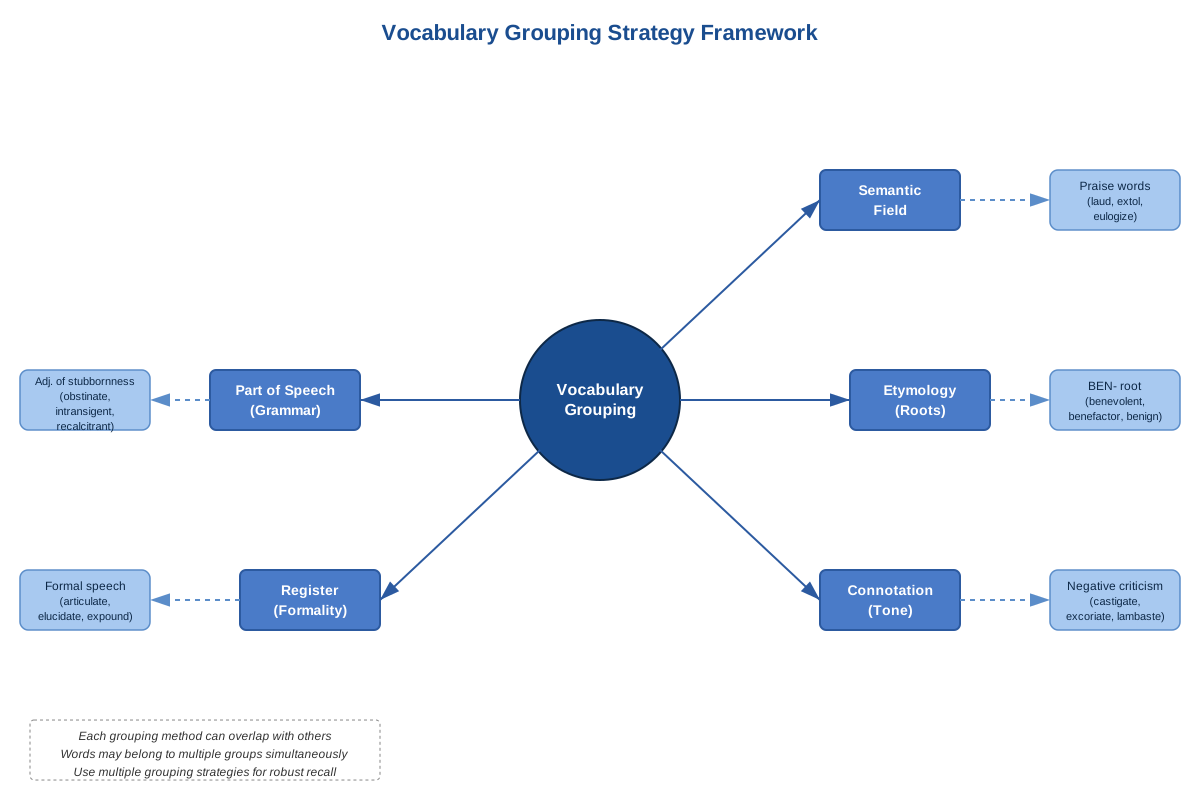
Vocabulary grouping is the systematic organization of words into clusters based on shared semantic, etymological, or functional characteristics. This strategy operates on the principle of associative learning, where the brain creates neural pathways connecting related information. When words are grouped meaningfully, recalling one word activates the entire network, facilitating faster retrieval and more accurate usage.
The fundamental principle underlying vocabulary grouping is that words exist not in isolation but within complex webs of meaning. Understanding these relationships enables test-takers to approach vocabulary questions strategically rather than relying solely on memorization. The GRE specifically tests this deeper understanding by presenting answer choices that may share superficial similarities but differ in crucial ways.
Types of Vocabulary Groups
Semantic Groups (Meaning-Based)
Semantic grouping organizes words by shared meanings or concepts. This represents the most common and intuitive form of vocabulary grouping. For example:
Words meaning "to praise": acclaim, laud, extol, eulogize, commend, applaud, venerate
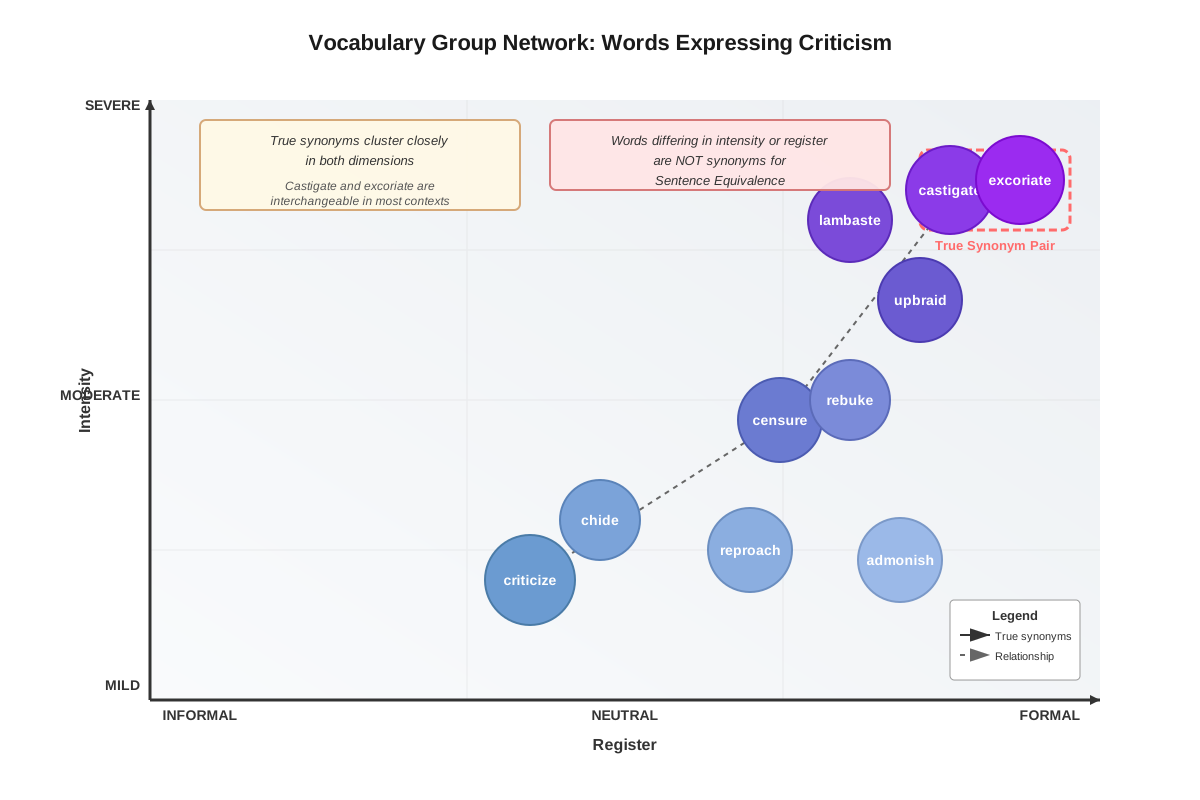
Words meaning "to criticize": censure, denounce, castigate, excoriate, lambaste, rebuke, reproach
Words meaning "talkative": loquacious, garrulous, voluble, verbose, prolix
Words meaning "brief/concise": laconic, terse, succinct, pithy, concise
Etymological Groups (Root-Based)
Etymological grouping clusters words sharing common roots, prefixes, or suffixes. This approach proves particularly powerful for decoding unfamiliar words:
BEN/BON (good): benevolent, benefactor, benign, bonus, bonhomie
MAL/MALE (bad): malevolent, malicious, malady, malediction, malign
LOQUI/LOCUT (speak): loquacious, eloquent, colloquial, circumlocution, elocution
GREG (group): gregarious, congregation, segregate, aggregate, egregious
Connotation Groups (Tone-Based)
Words grouped by emotional tone or register help distinguish between synonyms with different connotations:
| Neutral | Positive | Negative |
|---|---|---|
| thin | slender, svelte | gaunt, emaciated |
| confident | assured, self-possessed | arrogant, presumptuous |
| careful | meticulous, thorough | fastidious, finicky |
| unusual | unique, distinctive | bizarre, aberrant |
Intensity Groups (Degree-Based)
Organizing words by intensity helps identify appropriate word choices based on context:
Anger (mild to extreme): annoyed → irritated → angry → furious → apoplectic → incensed
Happiness (mild to extreme): pleased → happy → delighted → ecstatic → euphoric → rapturous
Sadness (mild to extreme): disappointed → sad → melancholy → despondent → anguished → inconsolable
Strategic Application to Sentence Equivalence
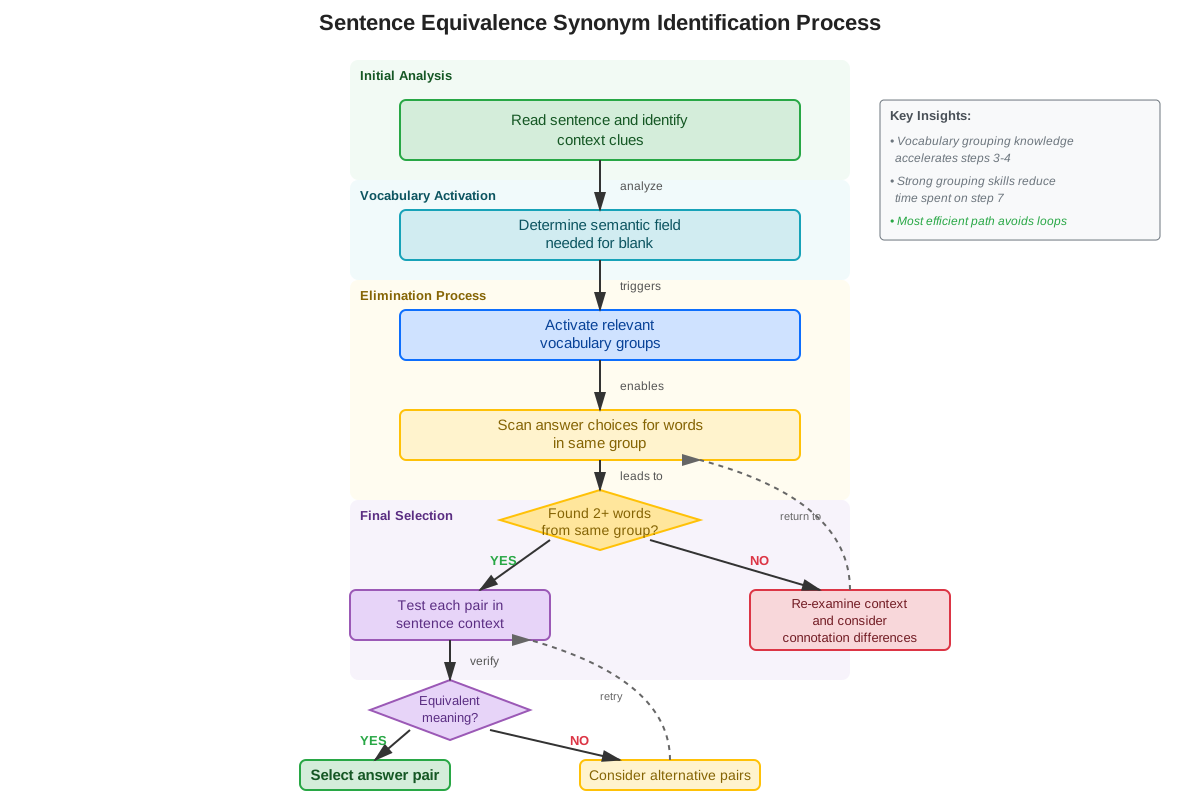
Sentence Equivalence questions require selecting two words that produce sentences with equivalent meanings. Vocabulary grouping directly supports this task by enabling rapid identification of true synonyms. However, the GRE frequently includes trap answers—words that belong to the same semantic field but differ in intensity, connotation, or specific meaning.
Consider this example structure:
"The professor's lecture was so _______ that students struggled to remain attentive."
Potential answer choices might include: tedious, monotonous, challenging, complex, soporific, demanding
Vocabulary grouping reveals that "tedious," "monotonous," and "soporific" all relate to boredom, while "challenging," "complex," and "demanding" relate to difficulty. However, only "tedious" and "monotonous" function as true synonyms in this context, both indicating boring repetitiveness that causes inattention.
Building Effective Vocabulary Networks
Creating personal vocabulary networks involves several key steps:
- Identify core vocabulary words from GRE word lists or practice materials
- Research each word's etymology to understand its root meaning
- List synonyms and antonyms to establish semantic relationships
- Note connotations and register (formal, informal, technical, etc.)
- Create example sentences demonstrating proper usage
- Connect to known words through shared roots or meanings
- Review and reinforce connections through spaced repetition
Concept Relationships
Vocabulary grouping serves as a foundational strategy that connects to virtually every aspect of GRE Verbal Reasoning. The relationship flows as follows:
Etymology knowledge → Vocabulary grouping → Synonym recognition → Sentence Equivalence success
Understanding word roots and affixes enables effective grouping, which in turn facilitates rapid synonym identification during Sentence Equivalence questions. This same pathway supports Text Completion, where recognizing semantic fields helps predict appropriate word choices.
Vocabulary grouping ↔ Context clues: These strategies work synergistically. Vocabulary groups provide frameworks for understanding unfamiliar words, while context clues help determine which member of a vocabulary group fits a specific situation.
Connotation awareness → Vocabulary grouping → Precise word choice: Understanding subtle differences in tone and register enables more sophisticated grouping, which improves accuracy when distinguishing between near-synonyms.
The relationship to prerequisite knowledge is equally important. Knowledge of parts of speech determines which words can legitimately substitute for one another (only adjectives can replace adjectives, etc.). Understanding of roots and affixes enables etymological grouping. Familiarity with connotation versus denotation allows for nuanced categorization within semantic groups.
High-Yield Facts
⭐ Sentence Equivalence questions always require two answer choices that are true synonyms, not just related words
⭐ Words in the same semantic field may differ significantly in intensity, connotation, or specific meaning
⭐ Approximately 80% of GRE vocabulary words derive from Latin or Greek roots, making etymological grouping highly effective
⭐ The GRE frequently includes trap answers that share a semantic field with the correct answer but differ in crucial ways
⭐ Organizing vocabulary into groups of 5-7 related words optimizes memory retention according to cognitive psychology research
- Words with similar meanings often have different registers (formal vs. informal) that affect appropriateness in context
- Antonym pairs provide efficient vocabulary grouping opportunities (e.g., learning "laconic" alongside "verbose")
- Prefix knowledge enables rapid grouping: words beginning with "mal-," "mis-," or "dis-" typically carry negative meanings
- Connotation differences often determine which synonym pair is correct in Sentence Equivalence questions
- Creating visual vocabulary maps with central concepts and radiating related words enhances retention
- Words sharing suffixes often share parts of speech and grammatical function (e.g., -ous, -ious, -eous typically form adjectives)
- The GRE tests depth of vocabulary knowledge, not breadth—understanding nuances within word groups matters more than knowing thousands of isolated words
Quick check — test yourself on Vocabulary grouping so far.
Try Flashcards →Common Misconceptions
Misconception: All synonyms are interchangeable in any context → Correction: Synonyms often differ in connotation, intensity, or register. "Slender" and "emaciated" both mean thin, but carry vastly different connotations. The GRE exploits these differences by including near-synonyms as trap answers.
Misconception: Vocabulary grouping means simply memorizing lists of related words → Correction: Effective vocabulary grouping requires understanding the relationships between words, including subtle differences in meaning, appropriate contexts for usage, and etymological connections. Passive memorization without comprehension provides minimal benefit.
Misconception: Words with the same root always have related meanings → Correction: While etymological grouping is powerful, some words have diverged significantly from their root meanings over time. "Egregious" derives from "greg" (group) but now means "outstandingly bad," having evolved from "standing out from the group."
Misconception: The two correct answers in Sentence Equivalence questions must be perfect synonyms in all contexts → Correction: The correct answers must produce equivalent sentence meanings in the specific context provided, but they need not be interchangeable in every possible context. Context determines which aspect of meaning is relevant.
Misconception: Learning vocabulary groups eliminates the need to understand individual word meanings → Correction: Vocabulary grouping is a organizational strategy that enhances learning, but deep understanding of individual words remains essential. Groups provide frameworks, but specific knowledge of each word's nuances, usage patterns, and connotations is still required.
Misconception: Formal and informal synonyms can be used interchangeably on the GRE → Correction: The GRE consistently uses formal, academic vocabulary. Understanding register differences within vocabulary groups helps eliminate informal options that, while technically synonymous, would be inappropriate in academic contexts.
Worked Examples
Example 1: Semantic Grouping Application
Question: The scientist's hypothesis was so _______ that even her colleagues found it difficult to accept.
Answer choices:
(A) conventional
(B) radical
(C) innovative
(D) revolutionary
(E) traditional
(F) methodical
Solution Process:
Step 1: Identify the context clue. "Difficult to accept" suggests something unusual or extreme that challenges conventional thinking.
Step 2: Apply vocabulary grouping to categorize answer choices:
- Group 1 (conventional/traditional): conventional, traditional, methodical
- Group 2 (unconventional/extreme): radical, innovative, revolutionary
Step 3: Determine which group fits the context. Since colleagues found it "difficult to accept," the hypothesis must be unconventional.
Step 4: Distinguish between words in Group 2:
- "Innovative" suggests newness but not necessarily difficulty accepting
- "Radical" and "revolutionary" both suggest extreme departure from norms that would challenge acceptance
Step 5: Verify equivalence. Both "radical" and "revolutionary" produce sentences with equivalent meanings: the hypothesis was so extreme/unconventional that acceptance was difficult.
Answer: (B) radical and (D) revolutionary
Learning Objective Connection: This example demonstrates applying vocabulary grouping to GRE-style questions accurately by first categorizing words semantically, then distinguishing nuances within the relevant group.
Example 2: Connotation-Based Grouping
Question: Despite his reputation for being _______, the executive surprised everyone by accepting criticism gracefully.
Answer choices:
(A) arrogant
(B) confident
(C) imperious
(D) assured
(E) humble
(F) modest
Solution Process:
Step 1: Identify the contrast signal. "Despite" indicates the blank should contrast with "accepting criticism gracefully."
Step 2: Apply connotation-based grouping:
| Positive Connotation | Negative Connotation | Neutral/Humble |
|---|---|---|
| confident, assured | arrogant, imperious | humble, modest |
Step 3: Determine which group creates the necessary contrast. Accepting criticism gracefully is humble behavior, so the blank needs a contrasting negative quality.
Step 4: Distinguish between negative options:
- "Arrogant" suggests excessive pride and superiority
- "Imperious" suggests domineering, commanding behavior
Step 5: Verify both create equivalent meanings. Both words describe someone who would typically resist criticism due to excessive pride or authority.
Answer: (A) arrogant and (C) imperious
Learning Objective Connection: This example illustrates identifying when vocabulary grouping is being tested (recognizing that the question requires understanding connotation differences) and explaining the core strategy (organizing words by emotional tone to identify true synonyms).
Exam Strategy
Recognition Triggers
Watch for these signals that vocabulary grouping will help:
- Sentence Equivalence questions: Always require identifying synonym pairs within vocabulary groups
- Multiple answer choices from the same semantic field: Indicates the need to distinguish subtle differences
- Context clues suggesting specific connotations: Signals that connotation-based grouping is relevant
- Words with recognizable roots or affixes: Suggests etymological grouping may help decode meanings
Systematic Approach
- Read the sentence completely before examining answer choices
- Identify context clues that suggest the blank's meaning, connotation, and intensity
- Quickly categorize answer choices into semantic groups
- Eliminate groups that don't fit the context
- Within the relevant group, distinguish between options based on intensity, connotation, or specific meaning
- Verify that your two choices produce truly equivalent sentence meanings
Process of Elimination
Use vocabulary grouping to eliminate efficiently:
- Eliminate opposite groups first: If context suggests positive meaning, eliminate all negative words
- Eliminate intensity mismatches: If context suggests mild emotion, eliminate extreme words
- Eliminate register mismatches: Eliminate informal words in formal contexts
- Eliminate single words from groups: If five words fall into two groups and one stands alone, the singleton is likely incorrect
Time Management
Exam Tip: Spend 15-20 seconds categorizing answer choices into vocabulary groups before attempting detailed analysis. This initial investment saves time by focusing attention on viable options.
For Sentence Equivalence questions:
- 30 seconds: Read and understand the sentence
- 20 seconds: Categorize answer choices into groups
- 30 seconds: Distinguish within relevant groups and verify equivalence
- Total: ~80 seconds per question
If unable to categorize clearly within 20 seconds, make educated guesses based on partial grouping rather than spending excessive time on a single question.
Memory Techniques
The GROUPS Mnemonic
Gather words with shared meanings
Recognize roots and etymological connections
Organize by connotation (positive, negative, neutral)
Understand intensity differences (mild to extreme)
Practice with example sentences
Space repetition to reinforce networks
Visualization Strategy: Semantic Webs
Create mental images of vocabulary webs with a central concept and radiating related words. For example, visualize "PRAISE" at the center with spokes extending to "acclaim," "laud," "extol," etc. Color-code by intensity: light colors for mild praise, bright colors for extreme praise.
The Root Family Technique
Learn root families as units. When encountering "BEN" (good), immediately recall the entire family: benevolent, benefactor, benign, benediction, beneficent. This creates automatic associations that activate during exam conditions.
Acronym for Common Negative Prefixes
MAD DIME helps remember negative prefixes:
- Mal- (bad)
- A- (without)
- Dis- (not/opposite)
- De- (down/away)
- In-/Im- (not)
- Mis- (wrong)
- E- (out/former)
The Synonym Pair Drill
Create flashcards with synonym pairs from the same vocabulary group. Regular review strengthens the neural pathways connecting related words, making synonym recognition automatic during timed conditions.
Summary
Vocabulary grouping represents a strategic, efficient approach to mastering GRE vocabulary by organizing words into meaningful clusters based on semantic relationships, etymological connections, connotations, and intensity levels. Rather than memorizing thousands of isolated words, this method leverages associative learning principles to build robust mental networks that facilitate rapid recall and accurate usage. The strategy proves particularly valuable for Sentence Equivalence questions, which require identifying true synonym pairs that produce equivalent sentence meanings. Effective vocabulary grouping involves understanding not just shared meanings but also crucial differences in connotation, intensity, and register that distinguish near-synonyms. By systematically categorizing answer choices and recognizing word relationships, test-takers can eliminate incorrect options efficiently and select appropriate synonym pairs with confidence. Success requires moving beyond passive memorization to active engagement with word relationships, etymological patterns, and contextual usage.
Key Takeaways
- Vocabulary grouping organizes words into meaningful clusters based on semantic, etymological, or connotational relationships, dramatically improving retention and recall
- Sentence Equivalence questions specifically test the ability to identify true synonyms within vocabulary groups while avoiding trap answers from the same semantic field
- Words in the same semantic group often differ crucially in intensity, connotation, or register—understanding these differences is essential for GRE success
- Etymological grouping provides powerful decoding tools since approximately 80% of GRE vocabulary derives from Latin or Greek roots
- Effective vocabulary grouping requires active engagement with word relationships, not passive memorization of lists
- Systematic categorization of answer choices into vocabulary groups enables efficient elimination and accurate selection
- Regular practice building and reviewing vocabulary networks creates automatic associations that function under timed exam conditions
Related Topics
Sentence Equivalence Strategy: Builds directly on vocabulary grouping by applying these organizational principles to specific question formats, including advanced techniques for verifying answer equivalence and avoiding common traps.
Context Clues and Inference: Works synergistically with vocabulary grouping—while grouping provides organizational frameworks, context clues help determine which member of a group fits specific situations.
Etymology and Word Roots: Deepens vocabulary grouping effectiveness by providing systematic understanding of how words are constructed and related, enabling more sophisticated categorization and better decoding of unfamiliar words.
Text Completion Strategies: Applies vocabulary grouping principles to multi-blank questions, where understanding semantic fields helps predict appropriate word choices and maintain logical consistency across multiple blanks.
Reading Comprehension Vocabulary: Extends vocabulary grouping to passage-based questions where recognizing word relationships enhances understanding of complex academic texts and author's tone.
Practice CTA
Now that you understand the principles and strategies of vocabulary grouping, it's time to reinforce this knowledge through active practice. Attempt the practice questions designed specifically for this topic, focusing on applying the systematic categorization approach outlined in this guide. Use the flashcards to build your personal vocabulary networks, organizing words into meaningful groups rather than studying them in isolation. Remember that vocabulary grouping is a skill that improves with deliberate practice—each question you work through strengthens the neural pathways that will enable automatic synonym recognition during the actual exam. Your investment in mastering this strategy will pay dividends across the entire Verbal Reasoning section!
Sign up free to keep reading
Create a free AnvayaPrep account to finish this GRE guide on Vocabulary grouping — plus flashcards and practice questions.