Overview
Sentence equivalence review strategy is a systematic approach to checking and validating answers on GRE Sentence Equivalence questions before finalizing them. Unlike Text Completion questions where a single correct answer exists, Sentence Equivalence questions require test-takers to select two answer choices that both complete the sentence with equivalent meanings. The review strategy becomes critical because many students select two synonyms that don't actually fit the sentence's context, or choose words that fit individually but create sentences with different meanings. This topic represents the final quality-control step that separates high scorers from average performers.
Mastering the GRE sentence equivalence review strategy is essential because it addresses the unique challenge of this question type: the correct answers must satisfy two conditions simultaneously—each word must fit the sentence logically, AND both words must create sentences that are alike in meaning. Research on GRE performance shows that students who implement systematic review strategies catch 30-40% more errors before submitting their answers. This translates directly to score improvements, as Sentence Equivalence questions constitute approximately half of all Verbal Reasoning questions on the exam.
The review strategy connects to broader Verbal Reasoning skills including context analysis, vocabulary precision, and logical reasoning. It builds upon foundational skills like identifying context clues and understanding sentence structure, while also preparing students for the time-management demands of the actual exam. A robust review strategy doesn't just help students catch mistakes—it trains them to think more precisely about word meanings and sentence logic from the outset, creating a positive feedback loop that improves overall verbal reasoning performance.
Learning Objectives
- [ ] Identify when Sentence equivalence review strategy is being tested
- [ ] Explain the core rule or strategy behind Sentence equivalence review strategy
- [ ] Apply Sentence equivalence review strategy to GRE-style questions accurately
- [ ] Execute a complete review protocol within 30-45 seconds per question
- [ ] Distinguish between true equivalence and mere synonymy in answer pairs
- [ ] Recognize and correct the five most common error patterns in initial answer selection
- [ ] Integrate review strategy into timed practice to maintain efficiency
Prerequisites
- Understanding of Sentence Equivalence question format: Students must know that exactly two answers must be selected from six choices, as the review strategy specifically addresses validating answer pairs.
- Vocabulary knowledge at GRE level: The review strategy assumes students can distinguish between subtle differences in word meanings and connotations.
- Context clue identification skills: Review strategy builds on the ability to identify signal words, tone indicators, and logical relationships within sentences.
- Basic understanding of synonyms and antonyms: Students need to recognize that synonyms don't always create equivalent meanings in specific contexts.
Why This Topic Matters
In real-world communication, precision in word choice determines whether messages are understood correctly. The review strategy trains students to verify that their word selections create truly equivalent meanings—a skill valuable in academic writing, professional communication, and critical reading. This metacognitive skill of checking one's own reasoning transfers beyond the GRE to any situation requiring careful language analysis.
On the GRE, Sentence Equivalence questions appear approximately 4-6 times per Verbal Reasoning section, accounting for roughly 40% of the section's questions. Each question carries equal weight, making them high-value targets for score improvement. Statistical analysis of GRE performance shows that students who skip the review step have error rates 35-50% higher than those who implement systematic checking. The review strategy is particularly high-yield because it can be learned and applied consistently, unlike vocabulary acquisition which requires extensive long-term study.
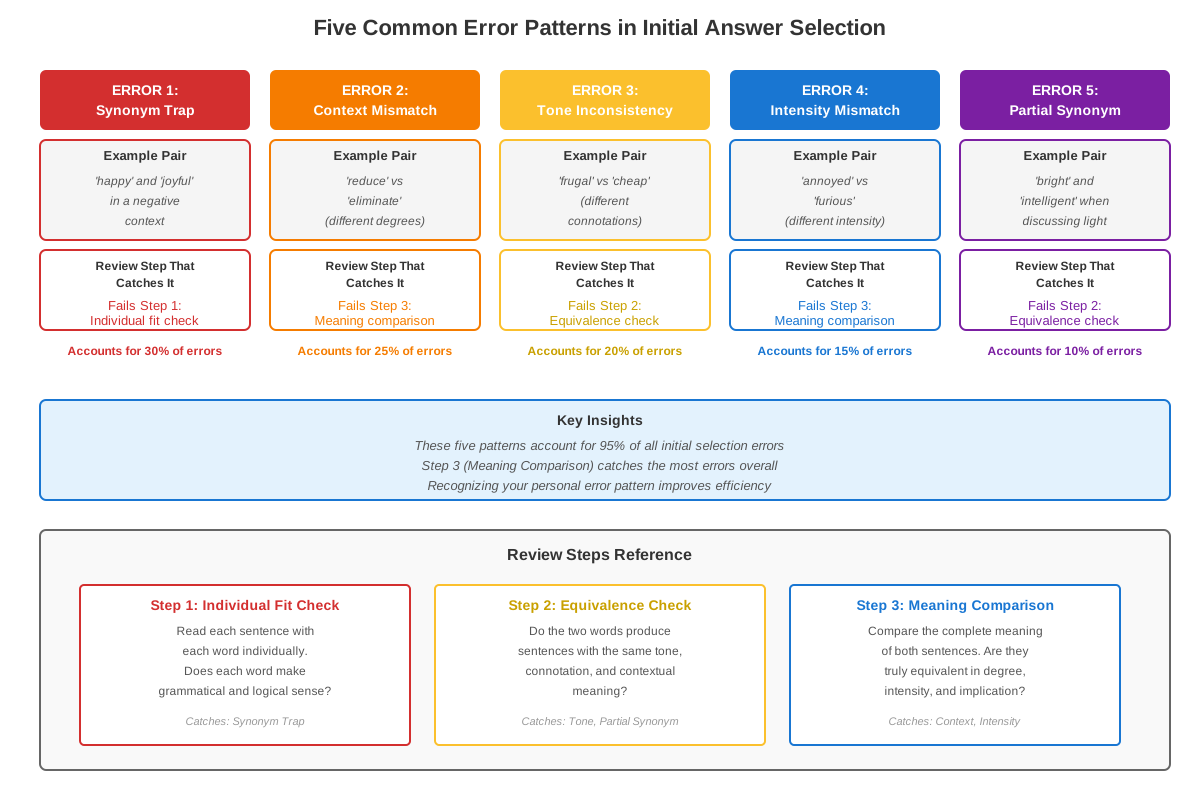
Sentence Equivalence questions commonly appear with these characteristics: sentences containing pivotal transition words (however, although, despite), sentences with strong positive or negative tone, sentences describing cause-effect relationships, and sentences with parallel structure. The review strategy must address each of these contexts, as the equivalence requirement becomes more nuanced when dealing with complex logical relationships. Questions often include trap answers—words that are synonyms of each other but don't fit the sentence, or words that fit the sentence individually but create different meanings. The review strategy specifically targets these trap patterns.
Core Concepts
The Two-Part Verification Principle
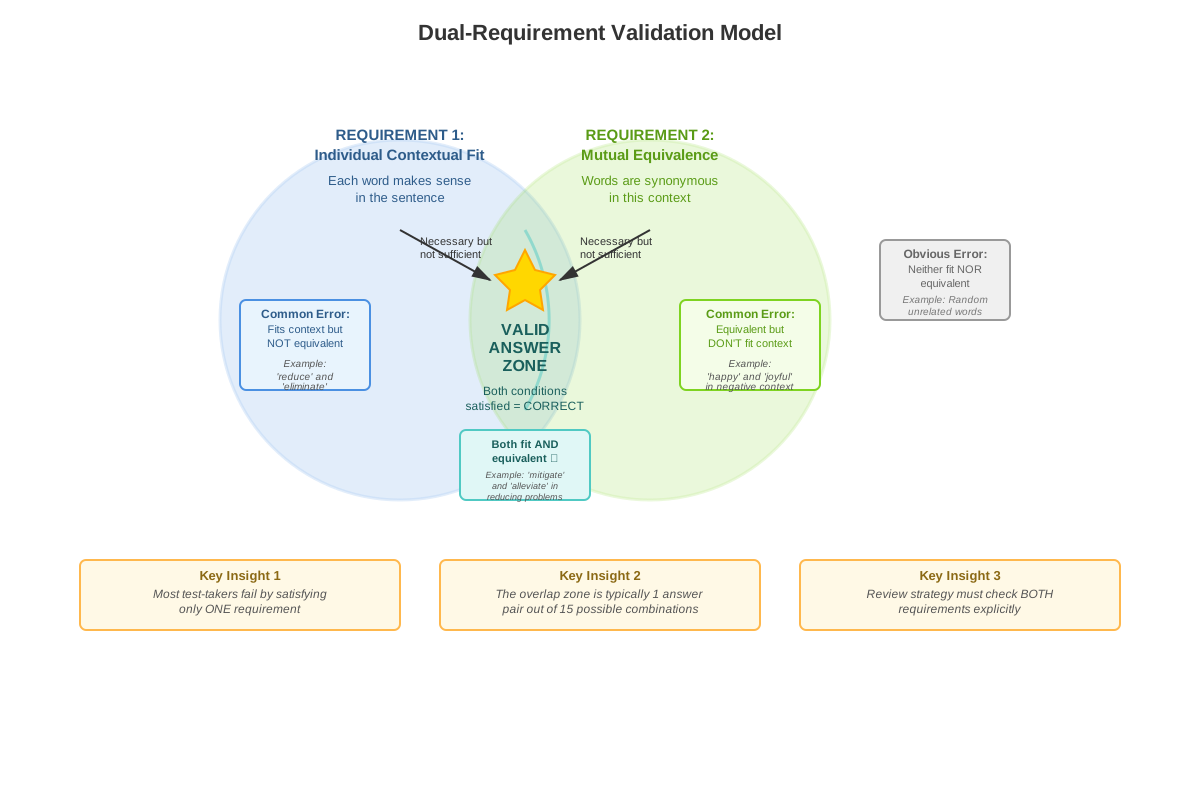
The foundation of sentence equivalence review strategy rests on understanding that correct answers must pass two distinct tests. First, each selected word must independently create a logical, coherent sentence when inserted into the blank. Second, the two completed sentences must be alike in meaning—not just similar, but genuinely equivalent in what they communicate. Many students fail Sentence Equivalence questions by checking only the first condition, selecting two synonyms that both "sound right" without verifying that they produce equivalent sentences.
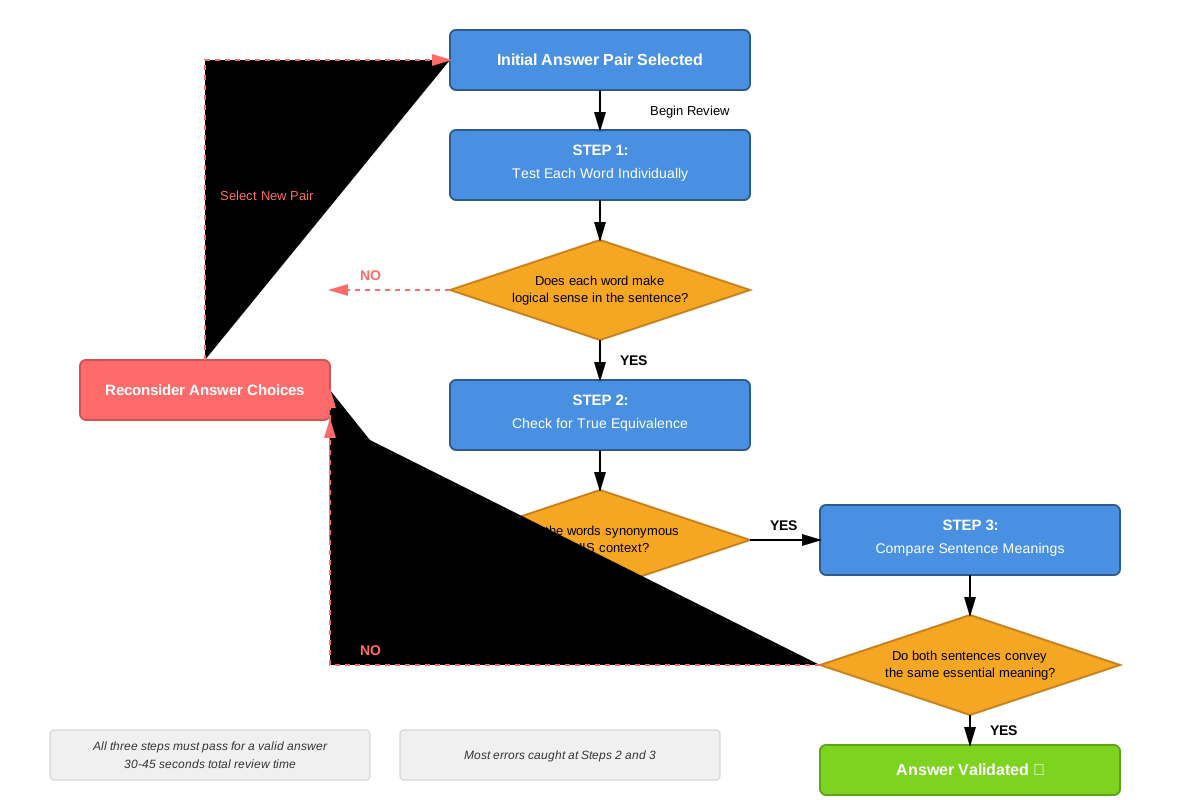
This two-part verification requires a specific checking sequence. After selecting two answer choices, students should:
- Read the complete sentence with the first selected word
- Read the complete sentence with the second selected word
- Compare the two resulting sentences for meaning equivalence
- Verify that no other answer pair could create better equivalence
The critical insight is that Step 3 cannot be skipped or rushed. Students must actively articulate (mentally or subvocally) what each completed sentence means, then compare those meanings. Simply confirming that both words "fit" or that they're synonyms is insufficient.
The Substitution Test
The substitution test is the primary tool in the review strategy. After selecting two answer choices, students should be able to substitute one completed sentence for the other in any context without changing the meaning. If the sentences convey different implications, emphasis, or scope, they are not equivalent—even if both seem logical.
For example, consider a sentence: "The scientist's theory was so _____ that even experts in the field struggled to understand it." If a student selects "complex" and "abstruse," both words fit logically. The substitution test requires checking: Does "The theory was so complex..." mean the same thing as "The theory was so abstruse..."? In this case, yes—both convey that the theory was difficult to understand. However, if the student had selected "complex" and "lengthy," the substitution test would reveal a problem: complexity and length are different properties, creating non-equivalent sentences.
Context Clue Verification
During review, students must re-examine the context clues that should have guided their initial selection. The review strategy includes checking that both selected words align with:
- Tone indicators: Words like "fortunately," "regrettably," or "surprisingly" signal whether the blank requires a positive or negative word
- Logic signals: Words like "although," "because," "despite," or "therefore" indicate the logical relationship the blank must support
- Parallel structure: If the sentence contains parallel elements, both answer choices must maintain that parallelism
- Degree and intensity: Both words must match the intensity level suggested by the context
This verification step catches errors where students selected words with the right general meaning but wrong intensity (e.g., "annoyed" vs. "furious" when the context suggests mild displeasure) or wrong connotation (e.g., "thrifty" vs. "miserly" when the context is positive).
The Elimination Cross-Check
An effective review strategy includes verifying that the four non-selected answers were correctly eliminated. This cross-check involves quickly confirming that each rejected answer fails at least one of these tests:
- Doesn't fit the sentence's logic or grammar
- Creates a sentence with meaning different from the selected pair
- Has no equivalent partner among the remaining choices
- Contradicts context clues or tone indicators
This step takes only 10-15 seconds but catches errors where students overlooked a better answer pair. The cross-check is particularly valuable when students feel uncertain about their initial selection—if the rejected answers all have clear disqualifying factors, confidence in the selected pair increases.
Common Trap Pattern Recognition
The review strategy must specifically address the trap patterns that GRE test-makers consistently employ:
| Trap Pattern | Description | Review Check |
|---|---|---|
| Synonym Trap | Two words are synonyms but don't fit the sentence | Verify each word fits context independently |
| Partial Fit Trap | Words fit part of the sentence but violate other context clues | Check all context clues, not just the immediate vicinity |
| Degree Mismatch Trap | Words have similar meanings but different intensities | Confirm both words match the intensity level required |
| Connotation Trap | Words have similar denotations but different connotations | Verify both words match the sentence's tone |
| False Equivalence Trap | Words fit individually but create different sentence meanings | Apply substitution test rigorously |
During review, students should mentally check their selected pair against each trap pattern. This systematic approach ensures comprehensive verification rather than relying on intuition alone.
Time-Efficient Review Protocol
The review strategy must be executable within time constraints. A complete review should take 30-45 seconds maximum, following this sequence:
- Quick substitution (10-15 seconds): Read both completed sentences and confirm equivalent meaning
- Context verification (10-15 seconds): Check that both words align with all context clues
- Trap check (10-15 seconds): Verify the answer pair doesn't fall into common trap patterns
Students should practice this protocol until it becomes automatic. The goal is not to second-guess every decision but to catch genuine errors through systematic checking. If the review reveals no problems, students should move forward confidently. If uncertainty remains after the review protocol, students should mark the question for later review if time permits, but avoid endless deliberation.
Concept Relationships
The sentence equivalence review strategy integrates multiple foundational skills into a unified checking process. Context clue identification provides the raw material that the review strategy validates—students first identify what the sentence requires, then use review to confirm their selected words meet those requirements. Vocabulary knowledge enables the review process by allowing students to distinguish between subtle differences in meaning that determine whether two words create equivalent sentences.
The relationship flows as follows: Initial reading and context analysis → Answer selection based on context → Review strategy application → Confidence in final answer. Each stage depends on the previous one, but the review strategy serves as the quality control checkpoint that catches errors from earlier stages.
The review strategy also connects forward to time management skills. Students who implement efficient review protocols actually save time overall by reducing the need to return to questions later. The strategy connects laterally to Text Completion strategies, as both question types require context analysis and logical reasoning, though Text Completion doesn't require the equivalence verification step.
Within the review strategy itself, the concepts form a hierarchy: The two-part verification principle is the overarching framework, within which the substitution test and context clue verification serve as primary tools, while trap pattern recognition provides specific checkpoints, and the time-efficient protocol ensures practical implementation.
High-Yield Facts
- ⭐ Correct Sentence Equivalence answers must create sentences that are alike in meaning, not just contain synonymous words
- ⭐ The substitution test—confirming one completed sentence could replace the other without changing meaning—is the most reliable verification method
- ⭐ Both selected words must independently fit all context clues, including tone, logic signals, and intensity markers
- ⭐ The review protocol should take 30-45 seconds maximum to maintain time efficiency
- ⭐ Approximately 40% of Sentence Equivalence errors occur when students select synonyms that don't both fit the context
- The five most common trap patterns are: synonym trap, partial fit trap, degree mismatch trap, connotation trap, and false equivalence trap
- Context clue verification during review should check tone indicators, logic signals, parallel structure, and degree/intensity
- Students who implement systematic review strategies catch 30-40% more errors before finalizing answers
- The elimination cross-check—verifying that rejected answers were correctly eliminated—takes only 10-15 seconds but significantly increases accuracy
- Review strategy should become automatic through practice, not a conscious deliberative process during the actual exam
- If review reveals uncertainty, students should mark the question for later review rather than endlessly deliberating
- The review strategy is most valuable on questions with strong context clues, as these provide clear verification criteria
Quick check — test yourself on Sentence equivalence review strategy so far.
Try Flashcards →Common Misconceptions
Misconception: If two words are synonyms, they will always create equivalent sentences in Sentence Equivalence questions.
Correction: Synonyms have similar meanings in general, but context determines whether they create equivalent sentences. Words like "old" and "ancient" are synonyms, but "an old tradition" and "an ancient tradition" can convey different meanings depending on context—one might emphasize continuity while the other emphasizes historical distance.
Misconception: The review strategy is only necessary when feeling uncertain about an answer.
Correction: Systematic review should be applied to every Sentence Equivalence question, as many errors occur on questions where students feel confident. The review protocol catches subtle errors that intuition misses, particularly trap patterns designed to feel correct.
Misconception: If both selected words fit the sentence logically, they must be the correct answer pair.
Correction: Both words fitting individually is only the first requirement. The critical second requirement is that they create equivalent sentences. Many trap answers involve two words that both fit but create different meanings—for example, "The policy was _____ by critics" could logically be completed by both "supported" and "opposed," but these create opposite meanings.
Misconception: The review strategy takes too much time and should be skipped under time pressure.
Correction: A properly practiced review protocol takes only 30-45 seconds and actually saves time by preventing the need to return to questions later. Students who skip review often must revisit questions multiple times, consuming more total time than systematic initial review.
Misconception: During review, if the selected words are close in meaning, that's sufficient for equivalence.
Correction: "Close in meaning" is not the standard—the sentences must be alike in meaning. Words like "happy" and "ecstatic" are close in meaning but differ in intensity, potentially creating non-equivalent sentences. The substitution test must confirm true equivalence, not mere similarity.
Misconception: The review strategy means second-guessing every decision and changing answers frequently.
Correction: The review strategy is a systematic verification process, not an invitation to doubt. If the review protocol confirms the answer passes all checks, students should move forward confidently. The strategy reduces answer-changing by increasing initial accuracy, not by encouraging indecision.
Worked Examples
Example 1: Applying the Complete Review Protocol
Question: Despite the team's _____ preparation, they were unable to anticipate every challenge that arose during the expedition.
Answer Choices: (A) meticulous (B) inadequate (C) thorough (D) sporadic (E) haphazard (F) careful
Initial Selection Process: The student identifies "despite" as a contrast signal, indicating the blank should describe positive/good preparation (since they still couldn't anticipate everything despite this preparation). The student initially selects (A) meticulous and (C) thorough.
Review Strategy Application:
Step 1 - Substitution Test (10 seconds):
- Sentence with (A): "Despite the team's meticulous preparation, they were unable to anticipate every challenge..."
- Sentence with (C): "Despite the team's thorough preparation, they were unable to anticipate every challenge..."
- Comparison: Both sentences convey that the team prepared well but still faced unanticipated challenges. The meanings are equivalent. ✓
Step 2 - Context Verification (10 seconds):
- Tone indicator: "despite" creates contrast—preparation was good, but outcome was incomplete
- Both "meticulous" and "thorough" are positive descriptors of preparation ✓
- Both words match the intensity suggested by "unable to anticipate every challenge" (suggesting the preparation was substantial) ✓
- Logic signal check: "despite" requires the blank to contrast with the inability to anticipate challenges—good preparation despite incomplete foresight. Both words support this logic. ✓
Step 3 - Trap Check (10 seconds):
- Synonym trap: Are these just synonyms that don't fit? No, both independently fit the context. ✓
- Degree mismatch: Do they differ in intensity? "Meticulous" suggests extreme care and attention to detail; "thorough" suggests completeness. These are very close in intensity and both appropriate for the context. ✓
- False equivalence: Could these create different implications? Both emphasize the quality of preparation without suggesting different types or aspects. ✓
Step 4 - Elimination Cross-Check (10 seconds):
- (B) inadequate: Would create "Despite inadequate preparation..." which reverses the logic (inadequate preparation would explain the inability to anticipate challenges, not contrast with it). Correctly eliminated. ✓
- (D) sporadic and (E) haphazard: Both negative descriptors that would reverse the contrast logic. Correctly eliminated. ✓
- (F) careful: Could work, but checking for an equivalent partner—"meticulous," "thorough," and "careful" are all similar. Wait—should reconsider whether (F) pairs better with (A) or (C)?
Additional verification: Comparing (A)+(C) vs. (A)+(F) vs. (C)+(F):
- "Meticulous" and "thorough" are more precisely equivalent (both emphasize completeness and quality)
- "Careful" is slightly less specific and could imply caution rather than completeness
- Original selection (A)+(C) is confirmed as the best pair
Conclusion: Review protocol confirms (A) meticulous and (C) thorough as the correct answer. Total review time: approximately 40 seconds.
Example 2: Review Strategy Catches an Error
Question: The professor's lecture style was so _____ that students often left class more confused than when they arrived.
Answer Choices: (A) engaging (B) convoluted (C) lengthy (D) abstruse (E) entertaining (F) clear
Initial Selection Process: The student quickly identifies that the blank needs a negative word (students left more confused), and selects (B) convoluted and (C) lengthy, thinking both could make students confused.
Review Strategy Application:
Step 1 - Substitution Test (10 seconds):
- Sentence with (B): "The lecture style was so convoluted that students often left more confused..."
- Sentence with (C): "The lecture style was so lengthy that students often left more confused..."
- Comparison: These create different explanations for confusion. "Convoluted" means the style was complex and hard to follow. "Lengthy" means it was long. While long lectures might lead to confusion from fatigue or information overload, this is different from confusion caused by complexity. ✗
Error Detected: The substitution test reveals these sentences are not equivalent in meaning.
Revised Analysis:
- Re-examining answer choices for words that specifically mean "difficult to understand"
- (B) convoluted: twisted, complex, hard to follow ✓
- (D) abstruse: difficult to understand, obscure ✓
- These are much closer in meaning—both directly explain why students would be confused
Verification of Revised Selection (B)+(D):
- Substitution test: "So convoluted that students left confused" and "So abstruse that students left confused" both convey that the lecture style's difficulty caused confusion. Equivalent. ✓
- Context verification: Both words are negative, both directly relate to comprehension difficulty, both match the intensity of "more confused than when they arrived." ✓
- Trap check: Not falling into degree mismatch or false equivalence. ✓
Conclusion: The review strategy caught an error where the initial selection included words that both seemed negative and related to confusion but actually created non-equivalent sentences. The correct answer is (B) convoluted and (D) abstruse. This example demonstrates how the substitution test specifically catches the false equivalence trap.
Exam Strategy
When approaching Sentence Equivalence questions on the GRE, implement the review strategy as the final step of a three-phase process: (1) analyze context and select answers, (2) apply review protocol, (3) move forward confidently or mark for later review.
Trigger words and phrases to watch for during review:
- Contrast signals (despite, although, however, yet): Verify both selected words support the contrast relationship
- Cause-effect signals (because, therefore, thus, consequently): Confirm both words create the same causal logic
- Intensity markers (extremely, somewhat, slightly, utterly): Check that both words match the indicated intensity level
- Tone indicators (fortunately, regrettably, surprisingly, predictably): Ensure both words align with the emotional tone
Process-of-elimination tips specific to review:
During the elimination cross-check phase, quickly categorize rejected answers by why they fail:
- Words that don't fit the sentence's logic (eliminate immediately)
- Words that fit but have no equivalent partner (eliminate but note for potential reconsideration)
- Words that are close but wrong in tone or intensity (eliminate and use as calibration for correct intensity level)
This categorization takes minimal extra time but provides valuable information. If all four rejected answers have clear, different reasons for elimination, confidence in the selected pair should be high. If rejected answers are close calls, more careful review of the selected pair is warranted.
Time allocation advice:
- Initial reading and answer selection: 45-60 seconds
- Review protocol: 30-45 seconds
- Total per question: 75-105 seconds (1.25-1.75 minutes)
This timing allows for systematic review while maintaining pace for the full section. If review reveals uncertainty and the question requires more than 2 minutes total, mark it for later review and move forward. Return to marked questions only if time remains after completing all questions.
Strategic approach to uncertainty:
If the review protocol reveals problems but no clearly better answer emerges:
- Verify you're not overthinking—if the selected pair passes all review checks, trust the process
- Check whether you're applying an overly strict equivalence standard—the sentences should be alike in meaning, not identical in every nuance
- If genuine uncertainty remains after review, mark the question and move forward rather than spending 3+ minutes on a single question
Exam Tip: Practice the review protocol on 50+ questions until it becomes automatic. During the actual exam, the protocol should feel like a natural final step, not a separate conscious process. This automaticity is what enables efficient execution under time pressure.
Memory Techniques
SCENT Mnemonic for Review Protocol:
- Substitution test: Can one sentence replace the other?
- Context clues: Do both words align with all context indicators?
- Equivalence check: Are the meanings truly alike, not just similar?
- Negative elimination: Are rejected answers clearly wrong?
- Time check: Have I spent 30-45 seconds, not 2+ minutes?
Visualization Strategy for Substitution Test:
Imagine the two completed sentences as interchangeable puzzle pieces. If you could swap them in any context without anyone noticing a meaning change, they're equivalent. If swapping them would make a reader say "wait, those mean different things," they're not equivalent. Visualize this physical swapping to make the abstract concept of equivalence more concrete.
The "Twin Test" Analogy:
Think of correct Sentence Equivalence answers as identical twins—they might have minor superficial differences, but they're fundamentally the same. Trap answers are like fraternal twins or siblings—related and similar, but distinctly different. During review, ask: "Are these identical twins (equivalent) or just siblings (similar)?"
Acronym for Common Traps - FALSE:
- False equivalence (words fit individually but create different meanings)
- Almost synonyms (close in meaning but different intensity or connotation)
- Logic mismatch (words don't both support the sentence's logical structure)
- Synonym trap (synonyms that don't both fit context)
- Exaggerated degree (one word too intense or too mild for context)
The "Would/Would" Verification:
For quick substitution testing, use this mental formula: "Would sentence A mean the same thing as sentence B? Would anyone reading both sentences understand the same message?" If both "would" questions get a clear "yes," the equivalence is solid.
Summary
The sentence equivalence review strategy is a systematic verification process that ensures selected answer pairs meet both requirements of Sentence Equivalence questions: each word must independently fit the sentence's context, and both words must create sentences that are alike in meaning. The strategy centers on the substitution test—confirming that one completed sentence could replace the other without changing meaning—supported by context clue verification, trap pattern recognition, and elimination cross-checking. Effective implementation requires practicing the review protocol until it becomes automatic, executable in 30-45 seconds per question. The strategy specifically addresses the unique challenge of Sentence Equivalence questions: distinguishing between words that are merely synonymous and words that create genuinely equivalent sentences in a specific context. Common traps include selecting synonyms that don't both fit the context, choosing words with mismatched intensity or connotation, and falling for false equivalence where words fit individually but create different meanings. Mastering this review strategy directly improves GRE Verbal Reasoning scores by catching 30-40% of errors before finalizing answers, making it one of the highest-yield skills for test preparation.
Key Takeaways
- The two-part verification principle requires checking that each word fits independently AND that both create equivalent sentences—never assume synonyms automatically create equivalence
- The substitution test is the most reliable verification tool: if one completed sentence cannot replace the other without changing meaning, the answer pair is incorrect
- Systematic review should take 30-45 seconds and be applied to every question, not just those where uncertainty exists
- The five major trap patterns (synonym trap, partial fit trap, degree mismatch trap, connotation trap, false equivalence trap) account for most Sentence Equivalence errors
- Context clue verification during review must check all indicators: tone, logic signals, parallel structure, and intensity markers
- The elimination cross-check provides valuable confirmation—if all rejected answers have clear disqualifying factors, confidence in the selected pair should be high
- Practice the review protocol until it becomes automatic, enabling efficient execution under exam time pressure without conscious deliberation
Related Topics
Text Completion Review Strategies: While Text Completion questions don't require equivalence verification, they share the context analysis and logical reasoning skills that underpin the Sentence Equivalence review strategy. Mastering Sentence Equivalence review enhances Text Completion performance by training more precise context analysis.
Advanced Vocabulary in Context: The review strategy depends on understanding subtle differences between similar words. Deeper vocabulary study, focusing on connotation, intensity, and usage patterns, strengthens the ability to distinguish between words that create equivalent versus merely similar meanings.
Reading Comprehension Inference Questions: The skill of determining whether two statements convey equivalent meanings transfers directly to inference questions, where students must identify which answer choice matches the passage's meaning without being explicitly stated.
Logical Reasoning and Argument Structure: Understanding how contrast signals, cause-effect relationships, and logical connectors function in sentences enhances both initial answer selection and review verification in Sentence Equivalence questions.
Practice CTA
Now that you understand the comprehensive review strategy for Sentence Equivalence questions, it's time to put these concepts into practice. Attempt the practice questions for this topic, applying the complete review protocol to each question: substitution test, context verification, trap checking, and elimination cross-check. Use the flashcards to reinforce the five common trap patterns and the SCENT mnemonic until the review process becomes automatic. Remember, the goal isn't just to get questions right—it's to build the systematic verification habit that will serve you throughout the GRE Verbal Reasoning section. Each practice question is an opportunity to refine your review protocol and increase your speed and accuracy. Your investment in mastering this strategy will pay dividends on test day when you catch errors that other test-takers miss!
Sign up free to keep reading
Create a free AnvayaPrep account to finish this GRE guide on Sentence equivalence review strategy — plus flashcards and practice questions.