Overview
Although and however clues represent one of the most powerful and frequently tested signal patterns in GRE Text Completion and Sentence Equivalence questions. These contrast indicators alert test-takers to a fundamental shift in direction within a sentence or passage, signaling that the blank should be filled with a word that opposes, contradicts, or contrasts with information provided elsewhere in the sentence. Mastering the recognition and application of these clues is essential for achieving high scores on the Verbal Reasoning section, as they appear in approximately 30-40% of all text completion questions.
The concept of GRE although and however clues extends beyond simply recognizing the words "although" and "however." This category encompasses a broad family of contrast words and phrases that function similarly, including "despite," "nevertheless," "yet," "while," "whereas," "in contrast," and many others. Understanding how these signals operate allows test-takers to predict the semantic direction of missing words with remarkable accuracy, often narrowing answer choices to one or two possibilities before even examining the options. This predictive power transforms difficult vocabulary questions into logical puzzles that can be solved through structural analysis rather than pure vocabulary knowledge alone.
Within the broader landscape of Verbal Reasoning, contrast clues form one pillar of a comprehensive signal-word strategy. While continuation clues (words like "and," "furthermore," "similarly") indicate that ideas flow in the same direction, contrast clues mark pivotal reversals. Together, these signal patterns create the logical architecture that underlies virtually every GRE sentence completion question. Students who develop fluency in identifying and interpreting these structural markers gain a decisive advantage, as they can decode sentence logic even when encountering unfamiliar vocabulary in the answer choices.
Learning Objectives
- [ ] Identify when Although and however clues is being tested
- [ ] Explain the core rule or strategy behind Although and however clues
- [ ] Apply Although and however clues to GRE-style questions accurately
- [ ] Distinguish between different types of contrast signals and their syntactic positions
- [ ] Predict the semantic direction of blanks based on contrast clue placement
- [ ] Recognize compound sentences containing multiple contrast signals
- [ ] Evaluate answer choices by testing them against the contrast relationship established by signal words
Prerequisites
- Basic sentence structure understanding: Recognition of independent and dependent clauses is necessary to identify which portions of a sentence are being contrasted.
- Fundamental vocabulary knowledge: While contrast clues reduce vocabulary demands, students must still understand common GRE words to recognize semantic opposites.
- Familiarity with GRE question formats: Understanding how Text Completion and Sentence Equivalence questions are structured allows students to apply contrast clue strategies effectively.
- Logical reasoning skills: The ability to recognize when two ideas oppose each other forms the foundation for using contrast signals.
Why This Topic Matters
Contrast clues represent one of the highest-yield study investments for GRE preparation. Research on actual GRE questions reveals that contrast signals appear in approximately 35% of all Text Completion questions and 25% of Sentence Equivalence questions. This frequency means that mastering this single concept can directly improve performance on dozens of questions across multiple test sections. Unlike pure vocabulary memorization, which requires learning thousands of individual words, contrast clue mastery provides a systematic approach that works across countless question variations.
In real-world applications, the ability to recognize contrast signals enhances reading comprehension across academic and professional contexts. Graduate-level texts frequently employ sophisticated contrast structures to present nuanced arguments, compare competing theories, or acknowledge limitations while advancing claims. Students who develop sensitivity to these signals become more efficient readers of complex material, a skill that extends far beyond test day into graduate coursework and research.
On the GRE specifically, contrast clues appear in several distinct question patterns. Single-blank Text Completion questions often present a straightforward contrast between two clauses. Double-blank and triple-blank questions may feature multiple contrast signals that create complex logical chains. Sentence Equivalence questions frequently use contrast structures where the blank must oppose a clearly stated idea, making the two correct answers synonyms that both contrast with the given information. Reading Comprehension passages also employ contrast signals to mark important transitions between competing viewpoints or to signal the author's disagreement with a position.
Core Concepts
The Fundamental Contrast Principle
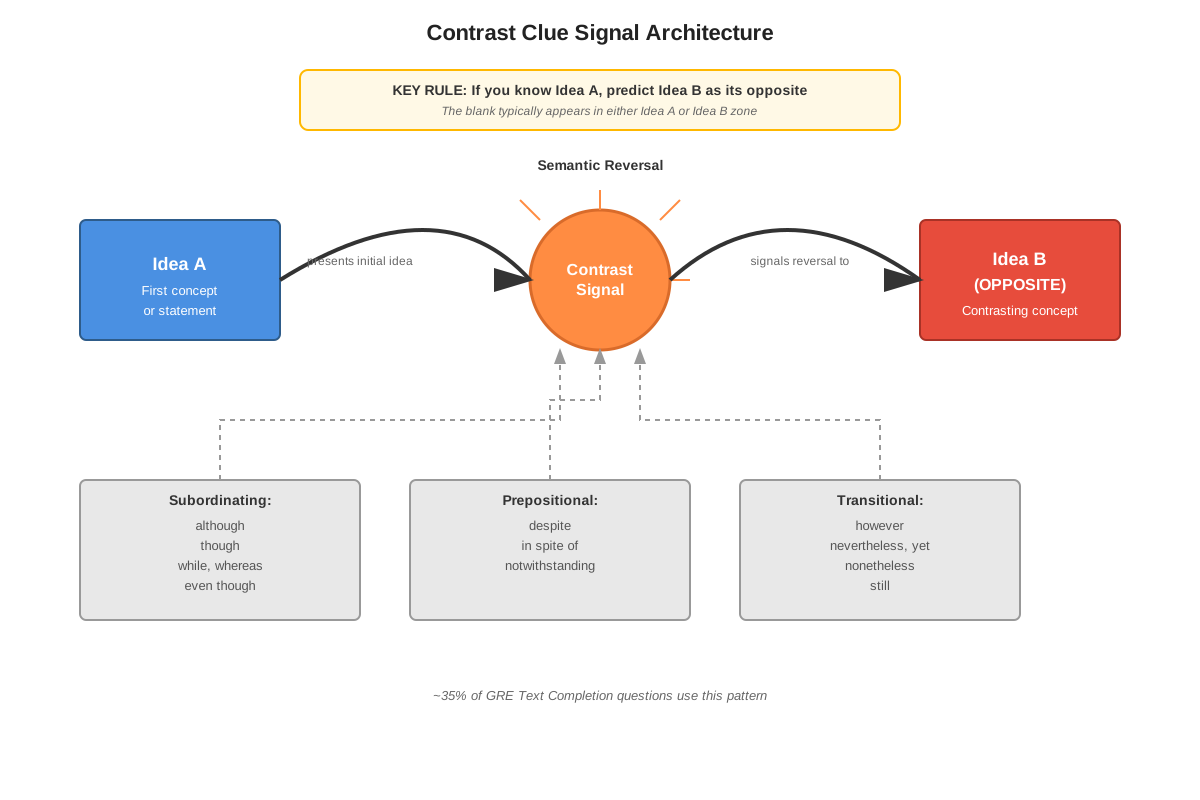
The core mechanism underlying all contrast clues is the semantic reversal principle: when a contrast signal appears in a sentence, the information on one side of that signal must oppose, contradict, or differ from the information on the other side. This opposition can take several forms—direct antonyms (hot vs. cold), contradictory concepts (success vs. failure), or more subtle contrasts (expected vs. surprising). The blank in a GRE question will typically require a word that completes this contrast relationship.
Consider the basic structure: "Although X, Y." The word "although" signals that X and Y are in opposition. If X describes something positive, Y will likely describe something negative (or vice versa). If X describes an expectation, Y will describe a reality that violates that expectation. The blank could appear in either the X position or the Y position, but in both cases, understanding the contrast relationship allows prediction of the missing word's meaning.
Categories of Contrast Signals
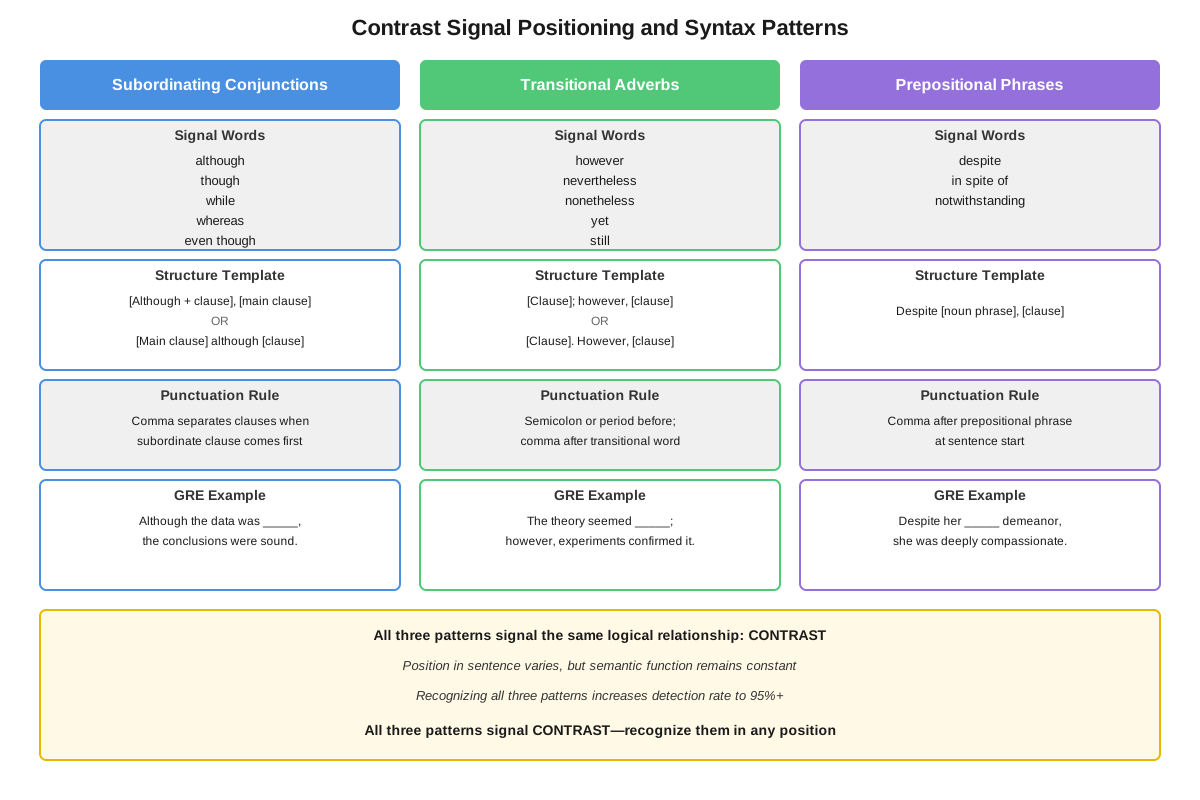
Contrast signals fall into several grammatical and functional categories, each with distinct syntactic behavior:
| Category | Examples | Syntactic Position | Usage Pattern |
|---|---|---|---|
| Subordinating conjunctions | although, though, while, whereas, even though | Beginning of dependent clause | Creates dependent clause that contrasts with main clause |
| Coordinating conjunctions | but, yet | Between independent clauses | Joins two contrasting independent clauses |
| Conjunctive adverbs | however, nevertheless, nonetheless, still | Beginning or middle of independent clause | Signals contrast with previous sentence or clause |
| Prepositions | despite, in spite of, notwithstanding | Before noun phrases | Introduces contrasting circumstance |
| Transitional phrases | on the other hand, in contrast, conversely, by contrast | Beginning of sentence or clause | Explicitly marks shift to opposing idea |
Understanding these categories helps test-takers recognize contrast signals regardless of sentence structure. A sentence beginning with "Despite her extensive preparation" signals the same type of contrast as one containing "She prepared extensively; however, she..."
Identifying the Contrasted Elements
The critical skill in applying contrast clues involves identifying precisely which elements are being contrasted. In complex sentences, multiple ideas may be present, but the contrast signal specifically links two particular concepts. Consider this example:
"Although the scientist's methodology was rigorous, her conclusions were _____ because she had failed to account for confounding variables."
The contrast signal "although" creates opposition between "rigorous methodology" and something about the conclusions. The second clause provides additional information ("failed to account for confounding variables") that explains why the conclusions have a negative quality. The blank must contain a word with negative connotations that contrasts with "rigorous"—words like "flawed," "questionable," or "unreliable" would fit.
Directional Prediction Strategy
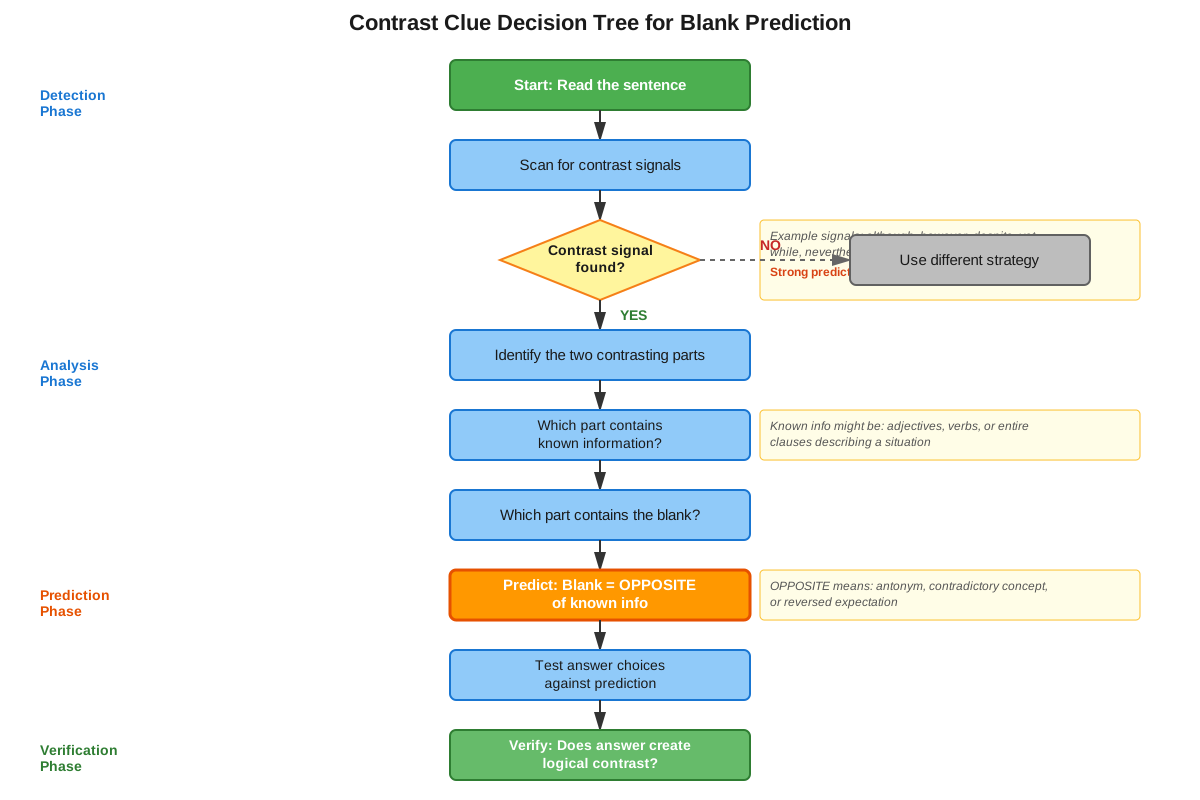
Once a contrast signal is identified, test-takers should follow this systematic process:
- Locate the contrast signal and identify its type
- Identify the two elements being contrasted (which clauses or phrases does the signal connect?)
- Determine which element contains known information and which contains the blank
- Characterize the known information (positive/negative, expected/unexpected, etc.)
- Predict the opposite characteristic for the blank
- Formulate a simple prediction word before examining answer choices
- Evaluate answer choices against the prediction
This process transforms vocabulary questions into logic puzzles. Even if the answer choices contain unfamiliar words, understanding the required direction (positive vs. negative, for example) can eliminate wrong answers.
Complex Contrast Structures
Advanced GRE questions often feature multiple contrast signals or nested contrast relationships. Consider:
"Although critics initially dismissed the theory as _____, subsequent research, while not entirely vindicating its claims, nevertheless demonstrated that it contained _____ insights."
This sentence contains three contrast signals: "although," "while," and "nevertheless." The first blank contrasts with the idea that subsequent research found value in the theory. The second blank must be positive (since the research found insights) but qualified (since it didn't "entirely vindicate" the theory). Words like "specious" or "fanciful" fit the first blank, while "some valuable" or "certain prescient" fit the second.
Implicit Contrast Signals
Not all contrasts are marked by explicit signal words. The GRE also tests recognition of implicit contrasts created through:
- Negation: "The results were not what researchers expected" (implies contrast between expectation and reality)
- Surprising juxtaposition: "The dictator, known for his cruelty, showed unexpected _____" (the juxtaposition of "cruelty" and "unexpected" signals contrast)
- Temporal shifts: "Once celebrated, the artist is now _____" (temporal contrast between past and present)
Recognizing these implicit patterns requires sensitivity to logical relationships beyond explicit signal words.
Concept Relationships
The mastery of contrast clues builds upon and connects to several other essential GRE concepts. At the most fundamental level, sentence structure analysis enables identification of where contrast signals operate—students must recognize independent and dependent clauses to determine which sentence elements are being opposed. This structural understanding forms the foundation upon which contrast clue recognition is built.
Contrast clues exist in direct relationship with continuation clues (also called support clues or same-direction signals). These two categories represent opposite logical operations: continuation clues indicate that ideas flow in the same semantic direction, while contrast clues mark reversals. Many GRE sentences contain both types of signals, creating complex logical chains: "Although X, Y; furthermore, Z" means Y and Z continue in the same direction, but both oppose X.
The relationship map flows as follows:
Sentence Structure Recognition → enables → Signal Word Identification → branches into → Contrast Clues and Continuation Clues → both feed into → Semantic Direction Prediction → enables → Answer Choice Evaluation → leads to → Correct Answer Selection
Within the contrast clue family itself, understanding the different categories (subordinating conjunctions, conjunctive adverbs, prepositions) allows recognition of contrast signals regardless of their grammatical form. This internal relationship means that mastering one type of contrast signal accelerates learning of others, as they all perform the same logical function despite different syntactic behaviors.
Contrast clues also connect forward to more advanced topics like tone and attitude recognition in Reading Comprehension passages. Authors frequently use contrast signals to mark their disagreement with others' views or to acknowledge counterarguments before refuting them. Sensitivity to these signals helps students track argumentative structure in complex passages.
High-Yield Facts
⭐ Contrast signals appear in approximately 35% of all GRE Text Completion questions, making them one of the most frequently tested structural patterns.
⭐ The blank must semantically oppose the contrasted element, not simply differ from it—the opposition should be logical and meaningful within the sentence context.
⭐ "Although" and "though" create dependent clauses that contrast with the main clause, regardless of whether the dependent clause comes first or second in the sentence.
⭐ "However" and "nevertheless" are conjunctive adverbs that must be preceded by a semicolon or period, not a comma, when joining independent clauses.
⭐ "Despite" and "in spite of" must be followed by noun phrases, not complete clauses—they cannot be followed by a subject and verb without additional structure.
- Contrast signals can appear at the beginning, middle, or end of sentences, requiring flexible recognition strategies.
- Multiple contrast signals in a single sentence create complex logical relationships that must be mapped systematically.
- The strength of contrast varies—"although" suggests a weaker opposition than "despite" or "notwithstanding," though this distinction rarely affects answer selection.
- Implicit contrasts (created through negation or surprising juxtaposition) are tested as frequently as explicit contrast signals on difficult questions.
- When a sentence contains both a contrast signal and a continuation signal, the continuation signal typically operates within one side of the contrast, not across it.
- Temporal contrast words ("once," "formerly," "previously" vs. "now," "currently") create past-present oppositions that function like explicit contrast signals.
- The phrase "far from" functions as a contrast signal meaning "not at all" or "the opposite of."
- Contrast signals in Sentence Equivalence questions typically require both correct answers to be synonyms that contrast with the same element in the sentence.
- Questions featuring contrast signals tend to have more predictable answers than those relying purely on vocabulary, making them high-value targets for time investment.
- Recognizing the contrast signal is only half the task—identifying precisely which elements are being contrasted determines success or failure.
Quick check — test yourself on Although and however clues so far.
Try Flashcards →Common Misconceptions
Misconception: Any sentence containing "although" or "however" is testing contrast clues. → Correction: While these words do signal contrast, the GRE question must specifically require understanding that contrast to solve it. Some sentences contain contrast signals but test vocabulary or other concepts primarily. The contrast signal is being tested when understanding the opposition is necessary to predict the blank's meaning.
Misconception: Contrast always means direct antonyms (hot/cold, big/small). → Correction: Contrast on the GRE encompasses a broader range of oppositions, including expected vs. actual, typical vs. exceptional, appearance vs. reality, and past vs. present. The opposition must be logical and contextually appropriate, but it need not involve simple antonyms.
Misconception: "However" and "but" are interchangeable and can be used in the same syntactic positions. → Correction: "But" is a coordinating conjunction that can join independent clauses with only a comma ("X, but Y"). "However" is a conjunctive adverb that requires a semicolon or period before it when joining independent clauses ("X; however, Y" or "X. However, Y"). This grammatical distinction doesn't affect GRE question solving but helps in understanding sentence structure.
Misconception: The blank always appears in the clause after the contrast signal. → Correction: Blanks can appear on either side of a contrast signal. "Although the performance was _____, critics praised it" and "Although the performance was disappointing, critics _____ it" both use contrast signals, but the blank appears in different positions relative to "although."
Misconception: If a sentence has multiple blanks and one contrast signal, all blanks must relate to that contrast. → Correction: In multi-blank questions, a contrast signal may govern only one blank while other blanks are determined by different logical relationships (continuation, cause-effect, etc.). Each blank must be analyzed individually to determine which signals control it.
Misconception: Stronger contrast words like "despite" indicate more extreme answer choices. → Correction: The intensity of the contrast signal doesn't directly correlate with the extremity of the correct answer. "Despite" and "although" both signal opposition; the correct answer's intensity is determined by the context and the specific words being contrasted, not by the signal word itself.
Misconception: Recognizing the contrast signal is sufficient to answer the question correctly. → Correction: Recognition is only the first step. Test-takers must also identify which specific elements are being contrasted, characterize the known element accurately, and predict the appropriate opposite. Many errors occur not from missing the signal but from misidentifying what is being contrasted.
Worked Examples
Example 1: Single-Blank Text Completion
Question: Although the new policy was designed to promote transparency, its implementation was so _____ that it actually obscured important information from public view.
Step 1 - Identify the contrast signal: "Although" at the beginning of the sentence signals that the two clauses will present opposing ideas.
Step 2 - Identify the contrasted elements: The first clause tells us the policy was "designed to promote transparency" (making information visible/clear). The second clause tells us the implementation "actually obscured important information" (made information hidden/unclear). These are already in opposition regarding the outcome.
Step 3 - Locate the blank and its relationship to known information: The blank describes the implementation. We know the implementation "obscured information" despite the policy being designed for transparency. The word "so" before the blank indicates that the blank's quality was extreme enough to cause the obscuring effect.
Step 4 - Predict the blank's meaning: The blank must describe a negative quality of the implementation that would cause it to obscure rather than reveal information. Words suggesting confusion, complexity, or poor execution would fit. Prediction: "confusing," "complicated," or "poorly executed."
Step 5 - Evaluate answer choices:
- (A) transparent - This continues the same direction as "promote transparency," violating the contrast
- (B) convoluted - This means excessively complex/complicated, fitting our prediction perfectly
- (C) straightforward - This would support transparency, not obscure it
- (D) innovative - This is neutral/positive but doesn't explain obscuring information
- (E) conventional - This doesn't logically connect to obscuring information
Answer: (B) convoluted
Connection to learning objectives: This example demonstrates identifying the contrast signal ("although"), explaining the core strategy (finding opposition between designed purpose and actual effect), and applying it to select the correct answer by predicting semantic direction.
Example 2: Double-Blank Text Completion with Multiple Signals
Question: While the historian's research was undeniably (i)_____, her writing style was so (ii)_____ that even specialists in the field found her work difficult to penetrate; nevertheless, those who persevered discovered insights that were genuinely (iii)_____.
Blank (i) options: A) meticulous B) superficial C) derivative
Blank (ii) options: D) accessible E) opaque F) eloquent
Blank (iii) options: G) profound H) mundane I) questionable
Step 1 - Map the contrast signals: This sentence contains two contrast signals: "while" (contrasting research quality with writing style) and "nevertheless" (contrasting difficulty with value of insights).
Step 2 - Analyze the first contrast (Blanks i and ii): "While" signals that the research quality and writing style are opposed. The second clause tells us the writing made the work "difficult to penetrate." For this to be a contrast, the research itself must be positive (high quality). The word "undeniably" reinforces that Blank (i) is strongly positive. Blank (ii) must mean something like "difficult to understand" or "unclear" to explain why the work was hard to penetrate.
Step 3 - Predict Blanks (i) and (ii):
- Blank (i): positive quality of research → "meticulous" (A) fits; "superficial" and "derivative" are negative
- Blank (ii): quality making writing hard to understand → "opaque" (E) fits; "accessible" is the opposite, "eloquent" would make it easier
Step 4 - Analyze the second contrast (Blank iii): "Nevertheless" signals that despite the difficulty, those who persevered found something valuable. The contrast is between "difficult to penetrate" (negative experience) and the insights discovered (which must be positive/valuable to justify persevering).
Step 5 - Predict Blank (iii): Must be strongly positive to contrast with the difficulty and justify the effort → "profound" (G) fits; "mundane" would not justify persevering, "questionable" is negative.
Answers: (i) A - meticulous, (ii) E - opaque, (iii) G - profound
Connection to learning objectives: This example demonstrates handling multiple contrast signals in a complex sentence, distinguishing between different types of contrast signals ("while" vs. "nevertheless"), and predicting semantic direction for multiple blanks based on their positions relative to contrast signals.
Exam Strategy
Recognition Phase Strategy
When approaching any GRE Text Completion or Sentence Equivalence question, invest the first 5-10 seconds in signal word reconnaissance. Scan the sentence specifically for contrast indicators before reading for full comprehension. This initial scan should identify:
- Explicit contrast words (although, however, despite, yet, etc.)
- Negation words (not, never, rarely, hardly)
- Temporal shifts (once, formerly, now, currently)
- Surprising juxtapositions (unexpected, surprisingly, paradoxically)
Exam Tip: Circle or mentally note every contrast signal before attempting to solve the question. This prevents overlooking secondary signals in complex sentences.
Trigger Word Mastery
Develop automatic recognition of high-frequency contrast triggers. The most common GRE contrast signals, in order of frequency, are:
Tier 1 (Appear in 5+ questions per test): although, however, but, despite, yet, while
Tier 2 (Appear in 2-4 questions per test): nevertheless, though, whereas, in contrast, on the other hand, rather than
Tier 3 (Appear occasionally): nonetheless, notwithstanding, conversely, by contrast, even though, still, in spite of
Memorize these lists and practice identifying them in reading material outside of GRE prep to build automatic recognition.
The Prediction-Before-Choices Protocol
Never look at answer choices before making a prediction. This protocol prevents the test writers' carefully crafted wrong answers from contaminating logical analysis. The process should be:
- Identify contrast signal(s)
- Determine what is being contrasted
- Characterize the known element
- Write down a simple prediction word (even if it's basic like "bad" or "good")
- Only then examine answer choices
- Eliminate choices that don't match the predicted direction
- Select the best match from remaining choices
This approach is especially powerful when answer choices contain unfamiliar vocabulary. If the prediction is "something negative," test-takers can often eliminate positive-sounding words even without knowing precise definitions.
Process of Elimination Specific to Contrast Questions
For contrast clue questions, eliminate answer choices that:
- Continue in the same direction as the contrasted element rather than opposing it
- Are neutral when the context requires a clear positive or negative
- Create logical contradictions when inserted (beyond the intended contrast)
- Ignore the contrast signal entirely by making the sentence non-contrastive
Exam Tip: If two answer choices seem equally opposite to the contrasted element, the correct answer is usually the one that creates the more precise or sophisticated meaning, not just any opposite.
Time Allocation Wisdom
Contrast clue questions should be faster to solve than pure vocabulary questions because they provide structural guidance. Allocate time as follows:
- Simple single-blank with clear contrast: 45-60 seconds
- Double-blank with one contrast signal: 75-90 seconds
- Triple-blank or multiple contrast signals: 90-120 seconds
If a contrast clue question is taking longer than these benchmarks, the contrast signal may not be the primary solving mechanism, or there may be a misidentification of what is being contrasted. In such cases, consider moving on and returning if time permits.
Sentence Equivalence Special Considerations
In Sentence Equivalence questions, contrast clues provide especially strong guidance because both correct answers must create the same contrast relationship. The strategy becomes:
- Identify the contrast signal and what is being contrasted
- Predict the required direction (positive/negative, expected/unexpected, etc.)
- Eliminate all choices that don't match the direction
- From remaining choices, select the two that are most synonymous with each other
The synonymy requirement means that if one answer choice perfectly fits the contrast but has no synonym among the other choices, it cannot be correct.
Memory Techniques
The ABCD Contrast Mnemonic
Remember the four most common contrast signal categories with ABCD:
- Although-family (although, though, even though)
- But-family (but, yet)
- Conjunctive adverbs (however, nevertheless, nonetheless)
- Despite-family (despite, in spite of, notwithstanding)
This acronym helps ensure comprehensive recognition across all grammatical categories.
The Opposition Visualization Technique
When encountering a contrast signal, visualize a physical barrier or wall between the two contrasted elements. On one side of the wall, write the known information with a + or - sign indicating its valence. On the other side, the blank must have the opposite sign. This spatial visualization helps prevent errors where test-takers accidentally continue in the same direction rather than contrasting.
The "Flip It" Mental Routine
Develop an automatic mental routine: whenever a contrast signal is identified, immediately think "flip it." This verbal cue triggers the cognitive process of reversing semantic direction. If the known element is "successful," thinking "flip it" prompts consideration of "unsuccessful" or "failing." If the known element is "expected," "flip it" prompts "unexpected" or "surprising."
The Contrast Signal Song
Create a rhythmic chant of contrast signals to build automatic recognition:
"Although, though, even though / But and yet, here we go / However, nevertheless / Despite, in spite of, nonetheless / While, whereas, on the other hand / Contrast signals help me understand"
Silly as it may seem, rhythmic memorization enhances recall under test pressure.
The Three-Question Checklist
Before finalizing any answer on a suspected contrast question, mentally check:
- Did I find the contrast signal? (If no, look again)
- Did I identify what's being contrasted? (If unclear, re-read)
- Does my answer oppose the right element? (If unsure, verify)
This checklist prevents the most common errors: missing the signal, misidentifying the contrasted elements, or opposing the wrong part of the sentence.
Summary
Mastering although and however clues provides one of the highest-yield returns on study investment for GRE Verbal Reasoning. These contrast signals, appearing in approximately one-third of all text completion questions, transform vocabulary challenges into logical puzzles by revealing the structural relationships between sentence elements. The core principle is straightforward: contrast signals indicate that elements on opposite sides must semantically oppose each other, allowing test-takers to predict blank meanings through logical analysis rather than pure vocabulary knowledge. Success requires three competencies: recognizing contrast signals across multiple grammatical categories (subordinating conjunctions, conjunctive adverbs, prepositions, and transitional phrases), identifying precisely which elements are being contrasted, and predicting the semantic direction required to complete the opposition. Advanced application involves handling multiple contrast signals in complex sentences and recognizing implicit contrasts created through negation or surprising juxtaposition. By following systematic strategies—scanning for signals before reading for comprehension, making predictions before examining answer choices, and using process of elimination based on semantic direction—students can achieve consistent accuracy on these high-frequency question types while reducing time per question.
Key Takeaways
- Contrast signals appear in 35% of Text Completion questions, making them one of the most frequently tested patterns and a high-priority mastery target
- The fundamental rule is semantic opposition: blanks must oppose, contradict, or contrast with specific elements identified by the contrast signal
- Recognition must span multiple grammatical categories: subordinating conjunctions (although, while), conjunctive adverbs (however, nevertheless), prepositions (despite), and transitional phrases (on the other hand)
- Systematic prediction before examining answer choices prevents contamination by wrong answers and enables solving even with unfamiliar vocabulary
- Identifying what is being contrasted is as important as recognizing the signal itself—many errors result from opposing the wrong sentence element
- Complex sentences may contain multiple contrast signals requiring careful mapping of which signals govern which blanks
- Time efficiency improves dramatically when contrast signals are recognized, as they provide structural shortcuts to correct answers
Related Topics
Continuation and Support Clues: The logical complement to contrast clues, these signals (furthermore, similarly, likewise, and) indicate that ideas flow in the same semantic direction. Mastering both contrast and continuation clues provides comprehensive coverage of signal-word strategies.
Cause and Effect Relationships: Many GRE sentences combine contrast signals with causal relationships (because, therefore, thus), creating complex logical chains. Understanding how these interact enables solving advanced multi-blank questions.
Tone and Attitude Recognition: In Reading Comprehension passages, contrast signals often mark shifts in authorial attitude or disagreements with other viewpoints. Sensitivity to these signals enhances passage mapping and question accuracy.
Sentence Equivalence Strategy: While contrast clues apply to both Text Completion and Sentence Equivalence, the latter requires additional consideration of synonymy between correct answers. Mastering contrast clues in Text Completion provides foundation for Sentence Equivalence success.
Vocabulary in Context: Even with strong contrast clue skills, some questions require understanding nuanced vocabulary differences between near-synonyms. Contrast clue mastery reduces but doesn't eliminate vocabulary study needs.
Practice CTA
Now that you understand the principles and strategies behind although and however clues, it's time to cement this knowledge through active practice. Attempt the practice questions associated with this topic, focusing on applying the systematic approach outlined in the Exam Strategy section: identify signals, determine what's being contrasted, predict before looking at choices, and eliminate based on semantic direction. As you practice, you'll develop the automatic recognition and rapid analysis that characterize top scorers. Remember that contrast clues represent one of the most reliable patterns on the GRE—investing time in mastering this topic will pay dividends across dozens of questions on test day. Review the flashcards to reinforce recognition of the full range of contrast signals, and return to the Worked Examples whenever you encounter difficulty. With focused practice, these questions will transform from challenging vocabulary tests into straightforward logical puzzles. You've got this!
Sign up free to keep reading
Create a free AnvayaPrep account to finish this GRE guide on Although and however clues — plus flashcards and practice questions.