Overview
Because and therefore clues represent one of the most fundamental and high-yield strategies for conquering GRE Text Completion questions. These logical connectors signal cause-and-effect relationships within sentences, providing explicit roadmaps to the correct answer. When a sentence contains words like "because," "since," "therefore," or "thus," the test-maker is establishing a direct logical relationship between two parts of the sentence—and understanding this relationship is the key to selecting the right word to fill the blank.
Mastering GRE because and therefore clues is essential because these signal words appear in approximately 30-40% of all Text Completion questions. Unlike more subtle contextual clues that require inference, because and therefore clues explicitly tell test-takers how ideas connect. When you see "because," you know the following clause explains the reason for something stated elsewhere. When you see "therefore," you know a conclusion or result is being drawn from previous information. This directness makes these clues among the most reliable tools in your GRE arsenal.
Within the broader landscape of Verbal Reasoning, because and therefore clues form the foundation of logical reading comprehension. They connect to contrast clues (which signal opposition rather than causation), definition clues (which provide direct meanings), and example clues (which illustrate concepts). Understanding causal relationships prepares students not only for Text Completion but also for Reading Comprehension passages where tracking an author's logical flow is critical, and for Sentence Equivalence questions where parallel reasoning must be identified.
Learning Objectives
- [ ] Identify when Because and therefore clues is being tested
- [ ] Explain the core rule or strategy behind Because and therefore clues
- [ ] Apply Because and therefore clues to GRE-style questions accurately
- [ ] Distinguish between forward-pointing and backward-pointing causal indicators
- [ ] Recognize synonymous causal signal words beyond "because" and "therefore"
- [ ] Predict blank content before reviewing answer choices using causal logic
- [ ] Combine because and therefore clues with other contextual signals for complex sentences
Prerequisites
- Basic sentence structure understanding: Recognizing independent and dependent clauses helps identify which part of the sentence provides the cause and which provides the effect
- Vocabulary fundamentals: A working knowledge of intermediate vocabulary enables students to understand the non-blank portions of sentences that contain the clues
- Logical reasoning basics: Understanding simple if-then relationships and cause-effect logic forms the foundation for applying these clues effectively
Why This Topic Matters
In real-world communication, causal relationships structure how humans explain phenomena, justify decisions, and construct arguments. Scientists use "because" to explain experimental results; business leaders use "therefore" to justify strategic choices; writers use causal connectors to build persuasive narratives. The GRE tests these relationships because graduate-level work demands the ability to follow complex chains of reasoning in academic texts.
On the GRE specifically, because and therefore clues appear in 35-45% of Text Completion questions, making them the single most common type of explicit clue. They appear across all difficulty levels, from straightforward single-blank questions to complex three-blank passages. The Educational Testing Service (ETS) favors these clues because they test pure logical reasoning—the ability to track how ideas connect—rather than obscure vocabulary knowledge alone.
These clues typically appear in several formats: single-sentence Text Completions where one clause explains another; multi-sentence passages where a conclusion follows from evidence; and complex sentences with multiple causal relationships. Questions may place the blank in either the cause or the effect portion of the sentence, requiring students to work both forward (from cause to effect) and backward (from effect to cause). The most challenging questions combine causal clues with contrast words or multiple blanks, creating layered logical relationships.
Core Concepts
The Fundamental Causal Relationship
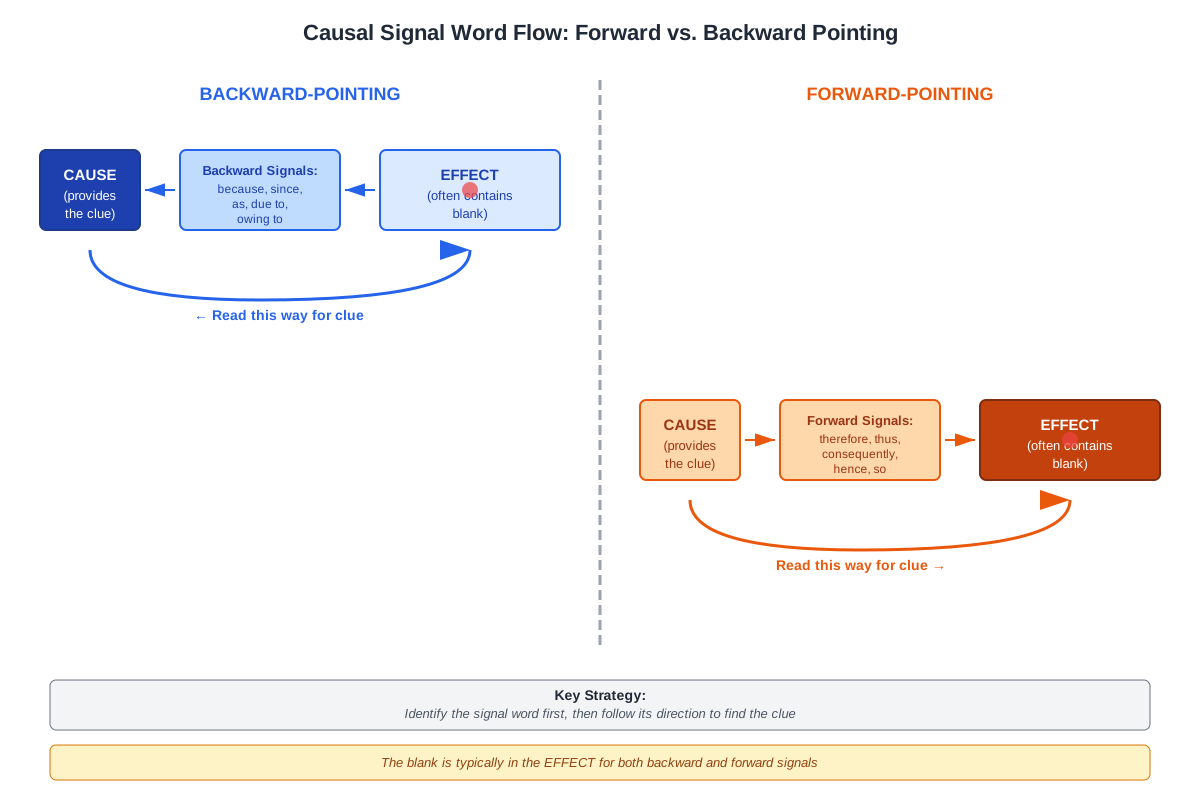
At its core, a causal relationship in GRE sentences consists of two components: a cause (the reason something happens) and an effect (the result or consequence). Because and therefore clues explicitly signal which component is which. The word "because" introduces the cause and points to something that has already been stated or will follow. The word "therefore" introduces the effect or conclusion drawn from previously stated information.
Consider this structure: "The experiment failed because the equipment was faulty." Here, "because" signals that "the equipment was faulty" is the cause, and "the experiment failed" is the effect. Reverse the logic: "The equipment was faulty; therefore, the experiment failed." Now "therefore" signals that "the experiment failed" is the effect following from the cause "the equipment was faulty."
Forward-Pointing Causal Indicators
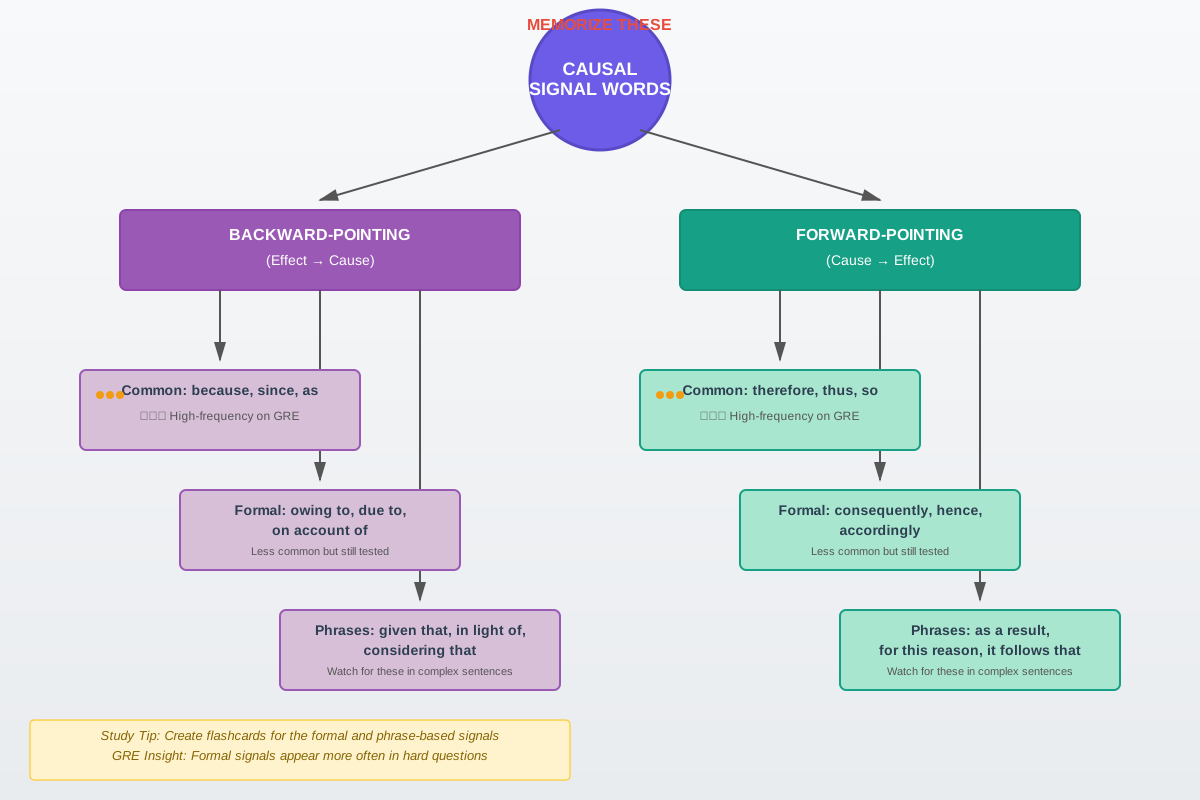
Forward-pointing indicators signal that a cause is about to be stated, or that an effect will follow from what was just mentioned. These words tell readers to expect a result or conclusion:
- Therefore: Signals a conclusion or result
- Thus: Indicates a logical consequence
- Hence: Shows a result following from previous information
- Consequently: Emphasizes the effect of prior causes
- Accordingly: Suggests action or result matching prior conditions
- As a result: Explicitly marks an effect
- So: Informal marker of consequence
Example: "The drought persisted for months; therefore, the harvest was _____." The blank must describe a negative outcome (sparse, meager, disappointing) because the drought (cause) leads to a poor harvest (effect).
Backward-Pointing Causal Indicators
Backward-pointing indicators signal that an explanation or reason is about to be provided for something already stated. These words tell readers to expect a cause:
- Because: Introduces the reason for something
- Since: Provides causal explanation (distinct from temporal "since")
- As: Can indicate causation in context
- For: Formal causal connector
- Due to: Attributes causation
- Owing to: Indicates reason
- Given that: Establishes causal premise
Example: "The harvest was _____ because the drought persisted for months." The blank must describe a negative outcome, but now the logical flow moves from effect (harvest) to cause (drought).
Directional Logic Flow
Understanding the direction of logical flow is crucial for applying these clues correctly. When you encounter a causal signal word, immediately identify:
- Which clause contains the cause?
- Which clause contains the effect?
- Where is the blank positioned—in the cause or effect?
- What logical relationship must the blank maintain?
| Signal Word | Points To | Blank Strategy |
|---|---|---|
| Because, Since, As | Cause follows | If blank is in cause: explain the effect; if blank is in effect: match the cause |
| Therefore, Thus, Hence | Effect follows | If blank is in effect: match the cause; if blank is in cause: predict the effect |
| Consequently, Accordingly | Effect follows | Blank should reflect logical outcome |
| Due to, Owing to | Cause follows | Blank should reflect logical reason |
Synonymous Variations
The GRE rarely uses the exact words "because" and "therefore" exclusively. Test-makers employ synonymous variations to test whether students understand the underlying logical relationship rather than memorizing specific trigger words. Recognizing these variations is essential:
Causal synonyms (because-type):
- Inasmuch as
- Insofar as
- On account of
- By virtue of
- In light of
- Considering that
Consequential synonyms (therefore-type):
- Ergo (formal/archaic)
- Wherefore (formal/archaic)
- It follows that
- This means that
- Which explains why
Complex Causal Chains
Advanced GRE questions present complex causal chains where multiple causes lead to multiple effects, or where causal relationships are nested within one another. These questions may contain multiple blanks, each requiring attention to its specific causal relationship.
Example structure: "Because A was _____ (blank 1), B occurred; therefore, C became _____ (blank 2)."
Here, blank 1 must explain why B happened, and blank 2 must reflect the consequence of both A and B. Students must track multiple logical connections simultaneously.
Negative Causation
Sometimes causal relationships involve negative causation—where the absence of something causes an effect, or where a cause prevents an effect. Signal phrases include:
- "Without X, Y would not..."
- "Lacking X, Y therefore..."
- "The absence of X meant that Y..."
These require careful attention because the logical relationship remains causal, but the polarity is reversed.
Concept Relationships
The concepts within because and therefore clues form a hierarchical relationship: Fundamental Causal Relationship (the base concept) → Forward-Pointing and Backward-Pointing Indicators (the two main categories) → Synonymous Variations (expanded recognition) → Complex Causal Chains (advanced application).
These clues connect to contrast clues as logical opposites—where contrast words signal opposition, causal words signal agreement and continuation. They relate to definition clues because causes often define or explain effects. They connect to example clues because examples can serve as evidence (causes) for broader claims (effects).
Understanding causal relationships in Text Completion directly supports Reading Comprehension skills, particularly in tracking argument structure and identifying author's reasoning. It also supports Sentence Equivalence by helping identify parallel logical structures. Mastery of these clues enables progression to more complex topics like combined clue strategies and multi-blank coordination.
High-Yield Facts
⭐ Because and therefore clues appear in 35-45% of all GRE Text Completion questions, making them the most common explicit clue type
⭐ "Because" and "since" introduce causes; "therefore" and "thus" introduce effects
⭐ The blank can appear in either the cause clause or the effect clause—identify which before predicting
⭐ Causal signal words establish agreement between clauses, not contrast—the blank should maintain logical consistency
⭐ Multiple causal indicators in one sentence create chains: track each relationship separately
- "Consequently," "accordingly," and "as a result" are synonyms for "therefore"
- "Given that," "inasmuch as," and "owing to" are synonyms for "because"
- Temporal "since" (meaning "from that time") differs from causal "since" (meaning "because")—context determines meaning
- Negative causation ("without," "lacking") reverses polarity but maintains causal logic
- Complex sentences may contain both forward and backward causal indicators, requiring bidirectional analysis
Quick check — test yourself on Because and therefore clues so far.
Try Flashcards →Common Misconceptions
Misconception: All uses of "since" indicate causation → Correction: "Since" can be temporal ("since 1990") or causal ("since it rained"). Context determines meaning. If the sentence discusses time, "since" is temporal; if it discusses reasons, "since" is causal.
Misconception: The cause always comes before the effect in sentence order → Correction: Sentence order and logical order are independent. "The harvest failed because of drought" places effect before cause. "Because of drought, the harvest failed" places cause before effect. The signal word, not position, determines the relationship.
Misconception: "Therefore" and "however" can be used interchangeably → Correction: These words signal opposite relationships. "Therefore" indicates agreement and continuation (cause leads to expected effect), while "however" signals contrast (expectation is reversed). Confusing these destroys logical coherence.
Misconception: Only one causal relationship exists per sentence → Correction: Complex GRE sentences often contain multiple causal relationships, especially in three-blank questions. Each relationship must be tracked independently: "Because A, B occurred; therefore C, which meant D."
Misconception: The blank must always be a synonym of words in the other clause → Correction: The blank must be logically consistent with the causal relationship, not necessarily synonymous. If "because the weather was severe, the event was _____," the blank should be "cancelled" or "postponed" (logical effects), not "severe" (synonym).
Worked Examples
Example 1: Single-Blank with Backward Causal Indicator
Question: "The archaeologist's theory was met with _____ because it contradicted decades of established research and offered no compelling new evidence."
Step 1 - Identify the signal word: "Because" is a backward-pointing causal indicator, meaning the clause after "because" explains the reason for what came before.
Step 2 - Identify cause and effect:
- Effect: "The archaeologist's theory was met with _____"
- Cause: "it contradicted decades of established research and offered no compelling new evidence"
Step 3 - Analyze the cause: The cause is negative—the theory contradicts established work and lacks evidence. This would logically produce a negative reception.
Step 4 - Predict the blank: The blank describes how the theory was received. Given the negative cause, the effect must be negative reception: skepticism, criticism, doubt, dismissal.
Step 5 - Evaluate answer choices (hypothetical):
- (A) acclaim - INCORRECT (positive, contradicts negative cause)
- (B) skepticism - CORRECT (negative reception matching negative cause)
- (C) indifference - INCORRECT (neutral, doesn't match strong negative cause)
- (D) enthusiasm - INCORRECT (positive, contradicts negative cause)
- (E) curiosity - INCORRECT (neutral/positive, doesn't match negative cause)
Answer: (B) skepticism
Connection to learning objectives: This example demonstrates identifying when because clues are tested (objective 1), applying the core strategy of matching effect to cause (objective 2), and accurately solving a GRE-style question (objective 3).
Example 2: Multi-Blank with Forward Causal Indicator
Question: "The medication proved (i)_____ in clinical trials; therefore, regulatory agencies (ii)_____ its approval for widespread use."
Step 1 - Identify the signal word: "Therefore" is a forward-pointing causal indicator, meaning what follows is the effect or consequence of what came before.
Step 2 - Identify cause and effect:
- Cause: "The medication proved (i)_____"
- Effect: "regulatory agencies (ii)_____ its approval"
Step 3 - Recognize the logical dependency: Blank (ii) must logically follow from blank (i). If the medication proved effective (positive), agencies would approve it (positive action). If the medication proved ineffective (negative), agencies would deny approval (negative action).
Step 4 - Evaluate answer choices for blank (i) (hypothetical):
- Blank (i): efficacious, ineffective, controversial
Step 5 - Evaluate answer choices for blank (ii) (hypothetical):
- Blank (ii): expedited, delayed, reconsidered
Step 6 - Test logical pairs:
- "efficacious...expedited" - CORRECT (positive cause → positive effect)
- "ineffective...expedited" - INCORRECT (negative cause → positive effect = illogical)
- "ineffective...delayed" - POSSIBLE (negative cause → negative effect = logical)
- "controversial...reconsidered" - POSSIBLE (uncertain cause → cautious effect = logical)
Step 7 - Use context to finalize: The sentence structure with "therefore" suggests a straightforward positive outcome. "Efficacious...expedited" creates the clearest causal relationship.
Answer: (i) efficacious, (ii) expedited
Connection to learning objectives: This example demonstrates applying causal logic to complex multi-blank questions (objective 3), predicting content before reviewing choices (objective 5), and combining causal clues with logical reasoning (objective 7).
Exam Strategy
Recognition Phase
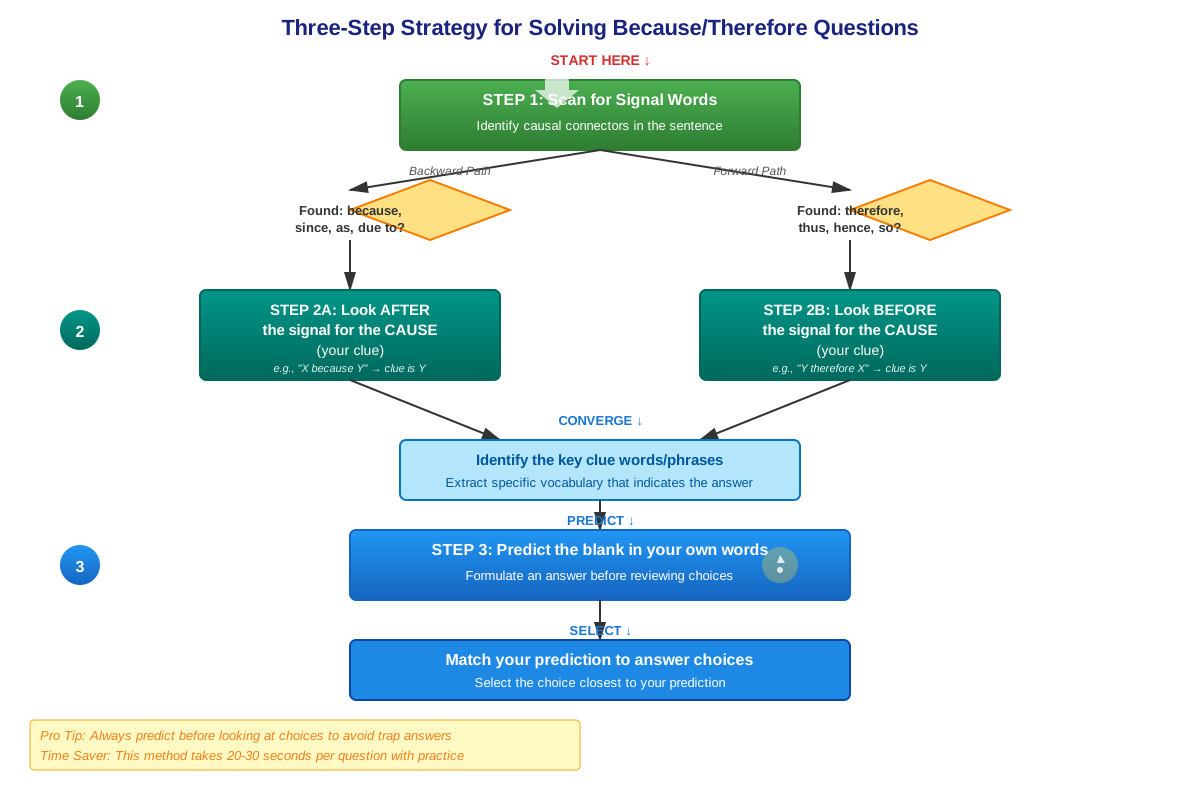
When approaching any Text Completion question, scan for causal signal words first. Before reading the entire sentence, quickly identify whether "because," "therefore," or their synonyms appear. This immediate recognition tells you that logical causation will guide your answer, making the question more predictable than those relying on subtle context.
Exam Tip: Spend 5-10 seconds scanning for signal words before deep reading. This pre-reading strategy saves time and focuses attention on the most important logical relationships.
Trigger Words to Watch For
Create a mental checklist of high-frequency causal triggers:
High-priority triggers (appear most frequently):
- because, since, therefore, thus, hence, consequently
Medium-priority triggers (appear regularly):
- accordingly, as a result, due to, owing to, given that, so
Low-priority triggers (appear occasionally):
- inasmuch as, insofar as, wherefore, ergo, for this reason
Directional Analysis Process
Follow this systematic process for every question with causal clues:
- Circle the causal signal word
- Draw an arrow from cause to effect
- Mark which clause contains the blank
- Determine whether you're working forward (cause→effect) or backward (effect→cause)
- Predict the blank's content based on logical necessity
- Eliminate answer choices that break the causal logic
Process of Elimination Strategy
For because and therefore clues specifically:
- Eliminate opposites first: If the cause is positive, eliminate negative effects (and vice versa)
- Eliminate neutral terms: Causal relationships typically involve clear positive or negative valence, not neutral terms
- Eliminate synonyms of the wrong clause: If the blank is in the effect, eliminate words that merely repeat the cause without showing consequence
- Test remaining choices by substitution: Read the complete sentence with each remaining choice to verify logical coherence
Time Allocation
- Simple single-blank with clear causal clue: 45-60 seconds
- Multi-blank with one causal relationship: 75-90 seconds
- Complex multi-blank with multiple causal chains: 90-120 seconds
Because and therefore clues actually save time compared to questions requiring subtle inference. Once you identify the causal relationship, prediction becomes straightforward, allowing faster elimination.
Common Trap Patterns
The GRE sets predictable traps in causal questions:
- Reversed polarity: Answer choices that would fit if the causal relationship were reversed
- Synonyms without logic: Words that match the tone of the cause but don't represent a logical effect
- Extreme terms: Overly strong words that exceed what the causal relationship supports
- Temporal confusion: Confusing temporal sequence with causal relationship
Memory Techniques
The CAUSE Acronym
Circle the signal word
Arrow from cause to effect
Understand which clause has the blank
Select the logical relationship
Eliminate illogical choices
Directional Mnemonic
"Because BACKS up, Therefore THROWS forward"
- Because looks BACK to explain what was already stated
- Therefore THROWS the logic FORWARD to a conclusion
Visual Association
Picture "because" as a foundation (it provides the base/reason for something above it) and "therefore" as an arrow pointing right (it moves forward to a conclusion). When you see these words, visualize these shapes to remember their directional function.
The Synonym Family Tree
Create mental groupings:
The "Because" Family: because, since, as, for, given that, due to, owing to, inasmuch as
The "Therefore" Family: therefore, thus, hence, consequently, accordingly, as a result, so
Memorize these families so you recognize any member instantly.
The Polarity Match Rule
"Positive cause → Positive effect; Negative cause → Negative effect"
This simple rule applies to 80% of causal questions. Memorize it as your default assumption, then watch for the 20% of questions that explicitly reverse this pattern.
Summary
Because and therefore clues represent the most explicit and reliable logical signals in GRE Text Completion questions, appearing in over one-third of all questions. These causal indicators establish clear cause-and-effect relationships that directly guide answer selection. "Because" and its synonyms introduce causes or reasons, while "therefore" and its synonyms introduce effects or conclusions. Success requires identifying the signal word, determining the direction of logical flow (forward to effect or backward to cause), locating the blank within the causal structure, and selecting answers that maintain logical consistency. The most challenging questions involve multiple causal relationships, synonymous variations of standard signal words, or negative causation, but the fundamental strategy remains constant: match the blank to its logical role in the causal chain. Mastering these clues provides a significant advantage because they transform potentially ambiguous questions into straightforward logical puzzles.
Key Takeaways
- Because and therefore clues appear in 35-45% of Text Completion questions, making them the highest-yield clue type to master
- "Because" introduces causes (reasons); "therefore" introduces effects (conclusions)
- Always identify which clause contains the cause and which contains the effect before predicting the blank
- The blank can appear in either the cause or effect clause—your prediction strategy must adapt accordingly
- Causal relationships maintain logical consistency: positive causes typically produce positive effects, negative causes produce negative effects
- Recognize synonymous variations: "since," "given that," "owing to" function like "because"; "thus," "hence," "consequently" function like "therefore"
- Complex questions may contain multiple causal relationships—track each independently and ensure all blanks maintain their respective logical connections
Related Topics
Contrast Clues: While because and therefore clues signal agreement and logical continuation, contrast clues (however, although, despite) signal opposition and reversal. Mastering causal clues provides the foundation for understanding how contrast clues create opposite logical relationships.
Combined Clue Strategies: Advanced Text Completion questions often combine multiple clue types in a single sentence—for example, a causal relationship modified by a contrast word. After mastering because and therefore clues, students can progress to questions requiring simultaneous application of multiple strategies.
Sentence Equivalence with Causal Logic: The logical reasoning skills developed through causal clues transfer directly to Sentence Equivalence questions, where students must identify two words that create equivalent causal relationships.
Reading Comprehension Argument Structure: Understanding causal relationships in Text Completion builds the foundation for tracking how authors construct arguments in Reading Comprehension passages, particularly in identifying premises (causes) and conclusions (effects).
Practice CTA
Now that you understand the fundamental strategy behind because and therefore clues, it's time to cement your mastery through active practice. Attempt the practice questions designed specifically for this topic, focusing on applying the systematic process outlined in this guide: identify the signal word, determine the direction of causation, predict the blank, and eliminate illogical choices. Use the flashcards to drill recognition of synonymous causal indicators until identifying these signals becomes automatic. Remember, because and therefore clues are among the most reliable tools in your GRE arsenal—consistent practice will transform them into quick points on test day. Your investment in mastering this high-yield topic will pay dividends across 35-45% of all Text Completion questions you encounter!
Sign up free to keep reading
Create a free AnvayaPrep account to finish this GRE guide on Because and therefore clues — plus flashcards and practice questions.