Overview
Shift words are critical linguistic signals that appear throughout GRE Text Completion questions, indicating a change in direction, contrast, or reversal of meaning within a sentence or passage. These transitional expressions serve as logical pivots that tell test-takers whether the blank should continue the same idea or introduce an opposing concept. Mastering shift words is essential because they function as the architectural framework of complex sentences, revealing the relationship between clauses and guiding readers toward the correct answer choice.
On the GRE Verbal Reasoning section, gre shift words appear in approximately 60-70% of Text Completion questions, making them one of the highest-yield concepts for score improvement. These words act as signposts that illuminate the logical structure of sentences, allowing test-takers to predict the type of word needed before even examining answer choices. Understanding shift words transforms Text Completion from a vocabulary guessing game into a logical reasoning exercise where students can systematically eliminate incorrect options and identify correct answers with confidence.
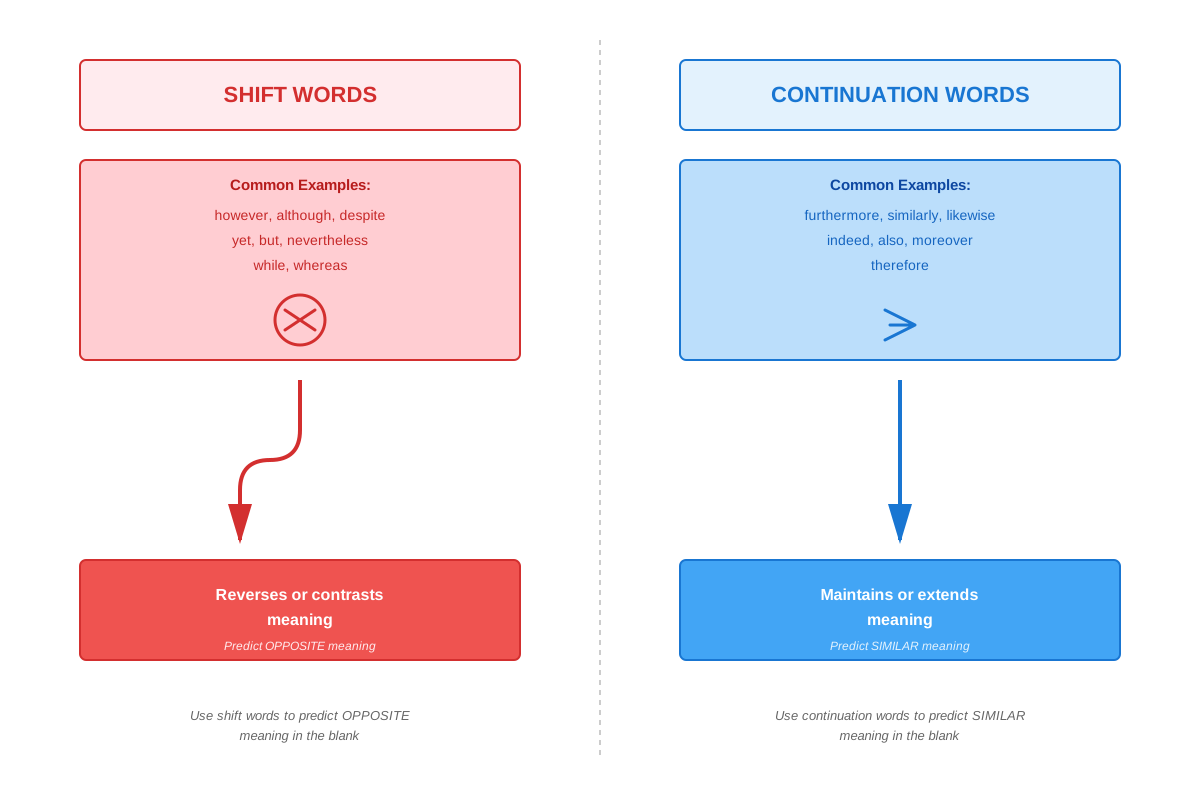
The concept of shift words connects fundamentally to broader Verbal Reasoning skills including reading comprehension, logical reasoning, and contextual vocabulary analysis. While continuation words (such as "furthermore" or "similarly") maintain the direction of an argument, shift words create contrast, introduce exceptions, or reverse expectations. This distinction between continuation and contrast represents one of the most frequently tested logical relationships on the GRE, appearing not only in Text Completion but also in Sentence Equivalence and Reading Comprehension questions where understanding argumentative structure proves essential.
Learning Objectives
- [ ] Identify when Shift words is being tested in GRE Text Completion questions
- [ ] Explain the core rule or strategy behind Shift words and their function in sentence logic
- [ ] Apply Shift words to GRE-style questions accurately and efficiently
- [ ] Distinguish between shift words and continuation words in complex sentence structures
- [ ] Predict the semantic direction of blanks based on shift word placement
- [ ] Recognize subtle shift words that indicate partial or qualified contrasts
- [ ] Evaluate answer choices by testing their logical compatibility with shift word signals
Prerequisites
- Basic sentence structure understanding: Recognizing independent and dependent clauses helps identify where shift words create logical pivots between ideas
- Fundamental vocabulary knowledge: A working vocabulary enables students to understand the concepts being contrasted when shift words appear
- Reading comprehension skills: The ability to extract main ideas from sentences provides the foundation for recognizing when those ideas shift direction
- Logical reasoning fundamentals: Understanding cause-and-effect relationships and contrasts allows students to interpret what shift words signal about sentence logic
Why This Topic Matters
Shift words represent one of the most reliable and high-yield strategies for improving GRE Verbal Reasoning scores because they provide objective, testable clues within sentence structure. Unlike pure vocabulary questions that depend on word knowledge, shift word questions reward logical analysis and strategic thinking. Students who master shift words can often determine correct answers even when they don't know every vocabulary word in the answer choices, making this skill particularly valuable for non-native English speakers and students with developing vocabularies.
On the GRE, shift words appear in approximately 15-20 questions per Verbal section, spanning Text Completion (both single-blank and multi-blank questions), Sentence Equivalence, and even Reading Comprehension questions where understanding argumentative transitions proves crucial. The Educational Testing Service (ETS) deliberately constructs sentences with shift words to test logical reasoning rather than mere vocabulary recognition, making this concept central to the exam's design philosophy.
In real-world applications, recognizing shift words enhances critical reading skills essential for graduate-level academic work. Scholarly articles, research papers, and complex arguments frequently employ these transitional expressions to introduce counterarguments, acknowledge limitations, or present contrasting evidence. Students who develop sensitivity to shift words become more sophisticated readers capable of tracking nuanced arguments and identifying logical relationships in professional and academic contexts.
Core Concepts
Definition and Function of Shift Words
Shift words are transitional expressions that signal a change in direction, introduce contrast, or indicate an unexpected reversal within a sentence or between clauses. These linguistic markers tell readers that the information following the shift word will oppose, contradict, qualify, or diverge from what came before. On the GRE, shift words function as logical operators that determine the semantic relationship between sentence components, making them essential clues for predicting blank content.
The fundamental principle underlying shift words is semantic opposition: when a shift word appears, the blank typically requires a word with opposite or contrasting meaning to what appears elsewhere in the sentence. For example, in the sentence "Although the politician's public statements were conciliatory, her private communications were _____," the shift word "although" signals that the blank needs a word contrasting with "conciliatory," such as "combative" or "antagonistic."
Categories of Shift Words
Shift words fall into several functional categories based on the type of contrast they introduce:
| Category | Function | Common Examples |
|---|---|---|
| Concessive | Acknowledge opposing point while maintaining main argument | although, though, even though, while, whereas, despite, in spite of |
| Adversative | Introduce direct opposition or contradiction | but, yet, however, nevertheless, nonetheless, still, conversely |
| Limiting | Restrict or qualify a previous statement | only, merely, just, simply, except, unless, save |
| Temporal Contrast | Show change over time | formerly, previously, once, originally, now, currently, no longer |
| Unexpected Result | Signal surprising or counterintuitive outcomes | surprisingly, unexpectedly, paradoxically, ironically, curiously |
Strong vs. Subtle Shift Words
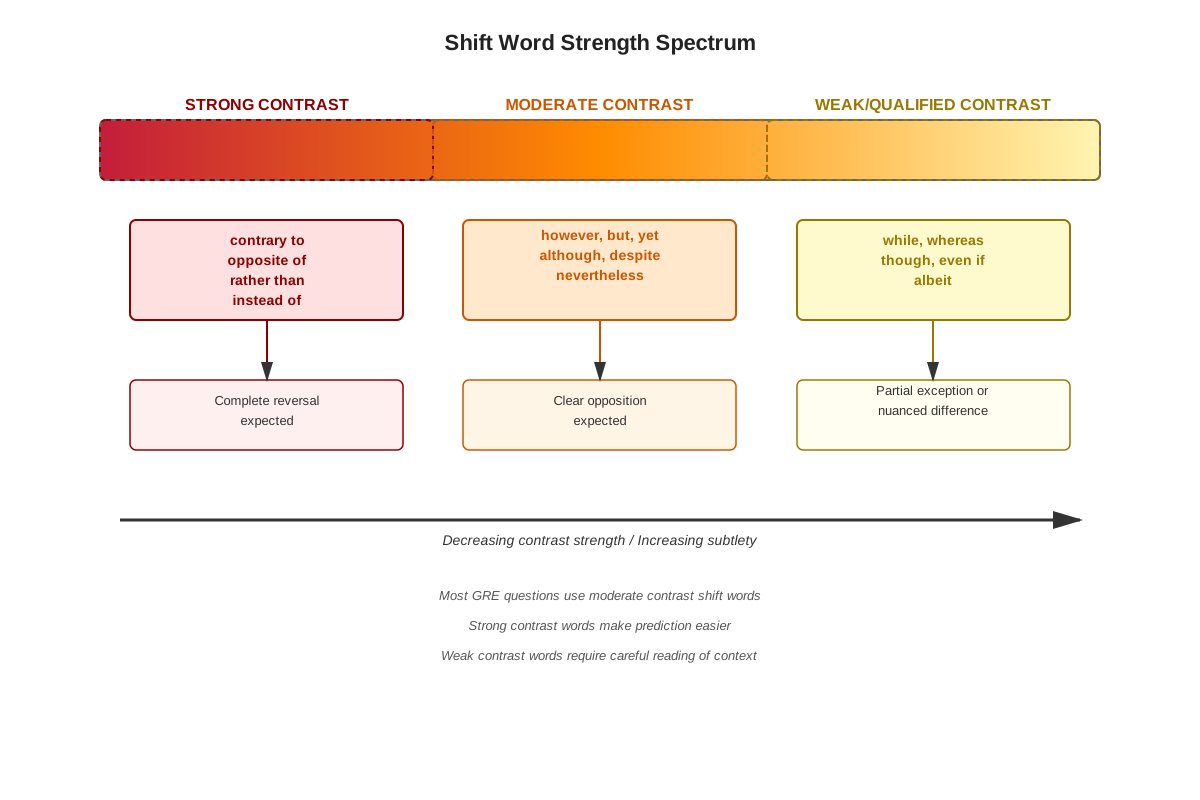
Not all shift words create equally dramatic contrasts. Strong shift words like "but," "however," and "despite" signal clear, direct opposition between ideas. These words indicate that the blank should contain a word with nearly opposite meaning to the contrasting element. For instance: "The theory was elegant but _____" clearly requires a word contrasting with "elegant," such as "impractical" or "flawed."
Subtle shift words like "while," "though," or "yet" may indicate partial contrast, qualified opposition, or nuanced differences rather than complete reversal. The sentence "While the artist's early work was conventional, her later pieces were _____" uses "while" to signal contrast, but the degree of opposition might be moderate (perhaps "innovative" or "experimental") rather than extreme.
Shift Words in Multi-Blank Questions
In Text Completion questions with multiple blanks, shift words become even more critical because they establish logical relationships between blanks. A shift word might appear between two blanks, indicating they should have contrasting meanings, or it might relate one blank to a word already present in the sentence. Consider: "Although the scientist's methodology was (i)_____, her conclusions were (ii)_____." The shift word "although" signals that blanks (i) and (ii) should contrast with each other—if (i) is "rigorous," then (ii) might be "questionable."
Identifying Shift Word Triggers
Recognizing when shift words are being tested requires attention to sentence structure. Key indicators include:
- Subordinate clauses beginning with shift words: "Although X, Y" or "Despite X, Y" structures
- Mid-sentence pivots: Sentences where "but," "yet," or "however" appear between independent clauses
- Negative constructions with shift implications: "Not X but Y" or "Rather than X, Y" patterns
- Temporal markers indicating change: "Once X, now Y" or "Previously X, currently Y" structures
The Shift Word Strategy
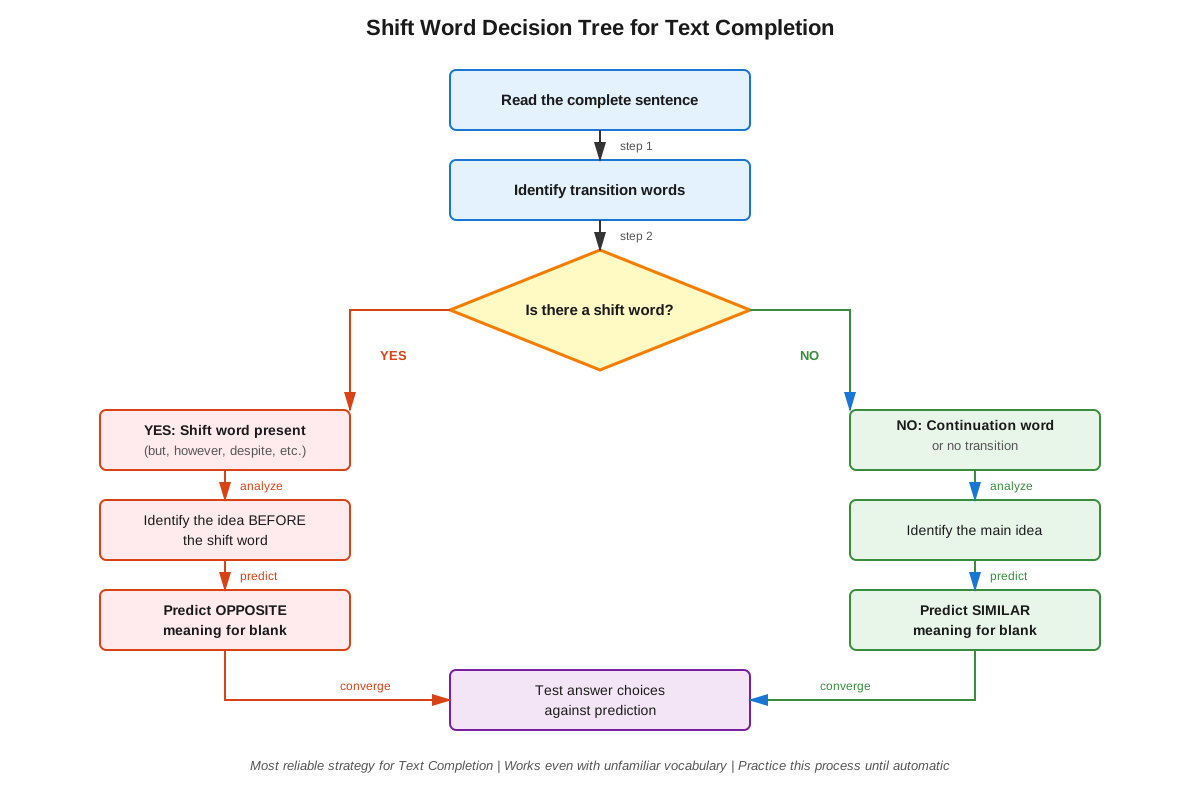
The systematic approach to shift word questions involves four steps:
- Scan for shift words: Quickly identify any transitional expressions that signal contrast or reversal
- Locate the contrasting element: Find the word or phrase that the blank should oppose
- Predict the semantic direction: Determine whether the blank needs a positive/negative word or specific conceptual opposite
- Test answer choices: Evaluate options based on whether they create the logical contrast signaled by the shift word
This strategy transforms Text Completion from vocabulary testing into logical puzzle-solving, allowing students to eliminate incorrect answers systematically even when they contain unfamiliar words.
Concept Relationships
Shift words connect intimately with several other Text Completion concepts. Continuation words (such as "furthermore," "additionally," "similarly") represent the logical opposite of shift words—where shift words signal contrast, continuation words indicate agreement or extension of ideas. Understanding both categories allows students to quickly determine whether a blank should match or oppose surrounding content.
The relationship flows as follows: Sentence structure → Transitional word identification → Logical relationship determination → Semantic prediction → Answer selection. Each step depends on the previous one, with shift words serving as the critical pivot point that determines whether the logical relationship is one of continuation or contrast.
Shift words also connect to contextual clues more broadly. While shift words specifically signal contrast, other contextual clues (definitions, examples, cause-and-effect markers) provide different types of information about blanks. Mastering shift words enhances overall contextual clue recognition because students develop sensitivity to how sentence structure reveals meaning.
Furthermore, shift word mastery supports Reading Comprehension skills by training students to track argumentative structure. Passages frequently use shift words to introduce counterarguments, acknowledge limitations, or present contrasting viewpoints. Students who automatically recognize these transitions can more easily identify author's perspective, logical structure, and rhetorical purpose—all frequently tested Reading Comprehension skills.
High-Yield Facts
⭐ Shift words signal that the blank should contrast with or oppose another element in the sentence
⭐ "Although," "despite," "but," "however," and "yet" are the five most common shift words on the GRE
⭐ When a shift word appears, immediately locate what the blank should contrast with before examining answer choices
⭐ In multi-blank questions, shift words often indicate that two blanks should have opposite meanings
⭐ Shift words can appear at the beginning, middle, or end of sentences, requiring careful structural analysis
- Approximately 60-70% of Text Completion questions contain shift words or test contrast relationships
- Subtle shift words like "while" and "though" may indicate partial rather than complete opposition
- Negative constructions ("not X but Y") function as shift indicators even without traditional shift words
⭐ Temporal shift words ("once," "formerly," "no longer") signal change over time rather than direct logical opposition
- Shift words in subordinate clauses often create more complex logical relationships than those in independent clauses
- Some sentences contain multiple shift words, requiring careful analysis of which contrasts apply to which blanks
- Recognizing shift words allows students to predict correct answers before reading answer choices, improving speed and accuracy
Quick check — test yourself on Shift words so far.
Try Flashcards →Common Misconceptions
Misconception: All shift words create complete, direct opposites between ideas → Correction: Shift words vary in strength; "while" and "though" often signal partial or qualified contrast, whereas "but" and "despite" typically indicate stronger opposition. The degree of contrast depends on both the shift word used and the broader sentence context.
Misconception: Shift words only appear at the beginning of sentences → Correction: Shift words can appear anywhere in sentence structure—at the beginning of subordinate clauses, between independent clauses, or even near the end of sentences. Students must scan entire sentences for these critical markers rather than focusing only on opening words.
Misconception: When a shift word appears, the blank always needs the exact antonym of another word in the sentence → Correction: Shift words signal conceptual contrast rather than strict antonyms. For example, if a shift word contrasts with "successful," the blank might need "problematic," "disappointing," or "controversial"—words that oppose the concept without being dictionary antonyms.
Misconception: Recognizing shift words eliminates the need to understand sentence meaning → Correction: Shift words provide structural clues about logical relationships, but students must still comprehend what concepts are being contrasted. The shift word "although" indicates contrast exists, but understanding what specifically contrasts requires reading comprehension and contextual analysis.
Misconception: Every sentence with "but" or "however" tests shift words → Correction: While these words often signal tested contrasts, sometimes they appear in sentences where other strategies (like definition clues or cause-and-effect relationships) prove more relevant. Students should identify shift words as one tool among several for approaching Text Completion questions.
Misconception: Shift words in Reading Comprehension passages function differently than in Text Completion → Correction: Shift words serve the same logical function across question types—signaling contrast, introducing counterarguments, or indicating reversals. Skills developed for Text Completion transfer directly to tracking argumentative structure in longer passages.
Worked Examples
Example 1: Single-Blank Text Completion
Question: Although the committee's initial proposal was met with widespread approval, the revised version proved to be highly _____.
(A) commendable
(B) contentious
(C) innovative
(D) comprehensive
(E) redundant
Solution Process:
Step 1 - Identify shift words: The sentence begins with "although," a strong concessive shift word signaling contrast.
Step 2 - Locate contrasting element: The phrase "widespread approval" describes the initial proposal's reception.
Step 3 - Predict semantic direction: Since "although" signals contrast, the revised version's reception should oppose "widespread approval." We need a word suggesting negative reception or disagreement.
Step 4 - Evaluate answer choices:
- (A) "commendable" means praiseworthy—continues rather than contrasts with approval ❌
- (B) "contentious" means controversial or causing disagreement—contrasts perfectly with approval ✓
- (C) "innovative" is neutral/positive—doesn't create the required contrast ❌
- (D) "comprehensive" is neutral/positive—doesn't create the required contrast ❌
- (E) "redundant" means unnecessary repetition—doesn't directly contrast with approval ❌
Answer: (B) contentious
Learning objective connection: This example demonstrates identifying shift words ("although"), explaining the core strategy (finding the contrasting element and predicting semantic direction), and applying the strategy to select the correct answer.
Example 2: Multi-Blank Text Completion
Question: The novelist's early works were characterized by (i)_____ prose that some critics found tedious; her later novels, however, demonstrated a (ii)_____ style that captivated readers.
Blank (i)
(A) ornate
(B) economical
(C) pedestrian
Blank (ii)
(D) verbose
(E) dynamic
(F) derivative
Solution Process:
Step 1 - Identify shift words: "However" appears between the two blanks, signaling that they should contrast with each other.
Step 2 - Analyze additional clues:
- Blank (i) describes prose that "some critics found tedious" (negative reception)
- Blank (ii) describes style that "captivated readers" (positive reception)
- The shift word "however" confirms these should oppose each other
Step 3 - Predict semantic directions:
- Blank (i) needs a word with negative connotations consistent with "tedious"
- Blank (ii) needs a word with positive connotations consistent with "captivated"
- The words should represent contrasting writing styles
Step 4 - Evaluate Blank (i) choices:
- (A) "ornate" (elaborate, decorated) could be tedious but isn't inherently negative
- (B) "economical" (concise, efficient) is generally positive—doesn't match "tedious" ❌
- (C) "pedestrian" (dull, unimaginative) matches "tedious" perfectly ✓
Step 5 - Evaluate Blank (ii) choices (knowing blank (i) is "pedestrian"):
- (D) "verbose" (wordy) doesn't contrast with "pedestrian" or match "captivated" ❌
- (E) "dynamic" (energetic, engaging) contrasts with "pedestrian" and matches "captivated" ✓
- (F) "derivative" (unoriginal) doesn't contrast with "pedestrian" ❌
Answer: Blank (i) = (C) pedestrian; Blank (ii) = (E) dynamic
Learning objective connection: This example shows how shift words establish relationships between multiple blanks, requiring students to recognize contrast signals and ensure both blanks work together logically.
Exam Strategy
Systematic Approach to Shift Word Questions
When approaching any Text Completion question, implement this time-efficient process:
- First 5 seconds: Scan the entire sentence for shift words before reading for meaning
- Next 10 seconds: Read the sentence carefully, identifying what element the blank should contrast with
- Next 5 seconds: Predict the semantic direction (positive/negative, specific concept) before looking at choices
- Final 10-15 seconds: Evaluate answer choices, eliminating those that don't create the required contrast
Exam Tip: If you identify a shift word, you've found the question's "key"—the structural element that unlocks the correct answer. Spend extra time ensuring you understand what contrasts with what before selecting an answer.
Trigger Phrases to Watch For
Beyond individual shift words, watch for these structural patterns that signal contrast:
- "Not X but Y" constructions: The blank typically relates to Y and contrasts with X
- "Rather than" phrases: Similar to "not X but Y," indicating the blank opposes the "rather than" element
- "Far from" constructions: "Far from being X, the Y was _____" signals the blank contrasts with X
- Semicolon with "however" or "yet": The clause after the semicolon contrasts with what came before
- "On the contrary" or "on the other hand": Strong signals of direct opposition
Process of Elimination Strategies
When shift words appear, eliminate answer choices systematically:
- Eliminate continuation words: If the shift word signals contrast, immediately eliminate any answer choice that would continue or agree with the contrasting element
- Eliminate neutral options: Shift words typically require clearly positive or negative words, not neutral descriptors
- Test remaining choices: For remaining options, mentally insert each into the sentence and verify it creates logical contrast
- Check for degree of contrast: Ensure the answer choice matches the strength of the shift word (strong shift words need stronger contrasts)
Time Allocation Advice
For single-blank questions with shift words: 30 seconds maximum. These questions reward quick pattern recognition rather than extended deliberation. If you've identified the shift word and contrasting element but still feel uncertain after 30 seconds, make your best guess and move forward.
For multi-blank questions with shift words: 60-75 seconds. The additional complexity of multiple blanks justifies more time, but shift words actually make these questions more manageable by establishing clear relationships between blanks.
Exam Tip: Shift word questions are often faster to solve than pure vocabulary questions because they provide structural clues. Use the time saved on these questions to allocate more time to challenging Reading Comprehension passages.
Memory Techniques
The ABCD Mnemonic for Common Shift Words
Although, But, Conversely, Despite—these four words represent the most frequently tested shift words on the GRE. Memorizing this acronym ensures you'll immediately recognize the most common contrast signals.
The "Traffic Light" Visualization
Visualize shift words as yellow traffic lights that signal "change ahead." Just as yellow lights warn drivers that the signal is about to change from green to red (or vice versa), shift words warn readers that the sentence direction is about to reverse. This mental image helps students pause and identify what's changing when they encounter shift words.
The Contrast Categories Acronym: CALTU
Remember shift word categories with CALTU:
- Concessive (although, though, despite)
- Adversative (but, however, yet)
- Limiting (only, merely, except)
- Temporal (formerly, once, no longer)
- Unexpected (surprisingly, paradoxically, ironically)
The "Opposite Day" Mental Trick
When you identify a shift word, mentally declare "Opposite Day!"—a playful reminder that the blank needs something contrasting with another sentence element. This simple mental cue prevents the common error of selecting answer choices that continue rather than contrast with the sentence's direction.
Physical Gesture Technique
Some students benefit from a subtle physical gesture when encountering shift words during practice: touching thumb to index finger as a kinesthetic reminder that a contrast point has been identified. This physical anchor reinforces the mental habit of pausing to analyze contrast relationships.
Summary
Shift words represent one of the highest-yield strategies for GRE Text Completion success because they provide objective, structural clues about logical relationships within sentences. These transitional expressions—including "although," "but," "however," "despite," and "yet"—signal that the blank should contrast with or oppose another element in the sentence. Mastering shift words transforms Text Completion from vocabulary guessing into logical analysis, allowing students to predict correct answers before examining choices. The systematic approach involves four steps: identifying shift words, locating the contrasting element, predicting semantic direction, and evaluating answer choices based on whether they create the required contrast. Shift words appear in approximately 60-70% of Text Completion questions and fall into categories including concessive, adversative, limiting, temporal, and unexpected result markers. Understanding both strong shift words (which signal direct opposition) and subtle shift words (which indicate partial contrast) enables students to navigate complex sentence structures confidently. This skill connects fundamentally to broader Verbal Reasoning abilities including reading comprehension and logical analysis, making shift word mastery essential for achieving top GRE scores.
Key Takeaways
- Shift words are the highest-yield structural clue in Text Completion, appearing in 60-70% of questions and providing objective signals about logical relationships
- The core strategy involves four steps: identify shift words, locate contrasting elements, predict semantic direction, and evaluate answer choices for logical contrast
- "Although," "but," "however," "despite," and "yet" are the five most frequently tested shift words on the GRE
- Shift words establish relationships between blanks in multi-blank questions, often indicating that two blanks should have contrasting meanings
- Not all shift words create equal contrast—strong shift words signal direct opposition while subtle shift words indicate partial or qualified contrast
- Recognizing shift words enables prediction of correct answers before reading choices, dramatically improving speed and accuracy
- Shift word skills transfer across question types, enhancing performance on Sentence Equivalence and Reading Comprehension by improving recognition of argumentative structure
Related Topics
Continuation Words and Same-Direction Signals: After mastering shift words, students should study continuation words ("furthermore," "additionally," "similarly") that signal agreement rather than contrast. Understanding both categories provides complete coverage of transitional logic on the GRE.
Cause-and-Effect Relationships: Many Text Completion questions test causal logic using words like "because," "therefore," and "consequently." Shift word mastery provides the foundation for recognizing these alternative logical structures.
Definition and Restatement Clues: Some sentences provide direct definitions or restatements that reveal blank content without using shift words. Combining shift word recognition with definition clue identification creates comprehensive Text Completion strategy.
Sentence Equivalence Strategy: Shift words appear frequently in Sentence Equivalence questions, where students must select two answer choices that create equivalent meanings. The contrast recognition skills developed through shift word study apply directly to this question type.
Reading Comprehension Argument Structure: Shift words signal important transitions in longer passages, including counterarguments, limitations, and perspective changes. Mastering shift words in Text Completion enhances ability to track complex arguments in Reading Comprehension passages.
Practice CTA
Now that you've mastered the concept of shift words and their strategic application to GRE Text Completion questions, it's time to reinforce your learning through active practice. Attempt the practice questions designed specifically for this topic, paying careful attention to identifying shift words, locating contrasting elements, and predicting semantic direction before evaluating answer choices. Use the flashcards to drill recognition of common shift words until identifying them becomes automatic. Remember that shift word mastery is a skill that improves rapidly with focused practice—students who systematically apply the four-step strategy typically see measurable score improvements within just a few practice sessions. Your investment in mastering this high-yield concept will pay dividends not only on Text Completion questions but across all Verbal Reasoning question types. Approach each practice question as an opportunity to refine your shift word recognition and strengthen your logical analysis skills!
Sign up free to keep reading
Create a free AnvayaPrep account to finish this GRE guide on Shift words — plus flashcards and practice questions.